

ASTM D6074-15(2022)
(Guide)Standard Guide for Characterizing Hydrocarbon Lubricant Base Oils
General Information
- Abstract
SIGNIFICANCE AND USE
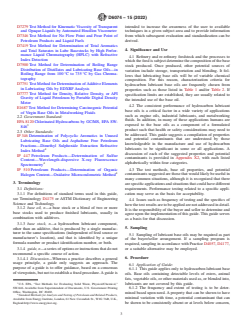
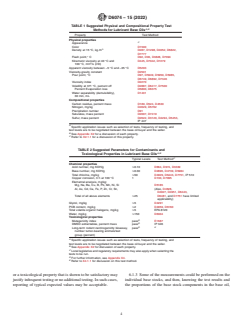
4.1 Refinery and re-refinery feedstock and the processes to which the feed is subject determine the composition of the base stock produced. Once produced, other potential sources of variation include storage, transportation and blending. It follows that lubricating base oils will be of variable chemical composition. For this reason, characterization criteria for hydrocarbon lubricant base oils are frequently chosen from properties such as those listed in Table 1 and/or Table 2. If specification limits are established, they are usually related to the intended use of the base oil.
4.2 The consistent performance of hydrocarbon lubricant base oils is a critical factor in a wide variety of applications such as engine oils, industrial lubricants, and metalworking fluids. In addition, in many of these applications humans are exposed to the base oils as a component of a formulated product such that health or safety considerations may need to be addressed. This guide suggests a compilation of properties and potential contaminants that are understood by those knowledgeable in the manufacture and use of hydrocarbon lubricants to be significant in some or all applications. A discussion of each of the suggested properties and potential contaminants is provided in Appendix X2, with each listed alphabetically within four categories.
4.3 The test methods, base oil properties, and potential contaminants suggested are those that would likely be useful in many common situations, although it is recognized that there are specific applications and situations that could have different requirements. Performance testing related to a specific application may serve as the basis for acceptability.
4.4 Issues such as frequency of testing and the specifics of how the test results are to be applied are not addressed in detail. It is the responsibility of the buyer and seller to determine and agree upon the implementation of this guide. This guide serves as a basis for that discussion.
SCOPE
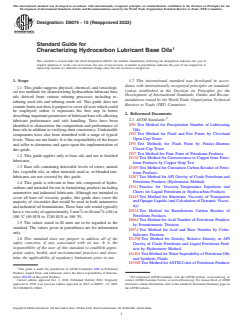
1.1 This guide suggests physical, chemical, and toxicological test methods for characterizing hydrocarbon lubricant base oils derived from various refining processes including re-refining used oils and refining crude oil. This guide does not contain limits nor does it purport to cover all tests which could be employed; rather, it represents the first step in better describing important parameters of lubricant base oils affecting lubricant performance and safe handling. Tests have been identified to characterize the composition and performance of base oils in addition to verifying their consistency. Undesirable components have also been identified with a range of typical levels. These are not limits. It is the responsibility of the buyer and seller to determine and agree upon the implementation of this guide.
1.2 This guide applies only to base oils and not to finished lubricants.
1.3 Base oils containing detectable levels of esters, animal fats, vegetable oils, or other materials used as, or blended into, lubricants are not covered by this guide.
1.4 This guide is relevant to base oils composed of hydrocarbons and intended for use in formulating products including automotive and industrial lubricants. Although not intended to cover all base oil viscosity grades, this guide does cover the majority of viscosities that would be used in both automotive and industrial oil formulations. These base oils would typically have a viscosity of approximately 2 mm2/s to 40 mm2/s (cSt) at 100 °C (50 SUS to 3740 SUS at 100 °F).
1.5 The values stated in SI units are to be regarded as the standard. The values given in parentheses are for information only.
1.6 This standard does not purport to address all of the safety concerns, if any, associated with its use. It is the responsibility of the user of this standard to establish appropriate safety, health, and environmental practices and determine the applicability of regulatory lim...
- Status
- Published
- Publication Date
- 30-Sep-2022
- Technical Committee
- D02 - Petroleum Products, Liquid Fuels, and Lubricants
- Drafting Committee
- D02.P0 - Recycled Products
Overview
ASTM D6074-15(2022) - Standard Guide for Characterizing Hydrocarbon Lubricant Base Oils provides a comprehensive framework for the evaluation and characterization of hydrocarbon-based lubricant base oils. Developed by ASTM International, this guide outlines key physical, chemical, and toxicological test methods suitable for use in assessing the properties and consistency of base oils derived from refining crude oil and re-refining used oils. It is intended to support quality control, product development, and safety assurance in the manufacture and use of lubricant base oils for automotive and industrial applications.
This standard does not set specification limits or cover all possible test methods, but it helps buyers and sellers agree upon relevant characterization criteria that affect the performance, consistency, and safe handling of hydrocarbon base oils. ASTM D6074 applies strictly to base oils composed of hydrocarbons and explicitly excludes finished lubricants and base oils containing significant levels of esters, animal fats, or vegetable oils.
Key Topics
Scope and Applicability:
- Covers characterization of hydrocarbon base oils from both traditional petroleum refining and re-refining of used oils.
- Does not address finished lubricants or non-hydrocarbon blends.
- Supports a wide range of viscosity grades relevant to automotive and industrial lubricants.
Characterization Parameters and Test Methods:
- Physical Properties: Appearance, color (ASTM D1500), density (ASTM D287, D1298, D4052, D6822, D7777), flash point (ASTM D92, D93), kinematic viscosity (ASTM D445, D7042), pour point (ASTM D97, D5949), viscosity index (ASTM D2270), volatility, water separability (ASTM D1401).
- Chemical Properties: Acid number (ASTM D664, D974), base number (ASTM D2896), sulfur content (ASTM D2622), elemental analysis (ASTM D5185, D4951), chlorine, nitrogen, carbon residue, glycol, PCB, volatile organic halides, and water content.
- Toxicological Properties: Testing for mutagenicity (ASTM E1687), DMSO extractables (IP 346), and long-term carcinogenicity.
Guidance on Test Selection and Frequency:
- Frequency and choice of testing are to be determined by agreement between stakeholders and tailored to specific needs.
- The guide suggests, but does not mandate, which tests to perform or how often.
Health, Safety, and Regulatory Considerations:
- Recognizes potential human exposure pathways and the importance of addressing toxicological properties.
- Stresses the necessity for users to establish safe practices and comply with applicable regulations.
Applications
- Lubricant Formulation: Ensures base oil quality and performance for formulating automotive engine oils, industrial lubricants, and metalworking fluids.
- Quality Control: Helps producers and users monitor batch-to-batch consistency and identify contamination or undesirable variation in hydrocarbon base oils.
- Regulatory Compliance: Provides a recognized methodology for base oil characterization that can support compliance with global safety and environmental standards.
- Procurement and Supply Agreements: Assists buyers and sellers in establishing mutually agreed-upon characterization parameters and test requirements for base oil transactions.
- R&D and Product Development: Guides selection of base oils with specific properties for targeted applications, optimizing performance and safety profiles.
Related Standards
- ASTM D445 - Test Method for Kinematic Viscosity of Transparent and Opaque Liquids
- ASTM D92/ASTM D93 - Flash Point Test Methods
- ASTM D2270 - Practice for Calculating Viscosity Index
- ASTM D1500 - ASTM Color of Petroleum Products
- ASTM D5185, ASTM D4951 - Elemental Analysis of Lubricating Oils
- ASTM D664, ASTM D974 - Acid Number Determination
- ASTM E1687 - Carcinogenic Potential Assessment
- IP 346 - Determination of Polycyclic Aromatics in Base Oils
ASTM D6074-15(2022) serves as an essential reference for professionals in the petroleum, lubricant, and chemical industries seeking to ensure the quality, safety, and reliability of hydrocarbon lubricant base oils. It supports informed decision-making, consistency in quality control, and facilitates global trade by providing a harmonized approach to base oil characterization.
Relations
- Effective Date
- 01-Apr-2024
- Effective Date
- 01-Mar-2024
- Effective Date
- 01-Mar-2024
- Effective Date
- 01-Mar-2024
- Effective Date
- 01-Mar-2024
- Refers
ASTM D4175-23a - Standard Terminology Relating to Petroleum Products, Liquid Fuels, and Lubricants - Effective Date
- 15-Dec-2023
- Effective Date
- 01-Dec-2023
- Effective Date
- 01-Dec-2023
- Effective Date
- 01-Nov-2023
- Effective Date
- 01-Oct-2023
- Refers
ASTM D4175-23e1 - Standard Terminology Relating to Petroleum Products, Liquid Fuels, and Lubricants - Effective Date
- 01-Jul-2023
- Effective Date
- 01-Jul-2023
- Effective Date
- 01-Aug-2020
- Effective Date
- 01-Jun-2020
- Refers
ASTM D5985-02(2020) - Standard Test Method for Pour Point of Petroleum Products (Rotational Method) - Effective Date
- 01-May-2020
Get Certified
Connect with accredited certification bodies for this standard

Element Materials Technology
Materials testing and product certification.

ABS Group Brazil
ABS Group certification services in Brazil.

ABS Quality Evaluations Inc.
American Bureau of Shipping quality certification.
Sponsored listings
Frequently Asked Questions
ASTM D6074-15(2022) is a guide published by ASTM International. Its full title is "Standard Guide for Characterizing Hydrocarbon Lubricant Base Oils". This standard covers: SIGNIFICANCE AND USE 4.1 Refinery and re-refinery feedstock and the processes to which the feed is subject determine the composition of the base stock produced. Once produced, other potential sources of variation include storage, transportation and blending. It follows that lubricating base oils will be of variable chemical composition. For this reason, characterization criteria for hydrocarbon lubricant base oils are frequently chosen from properties such as those listed in Table 1 and/or Table 2. If specification limits are established, they are usually related to the intended use of the base oil. 4.2 The consistent performance of hydrocarbon lubricant base oils is a critical factor in a wide variety of applications such as engine oils, industrial lubricants, and metalworking fluids. In addition, in many of these applications humans are exposed to the base oils as a component of a formulated product such that health or safety considerations may need to be addressed. This guide suggests a compilation of properties and potential contaminants that are understood by those knowledgeable in the manufacture and use of hydrocarbon lubricants to be significant in some or all applications. A discussion of each of the suggested properties and potential contaminants is provided in Appendix X2, with each listed alphabetically within four categories. 4.3 The test methods, base oil properties, and potential contaminants suggested are those that would likely be useful in many common situations, although it is recognized that there are specific applications and situations that could have different requirements. Performance testing related to a specific application may serve as the basis for acceptability. 4.4 Issues such as frequency of testing and the specifics of how the test results are to be applied are not addressed in detail. It is the responsibility of the buyer and seller to determine and agree upon the implementation of this guide. This guide serves as a basis for that discussion. SCOPE 1.1 This guide suggests physical, chemical, and toxicological test methods for characterizing hydrocarbon lubricant base oils derived from various refining processes including re-refining used oils and refining crude oil. This guide does not contain limits nor does it purport to cover all tests which could be employed; rather, it represents the first step in better describing important parameters of lubricant base oils affecting lubricant performance and safe handling. Tests have been identified to characterize the composition and performance of base oils in addition to verifying their consistency. Undesirable components have also been identified with a range of typical levels. These are not limits. It is the responsibility of the buyer and seller to determine and agree upon the implementation of this guide. 1.2 This guide applies only to base oils and not to finished lubricants. 1.3 Base oils containing detectable levels of esters, animal fats, vegetable oils, or other materials used as, or blended into, lubricants are not covered by this guide. 1.4 This guide is relevant to base oils composed of hydrocarbons and intended for use in formulating products including automotive and industrial lubricants. Although not intended to cover all base oil viscosity grades, this guide does cover the majority of viscosities that would be used in both automotive and industrial oil formulations. These base oils would typically have a viscosity of approximately 2 mm2/s to 40 mm2/s (cSt) at 100 °C (50 SUS to 3740 SUS at 100 °F). 1.5 The values stated in SI units are to be regarded as the standard. The values given in parentheses are for information only. 1.6 This standard does not purport to address all of the safety concerns, if any, associated with its use. It is the responsibility of the user of this standard to establish appropriate safety, health, and environmental practices and determine the applicability of regulatory lim...
SIGNIFICANCE AND USE 4.1 Refinery and re-refinery feedstock and the processes to which the feed is subject determine the composition of the base stock produced. Once produced, other potential sources of variation include storage, transportation and blending. It follows that lubricating base oils will be of variable chemical composition. For this reason, characterization criteria for hydrocarbon lubricant base oils are frequently chosen from properties such as those listed in Table 1 and/or Table 2. If specification limits are established, they are usually related to the intended use of the base oil. 4.2 The consistent performance of hydrocarbon lubricant base oils is a critical factor in a wide variety of applications such as engine oils, industrial lubricants, and metalworking fluids. In addition, in many of these applications humans are exposed to the base oils as a component of a formulated product such that health or safety considerations may need to be addressed. This guide suggests a compilation of properties and potential contaminants that are understood by those knowledgeable in the manufacture and use of hydrocarbon lubricants to be significant in some or all applications. A discussion of each of the suggested properties and potential contaminants is provided in Appendix X2, with each listed alphabetically within four categories. 4.3 The test methods, base oil properties, and potential contaminants suggested are those that would likely be useful in many common situations, although it is recognized that there are specific applications and situations that could have different requirements. Performance testing related to a specific application may serve as the basis for acceptability. 4.4 Issues such as frequency of testing and the specifics of how the test results are to be applied are not addressed in detail. It is the responsibility of the buyer and seller to determine and agree upon the implementation of this guide. This guide serves as a basis for that discussion. SCOPE 1.1 This guide suggests physical, chemical, and toxicological test methods for characterizing hydrocarbon lubricant base oils derived from various refining processes including re-refining used oils and refining crude oil. This guide does not contain limits nor does it purport to cover all tests which could be employed; rather, it represents the first step in better describing important parameters of lubricant base oils affecting lubricant performance and safe handling. Tests have been identified to characterize the composition and performance of base oils in addition to verifying their consistency. Undesirable components have also been identified with a range of typical levels. These are not limits. It is the responsibility of the buyer and seller to determine and agree upon the implementation of this guide. 1.2 This guide applies only to base oils and not to finished lubricants. 1.3 Base oils containing detectable levels of esters, animal fats, vegetable oils, or other materials used as, or blended into, lubricants are not covered by this guide. 1.4 This guide is relevant to base oils composed of hydrocarbons and intended for use in formulating products including automotive and industrial lubricants. Although not intended to cover all base oil viscosity grades, this guide does cover the majority of viscosities that would be used in both automotive and industrial oil formulations. These base oils would typically have a viscosity of approximately 2 mm2/s to 40 mm2/s (cSt) at 100 °C (50 SUS to 3740 SUS at 100 °F). 1.5 The values stated in SI units are to be regarded as the standard. The values given in parentheses are for information only. 1.6 This standard does not purport to address all of the safety concerns, if any, associated with its use. It is the responsibility of the user of this standard to establish appropriate safety, health, and environmental practices and determine the applicability of regulatory lim...
ASTM D6074-15(2022) is classified under the following ICS (International Classification for Standards) categories: 75.100 - Lubricants, industrial oils and related products. The ICS classification helps identify the subject area and facilitates finding related standards.
ASTM D6074-15(2022) has the following relationships with other standards: It is inter standard links to ASTM D445-24, ASTM D6749-24, ASTM D6481-24, ASTM D2007-19(2024)e1, ASTM D1500-24, ASTM D4175-23a, ASTM D7094-23, ASTM D6822-23, ASTM D445-23, ASTM D7095-23, ASTM D4175-23e1, ASTM D2887-23, ASTM D93-20, ASTM D5293-20, ASTM D5985-02(2020). Understanding these relationships helps ensure you are using the most current and applicable version of the standard.
ASTM D6074-15(2022) is available in PDF format for immediate download after purchase. The document can be added to your cart and obtained through the secure checkout process. Digital delivery ensures instant access to the complete standard document.
Standards Content (Sample)
This international standard was developed in accordance with internationally recognized principles on standardization established in the Decision on Principles for the
Development of International Standards, Guides and Recommendations issued by the World Trade Organization Technical Barriers to Trade (TBT) Committee.
Designation: D6074 − 15 (Reapproved 2022)
Standard Guide for
Characterizing Hydrocarbon Lubricant Base Oils
This standard is issued under the fixed designation D6074; the number immediately following the designation indicates the year of
original adoption or, in the case of revision, the year of last revision. A number in parentheses indicates the year of last reapproval. A
superscript epsilon (´) indicates an editorial change since the last revision or reapproval.
1. Scope 1.7 This international standard was developed in accor-
dance with internationally recognized principles on standard-
1.1 This guide suggests physical, chemical, and toxicologi-
ization established in the Decision on Principles for the
cal test methods for characterizing hydrocarbon lubricant base
Development of International Standards, Guides and Recom-
oils derived from various refining processes including re-
mendations issued by the World Trade Organization Technical
refining used oils and refining crude oil. This guide does not
Barriers to Trade (TBT) Committee.
contain limits nor does it purport to cover all tests which could
be employed; rather, it represents the first step in better
2. Referenced Documents
describingimportantparametersoflubricantbaseoilsaffecting
2.1 ASTM Standards:
lubricant performance and safe handling. Tests have been
D91 Test Method for Precipitation Number of Lubricating
identified to characterize the composition and performance of
Oils
base oils in addition to verifying their consistency. Undesirable
D92 Test Method for Flash and Fire Points by Cleveland
components have also been identified with a range of typical
Open Cup Tester
levels. These are not limits. It is the responsibility of the buyer
D93 Test Methods for Flash Point by Pensky-Martens
and seller to determine and agree upon the implementation of
Closed Cup Tester
this guide.
D97 Test Method for Pour Point of Petroleum Products
1.2 This guide applies only to base oils and not to finished
D130 Test Method for Corrosiveness to Copper from Petro-
lubricants.
leum Products by Copper Strip Test
1.3 Base oils containing detectable levels of esters, animal
D189 Test Method for Conradson Carbon Residue of Petro-
fats, vegetable oils, or other materials used as, or blended into,
leum Products
lubricants are not covered by this guide.
D287 Test Method for API Gravity of Crude Petroleum and
Petroleum Products (Hydrometer Method)
1.4 This guide is relevant to base oils composed of hydro-
D341 Practice for Viscosity-Temperature Equations and
carbons and intended for use in formulating products including
Charts for Liquid Petroleum or Hydrocarbon Products
automotive and industrial lubricants.Although not intended to
D445 Test Method for Kinematic Viscosity of Transparent
cover all base oil viscosity grades, this guide does cover the
and Opaque Liquids (and Calculation of Dynamic Viscos-
majority of viscosities that would be used in both automotive
ity)
and industrial oil formulations.These base oils would typically
2 2
D524 Test Method for Ramsbottom Carbon Residue of
haveaviscosityofapproximately2 mm /sto40mm /s(cSt)at
Petroleum Products
100 °C (50 SUS to 3740 SUS at 100 °F).
D664 Test Method for Acid Number of Petroleum Products
1.5 The values stated in SI units are to be regarded as the
by Potentiometric Titration
standard. The values given in parentheses are for information
D974 Test Method for Acid and Base Number by Color-
only.
Indicator Titration
1.6 This standard does not purport to address all of the
D1298 Test Method for Density, Relative Density, or API
safety concerns, if any, associated with its use. It is the
Gravity of Crude Petroleum and Liquid Petroleum Prod-
responsibility of the user of this standard to establish appro-
ucts by Hydrometer Method
priate safety, health, and environmental practices and deter-
D1401 TestMethodforWaterSeparabilityofPetroleumOils
mine the applicability of regulatory limitations prior to use.
and Synthetic Fluids
D1500 Test Method forASTM Color of Petroleum Products
This guide is under the jurisdiction of ASTM Committee D02 on Petroleum
Products, Liquid Fuels, and Lubricants and is the direct responsibility of Subcom-
mittee D02.P0 on Recycled Products. For referenced ASTM standards, visit the ASTM website, www.astm.org, or
Current edition approved Oct. 1, 2022. Published October 2022. Originally contact ASTM Customer Service at service@astm.org. For Annual Book of ASTM
approved in 1998. Last previous edition approved in 2015 as D6074 – 15. DOI: Standards volume information, refer to the standard’s Document Summary page on
10.1520/D6074-15R22. the ASTM website.
Copyright © ASTM International, 100 Barr Harbor Drive, PO Box C700, West Conshohocken, PA 19428-2959. United States
D6074 − 15 (2022)
(ASTM Color Scale) D5185 Test Method for Multielement Determination of
D2007 Test Method for Characteristic Groups in Rubber Used and Unused Lubricating Oils and Base Oils by
Extender and Processing Oils and Other Petroleum- Inductively Coupled Plasma Atomic Emission Spectrom-
Derived Oils by the Clay-Gel Absorption Chromato- etry (ICP-AES)
graphic Method D5293 Test Method for Apparent Viscosity of Engine Oils
D2161 Practice for Conversion of Kinematic Viscosity to and Base Stocks Between –10 °C and –35 °C Using
Saybolt Universal Viscosity or to Saybolt Furol Viscosity Cold-Cranking Simulator
D2270 Practice for Calculating Viscosity Index from Kine- D5453 Test Method for Determination of Total Sulfur in
matic Viscosity at 40 °C and 100 °C Light Hydrocarbons, Spark Ignition Engine Fuel, Diesel
D2501 Test Method for Calculation of Viscosity-Gravity Engine Fuel, and Engine Oil by Ultraviolet Fluorescence
Constant (VGC) of Petroleum Oils D5762 Test Method for Nitrogen in Liquid Hydrocarbons,
D2622 Test Method for Sulfur in Petroleum Products by Petroleum and Petroleum Products by Boat-Inlet Chemi-
Wavelength Dispersive X-ray Fluorescence Spectrometry luminescence
D2887 Test Method for Boiling Range Distribution of Pe- D5800 Test Method for Evaporation Loss of Lubricating
troleum Fractions by Gas Chromatography Oils by the Noack Method
D2896 TestMethodforBaseNumberofPetroleumProducts D5949 Test Method for Pour Point of Petroleum Products
by Potentiometric Perchloric Acid Titration (Automatic Pressure Pulsing Method)
D3120 Test Method for Trace Quantities of Sulfur in Light D5950 Test Method for Pour Point of Petroleum Products
Liquid Petroleum Hydrocarbons by Oxidative Microcou- (Automatic Tilt Method)
lometry D5984 Test Method for Semi-Quantitative Field Test
D3339 Test Method forAcid Number of Petroleum Products Method for Base Number in New and Used Lubricants by
by Semi-Micro Color Indicator Titration Color-Indicator Titration
D3828 Test Methods for Flash Point by Small Scale Closed D5985 Test Method for Pour Point of Petroleum Products
Cup Tester (Rotational Method)
D4052 Test Method for Density, Relative Density, and API D6160 Test Method for Determination of Polychlorinated
Gravity of Liquids by Digital Density Meter Biphenyls (PCBs) in Waste Materials by Gas Chromatog-
D4057 Practice for Manual Sampling of Petroleum and raphy
Petroleum Products D6304 Test Method for Determination of Water in Petro-
D4059 Test Method for Analysis of Polychlorinated Biphe- leum Products, Lubricating Oils, and Additives by Cou-
nyls in Insulating Liquids by Gas Chromatography lometric Karl Fischer Titration
D4175 Terminology Relating to Petroleum Products, Liquid D6375 Test Method for Evaporation Loss of Lubricating
Fuels, and Lubricants Oils by Thermogravimetric Analyzer (TGA) Noack
D4177 Practice for Automatic Sampling of Petroleum and Method
Petroleum Products D6417 Test Method for Estimation of Engine Oil Volatility
D4291 Test Method for Trace Ethylene Glycol in Used by Capillary Gas Chromatography
Engine Oil D6443 TestMethodforDeterminationofCalcium,Chlorine,
D4294 Test Method for Sulfur in Petroleum and Petroleum Copper, Magnesium, Phosphorus, Sulfur, and Zinc in
Products by Energy Dispersive X-ray Fluorescence Spec- Unused Lubricating Oils and Additives by Wavelength
trometry Dispersive X-ray Fluorescence Spectrometry (Mathemati-
D4530 Test Method for Determination of Carbon Residue cal Correction Procedure)
(Micro Method) D6481 Test Method for Determination of Phosphorus,
D4628 Test Method for Analysis of Barium, Calcium, Sulfur, Calcium, and Zinc in Lubrication Oils by Energy
Magnesium, and Zinc in Unused Lubricating Oils by Dispersive X-ray Fluorescence Spectroscopy
Atomic Absorption Spectrometry D6749 Test Method for Pour Point of Petroleum Products
D4629 Test Method for Trace Nitrogen in Liquid Hydrocar- (Automatic Air Pressure Method)
bons by Syringe/Inlet Oxidative Combustion and Chemi- D6822 Test Method for Density, Relative Density, and API
luminescence Detection Gravity of Crude Petroleum and Liquid Petroleum Prod-
D4739 Test Method for Base Number Determination by ucts by Thermohydrometer Method
Potentiometric Hydrochloric Acid Titration D6892 Test Method for Pour Point of Petroleum Products
D4927 Test Methods for Elemental Analysis of Lubricant (Robotic Tilt Method)
and Additive Components—Barium, Calcium, D7042 Test Method for Dynamic Viscosity and Density of
Phosphorus, Sulfur, and Zinc by Wavelength-Dispersive Liquids by Stabinger Viscometer (and the Calculation of
X-Ray Fluorescence Spectroscopy Kinematic Viscosity)
D4929 Test Method for Determination of Organic Chloride D7094 Test Method for Flash Point by Modified Continu-
Content in Crude Oil ously Closed Cup (MCCCFP) Tester
D4951 Test Method for Determination ofAdditive Elements D7095 Test Method for Rapid Determination of Corrosive-
in Lubricating Oils by Inductively Coupled Plasma ness to Copper from Petroleum Products Using a Dispos-
Atomic Emission Spectrometry able Copper Foil Strip
D6074 − 15 (2022)
D7279 Test Method for Kinematic Viscosity of Transparent intended to increase the awareness of the user to available
and Opaque Liquids by Automated Houillon Viscometer techniques in a given subject area and to provide information
D7346 Test Method for No Flow Point and Pour Point of from which subsequent evaluation and standardization can be
Petroleum Products and Liquid Fuels derived.
D7419 Test Method for Determination of Total Aromatics
4. Significance and Use
and Total Saturates in Lube Basestocks by High Perfor-
mance Liquid Chromatography (HPLC) with Refractive
4.1 Refinery and re-refinery feedstock and the processes to
Index Detection
whichthefeedissubjectdeterminethecompositionofthebase
D7500 Test Method for Determination of Boiling Range
stock produced. Once produced, other potential sources of
Distribution of Distillates and Lubricating Base Oils—in
variation include storage, transportation and blending. It fol-
Boiling Range from 100 °C to 735 °C by Gas Chroma-
lows that lubricating base oils will be of variable chemical
tography
composition. For this reason, characterization criteria for
D7751 Test Method for Determination ofAdditive Elements
hydrocarbon lubricant base oils are frequently chosen from
in Lubricating Oils by EDXRF Analysis
properties such as those listed in Table 1 and/or Table 2.If
D7777 Test Method for Density, Relative Density, or API
specification limits are established, they are usually related to
Gravity of Liquid Petroleum by Portable Digital Density
the intended use of the base oil.
Meter
4.2 The consistent performance of hydrocarbon lubricant
E1687 Test Method for Determining Carcinogenic Potential
base oils is a critical factor in a wide variety of applications
of Virgin Base Oils in Metalworking Fluids
such as engine oils, industrial lubricants, and metalworking
2.2 Government Standard:
fluids. In addition, in many of these applications humans are
EPA 8120 Chlorinated Hydrocarbons by GC/MS, EPA SW-
3 exposed to the base oils as a component of a formulated
product such that health or safety considerations may need to
2.3 Other Standards:
be addressed. This guide suggests a compilation of properties
IP 346 Determination of Polycyclic Aromatics in Unused
and potential contaminants that are understood by those
Lubricating Base Oils and Asphaltene Free Petroleum
knowledgeable in the manufacture and use of hydrocarbon
Fractions—Dimethyl Sulphoxide Extraction Refractive
4 lubricants to be significant in some or all applications. A
Index Method
discussion of each of the suggested properties and potential
IP 447 Petroleum Products—Determination of Sulfur
contaminants is provided in Appendix X2, with each listed
Content—Wavelength-dispersive X-ray Fluorescence
4 alphabetically within four categories.
Spectrometry
4.3 The test methods, base oil properties, and potential
IP 510 Petroleum Products—Determination of Organic
Halogen Content—Oxidative Microcoulometric Method contaminantssuggestedarethosethatwouldlikelybeusefulin
many common situations, although it is recognized that there
3. Terminology
arespecificapplicationsandsituationsthatcouldhavedifferent
requirements. Performance testing related to a specific appli-
3.1 Definitions:
cation may serve as the basis for acceptability.
3.1.1 For definitions of standard terms used in this guide,
see Terminology D4175 or ASTM Dictionary of Engineering
4.4 Issues such as frequency of testing and the specifics of
Science and Technology.
howthetestresultsaretobeappliedarenotaddressedindetail.
3.1.2 base oil, n—a base stock or a blend of two or more
It is the responsibility of the buyer and seller to determine and
base stocks used to produce finished lubricants, usually in
agree upon the implementation of this guide.This guide serves
combination with additives.
as a basis for that discussion.
3.1.3 base stock, n—a hydrocarbon lubricant component,
5. Sampling
other than an additive, that is produced by a single manufac-
turer to the same specifications (independent of feed source or
5.1 Sampling of lubricant base oils may be required as part
manufacturer’s location), and that is identified by a unique
of the buyer/seller arrangement. If a sampling program is
formula number or product identification number, or both.
required, sampling in accordance with Practice D4057, D4177,
3.1.4 guide, n—aseriesofoptionsorinstructionsthatdonot or a suitable alternative may be employed.
recommend a specific course of action.
6. Procedure
3.1.4.1 Discussion—Whereas a practice describes a general
usage principle, a guide only suggests an approach. The
6.1 Application of Guide:
purpose of a guide is to offer guidance, based on a consensus
6.1.1 This guide applies only to hydrocarbon lubricant base
of viewpoints, but not to establish a fixed procedure.Aguide is
oils. Base oils containing detectable levels of esters, animal
fats, vegetable oils, or other materials used as, or blended into,
lubricants are not covered by this guide.
U.S. EPA, “Test Methods for Evaluating Solid Waste, Physical/Chemical,”
SW-846. Available from Superintendent of Documents, U.S. Government Printing
6.1.2 The frequency and extent of testing is to be deter-
Office, Washington, DC 20402.
mined based upon need.Aproperty that can be shown to have
Standard Methods for Analysis and Testing of Petroleum and Related Products,
minimal variation with time, a potential contaminant that can
Available from Energy Institute, London, 61 New Cavendish St., W1G 7AR, U.K.,
England.http://www.energyinst.org. be shown to be consistently absent or at levels below concern,
D6074 − 15 (2022)
TABLE 1 Suggested Physical and Compositional Property Test
A,B
Methods for Lubricant Base Oils
Property Test Method
Physical properties
C
Appearance
Color D1500
Density at 15 °C, kg ⁄m D287, D1298, D4052, D6822,
D7777
Flash point,° C D92, D93, D3828, D7094
Kinematic viscosity at 40 °C and D445, D7042, D7279
100 °C, mm /s (cSt)
Apparent viscosity between –5 °C and –35 °C D5293
Viscosity-gravity constant D2501
Pour point, °C D97, D5949, D5950, D5985,
D6749, D6892, D7346
Viscosity index D2270
Volatility at 371 °C, percent off D2887, D6417, D7500
Percent Evaporation loss D5800, D6375
Water separability (demulsibility), D1401
30 min, mL
Compositional properties
Carbon residue, percent mass D189, D524, D4530
Nitrogen, mg/kg D4629, D5762
Precipitation number D91
Saturates, mass percent D2007, D7419
Sulfur, mass percent D2622, D3120, D4294, D5453,
IP 447
A
Specific application issues such as selection of tests, frequency of testing, and
test levels are to be negotiated between the base oil buyer and the seller.
B
See Appendix X2 for a discussion of each property.
C
Refer to X2.1.1 for a discussion of this property.
TABLE 2 Suggested Parameters for Contaminants and
A,B
Toxicological Properties in Lubricant Base Oils
C
Typical Levels Test Method
Chemical properties
Acid number, mg KOH/g #0.10 D664, D974, D3339
Base number, mg KOH/g #0.30 D2896, D4739, D5984
Total chlorine, mg/kg #50 D4929, D6443, D7751, IP 510
Copper corrosion, 3 h at 100 °C 1 D130, D7095
Elemental analysis, mg/kg:
Mg, Na, Ba, Cu, B, Pb, Mn, Ni, Si D5185
Al, As, Cd, Ca, Fe, P, Zn, Cr, Sn, (Also, D4628,
D4927, D4951, D6443,
Total of all above elements #25 D6481, and D7751 have limited
applicability)
Glycol, mg/kg #5 D4291
PCB content, mg/kg #2 D4059, D6160
Total volatile organic halogens, mg/kg #5 EPA 8120
Water, mg/kg #150 D6304
Toxicological properties
D
Mutagenicity index pass E1687
D
DMSO extractables, percent mass pass IP 346
DE
Long-term rodent carcinogenicity bioassay, pass
number tumor-bearing animals/test
group (percent)
A
Specific application issues such as selection of tests, frequency of testing, and
test levels are to be negotiated between the base oil buyer and the seller.
B
See Appendix X2 for discussion of each property.
C
Local legislative and regulatory requirements may also apply when selecting the
teststoberun.
D
For further information, see Appendix X4.
E
Refer to X4.1.1 for discussion on this test method.
or a toxicological property that is shown to be satisfactory may 6.1.3 Some of the measurements could be performed on the
justifyinfrequenttestingornoadditionaltesting.Insuchcases, individual base stocks, and then, knowing the test results and
reporting of typical expected values may be acceptable. the proportions of the base stock components in the base oil,
D6074 − 15 (2022)
test values can be calculated. Similarly, laboratory blends of other more appropriate method, and industry experience has
base stocks in appropriate ratios could substitute for actual shown the test method to give acceptable results.
stream samples when sampling is not practical. This procedure 6.1.6 If the test method is a modification to an accepted test
may be negotiated between the base oil buyer and the seller. method, it should be identified as such when providing
information on a base oil (for example, DXXXX Mod.).
6.1.4 The test methods suggested are not an exhaustive list.
Many nonstandardized methods are being used in the petro-
6.2 Properties and Potential Contaminants:
leum industry, such as supercritical fluid chromatography
6.2.1 Table 1 and Table 2 contain suggested properties,
(SFC), and thin layer chromatography (TLC) methods for the
potential contaminants, and commonly used test methods that
determination of saturates content. Further, there are more
one may want to include in a base oil evaluation.
complex tests available for some properties that might give
6.2.2 Table 1 includes physical and compositional proper-
equivalent or superior information. For example, estimates of
ties and test methods only.
dermal carcinogenic potential can be obtained from screener
6.2.3 Table 2 includes parameters that may relate to poten-
tests,suchasTestMethodE1687orIP 346,buttheLong-Term
tialcontaminantsandtotoxicologicalproperties.Typicallevels
Rodent Carcinogenicity Bioassay (that is, mouse skin-painting
were compiled through a survey of base oil producers. For
assay) represents the definitive test for the determination of
further details, see Research Report RR:D02-1416.
carcinogenicity hazard of base oils. It is up to the users of this
6.2.4 A discussion of the significance of each property is
guide to determine which test methods provide them with the
provided in Appendix X2.
information appropriate to their needs.
7. Keywords
NOTE 1—Local legislative and regulatory requirements may also apply
7.1 base oil; base stock; hydrocarbon; lubricants; oil
when selecting the tests to be run.
6.1.5 Some of the physical, compositional, and contaminant
Supporting data have been filed at ASTM International Headquarters and may
test methods cited in Table 1 and Table 2 are utilized outside of
beobtainedbyrequestingResearchReportRR:D02-1416.ContactASTMCustomer
their published scopes. If this is the case, there typically is no Service at service@astm.org.
APPENDIXES
(Nonmandatory Information)
X1. SIGNIFICANCE OF ASTM GUIDE FOR CHARACTERIZING LUBRICANT BASE OILS
X1.1 Rationale—This guide was generated in response to a agreed that it would be appropriate to present this information
request from automobile manufacturers thatASTM Committee as an educational guide and to include base oils from various
D02 develop a standard for re-refined base oils. As the refining processes, including both re-refining of used oils and
document evolved through the consensus process, it was refining of crude oils.
X2. SIGNIFICANCE OF PROPERTIES OF LUBRICANT BASE OILS
X2.1 Physical Properties however, that color is not always a reliable guide to product
quality and should not be used indiscriminately in product
X2.1.1 Appearance—Fully acceptable lubricant base oils
specifications.
are typically observed to be clear and bright. Simple visual
inspection of lubricant base oils may indicate the absence or X2.1.3 Density—Accurate determination of density of pe-
presence of undesirable contaminants (for example, water, troleum products is necessary for the conversion of measured
haze wax, suspended materials, and so forth). If such contami- volumes to volumes at the standard temperature of 15 °C or
nants are present, more definitive testing is recommended to 60 °F. These may then be converted to weight, mass, and/or
assess their effect on other base oil or finished lubricant bulk density using appropriate conversion tables. Accurate
functional properties. density determinations become critical with respect to transfer
of custody.
X2.1.2 Color—Determination of the color of lubricant base
oils is used mainly for manufacturing control purposes and is X2.1.4 Flash Point—Safe operation of mechanical equip-
an important characteristic since color is readily observed by ment requires an adequately high flash point. Flash point
the user of the product. In some cases, the color may serve as measures the tendency of the sample to form a flammable
an indication of the degree of refinement of the lubricant base mixture with air under controlled laboratory conditions. Flash
oil. When the color range of a particular product is known, a point can indicate the possible presence of highly volatile
variation outside the established range may indicate possible flammable materials in a relatively nonvolatile or nonflam-
contamination with another product. It should be noted, mable material, such as lubricant base oils.
D6074 − 15 (2022)
X2.1.5 Kinematic Viscosity—Correct operation of equip- compounds. The concentration of nitrogen is often used as a
mentdependsupontheappropriateviscosityoftheliquidbeing measure of the presence of nitrogen-containing additives for
used. Accurate measurement of the kinematic viscosity of quality purposes.
lubricant base oils is essential and fundamental in the formu-
X2.2.3 Precipitation Number—The precipitation number is
lation of lubricants, ensuring that product specifications and
sometimes referred to in the industry as asphaltenes, since
performance capabilities can be met.
petroleumnaphthainsolublesistheresultreported.Lowvalues
X2.1.5.1 Using appropriate viscosity conversion practices,
of precipitation number are desirable because they provide an
for example Practice D341 or Practice D2161, viscosities
indication that potentially reactive hydrocarbon insoluble ma-
provided by different test methods or reported at different
terials are not present in the lubricant base oil. The presence of
temperatures may be converted to kinematic viscosity at 40 °C
hydrocarbon insoluble material provides an indication of
and/or 100 °C if required.
incomplete base oil processing.
X2.1.6 Apparent Viscosity—Using a direct-indicating, rota-
X2.2.4 Saturates Content—Chemical composition can have
tional viscometer, the cranking viscosity of base oil is typically
an effect on the characteristics and performance capabilities of
measured to determine their suitability for use in engine oil
lubricant base oils in concert with formulation additives. The
formulations.
saturates level is a function of crude oil source, refining
sequence, and refining process severity. Chromatographic test
X2.1.7 Viscosity-Gravity Constant (VGC)—A useful func-
methods are used to measure saturates. Test Method D2007 is
tion for the approximate characterization of hydrocarbon
known to require extended time to complete and may not
lubricating base oil. Values of VGC near 0.800 indicate
provide reliable results for higher saturates materials.
samples of paraffinic character, while values close to 1.00
indicate a preponderance of aromatic structures. X2.2.5 Sulfur Content—Sulfur is a naturally occurring ele-
ment in crude petroleum and may act as an antioxidant in base
X2.1.8 Pour Point—The pour point of a lubricant base oil is
oils. With respect to lubricant base oils, the sulfur content is a
an indication of the lowest temperature of its utility for certain
function of crude source, refining process, and processing
applications. The pour point is a function of the severity of t
...