

ASTM D8503-23
(Test Method)Standard Test Method for Determining the Scuffing Temperature Limit of Lubricating Oils Using the SRV Test Machine
General Information
- Abstract
SIGNIFICANCE AND USE
5.1 This test method can be used to determine scuffing temperature limit and the evolution of coefficient of friction of lubricating oils with increasing temperatures for use in tribological contacts in which high-speed vibrational or start-stop motions are present for extended periods of time under initial high Hertzian line contact pressures. It has found application as a screening test for engine oils, gear lubricants and turbine oils. The test temperature may reach up to 300 °C. Users of this test method should determine whether results correlate with field performance or other applications. In comparison to the ball-on-disk geometry in accordance with Test Method D6425, the initial contact pressure is better retained over test time in this roller-on-disk geometry.
SCOPE
1.1 This test method covers the determination of a scuffing temperature limit of lubricating oils at prescribed conditions and the retention of friction over temperature load step increases in a roller-on-disk (flat) geometry when subjected to high-frequency, linear oscillation motion. This test method is executed under constant load, frequency and stroke in a SRV test machine. The evolution of coefficient of friction of lubricating oils as function of temperature is recorded and assessed.
1.2 Tribometrical scuffing tests were so far related to load step tests. This test method determines the upper temperature limit for operating a lubricant and can also be used to determine the ability of a non-EP lubricating oil to protect against scuffing with increasing temperature.
1.3 The values stated in SI units are to be regarded as standard. No other units of measurement are included in this standard.
1.4 This standard does not purport to address all of the safety concerns, if any, associated with its use. It is the responsibility of the user of this standard to establish appropriate safety, health, and environmental practices and determine the applicability of regulatory limitations prior to use.
1.5 This international standard was developed in accordance with internationally recognized principles on standardization established in the Decision on Principles for the Development of International Standards, Guides and Recommendations issued by the World Trade Organization Technical Barriers to Trade (TBT) Committee.
- Status
- Published
- Publication Date
- 28-Feb-2023
- Technical Committee
- D02 - Petroleum Products, Liquid Fuels, and Lubricants
- Drafting Committee
- D02.L0.11 - Tribological Properties of Industrial Fluids and Lubricates
Overview
ASTM D8503-23 is a standard test method developed by ASTM International for determining the scuffing temperature limit and friction retention of lubricating oils using the SRV (Schwingung, Reibung, Verschleiss) test machine. This standard is essential for assessing the performance of engine oils, gear lubricants, and turbine oils under conditions involving high-speed vibration or start-stop motion and significant Hertzian line contact pressures. The method involves a roller-on-disk setup with linear oscillatory movement, enabling users to measure how lubricants respond to increasing temperatures, up to 300 °C, particularly in tribological applications.
Key Topics
- Scuffing Temperature Limit Determination
- Identifies the maximum temperature a lubricating oil can withstand before scuffing occurs under severe operating conditions.
- Coefficient of Friction Evaluation
- Records and analyzes the evolution of the lubricating oil’s coefficient of friction as a function of rising temperature.
- Tribological Screening Test
- Serves as a rapid screening tool for evaluating lubricants used in demanding applications such as engines and turbines.
- SRV Test Machine Configuration
- Utilizes a high-frequency, linear-oscillation test machine configured for roller-on-disk geometry, maintaining constant load, frequency, and stroke.
- Field Application Correlation
- Emphasizes the importance of correlating laboratory results with real-world performance for specific lubricant applications.
- Roller-on-Disk Geometry
- Offers improved retention of initial contact pressure over time compared to ball-on-disk test methods.
Applications
ASTM D8503-23 provides valuable data for a range of industries where reliable lubrication is critical under extreme conditions:
- Automotive and Engine Oils
- Screens lubricating oils for their ability to resist scuffing and maintain low friction in high-speed, stop-start components.
- Industrial Gear and Turbine Lubricants
- Assesses gear and turbine oil formulations for stability and protective performance at elevated temperatures and under heavy loads.
- Research and Development
- Supports lubricant developers in comparing formulations and enhancing product robustness by quantifying performance across a broad temperature range.
- Quality Control
- Ensures consistency in oil batches and compliance with manufacturer specifications for high-performance machinery.
- Comparative Testing
- Enables benchmarking of non-extreme pressure (non-EP) lubricants alongside EP formulations to evaluate protective capability.
Related Standards
For comprehensive friction, wear, and scuffing performance evaluation, ASTM D8503-23 references and complements several international and ASTM standards, including:
- ASTM D6425 - Test Method for Measuring Friction and Wear Properties of Extreme Pressure (EP) Lubricating Oils Using SRV Test Machine
- ASTM D5706 - Test Method for Determining Extreme Pressure Properties of Lubricating Greases Using a High-Frequency, Linear-Oscillation (SRV) Test Machine
- ASTM D4175 - Terminology Relating to Petroleum Products, Liquid Fuels, and Lubricants
- ASTM D7755 - Practice for Determining the Wear Volume on Standard Test Pieces Used by High-Frequency, Linear-Oscillation (SRV) Test Machine
- DIN 5402-1, DIN 51631, and DIN 51834 - German standards covering roller geometry, cleaning solvents, and tribological test apparatus
- ASM Handbook, Friction, Lubrication, and Wear Technology - Reference for surface texture and wear measurement
Practical Value
By following ASTM D8503-23, laboratories and manufacturers can:
- Systematically characterize the thermal limit and anti-scuffing properties of a wide range of lubricating oils.
- Make informed choices in lubricant selection for high-performance, high-reliability machinery.
- Ensure compliance with international standards, improving global market acceptance of lubricants.
- Enhance equipment lifespan and reduce maintenance costs through rigorous lubricant screening.
Keywords: scuffing temperature limit, SRV test machine, lubricating oil, coefficient of friction, roller-on-disk, tribological test, ASTM D8503-23, lubricant screening, gear oils, engine oil performance
Relations
- Refers
ASTM D4175-23a - Standard Terminology Relating to Petroleum Products, Liquid Fuels, and Lubricants - Effective Date
- 15-Dec-2023
- Effective Date
- 01-Dec-2023
- Effective Date
- 01-Nov-2023
- Effective Date
- 01-Nov-2023
- Refers
ASTM D4175-23e1 - Standard Terminology Relating to Petroleum Products, Liquid Fuels, and Lubricants - Effective Date
- 01-Jul-2023
- Effective Date
- 15-Dec-2019
- Effective Date
- 01-Oct-2017
- Effective Date
- 15-Nov-2016
- Effective Date
- 01-Nov-2015
- Effective Date
- 01-Jun-2013
- Effective Date
- 01-May-2012
- Effective Date
- 01-Dec-2011
- Effective Date
- 01-Dec-2011
- Effective Date
- 01-Oct-2011
- Effective Date
- 01-Oct-2011
Get Certified
Connect with accredited certification bodies for this standard

Element Materials Technology
Materials testing and product certification.

ABS Group Brazil
ABS Group certification services in Brazil.

ABS Quality Evaluations Inc.
American Bureau of Shipping quality certification.
Sponsored listings
Frequently Asked Questions
ASTM D8503-23 is a standard published by ASTM International. Its full title is "Standard Test Method for Determining the Scuffing Temperature Limit of Lubricating Oils Using the SRV Test Machine". This standard covers: SIGNIFICANCE AND USE 5.1 This test method can be used to determine scuffing temperature limit and the evolution of coefficient of friction of lubricating oils with increasing temperatures for use in tribological contacts in which high-speed vibrational or start-stop motions are present for extended periods of time under initial high Hertzian line contact pressures. It has found application as a screening test for engine oils, gear lubricants and turbine oils. The test temperature may reach up to 300 °C. Users of this test method should determine whether results correlate with field performance or other applications. In comparison to the ball-on-disk geometry in accordance with Test Method D6425, the initial contact pressure is better retained over test time in this roller-on-disk geometry. SCOPE 1.1 This test method covers the determination of a scuffing temperature limit of lubricating oils at prescribed conditions and the retention of friction over temperature load step increases in a roller-on-disk (flat) geometry when subjected to high-frequency, linear oscillation motion. This test method is executed under constant load, frequency and stroke in a SRV test machine. The evolution of coefficient of friction of lubricating oils as function of temperature is recorded and assessed. 1.2 Tribometrical scuffing tests were so far related to load step tests. This test method determines the upper temperature limit for operating a lubricant and can also be used to determine the ability of a non-EP lubricating oil to protect against scuffing with increasing temperature. 1.3 The values stated in SI units are to be regarded as standard. No other units of measurement are included in this standard. 1.4 This standard does not purport to address all of the safety concerns, if any, associated with its use. It is the responsibility of the user of this standard to establish appropriate safety, health, and environmental practices and determine the applicability of regulatory limitations prior to use. 1.5 This international standard was developed in accordance with internationally recognized principles on standardization established in the Decision on Principles for the Development of International Standards, Guides and Recommendations issued by the World Trade Organization Technical Barriers to Trade (TBT) Committee.
SIGNIFICANCE AND USE 5.1 This test method can be used to determine scuffing temperature limit and the evolution of coefficient of friction of lubricating oils with increasing temperatures for use in tribological contacts in which high-speed vibrational or start-stop motions are present for extended periods of time under initial high Hertzian line contact pressures. It has found application as a screening test for engine oils, gear lubricants and turbine oils. The test temperature may reach up to 300 °C. Users of this test method should determine whether results correlate with field performance or other applications. In comparison to the ball-on-disk geometry in accordance with Test Method D6425, the initial contact pressure is better retained over test time in this roller-on-disk geometry. SCOPE 1.1 This test method covers the determination of a scuffing temperature limit of lubricating oils at prescribed conditions and the retention of friction over temperature load step increases in a roller-on-disk (flat) geometry when subjected to high-frequency, linear oscillation motion. This test method is executed under constant load, frequency and stroke in a SRV test machine. The evolution of coefficient of friction of lubricating oils as function of temperature is recorded and assessed. 1.2 Tribometrical scuffing tests were so far related to load step tests. This test method determines the upper temperature limit for operating a lubricant and can also be used to determine the ability of a non-EP lubricating oil to protect against scuffing with increasing temperature. 1.3 The values stated in SI units are to be regarded as standard. No other units of measurement are included in this standard. 1.4 This standard does not purport to address all of the safety concerns, if any, associated with its use. It is the responsibility of the user of this standard to establish appropriate safety, health, and environmental practices and determine the applicability of regulatory limitations prior to use. 1.5 This international standard was developed in accordance with internationally recognized principles on standardization established in the Decision on Principles for the Development of International Standards, Guides and Recommendations issued by the World Trade Organization Technical Barriers to Trade (TBT) Committee.
ASTM D8503-23 is classified under the following ICS (International Classification for Standards) categories: 75.100 - Lubricants, industrial oils and related products. The ICS classification helps identify the subject area and facilitates finding related standards.
ASTM D8503-23 has the following relationships with other standards: It is inter standard links to ASTM D4175-23a, ASTM D5706-23, ASTM D6425-23, ASTM E45-18a(2023), ASTM D4175-23e1, ASTM D6425-19, ASTM D6425-17, ASTM D5706-16, ASTM G40-15, ASTM G40-13, ASTM G40-12, ASTM D6425-11, ASTM D5706-11, ASTM D7755-11, ASTM E45-11a. Understanding these relationships helps ensure you are using the most current and applicable version of the standard.
ASTM D8503-23 is available in PDF format for immediate download after purchase. The document can be added to your cart and obtained through the secure checkout process. Digital delivery ensures instant access to the complete standard document.
Standards Content (Sample)
This international standard was developed in accordance with internationally recognized principles on standardization established in the Decision on Principles for the
Development of International Standards, Guides and Recommendations issued by the World Trade Organization Technical Barriers to Trade (TBT) Committee.
Designation: D8503 − 23
Standard Test Method for
Determining the Scuffing Temperature Limit of Lubricating
Oils Using the SRV Test Machine
This standard is issued under the fixed designation D8503; the number immediately following the designation indicates the year of
original adoption or, in the case of revision, the year of last revision. A number in parentheses indicates the year of last reapproval. A
superscript epsilon (´) indicates an editorial change since the last revision or reapproval.
1. Scope A295 Specification for High-Carbon Anti-Friction Bearing
Steel
1.1 This test method covers the determination of a scuffing
D235 Specification for Mineral Spirits (Petroleum Spirits)
temperature limit of lubricating oils at prescribed conditions
(Hydrocarbon Dry Cleaning Solvent)
and the retention of friction over temperature load step
D4175 Terminology Relating to Petroleum Products, Liquid
increases in a roller-on-disk (flat) geometry when subjected to
Fuels, and Lubricants
high-frequency, linear oscillation motion. This test method is
D5706 Test Method for Determining Extreme Pressure
executed under constant load, frequency and stroke in a SRV
Properties of Lubricating Greases Using a High-
test machine. The evolution of coefficient of friction of
Frequency, Linear-Oscillation (SRV) Test Machine
lubricating oils as function of temperature is recorded and
D6425 Test Method for Measuring Friction and Wear Prop-
assessed.
erties of Extreme Pressure (EP) Lubricating Oils Using
1.2 Tribometrical scuffing tests were so far related to load
SRV Test Machine
step tests. This test method determines the upper temperature
D7755 Practice for Determining the Wear Volume on Stan-
limit for operating a lubricant and can also be used to
dard Test Pieces Used by High-Frequency, Linear-
determine the ability of a non-EP lubricating oil to protect
Oscillation (SRV) Test Machine
against scuffing with increasing temperature.
E45 Test Methods for Determining the Inclusion Content of
1.3 The values stated in SI units are to be regarded as Steel
G40 Terminology Relating to Wear and Erosion
standard. No other units of measurement are included in this
standard. 2.2 DIN Standards:
DIN 5402–1 Rolling bearings – Parts of rolling bear-
1.4 This standard does not purport to address all of the
ings – Part 1: Cylindrical rollers
safety concerns, if any, associated with its use. It is the
DIN 51631:1999 Mineral spirits; special boiling point spir-
responsibility of the user of this standard to establish appro-
its; requirements
priate safety, health, and environmental practices and deter-
DIN 51834 Tribological Test in the Translatory Oscillation
mine the applicability of regulatory limitations prior to use.
Apparatus (Part 4: Determination of friction and wear data
1.5 This international standard was developed in accor-
for lubricating oils with the cylindrical roller-disk geom-
dance with internationally recognized principles on standard-
etry)
ization established in the Decision on Principles for the
Development of International Standards, Guides and Recom-
3. Terminology
mendations issued by the World Trade Organization Technical
3.1 Definitions:
Barriers to Trade (TBT) Committee.
3.1.1 For definitions of terms used in this test method, refer
to Terminologies D4175 and G40.
2. Referenced Documents
3.1.2 break-in, n—in tribology, an initial transition process
2.1 ASTM Standards:
occurring in newly established wearing contacts, often accom-
panied by transients in coefficient of friction or wear rate, or
This test method is under the jurisdiction of ASTM Committee D02 on both, that are uncharacteristic of the given tribological system’s
Petroleum Products, Liquid Fuels, and Lubricants and is the direct responsibility of
long-term behavior. (Synonym: run-in, wear-in)
Subcommittee D02.L0.11 on Tribological Properties of Industrial Fluids and
3.1.3 coeffıcient of friction, μ or f, n—in tribology, the
Lubricates.
Current edition approved March 1, 2023. Published March 2023. DOI: 10.1520/
dimensionless ratio of the friction force (F ) between two
f
D8503-23.
bodies to the normal force (F ) pressing these bodies together.
n
For referenced ASTM standards, visit the ASTM website, www.astm.org, or
contact ASTM Customer Service at service@astm.org. For Annual Book of ASTM
Standards volume information, refer to the standard’s Document Summary page on Available from Deutsches Institut für Normung e.V. (DIN), Am DIN-Platz,
the ASTM website. Burggrafenstrasse 6, 10787 Berlin, Germany, http://www.din.de.
Copyright © ASTM International, 100 Barr Harbor Drive, PO Box C700, West Conshohocken, PA 19428-2959. United States
D8503 − 23
μ 5 F ⁄ F (1) damaged the surfaces resulting in higher friction. The reaction
~ !
f n
layer was pierced resulting in metal-to-metal contact or the ball
3.1.4 extreme pressure (EP) lubricants, n—formulations
turned in the holder.
whose effects may become observable at different operating
conditions, preventing adhesive wear under mixed or boundary
3.3 Abbreviations: ®
lubrication regimes and are characterized by an in crea sed
3.3.1 SRV , n—Schwingung, Reibung, Verschleiss (Ger-
load carrying capacity or increased tribofilm strength.
man); oscillating, friction, wear (English translation).
3.1.5 Hertzian contact area, n—the apparent area of contact
4. Summary of Test Method
between two nonconforming solid bodies pressed against each
other, as calculated from Hertz‘ equations of elastic deforma-
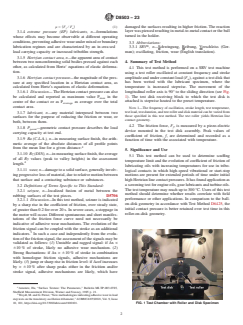
4.1 This test method is performed on a SRV test machine
tion.
using a test roller oscillated at constant frequency and stroke
3.1.6 Hertzian contact pressure—the magnitude of the pres- amplitude and under constant load (F ), against a test disk that
n
has been wetted with the lubricant specimen, where the
sure at any specified location in a Hertzian contact area, as
calculated from Hertz’s equations of elastic deformation. temperature is increased stepwise. The movement of the
longitudinal roller axis is 90° to the sliding direction (see Fig.
3.1.6.1 Discussion— The Hertzian contact pressure can also
be calculated and reported as maximum value P in the 1). The test disk receiving block to which the test disk is
max
attached is stepwise heated to the preset temperature.
centre of the contact or as P as average over the total
average
contact area.
NOTE 1—The frequency of oscillation, stroke length, test temperature,
test load, test duration, and test roller and disk material can be varied from
3.1.7 lubricant, n—any material interposed between two
those specified in this test method. The test roller yields Hertzian line
surfaces for the purpose of reducing the friction or wear, or
contact geometry.
both, between them.
4.2 The friction force, F , is measured by a piezo-electric
f
3.1.8 P —geometric contact pressure describes the load
geom
device mounted in the test disk assembly. Peak values of
carrying capacity at test end.
coefficient of friction, f, are determined and recorded as a
3.1.9 Ra (C.L.A.), n—in measuring surface finish, the arith-
function of time with the associated with temperature.
metic average of the absolute distances of all profile points
from the mean line for a given distance.
5. Significance and Use
3.1.10 Rz (DIN), n—in measuring surface finish, the average
5.1 This test method can be used to determine scuffing
of all Ry values (peak to valley heights) in the assessment
temperature limit and the evolution of coefficient of friction of
length.
lubricating oils with increasing temperatures for use in tribo-
3.1.11 wear, n—damage to a solid surface, generally involv-
logical contacts in which high-speed vibrational or start-stop
ing progressive loss of material, due to relative motion between
motions are present for extended periods of time under initial
that surface and a contacting substance or substances.
high Hertzian line contact pressures. It has found application as
a screening test for engine oils, gear lubricants and turbine oils.
3.2 Definitions of Terms Specific to This Standard:
The test temperature may reach up to 300 °C. Users of this test
3.2.1 seizure, n—localized fusion of metal between the
method should determine whether results correlate with field
rubbing surfaces of the test pieces. D5706
performance or other applications. In comparison to the ball-
3.2.1.1 Discussion—In this test method, seizure is indicated
on-disk geometry in accordance with Test Method D6425, the
by a sharp rise in the coefficient of friction, over steady state,
initial contact pressure is better retained over test time in this
of greater than 0.2 for over 20 s. In severe cases, a stoppage in
roller-on-disk geometry.
the motor will occur. Different spontaneous and short manifes-
tations of the friction force curve need not necessarily be
indicative of adhesive wear mechanisms. The evolution of the
friction signal can be coupled with the stroke as an additional
indicators. In such a case and independently from the evolu-
tion of the friction signal, the assessment of the signals may be
validated as follows: (1) Unstable and ragged signal: if Δx <
610 % of stroke, likely no adhesive wear mechanism. (2)
Strong fluctuations: if Δx > 610 % of stroke in combination
with homologue friction signals, adhesive mechanisms are
likely. (3) jump or sharp rise in friction level: if Δcof increases
by > 610 % after sharp peaks either in the fricition and/or
stroke signal, adhesive mechanisms are likely, which have
Amstutz, Hu, “Surface Texture: The Parameters,” Bulletin MI-TP-003-0785,
Sheffield Measurement Division, Warner and Swazey, 1985 p. 21.
Woydt, M. and G. Patzer, “New methodologies indicating adhesive wear in load
step tests on the translatory oscillation tribometer,” LUBRICANTS2021, Vol. 9, Issue
10, 101, https://doi.org/10.3390/lubricants9100101. FIG. 1 Test Chamber with Roller and Disk Specimen
D8503 − 23
6. Apparatus
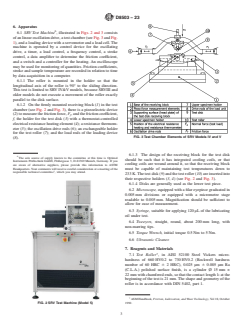
6.1 SRV Test Machine , illustrated in Figs. 2 and 3 consists
of an linear oscillation drive, a test chamber (see Fig. 3 and Fig.
1), and a loading device with a servomotor and a load cell. The
machine is operated by a control device for the oscillating
drive, a timer, a load control, a frequency control, a stroke
control, a data amplifier to determine the friction coefficient,
and a switch and a controller for the heating. An oscilloscope
may be used for monitoring of quantities. Friction coefficients,
stroke and sample temperature are recorded in relation to time
by data acquisition in a computer.
6.1.1 The roller is mounted in the holder so that the
longitudinal axis of the roller is 90° to the sliding direction.
This test is limited to SRV IV&V models, because SRVIII and
older models do not execute a movement of the roller exactly
parallel to the disk surface.
6.1.2 On the firmly mounted receiving block (1) in the test
chamber (see Fig. 2 and Fig. 3), there is a piezoelectric device
(2) to measure the friction force, F , and the friction coefficient,
f
f, the holder for the test disk (3) with a thermostat-controlled
electrical resistance heating element (4); a resistance thermom-
eter (5); the oscillation drive rods (6); an exchangeable holder
for the test roller (7); and the load rods of the loading device
FIG. 3 Test Chamber Elements of SRV Models IV and V
(8).
6.1.3 The design of the receiving block for the test disk
The sole source of supply known to the committee at this time is Optimol
should be such that it has integrated cooling coils, or that
Instruments Prüftechnik GmbH, Flößergasse 3, D-81369 Munich, Germany. If you
cooling coils are wound around it, so that the receiving block
are aware of alternative suppliers, please provide this information to ASTM
Headquarters. Your comments will receive careful consideration at a meeting of the
must be capable of maintaining test temperatures down to
responsible technical committee , which you may attend.
233 K. The test disk (9) and the test roller (10) are inserted into
their respective holders (3, 4) (see Fig. 2 and Fig. 3).
6.1.4 Disks are generally used as the lower test piece.
6.2 Microscope, equipped with a filar eyepiece graduated in
0.005 mm divisions or equipped with a micrometre stage
readable to 0.005 mm. Magnification should be sufficient to
allow for ease of measurement.
6.3 Syringe, suitable for applying 120 μL of the lubricating
oil under test.
6.4 Tweezers, straight, round, about 200 mm long, with
non-marring tips.
6.5 Torque Wrench, initial torque 0.5 Nm to 5 Nm.
6.6 Ultrasonic Cleaner.
7. Reagents and Materials
7.1 Test Roller , in AISI 52100 Steel Vickers micro-
hardness of 660 HV0.2 to 730 HV0.2 (Rockwell hardness
number of 60 HRC 6 2 HRC), 0.025 μm 6 0.005 μm Ra
(C.L.A.) polished surface finish, is a cylinder Ø 15 mm ×
22 mm with chamfered ends, so that the contact length l at the
beginning of the test is 21 mm. The shape and geometry of the
roller is in accordance with DIN 5402, part 1.
ASM Handbook, Friction, Lubrication, and Wear Technology, Vol 18, October
FIG. 2 SRV Test Machine (Model 5) 1992.
D8503 − 23
hydraulic oils. For jet turbine oils or engine oils it may the useful to
7.2 Test Disk, Lamellar grey cast iron with a high carbon
exceed 200 °C.
content having a perlitic matrix. Shape of graphite IA4-5.
Carbon content between 3.65 % by weight to 3.85 % by weight
8.4 Sample rates for result-relevant measurement channels:
carbon. Carbon equivalent: 4.15 < C + Si/4.3 < 4.30 (elemental
Coeff
...