

ASTM B387/B387M-23
(Specification)Standard Specification for Molybdenum and Molybdenum Alloy Bar, Rod, and Wire
General Information
- Abstract
ABSTRACT
This specification covers unalloyed molybdenum and molybdenum alloy bar, rod, and wire. The following materials are covered: molybdenum 360, molybdenum 361, molybdenum 363, molybdenum 364, molybdenum 365, and molybdenum 366. These materials shall be manufactured with conventional extrusion, forging, swaging, rolling, and drawing equipment. These shall materials be made by vacuum arc-melted or powder metallurgy methods. The chemical composition shall conform to the required contents of carbon, oxygen, nitrogen, iron, nickel, silicon, titanium, tungsten, zirconium, and molybdenum. Chemical analysis shall be done. Mechanical properties shall conform to the required tension properties: tensile strength, yield strength, elongation, and diamond pyramid hardness. Tension test shall also be done.
SCOPE
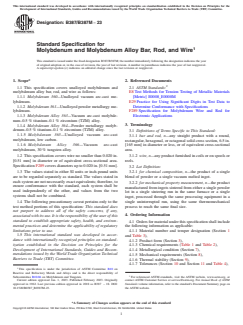
1.1 This specification covers unalloyed molybdenum and molybdenum alloy bar, rod, and wire as follows:
1.1.1 Molybdenum 360—Unalloyed vacuum arc-cast molybdenum.
1.1.2 Molybdenum 361—Unalloyed powder metallurgy molybdenum.
1.1.3 Molybdenum Alloy 363—Vacuum arc-cast molybdenum–0.5 % titanium–0.1 % zirconium (TZM) alloy.
1.1.4 Molybdenum Alloy 364—Powder metallurgy molybdenum–0.5 % titanium–0.1 % zirconium (TZM) alloy.
1.1.5 Molybdenum 365—Unalloyed vacuum arc-cast molybdenum, low carbon.
1.1.6 Molybdenum Alloy 366—Vacuum arc-cast molybdenum, 30 % tungsten alloy.
1.2 This specification covers wire no smaller than 0.020 in. [0.51 mm] in diameter or of equivalent cross-sectional area. Specification F289 covers diameters up to 0.020 in. [0.51 mm].
1.3 The values stated in either SI units or inch-pound units are to be regarded separately as standard. The values stated in each system are not necessarily exact equivalents; therefore, to ensure conformance with the standard, each system shall be used independently of the other, and values from the two systems shall not be combined.
1.4 The following precautionary caveat pertains only to the test method portions of this specification: This standard does not purport to address all of the safety concerns, if any, associated with its use. It is the responsibility of the user of this standard to establish appropriate safety, health, and environmental practices and determine the applicability of regulatory limitations prior to use.
1.5 This international standard was developed in accordance with internationally recognized principles on standardization established in the Decision on Principles for the Development of International Standards, Guides and Recommendations issued by the World Trade Organization Technical Barriers to Trade (TBT) Committee.
- Status
- Published
- Publication Date
- 31-Dec-2022
- Technical Committee
- B10 - Reactive and Refractory Metals and Alloys
- Drafting Committee
- B10.04 - Molybdenum and Tungsten
Buy Documents
ASTM B387/B387M-23 - Standard Specification for Molybdenum and Molybdenum Alloy Bar, Rod, and Wire
REDLINE ASTM B387/B387M-23 - Standard Specification for Molybdenum and Molybdenum Alloy Bar, Rod, and Wire
Overview
ASTM B387/B387M-23: Standard Specification for Molybdenum and Molybdenum Alloy Bar, Rod, and Wire is an internationally recognized specification developed by ASTM International. This standard covers the requirements for unalloyed molybdenum and several molybdenum alloy products in bar, rod, and wire forms. It ensures material quality, chemical composition, dimensional tolerances, mechanical properties, and proper manufacturing processes for molybdenum products used across critical industries.
The specification includes various material types such as unalloyed vacuum arc-cast molybdenum, powder metallurgy molybdenum, and alloys incorporating titanium, zirconium, or tungsten. ASTM B387/B387M-23 is essential for manufacturers, suppliers, and end-users requiring high-performance refractory metals for demanding applications.
Key Topics
Material Coverage
ASTM B387/B387M-23 specifies:- Molybdenum 360 and 361 (unalloyed, produced by vacuum arc-casting or powder metallurgy)
- Molybdenum Alloy 363 and 364 (TZM alloys with titanium and zirconium)
- Molybdenum 365 (low carbon unalloyed)
- Molybdenum Alloy 366 (molybdenum-tungsten alloy)
Manufacturing Methods
Covered products are manufactured via extrusion, forging, swaging, rolling, and drawing using standard equipment. Materials may be produced by vacuum arc-melting or powder metallurgy, ensuring high purity and performance.Chemical Composition and Analysis
Strict requirements for maximum allowable concentrations of elements such as carbon, oxygen, nitrogen, iron, nickel, silicon, titanium, tungsten, and zirconium. Both heat analysis and check analysis ensure consistent quality.Mechanical Properties
Molybdenum bar, rod, and wire must meet specific tensile strength, yield strength, elongation, and Vickers hardness requirements. Mechanical properties are verified through tensile and hardness testing at room temperature.Dimensional Tolerances
The standard defines tight tolerances for diameter, out-of-roundness, length, and straightness. These tolerances are crucial for ensuring compatibility with downstream manufacturing processes.Workmanship and Quality
Products must be free from defects such as cracks, seams, or inclusions beyond agreed standards. Surfaces can be supplied as-forged, rolled, swaged, drawn, cleaned, machined, or ground, based on purchaser requirements.
Applications
Molybdenum and molybdenum alloy bar, rod, and wire under ASTM B387/B387M-23 are widely used in industries that demand high-temperature strength, low coefficient of thermal expansion, and excellent corrosion resistance. Applications include:
- Aerospace Components: Rocket nozzles, structural supports, and heat shields
- Electronics: Filaments, electrodes, and supports in vacuum and electronic tube manufacturing
- Medical Devices: X-ray and radiation shielding, and specialized surgical tools
- Nuclear Industry: Core components, fuel rods, and reactors requiring high-temperature stability
- Chemical Processing: Components exposed to corrosive or high-temperature environments
By adhering to ASTM B387/B387M-23, manufacturers and users are assured of consistent product quality, optimal performance, and compliance with international requirements.
Related Standards
Adherence to related standards enhances compatibility and quality assurance throughout the supply chain. Relevant standards include:
- ASTM E8/E8M: Test Methods for Tension Testing of Metallic Materials
- ASTM E29: Guide for Using Significant Digits in Test Data
- ASTM E92: Test Methods for Vickers and Knoop Hardness of Metallic Materials
- ASTM E384: Microindentation Hardness Testing
- ASTM E1941: Determination of Carbon in Refractory and Reactive Metals
- ASTM F289: Specification for Molybdenum Wire and Rod for Electronic Applications
ASTM B387/B387M-23 sets a robust foundation for the production and use of high-quality molybdenum and molybdenum alloy products in critical and advanced technology sectors.
Relations
- Refers
ASTM F289-96(2019) - Standard Specification for Molybdenum Wire and Rod for Electronic Applications - Effective Date
- 01-Apr-2019
- Refers
ASTM F289-96(2014) - Standard Specification for Molybdenum Wire and Rod for Electronic Applications - Effective Date
- 01-Jun-2014
- Refers
ASTM F289-96(2009) - Standard Specification for Molybdenum Wire and Rod for Electronic Applications - Effective Date
- 01-May-2009
- Effective Date
- 01-Oct-2008
- Effective Date
- 15-Nov-2006
- Effective Date
- 15-Sep-2006
- Effective Date
- 01-May-2006
- Effective Date
- 01-Dec-2004
- Effective Date
- 01-Apr-2004
- Effective Date
- 10-Jul-2003
- Effective Date
- 10-May-2002
- Effective Date
- 10-Oct-2001
- Effective Date
- 10-Oct-2001
- Effective Date
- 10-Oct-2001
- Effective Date
- 10-Oct-2001
Buy Documents
ASTM B387/B387M-23 - Standard Specification for Molybdenum and Molybdenum Alloy Bar, Rod, and Wire
REDLINE ASTM B387/B387M-23 - Standard Specification for Molybdenum and Molybdenum Alloy Bar, Rod, and Wire
Get Certified
Connect with accredited certification bodies for this standard

Element Materials Technology
Materials testing and product certification.

Inštitut za kovinske materiale in tehnologije
Institute of Metals and Technology. Materials testing, metallurgical analysis, NDT.
Sponsored listings
Frequently Asked Questions
ASTM B387/B387M-23 is a technical specification published by ASTM International. Its full title is "Standard Specification for Molybdenum and Molybdenum Alloy Bar, Rod, and Wire". This standard covers: ABSTRACT This specification covers unalloyed molybdenum and molybdenum alloy bar, rod, and wire. The following materials are covered: molybdenum 360, molybdenum 361, molybdenum 363, molybdenum 364, molybdenum 365, and molybdenum 366. These materials shall be manufactured with conventional extrusion, forging, swaging, rolling, and drawing equipment. These shall materials be made by vacuum arc-melted or powder metallurgy methods. The chemical composition shall conform to the required contents of carbon, oxygen, nitrogen, iron, nickel, silicon, titanium, tungsten, zirconium, and molybdenum. Chemical analysis shall be done. Mechanical properties shall conform to the required tension properties: tensile strength, yield strength, elongation, and diamond pyramid hardness. Tension test shall also be done. SCOPE 1.1 This specification covers unalloyed molybdenum and molybdenum alloy bar, rod, and wire as follows: 1.1.1 Molybdenum 360—Unalloyed vacuum arc-cast molybdenum. 1.1.2 Molybdenum 361—Unalloyed powder metallurgy molybdenum. 1.1.3 Molybdenum Alloy 363—Vacuum arc-cast molybdenum–0.5 % titanium–0.1 % zirconium (TZM) alloy. 1.1.4 Molybdenum Alloy 364—Powder metallurgy molybdenum–0.5 % titanium–0.1 % zirconium (TZM) alloy. 1.1.5 Molybdenum 365—Unalloyed vacuum arc-cast molybdenum, low carbon. 1.1.6 Molybdenum Alloy 366—Vacuum arc-cast molybdenum, 30 % tungsten alloy. 1.2 This specification covers wire no smaller than 0.020 in. [0.51 mm] in diameter or of equivalent cross-sectional area. Specification F289 covers diameters up to 0.020 in. [0.51 mm]. 1.3 The values stated in either SI units or inch-pound units are to be regarded separately as standard. The values stated in each system are not necessarily exact equivalents; therefore, to ensure conformance with the standard, each system shall be used independently of the other, and values from the two systems shall not be combined. 1.4 The following precautionary caveat pertains only to the test method portions of this specification: This standard does not purport to address all of the safety concerns, if any, associated with its use. It is the responsibility of the user of this standard to establish appropriate safety, health, and environmental practices and determine the applicability of regulatory limitations prior to use. 1.5 This international standard was developed in accordance with internationally recognized principles on standardization established in the Decision on Principles for the Development of International Standards, Guides and Recommendations issued by the World Trade Organization Technical Barriers to Trade (TBT) Committee.
ABSTRACT This specification covers unalloyed molybdenum and molybdenum alloy bar, rod, and wire. The following materials are covered: molybdenum 360, molybdenum 361, molybdenum 363, molybdenum 364, molybdenum 365, and molybdenum 366. These materials shall be manufactured with conventional extrusion, forging, swaging, rolling, and drawing equipment. These shall materials be made by vacuum arc-melted or powder metallurgy methods. The chemical composition shall conform to the required contents of carbon, oxygen, nitrogen, iron, nickel, silicon, titanium, tungsten, zirconium, and molybdenum. Chemical analysis shall be done. Mechanical properties shall conform to the required tension properties: tensile strength, yield strength, elongation, and diamond pyramid hardness. Tension test shall also be done. SCOPE 1.1 This specification covers unalloyed molybdenum and molybdenum alloy bar, rod, and wire as follows: 1.1.1 Molybdenum 360—Unalloyed vacuum arc-cast molybdenum. 1.1.2 Molybdenum 361—Unalloyed powder metallurgy molybdenum. 1.1.3 Molybdenum Alloy 363—Vacuum arc-cast molybdenum–0.5 % titanium–0.1 % zirconium (TZM) alloy. 1.1.4 Molybdenum Alloy 364—Powder metallurgy molybdenum–0.5 % titanium–0.1 % zirconium (TZM) alloy. 1.1.5 Molybdenum 365—Unalloyed vacuum arc-cast molybdenum, low carbon. 1.1.6 Molybdenum Alloy 366—Vacuum arc-cast molybdenum, 30 % tungsten alloy. 1.2 This specification covers wire no smaller than 0.020 in. [0.51 mm] in diameter or of equivalent cross-sectional area. Specification F289 covers diameters up to 0.020 in. [0.51 mm]. 1.3 The values stated in either SI units or inch-pound units are to be regarded separately as standard. The values stated in each system are not necessarily exact equivalents; therefore, to ensure conformance with the standard, each system shall be used independently of the other, and values from the two systems shall not be combined. 1.4 The following precautionary caveat pertains only to the test method portions of this specification: This standard does not purport to address all of the safety concerns, if any, associated with its use. It is the responsibility of the user of this standard to establish appropriate safety, health, and environmental practices and determine the applicability of regulatory limitations prior to use. 1.5 This international standard was developed in accordance with internationally recognized principles on standardization established in the Decision on Principles for the Development of International Standards, Guides and Recommendations issued by the World Trade Organization Technical Barriers to Trade (TBT) Committee.
ASTM B387/B387M-23 is classified under the following ICS (International Classification for Standards) categories: 77.150.99 - Other products of non-ferrous metals. The ICS classification helps identify the subject area and facilitates finding related standards.
ASTM B387/B387M-23 has the following relationships with other standards: It is inter standard links to ASTM F289-96(2019), ASTM F289-96(2014), ASTM F289-96(2009), ASTM E29-08, ASTM E29-06b, ASTM E29-06a, ASTM E29-06, ASTM E29-04, ASTM E8-04, ASTM E8-03, ASTM E29-02e1, ASTM E8-01e1, ASTM E8-01e2, ASTM E8-01, ASTM E8-00b. Understanding these relationships helps ensure you are using the most current and applicable version of the standard.
ASTM B387/B387M-23 is available in PDF format for immediate download after purchase. The document can be added to your cart and obtained through the secure checkout process. Digital delivery ensures instant access to the complete standard document.
Standards Content (Sample)
This international standard was developed in accordance with internationally recognized principles on standardization established in the Decision on Principles for the
Development of International Standards, Guides and Recommendations issued by the World Trade Organization Technical Barriers to Trade (TBT) Committee.
Designation: B387/B387M − 23
Standard Specification for
Molybdenum and Molybdenum Alloy Bar, Rod, and Wire
This standard is issued under the fixed designation B387/B387M; the number immediately following the designation indicates the year
of original adoption or, in the case of revision, the year of last revision. A number in parentheses indicates the year of last reapproval.
A superscript epsilon (´) indicates an editorial change since the last revision or reapproval.
1. Scope* 2. Referenced Documents
1.1 This specification covers unalloyed molybdenum and 2.1 ASTM Standards:
molybdenum alloy bar, rod, and wire as follows: E8 Test Methods for Tension Testing of Metallic Materials
1.1.1 Molybdenum 360—Unalloyed vacuum arc-cast mo- [Metric] E0008_E0008M
lybdenum. E29 Practice for Using Significant Digits in Test Data to
1.1.2 Molybdenum 361—Unalloyed powder metallurgy mo- Determine Conformance with Specifications
lybdenum. F289 Specification for Molybdenum Wire and Rod for
1.1.3 Molybdenum Alloy 363—Vacuum arc-cast molybde- Electronic Applications
num–0.5 % titanium–0.1 % zirconium (TZM) alloy.
3. Terminology
1.1.4 Molybdenum Alloy 364—Powder metallurgy molyb-
denum–0.5 % titanium–0.1 % zirconium (TZM) alloy.
3.1 Definitions of Terms Specific to This Standard:
1.1.5 Molybdenum 365—Unalloyed vacuum arc-cast
3.1.1 bar and rod, n—any straight product with a round,
molybdenum, low carbon.
rectangular, hexagonal, or octagonal solid cross section, 6.5 in.
1.1.6 Molybdenum Alloy 366—Vacuum arc-cast
[165 mm] in diameter or less, or of equivalent cross-sectional
molybdenum, 30 % tungsten alloy.
area.
1.2 This specification covers wire no smaller than 0.020 in. 3.1.2 wire, n—any product furnished in coils or on spools or
[0.51 mm] in diameter or of equivalent cross-sectional area. reels.
Specification F289 covers diameters up to 0.020 in. [0.51 mm].
3.2 Lot Definition:
1.3 The values stated in either SI units or inch-pound units 3.2.1 for chemical composition, n—the product of a single
are to be regarded separately as standard. The values stated in blend of powder or a single vacuum melted ingot.
each system are not necessarily exact equivalents; therefore, to
3.2.2 for mechanical property measurement, n—the product
ensure conformance with the standard, each system shall be
manufactured from ingots sintered from either a single powder
used independently of the other, and values from the two
lot in a single sintering run in the same furnace or a single
systems shall not be combined.
ingot, processed through the same processing equipment in a
1.4 The following precautionary caveat pertains only to the
single uninterrupted run, using the same thermomechanical
test method portions of this specification: This standard does process to reach the same final size.
not purport to address all of the safety concerns, if any,
4. Ordering Information
associated with its use. It is the responsibility of the user of this
standard to establish appropriate safety, health, and environ-
4.1 Orders for material under this specification shall include
mental practices and determine the applicability of regulatory
the following information as applicable:
limitations prior to use.
4.1.1 Material number and temper designation (Section 1
1.5 This international standard was developed in accor-
and Table 3),
dance with internationally recognized principles on standard-
4.1.2 Product form (Section 3),
ization established in the Decision on Principles for the
4.1.3 Chemical requirements (Table 1 and Table 2),
Development of International Standards, Guides and Recom-
4.1.4 Metallurgical condition (Section 7),
mendations issued by the World Trade Organization Technical
4.1.5 Mechanical requirements (Section 8),
Barriers to Trade (TBT) Committee.
4.1.6 Thermal stability (Section 9),
4.1.7 Tolerances (Section 10 and Section 11 and Table 4),
This specification is under the jurisdiction of ASTM Committee B10 on
Reactive and Refractory Metals and Alloys and is the direct responsibility of
Subcommittee B10.04 on Molybdenum and Tungsten. For referenced ASTM standards, visit the ASTM website, www.astm.org, or
Current edition approved Jan. 1, 2023. Published February 2023. Originally contact ASTM Customer Service at service@astm.org. For Annual Book of ASTM
approved in 1962. Last previous edition approved in 2018 as B387 – 18. DOI: Standards volume information, refer to the standard’s Document Summary page on
10.1520/B0387_B0387M-23. the ASTM website.
*A Summary of Changes section appears at the end of this standard
Copyright © ASTM International, 100 Barr Harbor Drive, PO Box C700, West Conshohocken, PA 19428-2959. United States
B387/B387M − 23
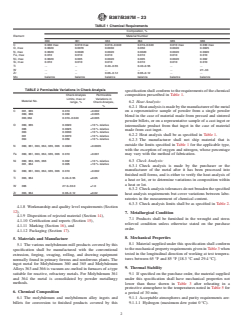
TABLE 1 Chemical Requirements
Composition, %
Element Material Number
360 361 363 364 365 366
C 0.030 max 0.010 max 0.010–0.040 0.010–0.040 0.010 max 0.030 max
O, max 0.0020 0.0070 0.0030 0.050 0.0020 0.0025
N, max 0.0020 0.0020 0.0020 0.0020 0.0020 0.0020
Fe, max 0.010 0.010 0.010 0.010 0.010 0.010
Ni, max 0.0020 0.005 0.0020 0.005 0.0020 0.002
Si, max 0.010 0.010 0.010 0.010 0.010 0.010
Ti . . 0.40–0.55 0.40–0.55 . .
W . . . . . 27–33
Zr . . 0.06–0.12 0.06–0.12 . .
Mo balance balance balance balance balance balance
TABLE 2 Permissible Variations in Check Analysis
specification shall conform to the requirements of the chemical
Check Analysis Permissible composition prescribed in Table 1.
Limits, max or Variations in
Material No.
6.2 Heat Analysis:
range, % Check Analysis,
%
6.2.1 Heat analysis is made by the manufacturer of the metal
C 361, 365 0.010 +0.002
on a representative sample of powder from a single powder
360, 366 0.030 +0.005
blend in the case of material made from pressed and sintered
363,364 0.010–0.040 ±0.005
powder billets, or on a representative sample of a cast ingot or
O 360, 365 0.0020 +10 % relative
intermediate product from that ingot in the case of material
366 0.0025 +10 % relative
made from cast ingot.
363 0.0030 +10 % relative
6.2.2 Heat analysis shall be as specified in Table 1.
361 0.0070 +10 % relative
364 0.050 +10 % relative
6.2.3 The manufacturer shall not ship material that is
outside the limits specified in Table 1 for the applicable type,
N 360, 361, 363, 364, 365, 366 0.0020 +0.0005
with the exception of oxygen and nitrogen, whose percentage
Fe 360, 361, 363, 364, 365, 366 0.010 +0.001
may vary with the method of fabrication.
Ni 360, 363, 365, 366 0.002 +10 % relative
6.3 Check Analysis:
361, 364 0.005 +10 % relative
6.3.1 Check analysis is made by the purchaser or the
manufacturer of the metal after it has been processed into
Si 360, 361, 363, 364, 365, 366 0.010 +0.002
finished mill forms, and is either to verify the heat analysis of
Ti 363, 364 0.40–0.55 ±0.05
a heat or lot, or to determine variations in composition within
a heat or lot.
W 366 27.0–33.0 ±1.0
6.3.2 Check analysis tolerances do not broaden the specified
Zr 363, 364 0.06–0.12 ±0.02
heat analysis requirements but cover variations between labo-
ratories in the measurement of chemical content.
6.3.3 Check analysis limits shall be as specified in Table 2.
4.1.8 Workmanship and quality level requirements (Section
12),
7. Metallurgical Condition
4.1.9 Disposition of rejected material (Section 14),
7.1 Products shall be furnished in the wrought and stress
4.1.10 Certification and reports (Section 15),
relieved condition unless otherwise stated on the purchase
4.1.11 Marking (Section 16), and
order.
4.1.12 Packaging (Section 17).
8. Mechanical Properties
5. Materials and Manufacture
8.1 Material supplied under this specification shall conform
5.1 The various molybdenum mill products covered by this
to the mechanical property requirements given in Table 3 when
specification shall be manufactured with the conventional
tested in the longitudinal direction of working at test tempera-
extrusion, forging, swaging, rolling, and drawing equipment
tures between 65 °F and 85 °F [18.3 °C and 29.4 °C].
normally found in primary ferrous and nonferrous plants. The
ingot metal for Molybdenum 360 and 365 and Molybdenum
9. Thermal Stability
Alloys 363 and 366 is vacuum arc-melted in furnaces of a type
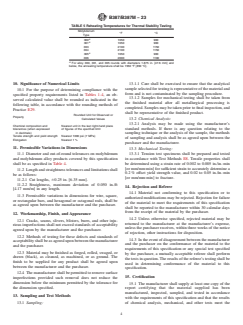
suitable for reactive, refractory metals. For Molybdenum 361 9.1 If specified on the purchase order, the material supplied
and 364 the metal is consolidated by powder metallurgy
under this specification shall have mechanical properties not
methods. lower than those shown in Table 3 after reheating in a
protective atmosphere to the temperatures noted in Table 5 for
6. Chemical Composition
a period of 30 min;
6.1 The molybdenum and molybdenum alloy ingots and 9.1.1 Acceptable atmospheres and purity requirements are:
billets for conversion to finished products covered by this 9.1.1.1 Hydrogen (maximum dew point 0 °C).
B387/B387M − 23
A
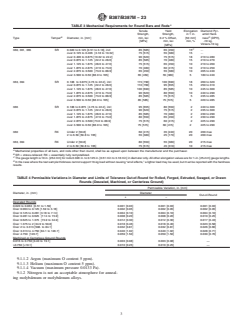
TABLE 3 Mechanical Requirements for Round Bars and Rods
Tensile Yield Elongation Diamond Pyr-
Strength, Strength, in 1 in. amid Hard-
B D
Type Temper Diameter, in. [mm] min, ksi 0.2 % Offset, [50 mm] ness (DPH),
-10 kg,
[MPa] min, ksi min, %
Vickers-10 kg
[MPa]
C
360, 361, 365 SR 0.020 to 0.125 [0.51 to 3.18], incl 85 [585] 65 [450] 15 .
over 0.125 to 0.406 [3.18 to 10.32] 75 [515] 55 [380] 15 .
over 0.406 to 0.875 [10.32 to 22.2] 90 [620] 75 [515] 18 210 to 280
over 0.875 to 1.125 [22.2 to 28.6] 85 [585] 70 [480] 15 210 to 270
over 1.125 to 1.875 [28.6 to 47.6] 75 [515] 65 [450] 10 210 to 260
over 1.875 to 2.875 [47.6 to 73.0] 70 [480] 60 [415] 10 210 to 250
over 2.875 to 3.500 [73.0 to 88.9] 65 [450] 55 [380] 10 205 to 240
over 3.500 to 6.50 [88.9 to 165] 65 [450] 55 [380] 5 180 to 240
363, 364 SR 0.188 to 0.875 [4.76 to 22.2], incl 115 [790] 100 [690] 18 260 to 320
over 0.875 to 1.125 [22.2 to 28.6] 110 [760] 95 [655] 15 250 to 310
over 1.125 to 1.875 [28.6 to 47.6] 100 [690] 85 [585] 10 245 to 300
over 1.875 to 2.875 [47.6 to 73.0] 90 [620] 80 [550] 10 240 to 290
over 2.875 to 3.500 [73.0 to 88.9] 85 [585] 75 [515] 5 235 to 285
over 3.500 to 6.50 [88.9 to 165] 85 [585] 75 [515] 5 220 to 285
366 SR 0.188 to 0.875 [4.76 to 22.2], incl 95 [655] 80 [550] 2 240 to 300
over 0.875 to 1.125 [22.2 to 28.6] 90 [620] 75 [515] 2 235 to 300
over 1.125 to 1.875 [28.6 to 47.6] 85 [585] 70 [480] 2 230
...
This document is not an ASTM standard and is intended only to provide the user of an ASTM standard an indication of what changes have been made to the previous version. Because
it may not be technically possible to adequately depict all changes accurately, ASTM recommends that users consult prior editions as appropriate. In all cases only the current version
of the standard as published by ASTM is to be considered the official document.
Designation: B387 − 18 B387/B387M − 23
Standard Specification for
Molybdenum and Molybdenum Alloy Bar, Rod, and Wire
This standard is issued under the fixed designation B387;B387/B387M; the number immediately following the designation indicates the
year of original adoption or, in the case of revision, the year of last revision. A number in parentheses indicates the year of last
reapproval. A superscript epsilon (´) indicates an editorial change since the last revision or reapproval.
1. Scope*
1.1 This specification covers unalloyed molybdenum and molybdenum alloy bar, rod, and wire as follows:
1.1.1 Molybdenum 360—Unalloyed vacuum arc-cast molybdenum.
1.1.2 Molybdenum 361—Unalloyed powder metallurgy molybdenum.
1.1.3 Molybdenum Alloy 363—Vacuum arc-cast molybdenum–0.5 % titanium–0.1 % zirconium (TZM) alloy.
1.1.4 Molybdenum Alloy 364—Powder metallurgy molybdenum–0.5 % titanium–0.1 % zirconium (TZM) alloy.
1.1.5 Molybdenum 365—Unalloyed vacuum arc-cast molybdenum, low carbon.
1.1.6 Molybdenum Alloy 366—Vacuum arc-cast molybdenum, 30 % tungsten alloy.
1.2 This specification covers wire no smaller than 0.020 in. (0.51 mm)[0.51 mm] in diameter or of equivalent cross-sectional area.
Specification F289 covers diameters up to 0.020 in. (0.51 mm).[0.51 mm].
1.3 The values stated in either SI units or inch-pound units are to be regarded separately as standard. The values given in
parentheses are mathematical conversions to SI units that are provided for information only and are not considered standard.stated
in each system are not necessarily exact equivalents; therefore, to ensure conformance with the standard, each system shall be used
independently of the other, and values from the two systems shall not be combined.
1.4 The following precautionary caveat pertains only to the test method portions of this specification: This standard does not
purport to address all of the safety concerns, if any, associated with its use. It is the responsibility of the user of this standard to
establish appropriate safety, health, and environmental practices and determine the applicability of regulatory limitations prior
to use.
1.5 This international standard was developed in accordance with internationally recognized principles on standardization
established in the Decision on Principles for the Development of International Standards, Guides and Recommendations issued
by the World Trade Organization Technical Barriers to Trade (TBT) Committee.
This specification is under the jurisdiction of ASTM Committee B10 on Reactive and Refractory Metals and Alloys and is the direct responsibility of Subcommittee
B10.04 on Molybdenum and Tungsten.
Current edition approved July 1, 2018Jan. 1, 2023. Published September 2018February 2023. Originally approved in 1962. Last previous edition approved in 20102018
as B387 – 10. DOI: 10.1520/B0387-18.18. DOI: 10.1520/B0387_B0387M-23.
*A Summary of Changes section appears at the end of this standard
Copyright © ASTM International, 100 Barr Harbor Drive, PO Box C700, West Conshohocken, PA 19428-2959. United States
B387/B387M − 23
2. Referenced Documents
2.1 ASTM Standards:
E8 Test Methods for Tension Testing of Metallic Materials [Metric] E0008_E0008M
E29 Practice for Using Significant Digits in Test Data to Determine Conformance with Specifications
E92 Test Methods for Vickers Hardness and Knoop Hardness of Metallic Materials
E384 Test Method for Microindentation Hardness of Materials
E1941 Test Method for Determination of Carbon in Refractory and Reactive Metals and Their Alloys by Combustion Analysis
F289 Specification for Molybdenum Wire and Rod for Electronic Applications
3. Terminology
3.1 Definitions of Terms Specific to This Standard:
3.1.1 bar and rod, n—any straight product with a round, rectangular, hexagonal, or octagonal solid cross section, 4 in. (101.6 mm)
6.5 in. [165 mm] in diameter or less, or of equivalent cross-sectional area.
3.1.2 wire, n—any product furnished in coils or on spools or reels.
3.2 Lot Definition:
3.2.1 for chemical composition, n—the product of a single blend of powder or a single vacuum melted ingot.
3.2.2 for mechanical property measurement, n—the product manufactured from ingots sintered from either a single powder lot in
a single sintering run in the same furnace or a single ingot, processed through the same processing equipment in a single
uninterrupted run, using the same thermomechanical process to reach the same final size.
4. Ordering Information
4.1 Orders for material under this specification shall include the following information as applicable:
4.1.1 Material number and temper designation (Section 1 and Table 3),
4.1.2 Product form (Section 3),
4.1.3 Chemical requirements (Table 1 and Table 2),
4.1.4 Metallurgical condition (Section 7),
4.1.5 Mechanical requirements (Section 8),
4.1.6 Thermal stability (Section 9),
TABLE 1 Chemical Requirements
Composition, %
Element Material Number
360 361 363 364 365 366
C 0.030 max 0.010 max 0.010–0.040 0.010–0.040 0.010 max 0.030 max
O, max 0.0020 0.0070 0.0030 0.050 0.0020 0.0025
N, max 0.0020 0.0020 0.0020 0.0020 0.0020 0.0020
Fe, max 0.010 0.010 0.010 0.010 0.010 0.010
Ni, max 0.0020 0.005 0.0020 0.005 0.0020 0.002
Si, max 0.010 0.010 0.010 0.010 0.010 0.010
Ti . . 0.40–0.55 0.40–0.55 . .
W . . . . . 27–33
Zr . . 0.06–0.12 0.06–0.12 . .
Mo balance balance balance balance balance balance
For referenced ASTM standards, visit the ASTM website, www.astm.org, or contact ASTM Customer Service at service@astm.org. For Annual Book of ASTM Standards
volume information, refer to the standard’s Document Summary page on the ASTM website.
B387/B387M − 23
TABLE 2 Permissible Variations in Check Analysis
Check Analysis Permissible
Limits, max or Variations in
Material No.
range, % Check Analysis,
%
C 361, 365 0.010 +0.002
360, 366 0.030 +0.005
363,364 0.010–0.040 ±0.005
O 360, 365 0.0020 +10 % relative
366 0.0025 +10 % relative
363 0.0030 +10 % relative
361 0.0070 +10 % relative
364 0.050 +10 % relative
N 360, 361, 363, 364, 365, 366 0.0020 +0.0005
Fe 360, 361, 363, 364, 365, 366 0.010 +0.001
Ni 360, 363, 365, 366 0.002 +10 % relative
361, 364 0.005 +10 % relative
Si 360, 361, 363, 364, 365, 366 0.010 +0.002
Ti 363, 364 0.40–0.55 ±0.05
W 366 27.0–33.0 ±1.0
Zr 363, 364 0.06–0.12 ±0.02
4.1.7 Tolerances (Section 10 and Section 11 and Table 4),
4.1.8 Workmanship and quality level requirements (Section 12),
4.1.9 Disposition of rejected material (Section 14),
4.1.10 Certification and reports (Section 15),
4.1.11 Marking (Section 16), and
4.1.12 Packaging (Section 17).
5. Materials and Manufacture
5.1 The various molybdenum mill products covered by this specification shall be manufactured with the conventional extrusion,
forging, swaging, rolling, and drawing equipment normally found in primary ferrous and nonferrous plants. The ingot metal for
Molybdenum 360 and 365 and Molybdenum Alloys 363 and 366 is vacuum arc-melted in furnaces of a type suitable for reactive,
refractory metals. For Molybdenum 361 and 364 the metal is consolidated by powder metallurgy methods.
6. Chemical Composition
6.1 The molybdenum and molybdenum alloy ingots and billets for conversion to finished products covered by this specification
shall conform to the requirements of the chemical composition prescribed in Table 1.
6.2 Heat Analysis:
6.2.1 Heat analysis is made by the manufacturer of the metal on a representative sample of powder from a single powder blend
in the case of material made from pressed and sintered powder billets, or on a representative sample of a cast ingot or intermediate
product from that ingot in the case of material made from cast ingot.
6.2.2 Heat analysis shall be as specified in Table 1.
B387/B387M − 23
A
TABLE 3 Mechanical Requirements for Round Bars and Rods
Tensile Yield Elongation Diamond Pyr-
Strength, Strength, in 1 in. amid Hard-
B D
Type Temper Diameter, in. (mm)[mm] min, ksi 0.2 % Offset, (50 mm)[50 ness (DPH),
-10 kg,
(MPa)[MPa] min, ksi mm]
Vickers-10 kg
(MPa)[MPa] min, %
C
360, 361, 365 SR 0.020 to 0.125 (0.51 to 3.18), incl 85 (585) 65 (450) 15 .
C
360, 361, 365 SR 0.020 to 0.125 [0.51 to 3.18], incl 85 [585] 65 [450] 15 .
over 0.125 to 0.406 (3.18 to 10.32) 75 (515) 55 (380) 15 .
over 0.125 to 0.406 [3.18 to 10.32] 75 [515] 55 [380] 15 .
over 0.406 to 0.875 (10.32 to 22.2) 90 (620) 75 (515) 18 210 to 280
over 0.406 to 0.875 [10.32 to 22.2] 90 [620] 75 [515] 18 210 to 280
over 0.875 to 1.125 (22.2 to 28.6) 85 (585) 70 (480) 15 210 to 270
over 0.875 to 1.125 [22.2 to 28.6] 85 [585] 70 [480] 15 210 to 270
over 1.125 to 1.875 (28.6 to 47.6) 75 (515) 65 (450) 10 210 to 260
over 1.125 to 1.875 [28.6 to 47.6] 75 [515] 65 [450] 10 210 to 260
over 1.875 to 2.875 (47.6 to 73.0) 70 (480) 60 (415) 10 210 to 250
over 1.875 to 2.875 [47.6 to 73.0] 70 [480] 60 [415] 10 210 to 250
over 2.875 to 3.500 (73.0 to 88.9) 65 (450) 55 (380) 10 205 to 240
over 2.875 to 3.500 [73.0 to 88.9] 65 [450] 55 [380] 10 205 to 240
over 3.500 to 6.50 [88.9 to 165] 65 [450] 55 [380] 5 180 to 240
363, 364 SR 0.188 to 0.875 (4.76 to 22.2), incl 115 (790) 100 (690) 18 260 to 320
363, 364 SR 0.188 to 0.875 [4.76 to 22.2], incl 115 [790] 100 [690] 18 260 to 320
over 0.875 to 1.125 (22.2 to 28.6) 110 (760) 95 (655) 15 250 to 310
over 0.875 to 1.125 [22.2 to 28.6] 110 [760] 95 [655] 15 250 to 310
over 1.125 to 1.875 (28.6 to 47.6) 100 (690) 85 (585) 10 245 to 300
over 1.125 to 1.875 [28.6 to 47.6] 100 [690] 85 [585] 10 245 to 300
over 1.875 to 2.875 (47.6 to 73.0) 90 (620) 80 (550) 10 240 to 290
over 1.875 to 2.875 [47.6 to 73.0] 90 [620] 80 [550] 10 240 to 290
over 2.875 to 3.500 (73.0 to 88.9) 85 (585) 75 (515) 5 235 to 285
over 2.875 to 3.500 [73.0 to 88.9] 85 [585] 75 [515] 5 235 to 285
over 3.500 to 6.50 [88.9 to 165] 85 [585] 75 [515] 5 220 to 285
366 SR 0.188 to 0.875 (4.76 to 22.2), incl 95 (655) 80 (550) 2 240 to 300
366 SR 0.188 to 0.875 [4.76 to 22.2], incl 95 [655] 80 [550] 2 240 to 300
over 0.875 to 1.125 (22.2 to 28.6) 90 (620) 75 (515) 2 235 to 300
over 0.875 to 1.125 [22.2 to 28.6] 90 [620] 75 [515] 2 235 to 300
over 1.125 to 1.875 (28.6 to 47.6) 85 (585) 70 (480) 2 230 to 290
over 1.125 to 1.875 [28.6 to 47.6] 85 [585] 70 [480] 2 230 to 290
over 1.875 to 2.875 (47.6 to 73.0) 80 (550) 65 (450) 2 230 to 290
over 1.875 to 2.875 [47.6 to 73.0] 80 [550] 65 [450] 2 230 to 290
over 2.875 to 3.500 (73.0 to 88.9) 75 (515) 60 (415) 2 225 to 290
over 2.875 to 3.500 [73.0 to 88.9] 75 [515] 60 [415] 2 225 to 290
over 3.500 to 6.50 [88.9 to 165] 75 [515] 60 [415] 2 225 to 290
360 RX Under 2 (50.8) 60 (415) 35 (240) 20 200 max
2 to 3.500 (50.8 to 88.9) 55 (380) 25 (170) 20 200 max
360 RX Under 2 [50.8] 60 [415] 35 [240] 20 200 max
2 to 6.50 [50.8 to 165] 55 [380] 25 [170] 20 200 max
363, 364 RX Under 2 (50.8) 80 (550) 55 (380) 20 215 max
2 to 3.500 (50.8 to 88.9) 75 (515) 45 (310) 10 215 max
363, 364 RX Under 2 [50.8] 80 [550] 55 [380] 20 215 max
2 to 6.50 [50.8 to 165] 75 [515] 45 [310] 10 215 max
A
Mechanical properties of all bars, and rods other than round, shall be as agreed upon between the manufacturer and the purchaser.
B
SR = stress-relieved; RX = essentially fully recrystallized.
C
The gagegauge length is 10 in. (254 mm)[254 mm] for rods 0.0200.020 in. to 0.125 in. (0.51[0.51 min to 3.18 min)min] in diameter only. All other elongation values are
for 1-in. (25-mm) gage[25-mm] gauge lengths.
D
In the case where the test sample thickness cannot support 10-kg load without causing “anvil effects,” a lighter load may be used, but must be reported with the hardness
results.
6.2.3 The m
...