

ASTM B350/B350M-11(2021)
(Specification)Standard Specification for Zirconium and Zirconium Alloy Ingots for Nuclear Application
General Information
- Abstract
ABSTRACT
This specification covers vacuum-melted zirconium and zirconium alloy ingots for nuclear application. Materials covered shall be produced by multiple vacuum arc melting, or electron beam melting, or other melting processes conventionally used for reactive metals. Unless otherwise specified, ingots shall be conditioned by machining or grinding or both to remove surface and subsurface defects detrimental to subsequent fabrication. The ingot shall conform to the chemical composition requirements prescribed. The ingots shall be analyzed for the alloying and impurity elements prescribed. Ingots shall be inspected ultrasonically using the prescribed methods. The test shall be conducted in accordance with practice E 114.
SIGNIFICANCE AND USE
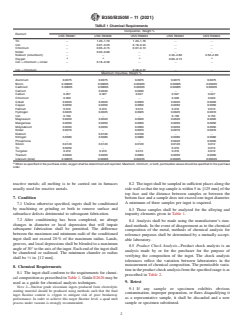
10.1 For purposes of determining compliance with the specified limits for requirements of the properties listed in Table 1 and Table 2, an observed value or a calculated value shall be rounded as indicated in accordance with the rounding method of Practice E29.
SCOPE
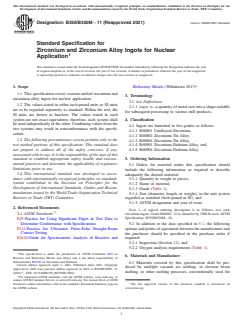
1.1 This specification covers vacuum-melted zirconium and zirconium alloy ingots for nuclear application.
1.2 The values stated in either inch-pound units or SI units are to be regarded separately as standard. Within the text, the SI units are shown in brackets. The values stated in each system are not exact equivalents; therefore, each system shall be used independently of the other. Combining values from the two systems may result in nonconformance with the specification.
1.3 The following precautionary caveat pertains only to the test method portions of this specification: This standard does not purport to address all of the safety concerns, if any, associated with its use. It is the responsibility of the user of this standard to establish appropriate safety, health, and environmental practices and determine the applicability of regulatory limitations prior to use.
1.4 This international standard was developed in accordance with internationally recognized principles on standardization established in the Decision on Principles for the Development of International Standards, Guides and Recommendations issued by the World Trade Organization Technical Barriers to Trade (TBT) Committee.
- Status
- Published
- Publication Date
- 31-Mar-2021
- Technical Committee
- B10 - Reactive and Refractory Metals and Alloys
- Drafting Committee
- B10.02 - Zirconium and Hafnium

Overview
ASTM B350/B350M-11(2021) is the standard specification developed by ASTM International for zirconium and zirconium alloy ingots used in nuclear applications. This standard establishes requirements for the chemical composition, manufacture, condition, testing, inspection, and certification of zirconium-based ingots intended for subsequent fabrication into products for use in the nuclear industry. It ensures that all materials covered are produced using controlled melting processes and evaluated according to rigorous safety and performance criteria.
Key Topics
- Material Grades: This specification covers five commonly used grades:
- R60001 (Unalloyed zirconium)
- R60802 (Zirconium-tin alloy)
- R60804 (Zirconium-tin alloy)
- R60901 (Zirconium-niobium alloy)
- R60904 (Zirconium-niobium alloy)
- Melting Processes: Ingots must be produced by multiple vacuum arc melting, electron beam melting, or other conventional vacuum processes suitable for reactive metals.
- Conditioning Requirements: Surface and subsurface defects detrimental to fabrication must be removed through machining, grinding, or both, ensuring quality and workability.
- Chemical Composition: Strict limits are set for alloying elements and impurities to ensure suitability for nuclear environments.
- Testing and Inspection:
- Ultrasonic inspection: All ingots are subject to ultrasonic inspection following ASTM E114 to detect internal defects.
- Chemical analysis: Ingots are sampled at multiple locations to confirm compliance with the specified chemical composition.
- Certification and Traceability: Producers must provide detailed certification verifying compliance with all specification requirements, including marking each ingot for traceability.
Applications
- Nuclear Reactor Components: The primary application of ASTM B350/B350M ingots is as starting material for fabricating parts used in nuclear reactors, such as fuel cladding, reactor core structural elements, and other critical components.
- Fuel Rod Production: High-purity zirconium and zirconium alloys, with tightly controlled impurities, are ideal for manufacturing fuel rod cladding due to their low neutron absorption cross-section and high corrosion resistance.
- Specialty Nuclear Engineering: Any process requiring vacuum-melted zirconium ingots that meet strict nuclear quality controls benefits from material certified to this standard.
Related Standards
- ASTM E29 – Practice for Using Significant Digits in Test Data to Determine Conformance with Specifications
- ASTM E114 – Practice for Ultrasonic Pulse-Echo Straight-Beam Contact Testing
- ASTM E2626 – Guide for Spectrometric Analysis of Reactive and Refractory Metals
- USNRC-RDT Standards – Cites ASTM B350/B350M within regulatory requirements for nuclear energy materials
Practical Value
Complying with ASTM B350/B350M-11(2021) ensures that zirconium and zirconium alloy ingots meet the high safety, purity, and reliability standards demanded by the nuclear industry. This supports consistent quality across the supply chain, reduces risks associated with in-service failures, and helps meet regulatory requirements. Because traceability, chemical composition, and internal integrity are all verified, using ingots specified by this standard is essential for organizations involved in nuclear power generation and fabrication of nuclear-grade components.
Keywords
Zirconium ingots, zirconium alloy, ASTM B350, nuclear applications, alloy specification, reactor grade zirconium, nuclear reactors, ingot certification, ultrasonic inspection, vacuum arc melting.
Relations
- Effective Date
- 15-Jun-2010
- Effective Date
- 01-Oct-2008
- Effective Date
- 15-Jun-2008
- Effective Date
- 15-Jun-2008
- Effective Date
- 15-Nov-2006
- Effective Date
- 15-Sep-2006
- Effective Date
- 01-May-2006
- Effective Date
- 01-Dec-2005
- Effective Date
- 01-Dec-2004
- Effective Date
- 10-May-2002
- Effective Date
- 01-Jan-2001
- Effective Date
- 01-Jan-2001
- Effective Date
- 10-May-1999
Get Certified
Connect with accredited certification bodies for this standard

Element Materials Technology
Materials testing and product certification.

Inštitut za kovinske materiale in tehnologije
Institute of Metals and Technology. Materials testing, metallurgical analysis, NDT.
Sponsored listings
Frequently Asked Questions
ASTM B350/B350M-11(2021) is a technical specification published by ASTM International. Its full title is "Standard Specification for Zirconium and Zirconium Alloy Ingots for Nuclear Application". This standard covers: ABSTRACT This specification covers vacuum-melted zirconium and zirconium alloy ingots for nuclear application. Materials covered shall be produced by multiple vacuum arc melting, or electron beam melting, or other melting processes conventionally used for reactive metals. Unless otherwise specified, ingots shall be conditioned by machining or grinding or both to remove surface and subsurface defects detrimental to subsequent fabrication. The ingot shall conform to the chemical composition requirements prescribed. The ingots shall be analyzed for the alloying and impurity elements prescribed. Ingots shall be inspected ultrasonically using the prescribed methods. The test shall be conducted in accordance with practice E 114. SIGNIFICANCE AND USE 10.1 For purposes of determining compliance with the specified limits for requirements of the properties listed in Table 1 and Table 2, an observed value or a calculated value shall be rounded as indicated in accordance with the rounding method of Practice E29. SCOPE 1.1 This specification covers vacuum-melted zirconium and zirconium alloy ingots for nuclear application. 1.2 The values stated in either inch-pound units or SI units are to be regarded separately as standard. Within the text, the SI units are shown in brackets. The values stated in each system are not exact equivalents; therefore, each system shall be used independently of the other. Combining values from the two systems may result in nonconformance with the specification. 1.3 The following precautionary caveat pertains only to the test method portions of this specification: This standard does not purport to address all of the safety concerns, if any, associated with its use. It is the responsibility of the user of this standard to establish appropriate safety, health, and environmental practices and determine the applicability of regulatory limitations prior to use. 1.4 This international standard was developed in accordance with internationally recognized principles on standardization established in the Decision on Principles for the Development of International Standards, Guides and Recommendations issued by the World Trade Organization Technical Barriers to Trade (TBT) Committee.
ABSTRACT This specification covers vacuum-melted zirconium and zirconium alloy ingots for nuclear application. Materials covered shall be produced by multiple vacuum arc melting, or electron beam melting, or other melting processes conventionally used for reactive metals. Unless otherwise specified, ingots shall be conditioned by machining or grinding or both to remove surface and subsurface defects detrimental to subsequent fabrication. The ingot shall conform to the chemical composition requirements prescribed. The ingots shall be analyzed for the alloying and impurity elements prescribed. Ingots shall be inspected ultrasonically using the prescribed methods. The test shall be conducted in accordance with practice E 114. SIGNIFICANCE AND USE 10.1 For purposes of determining compliance with the specified limits for requirements of the properties listed in Table 1 and Table 2, an observed value or a calculated value shall be rounded as indicated in accordance with the rounding method of Practice E29. SCOPE 1.1 This specification covers vacuum-melted zirconium and zirconium alloy ingots for nuclear application. 1.2 The values stated in either inch-pound units or SI units are to be regarded separately as standard. Within the text, the SI units are shown in brackets. The values stated in each system are not exact equivalents; therefore, each system shall be used independently of the other. Combining values from the two systems may result in nonconformance with the specification. 1.3 The following precautionary caveat pertains only to the test method portions of this specification: This standard does not purport to address all of the safety concerns, if any, associated with its use. It is the responsibility of the user of this standard to establish appropriate safety, health, and environmental practices and determine the applicability of regulatory limitations prior to use. 1.4 This international standard was developed in accordance with internationally recognized principles on standardization established in the Decision on Principles for the Development of International Standards, Guides and Recommendations issued by the World Trade Organization Technical Barriers to Trade (TBT) Committee.
ASTM B350/B350M-11(2021) is classified under the following ICS (International Classification for Standards) categories: 77.150.99 - Other products of non-ferrous metals. The ICS classification helps identify the subject area and facilitates finding related standards.
ASTM B350/B350M-11(2021) has the following relationships with other standards: It is inter standard links to ASTM E114-10, ASTM E29-08, ASTM E2626-08e1, ASTM E2626-08, ASTM E29-06b, ASTM E29-06a, ASTM E29-06, ASTM E114-95(2005), ASTM E29-04, ASTM E29-02e1, ASTM E114-95(2001), ASTM E114-95, ASTM E29-93a(1999). Understanding these relationships helps ensure you are using the most current and applicable version of the standard.
ASTM B350/B350M-11(2021) is available in PDF format for immediate download after purchase. The document can be added to your cart and obtained through the secure checkout process. Digital delivery ensures instant access to the complete standard document.
Standards Content (Sample)
This international standard was developed in accordance with internationally recognized principles on standardization established in the Decision on Principles for the
Development of International Standards, Guides and Recommendations issued by the World Trade Organization Technical Barriers to Trade (TBT) Committee.
Designation:B350/B350M −11 (Reapproved 2021) Used in USNRC-RDT standards
Standard Specification for
Zirconium and Zirconium Alloy Ingots for Nuclear
Application
This standard is issued under the fixed designation B350/B350M; the number immediately following the designation indicates the year
of original adoption or, in the case of revision, the year of last revision. A number in parentheses indicates the year of last reapproval.
A superscript epsilon (´) indicates an editorial change since the last revision or reapproval.
1. Scope Refractory Metals (Withdrawn 2017)
1.1 This specification covers vacuum-melted zirconium and
3. Terminology
zirconium alloy ingots for nuclear application.
3.1 Lot Definitions:
1.2 The values stated in either inch-pound units or SI units
3.1.1 ingot, n—a quantity of metal cast into a shape suitable
are to be regarded separately as standard. Within the text, the
for subsequent processing to various mill products.
SI units are shown in brackets. The values stated in each
system are not exact equivalents; therefore, each system shall
4. Classification
be used independently of the other. Combining values from the
4.1 Ingots are furnished in five grades as follows:
two systems may result in nonconformance with the specifi-
4.1.1 R60001 Unalloyed Zirconium,
cation.
4.1.2 R60802 Zirconium-Tin Alloy,
1.3 The following precautionary caveat pertains only to the
4.1.3 R60804 Zirconium-Tin Alloy,
test method portions of this specification: This standard does
4.1.4 R60901 Zirconium-Niobium Alloy, and
not purport to address all of the safety concerns, if any,
4.1.5 R60904 Zirconium-Niobium Alloy.
associated with its use. It is the responsibility of the user of this
5. Ordering Information
standard to establish appropriate safety, health, and environ-
mental practices and determine the applicability of regulatory
5.1 Orders for material under this specification should
limitations prior to use.
include the following information as required to describe
1.4 This international standard was developed in accor-
adequately the desired material:
dance with internationally recognized principles on standard-
5.1.1 Quantity in weight or pieces,
ization established in the Decision on Principles for the
5.1.2 Name of material,
Development of International Standards, Guides and Recom-
5.1.3 Grade (Table 1),
mendations issued by the World Trade Organization Technical
5.1.4 Size (diameter, length, or weight), in the unit system
Barriers to Trade (TBT) Committee.
regarded as standard (inch-pound or SI), and
5.1.5 ASTM designation and year of issue.
2. Referenced Documents
NOTE 1—A typical ordering description is as follows: two each
2.1 ASTM Standards: zirconium ingots, Grade R60001, 12 in. diameter by 1000 lb each,ASTM
Specification: B350/B350M – 01.
E29 Practice for Using Significant Digits in Test Data to
Determine Conformance with Specifications
5.2 In addition to the data specified in 5.1, the following
E114 Practice for Ultrasonic Pulse-Echo Straight-Beam options and points of agreement between the manufacturer and
Contact Testing
the purchaser should be specified in the purchase order if
E2626 Guide for Spectrometric Analysis of Reactive and
required:
5.2.1 Inspection (Section 12), and
5.2.2 Oxygen analysis requirements (Table 1).
This specification is under the jurisdiction of ASTM Committee B10 on
6. Materials and Manufacture
Reactive and Refractory Metals and Alloys and is the direct responsibility of
Subcommittee B10.02 on Zirconium and Hafnium.
6.1 Materials covered by this specification shall be pro-
Current edition approved April 1, 2021. Published April 2021. Originally
duced by multiple vacuum arc melting, or electron beam
approved in 1960. Last previous edition approved in 2016 as B350/B350M – 11
ɛ1
melting, or other melting processes conventionally used for
(2016) . DOI: 10.1520/B0350_B0350M-11R21.
For referenced ASTM standards, visit the ASTM website, www.astm.org, or
contact ASTM Customer Service at service@astm.org. For Annual Book of ASTM
Standards volume information, refer to the standard’s Document Summary page on The last approved version of this historical standard is referenced on
the ASTM website. www.astm.org.
Copyright © ASTM International, 100 Barr Harbor Drive, PO Box C700, West Conshohocken, PA 19428-2959. United States
B350/B350M−11 (2021)
TABLE 1 Chemical Requirements
Composition, Weight %
Element
UNS R60001 UNS R60802 UNS R60804 UNS R60901 UNS R60904
Tin . 1.20–1.70 1.20–1.70 . .
Iron . 0.07–0.20 0.18–0.24 . .
Chromium . 0.05–0.15 0.07–0.13 . .
Nickel . 0.03–0.08 . . .
Niobium (columbium) . . . 2.40–2.80 2.50–2.80
AA A A
Oxygen 0.09–0.15
Iron + chromium + nickel . 0.18–0.38 . . .
Iron + chromium . . 0.28–0.37 . .
Maximum Impurities, Weight %
Aluminum 0.0075 0.0075 0.0075 0.0075 0.0075
Boron 0.00005 0.00005 0.00005 0.00005 0.00005
Cadmium 0.00005 0.00005 0.00005 0.00005 0.00005
Calcium . 0.0030 0.0030 . .
Carbon 0.027 0.027 0.027 0.027 0.027
Chromium 0.020 . . 0.020 0.020
Cobalt 0.0020 0.0020 0.0020 0.0020 0.0020
Copper 0.0050 0.0050 0.0050 0.0050 0.0050
Hafnium 0.010 0.010 0.010 0.010 0.010
Hydrogen 0.0025 0.0025 0.0025 0.0025 0.0010
Iron 0.150 . . 0.150 0.150
Magnesium 0.0020 0.0020 0.0020 0.0020 0.0020
Manganese 0.0050 0.0050 0.0050 0.0050 0.0050
Molybdenum 0.0050 0.0050 0.0050 0.0050 0.0050
Nickel 0.0070 . 0.0070 0.0070 0.0070
Niobium . 0.0100 0.0100 . .
Nitrogen 0.0080 0.0080 0.0080 0.0080 0.0080
Phosphorus . . . 0.0020 0.0020
Silicon 0.0120 0.0120 0.0120 0.0120 0.012
Tin 0.0050 . . 0.010 0.010
Tungsten 0.010 0.010 0.010 0.010 0.010
Titanium 0.0050 0.0050 0.0050 0.0050 0.0050
Uranium (total) 0.00035 0.00035 0.00035 0.00035 0.00035
A
When so specified in the purchase order, oxygen shall be determined and reported. Maximum, minimum, or both, permissible values should be specified in the purchase
order.
reactive metals; all melting is to be carried out in furnaces 8.2 The ingot shall be sampled in sufficient places along the
usually used for reactive metals. side wall so that the top sample is within 5 in. [125 mm] of the
top face and the distance between samples or between the
7. Condition
bottom face and a sample does not exceed one ingot diameter.
A minimum of three samples per ingot is required.
7.1 Unless otherwise specified, ingots shall be conditioned
by machining or grinding or both to remove surface and
8.3 These samples shall be analyzed for the alloying and
subsurface defects detrimental to subsequent fabrication.
impurity elements given in Table 1.
7.2 After conditioning has been completed, no abrupt
8.4 Analysis shall be made using the manufacturer’s stan-
changes in diameter or local depression that will impair
dard methods. In the event of disagreement as to the chemical
subsequent fabrication shall be permitted. The difference
composition of the metal, methods of chemical analysis for
between the maximum and minimum radii of the conditioned
reference purposes shall be determined by a mutually accept-
ingot shall not exceed 20 % of the maximum radius. Lands,
able laboratory.
grooves, and local depressions shall be blended to a maximum
8.5 Product Check Analysis—Product check analysis is an
angle of 30° to the axis of the ingot. Each end of the ingot shall
analysis made by or for the purchaser for the purpose of
be chamfered or radiused. The minimum chamfer or radius
verifying the composition of the ingot. The check analysis
shall be ⁄2 in. [12 mm].
tolerances reflect the variation between laboratories in the
measurement of chemical composition. The permissible varia-
8. Chemical Requirements
tion in the product check analysis from the specified range is as
8.1 The ingot shall conform to the requirements for chemi-
prescribed
...