

ASTM E2313-22
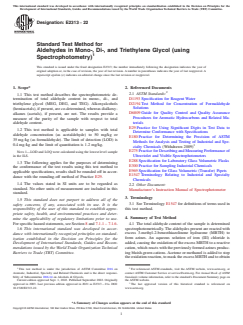
(Test Method)Standard Test Method for Aldehydes in Mono-, Di-, and Triethylene Glycol (using Spectrophotometry)
General Information
- Abstract
SIGNIFICANCE AND USE
5.1 Knowledge of the total aldehyde content of MEG is required to establish whether the product meets the requirements of its quality specifications.
SCOPE
1.1 This test method describes the spectrophotometric determination of total aldehyde content in mono-, di-, and triethylene glycol (MEG, DEG, and TEG). Alkoxyalcohols (hemiacetals), if present, are co-determined, whereas dialkoxyalkanes (acetals), if present, are not. The results provide a measure of the purity of the sample with respect to total aldehyde content.
1.2 This test method is applicable to samples with total aldehyde concentration (as acetaldehyde) to 50 mg/kg or 35 mg/kg (as formaldehyde). The limit of detection (LOD) is 0.4 mg/kg and the limit of quantitation is 1.2 mg/kg.
Note 1: LOD and LOQ were calculated using the lowest level sample in the ILS.
1.3 The following applies for the purposes of determining the conformance of the test results using this test method to applicable specifications, results shall be rounded off in accordance with the rounding-off method of Practice E29.
1.4 The values stated in SI units are to be regarded as standard. No other units of measurement are included in this standard.
1.5 This standard does not purport to address all of the safety concerns, if any, associated with its use. It is the responsibility of the user of this standard to establish appropriate safety, health, and environmental practices and determine the applicability of regulatory limitations prior to use. For specific hazard statements, see Section 8 and 7.1.1 – 7.1.6.
1.6 This international standard was developed in accordance with internationally recognized principles on standardization established in the Decision on Principles for the Development of International Standards, Guides and Recommendations issued by the World Trade Organization Technical Barriers to Trade (TBT) Committee.
- Status
- Published
- Publication Date
- 31-Aug-2022
- Technical Committee
- D16 - Aromatic, Industrial, Specialty and Related Chemicals
- Drafting Committee
- D16.14 - Alcohols & Glycols
Buy Documents
ASTM E2313-22 - Standard Test Method for Aldehydes in Mono-, Di-, and Triethylene Glycol (using Spectrophotometry)
REDLINE ASTM E2313-22 - Standard Test Method for Aldehydes in Mono-, Di-, and Triethylene Glycol (using Spectrophotometry)
Overview
ASTM E2313-22 is the international standard test method for determining total aldehyde content in mono-, di-, and triethylene glycol (MEG, DEG, and TEG) using spectrophotometry. Precise knowledge of aldehyde levels in glycols is essential for assessing product purity and compliance with commercial quality specifications. This standard is published by ASTM International and falls under the jurisdiction of the Committee D16 on Aromatic, Industrial, Specialty, and Related Chemicals.
The method utilizes a spectrophotometric approach to quantify aldehydes, offering reliable and widely accepted results for product quality control in industrial and laboratory environments.
Key Topics
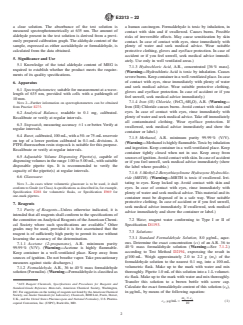
- Test Methodology: This standard specifies a spectrophotometric technique based on the reaction of aldehydes with 3-methyl-2-benzothiazolinone hydrazone (MBTH), leading to a colored product that can be measured at 635 nm.
- Scope and Applicability:
- Applicable to MEG, DEG, and TEG samples with aldehyde concentrations:
- Up to 50 mg/kg (as acetaldehyde)
- Up to 35 mg/kg (as formaldehyde)
- Limit of detection: 0.4 mg/kg; limit of quantitation: 1.2 mg/kg
- Applicable to MEG, DEG, and TEG samples with aldehyde concentrations:
- Co-Determination: Alkoxyalcohols (hemiacetals), if present, are measured alongside aldehydes, while dialkoxyalkanes (acetals) are not detected.
- Units and Reporting: All measurement results are reported in SI units and rounded in accordance with ASTM Practice E29.
- Safety Considerations: Users must adhere to appropriate safety, health, and environmental practices due to the potential hazards of chemicals involved, particularly formaldehyde and methanol.
Applications
ASTM E2313-22 is vital for industries that rely on high-purity glycols, including:
- Chemical Manufacturing: Ensures MEG, DEG, and TEG raw materials meet stringent purity standards before use in downstream processing or sale.
- Quality Control Laboratories: Provides a standardized method for routine batch analysis, batch release, and conformance to customer or regulatory requirements.
- Research and Development: Supports analytical verification during new product development or process optimization.
- Supplier and Customer Agreements: Facilitates mutual quality assurance between glycol manufacturers and buyers by standardizing aldehyde measurement and reporting, reducing disputes.
This method delivers reliable results suited for both in-house and third-party laboratories, supporting robust quality management systems.
Related Standards
ASTM E2313-22 references and aligns with several key ASTM standards to support accuracy, calibration, and quality:
- ASTM D1193: Specification for Reagent Water, ensuring purity of water used in testing.
- ASTM D2194: Test Method for Concentration of Formaldehyde Solutions, used for standard preparation.
- ASTM E29: Practice for Using Significant Digits in Test Data.
- ASTM E275: Practice for Measuring Performance of Ultraviolet and Visible Spectrophotometers.
- ASTM E288, E969: Specifications for laboratory volumetric glassware.
- ASTM E300: Practice for Sampling Industrial Chemicals.
- ASTM D6809: Guide for Quality Control and Quality Assurance Procedures for Aromatic Hydrocarbons and Related Materials.
Keywords: aldehydes in glycols, spectrophotometric determination, MEG, DEG, TEG, glycol purity, ASTM E2313, quality control, aldehyde analysis.
By adhering to ASTM E2313-22, laboratories and manufacturers can ensure reliable, reproducible, and industry-recognized assessment of aldehyde content in ethylene glycol products, enhancing overall product quality and regulatory compliance.
Relations
- Effective Date
- 01-Jul-2019
- Effective Date
- 01-Nov-2017
- Effective Date
- 01-Nov-2016
- Effective Date
- 01-Nov-2012
- Effective Date
- 01-Apr-2010
- Effective Date
- 01-Apr-2009
- Refers
ASTM E275-08 - Describing and Measuring Performance of Ultraviolet and Visible Spectrophotometers - Effective Date
- 15-Oct-2008
- Effective Date
- 01-Oct-2008
- Effective Date
- 01-Nov-2007
- Effective Date
- 01-Jun-2007
- Effective Date
- 01-Jun-2007
- Effective Date
- 15-Nov-2006
- Effective Date
- 15-Sep-2006
- Effective Date
- 01-May-2006
- Effective Date
- 01-Apr-2006
Buy Documents
ASTM E2313-22 - Standard Test Method for Aldehydes in Mono-, Di-, and Triethylene Glycol (using Spectrophotometry)
REDLINE ASTM E2313-22 - Standard Test Method for Aldehydes in Mono-, Di-, and Triethylene Glycol (using Spectrophotometry)
Get Certified
Connect with accredited certification bodies for this standard

ECOCERT
Organic and sustainability certification.

Eurofins Food Testing Global
Global leader in food, environment, and pharmaceutical product testing.

Intertek Bangladesh
Intertek certification and testing services in Bangladesh.
Sponsored listings
Frequently Asked Questions
ASTM E2313-22 is a standard published by ASTM International. Its full title is "Standard Test Method for Aldehydes in Mono-, Di-, and Triethylene Glycol (using Spectrophotometry)". This standard covers: SIGNIFICANCE AND USE 5.1 Knowledge of the total aldehyde content of MEG is required to establish whether the product meets the requirements of its quality specifications. SCOPE 1.1 This test method describes the spectrophotometric determination of total aldehyde content in mono-, di-, and triethylene glycol (MEG, DEG, and TEG). Alkoxyalcohols (hemiacetals), if present, are co-determined, whereas dialkoxyalkanes (acetals), if present, are not. The results provide a measure of the purity of the sample with respect to total aldehyde content. 1.2 This test method is applicable to samples with total aldehyde concentration (as acetaldehyde) to 50 mg/kg or 35 mg/kg (as formaldehyde). The limit of detection (LOD) is 0.4 mg/kg and the limit of quantitation is 1.2 mg/kg. Note 1: LOD and LOQ were calculated using the lowest level sample in the ILS. 1.3 The following applies for the purposes of determining the conformance of the test results using this test method to applicable specifications, results shall be rounded off in accordance with the rounding-off method of Practice E29. 1.4 The values stated in SI units are to be regarded as standard. No other units of measurement are included in this standard. 1.5 This standard does not purport to address all of the safety concerns, if any, associated with its use. It is the responsibility of the user of this standard to establish appropriate safety, health, and environmental practices and determine the applicability of regulatory limitations prior to use. For specific hazard statements, see Section 8 and 7.1.1 – 7.1.6. 1.6 This international standard was developed in accordance with internationally recognized principles on standardization established in the Decision on Principles for the Development of International Standards, Guides and Recommendations issued by the World Trade Organization Technical Barriers to Trade (TBT) Committee.
SIGNIFICANCE AND USE 5.1 Knowledge of the total aldehyde content of MEG is required to establish whether the product meets the requirements of its quality specifications. SCOPE 1.1 This test method describes the spectrophotometric determination of total aldehyde content in mono-, di-, and triethylene glycol (MEG, DEG, and TEG). Alkoxyalcohols (hemiacetals), if present, are co-determined, whereas dialkoxyalkanes (acetals), if present, are not. The results provide a measure of the purity of the sample with respect to total aldehyde content. 1.2 This test method is applicable to samples with total aldehyde concentration (as acetaldehyde) to 50 mg/kg or 35 mg/kg (as formaldehyde). The limit of detection (LOD) is 0.4 mg/kg and the limit of quantitation is 1.2 mg/kg. Note 1: LOD and LOQ were calculated using the lowest level sample in the ILS. 1.3 The following applies for the purposes of determining the conformance of the test results using this test method to applicable specifications, results shall be rounded off in accordance with the rounding-off method of Practice E29. 1.4 The values stated in SI units are to be regarded as standard. No other units of measurement are included in this standard. 1.5 This standard does not purport to address all of the safety concerns, if any, associated with its use. It is the responsibility of the user of this standard to establish appropriate safety, health, and environmental practices and determine the applicability of regulatory limitations prior to use. For specific hazard statements, see Section 8 and 7.1.1 – 7.1.6. 1.6 This international standard was developed in accordance with internationally recognized principles on standardization established in the Decision on Principles for the Development of International Standards, Guides and Recommendations issued by the World Trade Organization Technical Barriers to Trade (TBT) Committee.
ASTM E2313-22 is classified under the following ICS (International Classification for Standards) categories: 71.040.40 - Chemical analysis. The ICS classification helps identify the subject area and facilitates finding related standards.
ASTM E2313-22 has the following relationships with other standards: It is inter standard links to ASTM E969-02(2019), ASTM E288-10(2017), ASTM D6809-02(2016), ASTM E969-02(2012), ASTM E288-10, ASTM E1547-09, ASTM E275-08, ASTM E29-08, ASTM E969-02(2007), ASTM D6809-02(2007), ASTM D2194-02(2007), ASTM E29-06b, ASTM E29-06a, ASTM E29-06, ASTM E288-06. Understanding these relationships helps ensure you are using the most current and applicable version of the standard.
ASTM E2313-22 is available in PDF format for immediate download after purchase. The document can be added to your cart and obtained through the secure checkout process. Digital delivery ensures instant access to the complete standard document.
Standards Content (Sample)
This international standard was developed in accordance with internationally recognized principles on standardization established in the Decision on Principles for the
Development of International Standards, Guides and Recommendations issued by the World Trade Organization Technical Barriers to Trade (TBT) Committee.
Designation: E2313 − 22
Standard Test Method for
Aldehydes in Mono-, Di-, and Triethylene Glycol (using
Spectrophotometry)
This standard is issued under the fixed designation E2313; the number immediately following the designation indicates the year of
original adoption or, in the case of revision, the year of last revision. A number in parentheses indicates the year of last reapproval. A
superscript epsilon (´) indicates an editorial change since the last revision or reapproval.
1. Scope* 2. Referenced Documents
2.1 ASTM Standards:
1.1 This test method describes the spectrophotometric de-
D1193 Specification for Reagent Water
termination of total aldehyde content in mono-, di-, and
D2194 Test Method for Concentration of Formaldehyde
triethylene glycol (MEG, DEG, and TEG). Alkoxyalcohols
Solutions
(hemiacetals), if present, are co-determined, whereas dialkoxy-
D6809 Guide for Quality Control and Quality Assurance
alkanes (acetals), if present, are not. The results provide a
Procedures for Aromatic Hydrocarbons and Related Ma-
measure of the purity of the sample with respect to total
terials
aldehyde content.
E29 Practice for Using Significant Digits in Test Data to
1.2 This test method is applicable to samples with total
Determine Conformance with Specifications
aldehyde concentration (as acetaldehyde) to 50 mg/kg or
E180 Practice for Determining the Precision of ASTM
35 mg⁄kg (as formaldehyde). The limit of detection (LOD) is
Methods for Analysis and Testing of Industrial and Spe-
0.4 mg⁄kg and the limit of quantitation is 1.2 mg/kg. 3
cialty Chemicals (Withdrawn 2009)
E275 Practice for Describing and Measuring Performance of
NOTE 1—LOD and LOQ were calculated using the lowest level sample
in the ILS.
Ultraviolet and Visible Spectrophotometers
E288 Specification for Laboratory Glass Volumetric Flasks
1.3 The following applies for the purposes of determining
E300 Practice for Sampling Industrial Chemicals
the conformance of the test results using this test method to
E969 Specification for Glass Volumetric (Transfer) Pipets
applicable specifications, results shall be rounded off in accor-
E1547 Terminology Relating to Industrial and Specialty
dance with the rounding-off method of Practice E29.
Chemicals
1.4 The values stated in SI units are to be regarded as
2.2 Other Document:
standard. No other units of measurement are included in this
Manufacturer’s Instruction Manual of Spectrophotometer
standard.
3. Terminology
1.5 This standard does not purport to address all of the
safety concerns, if any, associated with its use. It is the 3.1 See Terminology E1547 for definitions of terms used in
this test method.
responsibility of the user of this standard to establish appro-
priate safety, health, and environmental practices and deter-
4. Summary of Test Method
mine the applicability of regulatory limitations prior to use.
For specific hazard statements, see Section 8 and 7.1.1 – 7.1.6. 4.1 The total aldehyde content of the sample is determined
spectrophotometrically.The aldehydes present are reacted with
1.6 This international standard was developed in accor-
excess 3-methyl-2-benzothiazolinone hydrazone (MBTH) to
dance with internationally recognized principles on standard-
form azines. An aqueous solution of iron (III) chloride is
ization established in the Decision on Principles for the
added, causing the oxidation of the excess MBTH to a reactive
Development of International Standards, Guides and Recom-
cation, which reacts with the previously formed azines produc-
mendations issued by the World Trade Organization Technical
ing bluish-green cations.Acetone or methanol is added to stop
Barriers to Trade (TBT) Committee.
the oxidation reaction, to mask the excess MBTH and to obtain
1 2
This test method is under the jurisdiction of ASTM Committee D16 on For referenced ASTM standards, visit the ASTM website, www.astm.org, or
Aromatic, Industrial, Specialty and Related Chemicals and is the direct responsi- contact ASTM Customer Service at service@astm.org. For Annual Book of ASTM
bility of Subcommittee D16.14 on Alcohols & Glycols. Standards volume information, refer to the standard’s Document Summary page on
Current edition approved Sept. 1, 2022. Published September 2022. Originally the ASTM website.
approved in 2003. Last previous edition approved in 2021 as E2313 – 21a. DOI: The last approved version of this historical standard is referenced on
10.1520/E2313-22. www.astm.org.
*A Summary of Changes section appears at the end of this standard
Copyright © ASTM International, 100 Barr Harbor Drive, PO Box C700, West Conshohocken, PA 19428-2959. United States
E2313 − 22
a clear solution. The absorbance of the test solution is a human carcinogen. Formaldehyde is toxic by inhalation, in
measured spectrophotometrically at 635 nm. The amount of contact with skin and if swallowed. Causes burns. Possible
aldehyde present in the test solution is derived from a previ-
risks of irreversible effects. May cause sensitization by skin
ously prepared calibration graph. The aldehyde content of the
contact. In case of contact with eyes, rinse immediately with
sample, expressed as either acetaldehyde or formaldehyde, is
plenty of water and seek medical advice. Wear suitable
calculated from the data obtained.
protective clothing, gloves and eye/face protection. In case of
accident or if you feel unwell, seek medical advice immedi-
5. Significance and Use
ately. Use only in well ventilated areas.)
5.1 Knowledge of the total aldehyde content of MEG is
7.1.3 Hydrochloric Acid, A.R., concentrated [36 % mass].
required to establish whether the product meets the require-
(Warning—Hydrochloric Acid is toxic by inhalation. Causes
ments of its quality specifications.
severe burns. Keep container in a well-ventilated place. In case
of contact with eyes, rinse immediately with plenty of water
6. Apparatus
and seek medical advice. Wear suitable protective clothing,
6.1 Spectrophotometer, suitable for measurement at a wave-
gloves and eye/face protection. In case of accident or if you
length of 635 nm, provided with cells with a pathlength of
feel unwell, seek medical advice immediately.)
10 mm.
7.1.4 Iron (lll) Chloride, (FeCl ·6H O), A.R. (Warning—
NOTE 2—Further information on spectrophotometers can be obtained 3 2
from Practice E275. Iron (III) Chloride causes burns. Avoid contact with skin and
eyes. In case of contact with eyes, rinse immediately with
6.2 Analytical Balance, readable to 0.1 mg, calibrated.
plenty of water and seek medical advice. Take off immediately
Recalibrate or verify at regular intervals.
all contaminated clothing. Wear eye/face protection. If
6.3 Stopwatch, measuring accuracy 61 s or better. Verify at
swallowed, seek medical advice immediately and show the
regular intervals.
container or label.)
6.4 Buret,calibrated,100mL,witha50-or75-mLreservoir
7.1.5 Methanol, A.R. minimum purity 99.99 % (V/V).
on top of a lower portion calibrated in 0.1-mL divisions. A
(Warning—Methanolishighlyflammable.Toxicbyinhalation
PTFE-fluorocarbon resin stopcock is suitable for this purpose.
and ingestion. Keep container in a well-ventilated place. Keep
Recalibrate or verify at regular intervals.
container tightly closed when not in use. Keep away from
6.5 Adjustable Volume Dispensing Pipette(s), capable of
sourcesofignition.Avoidcontactwithskin.Incaseofaccident
dispensing volumes in the range 1.00 to 5.00 mL, with suitable
or if you feel unwell, seek medical advice immediately (show
disposable pipette tips. It is recommended to verify the
the label where possible.)
capacity of the pipette(s) at regular intervals.
7.1.6 3-Methyl-2-Benzothiazolinone Hydrazone Hydrochlo-
6.6 Glassware:
ride (MBTH). (Warning—MBTH is toxic if swallowed. Irri-
tating to eyes. Keep locked up. Avoid contact with skin and
NOTE 3—In cases where volumetric glassware is to be used, it shall
conform to Grade (or Class)Aspecifications as described in, for example, eyes. In case of contact with eyes, rinse immediately with
Specification E288 for volumetric flasks, or Specification E969 for
plenty of water and seek medical advice. This material and its
one-mark pipettes.
container must be disposed of in a safe way. Wear suitable
protective clothing. In case of accident or if you feel unwell,
7. Reagents
seek medical advice immediately. If swallowed, seek medical
7.1 Purity of Reagents—Unless otherwise indicated, it is
advice immediately and show the container or label.)
intended that all reagents shall conform to the specifications of
7.2 Water, reagent water conforming to Type I or II of
the committee onAnalytical Reagents of theAmerican Chemi-
cal Society where such specifications are available. Other Specification D1193.
grades may be used, provided it is first ascertained that the
7.3 Solutions:
reagent is of sufficiently high purity to permit its use without
7.3.1 Standard Formaldehyde Solution, 8.0 µg/mL, aque-
lessening the accuracy of the determination.
ous. Determine the exact concentration (c ) of an A.R. 36 to
7.1.1 Acetone (2-propanone), A.R. minimum purity
40 % mass formaldehyde solution (Warning—See 7.1.2.)
99.99 % (V/V). (Warning—Acetone is highly flammable.
according to Test Method D2194, expressing the result in
Keep container in a well-ventilated place. Keep away from
g/100 mL. Weigh approximately 2.0 to 2.2 g (m)ofthe
sources of ignition. Do not breathe vapor. Take precautionary
formaldehyde solution to the nearest 0.1 mg, into a 100-mL
measures against static discharges.)
volumetric flask. Make up to the mark with water and mix
7.1.2 Formaldehyde, A.R., 36 to 40 % mass formaldehyde
thoroughly. Pipette 1.0 mLof this solution into a 1-Lvolumet-
solution (Formalin). (Warning—Formaldehyde is classified as
ric flask. Make up to the mark with water and mix thoroughly.
Transfer this solution to a brown bottle with screw cap.
ACS Reagent Chemicals, Specifications and Procedures for Reagents and
Calculate the exact formaldehyde content of this solution (c ),
Standard-Grade Reference Materials, American Chemical Society, Washington,
DC. For suggestions on the testing of reagents not listed by theAmerican Chemical in µg/mL, by means of the following equation:
Society, see Analar Standards for Laboratory Chemicals, BDH Ltd., Poole, Dorset,
m 3 c
U.K., and the United States Pharmacopeia and National Formulary, U.S. Pharma- 1 1
c , µg/mL 5 (1)
copeial Convention, Inc. (USPC), Rockville, MD. 10
E2313 − 22
where: and contact with skin and eyes. Wear suitable protective
clothingandgloves.Donotbreathegas,fumes,vapor,orspray.
c = concentration of concentrated formaldehyde solution
Use only in well ventilated areas. In case of contact with eyes
used, g/100 mL, and
rinse with plenty of water and seek medical advice.
m = mass of concentrated formaldehyde solution taken, g.
8.4 Formaldehyde is classified as a human carcinogen.
The concentrated and diluted formaldehyde solutions are
stable in excess of six months if stored at room temperature.
9. Sampling, Test Specimens, and Test Units
Do not store in a refrigerator. Prepare fresh solutions every six
months. 9.1 Followtherelevantinstructionsforsamplingasgivenin
Practice E300.
7.3.2 Hydrochloric Acid, 50 % (V/V). Dilute one volume of
A.R. concentrated hydrochloric acid (Warning—See 7.1.3.)
10. Preparation of Apparatus
with one volume of water.
10.1 Spectrophotometer—Check the performance of the
7.3.3 Iron (III) Chloride Solution, 0.3 % mass, aqueous.
spectrophotometer at regular intervals according to the guide-
Dissolve5gofA.R. iron (III) chloride. 6H O(Warning—See
lines given in Practice E275 and the manufacturer’s instruction
7.1.4.) in water, adding 1 or 2 drops of A.R. concentrated
manual.
hydrochloric acid to stabilize solution (Warning—See 7.1.3.)
and dilute to 1 L with water. Prepare a fresh solution daily.
10.2 Glassware—Thoroughly clean the cells and other
7.3.4 Methyl-2-benzothiazolone Hydrazone Solution
glassware using 50 % (V⁄V) hydrochloric acid (Warning—
(MBTH solution), 0.4 % mass, aqueous. Dissolve 400 61mg
See 7.1.3.) according to the guidelines in Practice E275.Ifthe
of MBTH hydrochloride (Warning—See 7.1.6.) in water in a
glasswareispersistentlystainedbyiron(III)chloride,cleanthe
100-mL volumetric flask. Make up to the mark and mix
affectedglasswareinaconcentratedhydrochloricacidbath.Do
thoroughly. Prepare a fresh solution daily.
not use acetone or methanol for cleaning, since this reacts with
MBTH.
7.4 Reagents, as described in Test Method D2194, for the
standardization of formaldehyde solution (see 7.3.1).
11. Calibration
7.4.1 Sodium Sulfite Solution, 12.5 % mass, aqueous. Dis-
11.1 Introduce the amounts of reagents as listed in Table 1
solve 125 g of anhydrous sodium sulfite (Na SO ) in water and
2 3
into separate 100-mL volumetric flasks in the following way:
dilute to 1 L.
First introduce the standard formaldehyde solution and water
NOTE 4—Sodium sulfite gradually oxidizes to sodium sulfate on
by means of a volumetric pipette, followed by MBTH solution.
exposure to air and therefore should be kept in a tightly closed container.
For best results freshly prepared reagent should be used.
11.2 Proceed as described in 12.5 through 12.7, measuring
the absorbances of the calibration solutions, including the
7.4.2 Sulfuric Acid, 0.5 mol/L (1.0 N). Prepare and stan-
blank solutions, against water at 635 nm in a 10-mm cell.
dardizesulfuricacid(H SO )against0.5mol/L(0.5N)sodium
2 4
hydroxide (NaOH) solution which has been standardized
11.3 If the mean blank absorbance exceeds its upper co
...
This document is not an ASTM standard and is intended only to provide the user of an ASTM standard an indication of what changes have been made to the previous version. Because
it may not be technically possible to adequately depict all changes accurately, ASTM recommends that users consult prior editions as appropriate. In all cases only the current version
of the standard as published by ASTM is to be considered the official document.
Designation: E2313 − 21a E2313 − 22
Standard Test Method for
Aldehydes in Mono-, Di-, and Triethylene Glycol (using
Spectrophotometry)
This standard is issued under the fixed designation E2313; the number immediately following the designation indicates the year of
original adoption or, in the case of revision, the year of last revision. A number in parentheses indicates the year of last reapproval. A
superscript epsilon (´) indicates an editorial change since the last revision or reapproval.
1. Scope*
1.1 This test method describes the spectrophotometric determination of total aldehyde content in mono-, di-, and triethylene glycol
(MEG, DEG, and TEG). Alkoxyalcohols (hemiacetals), if present, are co-determined, whereas dialkoxyalkanes (acetals), if
present, are not. The results provide a measure of the purity of the sample with respect to total aldehyde content.
1.2 This test method is applicable to samples with total aldehyde concentration (as acetaldehyde) to 50 mg/kg or 35 mg ⁄kg (as
formaldehyde). The limit of detection (LOD) is 0.4 mg ⁄kg and the limit of quantitation is 1.2 mg/kg.
NOTE 1—LOD and LOQ were calculated using the lowest level sample in the ILS.
1.3 The following applies for the purposes of determining the conformance of the test results using this test method to applicable
specifications, results shall be rounded off in accordance with the rounding-off method of Practice E29.
1.4 The values stated in SI units are to be regarded as standard. No other units of measurement are included in this standard.
1.5 This standard does not purport to address all of the safety concerns, if any, associated with its use. It is the responsibility
of the user of this standard to establish appropriate safety, health, and environmental practices and determine the applicability of
regulatory limitations prior to use. For specific hazard statements, see Section 8 and 7.1.1 – 7.1.6.
1.6 This international standard was developed in accordance with internationally recognized principles on standardization
established in the Decision on Principles for the Development of International Standards, Guides and Recommendations issued
by the World Trade Organization Technical Barriers to Trade (TBT) Committee.
2. Referenced Documents
2.1 ASTM Standards:
D1193 Specification for Reagent Water
D2194 Test Method for Concentration of Formaldehyde Solutions
D6809 Guide for Quality Control and Quality Assurance Procedures for Aromatic Hydrocarbons and Related Materials
E29 Practice for Using Significant Digits in Test Data to Determine Conformance with Specifications
This test method is under the jurisdiction of ASTM Committee D16 on Aromatic, Industrial, Specialty and Related Chemicals and is the direct responsibility of
Subcommittee D16.14 on Alcohols & Glycols.
Current edition approved Nov. 1, 2021Sept. 1, 2022. Published December 2021September 2022. Originally approved in 2003. Last previous edition approved in 2021 as
E2313 – 21.E2313 – 21a. DOI: 10.1520/E2313-21A.10.1520/E2313-22.
For referenced ASTM standards, visit the ASTM website, www.astm.org, or contact ASTM Customer Service at service@astm.org. For Annual Book of ASTM Standards
volume information, refer to the standard’s Document Summary page on the ASTM website.
*A Summary of Changes section appears at the end of this standard
Copyright © ASTM International, 100 Barr Harbor Drive, PO Box C700, West Conshohocken, PA 19428-2959. United States
E2313 − 22
E180 Practice for Determining the Precision of ASTM Methods for Analysis and Testing of Industrial and Specialty Chemicals
(Withdrawn 2009)
E275 Practice for Describing and Measuring Performance of Ultraviolet and Visible Spectrophotometers
E288 Specification for Laboratory Glass Volumetric Flasks
E300 Practice for Sampling Industrial Chemicals
E969 Specification for Glass Volumetric (Transfer) Pipets
E1547 Terminology Relating to Industrial and Specialty Chemicals
2.2 Other Document:
Manufacturer’s Instruction Manual of Spectrophotometer
3. Terminology
3.1 See Terminology E1547 for definitions of terms used in this test method.
4. Summary of Test Method
4.1 The total aldehyde content of the sample is determined spectrophotometrically. The aldehydes present are reacted with excess
3-methyl-2-benzothiazolinone hydrazone (MBTH) to form azines. An aqueous solution of iron (III) chloride is added, causing the
oxidation of the excess MBTH to a reactive cation, which reacts with the previously formed azines producing bluish-green cations.
Acetone or methanol is added to stop the oxidation reaction, to mask the excess MBTH and to obtain a clear solution. The
absorbance of the test solution is measured spectrophotometrically at 635 nm. The amount of aldehyde present in the test solution
is derived from a previously prepared calibration graph. The aldehyde content of the sample, expressed as either acetaldehyde or
formaldehyde, is calculated from the data obtained.
5. Significance and Use
5.1 Knowledge of the total aldehyde content of MEG is required to establish whether the product meets the requirements of its
quality specifications.
6. Apparatus
6.1 Spectrophotometer, suitable for measurement at a wavelength of 635 nm, provided with cells with a pathlength of 10 mm.
NOTE 2—Further information on spectrophotometers can be obtained from Practice E275.
6.2 Analytical Balance, readable to 0.1 mg, calibrated. Recalibrate or verify at regular intervals.
6.3 Stopwatch, measuring accuracy 61 s or better. Verify at regular intervals.
6.4 Buret, calibrated, 100 mL, with a 50- or 75-mL reservoir on top of a lower portion calibrated in 0.1-mL divisions. A
PTFE-fluorocarbon resin stopcock is suitable for this purpose. Recalibrate or verify at regular intervals.
6.5 Adjustable Volume Dispensing Pipette(s), capable of dispensing volumes in the range 1.00 to 5.00 mL, with suitable disposable
pipette tips. It is recommended to verify the capacity of the pipette(s) at regular intervals.
6.6 Glassware:
NOTE 3—In cases where volumetric glassware is to be used, it shall conform to Grade (or Class) A specifications as described in, for example,
Specification E288 for volumetric flasks, or Specification E969 for one-mark pipettes.
7. Reagents
7.1 Purity of Reagents—Unless otherwise indicated, it is intended that all reagents shall conform to the specifications of the
The last approved version of this historical standard is referenced on www.astm.org.
E2313 − 22
committee on Analytical Reagents of the American Chemical Society where such specifications are available. Other grades may
be used, provided it is first ascertained that the reagent is of sufficiently high purity to permit its use without lessening the accuracy
of the determination.
7.1.1 Acetone (2-propanone), A.R. minimum purity 99.99 % (V/V). (Warning—Acetone is highly flammable. Keep container in
a well-ventilated place. Keep away from sources of ignition. Do not breathe vapor. Take precautionary measures against static
discharges.)
7.1.2 Formaldehyde, A.R., 36 to 40 % mass formaldehyde solution (Formalin). (Warning—Formaldehyde is classified as a
human carcinogen. Formaldehyde is toxic by inhalation, in contact with skin and if swallowed. Causes burns. Possible risks of
irreversible effects. May cause sensitization by skin contact. In case of contact with eyes, rinse immediately with plenty of water
and seek medical advice. Wear suitable protective clothing, gloves and eye/face protection. In case of accident or if you feel unwell,
seek medical advice immediately. Use only in well ventilated areas.)
7.1.3 Hydrochloric Acid, A.R., concentrated [36 % mass]. (Warning—Hydrochloric Acid is toxic by inhalation. Causes severe
burns. Keep container in a well-ventilated place. In case of contact with eyes, rinse immediately with plenty of water and seek
medical advice. Wear suitable protective clothing, gloves and eye/face protection. In case of accident or if you feel unwell, seek
medical advice immediately.)
7.1.4 Iron (lll) Chloride, (FeCl ·6H O), A.R. (Warning—Iron (III) Chloride causes burns. Avoid contact with skin and eyes. In
3 2
case of contact with eyes, rinse immediately with plenty of water and seek medical advice. Take off immediately all contaminated
clothing. Wear eye/face protection. If swallowed, seek medical advice immediately and show the container or label.)
7.1.5 Methanol, A.R. minimum purity 99.99 % (V/V). (Warning—Methanol is highly flammable. Toxic by inhalation and
ingestion. Keep container in a well-ventilated place. Keep container tightly closed when not in use. Keep away from sources of
ignition. Avoid contact with skin. In case of accident or if you feel unwell, seek medical advice immediately (show the label where
possible.)
7.1.6 3-Methyl-2-Benzothiazolinone Hydrazone Hydrochloride (MBTH). (Warning—MBTH is toxic if swallowed. Irritating to
eyes. Keep locked up. Avoid contact with skin and eyes. In case of contact with eyes, rinse immediately with plenty of water and
seek medical advice. This material and its container must be disposed of in a safe way. Wear suitable protective clothing. In case
of accident or if you feel unwell, seek medical advice immediately. If swallowed, seek medical advice immediately and show the
container or label.)
7.2 Water, reagent water conforming to Type I or II of Specification D1193.
7.3 Solutions:
7.3.1 Standard Formaldehyde Solution, 8.0 μg/mL, aqueous. Determine the exact concentration (c ) of an A.R. 36 to 40 % mass
formaldehyde solution (Warning—See 7.1.2.) according to Test Method D2194, expressing the result in g/100 mL. Weigh
approximately 2.0 to 2.2 g (m ) of the formaldehyde solution to the nearest 0.1 mg, into a 100-mL volumetric flask. Make up to
the mark with water and mix thoroughly. Pipette 1.0 mL of this solution into a 1-L volumetric flask. Make up to the mark with
water and mix thoroughly. Transfer this solution to a brown bottle with screw cap. Calculate the exact formaldehyde content of
this solution (c ), in μg/mL, by means of the following equation:
m 3c
1 1
c , µg/mL 5 (1)
where:
c = concentration of concentrated formaldehyde solution used, g/100 mL, and
m = mass of concentrated formaldehyde solution taken, g.
The concentrated and diluted formaldehyde solutions are stable in excess of six months if stored at room temperature. Do not
store in a refrigerator. Prepare fresh solutions every six months.
ACS Reagent Chemicals, Specifications and Procedures for Reagents and Standard-Grade Reference Materials, American Chemical Society, Washington, DC. For
suggestions on the testing of reagents not listed by the American Chemical Society, see Analar Standards for Laboratory Chemicals, BDH Ltd., Poole, Dorset, U.K., and
the United States Pharmacopeia and National Formulary, U.S. Pharmacopeial Convention, Inc. (USPC), Rockville, MD.
E2313 − 22
7.3.2 Hydrochloric Acid, 50 % (V/V). Dilute one volume of A.R. concentrated hydrochloric acid (Warning—See 7.1.3.) with one
volume of water.
7.3.3 Iron (III) Chloride Solution, 0.3 % mass, aqueous. Dissolve 5 g of A.R. iron (III) chloride. 6H O (Warning—See 7.1.4.) in
water, adding 1 or 2 drops of A.R. concentrated hydrochloric acid to stabilize solution (Warning—See 7.1.3.) and dilute to 1 L
with water. Prepare a fresh solution daily.
7.3.4 Methyl-2-benzothiazolone Hydrazone Solution (MBTH solution),0.4 % mass, aqueous. Dissolve 400 6 1 mg of MBTH
hydrochloride (Warning—See 7.1.6.) in water in a 100-mL volumetric flask. Make up to the mark and mix thoroughly. Prepare
a fresh solution daily.
7.4 Reagents, as described in Test Method D2194, for the standardization of formaldehyde solution (see 7.3.1).
7.4.1 Sodium Sulfite Solution, 12.5 % mass, aqueous. Dissolve 125 g of anhydrous sodium sulfite (Na SO ) in water and dilute
2 3
to 1 L.
NOTE 4—Sodium sulfite gradually oxidizes to sodium sulfate on exposure to air and therefore should be kept in a tightly closed container. For best results
freshly prepared reagent should be used.
7.4.2 Sulfuric Acid, 0.5 mol/L (1.0 N). Prepare and standardize sulfuric acid (H SO ) against 0.5 mol/L (0.5 N) sodium hydroxide
2 4
(NaOH) solution which has been standardized against potassium acid phthalate to a thymolphthalein end point.
7.4.3 Thymolphthalein Indicator, 0.1 % mass, alcohol solution. Dissolve 1.0 g of thymolphthalein in 100 mL of methanol, ethanol,
or isopropanol and dilute to 1 L with additional alcohol.
7.5 Ethylene Glycol Quality Control Sample—It is recommended to select an Ethylene Glycol sample (fiber grade MEG, DEG or
TEG), similar to the product being analyzed and to use it as a quality control sample (Warning—See 8.28.3.). To this end, ensure
to obtain a sufficient amount and store it in such a way that it is stable for a known period of time and use it as such during this
period of time only. For more details, see 16.1.2.
8. Hazards
8.1 Consult current OSHA regulations and supplier’s Safety Data Sheets and local regulations for all materials used in this test
method.
8.2 Note health and safety warnings in Section 7.
8.3 Ethylene Glycol—Although (mono-, di-, and tri-) ethylene glycol in general is not classified as dangerous or flammable and
is not expected to impose a health hazard when used under normal conditions, it is recommended to avoid inhalation and contact
with skin and eyes. Wear suitable protective clothing and gloves. Do not breathe gas, fumes, vapor, or spray. Use only in well
ventilated areas. In case of contact with eyes rinse with plenty of water and seek medical advice.
8.4 Formaldehyde is classified as a human carcinogen.
9. Sampling, Test Specimens, and Test Units
9.1 Follow the relevant instructions for sampling as given in Practice E300.
10. Preparation of Apparatus
10.1 Spectrophotometer—Check the performance of the spectrophotometer at regular intervals according to
...