

ASTM E1899-23
(Test Method)Standard Test Method for Hydroxyl Groups Using Reaction with p-Toluenesulfonyl Isocyanate (TSI) and Potentiometric Titration with Tetrabutylammonium Hydroxide
General Information
- Abstract
SIGNIFICANCE AND USE
5.1 Hydroxyl is an important functional group and knowledge of its content is required in many intermediate and end use applications. This test method is for the determination of primary and secondary hydroxyl groups and can be used for the assay of compounds containing them.
5.2 This test method has the following advantages over other hydroxyl number methods: It is rapid (10 min), pyridine-free, ambient temperature, small sample size, applicable to extremely low hydroxyl numbers (
SCOPE
1.1 This test method covers the determination of hydroxyl groups attached to primary and secondary carbon atoms in aliphatic and cyclic compounds and phenols from 0.5 to 367 hydroxyl number. It is not suitable for determination of hydroxyl groups attached to tertiary carbon atoms. This test method is applicable to polyacetals, temperature sensitive materials, high solids polymer polyols, and rigid polyols. Other available test methods listed in Note 1 are not suitable for many of the sample types listed above.
1.1.1 This test method is currently recommended for neutral refined products. Successful application has been made, however, to some in-process samples that contain an excess of acidic species. Proper validation must be performed, of course, to show that the acidic species either does not interfere, or that the acidic species interference has been obviated.
Note 1: Other methods for determination of hydroxyl groups are given in Test Methods D817, D871, D4252, D4273, D4274, E222, E326, and E335.
1.2 The Limit of Detection (LOD) is 0.18 units and the Limit of Quantitation (LOQ) is 0.59 units. Unit = hydroxyl number (OH#).
Note 2: LOD and LOQ were calculated using Standard deviations from 14.1.2.1.
1.3 Review the current appropriate Safety Data Sheets (SDS) for detailed information concerning toxicity, first aid procedures, and safety precautions.
1.4 The values stated in SI units are to be regarded as standard. No other units of measurement are included in this standard.
1.5 The following applies for the purposes of determining the conformance of the test results using this test method to applicable specifications. Results shall be rounded off in accordance with the rounding-off method of Practice E29.
1.6 This standard does not purport to address all of the safety concerns, if any, associated, with its use. It is the responsibility of the user of this standard to establish appropriate safety, health, and environmental practices and determine the applicability of regulatory limitations prior to use. For specific hazards see Section 9.
1.7 This international standard was developed in accordance with internationally recognized principles on standardization established in the Decision on Principles for the Development of International Standards, Guides and Recommendations issued by the World Trade Organization Technical Barriers to Trade (TBT) Committee.
- Status
- Published
- Publication Date
- 31-Mar-2023
- Technical Committee
- D16 - Aromatic, Industrial, Specialty and Related Chemicals
- Drafting Committee
- D16.12 - Caustics and Peroxides
Buy Documents
ASTM E1899-23 - Standard Test Method for Hydroxyl Groups Using Reaction with <emph type="ital">p</emph >-Toluenesulfonyl Isocyanate (TSI) and Potentiometric Titration with Tetrabutylammonium Hydroxide
REDLINE ASTM E1899-23 - Standard Test Method for Hydroxyl Groups Using Reaction with <emph type="ital">p</emph >-Toluenesulfonyl Isocyanate (TSI) and Potentiometric Titration with Tetrabutylammonium Hydroxide
Overview
ASTM E1899-23: Standard Test Method for Hydroxyl Groups Using Reaction with p-Toluenesulfonyl Isocyanate (TSI) and Potentiometric Titration with Tetrabutylammonium Hydroxide provides a reliable, rapid approach for determining primary and secondary hydroxyl content in aliphatic and cyclic compounds, including phenols. This test method is particularly valuable for quality control and product characterization in the production of polymers such as polyacetals and polyols. It is suitable for samples with hydroxyl numbers between 0.5 and 367, making it effective even for low-hydroxyl-number materials and for high solids and temperature-sensitive compounds.
Adhering to widely recognized principles for international standards, ASTM E1899-23 streamlines testing by eliminating the need for pyridine, allowing ambient temperature operation, and requiring only a small sample size.
Key Topics
Scope of Measurement:
- Determines hydroxyl groups attached to primary and secondary carbons in a wide range of compounds.
- Not suitable for hydroxyl groups attached to tertiary carbon atoms.
- Applicable range: 0.5 to 367 hydroxyl number (OH#).
- Recommended for neutral, refined products, but may be validated for some in-process samples.
Analytical Method:
- Hydroxyl groups are reacted with p-toluenesulfonyl isocyanate (TSI) to form an acidic carbamate.
- Remaining TSI is neutralized with water.
- The sample then undergoes potentiometric titration with tetrabutylammonium hydroxide in a nonaqueous medium.
Advantages:
- Fast procedure (approximately 10 minutes).
- Ambient temperature operation.
- Pyridine-free, safer testing environment.
- Effective for low hydroxyl numbers (<1 OH#).
- Amenable to automation.
Precision and Detection:
- Limit of Detection (LOD): 0.18 OH#
- Limit of Quantitation (LOQ): 0.59 OH#
Safety Considerations:
- Safe handling of reagents is required, especially with TSI.
- Follow proper laboratory safety, health, and environmental practices.
Applications
Polymer and Polyol Manufacturing:
- Enables accurate determination of hydroxyl content in polyacetals, high solids polyols, rigid polyols, and temperature-sensitive materials.
- Ideal for quality control of polyol intermediates and finished products in polyurethane production.
Research and Development:
- Useful for assay development and characterization of new synthetic compounds containing primary or secondary hydroxyl groups.
- Supports innovation in specialty chemicals and advanced materials.
Process Monitoring:
- Suitable for neutral refined products and some in-process samples, provided acidic species are assessed for interference.
- Ensures product specification compliance and batch-to-batch consistency.
Quality Assurance:
- Facilitates robust data reporting and proficiency testing across laboratories.
- Supports compliance with international trade and customer requirements.
Related Standards
For specific sample types and alternative hydroxyl group determination methods, the following ASTM standards may be relevant:
- D817, D871: Testing cellulose acetate derivatives
- D1193: Reagent water specifications
- D4252, D4273, D4274: Polyol and polyurethane raw material testing
- E222: Hydroxyl groups via acetic anhydride acetylation
- E29: Use of significant digits in conformance testing
- E326, E335: Alternative esterification-based hydroxyl determinations
Keywords: hydroxyl number, potentiometric titration, p-toluenesulfonyl isocyanate, tetrabutylammonium hydroxide, polyacetals, polyols, ASTM E1899, functional group analysis, polymer quality control
By adopting ASTM E1899-23, laboratories and manufacturers ensure consistent, accurate hydroxyl group quantification critical to product performance and compliance in the chemical and polymer industries.
Relations
- Effective Date
- 01-Dec-2019
- Effective Date
- 01-Jan-2019
- Effective Date
- 01-Nov-2016
- Effective Date
- 01-Nov-2012
- Effective Date
- 01-Apr-2011
- Effective Date
- 01-Feb-2011
- Effective Date
- 01-Jun-2010
- Effective Date
- 01-Jun-2010
- Effective Date
- 01-Mar-2010
- Effective Date
- 01-Oct-2009
- Effective Date
- 01-Oct-2008
- Effective Date
- 01-Jun-2007
- Effective Date
- 15-Nov-2006
- Effective Date
- 15-Sep-2006
- Effective Date
- 01-May-2006
Buy Documents
ASTM E1899-23 - Standard Test Method for Hydroxyl Groups Using Reaction with <emph type="ital">p</emph >-Toluenesulfonyl Isocyanate (TSI) and Potentiometric Titration with Tetrabutylammonium Hydroxide
REDLINE ASTM E1899-23 - Standard Test Method for Hydroxyl Groups Using Reaction with <emph type="ital">p</emph >-Toluenesulfonyl Isocyanate (TSI) and Potentiometric Titration with Tetrabutylammonium Hydroxide
Get Certified
Connect with accredited certification bodies for this standard

ECOCERT
Organic and sustainability certification.

Eurofins Food Testing Global
Global leader in food, environment, and pharmaceutical product testing.

Intertek Bangladesh
Intertek certification and testing services in Bangladesh.
Sponsored listings
Frequently Asked Questions
ASTM E1899-23 is a standard published by ASTM International. Its full title is "Standard Test Method for Hydroxyl Groups Using Reaction with <emph type="ital">p</emph >-Toluenesulfonyl Isocyanate (TSI) and Potentiometric Titration with Tetrabutylammonium Hydroxide". This standard covers: SIGNIFICANCE AND USE 5.1 Hydroxyl is an important functional group and knowledge of its content is required in many intermediate and end use applications. This test method is for the determination of primary and secondary hydroxyl groups and can be used for the assay of compounds containing them. 5.2 This test method has the following advantages over other hydroxyl number methods: It is rapid (10 min), pyridine-free, ambient temperature, small sample size, applicable to extremely low hydroxyl numbers ( SCOPE 1.1 This test method covers the determination of hydroxyl groups attached to primary and secondary carbon atoms in aliphatic and cyclic compounds and phenols from 0.5 to 367 hydroxyl number. It is not suitable for determination of hydroxyl groups attached to tertiary carbon atoms. This test method is applicable to polyacetals, temperature sensitive materials, high solids polymer polyols, and rigid polyols. Other available test methods listed in Note 1 are not suitable for many of the sample types listed above. 1.1.1 This test method is currently recommended for neutral refined products. Successful application has been made, however, to some in-process samples that contain an excess of acidic species. Proper validation must be performed, of course, to show that the acidic species either does not interfere, or that the acidic species interference has been obviated. Note 1: Other methods for determination of hydroxyl groups are given in Test Methods D817, D871, D4252, D4273, D4274, E222, E326, and E335. 1.2 The Limit of Detection (LOD) is 0.18 units and the Limit of Quantitation (LOQ) is 0.59 units. Unit = hydroxyl number (OH#). Note 2: LOD and LOQ were calculated using Standard deviations from 14.1.2.1. 1.3 Review the current appropriate Safety Data Sheets (SDS) for detailed information concerning toxicity, first aid procedures, and safety precautions. 1.4 The values stated in SI units are to be regarded as standard. No other units of measurement are included in this standard. 1.5 The following applies for the purposes of determining the conformance of the test results using this test method to applicable specifications. Results shall be rounded off in accordance with the rounding-off method of Practice E29. 1.6 This standard does not purport to address all of the safety concerns, if any, associated, with its use. It is the responsibility of the user of this standard to establish appropriate safety, health, and environmental practices and determine the applicability of regulatory limitations prior to use. For specific hazards see Section 9. 1.7 This international standard was developed in accordance with internationally recognized principles on standardization established in the Decision on Principles for the Development of International Standards, Guides and Recommendations issued by the World Trade Organization Technical Barriers to Trade (TBT) Committee.
SIGNIFICANCE AND USE 5.1 Hydroxyl is an important functional group and knowledge of its content is required in many intermediate and end use applications. This test method is for the determination of primary and secondary hydroxyl groups and can be used for the assay of compounds containing them. 5.2 This test method has the following advantages over other hydroxyl number methods: It is rapid (10 min), pyridine-free, ambient temperature, small sample size, applicable to extremely low hydroxyl numbers ( SCOPE 1.1 This test method covers the determination of hydroxyl groups attached to primary and secondary carbon atoms in aliphatic and cyclic compounds and phenols from 0.5 to 367 hydroxyl number. It is not suitable for determination of hydroxyl groups attached to tertiary carbon atoms. This test method is applicable to polyacetals, temperature sensitive materials, high solids polymer polyols, and rigid polyols. Other available test methods listed in Note 1 are not suitable for many of the sample types listed above. 1.1.1 This test method is currently recommended for neutral refined products. Successful application has been made, however, to some in-process samples that contain an excess of acidic species. Proper validation must be performed, of course, to show that the acidic species either does not interfere, or that the acidic species interference has been obviated. Note 1: Other methods for determination of hydroxyl groups are given in Test Methods D817, D871, D4252, D4273, D4274, E222, E326, and E335. 1.2 The Limit of Detection (LOD) is 0.18 units and the Limit of Quantitation (LOQ) is 0.59 units. Unit = hydroxyl number (OH#). Note 2: LOD and LOQ were calculated using Standard deviations from 14.1.2.1. 1.3 Review the current appropriate Safety Data Sheets (SDS) for detailed information concerning toxicity, first aid procedures, and safety precautions. 1.4 The values stated in SI units are to be regarded as standard. No other units of measurement are included in this standard. 1.5 The following applies for the purposes of determining the conformance of the test results using this test method to applicable specifications. Results shall be rounded off in accordance with the rounding-off method of Practice E29. 1.6 This standard does not purport to address all of the safety concerns, if any, associated, with its use. It is the responsibility of the user of this standard to establish appropriate safety, health, and environmental practices and determine the applicability of regulatory limitations prior to use. For specific hazards see Section 9. 1.7 This international standard was developed in accordance with internationally recognized principles on standardization established in the Decision on Principles for the Development of International Standards, Guides and Recommendations issued by the World Trade Organization Technical Barriers to Trade (TBT) Committee.
ASTM E1899-23 is classified under the following ICS (International Classification for Standards) categories: 71.040.40 - Chemical analysis. The ICS classification helps identify the subject area and facilitates finding related standards.
ASTM E1899-23 has the following relationships with other standards: It is inter standard links to ASTM D817-12(2019), ASTM D871-96(2019), ASTM D6809-02(2016), ASTM D817-12, ASTM D4273-11, ASTM D4274-11, ASTM D871-96(2010), ASTM D817-96(2010), ASTM E222-10, ASTM D4252-89(2009), ASTM E29-08, ASTM D6809-02(2007), ASTM E29-06b, ASTM E29-06a, ASTM E29-06. Understanding these relationships helps ensure you are using the most current and applicable version of the standard.
ASTM E1899-23 is available in PDF format for immediate download after purchase. The document can be added to your cart and obtained through the secure checkout process. Digital delivery ensures instant access to the complete standard document.
Standards Content (Sample)
This international standard was developed in accordance with internationally recognized principles on standardization established in the Decision on Principles for the
Development of International Standards, Guides and Recommendations issued by the World Trade Organization Technical Barriers to Trade (TBT) Committee.
Designation: E1899 − 23
Standard Test Method for
Hydroxyl Groups Using Reaction with p-Toluenesulfonyl
Isocyanate (TSI) and Potentiometric Titration with
Tetrabutylammonium Hydroxide
This standard is issued under the fixed designation E1899; the number immediately following the designation indicates the year of
original adoption or, in the case of revision, the year of last revision. A number in parentheses indicates the year of last reapproval. A
superscript epsilon (´) indicates an editorial change since the last revision or reapproval.
1. Scope* 1.5 The following applies for the purposes of determining
the conformance of the test results using this test method to
1.1 This test method covers the determination of hydroxyl
applicable specifications. Results shall be rounded off in
groups attached to primary and secondary carbon atoms in
accordance with the rounding-off method of Practice E29.
aliphatic and cyclic compounds and phenols from 0.5 to 367
1.6 This standard does not purport to address all of the
hydroxyl number. It is not suitable for determination of
safety concerns, if any, associated, with its use. It is the
hydroxyl groups attached to tertiary carbon atoms. This test
responsibility of the user of this standard to establish appro-
method is applicable to polyacetals, temperature sensitive
priate safety, health, and environmental practices and deter-
materials, high solids polymer polyols, and rigid polyols. Other
mine the applicability of regulatory limitations prior to use.
available test methods listed in Note 1 are not suitable for many
For specific hazards see Section 9.
of the sample types listed above.
1.7 This international standard was developed in accor-
1.1.1 This test method is currently recommended for neutral
dance with internationally recognized principles on standard-
refined products. Successful application has been made,
ization established in the Decision on Principles for the
however, to some in-process samples that contain an excess of
Development of International Standards, Guides and Recom-
acidic species. Proper validation must be performed, of course,
mendations issued by the World Trade Organization Technical
to show that the acidic species either does not interfere, or that
Barriers to Trade (TBT) Committee.
the acidic species interference has been obviated.
NOTE 1—Other methods for determination of hydroxyl groups are given
2. Referenced Documents
in Test Methods D817, D871, D4252, D4273, D4274, E222, E326, and
E335. 2.1 ASTM Standards:
D817 Test Methods of Testing Cellulose Acetate Propionate
1.2 The Limit of Detection (LOD) is 0.18 units and the
and Cellulose Acetate Butyrate
Limit of Quantitation (LOQ) is 0.59 units. Unit = hydroxyl
D871 Test Methods of Testing Cellulose Acetate
number (OH#).
D1193 Specification for Reagent Water
NOTE 2—LOD and LOQ were calculated using Standard deviations
D4252 Test Methods for Chemical Analysis of Alcohol
from 14.1.2.1.
Ethoxylates and Alkylphenol Ethoxylates
1.3 Review the current appropriate Safety Data Sheets
D4273 Test Method for Polyurethane Raw Materials: Deter-
(SDS) for detailed information concerning toxicity, first aid
mination of Primary Hydroxyl Content of Polyether Poly-
procedures, and safety precautions.
ols
D4274 Test Methods for Testing Polyurethane Raw Materi-
1.4 The values stated in SI units are to be regarded as
als: Determination of Hydroxyl Numbers of Polyols
standard. No other units of measurement are included in this
D6809 Guide for Quality Control and Quality Assurance
standard.
Procedures for Aromatic Hydrocarbons and Related Ma-
terials
This test method is under the jurisdiction of ASTM Committee D16 on
Aromatic, Industrial, Specialty and Related Chemicals and is the direct responsi-
bility of Subcommittee D16.12 on Caustics and Peroxides. For referenced ASTM standards, visit the ASTM website, www.astm.org, or
Current edition approved April 1, 2023. Published June 2023. Originally contact ASTM Customer Service at service@astm.org. For Annual Book of ASTM
approved in 1997. Last previous edition approved in 2016 as E1899 – 16. DOI: Standards volume information, refer to the standard’s Document Summary page on
10.1520/E1899-23. the ASTM website.
*A Summary of Changes section appears at the end of this standard
Copyright © ASTM International, 100 Barr Harbor Drive, PO Box C700, West Conshohocken, PA 19428-2959. United States
E1899 − 23
E29 Practice for Using Significant Digits in Test Data to 5.2 This test method has the following advantages over
Determine Conformance with Specifications other hydroxyl number methods: It is rapid (10 min), pyridine-
E180 Practice for Determining the Precision of ASTM free, ambient temperature, small sample size, applicable to
Methods for Analysis and Testing of Industrial and Spe- extremely low hydroxyl numbers (<1), and is amenable to
cialty Chemicals (Withdrawn 2009) automation.
E222 Test Methods for Hydroxyl Groups Using Acetic
6. Interferences
Anhydride Acetylation
E300 Practice for Sampling Industrial Chemicals
6.1 Primary and secondary amines derivatize quantitatively
E326 Test Method for Hydroxyl Groups by Phthalic Anhy-
with the TSI reagent and contribute to the hydroxyl value.
dride Esterification (Withdrawn 2001)
6.2 High levels of water in the sample can interfere by
E335 Test Method for Hydroxyl Groups by Pyromellitic
consuming reagent. The amount of excess TSI reagent pre-
Dianhydride Esterification (Withdrawn 2002)
scribed by this test method is quite large, however, so that
rather high water levels can be accommodated. Optimum
3. Terminology
titration curves are obtained, however, when the water is <1 %.
3.1 Definitions:
6.3 Any acidic species with a pKa value close to that of the
3.1.1 hydroxyl number (OH#)—the milligrams of potassium
acidic carbamate (formed between TSI and the hydroxyl
hydroxide equivalent to the hydroxyl content of 1 g of sample.
compound), will contribute to the hydroxyl number and cause
3.1.1.1 Discussion—In the case of a pure compound, the
high values. Excess base in a sample may potentially react with
hydroxyl number is inversely proportional to the hydroxyl
the acidic carbamate to cause low hydroxyl number values. If
equivalent weight and the molecular weight:
this test method is to be used for samples other than neutral
refined products, the analyst must first validate this test method
equivalent weight g/equivalent 5 (1)
~ !
OH#
on a case-by-case basis. For example, an in-process sample
containing excess acid or base may be analyzed using Test
and:
Method B of Test Methods E222, to establish concordance of
results with the current TSI test method for that particular
56100 × number of OH groups per molecule
molecular weight g/mol 5
~ !
matrix. The identities of acidic or basic species contained in
OH#
in-process samples are frequently known, so that known
addition of these moieties to the sample can establish whether
4. Summary of Test Method
or not there is interference exhibited. For example, methane
4.1 According to a reaction given in Manser et al. (see Fig.
sulfonic acid titrates sufficiently before the acidic carbamate
1) the hydroxyl group is reacted with excess p-toluenesulfonyl
formed between TSI and ROH, and therefore does not inter-
isocyanate (TSI), to form an acidic carbamate. Water is added
fere. At the other extreme, methacrylic acid titrates well after
to convert unreacted isocyanate to sulfonamide, followed by
the acidic carbamate of interest and thus causes no interfer-
direct potentiometric titration of the acidic carbamate with
ence.
tetrabutylammonium hydroxide (Bu NOH) in nonaqueous me-
dium.
7. Apparatus
7.1 Potentiometric Autotitrator, equipped with a 10 mL or
5. Significance and Use
20 mL delivery buret. Ideally, the autotitrator should be ca-
5.1 Hydroxyl is an important functional group and knowl-
pable of generating the potentiometric titration curve in the
edge of its content is required in many intermediate and end
normal and derivative modes with automatic marking of end
use applications. This test method is for the determination of
points. However, an older model titrator without automatic
primary and secondary hydroxyl groups and can be used for the
marking of end points was shown to give excellent hydroxyl
assay of compounds containing them.
number results obtained by manually evaluating the mid-point
of the normal “S” shaped curve.
7.2 Glass Combination pH Electrode, consisting of a glass
sensing membrane and Ag/AgCl internal reference element.
7.3 Automatic Pipetter, 500 μL.
The last approved version of this historical standard is referenced on
www.astm.org.
7.4 Glass or Plastic Beakers, 100 mL.
Manser, G.E., Fletcher, R.W., and Knight, M.R., High Energy Binders Final
Report, Defense Technical Information Center, Ft. Belvoir, VA, Contract No.
7.5 Magnetic Stirrer and Stirring Bars (3 cm length is
N00014-82-C-0800, p. 1-3 of Appendix A, August, 1985.
optimum).
7.6 Glass Pipet, 10 mL and 20 mL, Class A.
7.7 Volumetric Flasks, 500 mL and 1000 mL.
7.8 Analytical Balance, accurate to 0.1 mg.
7.9 Standard Bulb Transfer Pipets, plastic, approximately
FIG. 1 Hydroxyl Group Reaction 15 cm length.
E1899 − 23
7.10 Graduated Cylinder, 10 mL, or Bottle Type Volumetric
Bu NOH, mL = mL of this titrant to reach a potentiometric
Dispenser.
end point in the reaction with KHP.
8. Reagents
8.10 Methanol.
8.1 Purity of Reagents—Unless otherwise indicated, it is 8.11 Acetone.
intended that all reagents shall conform to the specifications of
9. Hazards
the Committee on Analytical Reagents of the American Chemi-
cal Society, where such specifications are available. Other
9.1 p-Toluenesulfonyl Isocyanate (TSI) is harmful by
grades may be used, provided it is first ascertained that the
inhalation, in contact with skin, and if swallowed. It may cause
reagent is of sufficiently high purity to permit its use without
sensitization by inhalation and skin contact. It reacts violently
lessening the accuracy of the determination.
with water. It causes severe irritation. It is a Lachrymator. In
8.2 Purity of Water—Unless otherwise indicated, references case of contact with eyes, rinse immediately with plenty of
to water shall be understood to mean Type I or Type II reagent water and seek medical advice. Never add water to this
water as defined in Specification D1193. product.
8.3 Acetonitrile, HPLC Grade must be used as it is suffi- 9.2 Wear suitable protective clothing, gloves and eye/face
protection when handling p-Toluenesulfonyl Isocyanate. Use
ciently low in moisture so that molecular sieves are not needed
to dry this solvent. only in a chemical fume hood. Do not breathe vapor. Do not get
in eyes, on skin, or on clothing.
8.4 2-Propanol, HPLC Grade.
9.3 Consult current OSHA regulations, suppliers’ Safety
8.5 p-Toluenesulfonyl Isocyanate (TSI), 96 %—Maintain a
Data Sheet (SDS), and local regulations for all materials used
nitrogen pad above this reagent after opening bottle.
in this test method.
8.6 TSI Reagent—Pipet 20 mL of TSI into a dry 500 mL
volumetric flask half filled with acetonitrile. Dilute to the mark
10. Sampling
with acetonitrile and mix well. This reagent should be prepared
10.1 Special precautions may be necessary to ensure that a
fresh monthly.
representative sample is taken for analysis. General guidelines
8.7 Potassium Hydrogen Phthalate, Primary Standard.
for sampling may be found in Practice E300. Samples which
8.8 Tetrabutylammonium Hydroxide (Bu NOH), 1M Solu- are solids at room temperature should be heated in a low
tion in Methanol, 100 mL. temperature oven to obtain a clear liquid prior to weighing.
Low temperature (50 °C to 70 °C) should be tried first to avoid
8.9 Tetrabutylammonium Hydroxide (Titrant), 0.1 meq/
any undesirable changes in the sample. If higher temperatures
mL—Prepare by transferring the entire 100 mL of 1M Bu NOH
are required to melt the sample, for example, 110 °C, then the
in methanol (see 8.8) into a 1 L volumetric flask that is half
sample should be removed from the oven as soon as a clear
filled with 2-propanol. Rinse the emptied bottle that contained
liquid is obtained. After heating, invert the sample container
the solution in 8.8 and transfer the rinsings to the contents of
twenty times to ensure complete homogenization. Samples that
the 1 L volumetric flask. Swirl contents and dilute to the mark
are liquid at room temperature only require inversion mixing.
with 2-propanol. Stopper the flask and mix well. Finally,
transfer the flask contents to the buret reservoir of a potentio-
11. Procedure
metric autotitrator and standardize the titrate versus dried (2 h,
120 °C) potassium hydrogen phthalate (KHP) as follows: 11.1 Tare a 100 mL glass or plastic beaker on an analytical
balance and transfer a sample to the beaker using a glass or
dissolve approximately 0.18 g of KHP, weighed to 0.1 mg, in
about 60 mL of water contained in a 100 mL beaker. Stir plastic tr
...
This document is not an ASTM standard and is intended only to provide the user of an ASTM standard an indication of what changes have been made to the previous version. Because
it may not be technically possible to adequately depict all changes accurately, ASTM recommends that users consult prior editions as appropriate. In all cases only the current version
of the standard as published by ASTM is to be considered the official document.
Designation: E1899 − 16 E1899 − 23
Standard Test Method for
Hydroxyl Groups Using Reaction with p-Toluenesulfonyl
Isocyanate (TSI) and Potentiometric Titration with
Tetrabutylammonium Hydroxide
This standard is issued under the fixed designation E1899; the number immediately following the designation indicates the year of
original adoption or, in the case of revision, the year of last revision. A number in parentheses indicates the year of last reapproval. A
superscript epsilon (´) indicates an editorial change since the last revision or reapproval.
1. Scope*
1.1 This test method covers the determination of hydroxyl groups attached to primary and secondary carbon atoms in aliphatic
and cyclic compounds and phenols. phenols from 0.5 to 367 hydroxyl number. It is not suitable for determination of hydroxyl
groups attached to tertiary carbon atoms. This test method is applicable to polyacetals, temperature sensitive materials, high solids
polymer polyols, and rigid polyols. Other available test methods listed in Note 1 are not suitable for many of the sample types listed
above.
1.1.1 This test method is currently recommended for neutral refined products. Successful application has been made, however, to
some in-process samples that contain an excess of acidic species. Proper validation must be performed, of course, to show that the
acidic species either does not interfere, or that the acidic species interference has been obviated.
NOTE 1—Other methods for determination of hydroxyl groups are given in Test Methods D817, D871, D1957, D2195, D4252, D4273, D4274, E222,
E326, and E335.
1.2 The Limit of Detection (LOD) is 0.18 units and the Limit of Quantitation (LOQ) is 0.59 units. Unit = hydroxyl number (OH#).
NOTE 2—LOD and LOQ were calculated using Standard deviations from 14.1.2.1.
1.3 Review the current appropriate Safety Data Sheets (SDS) for detailed information concerning toxicity, first aid procedures, and
safety precautions.
1.4 The values stated in SI units are to be regarded as standard. No other units of measurement are included in this standard.
1.5 The following applies for the purposes of determining the conformance of the test results using this test method to applicable
specifications. Results shall be rounded off in accordance with the rounding-off method of Practice E29.
1.6 This standard does not purport to address all of the safety concerns, if any, associated, with its use. It is the responsibility
of the user of this standard to establish appropriate safety, health, and environmental practices and determine the applicability of
regulatory limitations prior to use. For specific hazards see Section 9.
This test method is under the jurisdiction of ASTM Committee D16 on Aromatic, Industrial, Specialty and Related Chemicals and is the direct responsibility of
Subcommittee D16.12 on Caustics and Peroxides.
Current edition approved April 1, 2016April 1, 2023. Published May 2016June 2023. Originally approved in 1997. Last previous edition approved in 20082016 as
E1899 – 08.E1899 – 16. DOI: 10.1520/E1899-16.10.1520/E1899-23.
*A Summary of Changes section appears at the end of this standard
Copyright © ASTM International, 100 Barr Harbor Drive, PO Box C700, West Conshohocken, PA 19428-2959. United States
E1899 − 23
1.7 This international standard was developed in accordance with internationally recognized principles on standardization
established in the Decision on Principles for the Development of International Standards, Guides and Recommendations issued
by the World Trade Organization Technical Barriers to Trade (TBT) Committee.
2. Referenced Documents
2.1 ASTM Standards:
D817 Test Methods of Testing Cellulose Acetate Propionate and Cellulose Acetate Butyrate
D871 Test Methods of Testing Cellulose Acetate
D1193 Specification for Reagent Water
D1957 Test Method for Hydroxyl Value of Fatty Oils and Acids (Withdrawn 2007)
D2195 Test Methods for Pentaerythritol (Withdrawn 2011)
D4252 Test Methods for Chemical Analysis of Alcohol Ethoxylates and Alkylphenol Ethoxylates
D4273 Test Method for Polyurethane Raw Materials: Determination of Primary Hydroxyl Content of Polyether Polyols
D4274 Test Methods for Testing Polyurethane Raw Materials: Determination of Hydroxyl Numbers of Polyols
D6809 Guide for Quality Control and Quality Assurance Procedures for Aromatic Hydrocarbons and Related Materials
E29 Practice for Using Significant Digits in Test Data to Determine Conformance with Specifications
E180 Practice for Determining the Precision of ASTM Methods for Analysis and Testing of Industrial and Specialty Chemicals
(Withdrawn 2009)
E222 Test Methods for Hydroxyl Groups Using Acetic Anhydride Acetylation
E300 Practice for Sampling Industrial Chemicals
E326 Test Method for Hydroxyl Groups by Phthalic Anhydride Esterification (Withdrawn 2001)
E335 Test Method for Hydroxyl Groups by Pyromellitic Dianhydride Esterification (Withdrawn 2002)
3. Terminology
3.1 Definitions:
3.1.1 hydroxyl number (OH#)—the milligrams of potassium hydroxide equivalent to the hydroxyl content of 1 g of sample.
3.1.1.1 Discussion—
In the case of a pure compound, the hydroxyl number is inversely proportional to the hydroxyl equivalent weight and the molecular
weight:
equivalent weight ~g/equivalent!5 (1)
OH#
and:
56100 ×number of OH groups per molecule
molecular weight ~g/mol!5
OH#
4. Summary of Test Method
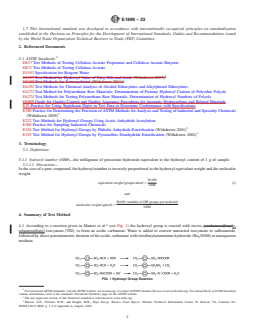
4.1 According to a reaction given in Manser et al. (see Fig. 1) the hydroxyl group is reacted with excess p-toluenesulfonylp-
toluenesulfonyl isocyanate (TSI), to form an acidic carbamate. Water is added to convert unreacted isocyanate to sulfonamide,
followed by direct potentiometric titration of the acidic carbamate with tetrabutylammonium hydroxide (Bu NOH) in nonaqueous
medium.
FIG. 1 Hydroxyl Group Reaction
For referenced ASTM standards, visit the ASTM website, www.astm.org, or contact ASTM Customer Service at service@astm.org. For Annual Book of ASTM Standards
volume information, refer to the standard’s Document Summary page on the ASTM website.
The last approved version of this historical standard is referenced on www.astm.org.
Manser, G.E., Fletcher, R.W., and Knight, M.R., High Energy Binders Final Report, Defense Technical Information Center, Ft. Belvoir, VA, Contract No.
N00014-82-C-0800, p. 1-3 of Appendix A, August, 1985.
E1899 − 23
5. Significance and Use
5.1 Hydroxyl is an important functional group and knowledge of its content is required in many intermediate and end use
applications. This test method is for the determination of primary and secondary hydroxyl groups and can be used for the assay
of compounds containing them.
5.2 This test method has the following advantages over other hydroxyl number methods: It is rapid (10 min), pyridine-free,
ambient temperature, small sample size, applicable to extremely low hydroxyl numbers (<1), and is amenable to automation.
6. Interferences
6.1 Primary and secondary amines derivatize quantitatively with the TSI reagent and contribute to the hydroxyl value.
6.2 High levels of water in the sample can interfere by consuming reagent. The amount of excess TSI reagent prescribed by this
test method is quite large, however, so that rather high water levels can be accommodated. Optimum titration curves are obtained,
however, when the water is <1 %.
6.3 Any acidic species with a pKa value close to that of the acidic carbamate (formed between TSI and the hydroxyl compound),
will contribute to the hydroxyl number and cause high values. Excess base in a sample may potentially react with the acidic
carbamate to cause low hydroxyl number values. If this test method is to be used for samples other than neutral refined products,
the analyst must first validate this test method on a case by case case-by-case basis. For example, an in-process sample containing
excess acid or base may be analyzed using Test Method B of Test Methods E222, to establish concordance of results with the
current TSI test method for that particular matrix. The identities of acidic or basic species contained in in-process samples are
frequently known, so that known addition of these moieties to the sample can establish whether or not there is interference
exhibited. For example, methane sulfonic acid titrates sufficiently before the acidic carbamate formed between TSI and ROH, and
therefore does not interfere. At the other extreme, methacrylic acid titrates well after the acidic carbamate of interest and thus
causes no interference.
7. Apparatus
7.1 Potentiometric Autotitrator, equipped with a 10- or 20-mL10 mL or 20 mL delivery buret. Ideally, the autotitrator should be
capable of generating the potentiometric titration curve in the normal and derivative modes with automatic marking of end points.
However, an older model titrator without automatic marking of end points was shown to give excellent hydroxyl number results
obtained by manually evaluating the mid-point of the normal “S” shaped curve.
7.2 Glass Combination pH Electrode, consisting of a glass sensing membrane and Ag/AgCl internal reference element.
7.3 Automatic Pipetter, 500 μL.
7.4 Glass or Plastic Beakers, 100 mL.
7.5 Magnetic Stirrer and Stirring Bars,Bars (3-cm(3 cm length is optimum).
7.6 Glass Pipet, 10 and 20 mL, 10 mL and 20 mL, Class A.
7.7 Volumetric Flasks, 500 and 1000 mL.500 mL and 1000 mL.
7.8 Analytical Balance, accurate to 0.1 mg.
7.9 Standard Bulb Transfer Pipets, plastic, approximately 15-cm15 cm length.
7.10 Graduated Cylinder, 10 mL, or Bottle Type Volumetric Dispenser.
E1899 − 23
8. Reagents
8.1 Purity of Reagents—Unless otherwise indicated, it is intended that all reagents shall conform to the specifications of the
Committee on Analytical Reagents of the American Chemical Society, where such specifications are available. Other grades may
be used, provided it is first ascertained that the reagent is of sufficiently high purity to permit its use without lessening the accuracy
of the determination.
8.2 Purity of Water—Unless otherwise indicated, references to water shall be understood to mean Type III or Type IIIII reagent
water as defined in Specification D1193.
8.3 Acetonitrile, HPLC Grade must be used as it is sufficiently low in moisture so that molecular sieves are not needed to dry this
solvent.
8.4 2-Propanol, HPLC Grade.
8.5 p-Toluenesulfonyl Isocyanate (TSI), 96 %—Maintain a nitrogen pad above this reagent after opening bottle.
8.6 TSI Reagent—Pipet 20 mL of TSI into a dry 500-mL500 mL volumetric flask half filled with acetonitrile. Dilute to the mark
with acetonitrile and mix well. This reagent should be prepared fresh monthly.
8.7 Potassium Hydrogen Phthalate, Primary Standard.
8.8 Tetrabutylammonium Hydroxide (Bu NOH), 1M Solution in Methanol, 100 mL.
8.9 Tetrabutylammonium Hydroxide (Titrant), 0.1 meq/mL—Prepare by transferring the entire 100 mL of 1M Bu NOH in
methanol (see 8.8) into a 1-L1 L volumetric flask that is half filled with 2-propanol. Rinse the emptied bottle that contained the
solution in 8.8 and transfer the rinsings to the contents of the 1-L1 L volumetric flask. Swirl contents and dilute to the mark with
2-propanol. Stopper the flask and mix well. Finally, transfer the flask contents to the buret reservoir of a potentiometric autotitrator
and standardize the titrate versus dried (2 h, 120°C) (2 h, 120 °C) potassium hydrogen phthalate (KHP) as follows: dissolve
approximately 0.18 g of KHP, weighed to 0.1 mg, in about 60 mL of water contained in a 100-mL100 mL beaker. Stir several
minutes to ensure complete dissolution of the KHP. Perform a potentiometric titration directly on the KHP solution using the 0.1
meq/mL Bu NOH titrant. Perform three to five standardization titrations to obtain a reliable average value for the 0.1 meq/mL
Bu NOH concentration.
KHP, g
N 5 (2)
0.20423 ×Bu NOH, mL
where:
N = concentration of the 0.1 meq/mL Bu NOH expressed to four decimal places, and
Bu NOH, mL = mL of this titrant to reach a potentiometric end point in the reaction with KHP.
8.10 Methanol.
8.11 Acetone.
9. Hazards
9.1 p-Toluenesulfonyl Isocyanate (TSI) is harmful by inhalation, in contact with skin, and if swallowed. It may cause sensitization
by inhalation and skin contact. It reacts violently with water. It causes severe irritation. It is a Lachrymator. In case of contact with
eyes, rinse immediately with plenty of water and seek medical advice. Never add water to this product.
Reagent Chemicals, American Chemical Society Specifications,ACS Reagent Chemicals, Specifications and Procedures for Reagents and Standard-Grade Reference
Materials, American Chemical Society, Washington, DC. For Suggestionssuggestions on the testing of reagents not listed by the American Chemical Society, see Analar
Standards for Laboratory Chemicals, BDH Ltd., Poole, Dorset, U.K., and the United States Pharmacopeia and National Formulary, U.S. Pharmacopeial Convention, Inc.
(USP),(USPC), Rockville, MD.
E1899 − 23
9.2 Wear suitable protective clothing, gloves and eye/face protection when handling p-Toluenesulfonyl Isocyanate. Use only in a
chemical fume hood. Do not breathe vapor.
...