


ASTM D5225-22
(Test Method)Standard Test Method for Measuring Solution Viscosity of Polymers with a Differential Viscometer
Standard Test Method for Measuring Solution Viscosity of Polymers with a Differential Viscometer
SIGNIFICANCE AND USE
5.1 Solution viscosity values for polymers are related to the average molecular size of that portion of the polymer which dissolves in the solvent.
SCOPE
1.1 This test method covers the determination of the solution viscosity of polymers using a differential or the modified differential viscometer. It is applicable to all polymers that dissolve completely without chemical reaction or degradation to form solutions that are stable with time and temperature. Results of the test are usually expressed as specific viscosity, intrinsic viscosity (limiting viscosity number), inherent viscosity (logarithmic viscosity number), or relative viscosity (viscosity ratio).
1.2 Since there is more than one type of viscometer available to measure a differential pressure, follow the manufacturer’s directions applicable to the equipment being used.
1.3 The solution viscosity values are comparable with those obtained using a glass capillary of Test Method D2857. This test method differs from the glass capillary in that the solvent and the solution are compared at the same time that a test is run. With a glass capillary, each solution must be referenced back to the solvent run in the same capillary at the same temperature.
1.4 The values stated in SI units are to be regarded as standard. No other units of measurement are included in this standard.
1.5 This standard does not purport to address all of the safety concerns, if any, associated with its use. It is the responsibility of the user of this standard to establish appropriate safety, health, and environmental practices and determine the applicability of regulatory limitations prior to use. For specific hazard statements, see Section 8.
Note 1: There is no known ISO equivalent to this standard.
1.6 This international standard was developed in accordance with internationally recognized principles on standardization established in the Decision on Principles for the Development of International Standards, Guides and Recommendations issued by the World Trade Organization Technical Barriers to Trade (TBT) Committee.
General Information
- Status
- Published
- Publication Date
- 31-Aug-2022
- Technical Committee
- D20 - Plastics
- Drafting Committee
- D20.70 - Analytical Methods
Relations
- Effective Date
- 01-Feb-2024
- Effective Date
- 01-Nov-2023
- Refers
ASTM D1243-22e1 - Standard Test Method for Dilute Solution Viscosity of Vinyl Chloride Polymers - Effective Date
- 01-May-2022
- Effective Date
- 01-Apr-2022
- Effective Date
- 01-Jan-2020
- Effective Date
- 01-Aug-2019
- Effective Date
- 15-Apr-2019
- Effective Date
- 01-Feb-2019
- Effective Date
- 01-Dec-2018
- Effective Date
- 01-Nov-2018
- Refers
ASTM D1600-18 - Standard Terminology for Abbreviated Terms Relating to Plastics (Withdrawn 2024) - Effective Date
- 01-Jan-2018
- Effective Date
- 01-Oct-2017
- Effective Date
- 01-Oct-2017
- Refers
ASTM E2935-17 - Standard Practice for Conducting Equivalence Testing in Laboratory Applications - Effective Date
- 01-Oct-2017
- Effective Date
- 15-Aug-2017
Overview
ASTM D5225-22: Standard Test Method for Measuring Solution Viscosity of Polymers with a Differential Viscometer defines a reliable procedure for determining the solution viscosity of polymers. This test method is suitable for all polymers that dissolve completely and do not degrade or react with the solvent, resulting in stable solutions under controlled time and temperature conditions.
Viscosity values obtained by this method are key to understanding the average molecular size of dissolved polymers. Solution viscosity can be reported as specific viscosity, intrinsic viscosity, inherent viscosity, or relative viscosity, supporting broad applicability in research, quality control, and material characterization in the polymer industry.
Key Topics
- Differential Viscometer Use: Utilizes a differential or modified differential viscometer for direct, simultaneous comparison of solvent and polymer solutions.
- Measurement Principle: Monitors differential pressure as polymer solution is injected, which directly correlates to the specific viscosity of the solution.
- Applicable Polymer Types: Suitable for any polymer forming stable solutions without chemical change.
- Standardization: Employs SI units exclusively for all measurements.
- Data Reproducibility: Offers guidance on test precision, repeatability, and reproducibility, aligning with ASTM and quality assessment practices.
Applications
ASTM D5225-22 is widely used in the plastics and polymer industries for quality assurance, material development, and research applications. Its core benefits include:
- Polymer Characterization: Viscosity measurement assists in establishing polymer molecular weight distribution and average molecular size, critical for understanding performance properties.
- Process Control: Routine application in production environments ensures polymer batches meet consistent quality standards.
- Material Comparison: The method allows comparison of viscosity data across different polymer types or processes, supporting material selection and substitution decisions.
- Regulatory Compliance: Following a recognized international standard aids compliance with quality management and testing requirements.
- Research and Development: Used for formulation studies where changes in polymer solution viscosity indicate key material property changes.
Unlike traditional glass capillary methods, this standard permits faster, more accurate viscosity comparison between sample and solvent by measuring both simultaneously. This speeds up analysis and minimizes potential errors due to temperature or solvent changes.
Safety Note: Solvents and compressed gases used may present health or environmental risks. Proper safety, health, and environmental practices must be established before use.
Related Standards
ASTM D5225-22 interfaces with a range of key documents and terminology within the materials testing and polymer industries:
- ASTM D2857: Practice for Dilute Solution Viscosity of Polymers (alternative method based on glass capillaries).
- ASTM D883: Terminology Relating to Plastics.
- ASTM D1243: Test Method for Dilute Solution Viscosity of Vinyl Chloride Polymers.
- ASTM D1600: Terminology for Abbreviated Terms Relating to Plastics.
- ASTM E456: Terminology Relating to Quality and Statistics.
- ASTM E691: Practice for Conducting Interlaboratory Studies to Determine Precision.
- ASTM E2935: Practice for Evaluating Equivalence of Two Testing Processes.
Note: No ISO equivalent currently exists for this standard. ASTM D5225-22 was also developed in accordance with internationally recognized standardization principles set by the World Trade Organization's TBT Committee.
To maximize the benefit of ASTM D5225-22, users should always refer to the most recent version of the standard and follow equipment manufacturer recommendations for viscometer operation.
Buy Documents
ASTM D5225-22 - Standard Test Method for Measuring Solution Viscosity of Polymers with a Differential Viscometer
REDLINE ASTM D5225-22 - Standard Test Method for Measuring Solution Viscosity of Polymers with a Differential Viscometer
Get Certified
Connect with accredited certification bodies for this standard

Smithers Quality Assessments
US management systems and product certification.

DIN CERTCO
DIN Group product certification.
Sponsored listings
Frequently Asked Questions
ASTM D5225-22 is a standard published by ASTM International. Its full title is "Standard Test Method for Measuring Solution Viscosity of Polymers with a Differential Viscometer". This standard covers: SIGNIFICANCE AND USE 5.1 Solution viscosity values for polymers are related to the average molecular size of that portion of the polymer which dissolves in the solvent. SCOPE 1.1 This test method covers the determination of the solution viscosity of polymers using a differential or the modified differential viscometer. It is applicable to all polymers that dissolve completely without chemical reaction or degradation to form solutions that are stable with time and temperature. Results of the test are usually expressed as specific viscosity, intrinsic viscosity (limiting viscosity number), inherent viscosity (logarithmic viscosity number), or relative viscosity (viscosity ratio). 1.2 Since there is more than one type of viscometer available to measure a differential pressure, follow the manufacturer’s directions applicable to the equipment being used. 1.3 The solution viscosity values are comparable with those obtained using a glass capillary of Test Method D2857. This test method differs from the glass capillary in that the solvent and the solution are compared at the same time that a test is run. With a glass capillary, each solution must be referenced back to the solvent run in the same capillary at the same temperature. 1.4 The values stated in SI units are to be regarded as standard. No other units of measurement are included in this standard. 1.5 This standard does not purport to address all of the safety concerns, if any, associated with its use. It is the responsibility of the user of this standard to establish appropriate safety, health, and environmental practices and determine the applicability of regulatory limitations prior to use. For specific hazard statements, see Section 8. Note 1: There is no known ISO equivalent to this standard. 1.6 This international standard was developed in accordance with internationally recognized principles on standardization established in the Decision on Principles for the Development of International Standards, Guides and Recommendations issued by the World Trade Organization Technical Barriers to Trade (TBT) Committee.
SIGNIFICANCE AND USE 5.1 Solution viscosity values for polymers are related to the average molecular size of that portion of the polymer which dissolves in the solvent. SCOPE 1.1 This test method covers the determination of the solution viscosity of polymers using a differential or the modified differential viscometer. It is applicable to all polymers that dissolve completely without chemical reaction or degradation to form solutions that are stable with time and temperature. Results of the test are usually expressed as specific viscosity, intrinsic viscosity (limiting viscosity number), inherent viscosity (logarithmic viscosity number), or relative viscosity (viscosity ratio). 1.2 Since there is more than one type of viscometer available to measure a differential pressure, follow the manufacturer’s directions applicable to the equipment being used. 1.3 The solution viscosity values are comparable with those obtained using a glass capillary of Test Method D2857. This test method differs from the glass capillary in that the solvent and the solution are compared at the same time that a test is run. With a glass capillary, each solution must be referenced back to the solvent run in the same capillary at the same temperature. 1.4 The values stated in SI units are to be regarded as standard. No other units of measurement are included in this standard. 1.5 This standard does not purport to address all of the safety concerns, if any, associated with its use. It is the responsibility of the user of this standard to establish appropriate safety, health, and environmental practices and determine the applicability of regulatory limitations prior to use. For specific hazard statements, see Section 8. Note 1: There is no known ISO equivalent to this standard. 1.6 This international standard was developed in accordance with internationally recognized principles on standardization established in the Decision on Principles for the Development of International Standards, Guides and Recommendations issued by the World Trade Organization Technical Barriers to Trade (TBT) Committee.
ASTM D5225-22 is classified under the following ICS (International Classification for Standards) categories: 83.080.01 - Plastics in general. The ICS classification helps identify the subject area and facilitates finding related standards.
ASTM D5225-22 has the following relationships with other standards: It is inter standard links to ASTM D883-24, ASTM D883-23, ASTM D1243-22e1, ASTM E456-13a(2022)e1, ASTM D883-20, ASTM D883-19c, ASTM D883-19a, ASTM D883-19, ASTM D883-18a, ASTM D883-18, ASTM D1600-18, ASTM E456-13A(2017)e1, ASTM E456-13A(2017)e3, ASTM E2935-17, ASTM D883-17. Understanding these relationships helps ensure you are using the most current and applicable version of the standard.
ASTM D5225-22 is available in PDF format for immediate download after purchase. The document can be added to your cart and obtained through the secure checkout process. Digital delivery ensures instant access to the complete standard document.
Standards Content (Sample)
This international standard was developed in accordance with internationally recognized principles on standardization established in the Decision on Principles for the
Development of International Standards, Guides and Recommendations issued by the World Trade Organization Technical Barriers to Trade (TBT) Committee.
Designation: D5225 − 22
Standard Test Method for
Measuring Solution Viscosity of Polymers with a Differential
Viscometer
This standard is issued under the fixed designation D5225; the number immediately following the designation indicates the year of
original adoption or, in the case of revision, the year of last revision. A number in parentheses indicates the year of last reapproval. A
superscript epsilon (´) indicates an editorial change since the last revision or reapproval.
1. Scope* mendations issued by the World Trade Organization Technical
Barriers to Trade (TBT) Committee.
1.1 This test method covers the determination of the solu-
tion viscosity of polymers using a differential or the modified
2. Referenced Documents
differential viscometer. It is applicable to all polymers that
2.1 ASTM Standards:
dissolve completely without chemical reaction or degradation
D883 Terminology Relating to Plastics
to form solutions that are stable with time and temperature.
D1243 Test Method for Dilute Solution Viscosity of Vinyl
Results of the test are usually expressed as specific viscosity,
Chloride Polymers
intrinsic viscosity (limiting viscosity number), inherent viscos-
D1600 Terminology forAbbreviatedTerms Relating to Plas-
ity (logarithmic viscosity number), or relative viscosity (vis-
tics
cosity ratio).
D2857 Practice for Dilute Solution Viscosity of Polymers
1.2 Since there is more than one type of viscometer avail-
E456 Terminology Relating to Quality and Statistics
able to measure a differential pressure, follow the manufactur-
E691 Practice for Conducting an Interlaboratory Study to
er’s directions applicable to the equipment being used.
Determine the Precision of a Test Method
E2935 Practice for Evaluating Equivalence of Two Testing
1.3 The solution viscosity values are comparable with those
Processes
obtained using a glass capillary of Test Method D2857. This
test method differs from the glass capillary in that the solvent
3. Terminology
and the solution are compared at the same time that a test is
3.1 Definitions:
run. With a glass capillary, each solution must be referenced
3.1.1 For definitions of terms pertaining to plastics used in
back to the solvent run in the same capillary at the same
this test method, refer to Terminology D883. For abbreviations
temperature.
used in this test method, refer to terminology D1600, unless
1.4 The values stated in SI units are to be regarded as
otherwise indicated. For definitions of terms that appear in this
standard. No other units of measurement are included in this
test method relating to quality and statistics, refer to Terminol-
standard.
ogy E456.
1.5 This standard does not purport to address all of the
3.1.2 inherent viscosity, n—the ratioof the natural logarithm
safety concerns, if any, associated with its use. It is the
of the relative viscosity to the concentration. The IUPAC term
responsibility of the user of this standard to establish appro-
for inherent viscosity is logarithmic viscosity number.
priate safety, health, and environmental practices and deter-
3.1.3 intrinsicviscosity,n—limitofthereducedandinherent
mine the applicability of regulatory limitations prior to use.
viscosities as the concentration of the polymeric solute ap-
For specific hazard statements, see Section 8.
proaches zero and represents the capacity of the polymer to
NOTE 1—There is no known ISO equivalent to this standard. increase viscosity. The IUPAC term for intrinsic viscosity is
limiting viscosity number.
1.6 This international standard was developed in accor-
dance with internationally recognized principles on standard-
3.1.4 reduced viscosity, n—the ratio of the specific viscosity
ization established in the Decision on Principles for the to the concentration. Reduced viscosity is a measure of the
Development of International Standards, Guides and Recom-
specific capacity of the polymer to increase the relative
viscosity. The IUPAC term for reduced viscosity is viscosity
number.
This test method is under the jurisdiction ofASTM Committee D20 on Plastics
and is the direct responsibility of Subcommittee D20.70 on Analytical Methods. For referenced ASTM standards, visit the ASTM website, www.astm.org, or
Current edition approved Sept. 1, 2022. Published September 2022. Originally contact ASTM Customer Service at service@astm.org. For Annual Book of ASTM
approved in 1992. Last previous edition approved in 2017 as D5225 - 17. DOI: Standards volume information, refer to the standard’s Document Summary page on
10.1520/D5225-22. the ASTM website.
*A Summary of Changes section appears at the end of this standard
Copyright © ASTM International, 100 Barr Harbor Drive, PO Box C700, West Conshohocken, PA 19428-2959. United States
D5225 − 22
3.1.5 relative viscosity, n—the ratio of the polymer solution
pressure to the pressure of the solvent.
3.1.6 specific viscosity, n—the relative viscosity minus one.
3.1.7 viscosity constant, K, n—baseline reading when sol-
vent is present in both capillaries.
4. Summary of Test Method
4.1 Differential Viscometer (Fig. 1):
4.1.1 The viscosity measurement with the differential vis-
cometer is based on a fluid analog of the Wheatstone Bridge.
FIG. 2 Relative Viscometer
Pure solvent at constant inlet pressure P enters a balanced
i
capillary network and flows through, producing a zero or
P η
2 2
baseline pressure on the differential pressure transducer. Solu-
5 K 5 K·Relative Viscosity (2)
P η
1 1
tion is loaded into the sample reservoir A and then injected
onstream by means of the switching valve S . The differential
4.2.1.1 K, the viscosity constant, is obtained from the
A
pressure begins to rise until it reaches a steady state value of
baseline reading when solvent is present in both capillaries, so
∆P proportional to the specific viscosity of the solution. The
η /η is unity.
2 1
differential pressure is monitored continuously on a strip chart
4.2.1.2 With the valve in LOAD position, the sample is
recorder or computer, providing a baseline where ∆P is
flushed through the sample loop by the syringe pump. A
measured. The equation relating ∆P to specific viscosity is:
baseline reading is established and recorded by the computer
data acquisition system. When the valve is switched to the
4∆P
η 5 (1)
sp
INJECT position, solvent flowing from capillary 1 pushes the
P 2 2∆P
i
sample into capillary 2. The differential pressure P will
4.1.2 Derivation of the equation is in Annex A1.
increase due to the higher viscosity of the sample solution.The
4.2 Modified Differential Viscometer (Fig. 2): steady state value of P /P then yields the value of relative
2 1
4.2.1 The modified differential viscometer has two stainless viscosity of the sample.
steel capillaries connected in series with a sample loading/
P
Relative Viscosity 5 (3)
injection valve before the second capillary. Two differential
KP
pressure transducers, P and P , are connected in parallel
1 2
4.2.1.3 Absolute viscosity of the sample may be calculated
across the capillaries. A pump continuously supplies solvent
from relative viscosity, RV, assuming the viscosity of the
flow. The ratio of the pressures P and P is proportional to the
2 1
solvent is known.
ratio of the viscosities of the fluid in capillary 2 to that in
capillary 1.
η~sample! 5 RV·η~solvent! (4)
5. Significance and Use
5.1 Solution viscosity values for polymers are related to the
average molecular size of that portion of the polymer which
dissolves in
...
This document is not an ASTM standard and is intended only to provide the user of an ASTM standard an indication of what changes have been made to the previous version. Because
it may not be technically possible to adequately depict all changes accurately, ASTM recommends that users consult prior editions as appropriate. In all cases only the current version
of the standard as published by ASTM is to be considered the official document.
Designation: D5225 − 17 D5225 − 22
Standard Test Method for
Measuring Solution Viscosity of Polymers with a Differential
Viscometer
This standard is issued under the fixed designation D5225; the number immediately following the designation indicates the year of
original adoption or, in the case of revision, the year of last revision. A number in parentheses indicates the year of last reapproval. A
superscript epsilon (´) indicates an editorial change since the last revision or reapproval.
1. Scope*
1.1 This test method covers the determination of the solution viscosity of polymers using a differential or the modified differential
viscometer. It is applicable to all polymers that dissolve completely without chemical reaction or degradation to form solutions that
are stable with time and temperature. Results of the test are usually expressed as specific viscosity, intrinsic viscosity (limiting
viscosity number), inherent viscosity (logarithmic viscosity number), or relative viscosity (viscosity ratio).
1.2 Since there is more than one type of viscometer available to measure a differential pressure, follow the manufacturer’s
directions applicable to the equipment being used.
1.3 The solution viscosity values are comparable with those obtained using a glass capillary of Test Method D2857. This test
method differs from the glass capillary in that the solvent and the solution are compared at the same time that a test is run. With
a glass capillary, each solution must be referenced back to the solvent run in the same capillary at the same temperature.
1.4 The values stated in SI units are to be regarded as standard. No other units of measurement are included in this standard.
1.5 This standard does not purport to address all of the safety concerns, if any, associated with its use. It is the responsibility
of the user of this standard to establish appropriate safety, health, and environmental practices and determine the applicability of
regulatory limitations prior to use. For specific hazard statements, see Section 8.
NOTE 1—There is no known ISO equivalent to this standard.
1.6 This international standard was developed in accordance with internationally recognized principles on standardization
established in the Decision on Principles for the Development of International Standards, Guides and Recommendations issued
by the World Trade Organization Technical Barriers to Trade (TBT) Committee.
2. Referenced Documents
2.1 ASTM Standards:
D883 Terminology Relating to Plastics
D1243 Test Method for Dilute Solution Viscosity of Vinyl Chloride Polymers
D1600 Terminology for Abbreviated Terms Relating to Plastics
D2857 Practice for Dilute Solution Viscosity of Polymers
This test method is under the jurisdiction of ASTM Committee D20 on Plastics and is the direct responsibility of Subcommittee D20.70 on Analytical Methods.
Current edition approved Dec. 1, 2017Sept. 1, 2022. Published January 2018September 2022. Originally approved in 1992. Last previous edition approved in 20142017
as D5225 - 14.D5225 - 17. DOI: 10.1520/D5225-17.10.1520/D5225-22.
For referenced ASTM standards, visit the ASTM website, www.astm.org, or contact ASTM Customer Service at service@astm.org. For Annual Book of ASTM Standards
volume information, refer to the standard’s Document Summary page on the ASTM website.
*A Summary of Changes section appears at the end of this standard
Copyright © ASTM International, 100 Barr Harbor Drive, PO Box C700, West Conshohocken, PA 19428-2959. United States
D5225 − 22
E456 Terminology Relating to Quality and Statistics
E691 Practice for Conducting an Interlaboratory Study to Determine the Precision of a Test Method
E2935 Practice for Evaluating Equivalence of Two Testing Processes
3. Terminology
3.1 Definitions:
3.1.1 For definitions of terms pertaining to plastics used in this test method, refer to Terminology D883. For abbreviations used
in this test method, refer to terminology D1600, unless otherwise indicated. For definitions of terms that appear in this test method
relating to quality and statistics, refer to Terminology E456.
3.1.2 inherent viscosity—viscosity, n—the ratio of the natural logarithm of the relative viscosity to the concentration. The IUPAC
term for inherent viscosity is logarithmic viscosity number.
3.1.3 intrinsic viscosity—viscosity, n—limit of the reduced and inherent viscosities as the concentration of the polymeric solute
approaches zero and represents the capacity of the polymer to increase viscosity. The IUPAC term for intrinsic viscosity is limiting
viscosity number.
3.1.4 reduced viscosity—viscosity, n—the ratio of the specific viscosity to the concentration. Reduced viscosity is a measure of the
specific capacity of the polymer to increase the relative viscosity. The IUPAC term for reduced viscosity is viscosity number.
3.1.5 relative viscosity—viscosity, n—the ratio of the polymer solution pressure to the pressure of the solvent.
3.1.6 specific viscosity—viscosity, n—the relative viscosity minus one.
3.1.7 viscosity constant, K—K, n—baseline reading when solvent is present in both capillaries.
4. Summary of Test Method
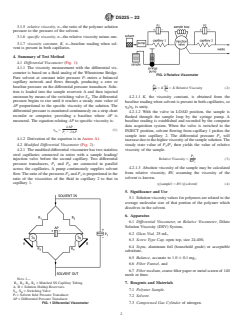
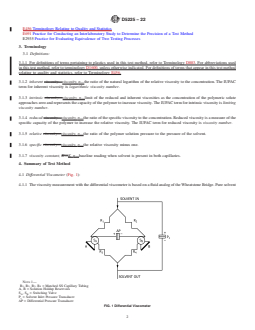
4.1 Differential Viscometer (Fig. 1):
4.1.1 The viscosity measurement with the differential viscometer is based on a fluid analog of the Wheatstone Bridge. Pure solvent
NOTE 1—
R , R , R , R = Matched SS Capillary Tubing
1 2 3 4
A, B = Solution Holdup Reservoirs
S , S = Switching Valve
A B
P = Solvent Inlet Pressure Transducer
i
ΔP = Differential Pressure Transducer
FIG. 1 Differential Viscometer
D5225 − 22
at constant inlet pressure P enters a balanced capillary network and flows through, producing a zero or baseline pressure on the
i
differential pressure transducer. Solution is loaded into the sample reservoir A and then injected onstream by means of the
switching valve S . The differential pressure begins to rise until it reaches a steady state value of ΔP proportional to the specific
A
viscosity of the solution. The differential pressure is monitored continuously on a strip chart recorder or computer, providing a
baseline where ΔP is measured. The equation relating ΔP to specific viscosity is:
4ΔP
η 5 (1)
sp
P 2 2ΔP
i
4.1.2 Derivation of the equation is in Annex A1.
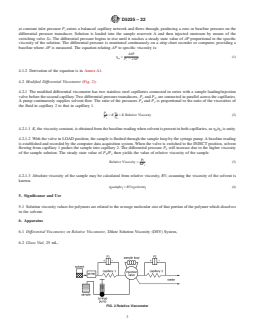
4.2 Modified Differential Viscometer (Fig. 2):
4.2.1 The modified differential viscometer has two stainless steel capillaries connected in series with a sample loading/injection
valve before the second capillary. Two differential pressure transducers, P and P , are connected in parallel across the capillaries.
1 2
A pump continuously supplies solvent flow. The ratio of the pressures P and P is proportional to the ratio of the viscosities of
2 1
the fluid in capillary 2 to that in capillary 1.
P η
2 2
5 K 5 K·Relative Viscosity (2)
P η
1 1
4.2.1.1 K, the viscosity constant, is obtained from the baseline reading when solvent is present in both capillaries, so η /η is unity.
2 1
4.2.1.2 With the valve in LOAD position, the sample is flushed through the sample loop by the syringe pump. A baseline reading
is established and recorded by the computer data acquisition system. When the valve is switched to the INJECT position, solvent
flowing from capillary 1 pushes the sample into capillary 2. The differential pressure P will increase due to the higher viscosity
of the sample solution. The steady state value of P /P then yields the value of relative viscosity of the sample.
2 1
P
Relative Viscosity 5 (3)
KP
4.2.1.3 Absolute viscosity of the sample may be calculated from relative viscosity, RV, assuming the viscosity of the solvent is
known.
η~sample!5 RV·η~solvent! (4)
5. Significance and Use
5.1 Solution viscosity values for polymers are related to the average molecular size of that portion of the polymer which dissolves
in the solvent.
6. Apparatus
6.1 Differential Viscometer, or Relative Viscometer, Dilute Solution Viscosity (DSV) System,
6.2 Glass Vial, 25 mL,
FIG. 2 Relative Viscometer
...
Questions, Comments and Discussion
Ask us and Technical Secretary will try to provide an answer. You can facilitate discussion about the standard in here.
Loading comments...