

ASTM D8490-23a
(Test Method)Standard Test Method for Determining the Pore Size Characteristics of Geotextiles Using an Optical Method
General Information
- Abstract
SIGNIFICANCE AND USE
5.1 The significant opening size of geotextiles is usually determined using Test Method D4751, which involves sieving calibrated beads through specimens of the geotextile being evaluated. However, Test Method D4751 includes many risks of errors due to static electricity, precision of the glass beads, among other issues.5 This risk of error is even higher with knitted geotextiles which exhibit a very low tensile modulus. This test method is proposed as an alternate to Test Method D4751 using a nondestructive technique, where the stress conditions are controlled without manipulation of the specimen.
5.2 This test method has been found to provide representative results for products exhibiting a planar structure, such as two-dimensional knits.
5.3 In case of a dispute arising from differences in reported test results when using ASTM D4751 Method A and this method, ASTM D4751 Method A shall be considered the referee method. However, data obtained using ASTM D4751 Method A should be reviewed considering the high risk of human error associated with the control of the stress condition of the geotextile.
5.4 Equivalency with the other pore opening size determined using other standards (for example, ISO 12956 and CGSB 148.1 No. 10) can also be considered using adequate correlations with test results obtained with these standards.
SCOPE
1.1 This test method covers the determination of the pore size characteristics of geotextiles using an optical method and image analysis.
1.2 This method has been developed for determination of the Image Opening Size (IOS) of knitted geotextiles by image analysis. Other properties may be obtained based on the pore size distribution.
1.3 The applicability of this test method must be assessed on a product-by-product basis, as it requires light to pass through its thickness to provide a useful observation. As a general rule, the tested product must be thin. Example of products which cannot be tested using this test method is thick needle-punched nonwoven and woven with a complex three-dimensional structure.
1.4 This test method shows values in both SI units and inch-pound units. SI units is the technically correct name for the system of metric units known as the International System of Units. Inch-pound units is the technically correct name for the customary units used in the United States. The values in inch-pound units are provided for information only.
1.5 This standard does not purport to address all of the safety concerns, if any, associated with its use. It is the responsibility of the user of this standard to establish appropriate safety, health, and environmental practices and determine the applicability of regulatory limitations prior to use.
1.6 This international standard was developed in accordance with internationally recognized principles on standardization established in the Decision on Principles for the Development of International Standards, Guides and Recommendations issued by the World Trade Organization Technical Barriers to Trade (TBT) Committee.
- Status
- Published
- Publication Date
- 14-Jun-2023
- Technical Committee
- D35 - Geosynthetics
- Drafting Committee
- D35.03 - Permeability and Filtration
Buy Documents
ASTM D8490-23a - Standard Test Method for Determining the Pore Size Characteristics of Geotextiles Using an Optical Method
REDLINE ASTM D8490-23a - Standard Test Method for Determining the Pore Size Characteristics of Geotextiles Using an Optical Method
Overview
ASTM D8490-23a - Standard Test Method for Determining the Pore Size Characteristics of Geotextiles Using an Optical Method - provides a nondestructive approach for measuring the pore size distribution, notably the Image Opening Size (IOS), of geotextiles through image analysis. This standard delivers an alternative to traditional bead-sieving methods, reducing human error and potential specimen manipulation, especially with delicate knitted geotextiles. The method employs optical imaging to analyze geotextile openings, offering more representative results for products with planar, two-dimensional structures.
Key Topics
- Image Opening Size (IOS): Defines the median size of openings through which particles can pass, as determined by optical image analysis.
- Pore Size Distribution: The test enables detailed analysis of opening sizes across a sample, which is critical for filtration applications.
- Optical and Image Analysis Method: Relies on brightfield imaging and digital processing to estimate opening size distribution accurately, avoiding physical bead-sieving limitations.
- Applicability: Designed primarily for thin, planar geotextiles such as circular knits. The sample must allow light transmission for successful observation.
- Product Suitability: Not suitable for thick needle-punched nonwoven or complex three-dimensional woven geotextiles.
- Comparison with Other Methods: Intended as an alternative to ASTM D4751 (glass bead sieving), which can be error-prone, particularly with low-modulus products.
Applications
ASTM D8490-23a is valuable for quality control, specification compliance, and research where accurate characterization of geotextile pore size is critical. Applications include:
- Civil Engineering: Selection and validation of geotextiles for drainage systems, especially in applications involving soil filtration or separation.
- Infrastructure Projects: Specification and verification of geotextile performance in roadbeds, embankments, and erosion control.
- Manufacturer Quality Assurance: Consistent, repeatable assessment of product characteristics during production, especially for circular knit geotextiles.
- Dispute Resolution: Provides a consistent alternative when test result differences arise between bead-sieving and optical methods, noting ASTM D4751 Method A as the referee.
- Product Development: Helps manufacturers refine geotextile designs to optimize opening size and distribution based on performance requirements.
Related Standards
Adherence to ASTM D8490-23a ensures compatibility and correlation with various international and industry-specific geotextile standards, including:
- ASTM D4751: Test Methods for Determining Apparent Opening Size of a Geotextile (bead sieving reference method).
- ISO 12956: International method for geotextile pore size characterization.
- CGSB 148.1 No. 10: Canadian standard for filtration opening size in geosynthetics.
- ASTM D123 & D4439: Terminology standards for textiles and geosynthetics.
- ASTM D4354: Sampling practice for geosynthetics and related materials.
Practical Value
Implementing ASTM D8490-23a enhances the accuracy and repeatability of geotextile pore size measurements, particularly when traditional methods are challenged by static, specimen handling, or product flexibility. Through optical imaging and analysis, engineers and manufacturers gain:
- Reduced error sources by minimizing specimen manipulation and static effects.
- Insightful pore size distribution data for product performance evaluation.
- Nondestructive testing benefits, preserving sample integrity.
- Alignment with global test standards for broader acceptability in international markets.
By integrating ASTM D8490-23a into laboratory practice, geotextile producers, civil engineers, and quality control professionals access a reliable, standardized method for characterizing the critical filtration properties of modern geotextiles.
Keywords: geotextile, pore size, image analysis, optical test, filtration, opening size, ASTM D8490, IOS, geosynthetics, quality control.
Relations
- Effective Date
- 01-Feb-2024
- Effective Date
- 01-May-2020
- Effective Date
- 01-Jan-2020
- Effective Date
- 15-Apr-2018
- Effective Date
- 01-Aug-2017
- Effective Date
- 01-Mar-2017
- Effective Date
- 01-Jul-2016
- Effective Date
- 15-Sep-2015
- Effective Date
- 01-Sep-2015
- Effective Date
- 01-Sep-2015
- Effective Date
- 01-Jul-2015
- Effective Date
- 01-Apr-2015
- Effective Date
- 01-Mar-2014
- Effective Date
- 01-Oct-2013
- Effective Date
- 15-Jun-2013
Buy Documents
ASTM D8490-23a - Standard Test Method for Determining the Pore Size Characteristics of Geotextiles Using an Optical Method
REDLINE ASTM D8490-23a - Standard Test Method for Determining the Pore Size Characteristics of Geotextiles Using an Optical Method
Get Certified
Connect with accredited certification bodies for this standard

Control Union Certifications
Global certification for agriculture and sustainability.

Hohenstein Institut
Textile testing and certification.

Bureau Veritas Bangladesh
Bureau Veritas certification services in Bangladesh.
Sponsored listings
Frequently Asked Questions
ASTM D8490-23a is a standard published by ASTM International. Its full title is "Standard Test Method for Determining the Pore Size Characteristics of Geotextiles Using an Optical Method". This standard covers: SIGNIFICANCE AND USE 5.1 The significant opening size of geotextiles is usually determined using Test Method D4751, which involves sieving calibrated beads through specimens of the geotextile being evaluated. However, Test Method D4751 includes many risks of errors due to static electricity, precision of the glass beads, among other issues.5 This risk of error is even higher with knitted geotextiles which exhibit a very low tensile modulus. This test method is proposed as an alternate to Test Method D4751 using a nondestructive technique, where the stress conditions are controlled without manipulation of the specimen. 5.2 This test method has been found to provide representative results for products exhibiting a planar structure, such as two-dimensional knits. 5.3 In case of a dispute arising from differences in reported test results when using ASTM D4751 Method A and this method, ASTM D4751 Method A shall be considered the referee method. However, data obtained using ASTM D4751 Method A should be reviewed considering the high risk of human error associated with the control of the stress condition of the geotextile. 5.4 Equivalency with the other pore opening size determined using other standards (for example, ISO 12956 and CGSB 148.1 No. 10) can also be considered using adequate correlations with test results obtained with these standards. SCOPE 1.1 This test method covers the determination of the pore size characteristics of geotextiles using an optical method and image analysis. 1.2 This method has been developed for determination of the Image Opening Size (IOS) of knitted geotextiles by image analysis. Other properties may be obtained based on the pore size distribution. 1.3 The applicability of this test method must be assessed on a product-by-product basis, as it requires light to pass through its thickness to provide a useful observation. As a general rule, the tested product must be thin. Example of products which cannot be tested using this test method is thick needle-punched nonwoven and woven with a complex three-dimensional structure. 1.4 This test method shows values in both SI units and inch-pound units. SI units is the technically correct name for the system of metric units known as the International System of Units. Inch-pound units is the technically correct name for the customary units used in the United States. The values in inch-pound units are provided for information only. 1.5 This standard does not purport to address all of the safety concerns, if any, associated with its use. It is the responsibility of the user of this standard to establish appropriate safety, health, and environmental practices and determine the applicability of regulatory limitations prior to use. 1.6 This international standard was developed in accordance with internationally recognized principles on standardization established in the Decision on Principles for the Development of International Standards, Guides and Recommendations issued by the World Trade Organization Technical Barriers to Trade (TBT) Committee.
SIGNIFICANCE AND USE 5.1 The significant opening size of geotextiles is usually determined using Test Method D4751, which involves sieving calibrated beads through specimens of the geotextile being evaluated. However, Test Method D4751 includes many risks of errors due to static electricity, precision of the glass beads, among other issues.5 This risk of error is even higher with knitted geotextiles which exhibit a very low tensile modulus. This test method is proposed as an alternate to Test Method D4751 using a nondestructive technique, where the stress conditions are controlled without manipulation of the specimen. 5.2 This test method has been found to provide representative results for products exhibiting a planar structure, such as two-dimensional knits. 5.3 In case of a dispute arising from differences in reported test results when using ASTM D4751 Method A and this method, ASTM D4751 Method A shall be considered the referee method. However, data obtained using ASTM D4751 Method A should be reviewed considering the high risk of human error associated with the control of the stress condition of the geotextile. 5.4 Equivalency with the other pore opening size determined using other standards (for example, ISO 12956 and CGSB 148.1 No. 10) can also be considered using adequate correlations with test results obtained with these standards. SCOPE 1.1 This test method covers the determination of the pore size characteristics of geotextiles using an optical method and image analysis. 1.2 This method has been developed for determination of the Image Opening Size (IOS) of knitted geotextiles by image analysis. Other properties may be obtained based on the pore size distribution. 1.3 The applicability of this test method must be assessed on a product-by-product basis, as it requires light to pass through its thickness to provide a useful observation. As a general rule, the tested product must be thin. Example of products which cannot be tested using this test method is thick needle-punched nonwoven and woven with a complex three-dimensional structure. 1.4 This test method shows values in both SI units and inch-pound units. SI units is the technically correct name for the system of metric units known as the International System of Units. Inch-pound units is the technically correct name for the customary units used in the United States. The values in inch-pound units are provided for information only. 1.5 This standard does not purport to address all of the safety concerns, if any, associated with its use. It is the responsibility of the user of this standard to establish appropriate safety, health, and environmental practices and determine the applicability of regulatory limitations prior to use. 1.6 This international standard was developed in accordance with internationally recognized principles on standardization established in the Decision on Principles for the Development of International Standards, Guides and Recommendations issued by the World Trade Organization Technical Barriers to Trade (TBT) Committee.
ASTM D8490-23a is classified under the following ICS (International Classification for Standards) categories: 59.080.70 - Geotextiles. The ICS classification helps identify the subject area and facilitates finding related standards.
ASTM D8490-23a has the following relationships with other standards: It is inter standard links to ASTM D4439-24, ASTM D4354-12(2020), ASTM D4751-20, ASTM D4439-18, ASTM D4439-17, ASTM D123-17, ASTM D4751-16, ASTM D123-15b, ASTM D4439-15a, ASTM D123-15a, ASTM D4439-15, ASTM D123-15, ASTM D4439-14, ASTM E11-13, ASTM D123-13ae1. Understanding these relationships helps ensure you are using the most current and applicable version of the standard.
ASTM D8490-23a is available in PDF format for immediate download after purchase. The document can be added to your cart and obtained through the secure checkout process. Digital delivery ensures instant access to the complete standard document.
Standards Content (Sample)
This international standard was developed in accordance with internationally recognized principles on standardization established in the Decision on Principles for the
Development of International Standards, Guides and Recommendations issued by the World Trade Organization Technical Barriers to Trade (TBT) Committee.
Designation: D8490 − 23a
Standard Test Method for
Determining the Pore Size Characteristics of Geotextiles
Using an Optical Method
This standard is issued under the fixed designation D8490; the number immediately following the designation indicates the year of
original adoption or, in the case of revision, the year of last revision. A number in parentheses indicates the year of last reapproval. A
superscript epsilon (´) indicates an editorial change since the last revision or reapproval.
1. Scope 2. Referenced Documents
2.1 ASTM Standards:
1.1 This test method covers the determination of the pore
D123 Terminology Relating to Textiles
size characteristics of geotextiles using an optical method and
D4354 Practice for Sampling of Geosynthetics and Rolled
image analysis.
Erosion Control Products (RECPs) for Testing
1.2 This method has been developed for determination of
D4439 Terminology for Geosynthetics
the Image Opening Size (IOS) of knitted geotextiles by image
D4751 Test Methods for Determining Apparent Opening
analysis. Other properties may be obtained based on the pore
Size of a Geotextile
size distribution.
E11 Specification for Woven Wire Test Sieve Cloth and Test
Sieves
1.3 The applicability of this test method must be assessed on
2.2 Other Standards:
a product-by-product basis, as it requires light to pass through
ISO 12956 Geotextiles and Geotextile-Related Products—
its thickness to provide a useful observation. As a general rule,
Determination of the Characteristic Opening Size
the tested product must be thin. Example of products which
CGSB 148.1 No. 10 Methods of Testing Geosynthetics
cannot be tested using this test method is thick needle-punched
Geotextiles—Filtration Opening Size
nonwoven and woven with a complex three-dimensional struc-
ture. 3. Terminology
3.1 Definitions—For definitions of other textile terms used
1.4 This test method shows values in both SI units and
in this test method, refer to Terminology D123. For definitions
inch-pound units. SI units is the technically correct name for
of other terms relating to geosynthetics used in this test
the system of metric units known as the International System of
method, refer to Terminology D4439.
Units. Inch-pound units is the technically correct name for the
customary units used in the United States. The values in
3.2 Definitions of Terms Specific to This Standard:
inch-pound units are provided for information only. 3.2.1 circular knit, n—a structure produced by interlooping
one or more ends of yarn or comparable material in a
1.5 This standard does not purport to address all of the
continuously circular orientation around the fabric.
safety concerns, if any, associated with its use. It is the
3.2.2 ellipse diameter, n—measured from the “best-fit” el-
responsibility of the user of this standard to establish appro-
lipse fitting inside a given opening.
priate safety, health, and environmental practices and deter-
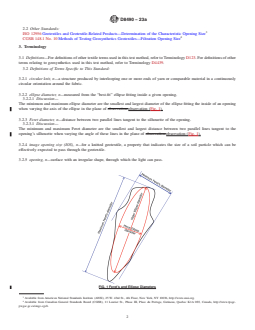
3.2.2.1 Discussion—The minimum and maximum ellipse
mine the applicability of regulatory limitations prior to use.
diameter are the smallest and largest diameter of the ellipse
1.6 This international standard was developed in accor-
fitting the inside of an opening when varying the axis of the
dance with internationally recognized principles on standard-
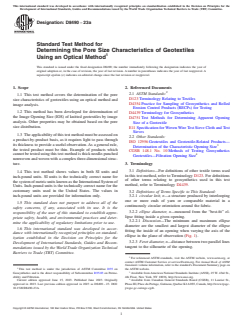
ellipse in the plane of observation (Fig. 1).
ization established in the Decision on Principles for the
3.2.3 Feret diameter, n—distance between two parallel lines
Development of International Standards, Guides and Recom-
tangent to the silhouette of the opening.
mendations issued by the World Trade Organization Technical
Barriers to Trade (TBT) Committee.
For referenced ASTM standards, visit the ASTM website, www.astm.org, or
contact ASTM Customer Service at service@astm.org. For Annual Book of ASTM
Standards volume information, refer to the standard’s Document Summary page on
This test method is under the jurisdiction of ASTM Committee D35 on the ASTM website.
Geosynthetics and is the direct responsibility of Subcommittee D35.03 on Perme- Available from American National Standards Institute (ANSI), 25 W. 43rd St.,
ability and Filtration. 4th Floor, New York, NY 10036, http://www.ansi.org.
Current edition approved June 15, 2023. Published June 2023. Originally Available from Canadian General Standards Board (CGSB), 11 Laurier St.,
approved in 2023. Last previous edition approved in 2023 as D8490 – 23. DOI: Phase III, Place du Portage, Gatineau, Quebec K1A 0S5, Canada, http://www.tpsgc-
10.1520/D8490-23A. pwgsc.gc.ca/ongc-cgsb.
Copyright © ASTM International, 100 Barr Harbor Drive, PO Box C700, West Conshohocken, PA 19428-2959. United States
D8490 − 23a
calibrated beads through specimens of the geotextile being
evaluated. However, Test Method D4751 includes many risks
of errors due to static electricity, precision of the glass beads,
among other issues. This risk of error is even higher with
knitted geotextiles which exhibit a very low tensile modulus.
This test method is proposed as an alternate to Test Method
D4751 using a nondestructive technique, where the stress
conditions are controlled without manipulation of the speci-
men.
5.2 This test method has been found to provide representa-
tive results for products exhibiting a planar structure, such as
two-dimensional knits.
5.3 In case of a dispute arising from differences in reported
test results when using ASTM D4751 Method A and this
method, ASTM D4751 Method A shall be considered the
referee method. However, data obtained using ASTM D4751
Method A should be reviewed considering the high risk of
human error associated with the control of the stress condition
of the geotextile.
5.4 Equivalency with the other pore opening size deter-
mined using other standards (for example, ISO 12956 and
CGSB 148.1 No. 10) can also be considered using adequate
correlations with test results obtained with these standards.
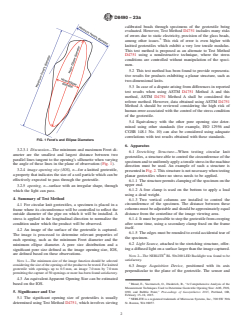
FIG. 1 Feret’s and Ellipse Diameters
6. Apparatus
3.2.3.1 Discussion—The minimum and maximum Feret di-
6.1 Stretching Structure—When testing circular knit
ameter are the smallest and largest distance between two
geotextiles, a structure able to control the circumference of the
parallel lines tangent to the opening’s silhouette when varying
specimen and to uniformly apply a tensile stress in the machine
the angle of these lines in the plane of observation (Fig. 1).
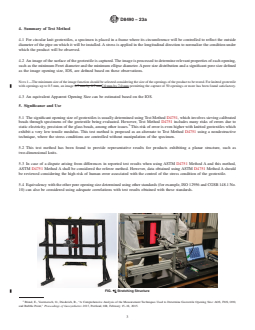
direction must be used. An example of such a structure is
3.2.4 image opening size (IOS), n—for a knitted geotextile,
presented in Fig. 2. This structure is not necessary when testing
a property that indicates the size of a soil particle which can be
planar geotextiles where no stress needs to be applied.
effectively expected to pass through the geotextile.
6.1.1 The structure permits clamping of the specimen on the
upper end.
3.2.5 opening, n—surface with an irregular shape, through
6.1.2 A free clamp is used on the bottom to apply a load
which the light can pass.
using a dead weight.
4. Summary of Test Method
6.1.3 Two vertical columns are installed to control the
circumference of the specimen. The distance between these
4.1 For circular knit geotextiles, a specimen is placed in a
columns must be adjustable and should be approximately equal
frame where its circumference will be controlled to reflect the
distance from the centerline of the image viewing area.
outside diameter of the pipe on which it will be installed. A
6.1.4 It must be possible to stop the geotextile from creeping
stress is applied in the longitudinal direction to normalize the
after some time, using a secondary clamp fixed on the frame
condition under which the product will be observed.
itself.
4.2 An image of the surface of the geotextile is captured.
6.1.5 The edges must be rounded to avoid accidental tear of
The image is processed to determine relevant properties of
the specimen.
each opening, such as the minimum Feret diameter and the
6.2 Light Source, attached to the stretching structure, offer-
minimum ellipse diameter. A pore size distribution and a
ing a diffused light on a surface larger than the image captured.
significant pore size defined as the image opening size, IOS,
are defined based on these observations. 6
NOTE 2—The NERLITE BL 50×200 LED Backlight was found to be
satisfactory.
NOTE 1—The minimum size of the image function should be selected
considering the size of the openings of the product to be tested. For knitted
6.3 Image Acquisition Device, positioned with its axis
geotextile with openings up to 0.5 mm, an image 7.0 mm by 7.0 mm
perpendicular to the plane of the geotextile. The sensor and
permitting the capture of 50 openings or more has been found satisfactory.
4.3 An equivalent Apparent Opening Size can be estimated
based on the IOS.
Blond, E., Veermersch, O., Diederich, R., “A Comprehensive Analysis of the
Measurement Techniques Used to Determine Geotextile Opening Size: AOS, FOS,
5. Significance and Use O90, and Bubble Point,” Proceedings of Geosynthetics 2015, Portland, OR,
February 15–18, 2015.
5.1 The significant opening size of geotextiles is usually
NERLITE is a registered trademark of Microscan Systems, Inc., 700 SW 39th
determined using Test Method D4751, which involves sieving St. Renton, WA 98057.
D8490 − 23a
FIG. 2 Stretching Structure
optic used must permit the capture of an image at least 7 mm 7.2.1 Cut at least three (3) specimens of the circular knit
by 7 mm, with a resolution of at least 250 pixels per millimeter geotextile with a minimum length of 500 mm. This length may
length captured on the test specimen for products with a mean have to be longer for products intended to be installed on pipes
opening size of 150 μm or more. Other image sizes may be with a nominal diameter larger than 150 mm (6 in.).
considered for smaller or bigger opening sizes. 7.2.2 Lay tubular fabric flat on a solid surface and make sure
edges of fabric are parallel in the longitudinal direction. Make
NOTE 3—The criteria of 250 pixels per millimeter length is equivalent
sure there are no wrinkles or torque in the fabric. Draw a line
to one pixel for 4 μm. However, this measurement differs from the
perpendicular to the longitudinal edges and make sure the line
precision of the opening size measurement considering the use of image
analysis technique.
is drawn across the width of fabric touching both parallel
NOTE 4—The sensor Basler ace acA3800-14m 10Mp equipped with a
edges. Draw a second line at the approximate location of the
Kowa 2/3” 10Mp LM35mm/F2.0 C-Mount lens was found to be satisfac-
lower clamp (for example, 300 to 500 mm depending on the
tory.
height of the structure and how much the fabric will stretch)
6.4 Image Processing Software, able to:
using the same technique as above.
6.4.1 Process the image to define edges of the openings
7.2.3 Make a cut 50 610 mm in the machine direction on
being measured and exclude stray yarns.
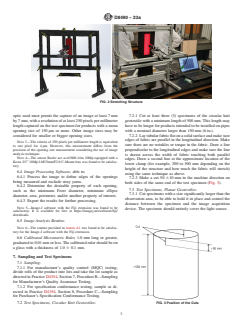
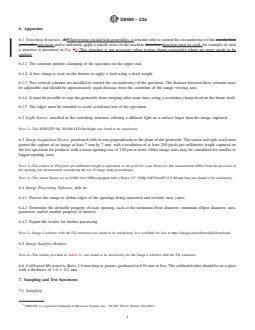
both sides of the same end of the test specimen (Fig. 3).
6.4.2 Determine the desirable property of each opening,
7.3 Test Specimens, Planar Geotextiles:
such as the minimum Feret diameter, minimum ellipse
7.3.1 Cut specimens with a size significantly larger than the
diameter, area, perimeter, and/or another property of interest.
observation area, to be able to hold it in place and control the
6.4.3 Export the results for further processing.
distance between the specimen and the image acquisition
NOTE 5—Image-J software with the Fiji extension was found to be
device. The specimen should entirely cover the light source.
satisfactory. It is available for free at https://imagej.net/software/fiji/
downloads.
6.5 Image Analysis Routine.
NOTE 6—The routine provided in Annex A1 was found to be satisfac-
tory for the Image-J software with the Fiji extension.
6.6 Calibrated Micrometric Ruler, 1.0 mm long or greater,
graduated to 0.01 mm or less. The calibrated ruler should be on
a glass with a thickness of 1.0 6 0.1 mm.
7. Sampling and Test Specimens
7.1 Sampling:
7.1.1 For manufacturer’s quality control (MQC) testing,
divide rolls of the product into lots and take the lot sample as
directed in Practice D4354, Section 7, Procedure B—Sampling
for Manufacturer’s Quality Assurance Testing.
7.1.2 For specification conformance testing, sample as di-
rected in Practice D4354, Section 8, Procedure C—Sampling
for Purchaser’s Specification Conformance Testing.
7.2 Test Specimens, Circular Knit Geotextiles: FIG. 3 Position of the Cuts
D8490 − 23a
8. Preparation of Apparatus 11. Stretching (for Circular Knit Geotextiles)
8.1 When testing circular knit geotextiles, the stretching 11.1 To obtain a laboratory sample for MQC testing of the
structure must be used. It must stand on a stable table or circular knit geotextile, follow the procedure below:
counter top, exempt of vibrations, allowing enough space for 11.1.1 Adjust the distance between the two vertical columns
the lower clamp to hang without touching a surface. so the circumference of the stretched specimen will be equal to
the circumference of the outside of the pipe on which the
8.2 When testing planar geotextiles where no stress needs to
geotextile is to be applied.
be applied on the specimen, the image acquisition device may
11.1.1.1 Annex A2 presents typical outside diameters of
be used in any direction as long as perpendicularity with the
corrugated HDPE drainage pipes. This information could be
test specimen and working distance is controlled.
used for determination of the distance to be used between the
8.3 Optics of the image acquisition device must be clean,
two vertical columns, should the pipe diameter be unknown.
without dust or mold.
11.1.2 Install the circular knit geotextile sample between the
two vertical columns, with the two cuts positioned equidistant
9. Calibration and Standardization
to the left and the right sides of the vertical plane where
9.1 A calibration must be performed each time there is a
measurements will be made. Pull the specimen through the
change of distance between the plane in focus (that is, the plane
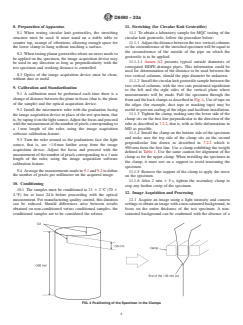
front and the back clamps as described in Fig. 4. Use of tape on
of the sample) and the optical acquisition device.
the edges (for example, duct tape or masking tape) may be
useful to prevent curling of the edges and facilitate installation.
9.2 Install the micrometric ruler with the graduation facing
11.1.3 Tighten the clamp, making sure the lower side of the
the image acquisition device in place of the test specimen, that
clamp sits on the first line perpendicular to the direction of the
is, by taping it on the light source. Adjust the fo
...
This document is not an ASTM standard and is intended only to provide the user of an ASTM standard an indication of what changes have been made to the previous version. Because
it may not be technically possible to adequately depict all changes accurately, ASTM recommends that users consult prior editions as appropriate. In all cases only the current version
of the standard as published by ASTM is to be considered the official document.
Designation: D8490 − 23 D8490 − 23a
Standard Test Method for
Determining the OpeningPore Size Characteristics of
Circular Knit Geotextiles Using an Optical Method
This standard is issued under the fixed designation D8490; the number immediately following the designation indicates the year of
original adoption or, in the case of revision, the year of last revision. A number in parentheses indicates the year of last reapproval. A
superscript epsilon (´) indicates an editorial change since the last revision or reapproval.
1. Scope
1.1 This test method covers the determination of the Image Opening Size (IOS) of a geotextile by pore size characteristics of
geotextiles using an optical method and image analysis.
1.2 This method has been developed for determination of the Image Opening Size (IOS) of knitted geotextiles by image analysis.
Other properties may be obtained based on the pore size distribution.
1.3 The applicability of this test method must be assessed on a product-by-product basis, as it requires light to pass through its
thickness to provide a useful observation. As a general rule, the tested product must be thin. Example of products which cannot
be tested using this test method is thick needle-punched nonwoven and woven with a complex three-dimensional structure.
1.4 This test method shows values in both SI units and inch-pound units. SI units is the technically correct name for the system
of metric units known as the International System of Units. Inch-pound units is the technically correct name for the customary units
used in the United States. The values in inch-pound units are provided for information only.
1.5 This standard does not purport to address all of the safety concerns, if any, associated with its use. It is the responsibility
of the user of this standard to establish appropriate safety, health, and environmental practices and determine the applicability of
regulatory limitations prior to use.
1.6 This international standard was developed in accordance with internationally recognized principles on standardization
established in the Decision on Principles for the Development of International Standards, Guides and Recommendations issued
by the World Trade Organization Technical Barriers to Trade (TBT) Committee.
2. Referenced Documents
2.1 ASTM Standards:
D123 Terminology Relating to Textiles
D4354 Practice for Sampling of Geosynthetics and Rolled Erosion Control Products (RECPs) for Testing
D4439 Terminology for Geosynthetics
D4751 Test Methods for Determining Apparent Opening Size of a Geotextile
E11 Specification for Woven Wire Test Sieve Cloth and Test Sieves
This test method is under the jurisdiction of ASTM Committee D35 on Geosynthetics and is the direct responsibility of Subcommittee D35.03 on Permeability and
Filtration.
Current edition approved Feb. 1, 2023June 15, 2023. Published February 2023June 2023. Originally approved in 2023. Last previous edition approved in 2023 as
D8490 – 23. DOI: 10.1520/D8490-23.10.1520/D8490-23A.
For referenced ASTM standards, visit the ASTM website, www.astm.org, or contact ASTM Customer Service at service@astm.org. For Annual Book of ASTM Standards
volume information, refer to the standard’s Document Summary page on the ASTM website.
Copyright © ASTM International, 100 Barr Harbor Drive, PO Box C700, West Conshohocken, PA 19428-2959. United States
D8490 − 23a
2.2 Other Standards:
ISO 12956 Geotextiles and Geotextile-Related Products—Determination of the Characteristic Opening Size
CGSB 148.1 No. 10 Methods of Testing Geosynthetics Geotextiles—Filtration Opening Size
3. Terminology
3.1 Definitions—For definitions of other textile terms used in this test method, refer to Terminology D123. For definitions of other
terms relating to geosynthetics used in this test method, refer to Terminology D4439.
3.2 Definitions of Terms Specific to This Standard:
3.2.1 circular knit, n—a structure produced by interlooping one or more ends of yarn or comparable material in a continuously
circular orientation around the fabric.
3.2.2 ellipse diameter, n—measured from the “best-fit” ellipse fitting inside a given opening.
3.2.2.1 Discussion—
The minimum and maximum ellipse diameter are the smallest and largest diameter of the ellipse fitting the inside of an opening
when varying the axis of the ellipse in the plane of observation.observation (Fig. 1).
3.2.3 Feret diameter, n—distance between two parallel lines tangent to the silhouette of the opening.
3.2.3.1 Discussion—
The minimum and maximum Feret diameter are the smallest and largest distance between two parallel lines tangent to the
opening’s silhouette when varying the angle of these lines in the plane of observation.observation (Fig. 1).
3.2.4 image opening size (IOS), n—for a knitted geotextile, a property that indicates the size of a soil particle which can be
effectively expected to pass through the geotextile.
3.2.5 opening, n—surface with an irregular shape, through which the light can pass.
FIG. 1 Feret’s and Ellipse Diameters
Available from American National Standards Institute (ANSI), 25 W. 43rd St., 4th Floor, New York, NY 10036, http://www.ansi.org.
Available from Canadian General Standards Board (CGSB), 11 Laurier St., Phase III, Place du Portage, Gatineau, Quebec K1A 0S5, Canada, http://www.tpsgc-
pwgsc.gc.ca/ongc-cgsb.
D8490 − 23a
4. Summary of Test Method
4.1 For circular knit geotextiles, a specimen is placed in a frame where its circumference will be controlled to reflect the outside
diameter of the pipe on which it will be installed. A stress is applied in the longitudinal direction to normalize the condition under
which the product will be observed.
4.2 An image of the surface of the geotextile is captured. The image is processed to determine relevant properties of each opening,
such as the minimum Feret diameter and the minimum ellipse diameter. A pore size distribution and a significant pore size defined
as the image opening size, IOS, are defined based on these observations.
NOTE 1—The minimum size of the image function should be selected considering the size of the openings of the product to be tested. For knitted geotextile
with openings up to 0.5 mm, an image 0.7 mm by 0.7 mm7.0 mm by 7.0 mm permitting the capture of 50 openings or more has been found satisfactory.
4.3 An equivalent Apparent Opening Size can be estimated based on the IOS.
5. Significance and Use
5.1 The significant opening size of geotextiles is usually determined using Test Method D4751, which involves sieving calibrated
beads through specimens of the geotextile being evaluated. However, Test Method D4751 includes many risks of errors due to
static electricity, precision of the glass beads, among other issues. This risk of error is even higher with knitted geotextiles which
exhibit a very low tensile modulus. This test method is proposed as an alternate to Test Method D4751 using a nondestructive
technique, where the stress conditions are controlled without manipulation of the specimen.
5.2 This test method has been found to provide representative results for products exhibiting a planar structure, such as
two-dimensional knits.
5.3 In case of a dispute arising from differences in reported test results when using ASTM D4751 Method A and this method,
ASTM D4751 Method A shall be considered the referee method. However, data obtained using ASTM D4751 Method A should
be reviewed considering the high risk of human error associated with the control of the stress condition of the geotextile.
5.4 Equivalency with the other pore opening size determined using other standards (for example, ISO 12956 and CGSB 148.1 No.
10) can also be considered using adequate correlations with test results obtained with these standards.
FIG. 12 Stretching Structure
Blond, E., Veermersch, O., Diederich, R., “A Comprehensive Analysis of the Measurement Techniques Used to Determine Geotextile Opening Size: AOS, FOS, O90,
and Bubble Point,” Proceedings of Geosynthetics 2015, Portland, OR, February 15–18, 2015.
D8490 − 23a
6. Apparatus
6.1 Stretching Structure—A When testing circular knit geotextiles, a structure able to control the circumference of the circular knit
geotextile, specimen and to uniformly apply a tensile stress in the machine direction. direction must be used. An example of such
a structure is presented in Fig. 12. This structure is not necessary when testing planar geotextiles where no stress needs to be
applied.
6.1.1 The structure permits clamping of the specimen on the upper end.
6.1.2 A free clamp is used on the bottom to apply a load using a dead weight.
6.1.3 Two vertical columns are installed to control the circumference of the specimen. The distance between these columns must
be adjustable and should be approximately equal distance from the centerline of the image viewing area.
6.1.4 It must be possible to stop the geotextile from creeping after some time, using a secondary clamp fixed on the frame itself.
6.1.5 The edges must be rounded to avoid accidental tear of the specimen.
6.2 Light Source, attached to the stretching structure, offering a diffused light on a surface larger than the image captured.
NOTE 2—The NERLITE BL 50×200 LED Backlight was found to be satisfactory.
6.3 Image Acquisition Device, positioned with its axis perpendicular to the plane of the geotextile. The sensor and optic used must
permit the capture of an image at least 7 mm by 7 mm, with a resolution of at least 250 pixels per millimeter length captured on
the test specimen for products with a mean opening size of 150 μm or more. Other image sizes may be considered for smaller or
bigger opening sizes.
NOTE 3—The criteria of 250 pixels per millimeter length is equivalent to one pixel for 4 μm. However, this measurement differs from the precision of
the opening size measurement considering the use of image analysis technique.
NOTE 4—The sensor Basler ace acA3800-14m 10Mp equipped with a Kowa 2/3” 10Mp LM35mm/F2.0 C-Mount lens was found to be satisfactory.
6.4 Image Processing Software, able to:
6.4.1 Process the image to define edges of the openings being measured and exclude stray yarns.
6.4.2 Determine the desirable property of each opening, such as the minimum Feret diameter, minimum ellipse diameter, area,
perimeter, and/or another property of interest.
6.4.3 Export the results for further processing.
NOTE 5—Image-J software with the Fiji extension was found to be satisfactory. It is available for free at https://imagej.net/software/fiji/downloads.
6.5 Image Analysis Routine.
NOTE 6—The routine provided in Annex A1 was found to be satisfactory for the Image-J software with the Fiji extension.
6.6 Calibrated Micrometric Ruler, 1.0 mm long or greater, graduated to 0.01 mm or less. The calibrated ruler should be on a glass
with a thickness of 1.0 6 0.1 mm.
7. Sampling and Test Specimens
7.1 Sampling:
NERLITE is a registered trademark of Microscan Systems, Inc., 700 SW 39th St. Renton, WA 98057.
D8490 − 23a
7.1.1 For manufacturer’s quality control (MQC) testing, divide rolls of circular knit geotextile fabric the product into lots and take
the lot sample as directed in Practice D4354, Section 7, Procedure B—Sampling for Manufacturer’s Quality Assurance Testing.
7.1.2 For specification conformance testing, sample as directed in Practice D4354, Section 8, Procedure C—Sampling for
Purchaser’s Specification Conformance Testing.
7.2 Test Specimens: Specimens, Circular Knit Geotextiles:
7.2.1 Cut at least three (3) specimens of the circular knit geotextile with a minimum length of 500 mm. This length may have to
be longer for products intended to be installed on pipes with a nominal diameter larger than 150 mm (6 in.).
7.2.2 Lay tubular fabric flat on a solid surface and make sure edges of fabric are parallel in the longitudinal direction. Make sure
there are no wrinkles or torque in the fabric. Draw a line perpendicular to the longitudinal edges and make sure the line is drawn
across the width of fabric touching both parallel edges. Draw a second line at the approximate location of the lower clamp (for
example, 300 to 500 mm depending on the height of the structure and how much the fabric will stretch) using the same technique
as above.
7.2.3 Make a cut 50 610 mm in the machine direction on both sides of the same end of the test specimen (Fig. 23).
7.3 Test Specimens, Planar Geotextiles:
7.3.1 Cut specimens with a size significantly larger than the observation area, to be able to hold it in place and control the distance
between the specimen and the image acquisition device. The specimen should entirely cover the light source.
8. Preparation of Apparatus
8.1 The When testing circular knit geotextiles, the stretching structure must be used. It must stand on a stable table or counter top,
exempt of vibrations, allowing enough space for the lower clamp to hang without touching a surface.
8.2 When testing planar geotextiles where no stress needs to be applied on the specimen, the image acquisition device may be used
in any direction as long as perpendicularity with the test specimen and working distance is controlled.
8.3 Optics of the image acquisition device must be clean, without dust or mold.
9. Calibration and Standardization
9.1 A calibration must be performed each time there is a change of distance between the plane in focus (that is, the plane of the
sample) and the optical acquisition device.
FIG. 23 Position of the Cuts
D8490 − 23a
9.2 Install the micrometric ruler with the graduation facing the image acquisition device in place of the test specimen, that is, by
taping it on the light source. Adjust the focus and proceed with the measurement of the number of pixels corresponding to a 1 mm
length of the ruler, using the image acquisition software calibration feature.
9.3 Turn the ruler around so the graduations face the light source, that is, are ~1.0 mm farther away from the image acquisition
device. Adjust the focus and proceed with the measurement of the number of pixels corresponding to a 1 mm length of the ruler,
using the image acquisition software calibration feature.
9.4 Average the measurements made in 9.1 and 9.2 to define the number of pixels per millimeter on the acquired image.
10. Conditioning
10.1 The samples must be conditioned to 21 6 2 °C (70 6 4 °F) for at least 24 h before proceeding with the optical measurement.
For manufacturing quality control, this duration can be reduced. Should differences arise between results obtained on
non-conditioned versus conditioned samples, the conditioned samples are to be considered the referee.
11. Stretching (for Circular Knit Geotextiles)
11.1 To obtain a labor
...