

ASTM D6213-17
(Practice)Standard Practice for Tests to Evaluate the Chemical Resistance of Geogrids to Liquids
General Information
- Abstract
SIGNIFICANCE AND USE
5.1 This practice is intended to provide a list of standard procedures for test programs investigating the chemical resistance of a geogrid to a liquid. This practice should be used in the absence of other specifications required for the particular situation being addressed.
5.2 This practice is intended to provide a basis of standardization for those wishing to compare or investigate the chemical resistance of a geogrid. It should be recognized that chemical resistance is a user judgment evaluation and that this practice does not offer procedures for interpreting the results obtained from test procedures contained in this practice. As a practice, this does not produce a test result.
5.3 This practice is for the chemical resistance assessment of geogrids and is written in parallel to similar practices for geomembranes, geotextiles, geonets, and geopipes. Each practice is to be considered individually for the geosynthetic under investigation and collectively for all geosynthetics exposed to the potentially harsh chemical environment under consideration.
SCOPE
1.1 This practice covers the procedures for testing of geogrids for chemical resistance to liquids.
1.2 This practice describes methods for measuring changes in physical and mechanical properties caused by immersion in test solutions that may be representative of anticipated end-use conditions.
1.3 This practice describes procedures for required and recommended testing of geogrids.
1.4 Evaluation or interpretation of test data is beyond the scope of this practice.
1.5 This practice is intended to be used in conjunction with Practice D5322 or Practice D5496, or both. The scope of this practice is limited to testing and reporting procedures for unexposed and exposed geogrid coupons.
1.6 This standard does not purport to address all of the safety concerns, if any, associated with its use. It is the responsibility of the user of this standard to establish appropriate safety and health practices and determine the applicability of regulatory limitations prior to use. Specific precautionary statements are given in Section 7.
1.7 This international standard was developed in accordance with internationally recognized principles on standardization established in the Decision on Principles for the Development of International Standards, Guides and Recommendations issued by the World Trade Organization Technical Barriers to Trade (TBT) Committee.
- Status
- Published
- Publication Date
- 30-Jun-2017
- Technical Committee
- D35 - Geosynthetics
- Drafting Committee
- D35.02 - Endurance Properties
Buy Documents

ASTM D6213-17 - Standard Practice for Tests to Evaluate the Chemical Resistance of Geogrids to Liquids

REDLINE ASTM D6213-17 - Standard Practice for Tests to Evaluate the Chemical Resistance of Geogrids to Liquids
Overview
ASTM D6213-17 is a standard practice developed by ASTM International for evaluating the chemical resistance of geogrids when exposed to various liquids. Geogrids are reinforcing geosynthetics commonly used in construction, civil engineering, and environmental applications where they may come into contact with potentially aggressive chemicals. This standard outlines consistent procedures to test geogrids, enabling meaningful comparison and assessment under controlled laboratory or field conditions. It is especially useful when there are no other applicable specifications for a given scenario.
Key Topics
- Testing Procedures: The standard details methods for preparing samples, immersing geogrid coupons in test liquids, and monitoring changes in their physical and mechanical properties over time.
- Assessment Criteria: Changes in properties such as visual appearance, tensile strength, and resin characteristics (e.g., melt index for polyolefin or inherent viscosity for polyester geogrids) are measured before and after exposure.
- Use of Referenced Standards: ASTM D6213-17 is intended to be used in conjunction with other standards, such as ASTM D5322 and ASTM D5496, to guide laboratory and field immersion procedures.
- Safety and Handling: The standard highlights the importance of safety and appropriate handling of hazardous chemicals during testing, including specified precautions and disposal requirements.
- Reporting Requirements: Comprehensive reporting guidelines ensure that data on sample preparation, test conditions, liquid chemistry, test methods, and results are fully documented to allow valid comparison and analysis.
Applications
ASTM D6213-17 is widely used for:
- Product Qualification: Manufacturers and project specifiers use these testing procedures to verify that geogrids will maintain their performance characteristics when exposed to various liquids, such as in landfill liners, roadway stabilization, or containment applications.
- Comparative Assessment: The standard provides a basis for comparing the chemical resistance of different geogrid products under identical test conditions.
- Standardization & Quality Assurance: Following a recognized standard helps ensure consistency in testing and reporting across different laboratories, organizations, and projects.
- Risk Assessment: Understanding the chemical resistance of geogrids supports effective design and risk mitigation in harsh or contaminated environments.
- Parallel Testing Across Geosynthetics: This practice is written to align with similar standards for other geosynthetics, including geomembranes, geotextiles, geonets, and geopipes, which is valuable in scenarios where multiple material types are exposed.
Related Standards
For comprehensive chemical resistance testing, ASTM D6213-17 references and aligns with several other ASTM standards, including:
- ASTM D5322 - Practice for Laboratory Immersion Procedures for Evaluating the Chemical Resistance of Geosynthetics to Liquids
- ASTM D5496 - Practice for In Field Immersion Testing of Geosynthetics
- ASTM D5747 - Practice for Tests to Evaluate the Chemical Resistance of Geomembranes to Liquids
- ASTM D4595 - Test Method for Tensile Properties of Geotextiles by the Wide-Width Strip Method
- ASTM D1238 - Test Method for Melt Flow Rates of Thermoplastics by Extrusion Plastometer
- ASTM D4603 - Test Method for Determining Inherent Viscosity of Poly(Ethylene Terephthalate) (PET) by Glass Capillary Viscometer
Practical Value
By following ASTM D6213-17, professionals in geotechnical engineering, environmental protection, and materials science can ensure that their geogrid products are suitable for chemically aggressive environments. This supports durability, compliance, and overall project success where geosynthetic reinforcement is exposed to challenging liquid waste or other chemicals. The standard's focus on procedure and reporting also underpins reliable quality control and facilitates transparent communication across project teams and stakeholders.
Keywords: ASTM D6213-17, geogrid, chemical resistance, geosynthetics, testing procedures, liquid exposure, civil engineering standards, quality assurance.
Relations
- Effective Date
- 01-Jul-2017
- Effective Date
- 01-Feb-2024
- Effective Date
- 01-Feb-2024
- Effective Date
- 01-Jan-2024
- Refers
ASTM D1238-23a - Standard Test Method for Melt Flow Rates of Thermoplastics by Extrusion Plastometer - Effective Date
- 15-Nov-2023
- Effective Date
- 01-Nov-2023
- Effective Date
- 01-Sep-2023
- Effective Date
- 01-Jan-2020
- Effective Date
- 01-Dec-2019
- Effective Date
- 01-Aug-2019
- Effective Date
- 15-Apr-2019
- Effective Date
- 01-Feb-2019
- Effective Date
- 01-Dec-2018
- Effective Date
- 01-Nov-2018
- Effective Date
- 01-May-2018
Buy Documents
ASTM D6213-17 - Standard Practice for Tests to Evaluate the Chemical Resistance of Geogrids to Liquids
REDLINE ASTM D6213-17 - Standard Practice for Tests to Evaluate the Chemical Resistance of Geogrids to Liquids
Get Certified
Connect with accredited certification bodies for this standard

Control Union Certifications
Global certification for agriculture and sustainability.

Hohenstein Institut
Textile testing and certification.

Bureau Veritas Bangladesh
Bureau Veritas certification services in Bangladesh.
Sponsored listings
Frequently Asked Questions
ASTM D6213-17 is a standard published by ASTM International. Its full title is "Standard Practice for Tests to Evaluate the Chemical Resistance of Geogrids to Liquids". This standard covers: SIGNIFICANCE AND USE 5.1 This practice is intended to provide a list of standard procedures for test programs investigating the chemical resistance of a geogrid to a liquid. This practice should be used in the absence of other specifications required for the particular situation being addressed. 5.2 This practice is intended to provide a basis of standardization for those wishing to compare or investigate the chemical resistance of a geogrid. It should be recognized that chemical resistance is a user judgment evaluation and that this practice does not offer procedures for interpreting the results obtained from test procedures contained in this practice. As a practice, this does not produce a test result. 5.3 This practice is for the chemical resistance assessment of geogrids and is written in parallel to similar practices for geomembranes, geotextiles, geonets, and geopipes. Each practice is to be considered individually for the geosynthetic under investigation and collectively for all geosynthetics exposed to the potentially harsh chemical environment under consideration. SCOPE 1.1 This practice covers the procedures for testing of geogrids for chemical resistance to liquids. 1.2 This practice describes methods for measuring changes in physical and mechanical properties caused by immersion in test solutions that may be representative of anticipated end-use conditions. 1.3 This practice describes procedures for required and recommended testing of geogrids. 1.4 Evaluation or interpretation of test data is beyond the scope of this practice. 1.5 This practice is intended to be used in conjunction with Practice D5322 or Practice D5496, or both. The scope of this practice is limited to testing and reporting procedures for unexposed and exposed geogrid coupons. 1.6 This standard does not purport to address all of the safety concerns, if any, associated with its use. It is the responsibility of the user of this standard to establish appropriate safety and health practices and determine the applicability of regulatory limitations prior to use. Specific precautionary statements are given in Section 7. 1.7 This international standard was developed in accordance with internationally recognized principles on standardization established in the Decision on Principles for the Development of International Standards, Guides and Recommendations issued by the World Trade Organization Technical Barriers to Trade (TBT) Committee.
SIGNIFICANCE AND USE 5.1 This practice is intended to provide a list of standard procedures for test programs investigating the chemical resistance of a geogrid to a liquid. This practice should be used in the absence of other specifications required for the particular situation being addressed. 5.2 This practice is intended to provide a basis of standardization for those wishing to compare or investigate the chemical resistance of a geogrid. It should be recognized that chemical resistance is a user judgment evaluation and that this practice does not offer procedures for interpreting the results obtained from test procedures contained in this practice. As a practice, this does not produce a test result. 5.3 This practice is for the chemical resistance assessment of geogrids and is written in parallel to similar practices for geomembranes, geotextiles, geonets, and geopipes. Each practice is to be considered individually for the geosynthetic under investigation and collectively for all geosynthetics exposed to the potentially harsh chemical environment under consideration. SCOPE 1.1 This practice covers the procedures for testing of geogrids for chemical resistance to liquids. 1.2 This practice describes methods for measuring changes in physical and mechanical properties caused by immersion in test solutions that may be representative of anticipated end-use conditions. 1.3 This practice describes procedures for required and recommended testing of geogrids. 1.4 Evaluation or interpretation of test data is beyond the scope of this practice. 1.5 This practice is intended to be used in conjunction with Practice D5322 or Practice D5496, or both. The scope of this practice is limited to testing and reporting procedures for unexposed and exposed geogrid coupons. 1.6 This standard does not purport to address all of the safety concerns, if any, associated with its use. It is the responsibility of the user of this standard to establish appropriate safety and health practices and determine the applicability of regulatory limitations prior to use. Specific precautionary statements are given in Section 7. 1.7 This international standard was developed in accordance with internationally recognized principles on standardization established in the Decision on Principles for the Development of International Standards, Guides and Recommendations issued by the World Trade Organization Technical Barriers to Trade (TBT) Committee.
ASTM D6213-17 is classified under the following ICS (International Classification for Standards) categories: 59.080.70 - Geotextiles. The ICS classification helps identify the subject area and facilitates finding related standards.
ASTM D6213-17 has the following relationships with other standards: It is inter standard links to ASTM D6213-97(2009), ASTM D4439-24, ASTM D883-24, ASTM D16-24, ASTM D1238-23a, ASTM D883-23, ASTM D5322-23, ASTM D883-20, ASTM D1695-07(2019), ASTM D883-19c, ASTM D883-19a, ASTM D883-19, ASTM D883-18a, ASTM D883-18, ASTM D4603-18. Understanding these relationships helps ensure you are using the most current and applicable version of the standard.
ASTM D6213-17 is available in PDF format for immediate download after purchase. The document can be added to your cart and obtained through the secure checkout process. Digital delivery ensures instant access to the complete standard document.
Standards Content (Sample)
This international standard was developed in accordance with internationally recognized principles on standardization established in the Decision on Principles for the
Development of International Standards, Guides and Recommendations issued by the World Trade Organization Technical Barriers to Trade (TBT) Committee.
Designation: D6213 − 17
Standard Practice for
Tests to Evaluate the Chemical Resistance of Geogrids to
Liquids
This standard is issued under the fixed designation D6213; the number immediately following the designation indicates the year of
original adoption or, in the case of revision, the year of last revision. A number in parentheses indicates the year of last reapproval. A
superscript epsilon (´) indicates an editorial change since the last revision or reapproval.
1. Scope D76 Specification for Tensile Testing Machines for Textiles
D123 Terminology Relating to Textiles
1.1 This practice covers the procedures for testing of
D883 Terminology Relating to Plastics
geogrids for chemical resistance to liquids.
D1238 Test Method for Melt Flow Rates of Thermoplastics
1.2 This practice describes methods for measuring changes
by Extrusion Plastometer
in physical and mechanical properties caused by immersion in
D1695 Terminology of Cellulose and Cellulose Derivatives
test solutions that may be representative of anticipated end-use
D4439 Terminology for Geosynthetics
conditions.
D4595 Test Method for Tensile Properties of Geotextiles by
1.3 This practice describes procedures for required and the Wide-Width Strip Method
D4603 Test Method for Determining Inherent Viscosity of
recommended testing of geogrids.
Poly(Ethylene Terephthalate) (PET) by Glass Capillary
1.4 Evaluation or interpretation of test data is beyond the
Viscometer
scope of this practice.
D5322 Practice for Laboratory Immersion Procedures for
1.5 This practice is intended to be used in conjunction with
Evaluating the Chemical Resistance of Geosynthetics to
Practice D5322 or Practice D5496, or both. The scope of this
Liquids
practice is limited to testing and reporting procedures for
D5496 Practice for In Field Immersion Testing of Geosyn-
unexposed and exposed geogrid coupons.
thetics
1.6 This standard does not purport to address all of the D5747 Practice for Tests to Evaluate the Chemical Resis-
safety concerns, if any, associated with its use. It is the tance of Geomembranes to Liquids
responsibility of the user of this standard to establish appro- E375 Definitions of Terms Relating to Resinography (With-
priate safety and health practices and determine the applica- drawn 1992)
bility of regulatory limitations prior to use. Specific precau-
3. Terminology
tionary statements are given in Section 7.
1.7 This international standard was developed in accor- 3.1 Definitions:
dance with internationally recognized principles on standard- 3.1.1 For definitions of terms used in this practice, refer to
ization established in the Decision on Principles for the Terminologies D16, D123, D883, D1695, D4439, and E375.
Development of International Standards, Guides and Recom-
4. Summary of Practice
mendations issued by the World Trade Organization Technical
Barriers to Trade (TBT) Committee. 4.1 This practice defines test methods and procedures for
evaluating the resistance of geogrids to liquid exposure by
2. Referenced Documents
monitoring physical and chemical properties of geogrid cou-
2.1 ASTM Standards:
pons after immersion in a test liquid.The physical condition of
D16 TerminologyforPaint,RelatedCoatings,Materials,and
the geogrid is monitored as a function of cumulative exposure
Applications
time by means of visual observations, and mechanical and
chemical property tests.
This practice is under the jurisdiction of ASTM Committee D35 on Geosyn-
thetics and is the direct responsibility of Subcommittee D35.02 on Endurance 5. Significance and Use
Properties.
5.1 This practice is intended to provide a list of standard
Current edition approved July 1, 2017. Published July 2017. Originally approved
procedures for test programs investigating the chemical resis-
in 1997. Last previous edition approved in 2009 as D6213 – 97 (2009). DOI:
10.1520/D6213-17.
tance of a geogrid to a liquid. This practice should be used in
For referenced ASTM standards, visit the ASTM website, www.astm.org, or
contact ASTM Customer Service at service@astm.org. For Annual Book of ASTM
Standards volume information, refer to the standard’s Document Summary page on The last approved version of this historical standard is referenced on
the ASTM website. www.astm.org.
Copyright © ASTM International, 100 Barr Harbor Drive, PO Box C700, West Conshohocken, PA 19428-2959. United States
D6213 − 17
the absence of other specifications required for the particular 9.1.1 Determine the number and dimensions of the test
situation being addressed. specimens according to the requirements of property tests
listed in Section 14 to be performed, the duration of the
5.2 This practice is intended to provide a basis of standard-
immersion, and the number of test intervals.
ization for those wishing to compare or investigate the chemi-
9.1.2 Sample—Sample in accordance with the respective
cal resistance of a geogrid. It should be recognized that
test methods selected for the geogrid.
chemical resistance is a user judgment evaluation and that this
9.1.3 Coupons—Cut coupons from geogrid sample repre-
practice does not offer procedures for interpreting the results
sentative of the geogrids being evaluated so as to provide a
obtained from test procedures contained in this practice. As a
sufficient number of specimens for each chosen property test
practice, this does not produce a test result.
and test interval. Discard any coupons that contain scratches or
5.3 This practice is for the chemical resistance assessment
other imperfections that might affect the test results, and cut
of geogrids and is written in parallel to similar practices for
replacement coupons.
geomembranes, geotextiles, geonets, and geopipes. Each prac-
9.1.4 Mix the selected coupons in a random fashion and
tice is to be considered individually for the geosynthetic under
re-select coupons for the immersion and baseline testing.
investigation and collectively for all geosynthetics exposed to
9.1.5 Specimens—After exposure, test specimens are cut
the potentially harsh chemical environment under consider-
from the coupons.
ation.
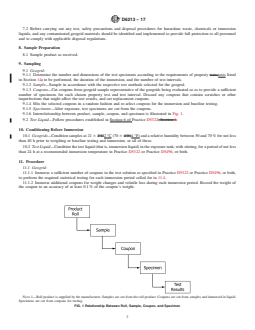
9.1.6 Interrelationship between product, sample, coupon,
and specimen is illustrated in Fig. 1.
6. Apparatus
9.2 Test Liquid—Follow procedures established in Section 6
6.1 Tensile Testing Machine—A constant-rate-of-extension
of Practice D5322.
(CRE) or constant-rate-of-traverse (CRT) type with auto-
10. Conditioning Before Immersion
graphic recorder conforming to the requirements of Specifica-
tion D76 shall be used.
10.1 Geogrids—Condition samples at 21 6 2 °C (70 6
4 °F) and a relative humidity between 50 and 70 % for not less
6.2 Testing Clamps—These clamps shall be sufficiently
than 40 h prior to weighing or baseline testing and immersion,
wide to grip the entire rib specimen and with appropriate
or all of these.
clamping power to prevent slipping or crushing (damage). The
10.2 Test Liquid—Condition the test liquid (that is, immer-
suggested style of clamp is wedge action type, commonly
available from the manufacturer of the tensile testing machine. sion liquid) in the exposure tank, with stirring, for a period of
not less than 24 h at a recommended immersion temperature in
6.3 All other required equipment is specified in the refer-
Practice D5322 or Practice D5496, or both.
enced test method standards. Refer to the appropriate standards
for a description of the apparatus necessary to perform those
11. Procedure
tests.
11.1 Geogrid:
11.1.1 Immerse a sufficient number of coupons in the test
7. Hazards
solution as specified in Practice D5322 or Practice D5496,or
7.1 Geogrids may be exposed to liquids that may contain
both, to perform the required statistical testing for each
hazardous chemicals. Appropriate precautions must be taken
immersion period called for in 11.4.
when handling hazardous waste, chemicals, and the immersion
11.1.2 Immerse additional coupons for weight changes and
solutions. Protective equipment suitable for the chemicals
volatile loss during each immersion period. Record the weight
being used must be worn by all personnel handling or exposed
of the coupon to an accuracy of at least 0.1 % of the coupon’s
to the chemicals. Particular care should be taken when opening
weight.
storage vessels at elevate
...
This document is not an ASTM standard and is intended only to provide the user of an ASTM standard an indication of what changes have been made to the previous version. Because
it may not be technically possible to adequately depict all changes accurately, ASTM recommends that users consult prior editions as appropriate. In all cases only the current version
of the standard as published by ASTM is to be considered the official document.
Designation: D6213 − 97 (Reapproved 2009) D6213 − 17
Standard Practice for
Tests to Evaluate the Chemical Resistance of Geogrids to
Liquids
This standard is issued under the fixed designation D6213; the number immediately following the designation indicates the year of
original adoption or, in the case of revision, the year of last revision. A number in parentheses indicates the year of last reapproval. A
superscript epsilon (´) indicates an editorial change since the last revision or reapproval.
1. Scope
1.1 This practice covers the procedures for testing of geogrids for chemical resistance to liquids.
1.2 This practice describes methods for measuring changes in physical and mechanical properties caused by immersion in test
solutions that may be representative of anticipated end-use conditions.
1.3 This practice describes procedures for required and recommended testing of geogrids.
1.4 Evaluation or interpretation of test data is beyond the scope of this practice.
1.5 This practice is intended to be used in conjunction with Practice D5322, or Practice D5496, or both. The scope of this
practice is limited to testing and reporting procedures for unexposed and exposed geogrid coupons.
1.6 This standard does not purport to address all of the safety concerns, if any, associated with its use. It is the responsibility
of the user of this standard to establish appropriate safety and health practices and determine the applicability of regulatory
limitations prior to use. Specific precautionary statements are given in Section 7.
1.7 This international standard was developed in accordance with internationally recognized principles on standardization
established in the Decision on Principles for the Development of International Standards, Guides and Recommendations issued
by the World Trade Organization Technical Barriers to Trade (TBT) Committee.
2. Referenced Documents
2.1 ASTM Standards:
D16 Terminology for Paint, Related Coatings, Materials, and Applications
D76 Specification for Tensile Testing Machines for Textiles
D123 Terminology Relating to Textiles
D883 Terminology Relating to Plastics
D1238 Test Method for Melt Flow Rates of Thermoplastics by Extrusion Plastometer
D1695 Terminology of Cellulose and Cellulose Derivatives
D4439 Terminology for Geosynthetics
D4595 Test Method for Tensile Properties of Geotextiles by the Wide-Width Strip Method
D4603 Test Method for Determining Inherent Viscosity of Poly(Ethylene Terephthalate) (PET) by Glass Capillary Viscometer
D5322 Practice for Laboratory Immersion Procedures for Evaluating the Chemical Resistance of Geosynthetics to Liquids
D5496 Practice for In Field Immersion Testing of Geosynthetics
D5747 Practice for Tests to Evaluate the Chemical Resistance of Geomembranes to Liquids
E375 Definitions of Terms Relating to Resinography (Withdrawn 1992)
3. Terminology
3.1 Definitions:
3.1.1 chemical resistance, n—for geosynthetics, the extent to which a material or product retains its original physical and
chemical characteristics as a function of immersion in, or contact with, a foreign substance. (D5747, D35)
This practice is under the jurisdiction of ASTM Committee D35 on Geosynthetics and is the direct responsibility of Subcommittee D35.02 on Endurance Properties.
Current edition approved June 1, 2009July 1, 2017. Published July 2009July 2017. Originally approved in 1997. Last previous edition approved in 20032009 as D6213 - 97
(2003).D6213 – 97 (2009). DOI: 10.1520/D6213-97R09.10.1520/D6213-17.
For referenced ASTM standards, visit the ASTM website, www.astm.org, or contact ASTM Customer Service at service@astm.org. For Annual Book of ASTM Standards
volume information, refer to the standard’s Document Summary page on the ASTM website.
The last approved version of this historical standard is referenced on www.astm.org.
Copyright © ASTM International, 100 Barr Harbor Drive, PO Box C700, West Conshohocken, PA 19428-2959. United States
D6213 − 17
3.1.1 For definitions of terms used in this practice, refer to Terminologies D16, D123, D883, D1695, D4439, and E375.
3.1.2 coating, n—a liquid, liquefiable or mastic composition that is converted to a solid protected, decorative, or functional
adherent film after application as a thin layer. (D16, D01)
3.1.3 coupon, n—a portion of a material or laboratory sample, from which multiple specimens can be taken for testing. (D5747,
D35)
3.1.4 composite, n—a material made up of distinct parts which contribute, either proportionately, or synergistically, to the
properties of the combination. (E375, D20)
3.1.5 geogrid, n—a reinforcing geosynthetic comprised of integrally connected elements with in-plane apertures between
elements. (D4439, D35)
3.1.6 geosynthetic, n—a planar product manufactured from polymeric material used with soil, rock, earth, or other geotechnical
engineering related material as an integral part of a man made project, structure, or system. (D4439, D35)
3.1.7 inherent viscosity—the quotient of the natural logarithm of relative viscosity by the concentration, that is in η /c. (D1695,
rel
D01)
3.1.8 integral, adj—in geosynthetics, forming a necessary part of the whole; a constituent. (D4439, D35)
3.1.9 relative viscosity—the ratio of the viscosity of a solution to that of the pure solvent. (D1695, D01)
3.1.10 melt index, n—the flow rate of PE material when measured in accordance with Test Method D1238.
3.1.11 polyester, n—a polymer in which the repeated structural unit in the chain is of the ester type. (D883, D20)
3.1.12 polyolefin, n—a polymer prepared by the polymerization of an olefin(s) as the sole monomer(s). (D883, D20)
3.1.13 sample, n—a portion of a lot of material that is taken for incubation, testing, or for record purposes. (D123, D13)
3.1.14 specimen, n—a specific portion of a material or laboratory sample upon which a test is performed or which is taken for
that purpose. (D4439, D35)
4. Summary of Practice
4.1 This practice defines test methods and procedures for evaluating the resistance of geogrids to liquid exposure by monitoring
physical and chemical properties of geogrid coupons after immersion in a test liquid. The physical condition of the geogrid is
monitored as a function of cumulative exposure time by means of visual observations, and mechanical and chemical property tests.
5. Significance and Use
5.1 This practice is intended to provide a list of standard procedures for test programs investigating the chemical resistance of
a geogrid to a liquid. This practice should be used in the absence of other specifications required for the particular situation being
addressed.
5.2 This practice is intended to provide a basis of standardization for those wishing to compare or investigate the chemical
resistance of a geogrid. It should be recognized that chemical resistance is a user judgment evaluation and that this practice does
not offer procedures for interpreting the results obtained from test procedures contained in this practice. As a practice, this does
not produce a test result.
5.3 This practice is for the chemical resistance assessment of geogrids and is written in parallel to similar practices for
geomembranes, geotextiles, geonets, and geopipes. Each practice is to be considered individually for the geosynthetic under
investigation and collectively for all geosynthetics exposed to the potentially harsh chemical environment under consideration.
6. Apparatus
6.1 Tensile Testing Machine—A constant-rate-of-extension (CRE) or constant-rate-of-traverse (CRT) type with autographic
recorder conforming to the requirements of Specification D76 shall be used.
6.2 Testing Clamps—These clamps shall be sufficiently wide to grip the entire rib specimen and with appropriate clamping
power to prevent slipping or crushing (damage). The suggested style of clamp is wedge action type, commonly available from the
manufacturer of the tensile testing machine.
6.3 All other required equipment is specified in the referenced test method standards. Refer to the appropriate standards for a
description of the apparatus necessary to perform those tests.
7. Hazards
7.1 Geogrids may be exposed to liquids that may contain hazardous chemicals. Appropriate precautions must be taken when
handling hazardous waste, chemicals, and the immersion solutions. Protective equipment suitable for the chemicals being used
must be worn by all personnel handling or exposed to the chemicals. Particular care should be taken when opening storage vessels
at elevated temperatures due to the increased volatility of organics and the increased activity of acids and bases. Care must also
be taken to prevent the spilling of hazardous materials and provisions must be made to clean up any accidental spills that do occur.
D6213 − 17
7.2 Before carrying out any test, safety precautions and disposal procedures for hazardous waste, chemicals or immersion
liquids, and any contaminated geogrid materials should be identified and implemented to provide full protection to all personnel
and to comply with applicable disposal regulations.
8. Sample Preparation
8.1 Sample product as received.
9. Sampling
9.1 Geogrid:
9.1.1 Determine the number and dimensions of the test specimens according to the requirements of property tests,tests listed
in Section 14, to be performed, the duration of the immersion, and the number of test intervals.
9.1.2 Sample—Sample in accordanc
...