

ASTM D4892-14(2019)e1
(Test Method)Standard Test Method for Density of Solid Pitch (Helium Pycnometer Method)
General Information
- Abstract
SIGNIFICANCE AND USE
5.1 This test method is useful in characterizing pitches as one element in establishing uniformity of shipments and sources of supply. With this method, the density is determined to two decimal places, which is sufficient for most applications. If a more precise measurement is required (three decimal places), use Test Methods D2320 or D71.
SCOPE
1.1 This test method covers the determination of pitch density by helium pycnometer. It is applicable at a range of room temperatures of 15 °C to 35 °C.
1.2 The values stated in SI units are to be regarded as standard. No other units of measurement are included in this standard.
1.3 This standard does not purport to address all of the safety concerns, if any, associated with its use. It is the responsibility of the user of this standard to establish appropriate safety, health, and environmental practices and determine the applicability of regulatory limitations prior to use.
1.4 This international standard was developed in accordance with internationally recognized principles on standardization established in the Decision on Principles for the Development of International Standards, Guides and Recommendations issued by the World Trade Organization Technical Barriers to Trade (TBT) Committee.
- Status
- Published
- Publication Date
- 31-May-2019
- Technical Committee
- D02 - Petroleum Products, Liquid Fuels, and Lubricants
- Drafting Committee
- D02.05 - Properties of Fuels, Petroleum Coke and Carbon Material


Overview
ASTM D4892-14(2019)e1: Standard Test Method for Density of Solid Pitch (Helium Pycnometer Method) is an internationally recognized standard that outlines a reliable method for measuring the density of solid pitch using a helium pycnometer. Developed by ASTM International, this standard ensures consistency in testing and reporting across laboratories and industries. Determining pitch density is vital for material characterization, quality assurance, and establishing uniformity in shipments and supply sources, particularly in industries utilizing petroleum-based and carbon materials.
Key Topics
- Measurement Range: The test is applicable to solid pitch samples at room temperatures between 15 °C and 35 °C.
- SI Units: All values and calculations are expressed in standard SI units, specifically grams per cubic centimeter (g/cm³).
- Helium Pycnometer: The method employs a helium pycnometer for precise volume measurement, as helium penetrates small pores and results in accurate density determination.
- Sample Preparation: Samples are crushed and sieved to a controlled particle size to ensure representative and repeatable results.
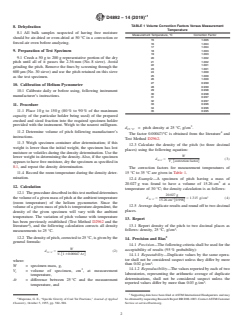
- Temperature Correction: Density values are corrected to a standard temperature of 25 °C using established correction factors to account for thermal expansion or contraction.
- Precision: The procedure is precise to two decimal places, which meets most industrial needs. For even higher precision (three decimal places), referenced test methods such as ASTM D2320 or D71 should be used.
- Safety Responsibility: Users must ensure all safety, health, and environmental practices are observed and comply with regulatory requirements.
Applications
This standard is widely used across various sectors that demand accurate density data for solid pitch, including:
- Quality Control: Ensuring material consistency across different batches and sources of pitch, which is crucial for both suppliers and buyers.
- Specification Compliance: Meeting contractual and regulatory requirements regarding material properties, especially in the petroleum, aluminum, and carbon materials industries.
- Product Development: Assisting in material research and process optimization by providing consistent and reproducible density measurements.
- Shipment Verification: Supporting uniformity in shipments by providing a standardized method for density verification.
- Reference Testing: Serving as a reference point for studies involving density-dependent properties of solid pitches and related materials.
Related Standards
The following standards complement or provide alternative approaches to the procedures in ASTM D4892-14(2019)e1:
- ASTM D71: Test Method for Relative Density of Solid Pitch and Asphalt (Displacement Method) - an alternative for determining pitch density, using water displacement.
- ASTM D2320: Test Method for Density (Relative Density) of Solid Pitch (Pycnometer Method) - allows for measurement to three decimal places, providing higher precision.
- ASTM D2962: Practice for Calculating Volume-Temperature Correction for Coal-Tar Pitches - offers guidance for temperature corrections during density measurements.
- ASTM D4296: Practice for Sampling Pitch - outlines proper procedures for obtaining representative samples.
- ASTM E11: Specification for Woven Wire Test Sieve Cloth and Test Sieves - relevant for sample preparation through sieving.
Keywords: density of solid pitch, helium pycnometer, ASTM D4892, pitch density testing, SI units, temperature correction, petroleum pitch characterization.
By following ASTM D4892-14(2019)e1, laboratories and industry professionals can achieve consistent, accurate, and internationally recognized results when determining the density of solid pitch, supporting quality and compliance across a broad range of applications.
Relations
- Replaces
ASTM D4892-14 - Standard Test Method for Density of Solid Pitch (Helium Pycnometer Method) - Effective Date
- 01-Jun-2019
- Effective Date
- 01-Mar-2024
- Refers
ASTM D2962-23 - Standard Practice for Calculating Volume-Temperature Correction For Coal-Tar Pitches - Effective Date
- 01-Oct-2023
- Effective Date
- 01-Dec-2019
- Effective Date
- 01-Jan-2019
- Effective Date
- 01-Dec-2018
- Effective Date
- 01-Apr-2015
- Effective Date
- 01-Apr-2015
- Effective Date
- 01-Oct-2013
- Effective Date
- 01-Nov-2012
- Refers
ASTM D2962-10 - Standard Practice for Calculating Volume-Temperature Correction For Coal-Tar Pitches - Effective Date
- 01-Oct-2010
- Effective Date
- 01-Oct-2009
- Effective Date
- 01-Oct-2009
- Effective Date
- 01-May-2009
- Effective Date
- 01-Dec-2008
Get Certified
Connect with accredited certification bodies for this standard

Element Materials Technology
Materials testing and product certification.

ABS Group Brazil
ABS Group certification services in Brazil.

ABS Quality Evaluations Inc.
American Bureau of Shipping quality certification.
Sponsored listings
Frequently Asked Questions
ASTM D4892-14(2019)e1 is a standard published by ASTM International. Its full title is "Standard Test Method for Density of Solid Pitch (Helium Pycnometer Method)". This standard covers: SIGNIFICANCE AND USE 5.1 This test method is useful in characterizing pitches as one element in establishing uniformity of shipments and sources of supply. With this method, the density is determined to two decimal places, which is sufficient for most applications. If a more precise measurement is required (three decimal places), use Test Methods D2320 or D71. SCOPE 1.1 This test method covers the determination of pitch density by helium pycnometer. It is applicable at a range of room temperatures of 15 °C to 35 °C. 1.2 The values stated in SI units are to be regarded as standard. No other units of measurement are included in this standard. 1.3 This standard does not purport to address all of the safety concerns, if any, associated with its use. It is the responsibility of the user of this standard to establish appropriate safety, health, and environmental practices and determine the applicability of regulatory limitations prior to use. 1.4 This international standard was developed in accordance with internationally recognized principles on standardization established in the Decision on Principles for the Development of International Standards, Guides and Recommendations issued by the World Trade Organization Technical Barriers to Trade (TBT) Committee.
SIGNIFICANCE AND USE 5.1 This test method is useful in characterizing pitches as one element in establishing uniformity of shipments and sources of supply. With this method, the density is determined to two decimal places, which is sufficient for most applications. If a more precise measurement is required (three decimal places), use Test Methods D2320 or D71. SCOPE 1.1 This test method covers the determination of pitch density by helium pycnometer. It is applicable at a range of room temperatures of 15 °C to 35 °C. 1.2 The values stated in SI units are to be regarded as standard. No other units of measurement are included in this standard. 1.3 This standard does not purport to address all of the safety concerns, if any, associated with its use. It is the responsibility of the user of this standard to establish appropriate safety, health, and environmental practices and determine the applicability of regulatory limitations prior to use. 1.4 This international standard was developed in accordance with internationally recognized principles on standardization established in the Decision on Principles for the Development of International Standards, Guides and Recommendations issued by the World Trade Organization Technical Barriers to Trade (TBT) Committee.
ASTM D4892-14(2019)e1 is classified under the following ICS (International Classification for Standards) categories: 75.140 - Waxes, bituminous materials and other petroleum products. The ICS classification helps identify the subject area and facilitates finding related standards.
ASTM D4892-14(2019)e1 has the following relationships with other standards: It is inter standard links to ASTM D4892-14, ASTM D4296-24, ASTM D2962-23, ASTM D71-94(2019), ASTM D2962-10(2019), ASTM D4296-18, ASTM D4296-83(2015)e1, ASTM D71-94(2015)e1, ASTM E11-13, ASTM D2320-98(2012), ASTM D2962-10, ASTM D4296-83(2009), ASTM D71-94(2009), ASTM E11-09e1, ASTM D2320-98(2008). Understanding these relationships helps ensure you are using the most current and applicable version of the standard.
ASTM D4892-14(2019)e1 is available in PDF format for immediate download after purchase. The document can be added to your cart and obtained through the secure checkout process. Digital delivery ensures instant access to the complete standard document.
Standards Content (Sample)
This international standard was developed in accordance with internationally recognized principles on standardization established in the Decision on Principles for the
Development of International Standards, Guides and Recommendations issued by the World Trade Organization Technical Barriers to Trade (TBT) Committee.
´1
Designation: D4892 − 14 (Reapproved 2019)
Standard Test Method for
Density of Solid Pitch (Helium Pycnometer Method)
This standard is issued under the fixed designation D4892; the number immediately following the designation indicates the year of
original adoption or, in the case of revision, the year of last revision. A number in parentheses indicates the year of last reapproval. A
superscript epsilon (´) indicates an editorial change since the last revision or reapproval.
This standard has been approved for use by agencies of the U.S. Department of Defense.
ε NOTE—SI units formatting was corrected editorially throughout in July 2019.
1. Scope 3. Terminology
1.1 This test method covers the determination of pitch 3.1 Definitions of Terms Specific to This Standard:
density by helium pycnometer. It is applicable at a range of 3.1.1 density, as determined by this test method— the mass
room temperatures of 15 °C to 35 °C. per unit volume and shall be reported as follows:
1.2 The values stated in SI units are to be regarded as density, 25 °C, g/cm ~grams per cubic centimeter! (1)
standard. No other units of measurement are included in this
4. Summary of Test Method
standard.
1.3 This standard does not purport to address all of the
4.1 The sample is pulverized and screened to a given
safety concerns, if any, associated with its use. It is the fraction, then the volume of a weighed portion of the fraction
responsibility of the user of this standard to establish appro-
is determined using a helium pycnometer.
priate safety, health, and environmental practices and deter-
mine the applicability of regulatory limitations prior to use.
5. Significance and Use
1.4 This international standard was developed in accor-
5.1 This test method is useful in characterizing pitches as
dance with internationally recognized principles on standard-
one element in establishing uniformity of shipments and
ization established in the Decision on Principles for the
sources of supply. With this method, the density is determined
Development of International Standards, Guides and Recom-
totwodecimalplaces,whichissufficientformostapplications.
mendations issued by the World Trade Organization Technical
If a more precise measurement is required (three decimal
Barriers to Trade (TBT) Committee.
places), use Test Methods D2320 or D71.
2. Referenced Documents
6. Apparatus
2.1 ASTM Standards:
6.1 Helium Pycnometer.
D71 Test Method for Relative Density of Solid Pitch and
6.2 Balance, capable of weighing a 150 g specimen to
Asphalt (Displacement Method)
within 1 mg.
D2320 Test Method for Density (Relative Density) of Solid
Pitch (Pycnometer Method)
6.3 Sieves, U.S. Standard 2.36 mm (No. 8), 600 µm
D2962 Practice for Calculating Volume-Temperature Cor-
(No. 30), conforming to Specification E11.
rection For Coal-Tar Pitches
6.4 Thermometer, for measuring room temperature.
D4296 Practice for Sampling Pitch
E11 Specification for Woven Wire Test Sieve Cloth and Test
7. Bulk Sampling
Sieves
7.1 Samples from shipments shall be taken in accordance
with Practice D4296 and shall be free of foreign substances.
This test method is under the jurisdiction of ASTM Committee D02 on
Petroleum Products, Liquid Fuels, and Lubricants and is the direct responsibility of
SubcommitteeD02.05onPropertiesofFuels,PetroleumCokeandCarbonMaterial.
CurrenteditionapprovedJune1,2019.PublishedJuly2019.Originallyapproved Helium pycnometers available from the following suppliers have been found
in 1989. Last previous edition approved in 2014 as D4892 – 14. DOI: 10.1520/ satisfactory for this purpose: (a) Beckman 2500 Harbor Blvd., Fullerton, CA, (b)
D4892-14R19E01. Micromeritics, 5680 Goshen Springs Rd., Norcross, GA, and (c) Quantachrome, 5
For referenced ASTM standards, visit the ASTM website, www.astm.org, or Aerial Way, Syosset, NY. If you are aware of alternative suppliers, please provide
contact ASTM Customer Service at service@astm.org. For Annual Book of ASTM this information to ASTM International Headquarters. Your comments will receive
Standards volume information, refer to the standard’s Document Summary page on careful consideration at a meeting of the responsible technical committee, which
the ASTM website. you may attend.
Copyright © ASTM International, 100 Barr Harbor Drive, PO Box C700, West Conshohocken, PA 19428-2959. United States
´1
D4892 − 14 (2019)
TABLE 1 Volume Correction Factors Versus Measurement
8. Dehydration
Temperature
8.1 All bulk samples suspected of having free moisture
Measurement Temperature, °C Correction Factor
should be air-dried or oven-dried at 50 °C in a convection or
15 1.005
forced-air oven before analyzing.
16 1.004
17 1.004
9. Preparation of Test Specimen 18 1.003
19 1.003
9.1 Crush a 50 g to 200 g representative portion of the dry
20 1.002
21 1.002
pitch until all of it passes the 2.36 mm (No. 8 sieve). Avoid
22 1.001
grinding the pitch. Remove the fines by screening through the
23 1.001
600 µm (No. 30 sieve
...