

ASTM D2962-23
(Practice)Standard Practice for Calculating Volume-Temperature Correction For Coal-Tar Pitches
General Information
- Abstract
SIGNIFICANCE AND USE
5.1 Coal tar pitch is shipped or stored, or both, at various temperatures, consequently a means is required to correct volume to a specified temperature.
SCOPE
1.1 This practice covers calculation of the amount of expansion or contraction of a volume of liquid coal-tar pitch due to a change of temperature.
1.2 The values stated in inch-pound units are to be regarded as standard. The values given in parentheses are mathematical conversions to SI units that are provided for information only and are not considered standard.
1.3 This standard does not purport to address all of the safety concerns, if any, associated with its use. It is the responsibility of the user of this standard to establish appropriate safety, health, and environmental practices and determine the applicability of regulatory limitations prior to use.
1.4 This international standard was developed in accordance with internationally recognized principles on standardization established in the Decision on Principles for the Development of International Standards, Guides and Recommendations issued by the World Trade Organization Technical Barriers to Trade (TBT) Committee.
- Status
- Published
- Publication Date
- 30-Sep-2023
- Technical Committee
- D02 - Petroleum Products, Liquid Fuels, and Lubricants
- Drafting Committee
- D02.02 - Hydrocarbon Measurement for Custody Transfer (Joint ASTM-API)
Buy Documents
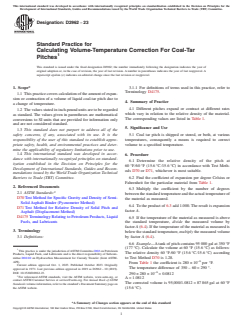


ASTM D2962-23 - Standard Practice for Calculating Volume-Temperature Correction For Coal-Tar Pitches
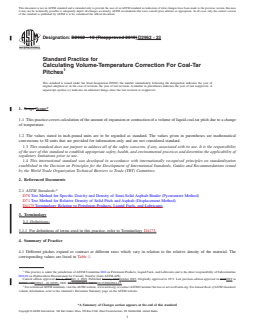


REDLINE ASTM D2962-23 - Standard Practice for Calculating Volume-Temperature Correction For Coal-Tar Pitches
Overview
ASTM D2962-23 - Standard Practice for Calculating Volume-Temperature Correction For Coal-Tar Pitches establishes a consistent method for calculating the expansion or contraction of liquid coal-tar pitch volumes in response to temperature changes. Since coal-tar pitch is commonly shipped and stored at varying temperatures, accurate volume measurement is essential for inventory management, custody transfer, and compliance with quality assurance protocols.
This ASTM practice ensures reliable and repeatable results in determining and correcting the measured volume of coal-tar pitch to a specified reference temperature, typically 60 °F (15.6 °C). The procedure uses relative density along with the coefficient of expansion to derive the necessary correction factor.
Key Topics
- Volume-Temperature Correction: This standard details how to convert the measured volume of liquid coal-tar pitch at any given temperature to its equivalent at a standard reference temperature.
- Relative Density Measurement: It references practices for determining the relative density of coal-tar pitch at standard conditions using specified ASTM test methods.
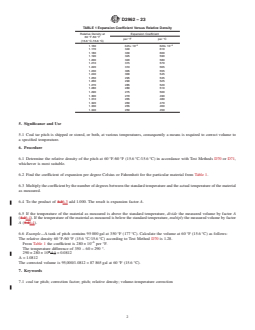
- Expansion Coefficient: Provides a tabulated relationship between relative density and the pitch’s expansion coefficient, which is essential for accurate volume correction.
- Inch-Pound and SI Units: The procedure utilizes inch-pound units as the primary standard, including SI conversions for informational purposes.
- Safety and Regulatory Compliance: Users of this standard are responsible for ensuring proper safety, health, and environmental practices are followed during application.
Applications
The ASTM D2962-23 standard practice is widely used in industries involving coal-tar pitches, such as:
- Petroleum Products Storage and Shipping: Ensuring accurate inventory and transfer measurements in tanks and pipelines, accounting for temperature-induced volume changes.
- Quality Control in Manufacturing: Supporting batch consistency by standardizing product volume at a reference temperature.
- Trade and Custody Transfer: Providing a recognized calculation method to ensure that traded volumes are consistent and fair regardless of shipping or storage temperature fluctuations.
- Regulatory Reporting: Assisting companies in meeting reporting requirements by standardizing measured quantities, thus enabling regulatory compliance and fit-for-purpose documentation.
This standard is especially vital in environments where coal-tar pitch is handled in bulk and temperature variations are significant.
Related Standards
Several ASTM standards are referenced or closely related to ASTM D2962-23, including:
- ASTM D70: Test Method for Specific Gravity and Density of Semi-Solid Asphalt Binder (Pycnometer Method), useful for measuring the density of semi-solid materials.
- ASTM D71: Test Method for Relative Density of Solid Pitch and Asphalt (Displacement Method), relevant for solids and semi-solids related to coal-tar pitches.
- ASTM D4175: Terminology Relating to Petroleum Products, Liquid Fuels, and Lubricants, providing definitions that ensure clear and consistent language in the petroleum industry.
By adhering to ASTM D2962-23, organizations ensure improved accuracy in volume correction for coal-tar pitches, facilitating better operational efficiency and contractual fairness. This standard plays a crucial role in quality management, inventory precision, and regulatory compliance within industries handling coal-tar pitch and similar thermally sensitive materials.
Relations
- Effective Date
- 01-Oct-2023
- Refers
ASTM D4175-23a - Standard Terminology Relating to Petroleum Products, Liquid Fuels, and Lubricants - Effective Date
- 15-Dec-2023
- Refers
ASTM D4175-23e1 - Standard Terminology Relating to Petroleum Products, Liquid Fuels, and Lubricants - Effective Date
- 01-Jul-2023
- Refers
ASTM D4175-23 - Standard Terminology Relating to Petroleum Products, Liquid Fuels, and Lubricants - Effective Date
- 01-Jul-2023
- Referred By
ASTM D4892-14(2019)e1 - Standard Test Method for Density of Solid Pitch (Helium Pycnometer Method) - Effective Date
- 01-Oct-2023
Buy Documents
ASTM D2962-23 - Standard Practice for Calculating Volume-Temperature Correction For Coal-Tar Pitches
REDLINE ASTM D2962-23 - Standard Practice for Calculating Volume-Temperature Correction For Coal-Tar Pitches
Get Certified
Connect with accredited certification bodies for this standard

DIBt (Deutsches Institut für Bautechnik)
German Institute for Building Technology.
DIN CERTCO
DIN Group product certification.

Aboma Certification B.V.
Specialized in construction, metal, and transport sectors.
Sponsored listings
Frequently Asked Questions
ASTM D2962-23 is a standard published by ASTM International. Its full title is "Standard Practice for Calculating Volume-Temperature Correction For Coal-Tar Pitches". This standard covers: SIGNIFICANCE AND USE 5.1 Coal tar pitch is shipped or stored, or both, at various temperatures, consequently a means is required to correct volume to a specified temperature. SCOPE 1.1 This practice covers calculation of the amount of expansion or contraction of a volume of liquid coal-tar pitch due to a change of temperature. 1.2 The values stated in inch-pound units are to be regarded as standard. The values given in parentheses are mathematical conversions to SI units that are provided for information only and are not considered standard. 1.3 This standard does not purport to address all of the safety concerns, if any, associated with its use. It is the responsibility of the user of this standard to establish appropriate safety, health, and environmental practices and determine the applicability of regulatory limitations prior to use. 1.4 This international standard was developed in accordance with internationally recognized principles on standardization established in the Decision on Principles for the Development of International Standards, Guides and Recommendations issued by the World Trade Organization Technical Barriers to Trade (TBT) Committee.
SIGNIFICANCE AND USE 5.1 Coal tar pitch is shipped or stored, or both, at various temperatures, consequently a means is required to correct volume to a specified temperature. SCOPE 1.1 This practice covers calculation of the amount of expansion or contraction of a volume of liquid coal-tar pitch due to a change of temperature. 1.2 The values stated in inch-pound units are to be regarded as standard. The values given in parentheses are mathematical conversions to SI units that are provided for information only and are not considered standard. 1.3 This standard does not purport to address all of the safety concerns, if any, associated with its use. It is the responsibility of the user of this standard to establish appropriate safety, health, and environmental practices and determine the applicability of regulatory limitations prior to use. 1.4 This international standard was developed in accordance with internationally recognized principles on standardization established in the Decision on Principles for the Development of International Standards, Guides and Recommendations issued by the World Trade Organization Technical Barriers to Trade (TBT) Committee.
ASTM D2962-23 is classified under the following ICS (International Classification for Standards) categories: 91.100.50 - Binders. Sealing materials. The ICS classification helps identify the subject area and facilitates finding related standards.
ASTM D2962-23 has the following relationships with other standards: It is inter standard links to ASTM D2962-10(2019), ASTM D4175-23a, ASTM D4175-23e1, ASTM D4175-23, ASTM D4892-14(2019)e1. Understanding these relationships helps ensure you are using the most current and applicable version of the standard.
ASTM D2962-23 is available in PDF format for immediate download after purchase. The document can be added to your cart and obtained through the secure checkout process. Digital delivery ensures instant access to the complete standard document.
Standards Content (Sample)
This international standard was developed in accordance with internationally recognized principles on standardization established in the Decision on Principles for the
Development of International Standards, Guides and Recommendations issued by the World Trade Organization Technical Barriers to Trade (TBT) Committee.
Designation: D2962 − 23
Standard Practice for
Calculating Volume-Temperature Correction For Coal-Tar
Pitches
This standard is issued under the fixed designation D2962; the number immediately following the designation indicates the year of
original adoption or, in the case of revision, the year of last revision. A number in parentheses indicates the year of last reapproval. A
superscript epsilon (´) indicates an editorial change since the last revision or reapproval.
1. Scope* 3.1.1 For definitions of terms used in this practice, refer to
Terminology D4175.
1.1 This practice covers calculation of the amount of expan-
sion or contraction of a volume of liquid coal-tar pitch due to
4. Summary of Practice
a change of temperature.
4.1 Different pitches expand or contract at different rates
1.2 The values stated in inch-pound units are to be regarded
which vary in relation to the relative density of the material.
as standard. The values given in parentheses are mathematical
The corresponding values are listed in Table 1.
conversions to SI units that are provided for information only
and are not considered standard.
5. Significance and Use
1.3 This standard does not purport to address all of the
safety concerns, if any, associated with its use. It is the 5.1 Coal tar pitch is shipped or stored, or both, at various
responsibility of the user of this standard to establish appro- temperatures, consequently a means is required to correct
priate safety, health, and environmental practices and deter- volume to a specified temperature.
mine the applicability of regulatory limitations prior to use.
1.4 This international standard was developed in accor-
6. Procedure
dance with internationally recognized principles on standard-
6.1 Determine the relative density of the pitch at
ization established in the Decision on Principles for the
60 °F ⁄60 °F (15.6 °C ⁄15.6 °C) in accordance with Test Meth-
Development of International Standards, Guides and Recom-
ods D70 or D71, whichever is most suitable.
mendations issued by the World Trade Organization Technical
6.2 Find the coefficient of expansion per degree Celsius or
Barriers to Trade (TBT) Committee.
Fahrenheit for the particular material from Table 1.
2. Referenced Documents
6.3 Multiply the coefficient by the number of degrees
2.1 ASTM Standards:
between the standard temperature and the actual temperature of
D70 Test Method for Specific Gravity and Density of Semi-
the material as measured.
Solid Asphalt Binder (Pycnometer Method)
6.4 To the product of 6.3 add 1.000. The result is expansion
D71 Test Method for Relative Density of Solid Pitch and
factor A.
Asphalt (Displacement Method)
D4175 Terminology Relating to Petroleum Products, Liquid
6.5 If the temperature of the material as measured is above
Fuels, and Lubricants
the standard temperature, divide the measured volume by
factor A (6.4). If the temperature of the material as measured is
3. Terminology
below the standard temperature, multiply the measured volume
by factor A (6.4).
3.1 Definitions:
6.6 Example—A tank of pitch contains 95 000 gal at 350 °F
(177 °C). Calculate the volume at 60 °F (15.6 °C) as follows:
This practice is under the jurisdiction of ASTM Committee
...
This document is not an ASTM standard and is intended only to provide the user of an ASTM standard an indication of what changes have been made to the previous version. Because
it may not be technically possible to adequately depict all changes accurately, ASTM recommends that users consult prior editions as appropriate. In all cases only the current version
of the standard as published by ASTM is to be considered the official document.
Designation: D2962 − 10 (Reapproved 2019) D2962 − 23
Standard Practice for
Calculating Volume-Temperature Correction For Coal-Tar
Pitches
This standard is issued under the fixed designation D2962; the number immediately following the designation indicates the year of
original adoption or, in the case of revision, the year of last revision. A number in parentheses indicates the year of last reapproval. A
superscript epsilon (´) indicates an editorial change since the last revision or reapproval.
1. Scope Scope*
1.1 This practice covers calculation of the amount of expansion or contraction of a volume of liquid coal-tar pitch due to a change
of temperature.
1.2 The values stated in inch-pound units are to be regarded as standard. The values given in parentheses are mathematical
conversions to SI units that are provided for information only and are not considered standard.
1.3 This standard does not purport to address all of the safety concerns, if any, associated with its use. It is the responsibility
of the user of this standard to establish appropriate safety, health, and environmental practices and determine the applicability of
regulatory limitations prior to use.
1.4 This international standard was developed in accordance with internationally recognized principles on standardization
established in the Decision on Principles for the Development of International Standards, Guides and Recommendations issued
by the World Trade Organization Technical Barriers to Trade (TBT) Committee.
2. Referenced Documents
2.1 ASTM Standards:
D70 Test Method for Specific Gravity and Density of Semi-Solid Asphalt Binder (Pycnometer Method)
D71 Test Method for Relative Density of Solid Pitch and Asphalt (Displacement Method)
D4175 Terminology Relating to Petroleum Products, Liquid Fuels, and Lubricants
3. Terminology
3.1 Definitions:
3.1.1 For definitions of terms used in this practice, refer to Terminology D4175.
4. Summary of Practice
4.1 Different pitches expand or contract at different rates which vary in relation to the relative density of the material. The
corresponding values are listed in Table 1.
This practice is under the jurisdiction of ASTM Committee D02 on Petroleum Products, Liquid Fuels, and Lubricants and is the direct responsibility of Subcommittee
D02.02 on Hydrocarbon Measurement for Custody Transfer (Joint ASTM-API).
Current edition approved Jan. 1, 2019Oct. 1, 2023. Published January 2019October 2023. Originally approved in 1971. Last previous edition approved in 20102019 as
D2962 – 10.D2962 – 10 (2019). DOI: 10.1520/D2962-10R19.10.1520/D2962-23.
For referenced ASTM standards, visit the ASTM website, www.astm.org, or contact ASTM Customer Service at service@astm.org. For Annual Book of ASTM Standards
volume information, refer to the standard’s Document Summary page on the ASTM website.
*A Summary of Changes section appears at the end of this standard
Copyright © ASTM International, 100 Barr Harbor Drive, PO Box C700, West Conshohocken, PA 19428-2959. United States
D2962 − 23
TABLE 1 Expansion Coefficient Versus Relative Density
Relative Density at Expansion Coefficient
60 °F ⁄60 °F
per °F per °C
(15.6 °C ⁄15.6
...