

ASTM D2416-20
(Test Method)Standard Test Method for Coking Value of Tar and Pitch (Modified Conradson)
General Information
- Abstract
SIGNIFICANCE AND USE
4.1 This test method is useful for indicating the relative coke-forming propensities and for evaluating and characterizing tars and pitches. This test method can also be used as one element in establishing the uniformity of shipments or sources of supply.
SCOPE
1.1 This test method covers the determination of the coking value of tar and pitch having an ash content not over 0.5 % as determined by Test Method D2415.
1.2 Coking values by this test method are practically the same as those obtained by Test Method D189, but results are more reproducible. The apparatus used is identical, except that an electric furnace is substituted for the gas flame.
1.3 The values stated in SI units are to be regarded as standard. No other units of measurement are included in this standard.
1.4 This standard does not purport to address all of the safety concerns, if any, associated with its use. It is the responsibility of the user of this standard to establish appropriate safety, health, and environmental practices and determine the applicability of regulatory limitations prior to use.
1.5 This international standard was developed in accordance with internationally recognized principles on standardization established in the Decision on Principles for the Development of International Standards, Guides and Recommendations issued by the World Trade Organization Technical Barriers to Trade (TBT) Committee.
- Status
- Published
- Publication Date
- 31-May-2020
- Technical Committee
- D02 - Petroleum Products, Liquid Fuels, and Lubricants
- Drafting Committee
- D02.05 - Properties of Fuels, Petroleum Coke and Carbon Material



Overview
ASTM D2416-20: Standard Test Method for Coking Value of Tar and Pitch (Modified Conradson) sets out a precise laboratory procedure to determine the coking value of tar and pitch materials with an ash content of no more than 0.5%. Developed and maintained by ASTM International, this standard test method is widely used in the petroleum, chemical, and metallurgical industries to evaluate the coke-forming tendency of these carbonaceous materials.
This method is essential for assessing and controlling the quality and uniformity of tar and pitch, which are critical raw materials in processes such as aluminum smelting, steel production, and carbon electrode manufacturing. The procedure provides reproducible results based on a modified Conradson approach, using an electric furnace for improved consistency over traditional gas flame methods.
Key Topics
Purpose and Significance
- Determines the relative coking value, indicating coke-forming properties of tar and pitch
- Helps characterize and evaluate material quality and source uniformity
- Results are comparable to those from ASTM D189 but offer greater reproducibility
Scope
- Applies to tar and pitch samples with ash content not exceeding 0.5% (as per ASTM D2415)
- Uses SI units as the standard measurement system
Test Method Summary
- Vaporizes and pyrolyzes a measured sample in standardized equipment with limited oxygen
- The residue percentage after testing is reported as the coking value
- Employs an electric furnace to maintain controlled heating at a specified temperature
Precision and Reproducibility
- Repeatability: results by the same operator in the same lab should not differ by more than 1.0%
- Reproducibility: results between different laboratories should not differ by more than 2.0%
Safety Considerations
- Users must establish and follow appropriate safety, health, and environmental procedures and comply with relevant regulations
Applications
Quality Control
- Ensures batch-to-batch consistency of tar and pitch by monitoring coking values
- Supports procurement and specification processes for industrial buyers
Material Characterization
- Assists in identifying the origin, suitability, and intended application of tar and pitch products
- Used as a routine quality indicator in refineries and chemical processing plants
Industries Benefitting from the Standard
- Aluminum smelters utilizing pitch in anode production
- Steel manufacturers relying on coke for blast furnace operations
- Producers and users of carbon electrodes and carbon black
Establishing Source Uniformity
- The test method can confirm uniformity across shipments from the same or different suppliers, supporting supply chain reliability
Related Standards
- ASTM D2415 - Standard Test Method for Ash in Coal Tar and Pitch (Referenced for determining ash content)
- ASTM D189 - Test Method for Conradson Carbon Residue of Petroleum Products (Similar measurement technique)
- ASTM D140 - Practice for Sampling Asphalt Materials (Ensures representative sampling)
- ASTM D370 - Practice for Dehydration of Oil-Type Preservatives (Procedures for sample dehydration)
- ASTM E11 - Specification for Woven Wire Test Sieve Cloth and Test Sieves (Used for sample preparation)
Keywords: coking value, tar, pitch, ASTM D2416, modified Conradson, carbon residue, electric furnace, industrial standard, quality control, petroleum products, material characterization
Adhering to ASTM D2416-20 ensures reliable, comparable results-facilitating industry best practices in material quality evaluation and process control.
Relations
- Replaces
ASTM D2416-84(2015)e1 - Standard Test Method for Coking Value of Tar and Pitch (Modified Conradson) - Effective Date
- 01-Jun-2020
- Effective Date
- 01-Jun-2020
- Effective Date
- 01-Oct-2013
- Effective Date
- 01-Nov-2012
- Refers
ASTM D189-06(2010)e1 - Standard Test Method for Conradson Carbon Residue of Petroleum Products - Effective Date
- 15-Nov-2010
- Effective Date
- 01-May-2009
- Effective Date
- 15-Oct-2008
- Effective Date
- 01-Feb-2007
- Effective Date
- 01-Nov-2006
- Effective Date
- 01-Nov-2006
- Effective Date
- 01-Nov-2005
- Effective Date
- 01-May-2004
- Effective Date
- 01-Nov-2003
- Effective Date
- 10-Dec-2002
- Effective Date
- 10-Dec-2002
Get Certified
Connect with accredited certification bodies for this standard

DIBt (Deutsches Institut für Bautechnik)
German Institute for Building Technology.
DIN CERTCO
DIN Group product certification.

Aboma Certification B.V.
Specialized in construction, metal, and transport sectors.
Sponsored listings
Frequently Asked Questions
ASTM D2416-20 is a standard published by ASTM International. Its full title is "Standard Test Method for Coking Value of Tar and Pitch (Modified Conradson)". This standard covers: SIGNIFICANCE AND USE 4.1 This test method is useful for indicating the relative coke-forming propensities and for evaluating and characterizing tars and pitches. This test method can also be used as one element in establishing the uniformity of shipments or sources of supply. SCOPE 1.1 This test method covers the determination of the coking value of tar and pitch having an ash content not over 0.5 % as determined by Test Method D2415. 1.2 Coking values by this test method are practically the same as those obtained by Test Method D189, but results are more reproducible. The apparatus used is identical, except that an electric furnace is substituted for the gas flame. 1.3 The values stated in SI units are to be regarded as standard. No other units of measurement are included in this standard. 1.4 This standard does not purport to address all of the safety concerns, if any, associated with its use. It is the responsibility of the user of this standard to establish appropriate safety, health, and environmental practices and determine the applicability of regulatory limitations prior to use. 1.5 This international standard was developed in accordance with internationally recognized principles on standardization established in the Decision on Principles for the Development of International Standards, Guides and Recommendations issued by the World Trade Organization Technical Barriers to Trade (TBT) Committee.
SIGNIFICANCE AND USE 4.1 This test method is useful for indicating the relative coke-forming propensities and for evaluating and characterizing tars and pitches. This test method can also be used as one element in establishing the uniformity of shipments or sources of supply. SCOPE 1.1 This test method covers the determination of the coking value of tar and pitch having an ash content not over 0.5 % as determined by Test Method D2415. 1.2 Coking values by this test method are practically the same as those obtained by Test Method D189, but results are more reproducible. The apparatus used is identical, except that an electric furnace is substituted for the gas flame. 1.3 The values stated in SI units are to be regarded as standard. No other units of measurement are included in this standard. 1.4 This standard does not purport to address all of the safety concerns, if any, associated with its use. It is the responsibility of the user of this standard to establish appropriate safety, health, and environmental practices and determine the applicability of regulatory limitations prior to use. 1.5 This international standard was developed in accordance with internationally recognized principles on standardization established in the Decision on Principles for the Development of International Standards, Guides and Recommendations issued by the World Trade Organization Technical Barriers to Trade (TBT) Committee.
ASTM D2416-20 is classified under the following ICS (International Classification for Standards) categories: 91.100.50 - Binders. Sealing materials. The ICS classification helps identify the subject area and facilitates finding related standards.
ASTM D2416-20 has the following relationships with other standards: It is inter standard links to ASTM D2416-84(2015)e1, ASTM D2415-20, ASTM E11-13, ASTM D2415-98(2012), ASTM D189-06(2010)e1, ASTM E11-09e1, ASTM D2415-98(2008), ASTM D140-01(2007), ASTM D189-06e1, ASTM D189-06, ASTM D189-05, ASTM E11-04, ASTM D2415-98(2003), ASTM D370-02e1, ASTM D370-02. Understanding these relationships helps ensure you are using the most current and applicable version of the standard.
ASTM D2416-20 is available in PDF format for immediate download after purchase. The document can be added to your cart and obtained through the secure checkout process. Digital delivery ensures instant access to the complete standard document.
Standards Content (Sample)
This international standard was developed in accordance with internationally recognized principles on standardization established in the Decision on Principles for the
Development of International Standards, Guides and Recommendations issued by the World Trade Organization Technical Barriers to Trade (TBT) Committee.
Designation: D2416 −20
Standard Test Method for
Coking Value of Tar and Pitch (Modified Conradson)
This standard is issued under the fixed designation D2416; the number immediately following the designation indicates the year of
original adoption or, in the case of revision, the year of last revision. A number in parentheses indicates the year of last reapproval. A
superscript epsilon (´) indicates an editorial change since the last revision or reapproval.
1. Scope* 3. Summary of Test Method
1.1 This test method covers the determination of the coking 3.1 A sample of the tar or pitch is vaporized and pyrolized
value of tar and pitch having an ash content not over 0.5 % as for a specified time at a specified temperature in special
standardized equipment that limits the available oxygen sup-
determined by Test Method D2415.
ply. The percentage of residue is reported as the coking value.
1.2 Coking values by this test method are practically the
same as those obtained by Test Method D189, but results are
4. Significance and Use
more reproducible. The apparatus used is identical, except that
4.1 This test method is useful for indicating the relative
an electric furnace is substituted for the gas flame.
coke-forming propensities and for evaluating and characteriz-
1.3 The values stated in SI units are to be regarded as
ing tars and pitches. This test method can also be used as one
standard. No other units of measurement are included in this
element in establishing the uniformity of shipments or sources
standard.
of supply.
1.4 This standard does not purport to address all of the
safety concerns, if any, associated with its use. It is the
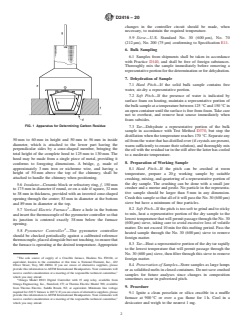
5. Apparatus (see Fig. 1)
responsibility of the user of this standard to establish appro-
5.1 Crucible—Wide-form, a, either porcelain, glazed
priate safety, health, and environmental practices and deter-
throughout, or silica, a; 29 mL to 31 mL capacity, 46 mm to
mine the applicability of regulatory limitations prior to use.
49 mm in rim diameter.
1.5 This international standard was developed in accor-
5.2 Skidmore Crucible—Iron crucible, b, flanged and
dance with internationally recognized principles on standard-
ringed, 65 mL to 82 mL capacity, 53 mm to 57 mm inside and
ization established in the Decision on Principles for the
60 mm to 67 mm outside diameter of flange, 37 mm to 39 mm
Development of International Standards, Guides and Recom-
in height, supplied with a cover without delivery tubes and
mendations issued by the World Trade Organization Technical
having the vertical opening closed. The horizontal opening of
Barriers to Trade (TBT) Committee.
about 6.5 mm shall be kept clean. The outside diameter of the
flat bottom shall be 30 mm to 32 mm.
2. Referenced Documents
5.3 Metal Crucible—Spun sheet-iron or nickel crucible, c,
2.1 ASTM Standards:
with cover; 78 mm to 82 mm in outside diameter at the top,
D140 Practice for Sampling Asphalt Materials
58 mm to 60 mm in height, and approximately 0.8 mm in
D189 Test Method for Conradson Carbon Residue of Petro-
thickness.At the bottom of this crucible, and level before each
leum Products
test,shallbealayerofabout25 mLofsand,orenoughtobring
D370 Practice for Dehydration of Oil-Type Preservatives
the Skidmore crucible, with cover on, nearly to the top of the
D2415 Test Method for Ash in Coal Tar and Pitch
sheet-iron crucible. The sand shall be dry and screened to pass
E11 Specification for Woven Wire Test Sieve Cloth and Test
through a 70 mesh (212 µm) screen and to be retained on a 200
Sieves
mesh (75 µm) screen.
5.4 WireSupport—Triangle (65 mm) of bare Nichrome wire
1.5 mm to 2.0 mm in cross section, having an opening small
This test method is under the jurisdiction of ASTM Committee D02 on
enough to support the bottom of the metal crucible (see 5.3).
Petroleum Products, Liquid Fuels, and Lubricants and is the direct responsibility of
SubcommitteeD02.05onPropertiesofFuels,PetroleumCokeandCarbonMaterial.
The triangle, d, shall have its arms bent to form a cradle that
Current edition approved June 1, 2020. Published June 2020. Originally
will support the metal crucible with its bottom level with the
ɛ1
approved in 1965. Last previous edition approved in 2015 as D2416 – 84 (2015) .
bottom of the insulator (see 5.6).
DOI: 10.1520/D2416-20.
For referenced ASTM standards, visit the ASTM website, www.astm.org, or
5.5 Hood—Circular, sheet-iron, e, from 120 mm to 130 mm
contact ASTM Customer Service at service@astm.org. For Annual Book of ASTM
in diameter, the height of the lower perpendicular side to be
Standards volume information, refer to the standard’s Document Summary page on
the ASTM website. from 50 mm to 53 mm; provided at the top with a chimney
*A Summary of Changes section appears at the end of this standard
Copyright © ASTM International, 100 Barr Harbor Drive, PO Box C700, West Conshohocken, PA 19428-2959. United States
D2416 − 20
changes in the controller circuit should be made, when
necessary, to maintain the required temperature.
5.9 Sieve—U.S. Standard No. 30 (600 µm), No. 70
(212 µm), No. 200 (75 µm) conforming to Specification E11.
6. Bulk Sampling
6.1 Samples from shipments shall be taken in accordance
with Practice D140, and shall be free of foreign substances.
Thoroughly mix the sample immediately before removing a
representative portion for the determination or for dehydration.
7. Dehydration of Sample
7.1 Hard Pitch—If the solid bulk sample contains free
water, air-dry a representative portion.
7.2 Soft Pitch—If the presence of water is indicated by
surface foam on heating, maintain a representative portion of
thebulksampleatatemperaturebetween125 °Cand150 °Cin
an open container until the surface is free from foam.Take care
not to overheat, and remove heat source immediately when
foam subsides.
FIG. 1 Apparatus for Determining Carbon Residue
7.3 Tar—Dehydrate a representative portion of the bulk
sample in accordance with Test Method D370, but stop the
distillation when the temperature reaches 170 °C. Separate any
50 mm to 60 mm in height and 50 mm to 56 mm in inside
oilfromthewaterthathasdistilledover(ifcrystalsarepresent,
diameter, which is attached to the lower part having the
warm sufficiently to ensure their solution), and thoroughly mix
perpendicular sides by a cone-shaped member, bringing the
the oil with the residual tar in the still after the latter has cooled
total height of the complete hood to 125 mm to 130 mm. The
to a moderate temperature.
hood may be made from a single piece of metal, providing it
8. Preparation of Working Sample
conforms to foregoing dimensions. A bridge, g, made of
approximately 3 mm iron or nichrome wire, and having a
8.1 Hard Pitch—If the pitch can be crushed at room
height of 50 mm above the top of the chimney, shall be
temperature, prepare a 20 g working sample by suitable
attached to handle the chimney when positioning.
crushing, mixing, and quartering of a representative portion of
the dry sample. The crushing can be done with a small jaw
5.6 Insulator—Cerami
...
This document is not an ASTM standard and is intended only to provide the user of an ASTM standard an indication of what changes have been made to the previous version. Because
it may not be technically possible to adequately depict all changes accurately, ASTM recommends that users consult prior editions as appropriate. In all cases only the current version
of the standard as published by ASTM is to be considered the official document.
´1
Designation: D2416 − 84 (Reapproved 2015) D2416 − 20
Standard Test Method for
Coking Value of Tar and Pitch (Modified Conradson)
This standard is issued under the fixed designation D2416; the number immediately following the designation indicates the year of
original adoption or, in the case of revision, the year of last revision. A number in parentheses indicates the year of last reapproval. A
superscript epsilon (´) indicates an editorial change since the last revision or reapproval.
ε NOTE—SI units formatting was corrected editorially in May 2015.
1. Scope Scope*
1.1 This test method covers the determination of the coking value of tar and pitch having an ash content not over 0.5 % as
determined by Test Method D2415.
1.2 Coking values by this test method are practically the same as those obtained by Test Method D189, but results are more
reproducible. The apparatus used is identical, except that an electric furnace is substituted for the gas flame.
1.3 The values stated in SI units are to be regarded as standard. No other units of measurement are included in this standard.
1.4 This standard does not purport to address all of the safety concerns, if any, associated with its use. It is the responsibility
of the user of this standard to establish appropriate safety safety, health, and healthenvironmental practices and determine the
applicability of regulatory limitations prior to use.
1.5 This international standard was developed in accordance with internationally recognized principles on standardization
established in the Decision on Principles for the Development of International Standards, Guides and Recommendations issued
by the World Trade Organization Technical Barriers to Trade (TBT) Committee.
2. Referenced Documents
2.1 ASTM Standards:
D140 Practice for Sampling Asphalt Materials
D189 Test Method for Conradson Carbon Residue of Petroleum Products
D370 Practice for Dehydration of Oil-Type Preservatives
D2415 Test Method for Ash in Coal Tar and Pitch
E11 Specification for Woven Wire Test Sieve Cloth and Test Sieves
3. Summary of Test Method
3.1 A sample of the tar or pitch is vaporized and pyrolized for a specified time at a specified temperature in special standardized
equipment that limits the available oxygen supply. The percentage of residue is reported as the coking value.
4. Significance and Use
4.1 This test method is useful for indicating the relative coke-forming propensities and for evaluating and characterizing tars
and pitches. This test method can also be used as one element in establishing the uniformity of shipments or sources of supply.
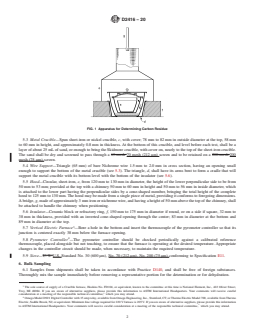
5. Apparatus (see Fig. 1)
5.1 Crucible—Wide-form, a, either porcelain, glazed throughout, or silica, a; 29 mL to 31 mL capacity, 46 mm to 49 mm in rim
diameter.
5.2 Skidmore Crucible—Iron crucible, b, flanged and ringed, 65 mL to 82 mL capacity, 53 mm to 57 mm inside and 60 mm to
67 mm outside diameter of flange, 37 mm to 39 mm in height, supplied with a cover without delivery tubes and having the vertical
opening closed. The horizontal opening of about 6.5 mm shall be kept clean. The outside diameter of the flat bottom shall be
30 mm to 32 mm.
This test method is under the jurisdiction of ASTM Committee D02 on Petroleum Products, Liquid Fuels, and Lubricants and is the direct responsibility of Subcommittee
D02.05 on Properties of Fuels, Petroleum Coke and Carbon Material.
Current edition approved April 1, 2015June 1, 2020. Published May 2015June 2020. Originally approved in 1965. Last previous edition approved in 20092015 as
ɛ1
D2416 – 84 (2009).(2015) . DOI: 10.1520/D2416-84R15E01.10.1520/D2416-20.
For referenced ASTM standards, visit the ASTM website, www.astm.org, or contact ASTM Customer Service at service@astm.org. For Annual Book of ASTM Standards
volume information, refer to the standard’s Document Summary page on the ASTM website.
*A Summary of Changes section appears at the end of this standard
Copyright © ASTM International, 100 Barr Harbor Drive, PO Box C700, West Conshohocken, PA 19428-2959. United States
D2416 − 20
FIG. 1 Apparatus for Determining Carbon Residue
5.3 Metal Crucible—Spun sheet-iron or nickel crucible, c, with cover; 78 mm to 82 mm in outside diameter at the top, 58 mm
to 60 mm in height, and approximately 0.8 mm in thickness. At the bottom of this crucible, and level before each test, shall be a
layer of about 25 mL of sand, or enough to bring the Skidmore crucible, with cover on, nearly to the top of the sheet-iron crucible.
The sand shall be dry and screened to pass through a 65-mesh 70 mesh (212 μm) screen and to be retained on a 200-mesh 200
mesh (75 μm) screen.
5.4 Wire Support—Triangle (65 mm) of bare Nichrome wire 1.5 mm to 2.0 mm in cross section, having an opening small
enough to support the bottom of the metal crucible (see 5.3). The triangle, d, shall have its arms bent to form a cradle that will
support the metal crucible with its bottom level with the bottom of the insulator (see 5.6).
5.5 Hood—Circular, sheet-iron, e, from 120 mm to 130 mm in diameter, the height of the lower perpendicular side to be from
50 mm to 53 mm; provided at the top with a chimney 50 mm to 60 mm in height and 50 mm to 56 mm in inside diameter, which
is attached to the lower part having the perpendicular sides by a cone-shaped member, bringing the total height of the complete
hood to 125 mm to 130 mm. The hood may be made from a single piece of metal, providing it conforms to foregoing dimensions.
A bridge, g, made of approximately 3 mm iron or nichrome wire, and having a height of 50 mm above the top of the chimney, shall
be attached to handle the chimney when positioning.
5.6 Insulator—Ceramic block or refractory ring, f, 150 mm to 175 mm in diameter if round, or on a side if square, 32 mm to
38 mm in thickness, provided with an inverted cone-shaped opening through the center; 83 mm in diameter at the bottom and
89 mm in diameter at the top.
5.7 Vertical Electric Furnace —Bore a hole in the bottom and insert the thermocouple of the pyrometer controller so that its
junction is centered exactly 38 mm below the furnace opening.
5.8 Pyrometer Controller —The pyrometer controller should be checked periodically against a calibrated reference
thermocouple, placed alongside but not touching, to ensure that the furnace is operating at the desired temperature. Appropriate
changes in the controller circuit should be made, when necessary, to maintain the required temperature.
5.9 Sieve—U. S. U.S. Standard No. 30 (600 μm), No. 70 (212 μm), No. 200 (75 μm) conforming to Specification E11.
6. Bulk Sampling
6.1 Samples from shipments shall be taken in accordance with Practice D140, and shall be free of foreign substances.
Thoroughly mix the sample immediately before removing a representative portion for the determination or for dehydration.
The sole source of supply of a Crucible furnace, Hoskins No. FD104, or equivalent, known to the committee at this time is National Element, Inc., 422 Oliver Street,
Troy, MI 48084. If you are aware of alternative suppliers, please provide this information to ASTM International Headquarters. Your comments will receive careful
consideration at a meeting of the responsible technical committee, which you may attend.
Omega Model D921 Digital Contro
...