

ASTM D1831-21
(Test Method)Standard Test Method for Roll Stability of Lubricating Grease
General Information
- Abstract
SIGNIFICANCE AND USE
5.1 The roll stability test is widely used in specifications. Test results are significant insofar as they can show a directional change in consistency that could occur in service. No accurate correlation is established between the test results and shear stability in actual service.
SCOPE
1.1 This test method covers determination of the changes in the consistency, as measured by cone penetration, of lubricating greases when worked in the roll stability test apparatus.
1.2 The values stated in SI units are to be regarded as standard. The values given in parentheses after SI units are provided for information only and are not considered standard.
1.3 This standard does not purport to address all of the safety concerns, if any, associated with its use. It is the responsibility of the user of this standard to establish appropriate safety, health, and environmental practices and determine the applicability of regulatory limitations prior to use.
1.4 This international standard was developed in accordance with internationally recognized principles on standardization established in the Decision on Principles for the Development of International Standards, Guides and Recommendations issued by the World Trade Organization Technical Barriers to Trade (TBT) Committee.
- Status
- Published
- Publication Date
- 30-Nov-2021
- Technical Committee
- D02 - Petroleum Products, Liquid Fuels, and Lubricants
- Drafting Committee
- D02.G0.02 - Consistency and Related Rheological Tests


Overview
ASTM D1831-21: Standard Test Method for Roll Stability of Lubricating Grease is an international standard developed by ASTM International for evaluating the change in consistency of lubricating grease when subjected to mechanical working. This test method is widely referenced in grease specifications to assess the potential for a change in grease consistency during service, providing key information about the stability of lubricating greases under low shear conditions.
This method specifically measures changes in the worked cone penetration of grease, utilizing a roll stability test apparatus to simulate mechanical agitation. Although the test shows the directional change in consistency that could occur in actual use, it does not directly correlate to in-service shear stability.
Key Topics
- Grease Consistency Assessment: Determines changes in consistency, measured as cone penetration, before and after mechanical working in the roll stability apparatus.
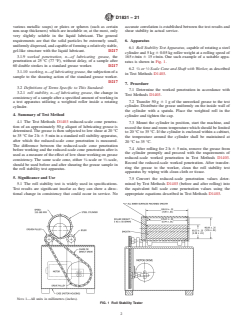
- Test Apparatus and Procedure: Uses a rotating cylinder containing a standard weight and sample, operating at controlled temperatures and durations to simulate real-world agitation effects.
- Measurement Units: All results are reported in SI units, specifically tenths of a millimeter for penetration changes, ensuring global applicability and consistency.
- Directionality of Change: The method reports both hardening (negative change) and softening (positive change) of lubricating grease, which are critical parameters for predicting performance in service.
- Precision and Repeatability: Includes guidelines for repeatability and reproducibility, aiding in quality control and inter-laboratory comparability.
- Operational Guidelines: Emphasizes the importance of standard procedure, including sample size, temperature range, and equipment configuration for valid results.
Applications
ASTM D1831-21 serves a vital role in the lubricants industry, contributing to quality assurance, product development, and compliance with customer or industry requirements. Key applications include:
- Product Development and Formulation Optimization: Lubricant developers use this test to optimize the composition of greases, ensuring appropriate consistency under working conditions.
- Quality Control in Manufacturing: Manufacturers implement this method to verify batch-to-batch consistency and monitor product stability over time.
- Specification Compliance: Ensures products meet specific standards for roll stability as required by customers, regulatory agencies, or industry certifications.
- Performance Prediction: Although the test does not provide a direct correlation to all service conditions, it offers valuable insight into the tendency of a grease to change consistency when subjected to mechanical agitation, which is crucial for critical machinery and automotive applications.
- Research and Comparative Testing: Allows researchers to compare new formulations and assess the impact of different thickeners, oils, and additives on grease stability.
Related Standards
To conduct the roll stability test and interpret results accurately, the following ASTM standards are commonly referenced alongside ASTM D1831-21:
- ASTM D217 - Test Methods for Cone Penetration of Lubricating Grease: Fundamental method for measuring grease consistency, used in both initial and post-roll stability measurements.
- ASTM D1403 - Test Methods for Cone Penetration of Lubricating Grease Using One-Quarter and One-Half Scale Cone Equipment: Specifies procedures when only limited sample quantities are available.
- ASTM D4175 - Standard Terminology Relating to Petroleum, Petroleum Products, and Lubricants: Provides definitions for terms used within ASTM grease testing methods.
By adhering to ASTM D1831-21 and related standards, manufacturers and laboratories can ensure reliable, repeatable measurement of lubricating grease roll stability, supporting product quality, customer satisfaction, and safety in diverse industrial applications.
Relations
- Effective Date
- 01-Jun-2020
- Effective Date
- 01-Apr-2020
- Effective Date
- 01-Feb-2020
- Effective Date
- 01-Jul-2019
- Effective Date
- 01-May-2019
- Effective Date
- 01-May-2019
- Effective Date
- 01-Aug-2018
- Effective Date
- 01-Oct-2016
- Effective Date
- 01-May-2010
- Effective Date
- 01-May-2010
- Effective Date
- 01-Nov-2007
- Effective Date
- 01-Nov-2007
- Effective Date
- 10-Dec-2002
- Effective Date
- 10-Dec-2002
- Effective Date
- 10-Nov-1997
Get Certified
Connect with accredited certification bodies for this standard

Element Materials Technology
Materials testing and product certification.

ABS Group Brazil
ABS Group certification services in Brazil.

ABS Quality Evaluations Inc.
American Bureau of Shipping quality certification.
Sponsored listings
Frequently Asked Questions
ASTM D1831-21 is a standard published by ASTM International. Its full title is "Standard Test Method for Roll Stability of Lubricating Grease". This standard covers: SIGNIFICANCE AND USE 5.1 The roll stability test is widely used in specifications. Test results are significant insofar as they can show a directional change in consistency that could occur in service. No accurate correlation is established between the test results and shear stability in actual service. SCOPE 1.1 This test method covers determination of the changes in the consistency, as measured by cone penetration, of lubricating greases when worked in the roll stability test apparatus. 1.2 The values stated in SI units are to be regarded as standard. The values given in parentheses after SI units are provided for information only and are not considered standard. 1.3 This standard does not purport to address all of the safety concerns, if any, associated with its use. It is the responsibility of the user of this standard to establish appropriate safety, health, and environmental practices and determine the applicability of regulatory limitations prior to use. 1.4 This international standard was developed in accordance with internationally recognized principles on standardization established in the Decision on Principles for the Development of International Standards, Guides and Recommendations issued by the World Trade Organization Technical Barriers to Trade (TBT) Committee.
SIGNIFICANCE AND USE 5.1 The roll stability test is widely used in specifications. Test results are significant insofar as they can show a directional change in consistency that could occur in service. No accurate correlation is established between the test results and shear stability in actual service. SCOPE 1.1 This test method covers determination of the changes in the consistency, as measured by cone penetration, of lubricating greases when worked in the roll stability test apparatus. 1.2 The values stated in SI units are to be regarded as standard. The values given in parentheses after SI units are provided for information only and are not considered standard. 1.3 This standard does not purport to address all of the safety concerns, if any, associated with its use. It is the responsibility of the user of this standard to establish appropriate safety, health, and environmental practices and determine the applicability of regulatory limitations prior to use. 1.4 This international standard was developed in accordance with internationally recognized principles on standardization established in the Decision on Principles for the Development of International Standards, Guides and Recommendations issued by the World Trade Organization Technical Barriers to Trade (TBT) Committee.
ASTM D1831-21 is classified under the following ICS (International Classification for Standards) categories: 75.100 - Lubricants, industrial oils and related products. The ICS classification helps identify the subject area and facilitates finding related standards.
ASTM D1831-21 has the following relationships with other standards: It is inter standard links to ASTM D1403-20b, ASTM D1403-20a, ASTM D1403-20, ASTM D217-19a, ASTM D1403-19, ASTM D217-19, ASTM D1403-18, ASTM D217-16, ASTM D217-10, ASTM D1403-10, ASTM D217-02(2007), ASTM D1403-02(2007), ASTM D217-02, ASTM D1403-02, ASTM D1403-97. Understanding these relationships helps ensure you are using the most current and applicable version of the standard.
ASTM D1831-21 is available in PDF format for immediate download after purchase. The document can be added to your cart and obtained through the secure checkout process. Digital delivery ensures instant access to the complete standard document.
Standards Content (Sample)
This international standard was developed in accordance with internationally recognized principles on standardization established in the Decision on Principles for the
Development of International Standards, Guides and Recommendations issued by the World Trade Organization Technical Barriers to Trade (TBT) Committee.
Designation: D1831 − 21
Standard Test Method for
Roll Stability of Lubricating Grease
This standard is issued under the fixed designation D1831; the number immediately following the designation indicates the year of
original adoption or, in the case of revision, the year of last revision. A number in parentheses indicates the year of last reapproval. A
superscript epsilon (´) indicates an editorial change since the last revision or reapproval.
This standard has been approved for use by agencies of the U.S. Department of Defense.
1. Scope* 3.1.1.1 Discussion—Thetermconsistencyisusedsomewhat
synonymously with penetration. Generally, consistency refers
1.1 This test method covers determination of the changes in
to the worked penetration of a grease. D217
the consistency, as measured by cone penetration, of lubricat-
ing greases when worked in the roll stability test apparatus. 3.1.2 lubricant, n—any material interposed between two
surfaces that reduces the friction or wear between them. D217
1.2 The values stated in SI units are to be regarded as
standard. The values given in parentheses after SI units are 3.1.3 lubricating grease, n—a semi-fluid to solid product of
a dispersion of a thickener in a liquid lubricant.
provided for information only and are not considered standard.
3.1.3.1 Discussion—The dispersion of the thickener forms a
1.3 This standard does not purport to address all of the
two-phase system and immobilizes the liquid lubricant by
safety concerns, if any, associated with its use. It is the
surface tension and other physical forces. Other ingredients
responsibility of the user of this standard to establish appro-
imparting special properties are often included. D217
priate safety, health, and environmental practices and deter-
mine the applicability of regulatory limitations prior to use.
3.1.4 penetration, n—of lubricating grease, the depth that
1.4 This international standard was developed in accor- the standard cone enters the sample when released to fall under
dance with internationally recognized principles on standard-
its own weight for 5 s. D217
ization established in the Decision on Principles for the
3.1.5 reduced-scale penetration, n—of lubricating grease,
Development of International Standards, Guides and Recom-
1 1
the depth in units of 0.1 mm that a ⁄4-scale cone or ⁄2-scale
mendations issued by the World Trade Organization Technical
cone penetrates the sample when released to fall under its own
Barriers to Trade (TBT) Committee.
weight for 5 s.
2. Referenced Documents 3.1.5.1 Discussion—The term reduced-scale penetration is
2 similar to the term penetration found in Test Methods D217.
2.1 ASTM Standards:
However, due to the differences in scale, the terms are not
D217 Test Methods for Cone Penetration of Lubricating
synonymous and should not be confused.
Grease
3.1.6 reduced-scale penetrometer, n—an instrument similar
D1403 Test Methods for Cone Penetration of Lubricating
to that shown in Fig. 1 of Test Methods D217, designed to
Grease Using One-Quarter and One-Half Scale Cone
measure the consistency or hardness of semi-liquid to semi-
Equipment
solid materials by measuring the depth to which the ⁄4-scale or
the ⁄2-scale cone falls into grease.
3. Terminology
1 1
3.1.6.1 Discussion—Either a ⁄4-scale cone or a ⁄2-scale
3.1 Definitions:
cone can be used to determine the consistency of lubricating
3.1.1 consistency, n—of lubricating grease, the degree of
greases when the quantity of sample available for testing is
resistance to movement under stress.
limited. The penetration forces are determined by the respec-
tive masses of the cones and shafts.
3.1.7 reduced-scale worked penetration, n—of lubricating
This test method is under the jurisdiction of ASTM Committee D02 on
grease, the penetration at 25 °C (77 °F), without delay, of a
Petroleum Products, Liquid Fuels, and Lubricants and is the direct responsibility of
1 1
Subcommittee D02.G0.02 on Consistency and Related Rheological Tests.
sample after 60 double strokes in a ⁄4-scale or ⁄2-scale grease
Current edition approved Dec. 1, 2021. Published January 2022. Originally
worker.
approved in 1961. Last previous edition approved in 2020 as D1831 – 20. DOI:
10.1520/D1831-21.
3.1.8 thickener, n—in lubricating grease, a substance com-
For referenced ASTM standards, visit the ASTM website, www.astm.org, or
posed of finely divided particles dispersed in a liquid lubricant
contact ASTM Customer Service at service@astm.org. For Annual Book of ASTM
to form the product’s structure.
Standards volume information, refer to the standard’s Document Summary page on
the ASTM website. 3.1.8.1 Discussion—The thickener can be fibers (such as
*A Summary of Changes section appears at the end of this standard
Copyright ©ASTM International, 100 Barr Harbor Drive, PO Box C700, West Conshohocken, PA19428-2959. United States
D1831 − 21
various metallic soaps) or plates or spheres (such as certain accurate correlation is established between the test results and
non-soap thickeners) which are insoluble or, at the most, only shear stability in actual service.
very slightly soluble in the liquid lubricant. The general
requirements are that the solid particles be extremely small, 6. Apparatus
uniformlydispersed,andcapableofformingarelativelystable,
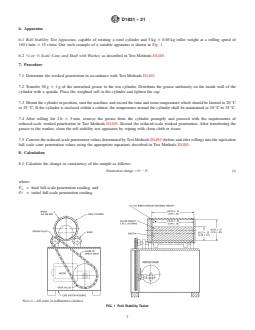
6.1 Roll Stability Test Apparatus, capable of rotating a steel
gel-like structure with the liquid lubricant. D217
cylinder and 5 kg 6 0.05 kg roller weight at a rolling speed of
3.1.9 worked penetration, n—of lubricating grease, the
165 r⁄min 6 15 r⁄min. One such example of a suitable appa-
penetration at 25 °C (77 °F), without delay, of a sample after
ratus is shown in Fig. 1.
60 double strokes in a standard grease worker. D217
1 1
6.2 ⁄4 or ⁄2 Scale Cone and Shaft with Worker, as described
3.1.10 working, n—of lubricating grease,thesubjectionofa
in Test Methods D1403.
sample to the shearing action of the standard grease worker.
D217
7. Procedure
3.2 Definitions of Terms Specific to This Standard:
7.1 Determine the worked penetration in accordance with
3.2.1 roll stability, n—of lubricating grease, the change in
Test Methods D1403.
consistency of a sample after a specified amount of working in
7.2 Transfer 50 g 6 1 g of the unworked grease to the test
a test apparatus utilizing a weighted roller inside a rotating
cylinder. Distribute the grease uniformly on the inside wall of
cylinder.
the cylinder with a spatula. P
...
This document is not an ASTM standard and is intended only to provide the user of an ASTM standard an indication of what changes have been made to the previous version. Because
it may not be technically possible to adequately depict all changes accurately, ASTM recommends that users consult prior editions as appropriate. In all cases only the current version
of the standard as published by ASTM is to be considered the official document.
Designation: D1831 − 20 D1831 − 21
Standard Test Method for
Roll Stability of Lubricating Grease
This standard is issued under the fixed designation D1831; the number immediately following the designation indicates the year of
original adoption or, in the case of revision, the year of last revision. A number in parentheses indicates the year of last reapproval. A
superscript epsilon (´) indicates an editorial change since the last revision or reapproval.
This standard has been approved for use by agencies of the U.S. Department of Defense.
1. Scope*
1.1 This test method covers determination of the changes in the consistency, as measured by cone penetration, of lubricating
greases when worked in the roll stability test apparatus.
1.2 The values stated in SI units are to be regarded as standard. The values given in parentheses after SI units are provided for
information only and are not considered standard.
1.3 This standard does not purport to address all of the safety concerns, if any, associated with its use. It is the responsibility
of the user of this standard to establish appropriate safety, health, and environmental practices and determine the applicability of
regulatory limitations prior to use.
1.4 This international standard was developed in accordance with internationally recognized principles on standardization
established in the Decision on Principles for the Development of International Standards, Guides and Recommendations issued
by the World Trade Organization Technical Barriers to Trade (TBT) Committee.
2. Referenced Documents
2.1 ASTM Standards:
D217 Test Methods for Cone Penetration of Lubricating Grease
D1403 Test Methods for Cone Penetration of Lubricating Grease Using One-Quarter and One-Half Scale Cone Equipment
3. Terminology
3.1 Definitions:
3.1.1 consistency, n—of lubricating grease, the degree of resistance to movement under stress.
3.1.1.1 Discussion—
The term consistency is used somewhat synonymously with penetration. Generally, consistency refers to the worked penetration
of a grease. D217
3.1.2 lubricant, n—any material interposed between two surfaces that reduces the friction or wear between them. D217
3.1.3 lubricating grease, n—a semi-fluid to solid product of a dispersion of a thickener in a liquid lubricant.
This test method is under the jurisdiction of ASTM Committee D02 on Petroleum Products, Liquid Fuels, and Lubricants and is the direct responsibility of Subcommittee
D02.G0.02 on Consistency and Related Rheological Tests.
Current edition approved June 1, 2020Dec. 1, 2021. Published September 2020January 2022. Originally approved in 1961. Last previous edition approved in 20192020
as D1831 – 19a.D1831 – 20. DOI: 10.1520/D1831-20.10.1520/D1831-21.
For referenced ASTM standards, visit the ASTM website, www.astm.org, or contact ASTM Customer Service at service@astm.org. For Annual Book of ASTM Standards
volume information, refer to the standard’s Document Summary page on the ASTM website.
*A Summary of Changes section appears at the end of this standard
Copyright © ASTM International, 100 Barr Harbor Drive, PO Box C700, West Conshohocken, PA 19428-2959. United States
D1831 − 21
3.1.3.1 Discussion—
The dispersion of the thickener forms a two-phase system and immobilizes the liquid lubricant by surface tension and other
physical forces. Other ingredients imparting special properties are often included. D217
3.1.4 penetration, n—of lubricating grease, the depth that the standard cone enters the sample when released to fall under its own
weight for 5 s. D217
1 1
3.1.5 reduced-scale penetration, n—of lubricating grease, the depth in units of 0.1 mm that a ⁄4-scale cone or ⁄2-scale cone
penetrates the sample when released to fall under its own weight for 5 s.
3.1.5.1 Discussion—
The term reduced-scale penetration is similar to the term penetration found in Test Methods D217. However, due to the differences
in scale, the terms are not synonymous and should not be confused.
3.1.6 reduced-scale penetrometer, n—an instrument similar to that shown in Fig. 1 of Test Methods D217, designed to measure
1 1
the consistency or hardness of semi-liquid to semi-solid materials by measuring the depth to which the ⁄4-scale or the ⁄2-scale cone
falls into grease.
3.1.6.1 Discussion—
1 1
Either a ⁄4-scale cone or a ⁄2-scale cone can be used to determine the consistency of lubricating greases when the quantity of
sample available for testing is limited. The penetration forces are determined by the respective masses of the cones and shafts.
3.1.7 reduced-scale worked penetration, n—of lubricating grease, the penetration at 25 °C (77 °F), without delay, of a sample after
1 1
60 double strokes in a ⁄4-scale or ⁄2-scale grease worker.
3.1.8 thickener, n—in lubricating grease, a substance composed of finely divided particles dispersed in a liquid lubricant to form
the product’s structure.
3.1.8.1 Discussion—
The thickener can be fibers (such as various metallic soaps) or plates or spheres (such as certain non-soap thickeners) which are
insoluble or, at the most, only very slightly soluble in the liquid lubricant. The general requirements are that the solid particles be
extremely small, uniformly dispersed, and capable of forming a relatively stable, gel-like structure with the liquid lubricant. D217
3.1.9 worked penetration, n—of lubricating grease, the penetration at 25 °C (77 °F), without delay, of a sample after 60 double
strokes in a standard grease worker. D217
3.1.10 working, n—of lubricating grease, the subjection of a sample to the shearing action of the standard grease worker. D217
3.2 Definitions of Terms Specific to This Standard:
3.2.1 roll stability, n—of lubricating grease, the change in consistency of a sample after a specified amount of working in a test
apparatus utilizing a weighted roller inside a rotating cylinder.
4. Summary of Test Method
4.1 The Test Methods D1403 reduced-scale cone penetration of an approximately 50 g aliquot of lubricating grease is determined.
The grease is then subjected to low shear at 20 °C to 35 °C for 2 h 6 5 min in a standard roll stability apparatus, after which the
reduced-scale cone penetration is measured. The difference between the reduced-scale cone penetration before working and the
reduced-scale cone penetration after is used as a measure of the effect of low shear working on grease consistency. The same scale
1 1
cone, either ⁄4-scale or ⁄2-scale, should be used before and after shearing the grease sample in the roll stability test apparatus.
5. Significance and Use
5.1 The roll stability test is widely used in specifications. Test results are significant insofar as they can show a directional change
in consistency that could occur in service. No accurate correlation is established between the test results and shear stability
...