

ASTM E720-23
(Guide)Standard Guide for Selection and Use of Neutron Sensors for Determining Neutron Spectra Employed in Radiation-Hardness Testing of Electronics
General Information
- Abstract
SIGNIFICANCE AND USE
3.1 Because of the wide variety of materials being used in neutron-activation measurements, this guide is presented with the objective of bringing improved uniformity to the specific field of interest here: hardness testing of electronics primarily in critical assembly reactor environments.
Note 2: Some of the techniques discussed are useful for 14-MeV dosimetry. See Test Method E496 for activation detector materials suitable for 14-MeV neutron effects testing.
Note 3: The materials recommended in this guide are suitable for 252Cf or other weak source effects testing provided the fluence is sufficient to generate countable activities.
3.2 This guide is organized into two overlapping subjects: the criteria used for sensor selection, and the procedures used to ensure the proper determination of activities for determination of neutron spectra. See Terminology E170 and Test Methods E181. Determination of neutron spectra with activation sensor data is discussed in Guides E721 and E944.
SCOPE
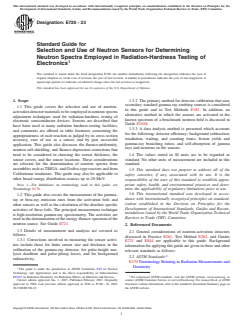
1.1 This guide covers the selection and use of neutron-activation detector materials to be employed in neutron spectra adjustment techniques used for radiation-hardness testing of electronic semiconductor devices. Sensors are described that have been used at many radiation hardness-testing facilities, and comments are offered in table footnotes concerning the appropriateness of each reaction as judged by its cross-section accuracy, ease of use as a sensor, and by past successful application. This guide also discusses the fluence-uniformity, neutron self-shielding, and fluence-depression corrections that need to be considered in choosing the sensor thickness, the sensor covers, and the sensor locations. These considerations are relevant for the determination of neutron spectra from assemblies such as TRIGA- and Godiva-type reactors and from Californium irradiators. This guide may also be applicable to other broad energy distribution sources up to 20 MeV.
Note 1: For definitions on terminology used in this guide, see Terminology E170.
1.2 This guide also covers the measurement of the gamma-ray or beta-ray emission rates from the activation foils and other sensors as well as the calculation of the absolute specific activities of these foils. The principal measurement technique is high-resolution gamma-ray spectrometry. The activities are used in the determination of the energy-fluence spectrum of the neutron source. See Guide E721.
1.3 Details of measurement and analysis are covered as follows:
1.3.1 Corrections involved in measuring the sensor activities include those for finite sensor size and thickness in the calibration of the gamma-ray detector, for pulse-height analyzer deadtime and pulse-pileup losses, and for background radioactivity.
1.3.2 The primary method for detector calibration that uses secondary standard gamma-ray emitting sources is considered in this guide and in Test Methods E181. In addition, an alternative method in which the sensors are activated in the known spectrum of a benchmark neutron field is discussed in Guide E1018.
1.3.3 A data analysis method is presented which accounts for the following: detector efficiency; background subtraction; irradiation, waiting, and counting times; fission yields and gamma-ray branching ratios; and self-absorption of gamma rays and neutrons in the sensors.
1.4 The values stated in SI units are to be regarded as standard. No other units of measurement are included in this standard.
1.5 This standard does not purport to address all of the safety concerns, if any, associated with its use. It is the responsibility of the user of this standard to establish appropriate safety, health, and environmental practices and determine the applicability of regulatory limitations prior to use.
1.6 This international standard was developed in accordance with internationally recognized principles on standardization established in the Decis...
- Status
- Published
- Publication Date
- 31-Dec-2022
- Technical Committee
- E10 - Nuclear Technology and Applications
Buy Documents
ASTM E720-23 - Standard Guide for Selection and Use of Neutron Sensors for Determining Neutron Spectra Employed in Radiation-Hardness Testing of Electronics
REDLINE ASTM E720-23 - Standard Guide for Selection and Use of Neutron Sensors for Determining Neutron Spectra Employed in Radiation-Hardness Testing of Electronics
Overview
ASTM E720-23: Standard Guide for Selection and Use of Neutron Sensors for Determining Neutron Spectra Employed in Radiation-Hardness Testing of Electronics provides comprehensive guidelines for selecting and using neutron-activation detector materials in the testing of electronic semiconductor devices. This standard, issued by ASTM International, is crucial for ensuring uniformity and accuracy when measuring neutron spectra-particularly in radiation-hardness testing environments such as critical assembly reactors, TRIGA- and Godiva-type reactors, and californium irradiators. The guide is designed to support practitioners in obtaining reliable data for the adjustment and interpretation of neutron fields, which is imperative for testing electronic components' resilience to neutron-induced damage.
Key Topics
- Sensor Selection Criteria: The guide details how to choose neutron-activation detectors based on cross-section accuracy, ease of use, previous successful applications, and suitability for the intended spectral range. Recommendations are based on consensus evaluations, such as ENDF/B and IRDF dosimetry cross sections.
- Spectrum Determination Procedures: It outlines procedures ensuring proper measurement of sensor activities-including high-resolution gamma-ray spectrometry and corrections for sensor size, thickness, and background radioactivity. Calibration using secondary gamma-ray sources and spectrum benchmarks is also addressed.
- Corrections and Calibration: Users must account for factors like fluence-uniformity, neutron self-shielding, fluence depression, and impurity corrections when deploying activation foils. Calibration methods and data analysis techniques are provided to maximize the accuracy of spectral adjustments.
- Foil Handling and Covering: Recommendations for encapsulating and covering activation foils (e.g., with cadmium or boron shields) are included to minimize contamination and optimize detection of specific neutron energy ranges.
- Quality Assurance: Procedures for validating foil purity, handling radioactive materials safely, and recording impurity analysis are detailed to ensure that only reliable and meaningful data are produced.
Applications
The ASTM E720-23 standard is essential for:
- Radiation-Hardness Testing: Electronics used in high-radiation environments (spacecraft, nuclear reactors, etc.) must undergo testing to verify their resilience against neutron radiation. This guide assists in accurate spectrum characterization, leading to more reliable component certification.
- Research and Development: Scientists and engineers use this standard in experimental setups for neutron spectrum measurement, supporting innovation in radiation-tolerant materials and devices.
- Calibration and Benchmarking: Calibration of neutron measurement instruments and benchmarking of neutron fields in laboratories and test reactors rely on the uniform practices established in this guide.
- Regulatory Compliance: Adhering to internationally-recognized methods ensures compliance with industry and governmental standards for radiation testing and electronic device certification.
Related Standards
ASTM E720-23 references several important documents to provide a complete framework for neutron spectrum determination:
- ASTM E170: Terminology Relating to Radiation Measurements and Dosimetry
- ASTM E181: Test Methods for Detector Calibration and Analysis of Radionuclides
- ASTM E261: Practice for Determining Neutron Fluence and Spectra by Radioactivation Techniques
- ASTM E721: Guide for Determining Neutron Energy Spectra from Neutron Sensors for Radiation-Hardness Testing of Electronics
- ASTM E844: Guide for Sensor Set Design and Irradiation for Reactor Surveillance
- ASTM E944: Guide for Application of Neutron Spectrum Adjustment Methods in Reactor Surveillance
- ASTM E496: Test Methods for Measuring Neutron Fluence and Average Energy from Neutron Generators
- ASTM E1018: Guide for Application of ASTM Evaluated Cross Section Data File
By following ASTM E720-23, laboratories and testing facilities ensure accuracy, repeatability, and international compatibility in neutron spectrum measurements-supporting advancements in electronic reliability and safety under neutron exposure.
Keywords: ASTM E720-23, neutron sensors, neutron spectrum, radiation-hardness testing, activation detectors, spectrum adjustment, electronics testing, gamma-ray spectrometry, reactor surveillance, calibration.
Relations
- Effective Date
- 01-Jul-2020
- Effective Date
- 01-Mar-2020
- Effective Date
- 01-Mar-2020
- Effective Date
- 01-Nov-2019
- Refers
ASTM E704-19 - Standard Test Method for Measuring Reaction Rates by Radioactivation of Uranium-238 - Effective Date
- 01-Oct-2019
- Effective Date
- 01-Oct-2019
- Refers
ASTM E705-18 - Standard Test Method for Measuring Reaction Rates by Radioactivation of Neptunium-237 - Effective Date
- 01-Dec-2018
- Effective Date
- 01-Dec-2018
- Effective Date
- 01-Jun-2018
- Effective Date
- 01-Jun-2018
- Effective Date
- 01-Aug-2017
- Effective Date
- 01-Jun-2017
- Effective Date
- 01-Oct-2016
- Effective Date
- 15-Feb-2016
- Effective Date
- 01-Sep-2015
Buy Documents
ASTM E720-23 - Standard Guide for Selection and Use of Neutron Sensors for Determining Neutron Spectra Employed in Radiation-Hardness Testing of Electronics
REDLINE ASTM E720-23 - Standard Guide for Selection and Use of Neutron Sensors for Determining Neutron Spectra Employed in Radiation-Hardness Testing of Electronics
Get Certified
Connect with accredited certification bodies for this standard

DIN CERTCO
DIN Group product certification.

Smithers Quality Assessments
US management systems and product certification.
Sponsored listings
Frequently Asked Questions
ASTM E720-23 is a guide published by ASTM International. Its full title is "Standard Guide for Selection and Use of Neutron Sensors for Determining Neutron Spectra Employed in Radiation-Hardness Testing of Electronics". This standard covers: SIGNIFICANCE AND USE 3.1 Because of the wide variety of materials being used in neutron-activation measurements, this guide is presented with the objective of bringing improved uniformity to the specific field of interest here: hardness testing of electronics primarily in critical assembly reactor environments. Note 2: Some of the techniques discussed are useful for 14-MeV dosimetry. See Test Method E496 for activation detector materials suitable for 14-MeV neutron effects testing. Note 3: The materials recommended in this guide are suitable for 252Cf or other weak source effects testing provided the fluence is sufficient to generate countable activities. 3.2 This guide is organized into two overlapping subjects: the criteria used for sensor selection, and the procedures used to ensure the proper determination of activities for determination of neutron spectra. See Terminology E170 and Test Methods E181. Determination of neutron spectra with activation sensor data is discussed in Guides E721 and E944. SCOPE 1.1 This guide covers the selection and use of neutron-activation detector materials to be employed in neutron spectra adjustment techniques used for radiation-hardness testing of electronic semiconductor devices. Sensors are described that have been used at many radiation hardness-testing facilities, and comments are offered in table footnotes concerning the appropriateness of each reaction as judged by its cross-section accuracy, ease of use as a sensor, and by past successful application. This guide also discusses the fluence-uniformity, neutron self-shielding, and fluence-depression corrections that need to be considered in choosing the sensor thickness, the sensor covers, and the sensor locations. These considerations are relevant for the determination of neutron spectra from assemblies such as TRIGA- and Godiva-type reactors and from Californium irradiators. This guide may also be applicable to other broad energy distribution sources up to 20 MeV. Note 1: For definitions on terminology used in this guide, see Terminology E170. 1.2 This guide also covers the measurement of the gamma-ray or beta-ray emission rates from the activation foils and other sensors as well as the calculation of the absolute specific activities of these foils. The principal measurement technique is high-resolution gamma-ray spectrometry. The activities are used in the determination of the energy-fluence spectrum of the neutron source. See Guide E721. 1.3 Details of measurement and analysis are covered as follows: 1.3.1 Corrections involved in measuring the sensor activities include those for finite sensor size and thickness in the calibration of the gamma-ray detector, for pulse-height analyzer deadtime and pulse-pileup losses, and for background radioactivity. 1.3.2 The primary method for detector calibration that uses secondary standard gamma-ray emitting sources is considered in this guide and in Test Methods E181. In addition, an alternative method in which the sensors are activated in the known spectrum of a benchmark neutron field is discussed in Guide E1018. 1.3.3 A data analysis method is presented which accounts for the following: detector efficiency; background subtraction; irradiation, waiting, and counting times; fission yields and gamma-ray branching ratios; and self-absorption of gamma rays and neutrons in the sensors. 1.4 The values stated in SI units are to be regarded as standard. No other units of measurement are included in this standard. 1.5 This standard does not purport to address all of the safety concerns, if any, associated with its use. It is the responsibility of the user of this standard to establish appropriate safety, health, and environmental practices and determine the applicability of regulatory limitations prior to use. 1.6 This international standard was developed in accordance with internationally recognized principles on standardization established in the Decis...
SIGNIFICANCE AND USE 3.1 Because of the wide variety of materials being used in neutron-activation measurements, this guide is presented with the objective of bringing improved uniformity to the specific field of interest here: hardness testing of electronics primarily in critical assembly reactor environments. Note 2: Some of the techniques discussed are useful for 14-MeV dosimetry. See Test Method E496 for activation detector materials suitable for 14-MeV neutron effects testing. Note 3: The materials recommended in this guide are suitable for 252Cf or other weak source effects testing provided the fluence is sufficient to generate countable activities. 3.2 This guide is organized into two overlapping subjects: the criteria used for sensor selection, and the procedures used to ensure the proper determination of activities for determination of neutron spectra. See Terminology E170 and Test Methods E181. Determination of neutron spectra with activation sensor data is discussed in Guides E721 and E944. SCOPE 1.1 This guide covers the selection and use of neutron-activation detector materials to be employed in neutron spectra adjustment techniques used for radiation-hardness testing of electronic semiconductor devices. Sensors are described that have been used at many radiation hardness-testing facilities, and comments are offered in table footnotes concerning the appropriateness of each reaction as judged by its cross-section accuracy, ease of use as a sensor, and by past successful application. This guide also discusses the fluence-uniformity, neutron self-shielding, and fluence-depression corrections that need to be considered in choosing the sensor thickness, the sensor covers, and the sensor locations. These considerations are relevant for the determination of neutron spectra from assemblies such as TRIGA- and Godiva-type reactors and from Californium irradiators. This guide may also be applicable to other broad energy distribution sources up to 20 MeV. Note 1: For definitions on terminology used in this guide, see Terminology E170. 1.2 This guide also covers the measurement of the gamma-ray or beta-ray emission rates from the activation foils and other sensors as well as the calculation of the absolute specific activities of these foils. The principal measurement technique is high-resolution gamma-ray spectrometry. The activities are used in the determination of the energy-fluence spectrum of the neutron source. See Guide E721. 1.3 Details of measurement and analysis are covered as follows: 1.3.1 Corrections involved in measuring the sensor activities include those for finite sensor size and thickness in the calibration of the gamma-ray detector, for pulse-height analyzer deadtime and pulse-pileup losses, and for background radioactivity. 1.3.2 The primary method for detector calibration that uses secondary standard gamma-ray emitting sources is considered in this guide and in Test Methods E181. In addition, an alternative method in which the sensors are activated in the known spectrum of a benchmark neutron field is discussed in Guide E1018. 1.3.3 A data analysis method is presented which accounts for the following: detector efficiency; background subtraction; irradiation, waiting, and counting times; fission yields and gamma-ray branching ratios; and self-absorption of gamma rays and neutrons in the sensors. 1.4 The values stated in SI units are to be regarded as standard. No other units of measurement are included in this standard. 1.5 This standard does not purport to address all of the safety concerns, if any, associated with its use. It is the responsibility of the user of this standard to establish appropriate safety, health, and environmental practices and determine the applicability of regulatory limitations prior to use. 1.6 This international standard was developed in accordance with internationally recognized principles on standardization established in the Decis...
ASTM E720-23 is classified under the following ICS (International Classification for Standards) categories: 83.140.10 - Films and sheets. The ICS classification helps identify the subject area and facilitates finding related standards.
ASTM E720-23 has the following relationships with other standards: It is inter standard links to ASTM E265-15(2020), ASTM E1018-20, ASTM E1018-20e1, ASTM E393-19, ASTM E704-19, ASTM E944-19, ASTM E705-18, ASTM E263-18, ASTM E1297-18, ASTM E844-18, ASTM E262-17, ASTM E170-17, ASTM E170-16a, ASTM E170-16, ASTM E170-15a. Understanding these relationships helps ensure you are using the most current and applicable version of the standard.
ASTM E720-23 is available in PDF format for immediate download after purchase. The document can be added to your cart and obtained through the secure checkout process. Digital delivery ensures instant access to the complete standard document.
Standards Content (Sample)
This international standard was developed in accordance with internationally recognized principles on standardization established in the Decision on Principles for the
Development of International Standards, Guides and Recommendations issued by the World Trade Organization Technical Barriers to Trade (TBT) Committee.
Designation: E720 − 23
Standard Guide for
Selection and Use of Neutron Sensors for Determining
Neutron Spectra Employed in Radiation-Hardness Testing of
Electronics
This standard is issued under the fixed designation E720; the number immediately following the designation indicates the year of
original adoption or, in the case of revision, the year of last revision.Anumber in parentheses indicates the year of last reapproval.A
superscript epsilon (´) indicates an editorial change since the last revision or reapproval.
This standard has been approved for use by agencies of the U.S. Department of Defense.
1. Scope 1.3.2 The primary method for detector calibration that uses
secondary standard gamma-ray emitting sources is considered
1.1 This guide covers the selection and use of neutron-
in this guide and in Test Methods E181. In addition, an
activationdetectormaterialstobeemployedinneutronspectra
alternative method in which the sensors are activated in the
adjustment techniques used for radiation-hardness testing of
known spectrum of a benchmark neutron field is discussed in
electronic semiconductor devices. Sensors are described that
Guide E1018.
have been used at many radiation hardness-testing facilities,
1.3.3 A data analysis method is presented which accounts
and comments are offered in table footnotes concerning the
for the following: detector efficiency; background subtraction;
appropriateness of each reaction as judged by its cross-section
irradiation, waiting, and counting times; fission yields and
accuracy, ease of use as a sensor, and by past successful
gamma-ray branching ratios; and self-absorption of gamma
application. This guide also discusses the fluence-uniformity,
rays and neutrons in the sensors.
neutron self-shielding, and fluence-depression corrections that
need to be considered in choosing the sensor thickness, the 1.4 The values stated in SI units are to be regarded as
sensor covers, and the sensor locations. These considerations standard. No other units of measurement are included in this
are relevant for the determination of neutron spectra from standard.
assembliessuchasTRIGA-andGodiva-typereactorsandfrom
1.5 This standard does not purport to address all of the
Californium irradiators. This guide may also be applicable to
safety concerns, if any, associated with its use. It is the
other broad energy distribution sources up to 20 MeV.
responsibility of the user of this standard to establish appro-
priate safety, health, and environmental practices and deter-
NOTE 1—For definitions on terminology used in this guide, see
Terminology E170. mine the applicability of regulatory limitations prior to use.
1.6 This international standard was developed in accor-
1.2 This guide also covers the measurement of the gamma-
dance with internationally recognized principles on standard-
ray or beta-ray emission rates from the activation foils and
ization established in the Decision on Principles for the
other sensors as well as the calculation of the absolute specific
Development of International Standards, Guides and Recom-
activities of these foils. The principal measurement technique
mendations issued by the World Trade Organization Technical
is high-resolution gamma-ray spectrometry. The activities are
Barriers to Trade (TBT) Committee.
usedinthedeterminationoftheenergy-fluencespectrumofthe
neutron source. See Guide E721.
2. Referenced Documents
1.3 Details of measurement and analysis are covered as
2.1 General considerations of neutron-activation detectors
follows:
discussed in Practice E261, Test Method E262, and Guides
1.3.1 Corrections involved in measuring the sensor activi-
E721 and E844 are applicable to this guide. Background
ties include those for finite sensor size and thickness in the
informationforapplyingthisguidearegivenintheseandother
calibration of the gamma-ray detector, for pulse-height ana-
relevant standards as follows:
lyzer deadtime and pulse-pileup losses, and for background
2.2 ASTM Standards:
radioactivity.
E170Terminology Relating to Radiation Measurements and
Dosimetry
This guide is under the jurisdiction of ASTM Committee E10 on Nuclear
Technology and Applications and is the direct responsibility of Subcommittee
E10.07 on Radiation Dosimetry for Radiation Effects on Materials and Devices. For referenced ASTM standards, visit the ASTM website, www.astm.org, or
Current edition approved Jan. 1, 2023. Published February 2023. Originally contact ASTM Customer Service at service@astm.org. For Annual Book of ASTM
approved in 1980. Last previous edition approved in 2016 as E720–16. DOI: Standards volume information, refer to the standard’s Document Summary page on
10.1520/E0720-23. the ASTM website.
Copyright © ASTM International, 100 Barr Harbor Drive, PO Box C700, West Conshohocken, PA 19428-2959. United States
E720 − 23
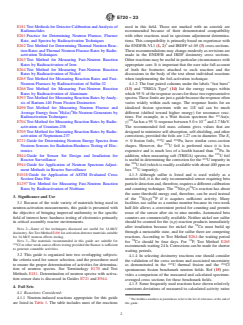
E181Test Methods for Detector Calibration andAnalysis of used in this field. Those not marked with an asterisk are
Radionuclides recommended because of their demonstrated compatibility
E261Practice for Determining Neutron Fluence, Fluence with other reactions used in spectrum adjustment determina-
Rate, and Spectra by Radioactivation Techniques tions.This compatibility is primarily based on experience with
E262Test Method for Determining Thermal Neutron Reac- the ENDF/B-VI.1 (1, 2) and IRDFF n1.05 (3) cross-sections.
tion Rates and Thermal Neutron Fluence Rates by Radio- These recommendations may change modestly as revisions are
activation Techniques made in the ENDF/B and IRDF dosimetry cross sections.
E263Test Method for Measuring Fast-Neutron Reaction Other reactions may be useful in particular circumstances with
Rates by Radioactivation of Iron appropriate care. It is important that the user take full account
E264Test Method for Measuring Fast-Neutron Reaction of both the footnotes attached to each reaction and the
Rates by Radioactivation of Nickel discussions in the body of the text about individual reactions
E265Test Method for Measuring Reaction Rates and Fast- when implementing the foil-activation technique.
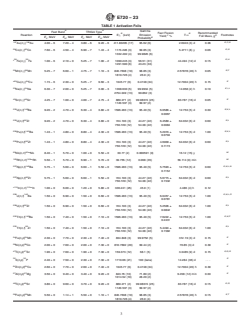
Neutron Fluences by Radioactivation of Sulfur-32 4.1.2 The four paired columns under the labels “fast burst”
E266Test Method for Measuring Fast-Neutron Reaction (13) and “TRIGA Type” (14) list the energy ranges within
Rates by Radioactivation of Aluminum which95%oftheresponseoccursforthesetworepresentative
E393Test Method for Measuring Reaction Rates byAnaly- spectra.Theselimitsarejustaguidebecausetheresponseoften
sis of Barium-140 From Fission Dosimeters varies widely within each range. The response limits for an
E496Test Method for Measuring Neutron Fluence and idealized fission spectrum with no 1/E tail can be much
3 4
Average Energy from H(d,n) He Neutron Generators by different (shifted toward higher energy) for resonance reac-
Radioactivation Techniques tions. For example, in a Watt fission spectrum the Au(n,
198 −2
E704Test Method for Measuring Reaction Rates by Radio- γ) Au has a 95% response between 5.0×10 and 2.7 MeV.
activation of Uranium-238 The recommended foil mass column gives values that are
E705Test Method for Measuring Reaction Rates by Radio- designed to minimize self-absorption, self-shielding, and other
activation of Neptunium-237 corrections, provided the foils are 1.27 cm in diameter. The E
t
235 239
E721Guide for Determining Neutron Energy Spectra from > 0 fission foils, U and Pu, have similar cross-section
Neutron Sensors for Radiation-Hardness Testing of Elec- shapes. However, the U foil is preferred since it is less
tronics expensive and is much less of a health hazard than Pu. In
E844Guide for Sensor Set Design and Irradiation for addition, when measuring soft (TRIGA) spectra, the U foil
Reactor Surveillance is useful in determining the correction for the U impurity in
E944Guide for Application of Neutron Spectrum Adjust- the Ufoil(whichisreadilyavailablewithabout400ppmor
ment Methods in Reactor Surveillance less U impurity).
E1018Guide for Application of ASTM Evaluated Cross 4.1.3 Although sulfur is listed and is used widely as a
Section Data File monitor foil, it is the only recommended sensor requiring beta
E1297Test Method for Measuring Fast-Neutron Reaction particledetectionand,therefore,requiresadifferentcalibration
58 58
Rates by Radioactivation of Niobium and counting technique. The Ni(n,p) Co reaction has about
the same threshold energy and, therefore, can be used instead
32 32
3. Significance and Use
of the S(n,p) P if it acquires sufficient activity. Many
3.1 Because of the wide variety of materials being used in facilities use sulfur as a routine monitor because its two-week
half-life allows a convenient period for counting and permits
neutron-activation measurements, this guide is presented with
the objective of bringing improved uniformity to the specific reuse of the sensor after six to nine months. Automated beta
counters are commercially available. Neither nickel nor sulfur
field of interest here: hardness testing of electronics primarily
in critical assembly reactor environments. should be counted for the (n,p) reaction products immediately
after irradiation because for nickel the Co must build up
NOTE 2—Some of the techniques discussed are useful for 14-MeV
through a metastable state, and for sulfur there are competing
dosimetry.SeeTestMethodE496foractivationdetectormaterialssuitable
reactions. According to Test Method E264 the waiting period
for 14-MeV neutron effects testing.
58 32
NOTE 3—The materials recommended in this guide are suitable for
for Co should be four days. For P, Test Method E265
Cforotherweaksourceeffectstestingprovidedthefluenceissufficient
recommendswaiting24h.Correctionscanbemadeforshorter
to generate countable activities.
waiting periods.
3.2 This guide is organized into two overlapping subjects:
4.1.4 In selecting dosimetry reactions one should consider
the criteria used for sensor selection, and the procedures used
the validation of the cross sections and associated uncertainty
235 252
to ensure the proper determination of activities for determina-
as demonstrated in the U thermal fission and the Cf
tion of neutron spectra. See Terminology E170 and Test
spontaneous fission benchmark neutron fields. Ref (15) pro-
Methods E181. Determination of neutron spectra with activa-
vides a comparison of the measured and calculated spectrum-
tion sensor data is discussed in Guides E721 and E944.
averaged cross sections for these benchmark fields.
4.1.5 Some frequently used reactions have shown relatively
4. Foil Sets
consistent deviations of measured to calculated activity ratios
4.1 Reactions Considered:
4.1.1 Neutron-induced reactions appropriate for this guide
Theboldfacenumbersinparenthesesrefertothelistofreferencesattheendof
are listed in Table 1. The table includes most of the reactions this guide.
E720 − 23
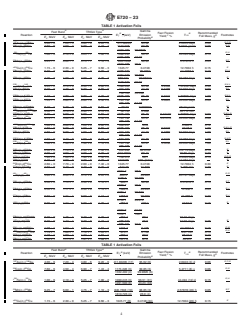
TABLE 1 Activation Foils
A A
Gamma
Fast Burst TRIGA Type
Fast Fission Recommended
B B
Reaction Eγ, (keV) Emission T Footnotes
C 1/2 D
Yield, % Foil Mass, g
B
E , MeV E , MeV E , MeV E , MeV
L H L H Probability
197 198 E,F,G
Au(n,γ) Au 4.00 − 6 7.20 − 4 3.80 − 6 9.20 − 6 411.80205 (17) 95.62 (6) 2.6943 (3) d 0.06
59 60 E,G
Co(n,γ) Co 7.60 − 6 4.50 − 4 6.90 − 7 1.43 − 4 1173.228 (3) 99.85 (3) 5.2711 (8) y 0.06
1332.492 (4) 99.9826 (6)
58 59 E,H
* Fe(n,γ) Fe 1.00 − 6 2.10 + 0 5.25 − 7 1.00 − 2 1099.245 (3) 56.51 (31) 44.494 (12) d 0.15
1291.590 (6) 43.23 (33)
55 56 E,F
Mn(n,γ) Mn 5.25 − 7 6.60 − 1 4.75 − 7 1.10 − 3 846.7638 (19) 98.85 (3) 2.57878 (46) h 0.05
1810.726 (4) 26.9 (4)
63 64 E
* Cu(n,γ) Cu 1.15 − 6 2.30 + 0 5.25 − 7 9.60 − 3 1345.77 (6) 0.4748 (34) 12.7004 (20) h 0.15
23 24 E,I,J
Na(n,γ) Na 6.30 − 7 2.00 + 0 5.25 − 7 3.00 − 3 1368.630 (5) 99.9934 (5) 14.958 (2) h 0.10
2754.049 (13) 99.862 (3)
45 46 E
Sc(n,γ) Sc 4.25 − 7 1.00 + 0 4.00 − 7 4.75 − 4 889.271 (2) 99.98374 (25) 83.787 (16) d 0.05
1120.537 (3) 99.97 (2)
235 140 E,K,L
U(n,f) Ba 9.20 − 2 4.70 + 0 6.30 − 4 3.80 + 0 1596.203 (13) 95.40 (5) 6.0586 ± 12.753 (5) d 0.30
0.0067
235 95 E,L
U(n,f) Zr 9.20 − 2 4.70 + 0 6.30 − 4 3.80 + 0 724.193 (3) 44.27 (22) 6.4589 ± 64.032 (6) d 0.60
756.729 (12) 54.38 (22) 0.0084
239 140 E,K,L
Pu(n,f) Ba 1.43 − 1 4.80 + 0 8.80 − 4 4.30 + 0 1596.203 (13) 95.40 (5) 5.2916 ± 12.753 (5) d 1.00
0.0794
239 95 E,L
Pu(n,f) Zr 1.43 − 1 4.80 + 0 8.80 − 4 4.30 + 0 724.193 (3) 44.27 (22) 4.6909 ± 64.032 (6) d 0.60
756.729 (12) 54.38 (22) 0.1173
93 93m M
Nb(n,n') Nb 8.40 − 1 5.70 + 0 1.00 + 0 5.50 + 0 30.77 (2) 0.000591 (9) 16.12 (15) y
103 103m M
Rh(n,n') Rh 5.50 − 1 5.70 + 0 6.90 − 1 5.70 + 0 39.755 (12) 0.068 (35) 56.114 (9) min
237 140 E,K,L,N
Np(n,f) Ba 5.75 − 1 5.60 + 0 6.60 − 1 5.50 + 0 1596.203 (13) 95.40 (5) 5.7593 ± 12.753 (5) d 0.60
0.1152
237 95 E,L
Np(n,f) Zr 5.75 − 1 5.60 + 0 6.60 − 1 5.50 + 0 724.193 (3) 44.27 (22) 5.6715 ± 64.032 (6) d 0.60
756.729 (12) 54.38 (22) 0.1532
115 115m
* In(n,n') In 1.00 + 0 6.00 + 0 1.20 + 0 5.80 + 0 336.241 (25) 45.9 (1) 4.486 (4) h 0.12
238 140 E,K,L,O
U(n,f) Ba 1.50 + 0 6.90 + 0 1.50 + 0 6.60 + 0 1596.203 (13) 95.40 (5) 6.0457 ± 12.753 (5) d 1.00
0.0781
238 95 E,L
U(n,f) Zr 1.50 + 0 6.90 + 0 1.50 + 0 6.60 + 0 724.193 (3) 44.27 (22) 5.2506 ± 64.032 (6) d 1.00
756.729 (12) 54.38 (22) 0.0842
232 140 E,K,P
Th(n,f) Ba 1.50 + 0 7.40 + 0 1.50 + 0 7.10 + 0 1596.203 (13) 95.40 (5) 7.6222 ± 12.753 (5) d 1.00
0.2431
232 95 E,L
Th(n,f) Zr 1.50 + 0 7.40 + 0 1.50 + 0 7.10 + 0 724.193 (3) 44.27 (22) 5.4494 ± 64.032 (6) d 1.00
756.729 (12) 54.38 (22) 0.1582
54 54 E
Fe(n,p) Mn 2.30 + 0 7.70 + 0 2.30 + 0 7.40 + 0 834.848 (3) 99.9752 (5) 312.19 (3) d 0.15
58 58 E
Ni(n,p) Co 2.00 + 0 7.60 + 0 2.00 + 0 7.30 + 0 810.7602 (20) 99.44 (2) 70.85 (3) d 0.30
47 47 E,Q,R
Ti(n,p) Sc 1.90 + 0 7.60 + 0 1.90 + 0 7.30 + 0 159.373 (12) 68.1 (5) 3.3485 (9) d 0.15
32 32 S
S(n,p) P 2.40 + 0 7.50 + 0 2.30 + 0 7.30 + 0 1710.66 (21) 100 (beta) 14.284 (36) d . . .
64 64 E
Zn(n,p) Cu 2.60 + 0 7.70 + 0 2.60 + 0 7.40 + 0 1345.77 (6) 0.4748 (34) 12.7004 (20) h 0.30
27 27 E
Al(n,p) Mg 3.50 + 0 9.40 + 0 3.40 + 0 9.20 + 0 843.76 (10) 71.80 (2) 9.458 (12) min 0.30
1014.52 (10) 28.20 (2)
46 46 E,Q
Ti(n,p) Sc 3.80 + 0 9.60 + 0 3.70 + 0 9.20 + 0 889.271 (2) 99.98374 (25) 83.787 (16) d 0.15
1120.537 (3) 99.97 (2)
56 56 E,T
Fe(n,p) Mn 5.50 + 0 1.14 + 1 5.50 + 0 1.10 + 1 846.7638 (19) 98.85 (3) 2.57878 (46) h 0.15
1810.726 (4) 26.9 (4)
E720 − 23
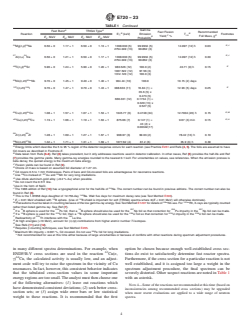
TABLE 1 Continued
A A
Gamma
Fast Burst TRIGA Type
Fast Fission Recommended
B B
Reaction Eγ, (keV) Emission T Footnotes
C 1/2 D
Yield, % Foil Mass, g
B
E , MeV E , MeV E , MeV E , MeV
Probability
L H L H
24 24 E,J
Mg(n,p) Na 6.50 + 0 1.17 + 1 6.50 + 0 1.13 + 1 1368.630 (5) 99.9934 (5) 14.997 (12) h 0.03
2754.049 (13) 99.862 (3)
27 24 E,J
Al(n,α) Na 6.50 + 0 1.21 + 1 6.50 + 0 1.17 + 1 1368.630 (5) 99.9934 (5) 14.997 (12) h 0.30
2754.049 (13) 99.862 (3)
48 48 E
Ti(n,p) Sc 5.90 + 0 1.24 + 1 5.90 + 0 1.20 + 1 983.526 (12) 100.0 (2) 43.71 (9) h 0.15
1037.522 (12) 97.56 (3)
1312.120 (12) 100.0 (3)
93 92m
Nb(n,2n) Nb 9.70 + 0 1.45 + 1 9.40 + 0 1.40 + 1 934.44 (10) 100.0 10.15 (2) days
127 126 E
I(n,2n) I 9.70 + 0 1.47 + 1 9.70 + 0 1.43 + 1 388.633 (11) 16.84 (1) = 12.93 (5) days 0.25
35.6 (5) x
0.473 (5)
666.331 (12) 0.1734 (1) =
0.329 (13) x
0.527 (5)
65 64 E,M
Cu(n,2n) Cu 1.08 + 1 1.57 + 1 1.07 + 1 1.53 + 1 1345.77 (6) 0.4748 (34) 12.7004 (20) h 0.15
63 62 E,H
* Cu(n,2n) Cu 1.19 + 1 1.66 + 1 1.19 + 1 1.63 + 1 875.66 (7) 0.147 (1) = 9.67 (3) min 0.15
43 (2) x
0.00342(17)
90 89
Zr(n,2n) Zr 1.28 + 1 1.69 + 1 1.27 + 1 1.67 + 1 908.97 (3) 99.03 (2) 78.42 (13) h 0.10
58 57
Ni(n,2n) Ni 1.32 + 1 1.71 + 1 1.31 + 1 1.69 + 1 1377.62 (4) 81.2 (6) 35.9 (3) h 0.30
A
Energy limits which describe the 5 to 95 % region of the detector response occurs for each reaction (see Practice E261 and Refs (4, 5). The foils are assumed to have
Cd covers as described in Footnote E.
B
Data taken from Refs (6-8). Ref (8) takes precedent, but it only addresses reactions used in detector calibration. In other cases, Ref (6) provides the half-life and Ref
(7) provides the gamma yields. Many gamma-ray energies rounded to the nearest 0.1 keV. For uncertainties on values, see references. When the emission process is
beta decay, the quoted energy is the maximum beta energy.
C
Fission yields can be found in Ref (9).
D
Choice of mass is based on assumed foil diameter of 1.27 cm.
E
Cd covers 0.5 to 1 mm thicknesses. Pairs of bare and Cd-covered foils are advantageous for resonance reactions.
F 59 197 55
Use Co instead of Au and Mn for very long irradiations.
G
Use dilute aluminum-gold alloy (<0.2 % Au) when possible.
H
Do not count the 0.511 line.
I
Use in the form of NaCl.
J 24
The 1986 edition of Ref (10) has a typographical error for the half-life of Na. The correct number can be found in previous editions. The correct number can also be
found in Ref (6).
K 140
This is the 1.67858 days daughter of 12.753-day Ba. Wait five days for maximum decay rate (see Test Method E393).
L 10 10
E = 0.01 MeV shielded with B sphere. (Use of B shield is important for soft (TRIGA) spectra where Φ(E < 0.01 MeV) will otherwise dominate).
t
M 93m 103m
Precautions must be taken in counting because of the low gamma-ray energy. See Test Method E1297 for details of Nb use. For Rh, X-rays are typically counted
rather than listed gamma ray. See Ref (7).
N 10 239 10 237 239 237
If a B sphere is used for the Pu foil, then a B sphere should also be used for the Np foil so that correction for Pu impurity in the Np foil can be made.
O 10 235 10 238 235 238
If a B sphere is used for the U foil, then a B sphere should also be used for the U foil so that correction for U impurity in the U foil can be made.
P 232 140
Radioactivity of Th interferes with the La line.
Q
At high energies (>10 MeV), account for (n,np) contributions from higher atomic number Ti isotopes.
R
See Refs (11) and (12).
S
Requires β counting techniques, see Test Method E265.
T 56
Maximum Mn impurity = 0.001 %, Cd covered. Do not use Fe foil for long irradiations.
* Not recommended for use at this time either because of large uncertainties or because of conflicts with other reactions during spectrum adjustment procedures.
in many different spectra determinations. For example, when option be chosen because enough well-established cross sec-
ENDF/B-V cross sections are used in the reaction Cu(n, tions do exist to satisfactorily determine fast reactor spectra.
γ) Cu, the calculated activity is usually low, and an adjust- Furthermore, if the cross section for a particular reaction is not
ment code will try to raise the spectrum in the vicinity of Cu well established, and it is assigned too large a weight in the
resonances. In fact, however, this consistent behavior indicates spectrum adjustment procedure, the final spectrum can be
that the tabulated cross-section values in some important severely distorted. Other suspect reactions are noted in Table 1
energyregionsaretoosmall.Theanalystmustthenchooseone with an asterisk.
of the following alternatives: (1) leave out reactions which
NOTE4—Someofthereactionsnotrecommendedatthistime(basedon
have demonstrated consistent deviations; (2) seek better cross-
inconsistencies among recommended cross sections) may be upgraded
section sets; or (3) assign wide error bars or low statistical
when more recent evaluations are applied to a wide range of neutron
weight to these reactions. It is recommended that the first spectra.
E720 − 23
Guide E844, Practice E261, and Test Methods E262, E263, E264, E265,
4.2 Foil Impurities:
E266, E704, and E705.
4.2.1 Foil impurities are especially serious for a moderated
source (TRIGA reactor) when an impurity leads to the same
5. Apparatus
reaction product by way of thermal-neutron capture. Some
5.1 The gamma-ray detector should be a germanium-type
examples of these foils, with impurities in parentheses, are
238 235 27 23 56 55 24 23 detector (either Ge(Li) or intrinsic) with an energy resolution
U( U), Al ( Na), Fe ( Mn), and Mn ( Na).
of 2.5 keV or better (full-width at half-maximum (FWHM) at
4.2.2 For a soft spectrum, such as the TRIGA J-tube
1173 keV). Associated equipment would include a multichan-
spectrum[boral(thatis,aboron-aluminumalloy)shielded],the
nel pulse-height analyzer and a precision pulse generator with
number of fissions in the U foil (Cd covered) is about 100
238 238 calibrated pulse-height and pulse-rate inputs into the detection
timesthenumberoccurringinthe Ufoil;therefore,the U
system.
musthaveanimpuritylevelof Uofnomorethanabout200
5.2 Foil and source holders should be used to provide
ppmforanuncertaintyof2%orlessindeterminingaccurately
238 235
precise positioning of a gamma-ray standard source and of
the U activity. Higher impurity levels of U can be
each activated foil with respect to the detector. Required
tolerated for Godiva-type reactors where the fluence below
precision is about 0.2 mm or better in distance from the
10keVismuchlower,orwithTRIGA-typereactorsifthe U
window of the detector or in lateral alignment.
foil data are used for correcting the U activity.
4.2.3 When the Fe foil (Cd covered) is used in a TRIGA
5.3 National standard sources that are traceable to NIST(or
spectrum, it should have no more than 10 ppm Mn impurity
theirequivalent)shouldbeusedforcalibrationofthedetection
55 56
to keep the contribution from the Mn(n,γ) Mn reaction to
system.
less than 2%. Similarly, the Mn impurity should be no more
6. Precautions
than 100 ppm when using the Fe foil at 50 cm from a
Godiva-type reactor (which is approximately 2 m above the
6.1 Scattering Problems—Asensor with a strong resonance
concrete floor) in order to achieve the same level of accuracy.
absorption, such as a thick U foil, should not be placed in
Data from a Mn foil (Cd covered) can be used to correct the
frontofa1/vdetector,andthickfoilswithcoversshouldnotbe
Fe data if the impurity correction is ≤20% of the total (n,p)
stackedbecauseaccuratecorrectionsfortheresultantscattering
activation, and the percent of manganese in iron is accurately
are difficult to determine. With an isotropic neutron-fluence,
known.
Φ , incident on stacked foils, the reduction in the fluence rate
o
caused by scattering at a given foil can be estimated by using
4.3 Influence of Nuclear Data on Foil Selection:
the following equation:
4.3.1 Sincethetotalnumberofinteractionsisdeducedfrom
2( σ X
an absolute specific activity determination, that activity should i i i
Φ 5Φ e
o
be determined with good accuracy (of the order of 5%), and
where Φ is the attenuated fluence, ∑ is a summation-over-i
i
the foils selected should have gamma-ray yields known to the
symbol, σ is the total macroscopic scattering cross section in
i
same or better accuracy. Some of the factors involved in
−1 th
cm , and X is the thickness of the i foil in centimetres. The
i
determining these yields include conversion-electron
summationisuptothefoilofinterest,locatedatitsappropriate
production, branching ratio to a given energy level, and fission
depth (distance from source) in the foil stack. For best results,
yield.
the reduction in fluence rate should be less than 10% for the
4.3.2 The 1596.203-keV gamma-ray transition from La
232 foil located at the maximum depth.
produced by Th fission is not usually useful because of
6.2 Foil Self-Shielding—For the thicknesses of the foils
interference from Th radioactivity. This often has led to the
use of the 537.303-keV transition from the Ba precursor of recommended, the correction for self-shielding is recom-
mended for all (n,γ) and (n,f) reactions. A pure gold foil is an
La, having a gamma-transition probability of 0.2439 per
140 140
Ba decay. The use of Ba generally requires the chemical example of a self-shielding foil with its highly absorbing
resonance at about 5 eV. The correction for a 0.025mm thick
separation of this isotope from the rest of the fission products
so that the 537.303-keV line can be seen above competing foil being about a factor of two for epicadmium neutrons (that
is, neutrons with energies greater than 0.5 eV) (16).
lines. See Test Method E393.
4.3.3 The choice of element, and hence the gamma-ray
NOTE 6—Dilute aluminum-gold alloys are available and do not gener-
transition, directly influences the accuracy of determining the
ally require self-shielding corrections.
specific activity induced by neutron irradiation. It also influ-
6.3 Fluence Nonuniformity—If all the foils cannot be lo-
ences the final choice of foil thickness, in that the selection of
cated in a region of uniform fluence rate (as determined by
an element resulting in a low-energy gamma ray may lead to a
symmetry considerations), they can be located at different
large self-absorption correction. For example, the Th foil of
positions (and, hence, with different fluence rates) as long as
Table 1 has a maximum attenuation of 22%, or an average
the neutron energy spectrum is constant. If the fluence varies
correction of about 11%, for the 537.303-keV transition. This
by more than 3% from point to point, fluence monitors should
represents an upper limit for the thickness of that foil.
be used with each foil. Around a Godiva-type reactor, sulfur
Therefore, the self-attenuation of gamma rays, as well as the
foils can serve as monitors near the individual foils. Where
neutron self-shielding discussed later, will influence the foil
58 58
space is more limited, then nickel [ Ni(n,p) Co], iron
selection. 54 54 27 24
[ Fe(n,p) Mn], or even aluminum [ Al(n,α) Na] should be
NOTE 5—For other considerations in the selection of specific foils, see considered for monitors. (See Practice E261 for other relevant
E720 − 23
considerations.) Often a better solution is obtained by mount- then it will be difficult to determine the neutron spectrum from
−2 −7
ingallfoilsonarotatingdiskorringtoensurethattheyreceive 10 MeV down to about 3×10 MeV. If the TRIGA
the same fluence. irradiation cavity has only partial boral shielding, it is impor-
tant that all the fission foils, all the 1/v foils, and the foils with
6.4 Fluence Rate Depression—At low energies, fluence rate
important 1/v impurities be placed in a boral “box” or a B
depression can be significant for bare thermal-neutron detec-
10 2
cover. For best results, a B cover of 1 to 1.8 g/cm of (93%)
tors near cadmium-covered foils if both are embedded in a
B should be used. In this way, the fraction of activations
moderator. This is because the cover on one foil can shadow
−7
arising from neutrons in the energy range from 3×10 MeV
adjacent bare foils. At high energies, depression can be
−2
to 10 MeV will be reduced greatly. The effect of the cover
significant for foils irradiated under the same conditions if the
thickness can be accounted for by a spectrum adjustment code
moderatorcontainsreactorfuel.However,thisisordinarilynot
provided that the effective attenuation cross section that
a problem, since in the sizable irradiation volumes normally
accounts for scattering in the cover is available. See 7.2.5.
usedforradiationdamagestudies,thecadmiumcovers(aswell
7.2.4 For a Godiva-type reactor, B covers may not be
as the foils) generally subtend a negligibly small solid angle at
required, and cadmium covers may be sufficient for irradiation
the point of any surrounding moderator or fuel. Fluence rate
distances of less than 1 m from the reactor when the reactor is
depression is usually insignificant for irradiation in a Godiva
locatedafewmetersabovetheconcretefloor.Cadmiumcovers
reactor glory hole.
also may be used in the glory hole where the number of
7. General Handling Procedures
low-energy neutrons is insignificant. If B covers are used,
activities may require correction for scattering by the B. The
7.1 Foil Encapsulation—Fission foils should be encapsu-
correction can be determined either experimentally with pure
lated in sealed containers to avoid oxidation, loss of material,
237 232
finite-threshold fission foils ( Np or Th) that contain
and for health-safety requirements. If a Pu foil is used
negligible zero-threshold impurities, or with a neutron trans-
(instead of the much safer U foil), it will require special
port calculation that considers the thickness of the material
encapsulation and periodic monitoring to check for leakage of
(17).
the material. Copper encapsulation has been found satisfactory
235 238 237 232
7.2.5 The attenuation by a boron cover of the neutron
for U, U, Np, and Th foils. The thickness of the
fluence is not adequately treated by many of the spectrum
copper capsule should be about 0.1 to 0.25 mm at the flat
adjustment codes (18). Some versions of the spectrum adjust-
surfaces and soldered at the periphery.
ment code, SAND II (19), for example, use a simple exponen-
7.2 Foil Covers:
tial attenuation function versus energy, and because most
7.2.1 As noted in Table 1, cadmium covers of 0.5 to 1mm
irradiations are conducted in wide-beam or isotropic
thickness are prescribed for all fission foils and 1/v detectors.
configurations, scattered neutrons are not in general lost from
Cadmium covers also should be used for finite-threshold foils
the beam.As a result, the absorption cross section of the boron
with trace impurities that yield the same reaction product by
should generally be used to determine the attenuation.
means of thermal-neutron capture. Examples are foils such as
However,inmanyconfigurations(suchasnarrow-beamgeom-
238 56 58 27 235 55 59
U, Fe, Ni,and Alwithimpuritiesof U, Mn, Co,
etry or down scattering of the neutrons to lower energy), the
and Na, respectively. Depending on the concentration, such
scattering portion of the cross section can remove additional
impurities can lead to large correction factors. For large
neutronsandthetrueeffectiveremovalcrosssectionvaluewill
correctionfactors(thatis,greaterthan5%),cadmium-covered
fall somewhere in between the total and the absorption cross
foilsmadeoftheimpuritymaterialsshouldbeirradiated.Then,
section. This is especially noticeable if the response of the foil
corrections can be made with good accuracy if the impurity
is concentrated above the 10-keV limit where the B absorp-
concentration in the primary threshold foil is accurately
tion ceases to dominate the cross section. Thus, for high-
known. If the impurity concentration is not known, a thermal-
238 237
threshold fission foils such as U and Np or a normal
neutron activation analysis of the foil can provide data for the
threshold foil such as nickel, the additional scattering will
necessarycorrection.Cadmiumcoversmaynotberequiredfor
result in additional attenuation. For example, some experi-
foilsirradiatedintheempty“gloryhole”ofafast-pulsereactor,
mentsandcalculationsindicatethatthesecorrectionsareofthe
a cavity in which little or no moderator material is normally
order of 10% for a 1.65-g/cm B cover and a thin 12.7mm
present (that is, less than 0.5 g/cm ).
diameter fission foil (20). Other work indicates that these
7.2.2 Covers of B for fission foils are useful when
scattering corrections may be somewhat larger (21). Strictly
measuring a soft TRIGAspectrum. However, if a boral shield
speaking, a calculation of the transport in the full-experiment
that provides good 4-π geometry surrounds the irradiation
geometry through the boron cover should be performed for
cavity, and if a negligible amount of moderator is contained
each geometry (18). Measurements with a high-threshold foil,
withintheshield,thenthe Bcoversmaynotberequired.The
58 58
Ni(n,p) Co, have shown a transmission factor of 0.9 in a
effect of the boral shielding should be accounted for properly
Godiva-type exposure geometry (15). This compares with a
when the neutron spectrum is adjusted with a proper computer
calculated value (for which only the boron capture cross
code. More is said about boron cover corrections in 7.2.4.
section is used) of 0.96.
NOTE 7—Spectra adjustment codes are discussed in Guides E721 and
NOTE 8—A monitor foil such as nickel used both inside and outside a
E944.
boron ball can be used to normalize the boron-covered-fission-foil
7.2.3 If no B covers are used for the foils, and if the
exposure to that of the rest of the foil set in case positioning errors are
TRIGA irradiation cavity is only partially shielded by boral, likely to be significant. The nickel ratio is not very sensitive to spectrum
E720 − 23
shape. The procedure is to multiply the fission foil activities by a factor
where:
that ensures that the ratio of nickel activities inside and outside the boron
R = measuredspecificactivityofanactivatedfoilisotope
j
ball is about 0.9.
j,
7.2.6 Another advantage of using covers (B, Cd) on broad
σ(E) = neutron cross section at energy E for isotope j,
j
energy-response foils is that it restricts that response and Φ(E) = incident neutron fluence differential in energy, and
n = number of reactions.
permits improved definition
...
This document is not an ASTM standard and is intended only to provide the user of an ASTM standard an indication of what changes have been made to the previous version. Because
it may not be technically possible to adequately depict all changes accurately, ASTM recommends that users consult prior editions as appropriate. In all cases only the current version
of the standard as published by ASTM is to be considered the official document.
Designation: E720 − 16 E720 − 23
Standard Guide for
Selection and Use of Neutron Sensors for Determining
Neutron Spectra Employed in Radiation-Hardness Testing of
Electronics
This standard is issued under the fixed designation E720; the number immediately following the designation indicates the year of
original adoption or, in the case of revision, the year of last revision. A number in parentheses indicates the year of last reapproval. A
superscript epsilon (´) indicates an editorial change since the last revision or reapproval.
This standard has been approved for use by agencies of the U.S. Department of Defense.
1. Scope
1.1 This guide covers the selection and use of neutron-activation detector materials to be employed in neutron spectra adjustment
techniques used for radiation-hardness testing of electronic semiconductor devices. Sensors are described that have been used at
many radiation hardness-testing facilities, and comments are offered in table footnotes concerning the appropriateness of each
reaction as judged by its cross-section accuracy, ease of use as a sensor, and by past successful application. This guide also
discusses the fluence-uniformity, neutron self-shielding, and fluence-depression corrections that need to be considered in choosing
the sensor thickness, the sensor covers, and the sensor locations. These considerations are relevant for the determination of neutron
spectra from assemblies such as TRIGA- and Godiva-type reactors and from Californium irradiators. This guide may also be
applicable to other broad energy distribution sources up to 20 MeV.
NOTE 1—For definitions on terminology used in this guide, see Terminology E170.
1.2 This guide also covers the measurement of the gamma-ray or beta-ray emission rates from the activation foils and other sensors
as well as the calculation of the absolute specific activities of these foils. The principal measurement technique is high-resolution
gamma-ray spectrometry. The activities are used in the determination of the energy-fluence spectrum of the neutron source. See
Guide E721.
1.3 Details of measurement and analysis are covered as follows:
1.3.1 Corrections involved in measuring the sensor activities include those for finite sensor size and thickness in the calibration
of the gamma-ray detector, for pulse-height analyzer deadtime and pulse-pileup losses, and for background radioactivity.
1.3.2 The primary method for detector calibration that uses secondary standard gamma-ray emitting sources is considered in this
guide and in Test Methods E181. In addition, an alternative method in which the sensors are activated in the known spectrum of
a benchmark neutron field is discussed in Guide E1018.
1.3.3 A data analysis method is presented which accounts for the following: detector efficiency; background subtraction;
irradiation, waiting, and counting times; fission yields and gamma-ray branching ratios; and self-absorption of gamma rays and
neutrons in the sensors.
This guide is under the jurisdiction of ASTM Committee E10 on Nuclear Technology and Applications and is the direct responsibility of Subcommittee E10.07 on
Radiation Dosimetry for Radiation Effects on Materials and Devices.
Current edition approved Dec. 1, 2016Jan. 1, 2023. Published February 2017February 2023. Originally approved in 1980. Last previous edition approved in 20112016
as E720 – 11.E720 – 16. DOI: 10.1520/E0720-16.10.1520/E0720-23.
Copyright © ASTM International, 100 Barr Harbor Drive, PO Box C700, West Conshohocken, PA 19428-2959. United States
E720 − 23
1.4 The values stated in SI units are to be regarded as standard. No other units of measurement are included in this standard.
1.5 This standard does not purport to address all of the safety concerns, if any, associated with its use. It is the responsibility
of the user of this standard to establish appropriate safety and healthsafety, health, and environmental practices and determine
the applicability of regulatory limitations prior to use.
1.6 This international standard was developed in accordance with internationally recognized principles on standardization
established in the Decision on Principles for the Development of International Standards, Guides and Recommendations issued
by the World Trade Organization Technical Barriers to Trade (TBT) Committee.
2. Referenced Documents
2.1 General considerations of neutron-activation detectors discussed in Practice E261, Test Method E262, and Guides E721 and
E844 are applicable to this guide. Background information for applying this guide are given in these and other relevant standards
as follows:
2.2 ASTM Standards:
E170 Terminology Relating to Radiation Measurements and Dosimetry
E181 Test Methods for Detector Calibration and Analysis of Radionuclides
E261 Practice for Determining Neutron Fluence, Fluence Rate, and Spectra by Radioactivation Techniques
E262 Test Method for Determining Thermal Neutron Reaction Rates and Thermal Neutron Fluence Rates by Radioactivation
Techniques
E263 Test Method for Measuring Fast-Neutron Reaction Rates by Radioactivation of Iron
E264 Test Method for Measuring Fast-Neutron Reaction Rates by Radioactivation of Nickel
E265 Test Method for Measuring Reaction Rates and Fast-Neutron Fluences by Radioactivation of Sulfur-32
E266 Test Method for Measuring Fast-Neutron Reaction Rates by Radioactivation of Aluminum
E393 Test Method for Measuring Reaction Rates by Analysis of Barium-140 From Fission Dosimeters
3 4
E496 Test Method for Measuring Neutron Fluence and Average Energy from H(d,n) He Neutron Generators by Radioactivation
Techniques
E704 Test Method for Measuring Reaction Rates by Radioactivation of Uranium-238
E705 Test Method for Measuring Reaction Rates by Radioactivation of Neptunium-237
E721 Guide for Determining Neutron Energy Spectra from Neutron Sensors for Radiation-Hardness Testing of Electronics
E844 Guide for Sensor Set Design and Irradiation for Reactor Surveillance
E944 Guide for Application of Neutron Spectrum Adjustment Methods in Reactor Surveillance
E1018 Guide for Application of ASTM Evaluated Cross Section Data File
E1297 Test Method for Measuring Fast-Neutron Reaction Rates by Radioactivation of Niobium
3. Significance and Use
3.1 Because of the wide variety of materials being used in neutron-activation measurements, this guide is presented with the
objective of bringing improved uniformity to the specific field of interest here: hardness testing of electronics primarily in critical
assembly reactor environments.
NOTE 2—Some of the techniques discussed are useful for 14-MeV dosimetry. See Test Method E496 for activation detector materials suitable for 14-MeV
neutron effects testing.
NOTE 3—The materials recommended in this guide are suitable for Cf or other weak source effects testing provided the fluence is sufficient to generate
countable activities.
3.2 This guide is organized into two overlapping subjects;subjects: the criteria used for sensor selection, and the procedures used
to ensure the proper determination of activities for determination of neutron spectra. See Terminology E170 and Test Methods
E181. Determination of neutron spectra with activation sensor data is discussed in Guides E721 and E944.
4. Foil Sets
4.1 Reactions Considered:
For referenced ASTM standards, visit the ASTM website, www.astm.org, or contact ASTM Customer Service at service@astm.org. For Annual Book of ASTM Standards
volume information, refer to the standard’s Document Summary page on the ASTM website.
E720 − 23
4.1.1 Neutron-induced reactions appropriate for this guide are listed in Table 1. The table includes most of the reactions used in
this field. Those not marked with an asterisk are recommended because of their demonstrated compatibility with other reactions
used in spectrum adjustment determinations. This compatibility is primarily based on experience with the ENDF/B-VI.1 (1, 2) ,
and IRDFF n1.05 (3) cross-sections. These recommendations may change modestly as revisions are made in the ENDF/B and
IRDF dosimetry cross sections. Other reactions may be useful in particular circumstances with appropriate care. It is important that
the user take full account of both the footnotes attached to each reaction and the discussions in the body of the text about individual
reactions when implementing the foil-activation technique.
4.1.2 The four paired columns under the labels fast burst“fast burst” (13) and “TRIGA Type” (14) Type” list the energy ranges
within which 95 % of the response occurs for these two representative spectra. These limits are just a guide because the response
often varies widely within each range. The response limits for an idealized fission spectrum with no 1/E tail can be much different
197 198
(shifted toward higher energy) for resonance reactions. For example, in a Watt fission spectrum the Au(n,γ) Au has a 95 %
−2
response between 5.0 × 10 and 2.7 MeV. The recommended foil mass column gives values that are designed to minimize
self-absorption, self-shielding, and other corrections, provided the foils are 1.27 cm in diameter. The E > 0 fission foils, U and
t
239 235
Pu, have similar cross-section shapes. However, the U foil is preferred since it is less expensive and is much less of a health
239 235
hazard than Pu. In addition, when measuring soft (TRIGA) spectra, the U foil is useful in determining the correction for the
235 238 235
U impurity in the U foil (which is readily available with about 400 ppm or less U impurity).
4.1.3 Although sulfur is listed and is used widely as a monitor foil, it is the only recommended sensor requiring beta particle
58 58
detection and, therefore, requires a different calibration and counting technique. The Ni(n,p) Co reaction has about the same
32 32
threshold energy and, therefore, can be used instead of the S(n,p) P if it acquires sufficient activity. Many facilities use sulfur
as a routine monitor because its two-week half-life allows a convenient period for counting and permits reuse of the sensor after
6 to 9six to nine months. Automated beta counters are commercially available. Neither nickel nor sulfur should be counted for the
(n,p) reaction products immediately after irradiation because for nickel the Co must build up through a metastable state, and for
58 32
sulfur there are competing reactions. According to Test Method E264 the waiting period for Co should be 4four days. For P,
Test Method E265 recommends waiting 24 h. Corrections can be made for shorter waiting periods.
4.1.4 In selecting dosimetry reactions one should consider the validation of the cross sections and associated uncertainty as
235 252
demonstrated in the U thermal fission and the Cf spontaneous fission benchmark neutron fields. Ref (15) provides a
comparison of the measured and calculated spectrum-averaged cross sections for these benchmark fields.
4.1.5 Some frequently used reactions have shown relatively consistent deviations of measured to calculated activity ratios in many
63 64
different spectra determinations. For example, when ENDF/B-V cross sections are used in the reaction Cu(n,γ) Cu, the
calculated activity is usually low, and an adjustment code will try to raise the spectrum in the vicinity of Cu resonances. In fact,
however, this consistent behavior indicates that the tabulated cross-section values in some important energy regionregions are too
small. The analyst must then choose one of the following alternatives: (1) leave out reactions which have demonstrated consistent
deviations; (2) seek better cross-section sets; or (3) assign wide error bars or low statistical weight to these reactions. It is
recommended that the first option be chosen because a sufficient number of enough well-established cross sections do exist to
satisfactorily determine fast reactor spectra. Furthermore, if the cross section for a particular reaction is not well established, and
it is assigned too large a weight in the spectrum adjustment procedure, the final spectrum can be severely distorted. Other suspect
reactions are noted in Table 1 with an asterisk.
NOTE 4—Some of the reactions not recommended at this time (on the basis of (based on inconsistencies among recommended cross sections) may be
upgraded when more recent evaluations are applied to a wide range of neutron spectra.
The boldface numbers in parentheses refer to the list of references at the end of this guide.
E720 − 23
TABLE 1 Activation Foils
A A
Gamma
Fast Burst TRIGA Type
Fast Fission Recommended
B B
Reaction Eγ , (keV) Emission T Footnotes
C 1/2 D
Yield, % Foil Mass, g
B
E , MeV E , MeV E , MeV E , MeV
L H L H Probability
197 198 E,F,G
Au(n,γ) Au 4.00 − 6 7.20 − 4 3.80 − 6 9.20 − 6 411.80205 95.62 2.6943 days 0.06
59 60 E,G
Co(n,γ) Co 7.60 − 6 4.50 − 4 6.90 − 7 1.43 − 4 1173.228 99.85 5.2711 years 0.06
1332.492 99.9826
58 59 E,H
* Fe(n,γ) Fe 1.00 − 6 2.10 + 0 5.25 − 7 1.00 − 2 1099.245 56.51 44.494 days 0.15
1291.590 43.23
55 56 E,F
Mn(n,γ) Mn 5.25 − 7 6.60 − 1 4.75 − 7 1.10 − 3 846.7638 98.85 2.57878 h 0.05
1810.726 26.9
63 64 E
* Cu(n,γ) Cu 1.15 − 6 2.30 + 0 5.25 − 7 9.60 − 3 1345.77 0.4748 12.7004 h 0.15
23 24 E,I,J
Na(n,γ) Na 6.30 − 7 2.00 + 0 5.25 − 7 3.00 − 3 1368.630 99.9934 14.4958 h 0.10
2754.049 99.862
45 46 E
Sc(n,γ) Sc 4.25 − 7 1.00 + 0 4.00 − 7 4.75 − 4 889.271 99.98374 83.787 days 0.05
1120.537 99.97
235 140 E,K,L
U(n,f) La 9.20 − 2 4.70 + 0 6.30 − 4 3.80 + 0 1596.203 95.40 5.9599 1.67858 days 0.30
235 95 E,L
U(n,f) Zr 9.20 − 2 4.70 + 0 6.30 − 4 3.80 + 0 724.192 44.27 6.3488 64.032 days 0.60
756.725 54.438
239 140 E,K,L
Pu(n,f) La 1.43 − 1 4.80 + 0 8.80 − 4 4.30 + 0 1596.203 95.40 5.3244 1.67858 days 1.00
239 95 E,L
Pu(n,f) Zr 1.43 − 1 4.80 + 0 8.80 − 4 4.30 + 0 724.192 44.27 4.6825 64.032 days 0.60
756.725 54.38
93 93m M
Nb(n,n') Nb 8.40 − 1 5.70 + 0 1.00 + 0 5.50 + 0 30.77 0.000591 16.12 years
103 103m M
Rh(n,n') Rh 5.50 − 1 5.70 + 0 6.90 − 1 5.70 + 0 39.755 0.068 56.114 min
237 140 E,K,L,N
Np(n,f) La 5.75 − 1 5.60 + 0 6.60 − 1 5.50 + 0 1596.203 95.40 5.74440 1.67858 days 0.60
237 95 E,L
Np(n,f) Zr 5.75 − 1 5.60 + 0 6.60 − 1 5.50 + 0 724.192 44.27 5.61470 64.032 days 0.60
756.725 54.38
115 115m
* In(n,n') In 1.00 + 0 6.00 + 0 1.20 + 0 5.80 + 0 336.241 45.8 4.486 h 0.12
238 140 E,K,L,O
U(n,f) La 1.50 + 0 6.90 + 0 1.50 + 0 6.60 + 0 1596.203 95.40 5.9718 40.28 h 1.00
238 95 E,L
U(n,f) Zr 1.50 + 0 6.90 + 0 1.50 + 0 6.60 + 0 724.192 44.27 5.1883 64.032 days 1.00
756.725 54.38
232 140 E,K,P
Th(n,f) Ba 1.50 + 0 7.40 + 0 1.50 + 0 7.10 + 0 537.303 24.39 7.7121 12.753 days 1.00
232 95 E,L
Th(n,f) Zr 1.50 + 0 7.40 + 0 1.50 + 0 7.10 + 0 724.192 44.27 5.5230 64.032 days 1.00
756.725 54.38
54 54 E
Fe(n,p) Mn 2.30 + 0 7.70 + 0 2.30 + 0 7.40 + 0 834.848 99.9752 312.19 days 0.15
58 58 E
Ni(n,p) Co 2.00 + 0 7.60 + 0 2.00 + 0 7.30 + 0 810.7602 99.44 70.85 days 0.30
47 47 E,Q,R
Ti(n,p) Sc 1.90 + 0 7.60 + 0 1.90 + 0 7.30 + 0 159.373 68.1 3.3485 days 0.15
32 32 S
S(n,p) P 2.40 + 0 7.50 + 0 2.30 + 0 7.30 + 0 1710.66 100. (beta) 14.284 days .
64 64 E
Zn(n,p) Cu 2.60 + 0 7.70 + 0 2.60 + 0 7.40 + 0 1345.77 0.4748 12.7004 h 0.30
27 27 E
Al(n,p) Mg 3.50 + 0 9.40 + 0 3.40 + 0 9.20 + 0 843.76 71.800 9.458 min 0.30
1014.4 28.0
46 46 E,Q
Ti(n,p) Sc 3.80 + 0 9.60 + 0 3.70 + 0 9.20 + 0 889.3 99.983 83.787 days 0.15
1120.5 99.986
56 56 E,T
Fe(n,p) Mn 5.50 + 0 1.14 + 1 5.50 + 0 1.10 + 1 846.7 98.85 2.57878 h 0.15
1810.7 26.9
24 24 E,J
Mg(n,p) Na 6.50 + 0 1.17 + 1 6.50 + 0 1.13 + 1 1368.6 99.993 14.958 h 0.03
2754.1 99.872
27 24 E,J
Al(n,α) Na 6.50 + 0 1.21 + 1 6.50 + 0 1.17 + 1 1368.6 99.993 14.958 h 0.30
2754.1 99.872
48 48 E
Ti(n,p) Sc 5.90 + 0 1.24 + 1 5.90 + 0 1.20 + 1 983.5 100.1 43.67 h 0.15
1037.5 97.56
1312.1 100.1
93 92m
Nb(n,2n) Nb 9.70 + 0 1.45 + 1 9.40 + 0 1.40 + 1 934.4 99.1 10.15 days
127 126 E
I(n,2n) I 9.70 + 0 1.47 + 1 9.70 + 0 1.43 + 1 388.633 35.6 12.93 days 0.25
666.331 32.9
65 64 E,M
Cu(n,2n) Cu 1.08 + 1 1.57 + 1 1.07 + 1 1.53 + 1 1345.7 0.475 12.7004 h 0.15
63 62 E,H
* Cu(n,2n) Cu 1.19 + 1 1.66 + 1 1.19 + 1 1.63 + 1 875.7 0.150 9.67 min 0.15
90 89
Zr(n,2n) Zr 1.28 + 1 1.69 + 1 1.27 + 1 1.67 + 1 909.1 99.0 78.42 h 0.10
58 57
Ni(n,2n) Ni 1.32 + 1 1.71 + 1 1.31 + 1 1.69 + 1 1377.6 81.2 35.9 h 0.30
TABLE 1 Activation Foils
A A
Gamma
Fast Burst TRIGA Type
Fast Fission Recommended
B B
Reaction Eγ, (keV) Emission T Footnotes
C 1/2 D
Yield, % Foil Mass, g
B
E , MeV E , MeV E , MeV E , MeV
Probability
L H L H
197 198 E,F,G
Au(n,γ) Au 4.00 − 6 7.20 − 4 3.80 − 6 9.20 − 6 411.80205 (17) 95.62 (6) 2.6943 (3) d 0.06
59 60 E,G
Co(n,γ) Co 7.60 − 6 4.50 − 4 6.90 − 7 1.43 − 4 1173.228 (3) 99.85 (3) 5.2711 (8) y 0.06
1332.492 (4) 99.9826 (6)
58 59 E,H
* Fe(n,γ) Fe 1.00 − 6 2.10 + 0 5.25 − 7 1.00 − 2 1099.245 (3) 56.51 (31) 44.494 (12) d 0.15
1291.590 (6) 43.23 (33)
55 56 E,F
Mn(n,γ) Mn 5.25 − 7 6.60 − 1 4.75 − 7 1.10 − 3 846.7638 (19) 98.85 (3) 2.57878 (46) h 0.05
1810.726 (4) 26.9 (4)
63 64 E
* Cu(n,γ) Cu 1.15 − 6 2.30 + 0 5.25 − 7 9.60 − 3 1345.77 (6) 0.4748 (34) 12.7004 (20) h 0.15
E720 − 23
TABLE 1 Continued
A A
Gamma
Fast Burst TRIGA Type
Fast Fission Recommended
B B
Reaction Eγ, (keV) Emission T Footnotes
C 1/2 D
Yield, % Foil Mass, g
B
E , MeV E , MeV E , MeV E , MeV
L H L H Probability
23 24 E,I,J
Na(n,γ) Na 6.30 − 7 2.00 + 0 5.25 − 7 3.00 − 3 1368.630 (5) 99.9934 (5) 14.958 (2) h 0.10
2754.049 (13) 99.862 (3)
45 46 E
Sc(n,γ) Sc 4.25 − 7 1.00 + 0 4.00 − 7 4.75 − 4 889.271 (2) 99.98374 (25) 83.787 (16) d 0.05
1120.537 (3) 99.97 (2)
235 140 E,K,L
U(n,f) Ba 9.20 − 2 4.70 + 0 6.30 − 4 3.80 + 0 1596.203 (13) 95.40 (5) 6.0586 ± 12.753 (5) d 0.30
0.0067
235 95 E,L
U(n,f) Zr 9.20 − 2 4.70 + 0 6.30 − 4 3.80 + 0 724.193 (3) 44.27 (22) 6.4589 ± 64.032 (6) d 0.60
756.729 (12) 54.38 (22) 0.0084
239 140 E,K,L
Pu(n,f) Ba 1.43 − 1 4.80 + 0 8.80 − 4 4.30 + 0 1596.203 (13) 95.40 (5) 5.2916 ± 12.753 (5) d 1.00
0.0794
239 95 E,L
Pu(n,f) Zr 1.43 − 1 4.80 + 0 8.80 − 4 4.30 + 0 724.193 (3) 44.27 (22) 4.6909 ± 64.032 (6) d 0.60
756.729 (12) 54.38 (22) 0.1173
93 93m M
Nb(n,n') Nb 8.40 − 1 5.70 + 0 1.00 + 0 5.50 + 0 30.77 (2) 0.000591 (9) 16.12 (15) y
103 103m M
Rh(n,n') Rh 5.50 − 1 5.70 + 0 6.90 − 1 5.70 + 0 39.755 (12) 0.068 (35) 56.114 (9) min
237 140 E,K,L,N
Np(n,f) Ba 5.75 − 1 5.60 + 0 6.60 − 1 5.50 + 0 1596.203 (13) 95.40 (5) 5.7593 ± 12.753 (5) d 0.60
0.1152
237 95 E,L
Np(n,f) Zr 5.75 − 1 5.60 + 0 6.60 − 1 5.50 + 0 724.193 (3) 44.27 (22) 5.6715 ± 64.032 (6) d 0.60
756.729 (12) 54.38 (22) 0.1532
115 115m
* In(n,n') In 1.00 + 0 6.00 + 0 1.20 + 0 5.80 + 0 336.241 (25) 45.9 (1) 4.486 (4) h 0.12
238 140 E,K,L,O
U(n,f) Ba 1.50 + 0 6.90 + 0 1.50 + 0 6.60 + 0 1596.203 (13) 95.40 (5) 6.0457 ± 12.753 (5) d 1.00
0.0781
238 95 E,L
U(n,f) Zr 1.50 + 0 6.90 + 0 1.50 + 0 6.60 + 0 724.193 (3) 44.27 (22) 5.2506 ± 64.032 (6) d 1.00
756.729 (12) 54.38 (22) 0.0842
232 140 E,K,P
Th(n,f) Ba 1.50 + 0 7.40 + 0 1.50 + 0 7.10 + 0 1596.203 (13) 95.40 (5) 7.6222 ± 12.753 (5) d 1.00
0.2431
232 95 E,L
Th(n,f) Zr 1.50 + 0 7.40 + 0 1.50 + 0 7.10 + 0 724.193 (3) 44.27 (22) 5.4494 ± 64.032 (6) d 1.00
756.729 (12) 54.38 (22) 0.1582
54 54 E
Fe(n,p) Mn 2.30 + 0 7.70 + 0 2.30 + 0 7.40 + 0 834.848 (3) 99.9752 (5) 312.19 (3) d 0.15
58 58 E
Ni(n,p) Co 2.00 + 0 7.60 + 0 2.00 + 0 7.30 + 0 810.7602 (20) 99.44 (2) 70.85 (3) d 0.30
47 47 E,Q,R
Ti(n,p) Sc 1.90 + 0 7.60 + 0 1.90 + 0 7.30 + 0 159.373 (12) 68.1 (5) 3.3485 (9) d 0.15
32 32 S
S(n,p) P 2.40 + 0 7.50 + 0 2.30 + 0 7.30 + 0 1710.66 (21) 100 (beta) 14.284 (36) d . . .
64 64 E
Zn(n,p) Cu 2.60 + 0 7.70 + 0 2.60 + 0 7.40 + 0 1345.77 (6) 0.4748 (34) 12.7004 (20) h 0.30
27 27 E
Al(n,p) Mg 3.50 + 0 9.40 + 0 3.40 + 0 9.20 + 0 843.76 (10) 71.80 (2) 9.458 (12) min 0.30
1014.52 (10) 28.20 (2)
46 46 E,Q
Ti(n,p) Sc 3.80 + 0 9.60 + 0 3.70 + 0 9.20 + 0 889.271 (2) 99.98374 (25) 83.787 (16) d 0.15
1120.537 (3) 99.97 (2)
56 56 E,T
Fe(n,p) Mn 5.50 + 0 1.14 + 1 5.50 + 0 1.10 + 1 846.7638 (19) 98.85 (3) 2.57878 (46) h 0.15
1810.726 (4) 26.9 (4)
24 24 E,J
Mg(n,p) Na 6.50 + 0 1.17 + 1 6.50 + 0 1.13 + 1 1368.630 (5) 99.9934 (5) 14.997 (12) h 0.03
2754.049 (13) 99.862 (3)
27 24 E,J
Al(n,α) Na 6.50 + 0 1.21 + 1 6.50 + 0 1.17 + 1 1368.630 (5) 99.9934 (5) 14.997 (12) h 0.30
2754.049 (13) 99.862 (3)
48 48 E
Ti(n,p) Sc 5.90 + 0 1.24 + 1 5.90 + 0 1.20 + 1 983.526 (12) 100.0 (2) 43.71 (9) h 0.15
1037.522 (12) 97.56 (3)
1312.120 (12) 100.0 (3)
93 92m
Nb(n,2n) Nb 9.70 + 0 1.45 + 1 9.40 + 0 1.40 + 1 934.44 (10) 100.0 10.15 (2) days
E720 − 23
TABLE 1 Continued
A A
Gamma
Fast Burst TRIGA Type
Fast Fission Recommended
B B
Reaction Eγ, (keV) Emission T Footnotes
C 1/2 D
Yield, % Foil Mass, g
B
E , MeV E , MeV E , MeV E , MeV
L H L H Probability
127 126 E
I(n,2n) I 9.70 + 0 1.47 + 1 9.70 + 0 1.43 + 1 388.633 (11) 16.84 (1) = 12.93 (5) days 0.25
35.6 (5) x
0.473 (5)
666.331 (12) 0.1734 (1) =
0.329 (13) x
0.527 (5)
65 64 E,M
Cu(n,2n) Cu 1.08 + 1 1.57 + 1 1.07 + 1 1.53 + 1 1345.77 (6) 0.4748 (34) 12.7004 (20) h 0.15
63 62 E,H
* Cu(n,2n) Cu 1.19 + 1 1.66 + 1 1.19 + 1 1.63 + 1 875.66 (7) 0.147 (1) = 9.67 (3) min 0.15
43 (2) x
0.00342(17)
90 89
Zr(n,2n) Zr 1.28 + 1 1.69 + 1 1.27 + 1 1.67 + 1 908.97 (3) 99.03 (2) 78.42 (13) h 0.10
58 57
Ni(n,2n) Ni 1.32 + 1 1.71 + 1 1.31 + 1 1.69 + 1 1377.62 (4) 81.2 (6) 35.9 (3) h 0.30
A
Energy limits which describe the 5 –to 95 % region of the detector response occurs for each reaction (see Practice E261 and Refs (4, 5). The foils are assumed to have
Cd covers as described in Footnote E.
B
Data taken from Refs (6-8). Ref (8) takes precedent, but it only addresses reactions used in detector calibration. In other cases, Ref (6) provides the half-life and Ref
(7) provides the gamma yields. Many gamma-ray energies rounded to the nearest 0.1 keV. For uncertainties on values, see references. When the emission process is
beta decay, the quoted energy is the maximum beta energy.
C
Fission yields can be found in Ref (9).
D
Choice of mass is based on assumed foil diameter of 1.27 cm.
E
Cd covers 0.5 to 1-mm1 mm thicknesses. Pairs of bare and Cd-covered foils are advantageous for resonance reactions.
F 59 197 55
Use Co instead of Au and Mn for very long irradiations.
G
Use dilute aluminum-gold alloy (<0.2 % Au) when possible.
H
Do not count the 0.511 line.
I
Use in the form of NaCl.
J 24
The 1986 edition of Ref (10) has a typographical error for the half-life of Na. The correct number can be found in previous editions. The correct number can also be
found in Ref (6).
K 140
This is the 1.67858 days daughter of 12.753-day Ba. Wait 5five days for maximum decay rate (see Test Method E393).
L 10 10
E = 0.01 MeV shielded with B sphere. (Use of B shield is important for soft (TRIGA) spectra where Φ(E < 0.01 MeV) will otherwise dominate).
tt
M 93m 103m
Precautions must be taken in counting because of the low gamma-ray energy. See Test Method E1297 for details of Nb use. For Rh, X-rays are typically counted
rather than listed gamma ray. See Ref (7).
N 10 239 10 237 239 237
If a B sphere is used for the Pu foil, then a B sphere should also be used for the Np foil so that correction for Pu impurity in the Np foil can be made.
O 10 235 10 238 235 238
If a B sphere is used for the U foil, then a B sphere should also be used for the U foil so that correction for U impurity in the U foil can be made.
P 232 140
Radioactivity of Th interferes with the La line.
Q
At high energies (>10 MeV), account for (n,np) contributions from higher atomic number Ti isotopes.
R
See Refs (11) and (12).).
S
Requires β counting techniques, see Test Method E265.
T 56
Maximum Mn impurity = 0.001 %, Cd covered. Do not use Fe foil for long irradiations.
* Not recommended for use at this time either because of large uncertainties or because of conflicts with other reactions during spectrum adjustment procedures.
4.2 Foil Impurities:
4.2.1 Foil impurities are especially serious for a moderated source (TRIGA reactor) when an impurity leads to the same reaction
238 235 27
product by way of thermal-neutron capture. Some examples of these foils, with impurities in parentheses, are U ( U), Al
23 56 55 24 23
( Na), Fe ( Mn), and Mn ( Na).
4.2.2 For a soft spectrum, such as the TRIGA J-tube spectrum [boral (boron-aluminum (that is, a boron-aluminum alloy) shielded],
235 238 238
the number of fissions in the U foil (Cd covered) is about 100 times the number occurring in the U foil; therefore, the U
must have an impurity level of U of no more than about 200 ppm for an uncertainty of 2 % or less in determining accurately
238 235
the U activity. Higher impurity levels of U can be tolerated for Godiva-type reactors where the fluence below 10 keV 10 keV
235 238
is much lower, or with TRIGA-type reactors if the U foil data are used for correcting the U activity.
56 55
4.2.3 When the Fe foil (Cd covered) is used in a TRIGA spectrum, it should have no more than 10 ppm Mn impurity to keep
55 56 55
the contribution from the Mn(n,γ) Mn reaction to less than 2 %. Similarly, the Mn impurity should be no more than 100 ppm
when using the Fe foil at 50 cm from a Godiva-type reactor (which is approximately 2 m above the concrete floor) in order to
55 56
achieve the same level of accuracy. Data from a Mn foil (Cd covered) can be used to correct the Fe data if the impurity
correction is ≤20 % of the total (n,p) activation, and the percent of manganese in iron is accurately known.
4.3 Influence of Nuclear Data on Foil Selection:
E720 − 23
4.3.1 Since the total number of interactions is deduced from an absolute specific activity determination, that activity should be
determined with good accuracy (of the order of 5 %), and the foils selected should have gamma-ray yields known to the same or
better accuracy. Some of the factors involved in determining these yields include conversion-electron production, branching ratio
to a given energy level, and fission yield.
140 232
4.3.2 The 1596.203-keV gamma-ray transition from La produced by Th fission is not usually useful because of interference
232 140 140
from Th radioactivity. This often has led to the use of the 537.303-keV transition from the Ba precursor of La, having a
140 140
gamma-transition probability of 0.2439 per Ba decay. The use of Ba generally requires the chemical separation of this isotope
from the rest of the fission products so that the 537.303-keV line can be seen above competing lines. See Test Method E393.
4.3.3 The choice of element, and hence the gamma-ray transition, directly influences the accuracy of determining the specific
activity induced by neutron irradiation. It also influences the final choice of foil thickness, in that the selection of an element
resulting in a low-energy gamma ray may lead to a large self-absorption correction. For example, the Th foil of Table 1 has a
maximum attenuation of 22 %, or an average correction of about 11 %, for the 537.303-keV transition. This represents an upper
limit for the thickness of that foil. Therefore, the self-attenuation of gamma rays, as well as the neutron self-shielding discussed
later, will influence the foil selection.
NOTE 5—For other considerations in the selection of specific foils, see Guide E844, Practice E261, and Test Methods E262, E263, E264, E265, E266,
E704, and E705.
5. Apparatus
5.1 The gamma-ray detector should be a germanium-type detector (either Ge(Li) or intrinsic) with an energy resolution of 2.5 keV
or better (full-width at half-maximum (FWHM) at 1173 keV). Associated equipment would include a multichannel pulse-height
analyzer and a precision pulse generator with calibrated pulse-height and pulse-rate inputs into the detection system.
5.2 Foil and source holders should be used to provide precise positioning of a gamma-ray standard source and of each activated
foil with respect to the detector. Required precision is about 0.2 mm or better in distance from the window of the detector or in
lateral alignment.
5.3 National standard sources that are traceable to NIST (or their equivalent) should be used for calibration of the detection system.
6. Precautions
6.1 Scattering Problems—A sensor with a strong resonance absorption, such as a thick U foil, should not be placed in front of
a 1/v detector, and thick foils with covers should not be stacked because accurate corrections for the resultant scattering are difficult
to determine. With an isotropic neutron-fluence, Φ , incident on stacked foils, the reduction in the fluence rate caused by scattering
o
at a given foil can be estimated by using the following equation:
2( σ X
i i i
Φ 5 Φ e
o
−1
where Φ is the attenuated fluence, ∑ is a summation-over-i symbol, σ is the total macroscopic scattering cross section in cm ,
i i
th
and X is the thickness of the i foil in centimetres. The summation is up to the foil of interest, located at its appropriate depth
i
(distance from source) in the foil stack. For best results, the reduction in fluence rate should be less than 10 % for the foil located
at the maximum depth.
6.2 Foil Self-Shielding—For the thicknesses of the foils recommended, the correction for self-shielding is recommended for all
(n,γ) and (n,f) reactions. A pure gold foil is an example of a self shielding self-shielding foil with its highly absorbing resonance
at about 5 eV. The correction for a 0.025-mm0.025 mm thick foil being about a factor of two for epicadmium neutrons (that is,
neutrons with energies greater than 0.5 eV) (16).
NOTE 6—Dilute aluminum-gold alloys are available and do not generally require self-shielding corrections.
6.3 Fluence Nonuniformity—If all the foils cannot be located in a region of uniform fluence rate (as determined by symmetry
considerations), they can be located at different positions (and, hence, with different fluence rates) as long as the neutron energy
spectrum is constant. If the fluence varies by more than 3 % from point to point, fluence monitors should be used with each foil.
Around a Godiva-type reactor, sulfur foils can serve as monitors near the individual foils. Where space is more limited, then nickel
E720 − 23
58 58 54 54 27 24
[ Ni(n,p) Co], iron [ Fe(n,p) Mn], or even aluminum [ Al(n,α) Na] should be considered for monitors. (See Practice E261
for other relevant considerations.) Often a better solution is obtained by mounting all foils on a rotating disk or ring to ensure that
they receive the same fluence.
6.4 Fluence Rate Depression—At low energies, fluence rate depression can be significant for bare thermal-neutron detectors near
cadmium-covered foils if both are embedded in a moderator. This is because the cover on one foil can shadow adjacent bare foils.
At high energies, depression can be significant for foils irradiated under the same conditions if the moderator contains reactor fuel.
However, this is ordinarily not a problem, since in the sizable irradiation volumes normally used for radiation damage studies, the
cadmium covers (as well as the foils) generally subtend a negligibly small solid angle at the point of any surrounding moderator
or fuel. Fluence rate depression is usually insignificant for irradiation in a Godiva reactor glory hole.
7. General Handling Procedures
7.1 Foil Encapsulation—Fission foils should be encapsulated in sealed containers to avoid oxidation, loss of material, and for
239 235
health-safety requirements. If a Pu foil is used (instead of the much safer U foil), it will require special encapsulation and
235 238 237
periodic monitoring to check for leakage of the material. Copper encapsulation has been found satisfactory for U, U, Np,
and Th foils. The thickness of the copper capsule should be about 0.1 to 0.25 mm at the flat surfaces and soldered at the
periphery.
7.2 Foil Covers:
7.2.1 As noted in Table 1, cadmium covers of 0.5 to 1-mm1 mm thickness are prescribed for all fission foils and 1/v detectors.
Cadmium covers also should be used for finite-threshold foils with trace impurities that yield the same reaction product by means
238 56 58 27 235 55 59 23
of thermal-neutron capture. Examples are foils such as U, Fe, Ni, and Al with impurities of U, Mn, Co, and Na,
respectively. Depending on the concentration, such impurities can lead to large correction factors. For large correction factors (that
is, greater than 5 %), cadmium-covered foils made of the impurity materials should be irradiated. Then, corrections can be made
with good accuracy if the impurity concentration in the primary threshold foil is accurately known. If the impurity concentration
is not known, a thermal-neutron activation analysis of the foil can provide data for the necessary correction. Cadmium covers may
not be required for foils irradiated in the empty “glory hole” of a fast-pulse reactor, a cavity in which little or no moderator material
is normally present (that is, less than 0.5 g/cm ).
7.2.2 Covers of B for fission foils are useful when measuring a soft TRIGA spectrum. However, if a boral shield that provides
good 4-π geometry surrounds the irradiation cavity, and if a negligible amount of moderator is contained within the shield, then
the B covers may not be required. The effect of the boral shielding should be accounted for properly when the neutron spectrum
is adjusted with a proper computer code. More is said about boron cover corrections in 7.2.4.
NOTE 7—Spectra adjustment codes are discussed in Guides E721 and E944.
7.2.3 If no B covers are used for the foils, and if the TRIGA irradiation cavity is only partially shielded by boral, then it will
−2 −7
be difficult to determine the neutron spectrum from 10 MeV down to about 3 × 10 MeV. If the TRIGA irradiation cavity has
only partial boral shielding, it is important that all the fission foils, all the 1/v foils, and the foils with important 1/v impurities be
10 10 2 10
placed in a boral “box” or a B cover. For best results, a B cover of 1 to 1.8 g/cm of (93 %) B should be used. In this way,
−7 −2
the fraction of activations arising from neutrons in the energy range from 3 × 10 MeV to 10 MeV will be reduced greatly. The
effect of the cover thickness can be accounted for by a spectrum adjustment code provided that the effective attenuation cross
section that accounts for scattering in the cover is available. See 7.2.5.
7.2.4 For a Godiva-type reactor, B covers may not be required, and cadmium covers may be sufficient for irradiation distances
of less than 1 m from the reactor when the reactor is located a few metresmeters above the concrete floor. Cadmium covers also
may be used in the glory hole where the number of low-energy neutrons is insignificant. If B covers are used, activities may
require correction for scattering by the B. The correction can be determined either experimentally with pure finite-threshold
237 232
fission foils ( Np or Th) that contain negligible zero-threshold impurities, or with a neutron transport calculation that takes
into account considers the thickness of the material (17).
7.2.5 The attenuation by a boron cover of the neutron fluence is not adequately treated by many of the spectrum adjustment codes
(18). Some versions of the spectrum adjustment code, SAND II (19), for example, use a simple exponential attenuation function
versus energy, and because most irradiations are conducted in wide-beam or isotropic configurations, scattered neutrons are not
in general lost from the beam. As a result, the absorption cross section of the boron should generally be used to determine the
E720 − 23
attenuation. However, in many configurations (such as narrow-beam geometry or down scattering of the neutrons to lower
energy)energy), the scattering portion of the cross section can remove additional neutrons and the true effective removal cross
section value will fall somewhere in between the total and the absorption cross section. This is especially noticeable if the response
of the foil is concentrated above the 10-keV limit where the B absorption ceases to dominate the cross section. Thus, for
238 237
high-threshold fission foils such as U and Np or a normal threshold foil such as nickel, the additional scattering will result
in additional attenuation. For example, some experiments and calculations indicate that these corrections are of the order of 10 %
for a 1.65-g/cm B cover and a thin 12.7-mm12.7 mm diameter fission foil (20). Other work indicates that these scattering
corrections may be somewhat larger (21). Strictly speaking, a calculation of the transport in the full-experiment geometry through
58 58
the boron cover should be performed for each geometry (18). Measurements with a high-threshold foil, Ni(n,p) Co, have shown
a transmission factor of 0.9 in a Godiva-type exposure geometry (15). This compares with a calculated value (for which only the
boron capture cross section is used) of 0.96.
NOTE 8—A monitor foil such as nickel used both inside and outside a boron ball can be used to normalize the boron-covered-fission-foil exposure to that
of the rest of the foil set in case positioning errors are likely to be significant. The nickel ratio is not very sensitive to spectrum shape. The procedure
is to multiply the fission foil activities by a factor that ensures that the ratio of nickel activities inside and outside the boron ball is about 0.9.
7.2.6 Another advantage of using covers (B, Cd) on broad energy-response foils is that it restricts that response and permits
improved definition of the spectrum during the adjustment process. If both bare and Cd-covered resonance materials (such as Au
and Na) are exposed, much better definition of the shape of the spectrum in the epithermal and thermal region can be obtained.
NOTE 9—Some versions of spectrum adjustment codes handle foil covers through the use of auxiliary codes that apply an energy-dependent-cover
correction factor to the dosimetry cross section.
7.2.7 If the spectrum is to be well defined, then the foil set must contain a large fraction of the reactions from Table 1 and possess
response functions spread as uniformly over energy as is possible. This is necessary to ensure that the spectrum adjustment codes
can arrive at sufficiently restricted solutions. With broad response functions the calculated fluence at one energy can influence the
237 239 235
calculated spectrum values at distant energies. If at all possible, include Np, and Pu or U to provide sensitivity between
10 keV and 1 MeV where few other reactions have significant response. Silicon devices are also sensitive in this energy region
and can be used as spectrum sensors (22).
8. Certification of Foil Purity
8.1 The foil purity analysis results should be recorded permanently so that appropriate impurity corrections can be made. The
acceptable uncertainty in the results mainly dictates what impurity concentrations are acceptable. It also depends on the nature and
235 238
source of the neutron spectrum being measured (see 4.2). If, for example, the percentage impurity of U in a foil of U is known
to be 400 ppm to an accuracy of 10 %, a separate U foil can be irradiated in the same way as the primary foil to determine a
235 238
proper correction factor. In this case, the impurity effect can be reduced to 10 % of its stated value (40 ppm) U in U by
applying the correction factor. In determining the activity of a U foil irradiated with a TRIGA spectrum to an uncertainty of 2 %
or less, up to 2000 ppm of U impurity could be tolerated (see 4.2).
9. Determination of Activities
9.1 A suitable set of sensors is placed in the neutron field under study. After irradiation, the specific activities of the sensor are
determined by counting the gamma-ray emissions from each foil and applying appropriate corrections.
NOTE 10—Other energy response functions appropriate for spectrum adjustment procedures measured by detection of other effects, such as emulsion
tracks or even displacement damage, can also be used successfully. See Guide E944, Section 4.1.
9.2 The measured specific activities of the activation foils are related to the incident neutron energy-fluence spectrum by the
following equation:
`
R 5 σ E Φ E dE 1 #j #n (1)
* ~ ! ~ !
j j
where:
R = measured specific activity of an activated foil isotope j,
j
σ (E) = neutron cross section at energy E for isotope j,
j
Φ(E) = incident neutron fluence differential in energy, and
E720 − 23
n = number of reactions.
9.3 The differential neutron energy-fluence spectrum Φ(E) is calculated by means of a computer code that utilizes the specific
activity data from the activation foil set. A number of these codes have been developed for this purpose and are available from
the Oak Ridge National Laboratory Radiation Safety Information Computation Center (23).
10. Detector Calibration Procedures
10.1 Follow the general considerations in GeneralTest Methods E181 and Test Method E265 on energy and efficiency calibration
of the detector.
10.2 The germanium detector is usually operated at low temperatures (near the boiling point of liquid nitrogen). This requires the
detector to be in a cryostat under vacuum. Normally, a thin window separates the detector’s face from the outside environment.
In such an enclosure, the exact position of the effective center of the active volume of the detector with respect to the cryostat
window may not be known precisely.
10.3 Very low-activity foils must be placed close to the detector window in order to achieve a reasonable count rate. For such close
foil-detector spacing, two problems occur that can affect the detector efficiency. One concerns the effects of finite source size on
the effective detector solid angle, and the other concerns coincidence photon summing. Coincidence summing occurs when a
radionuclide emits two or more cascade photons within the resolving time of the detector system. These problems are considered
in the following sections that deal with determining detector efficiency.
10.3.1 Measure the count rate under each energy peak from a small diameter (about 2 mm) standard source at some specified
distance, d (100 mm or greater), from the detector window. Use a long-lived mixed radionuclide standard source or several single
radionuclide standard sources (or their equivalents) for these measurements (see Note 11). Determine the detector efficiency, ε(d),
at this distance, d, from the source. The detector efficiency is defined as the ratio of the net count rate under the selected energy
peak to the known gamma-ray emission rate of the standard source at that energy. A log-log plot of these data provides an
efficiency-versus-energy curve for later use in estimating the efficiency for foils of larger diameter than the point calibration source.
NOTE 11—An example of a mixed radionuclide standard source suitable for this purpose is NBS SRM 4275B. NBS is now NIST. An alternative method
for calculating summing corrections is found in the documentation for this source. While this technique does not require the counting of foil materials
in two locations, as discussed below, it does require that the detector’s total efficiency curve be known. Experience has shown that a relatively crude
knowledge of the total efficiency curve is sufficient to calculate summing corrections within a few percent for the foils in Table 1 except for Ti.
10.3.2 To determine the detector efficiency for activated foil, j, select one of the higher-activity single-energy-transition foils,foils
197 198
(for example, Au(n,γ) Au with a 412-keV gamma ray), and measure the peak count rates at a position, c, close to the detector
window and at the distant position, d. From the definition of detector efficiency, it can be seen for Foilfoil j that the ratio of peak
count rates is equal to the ratio of efficiencies at the respective positions as follows:
˙
N c ε c
~ ! ~ !
p
j j
5 (2)
˙ ε~d!
N ~d! j
p j
where N˙ is the net count rate under the selected energy peak. It is important to note that the count rate N˙ is actually defined
p p
as the average count rate during the count period,
˙
N 5N /t ,
p p i
where t is the count period.
i
10.3.3 Assume that the efficiency at position d is approximately the same for both the selected foil and the standar
...