

ASTM A837/A837M-17(2022)
(Specification)Standard Specification for Steel Forgings, Alloy, for Carburizing Applications
General Information
- Abstract
ABSTRACT
This specification covers alloy steel forgings for carburizing applications. Forgings shall be considered weldable under proper conditions. Materials shall go through normalize, or normalize and temper heat treatment, prior to which rough machining may be performed at the option of the manufacturer. Each grade designation of steel shall conform to specified chemical compositions of carbon, manganese, phosphorus, sulfur, silicon, nickel, chromium, molybdenum, and copper. Hardness tests shall be conducted as well.
SCOPE
1.1 This specification covers alloy steel forgings for carburizing applications.
1.2 Forgings are considered weldable under proper conditions. Welding technique is of fundamental importance and it is presupposed that welding procedure and inspection shall be in accordance with approved methods for the class of material used.
1.3 This specification is expressed in both inch-pound units and in SI units. However, unless the order specifies the applicable M specification designation (SI units), the material shall be furnished to inch-pound units.
1.4 The values stated in either SI units or inch-pound units are to be regarded separately as standard. The values stated in each system are not necessarily exact equivalents; therefore, to ensure conformance with the standard, each system shall be used independently of the other, and values from the two systems shall not be combined.
1.5 This international standard was developed in accordance with internationally recognized principles on standardization established in the Decision on Principles for the Development of International Standards, Guides and Recommendations issued by the World Trade Organization Technical Barriers to Trade (TBT) Committee.
- Status
- Published
- Publication Date
- 28-Feb-2022
- Technical Committee
- A01 - Steel, Stainless Steel and Related Alloys
- Drafting Committee
- A01.06 - Steel Forgings and Billets


Overview
ASTM A837/A837M-17(2022): Standard Specification for Steel Forgings, Alloy, for Carburizing Applications defines the requirements for alloy steel forgings that are intended for carburizing treatments. Developed by ASTM International, this standard is used globally in industries that require high-quality alloy components capable of meeting strict durability and performance specifications. Carburizing applications typically demand enhanced surface hardness while maintaining a tough core, making the specifications in ASTM A837/A837M crucial for reliable and consistent outcomes. The standard supports dual units (inch-pound and SI), ensuring international applicability and precision in global supply chains.
Key Topics
Material Grades and Chemical Composition
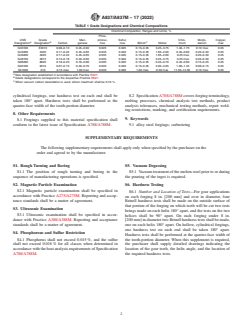
The standard sets forth precise chemical composition ranges for several alloy steel grades used in carburizing:- Elements such as carbon, manganese, phosphorus, sulfur, silicon, nickel, chromium, molybdenum, and copper are tightly controlled.
- Compliance with these compositions ensures material performance and suitability for carburizing processes.
Heat Treatment Requirements
Forgings must undergo either normalizing or normalizing and tempering. These processes optimize the steel's properties for carburizing and subsequent service.Machining and Hardness Testing
- Rough machining is permitted before heat treatment at the manufacturer’s discretion.
- Hardness is tightly regulated, with specific Brinell limits and detailed testing locations, especially for gear applications, to guarantee the material's fitness for intended use.
Weldability
Alloy steel forgings are considered weldable under proper procedures, provided that welding methods and inspections align with approved standards for the material class.Supplementary Requirements
- Options exist for additional inspections such as magnetic particle and ultrasonic examination.
- Extra chemical restrictions and vacuum degassing can be specified based on application-critical needs.
Applications
ASTM A837/A837M-17(2022) is employed across industries that require alloy steel forgings with reliable carburizing performance and controlled properties. Typical applications include:
Automotive and Transportation:
Used in the manufacture of gears, shafts, and other drivetrain components that benefit from a hard-wearing outer layer and a ductile core.Industrial Equipment:
Essential for high-stress parts such as bearings, rollers, and other components exposed to heavy wear, demanding precise heat treatment and hardness levels.Aerospace and Defense:
Applied in critical structural and mechanical parts where material quality, uniformity, and certification to international standards are mandatory.Gear Manufacturing:
Particularly relevant where carburized surfaces must meet specific hardness profiles, with clear testing protocols outlined for compliance.
By following ASTM A837/A837M, manufacturers, purchasers, and specifiers ensure the steel forgings meet required standards for composition, structure, and mechanical properties, resulting in reliable components for carburizing and demanding operating conditions.
Related Standards
ASTM A837/A837M references several other key ASTM standards that complement its requirements:
ASTM A788/A788M:
General requirements for steel forgings, covering terminology, melting, testing, repair, marking, and certification.ASTM A275/A275M:
Practice for magnetic particle examination of steel forgings to detect surface discontinuities.ASTM A388/A388M:
Specification for ultrasonic examination of steel forgings for identifying internal flaws.ASTM E527:
Practice for Numbering Metals and Alloys (UNS), correlating grade designations to unify alloy identification.
Compliance with ASTM A837/A837M-17(2022) and its referenced documents ensures consistency, safety, and performance in steel forgings for carburizing applications-vital for sectors where reliability and longevity are paramount.
Relations
- Effective Date
- 01-Nov-2023
- Effective Date
- 01-Nov-2023
- Effective Date
- 01-May-2019
- Effective Date
- 01-Nov-2018
- Effective Date
- 01-Sep-2018
- Effective Date
- 01-Mar-2018
- Effective Date
- 01-Nov-2017
- Effective Date
- 01-May-2017
- Effective Date
- 01-Dec-2016
- Effective Date
- 01-May-2015
- Effective Date
- 01-Oct-2014
- Effective Date
- 15-May-2014
- Effective Date
- 01-Nov-2013
- Refers
ASTM A275/A275M-08(2013) - Standard Practice for Magnetic Particle Examination of Steel Forgings - Effective Date
- 01-Apr-2013
- Effective Date
- 01-Oct-2011
Get Certified
Connect with accredited certification bodies for this standard

Element Materials Technology
Materials testing and product certification.

Inštitut za kovinske materiale in tehnologije
Institute of Metals and Technology. Materials testing, metallurgical analysis, NDT.
Sponsored listings
Frequently Asked Questions
ASTM A837/A837M-17(2022) is a technical specification published by ASTM International. Its full title is "Standard Specification for Steel Forgings, Alloy, for Carburizing Applications". This standard covers: ABSTRACT This specification covers alloy steel forgings for carburizing applications. Forgings shall be considered weldable under proper conditions. Materials shall go through normalize, or normalize and temper heat treatment, prior to which rough machining may be performed at the option of the manufacturer. Each grade designation of steel shall conform to specified chemical compositions of carbon, manganese, phosphorus, sulfur, silicon, nickel, chromium, molybdenum, and copper. Hardness tests shall be conducted as well. SCOPE 1.1 This specification covers alloy steel forgings for carburizing applications. 1.2 Forgings are considered weldable under proper conditions. Welding technique is of fundamental importance and it is presupposed that welding procedure and inspection shall be in accordance with approved methods for the class of material used. 1.3 This specification is expressed in both inch-pound units and in SI units. However, unless the order specifies the applicable M specification designation (SI units), the material shall be furnished to inch-pound units. 1.4 The values stated in either SI units or inch-pound units are to be regarded separately as standard. The values stated in each system are not necessarily exact equivalents; therefore, to ensure conformance with the standard, each system shall be used independently of the other, and values from the two systems shall not be combined. 1.5 This international standard was developed in accordance with internationally recognized principles on standardization established in the Decision on Principles for the Development of International Standards, Guides and Recommendations issued by the World Trade Organization Technical Barriers to Trade (TBT) Committee.
ABSTRACT This specification covers alloy steel forgings for carburizing applications. Forgings shall be considered weldable under proper conditions. Materials shall go through normalize, or normalize and temper heat treatment, prior to which rough machining may be performed at the option of the manufacturer. Each grade designation of steel shall conform to specified chemical compositions of carbon, manganese, phosphorus, sulfur, silicon, nickel, chromium, molybdenum, and copper. Hardness tests shall be conducted as well. SCOPE 1.1 This specification covers alloy steel forgings for carburizing applications. 1.2 Forgings are considered weldable under proper conditions. Welding technique is of fundamental importance and it is presupposed that welding procedure and inspection shall be in accordance with approved methods for the class of material used. 1.3 This specification is expressed in both inch-pound units and in SI units. However, unless the order specifies the applicable M specification designation (SI units), the material shall be furnished to inch-pound units. 1.4 The values stated in either SI units or inch-pound units are to be regarded separately as standard. The values stated in each system are not necessarily exact equivalents; therefore, to ensure conformance with the standard, each system shall be used independently of the other, and values from the two systems shall not be combined. 1.5 This international standard was developed in accordance with internationally recognized principles on standardization established in the Decision on Principles for the Development of International Standards, Guides and Recommendations issued by the World Trade Organization Technical Barriers to Trade (TBT) Committee.
ASTM A837/A837M-17(2022) is classified under the following ICS (International Classification for Standards) categories: 77.140.85 - Iron and steel forgings. The ICS classification helps identify the subject area and facilitates finding related standards.
ASTM A837/A837M-17(2022) has the following relationships with other standards: It is inter standard links to ASTM A388/A388M-23, ASTM A275/A275M-23, ASTM A788/A788M-19, ASTM A788/A788M-18b, ASTM A788/A788M-18a, ASTM A788/A788M-18, ASTM A788/A788M-17a, ASTM A788/A788M-17, ASTM A788/A788M-16a, ASTM A788/A788M-15, ASTM A788/A788M-14a, ASTM A788/A788M-14, ASTM A788/A788M-13, ASTM A275/A275M-08(2013), ASTM A788/A788M-11. Understanding these relationships helps ensure you are using the most current and applicable version of the standard.
ASTM A837/A837M-17(2022) is available in PDF format for immediate download after purchase. The document can be added to your cart and obtained through the secure checkout process. Digital delivery ensures instant access to the complete standard document.
Standards Content (Sample)
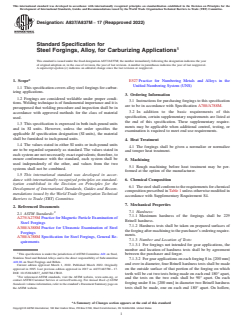
This international standard was developed in accordance with internationally recognized principles on standardization established in the Decision on Principles for the
Development of International Standards, Guides and Recommendations issued by the World Trade Organization Technical Barriers to Trade (TBT) Committee.
Designation: A837/A837M −17 (Reapproved 2022)
Standard Specification for
Steel Forgings, Alloy, for Carburizing Applications
This standard is issued under the fixed designationA837/A837M; the number immediately following the designation indicates the year
of original adoption or, in the case of revision, the year of last revision. A number in parentheses indicates the year of last reapproval.
A superscript epsilon (´) indicates an editorial change since the last revision or reapproval.
1. Scope* E527 Practice for Numbering Metals and Alloys in the
Unified Numbering System (UNS)
1.1 This specification covers alloy steel forgings for carbur-
izing applications.
3. Ordering Information
1.2 Forgings are considered weldable under proper condi-
3.1 Instructions for purchasing forgings to this specification
tions.Weldingtechniqueisoffundamentalimportanceanditis
are to be in accordance with Specification A788/A788M.
presupposed that welding procedure and inspection shall be in
3.2 In addition to the basic requirements of this
accordance with approved methods for the class of material
specification, certain supplementary requirements are listed at
used.
the end of this specification. These supplementary require-
1.3 This specification is expressed in both inch-pound units
ments may be applicable when additional control, testing, or
and in SI units. However, unless the order specifies the
examination is required to meet end use requirements.
applicable M specification designation (SI units), the material
shall be furnished to inch-pound units.
4. Heat Treatment
1.4 The values stated in either SI units or inch-pound units
4.1 The forgings shall be given a normalize or normalize
are to be regarded separately as standard. The values stated in
and temper heat treatment.
each system are not necessarily exact equivalents; therefore, to
ensure conformance with the standard, each system shall be
5. Machining
used independently of the other, and values from the two
5.1 Rough machining before heat treatment may be per-
systems shall not be combined.
formed at the option of the manufacturer.
1.5 This international standard was developed in accor-
dance with internationally recognized principles on standard-
6. Chemical Composition
ization established in the Decision on Principles for the
6.1 Thesteelshallconformtotherequirementsforchemical
Development of International Standards, Guides and Recom-
composition prescribed inTable 1 unless otherwise modified in
mendations issued by the World Trade Organization Technical
accordance with Supplementary Requirement S4.
Barriers to Trade (TBT) Committee.
7. Mechanical Properties
2. Referenced Documents
2 7.1 Hardness:
2.1 ASTM Standards:
7.1.1 Maximum hardness of the forgings shall be 229
A275/A275M Practice for Magnetic Particle Examination of
Brinell hardness.
Steel Forgings
7.1.2 Hardness tests shall be taken on prepared surfaces of
A388/A388M Practice for Ultrasonic Examination of Steel
theforgingaftermachiningtothepurchaser’sorderingrequire-
Forgings
ments.
A788/A788M Specification for Steel Forgings, General Re-
7.1.3 Number and Location of Tests:
quirements
7.1.3.1 For forgings not intended for gear applications, the
number and location of hardness tests shall be by agreement
This specification is under the jurisdiction of ASTM Committee A01 on Steel,
between the purchaser and forger.
Stainless Steel and Related Alloys and is the direct responsibility of Subcommittee
7.1.3.2 Forgearapplicationsoneachforging8in.[200mm]
A01.06 on Steel Forgings and Billets.
and over in diameter, four Brinell hardness tests shall be made
Current edition approved March 1, 2022. Published March 2022. Originally
on the outside surface of that portion of the forging on which
approved in 1985. Last previous edition approved in 2017 as A837/A837M – 17.
DOI: 10.1520/A0837_A0837M-17R22.
teeth will be cut two tests being made on each end 180° apart,
For referenced ASTM standards, visit the ASTM website, www.astm.org, or
and the tests on the two ends shall be 90° apart. On each
contact ASTM Customer Service at service@astm.org. For Annual Book of ASTM
forging under 8 in. [200 mm] in diameter two Brinell hardness
Standards volume information, refer to the standard’s Document Summary page on
the ASTM website. tests shall be made, one on each end 180° apart. On hollow,
*A Summary of Changes section appears at the end of this standard
Copyright ©ASTM International, 100 Barr Harbor Drive, PO Box C700, West Conshohocken, PA19428-2959. United States
A837/A837M − 17 (2022)
TABLE 1 Grade Designations and Chemical Compositions
Chemical Composition, Ranges and Limits, %
Phos-
UNS Grade Man- phorus, Sulfur, Chro- Molyb- Copper,
A B C
Designation Designation Carbon ganese max max Silicon Nickel mium denum max
G33106 E3310 0.08–0.13 0.45–0.60 0.025 0.025 0.15–0.35 3.25–3.75 1.40–1.75 0.10 max 0.35
G43200 4320 0.17–0.22 0.45–0.65 0.035
...