

ASTM F3540-21
(Guide)Standard Guide for Hazards for Consideration when Designing Exoskeletons
General Information
- Abstract
SIGNIFICANCE AND USE
4.1 Development of exoskeleton technologies requires careful analysis of potential risks that may be associated with their use. Failure to adequately assess risks may give rise to hazardous situations at many instances of exoskeleton use, for example during completion of human trials, during exoskeleton demonstrations in trade shows, as well as during exoskeleton training, wear, operation, transportation, maintenance, and disposal.
4.2 This guide provides a minimum set of hazards that should be considered by producers when analyzing and mitigating risks related to exoskeletons. This set of hazards should be supplemented with other hazards that may reflect unique safety concerns relevant to the exoskeleton technology and application. The following sources may provide additional insight based on exoskeleton technology and application:
4.2.1 IEC 60601 series;
4.2.2 IEC 80601-2-78;
4.2.3 ISO/DIS 13482;
4.2.4 Product standards established by military agencies (examples are NATO standards and United States Military Standards).
4.3 For each listed hazard, one example of harm scenario and examples of possible harm are provided. These examples are used to illustrate potential safety consequences related to such hazards. They do not reflect a comprehensive list of all possible acute or chronic injuries that may result from exoskeleton use. Additionally, although this guide does not address hazards that may result in damage of objects, these should be considered as well during the risk analysis process.
4.4 This guide does not provide detailed guidance for application of risk management processes to exoskeletons. However, the producer should use a structured approach to identify and monitor hazards, and mitigate related risks throughout the exoskeleton life-cycle. Additional guidance on risk management can be found in the following standards:
4.4.1 ISO 31000;
4.4.2 ISO 14971.
4.5 This guide does not supersede any established laws or regulations ...
SCOPE
1.1 This guide lists typical hazards that should be considered by exoskeleton producers when analyzing and managing potential risks related to exoskeletons.
1.2 Where possible, this guide provides references to agency standards, regulations, or guidelines for assessment of risks related to these hazards and for application of risk reduction measures.
1.3 This guide applies to all exoskeleton types, regardless of the applications of the technology such as consumer, industrial, medical, military, and emergency management services.
1.4 Units—The values stated in SI units are to be regarded as standard. No other units of measurement are included in this standard.
1.5 This standard does not purport to address all of the safety concerns, if any, associated with its use. It is the responsibility of the user of this standard to establish appropriate safety, health, and environmental practices and determine the applicability of regulatory limitations prior to use.
1.6 This international standard was developed in accordance with internationally recognized principles on standardization established in the Decision on Principles for the Development of International Standards, Guides and Recommendations issued by the World Trade Organization Technical Barriers to Trade (TBT) Committee.
- Status
- Published
- Publication Date
- 31-Oct-2021
- Technical Committee
- F48 - Exoskeletons and Exosuits
- Drafting Committee
- F48.02 - Human Factors and Ergonomics
Overview
ASTM F3540-21: Standard Guide for Hazards for Consideration when Designing Exoskeletons provides comprehensive guidance for identifying and managing risks in the design and use of exoskeleton technologies. Developed by ASTM International, this standard assists manufacturers, engineers, and safety professionals in recognizing typical hazards during the entire life-cycle of exoskeletons-including human trials, product demonstrations, training, operation, transportation, maintenance, and disposal. This guide applies across diverse sectors, such as consumer, industrial, medical, military, and emergency management, supporting safer integration of exoskeletons by referencing a broad set of international standards.
Key Topics
Hazard Identification and Risk Management
The document outlines a minimum set of hazards (e.g., mechanical, ergonomic, electrical, thermal, chemical, and control system hazards) essential for risk analysis when designing exoskeletons. For each hazard, it provides example scenarios and potential harms, promoting a structured approach to risk assessment and mitigation.Ergonomics and Human Factors
Emphasizes the importance of ergonomic fit, user posture, sensory perception (vision, hearing, tactile), and thermal comfort. Poor ergonomic design may result in musculoskeletal injuries, improper body alignment, or impaired awareness of environmental dangers.Mechanical and Material Risks
Addresses risks associated with moving parts (pinching, entanglement, crushing), mechanical failure (fastener fatigue, corrosion), and surface finishes (sharp edges, projections).Electrical and Thermal Hazards
Discusses hazards from stored electrical energy (battery failure, electrical shock, fire), thermal emissions (contact with hot or cold surfaces), and flammable materials.Control System Safety
Covers risks related to complex control systems in exoskeletons, including inadvertent activation, mislabeling of controls, loss of function, software errors, and hacking.References to Agency Standards
The guide cross-references a wide array of related safety and performance standards to support effective risk reduction.
Applications
Exoskeleton Manufacturers and Designers
Utilized to conduct thorough risk assessments during R&D, engineering, and testing phases, ensuring new exoskeleton products address key safety concerns across all user scenarios.Regulatory Compliance and Certification
Supports compliance with broader regulatory requirements by providing industry-accepted guidelines and linking to established standards for specific hazards (e.g., IEC 60601 for medical devices, ISO 13482 for robots, OSHA for occupational safety).Workplace and Clinical Integration
Guides employers, healthcare providers, and safety professionals in evaluating exoskeleton suitability and safety for industrial workers, patients in rehabilitation, or military personnel, accounting for diverse operational environments.Training and Maintenance Planning
Informs the creation of effective exoskeleton user training, care, and maintenance procedures to mitigate operational risks and enhance lifecycle safety.
Related Standards
The ASTM F3540-21 guide encourages supplementing its recommendations with additional standards to address unique technologies and scenarios, including:
- IEC 60601 Series: Safety of medical electrical equipment.
- IEC 80601-2-78: Medical robots for rehabilitation and compensation.
- ISO/DIS 13482: Safety of personal care robots.
- ISO 31000: Risk management guidelines.
- ISO 14971: Application of risk management to medical devices.
- OSHA 29 CFR and NFPA 70: Occupational safety and electrical codes.
- UL 94, ISO 13849: Fire safety and machinery control systems.
The guide also references standards for ergonomics (ISO 6385), vibration and noise (ISO 8041-1, ISO 11200), biological evaluation (ISO 10993 series), and personal protective equipment (BS EN 13921).
ASTM F3540-21 serves as an essential resource for ensuring exoskeletons are designed with a strong focus on safety and risk reduction. Its structured approach to hazard identification and use of cross-industry references makes it valuable for anyone involved in the development, deployment, or regulation of wearable robotics.
Relations
- Effective Date
- 01-Apr-2020
- Effective Date
- 01-Mar-2020
- Effective Date
- 01-Oct-2019
- Effective Date
- 01-Apr-2019
- Effective Date
- 01-Sep-2018
- Effective Date
- 01-Apr-2016
- Effective Date
- 01-Feb-2014
- Effective Date
- 01-Oct-2012
- Effective Date
- 15-Oct-2010
- Effective Date
- 15-Jul-2010
- Effective Date
- 01-May-2010
- Effective Date
- 01-Sep-2009
- Effective Date
- 01-Oct-2003
- Effective Date
- 01-Oct-2003
- Effective Date
- 10-Mar-1999
Get Certified
Connect with accredited certification bodies for this standard

DVS-ZERT GmbH
German welding certification society.
CARES (UK Certification Authority for Reinforcing Steels)
UK certification for reinforcing steels and construction.
EWF/IIW (European/International Welding Federation)
International welding personnel certification.
Sponsored listings
Frequently Asked Questions
ASTM F3540-21 is a guide published by ASTM International. Its full title is "Standard Guide for Hazards for Consideration when Designing Exoskeletons". This standard covers: SIGNIFICANCE AND USE 4.1 Development of exoskeleton technologies requires careful analysis of potential risks that may be associated with their use. Failure to adequately assess risks may give rise to hazardous situations at many instances of exoskeleton use, for example during completion of human trials, during exoskeleton demonstrations in trade shows, as well as during exoskeleton training, wear, operation, transportation, maintenance, and disposal. 4.2 This guide provides a minimum set of hazards that should be considered by producers when analyzing and mitigating risks related to exoskeletons. This set of hazards should be supplemented with other hazards that may reflect unique safety concerns relevant to the exoskeleton technology and application. The following sources may provide additional insight based on exoskeleton technology and application: 4.2.1 IEC 60601 series; 4.2.2 IEC 80601-2-78; 4.2.3 ISO/DIS 13482; 4.2.4 Product standards established by military agencies (examples are NATO standards and United States Military Standards). 4.3 For each listed hazard, one example of harm scenario and examples of possible harm are provided. These examples are used to illustrate potential safety consequences related to such hazards. They do not reflect a comprehensive list of all possible acute or chronic injuries that may result from exoskeleton use. Additionally, although this guide does not address hazards that may result in damage of objects, these should be considered as well during the risk analysis process. 4.4 This guide does not provide detailed guidance for application of risk management processes to exoskeletons. However, the producer should use a structured approach to identify and monitor hazards, and mitigate related risks throughout the exoskeleton life-cycle. Additional guidance on risk management can be found in the following standards: 4.4.1 ISO 31000; 4.4.2 ISO 14971. 4.5 This guide does not supersede any established laws or regulations ... SCOPE 1.1 This guide lists typical hazards that should be considered by exoskeleton producers when analyzing and managing potential risks related to exoskeletons. 1.2 Where possible, this guide provides references to agency standards, regulations, or guidelines for assessment of risks related to these hazards and for application of risk reduction measures. 1.3 This guide applies to all exoskeleton types, regardless of the applications of the technology such as consumer, industrial, medical, military, and emergency management services. 1.4 Units—The values stated in SI units are to be regarded as standard. No other units of measurement are included in this standard. 1.5 This standard does not purport to address all of the safety concerns, if any, associated with its use. It is the responsibility of the user of this standard to establish appropriate safety, health, and environmental practices and determine the applicability of regulatory limitations prior to use. 1.6 This international standard was developed in accordance with internationally recognized principles on standardization established in the Decision on Principles for the Development of International Standards, Guides and Recommendations issued by the World Trade Organization Technical Barriers to Trade (TBT) Committee.
SIGNIFICANCE AND USE 4.1 Development of exoskeleton technologies requires careful analysis of potential risks that may be associated with their use. Failure to adequately assess risks may give rise to hazardous situations at many instances of exoskeleton use, for example during completion of human trials, during exoskeleton demonstrations in trade shows, as well as during exoskeleton training, wear, operation, transportation, maintenance, and disposal. 4.2 This guide provides a minimum set of hazards that should be considered by producers when analyzing and mitigating risks related to exoskeletons. This set of hazards should be supplemented with other hazards that may reflect unique safety concerns relevant to the exoskeleton technology and application. The following sources may provide additional insight based on exoskeleton technology and application: 4.2.1 IEC 60601 series; 4.2.2 IEC 80601-2-78; 4.2.3 ISO/DIS 13482; 4.2.4 Product standards established by military agencies (examples are NATO standards and United States Military Standards). 4.3 For each listed hazard, one example of harm scenario and examples of possible harm are provided. These examples are used to illustrate potential safety consequences related to such hazards. They do not reflect a comprehensive list of all possible acute or chronic injuries that may result from exoskeleton use. Additionally, although this guide does not address hazards that may result in damage of objects, these should be considered as well during the risk analysis process. 4.4 This guide does not provide detailed guidance for application of risk management processes to exoskeletons. However, the producer should use a structured approach to identify and monitor hazards, and mitigate related risks throughout the exoskeleton life-cycle. Additional guidance on risk management can be found in the following standards: 4.4.1 ISO 31000; 4.4.2 ISO 14971. 4.5 This guide does not supersede any established laws or regulations ... SCOPE 1.1 This guide lists typical hazards that should be considered by exoskeleton producers when analyzing and managing potential risks related to exoskeletons. 1.2 Where possible, this guide provides references to agency standards, regulations, or guidelines for assessment of risks related to these hazards and for application of risk reduction measures. 1.3 This guide applies to all exoskeleton types, regardless of the applications of the technology such as consumer, industrial, medical, military, and emergency management services. 1.4 Units—The values stated in SI units are to be regarded as standard. No other units of measurement are included in this standard. 1.5 This standard does not purport to address all of the safety concerns, if any, associated with its use. It is the responsibility of the user of this standard to establish appropriate safety, health, and environmental practices and determine the applicability of regulatory limitations prior to use. 1.6 This international standard was developed in accordance with internationally recognized principles on standardization established in the Decision on Principles for the Development of International Standards, Guides and Recommendations issued by the World Trade Organization Technical Barriers to Trade (TBT) Committee.
ASTM F3540-21 is classified under the following ICS (International Classification for Standards) categories: 25.040.30 - Industrial robots. Manipulators. The ICS classification helps identify the subject area and facilitates finding related standards.
ASTM F3540-21 has the following relationships with other standards: It is inter standard links to ASTM C1055-20, ASTM F3427-20, ASTM F3323-19a, ASTM F3323-19, ASTM F3323-18, ASTM D1230-10(2016)e1, ASTM C1055-03(2014), ASTM C1057-12, ASTM F2808-10, ASTM D1230-10, ASTM C1057-03(2010), ASTM C1055-03(2009), ASTM C1057-03, ASTM C1055-03, ASTM C1055-99. Understanding these relationships helps ensure you are using the most current and applicable version of the standard.
ASTM F3540-21 is available in PDF format for immediate download after purchase. The document can be added to your cart and obtained through the secure checkout process. Digital delivery ensures instant access to the complete standard document.
Standards Content (Sample)
This international standard was developed in accordance with internationally recognized principles on standardization established in the Decision on Principles for the
Development of International Standards, Guides and Recommendations issued by the World Trade Organization Technical Barriers to Trade (TBT) Committee.
Designation: F3540 − 21
Standard Guide for
Hazards for Consideration when Designing Exoskeletons
This standard is issued under the fixed designation F3540; the number immediately following the designation indicates the year of
original adoption or, in the case of revision, the year of last revision. A number in parentheses indicates the year of last reapproval. A
superscript epsilon (´) indicates an editorial change since the last revision or reapproval.
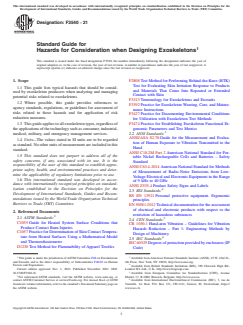
1. Scope F2808 Test Method for Performing Behind-the-Knee (BTK)
Test for Evaluating Skin Irritation Response to Products
1.1 This guide lists typical hazards that should be consid-
and Materials That Come Into Repeated or Extended
ered by exoskeleton producers when analyzing and managing
Contact with Skin
potential risks related to exoskeletons.
F3323 Terminology for Exoskeletons and Exosuits
1.2 Where possible, this guide provides references to
F3392 Practice for Exoskeleton Wearing, Care, and Mainte-
agency standards, regulations, or guidelines for assessment of
nance Instructions
risks related to these hazards and for application of risk
F3427 Practice for Documenting Environmental Conditions
reduction measures.
for Utilization with Exoskeleton Test Methods
F3474 Practice for Establishing Exoskeleton Functional Er-
1.3 Thisguideappliestoallexoskeletontypes,regardlessof
theapplicationsofthetechnologysuchasconsumer,industrial, gonomic Parameters and Test Metrics
2.2 ANSI Standards:
medical, military, and emergency management services.
ANSI/ASA S2.70 Guide for the Measurement and Evalua-
1.4 Units—The values stated in SI units are to be regarded
tion of Human Exposure to Vibration Transmitted to the
as standard. No other units of measurement are included in this
Hand
standard.
ANSI C18.2M Part 2 American National Standard for Por-
1.5 This standard does not purport to address all of the
table Nickel Rechargeable Cells and Batteries – Safety
safety concerns, if any, associated with its use. It is the
Standard
responsibility of the user of this standard to establish appro-
ANSI C63.4-2014 American National Standard for Methods
priate safety, health, and environmental practices and deter-
of Measurement of Radio-Noise Emissions from Low-
mine the applicability of regulatory limitations prior to use.
Voltage Electrical and Electronic Equipment in the Range
1.6 This international standard was developed in accor-
of 9 kHz to 40 GHz
dance with internationally recognized principles on standard-
ANSI Z535.4 Product Safety Signs and Labels
ization established in the Decision on Principles for the 4
2.3 BSI Standards:
Development of International Standards, Guides and Recom-
BS EN 13921 Personal protective equipment. Ergonomic
mendations issued by the World Trade Organization Technical
principles
Barriers to Trade (TBT) Committee.
EN 50581:2012 Technical documentation for the assessment
of electrical and electronic products with respect to the
2. Referenced Documents
restriction of hazardous substances
2.1 ASTM Standards: 5
2.4 CEN Standards:
C1055 Guide for Heated System Surface Conditions that
CR 1030-1 Hand-arm Vibration – Guidelines for Vibration
Produce Contact Burn Injuries
Hazards Reduction – Part 1: Engineering Methods by
C1057 Practice for Determination of Skin Contact Tempera-
Design of Machinery
ture from Heated Surfaces Using a Mathematical Model
2.5 IEC Standards:
and Thermesthesiometer
IEC 60529 Degrees of protection provided by enclosures (IP
D1230 Test Method for Flammability of Apparel Textiles
Code)
1 3
This guide is under the jurisdiction ofASTM Committee F48 on Exoskeletons Available fromAmerican National Standards Institute (ANSI), 25 W. 43rd St.,
and Exosuits and is the direct responsibility of Subcommittee F48.02 on Human 4th Floor, New York, NY 10036, http://www.ansi.org.
Factors and Ergonomics. Available from British Standards Institution (BSI), 389 Chiswick High Rd.,
Current edition approved Nov. 1, 2021. Published November 2021. DOI: London W4 4AL, U.K., http://www.bsigroup.com.
10.1520/F3540-21. Available from European Committee for Standardization (CEN), Avenue
For referenced ASTM standards, visit the ASTM website, www.astm.org, or Marnix 17, B-1000, Brussels, Belgium, http://www.cen.eu.
contact ASTM Customer Service at service@astm.org. For Annual Book of ASTM Available from International Electrotechnical Commission (IEC), 3, rue de
Standards volume information, refer to the standard’s Document Summary page on Varembé, 1st floor, P.O. Box 131, CH-1211, Geneva 20, Switzerland, https://
the ASTM website. www.iec.ch.
Copyright © ASTM International, 100 Barr Harbor Drive, PO Box C700, West Conshohocken, PA 19428-2959. United States
F3540 − 21
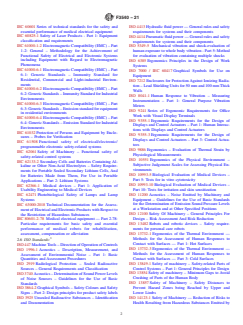
IEC 60601 Series of technical standards for the safety and ISO 4413 Hydraulic fluid power — General rules and safety
essential performance of medical electrical equipment requirements for systems and their components
IEC 60825-1 Safety of Laser Products - Part 1: Equipment ISO4414 Pneumaticfluidpower—Generalrulesandsafety
classification and requirements
requirements for systems and their components
IEC61000-1-2 ElectromagneticCompatibility(EMC)–Part
ISO 5349-5 Mechanical vibration and shock-evaluation of
1-2: General – Methodology for the Achievement of
human exposure to whole body vibration - Part 5: Method
Functional Safety of Electrical and Electronic Systems
for evaluation of vibration containing multiple shocks
including Equipment with Regard to Electromagnetic
ISO 6385 Ergonomics Principles in the Design of Work
Phenomena
Systems
IEC61000-6-1 ElectromagneticCompatibility(EMC)–Part
ISO 7000 / IEC 60417 Graphical Symbols for Use on
6-1: Generic Standards – Immunity Standard for
Equipment
Residential, Commercial and Light-industrial Environ-
ISO 7212 Enclosures for ProtectionAgainst Ionizing Radia-
ments
tion – Lead Shielding Units for 50 mm and 100 mmThick
IEC61000-6-2 ElectromagneticCompatibility(EMC)–Part
Walls
6-2:GenericStandards–ImmunityStandardforIndustrial
ISO 8041-1 Human Response to Vibration – Measuring
Environments
Instrumentation – Part 1: General Purpose Vibration
IEC61000-6-3 ElectromagneticCompatibility(EMC)–Part
Meters
6-3:GenericStandards–Emissionstandardforequipment
ISO 9241 Series of Ergonomic Requirements for Office
in residential environments
Work with Visual Display Terminals
IEC61000-6-4 ElectromagneticCompatibility(EMC)–Part
ISO 9355-1 Ergonomic Requirements for the Design of
6-4: Generic Standards – Emission Standard for Industrial
Displays and Control Actuators – Part 1: Human Interac-
Environments
tions with Displays and Control Actuators
IEC 61032 Protection of Persons and Equipment by Enclo-
ISO 9355-3 Ergonomic Requirements for the Design of
sures – Probes for Verification
Displays and Control Actuators – Part 3: Control Actua-
IEC 61508 Functional safety of electrical/electronic/
tors
programmable electronic safety-related systems
ISO 9886 Ergonomics – Evaluation of Thermal Strain by
IEC 62061 Safety of Machinery – Functional safety of
Physiological Measurements
safety-related control systems
ISO 10551 Ergonomics of the Physical Environment –
IEC 62133-2 Secondary Cells and Batteries Containing Al-
Subjective Judgement Scales for Assessing Physical En-
kaline or Other Non-Acid Electrolytes – Safety Require-
vironments
ments for Portable Sealed Secondary Lithium Cells, And
ISO 10993-5 Biological Evaluation of Medical Devices –
for Batteries Made from Them, For Use in Portable
Part 5: Tests for in vitro cytotoxicity
Applications – Part 2: Lithium Systems
ISO 10993-10 Biological Evaluation of Medical Devices –
IEC 62366-1 Medical devices – Part 1: Application of
Part 10: Tests for irritation and skin sensitization
Usability Engineering to Medical Devices
ISO 11200 Acoustics – Noise Emitted by Machinery and
IEC 62471 Photobiological Safety of Lamps and Lamp
Equipment – Guidelines for the Use of Basic Standards
Systems
for the Determination of Emission Sound Pressure Levels
IEC 63000:2018 Technical Documentation for the Assess-
mentofElectricalandElectronicProductswithRespectto at a Workstation and at Other Specified Positions
ISO 12100 Safety Of Machinery – General Principles For
the Restriction of Hazardous Substances
IEC 80601-2-78 Medical electrical equipment — Part 2-78: Design – Risk Assessment And Risk Reduction
Particular requirements for basic safety and essential ISO 13482 Robots and robotic devices – Safety require-
performance of medical robots for rehabilitation, ments for personal care robots
assessment, compensation or alleviation
ISO 13732-1 Ergonomics of the Thermal Environment —
Methods for the Assessment of Human Responses to
2.6 ISO Standards:
Contact with Surfaces — Part 1: Hot Surfaces
ISO447 MachineTools–DirectionofOperationofControls
ISO 13732-3 Ergonomics of the Thermal Environment —
ISO 1996-1 Acoustics – Description, Measurement, and
Methods for the Assessment of Human Responses to
Assessment of Environmental Noise – Part 1: Basic
Contact with Surfaces — Part 3: Cold Surfaces
Quantities and Assessment Procedures
ISO 13849-1 Safety of machinery – Safety-related Parts of
ISO 2919 Radiological Protection – Sealed Radioactive
Control Systems – Part 1: General Principles for Design
Sources – General Requirements and Classification
ISO 13854 Safety of machinery – Minimum Gaps to Avoid
ISO3740 Acoustics–DeterminationofSoundPowerLevels
Crushing of Parts of the Human Body
of Noise Sources – Guidelines for the Use of Basic
ISO 13857 Safety of Machinery – Safety Distances to
Standards
ISO 3864-2 Graphical Symbols – Safety Colours and Safety Prevent Hazard Zones being Reached by Upper and
Signs – Part 2: Design principles for product safety labels Lower Limbs
ISO 14123-1 Safety of Machinery — Reduction of Risks to
ISO 3925 Unsealed Radioactive Substances – Identification
and Documentation Health Resulting from Hazardous Substances Emitted by
F3540 − 21
Machinery — Part 1: Principles and Specifications for OSHA 1910.242(b) Hand and Portable Powered Tools and
Machinery Manufacturers Equipment, General
ISO 14152 Neutron Radiation Protection Shielding – Design
2.9 UL Standards:
Principles and Considerations for the Choice ofAppropri-
UL 94 Standard for Tests for Flammability of Plastic Mate-
ate Materials
rials for Parts in Devices and Appliances
ISO14159 SafetyofMachinery–HygieneRequirementsfor
UL 508A Industrial Control Panels
the Design of Machinery
UL 991 Standard for Tests for Safety-Related Control Em-
ISO 14971 Medical devices — Application of risk manage-
ploying Solid-State Devices
ment to medical devices
UL 2054 Standard for Household and Commercial Batteries
ISO 15537 Principles for Selecting and Using Test Persons
2.10 Federal Regulations:
for TestingAnthropometricAspects of Industrial Products
49 CFR § 571.101 Standard No. 101 Controls and Displays
and Designs
49 CFR § 571.118 Standard No. 118 Power-Operated
ISO 15667 Acoustics – Guidelines for Noise Control by
Window, Partition, and Roof panel systems
Enclosures and Cabins
FCC CFR 47 Part 15, Subpart B Radiated Emissions and
ISO 19353 Safety of Machinery – Fire Prevention and
Conducted Emissions (Sections 15.107 and 15.109)
Protection
2.11 Military Standards:
ISO 22523 External limb prostheses and external orthoses
MIL-HDBK-310 Global Climatic Data for Developing Mili-
— Requirements and test methods
tary Products
ISO 26262 Road Vehicles – Functional Safety
MIL-STD 810 Environmental Engineering Considerations
ISO 31000 Risk management — Guidelines
and Laboratory Tests
ISO/AWI 2631-1 Mechanical Vibration and Shock – Evalu-
MIL-STD-1246 MilitaryStandard:ProductCleanlinessLev-
ation of Human Exposure to Whole-body Vibration – Part
els Contamination Control Program
1: General Requirements
MIL-STD-1472 Department of Defense Design Criteria
ISO/DIS 13482 Robots and robotic devices — Safety
Standard: Human Engineering
requirements for non-industrial robots — Non-medical
personal care robot
3. Terminology
ISO/IEC Guide 51 Safety aspects — Guidelines for their
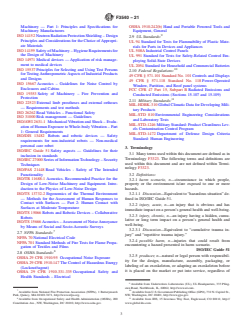
3.1 Many terms used within this document are defined as in
inclusion in standards
Terminology F3323. The following terms and definitions are
ISO/IEC27000 SeriesofInformationTechnology–Security
used within this document and are not defined within Termi-
Techniques
nology F3323.
ISO/PAS 21448 Road Vehicles - Safety of The Intended
Functionality
3.2 Definitions:
ISO/TR 11688-1 Acoustics. Recommended Practice for the 3.2.1 harm scenario, n—circumstance in which people,
Design of Low-Noise Machinery and Equipment. Intro-
property or the environment is/are exposed to one or more
duction to the Physics of Low-Noise Design
hazards.
ISO/TS 13732-2 Ergonomics of the Thermal Environment
3.2.1.1 Discussion—Equivalentto“hazardoussituation”de-
— Methods for the Assessment of Human Responses to
fined in ISO/IEC Guide 51.
Contact with Surfaces — Part 2: Human Contact with
3.2.2 injury, acute, n—an injury that is obvious and has
Surfaces at Moderate Temperature
immediate impact on a person’s general health and well-being.
ISO/TS 15066 Robots and Robotic Devices – Collaborative
3.2.3 injury, chronic, n—an injury having a hidden, cumu-
Robots
lative or long term impact on a person’s general health and
ISO/TS 15666 Acoustics –Assessment of NoiseAnnoyance
well-being.
by Means of Social and Socio-Acoustic Surveys
3.2.3.1 Discussion—Equivalent to “cumulative trauma in-
2.7 NFPA Standards:
jury” and “repetitive trauma injury.”
NFPA 70 National Electrical Code
3.2.4 possible harm, n—injuries that could result from
NFPA701 Standard Methods of Fire Tests for Flame Propa-
encountering a hazard presented in harm scenario.
gation of Textiles and Films
ISO/IEC Guide 51
2.8 OSHA Standards:
3.2.5 producer, n—natural or legal person with responsibil-
OSHA 29 CFR 1910.95 Occupational Noise Exposure
ity for the design, manufacture, assembly, packaging, or
OSHA 29 CFR 1910.147 The Control of Hazardous Energy
labeling of an exoskeleton, or adapting an exoskeleton before
(Lockout/tagout)
it is placed on the market or put into service, regardless of
OSHA 29 CFR 1910.331-335 Occupational Safety and
Health Standards – Electrical
Available from Underwriters Laboratories (UL), UL Headquarters, 333 Pfing-
sten Road, Northbrook, IL, 60062, http://www.ul.com.
7 10
Available from National Fire Protection Association (NFPA), 1 Batterymarch Available from U.S. Government Publishing Office (GPO), 732 N. Capitol St.,
Park, Quincy, MA 02169-7471, http://www.nfpa.org. NW, Washington, DC 20401, http://www.gpo.gov.
8 11
Available from Occupational Safety and Health Administration (OSHA), 200 Available from IHS, 15 Inverness Way East, Englewood, CO 80112, http://
Constitution Ave., NW, Washington, DC 20210, http://www.osha.gov. www.global.ihs.com.
F3540 − 21
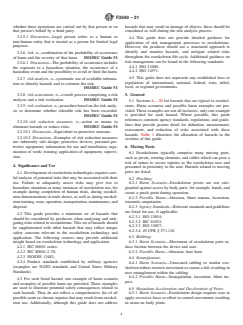
whether these operations are carried out by that person or on hazards that may result in damage of objects, these should be
that person’s behalf by a third party. considered as well during the risk analysis process.
3.2.5.1 Discussion—Legal person refers to a human or
4.4 This guide does not provide detailed guidance for
non-human entity that is treated as a person for limited legal
application of risk management processes to exoskeletons.
purposes.
However, the producer should use a structured approach to
identify and monitor hazards, and mitigate related risks
3.2.6 risk, n—combination of the probability of occurrence
throughout the exoskeleton life-cycle. Additional guidance on
of harm and the severity of that harm. ISO/IEC Guide 51
risk management can be found in the following standards:
3.2.6.1 Discussion—The probability of occurrence includes
4.4.1 ISO 31000;
the exposure to a hazardous situation, the occurrence of a
4.4.2 ISO 14971.
hazardous event and the possibility to avoid or limit the harm.
4.5 This guide does not supersede any established laws or
3.2.7 risk analysis, n—systematic use of available informa-
regulations of international, national, federal, state, tribal,
tion to identify hazards and to estimate the risk.
local, or regional governments.
ISO/IEC Guide 51
3.2.8 risk assessment, n—overall process comprising a risk 5. General
analysis and a risk evaluation. ISO/IEC Guide 51
5.1 Sections6–20 list hazards that are typical to exoskel-
etons. Harm scenarios and possible harm examples are pro-
3.2.9 risk evaluation, n—procedure based on the risk analy-
vided. These examples are not all inclusive, only one example
sis to determine whether tolerable risk has been exceeded.
is provided for each hazard. Where possible, this guide
ISO/IEC Guide 51
references common agency standards, regulations, and guide-
3.2.10 risk reduction measures, n—action or means to
lines that provide greater detail for definition, measurement,
eliminate hazards or reduce risks. ISO/IEC Guide 51
assessment, and reduction of risks associated with these
3.2.10.1 Discussion—Equivalent to protective measure.
hazards. Table 1 illustrates the allocation of hazards in the
3.2.10.2 Discussion—Examples of risk reduction measures
sections of this guide.
are: inherently safe design; protective devices; personal pro-
6. Moving Parts
tective equipment; information for use and installation; orga-
nization of work; training; application of equipment; supervi-
6.1 Exoskeletons typically comprise many moving parts,
sion.
such as pivots, rotating elements, and cables which can pose a
risk of minor to severe injuries to the exoskeleton user and
4. Significance and Use
personnel in proximity to the user. Hazards related to moving
parts are listed.
4.1 Development of exoskeleton technologies requires care-
ful analysis of potential risks that may be associated with their
6.2 Pinching:
use. Failure to adequately assess risks may give rise to
6.2.1 Harm Scenario—Exoskeleton pivots are not safe-
hazardous situations at many instances of exoskeleton use, for
guarded against access by body parts, for example, hands, and
example during completion of human trials, during exoskel-
create a pinch point during operation.
eton demonstrations in trade shows, as well as during exoskel-
6.2.2 Possible Harm—Abrasion, blunt trauma, laceration,
etontraining,wear,operation,transportation,maintenance,and
traumatic amputation.
disposal.
6.2.3 Agency Standards—Relevant standards and guidelines
are listed for use, if applicable.
4.2 This guide provides a minimum set of hazards that
6.2.3.1 ISO 13854;
should be considered by producers when analyzing and miti-
6.2.3.2 IEC 61032;
gating risks related to exoskeletons. This set of hazards should
6.2.3.3 ISO 13857;
be supplemented with other hazards that may reflect unique
6.2.3.4 49 CFR § 571.118.
safety concerns relevant to the exoskeleton technology and
application. The following sources may provide additional 6.3 Rubbing:
insight based on exoskeleton technology and application: 6.3.1 Harm Scenario—Movement of exoskeleton parts in-
4.2.1 IEC 60601 series; duce friction between the device and user.
6.3.2 Possible Harm—Abrasion, heat burn.
4.2.2 IEC 80601-2-78;
4.2.3 ISO/DIS 13482;
6.4 Entanglement:
4.2.4 Product standards established by military agencies
6.4.1 Harm Scenario—Unsecured cabling or similar exo-
(examples are NATO standards and United States Military
skeletontethersrestrictsmovementorcausesafall,resultingin
Standards).
user entanglement within the cabling.
6.4.2 Possible Harm—Strangulation, laceration, blunt im-
4.3 For each listed hazard, one example of harm scenario
pact.
and examples of possible harm are provided. These examples
are used to illustrate potential safety consequences related to 6.5 Hazardous Acceleration and Deceleration of Parts:
such hazards. They do not reflect a comprehensive list of all 6.5.1 Harm Scenario—Exoskeleton design requires user to
possible acute or chronic injuries that may result from exoskel- apply excessive force or effort to control movements resulting
eton use. Additionally, although this guide does not address in strain on body joints.
F3540 − 21
TABLE 1 Summary of Sections and Listed Hazards
No. Section Name Listed Hazards
6 Moving Parts Pinching, rubbing, entanglement and acceleration
7 Ergonomic Parameters Hazardous kinematic and kinetic patterns, body posture and fit, obstruction of vision,
smell, tactile senses, hearing, and proprioceptive response
8 Surface Finishes Rough or sharp edges, surfaces, and projections
9 Mechanical Failure Fastener failure, stress, fatigue, and corrosion
10 Noise and Vibration Emissions Hazardous noise and vibration
11 Thermal Emissions Hot or cold surfaces, liquids or gases, and fire
12 Stored Potential Energy Springs and elastic elements
Pressurized gas or liquids
13 Stored Electrical Energy Battery failure, capacitor failure, electrical failure (fire), arcing, exposed conductors,
short circuits, loss of power, electrostatic discharge
14 Chemical and Biological Agents Hazardous substances and fluids, infectious diseases, and related biohazards
15 Control Systems Erroneous mode activation, misunderstanding of system labels, unintentional access to
controls, incorrect functionality, excessive torque, inappropriate output, loss of function,
control system error, failure of emergency stop function, and system hacking
16 Gravity and Inertia Entrapment, inertial loading, shock loading, mass distribution, fit instability, and pressure
17 Physical Environment Collisions with objects and living beings, entrapment, and functional degradation
18 Emergencies Emergency exoskeleton doffing and building evacuation
19 Clothing and Personal Protective Equipment (PPE) Inability to wear and incompatibility with PPE
20 Radiation Non-ionizing and ionizing radiation
6.5.2 Possible Harm—Musculoskeletal injuries. 7.3.1 Harm Scenario—Volume of exoskeleton parts causes
user to adopt a particular and unusual posture to complete a
7. Ergonomic Parameters drilling task, resulting in dust falling in user’s eyes.
7.3.2 Possible Harm—Temporary or permanent eye injury.
7.1 Ergonomic design relates to the exoskeleton fitting the
7.3.3 Agency Standards—Relevant standards and guidelines
needs and abilities of the user, allowing the user to operate the
are listed for use, if applicable.
exoskeleton and adapt the exoskeleton function for a given
task. Natural human kinematics and kinetics should inform 7.3.3.1 Practice F3474;
exoskeleton kinematic and kinetic patterns. Modifications to 7.3.3.2 MIL-STD-1472.
the user’s kinematics or kinetics may lead to accidents or
7.4 Hazardous Fit:
injuries. Anthropometric data of the target user population
7.4.1 Harm Scenario—Poor alignment or incorrect orienta-
should inform the size, shape, form, and strength of the
tion of joints, such as exoskeleton joint axis of rotation
exoskeleton, to reduce the likelihood of inappropriate interac-
misaligned with anatomical joint axis of rotation, causing
tion between exoskeleton and user, and consequently, risk of
strain to user’s joints.
injury. Obstruction of any senses (vision, hearing,
7.4.2 Possible Harm—Musculoskeletal injury.
proprioception, tactile sense, smell, and taste) may lead to
7.4.3 Agency Standards—Relevant standards and guidelines
accidents. Body coverage and heat emissions may have negli-
are listed for use, if applicable.
gible to severe effects on the user’s thermoregulation.
7.4.3.1 ISO 15537.
7.2 Hazardous Kinematic and Kinetic Patterns:
7.2.1 Harm Scenario—Insufficient degrees of freedom in 7.5 Obstruction of Vision:
exoskeleton kinematic chain imposes awkward movement
7.5.1 Harm Scenario—Inability to see or avoid approaching
patterns.
hazard or to identify emergency signal in a timely manner,
7.2.2 Possible Harm—Musculoskeletal injury.
resulting in a fall.
7.2.3 Agency Standards—Relevant standards and guidelines
7.5.2 Possible Harm—Blunt trauma, fracture.
are listed for use, if applicable.
7.5.3 Agency Standards—Relevant standards and guidelines
7.2.3.1 Practice F3474.
are listed for use, if applicable.
7.3 Hazardous Body Posture: 7.5.3.1 MIL-STD-1472.
F3540 − 21
7.6 Obstruction of Smell: 9.2.2 Possible Harm—Blunt trauma, fracture, musculoskel-
7.6.1 Harm Scenario—Product odor masks environmental etal injury.
odor related to emergency, for example, gas leakage, burning
9.3 Over-Stress:
material, resulting in failure to avoid or evacuate dangerous
9.3.1 Harm Scenario—Inadequate design factor of safety
environment.
results in exoskeleton joint assembly failure under load,
7.6.2 Possible Harm—Chemical burn, heat burn.
causing loss of function or fall.
7.7 Impairment of Tactile Senses: 9.3.2 Possible Harm—Blunt trauma, fracture, musculoskel-
7.7.1 Harm Scenario—Numbnessinhandsorfeetcausedby etal injury.
fitment or contact with product preventing user from identify- 9.3.3 Agency Standards—Relevant standards and guidelines
ing pain signals. are listed for use, if applicable.
7.7.2 Possible Harm—Blunt trauma, laceration. 9.3.3.1 ISO 22523.
7.8 Obstruction of Hearing: 9.4 Over-Fatigue:
7.8.1 Harm Scenario—Product noise masks environmental 9.4.1 Harm Scenario—Cyclical loading of exoskeleton
soundsrelatedtoemergency,forexample,gasleakage,burning components results in failure, for example, bearing failure, and
material, resulting in failure to avoid or evacuate dangerous causes loss of function or fall.
environment. 9.4.2 Possible Harm—Blunt trauma, fracture, musculoskel-
7.8.2 Possible Harm—Chemical burn, heat b
...