

ASTM F681-82(2022)
(Practice)Standard Practice for Use of Branch Connections
General Information
- Abstract
ABSTRACT
This practice lists commonly used types of branch connections for carbon steel, chromium-molybdenum steel pipe and copper-nickel alloy tubing. The branch to run size applications are presented in details. The weld joint designs, fabricated branch connections and threaded fittings shall meet the requirements prescribed.
SCOPE
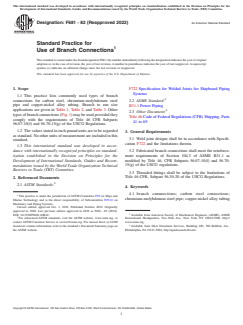
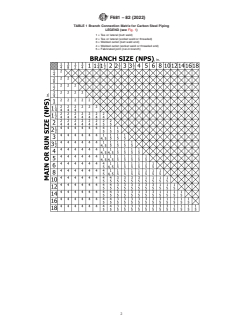
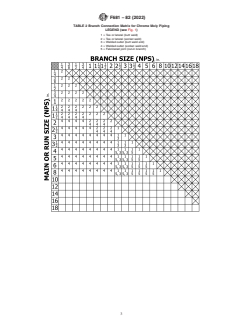
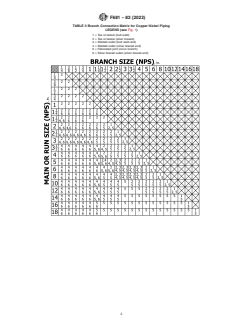
1.1 This practice lists commonly used types of branch connections for carbon steel, chromium-molybdenum steel pipe and copper-nickel alloy tubing. Branch to run size applications are given in Table 1, Table 2, and Table 3. Other types of branch connections (Fig. 1) may be used provided they comply with the requirements of Title 46 CFR Subparts 56.07-10(f) and 56.70-15(g) of the USCG Regulations.
FIG. 1 Illustrative Legend for Branch Connections
1.2 The values stated in inch-pound units are to be regarded as standard. No other units of measurement are included in this standard.
1.3 This international standard was developed in accordance with internationally recognized principles on standardization established in the Decision on Principles for the Development of International Standards, Guides and Recommendations issued by the World Trade Organization Technical Barriers to Trade (TBT) Committee.
- Status
- Published
- Publication Date
- 30-Sep-2022
- Technical Committee
- F25 - Ships and Marine Technology
- Drafting Committee
- F25.11 - Machinery and Piping Systems
Overview
ASTM F681-82(2022) - Standard Practice for Use of Branch Connections provides comprehensive guidance on commonly used types of branch connections for carbon steel, chromium-molybdenum steel pipe, and copper-nickel alloy tubing. Developed by ASTM International, this standard ensures safe, consistent, and code-compliant fabrication and installation of branch connections in piping systems. It is recognized by regulatory bodies, including the U.S. Coast Guard, and aligns with internationally recognized principles for standardization.
Key Topics
Branch Connection Types
The standard details a range of branch connection types suitable for various piping materials:- Carbon steel
- Chromium-molybdenum steel
- Copper-nickel alloy tubing
Branch-to-Run Size Applications
Comprehensive tables offer detailed guidance for selecting appropriate branch connections based on pipe sizes and materials.Connection Designs
- Tees or laterals (butt weld, socket weld, threaded, or silver brazed for copper-nickel)
- Welded outlets (butt weld, socket weld, or silver brazed)
- Fabricated joints (cut-in branches)
- Silver brazed outlets (for copper-nickel piping)
Regulatory Compliance
All branch connections must meet the requirements outlined in U.S. Coast Guard (USCG) regulations (Title 46 CFR Subparts 56.07-10(f) and 56.70-15(g)) and referenced standards such as ASME B31.1.Weld Joint and Fabrication Requirements
- Joint designs for welds must conform to Specification F722.
- Reinforcement requirements for fabricated connections must comply with ASME B31.1 as modified by applicable USCG requirements.
- Threaded fittings are subject to further USCG limitations.
Measurement Units
The standard exclusively employs inch-pound units for all specifications and tables.
Applications
The ASTM F681-82(2022) standard is critical for engineering, design, and maintenance in sectors requiring reliable pipe branch connections, including:
- Shipboard Piping Systems: Mandated by maritime regulations, ensuring safety and reliability in vessel machinery and piping.
- Industrial Piping Networks: Used in power plants and chemical processing facilities where branch connections for high-pressure or corrosive fluids are essential.
- Oil and Gas Sector: Applied in piping infrastructure for oil rigs, refineries, and fuel distribution systems.
- Marine and Offshore Construction: Offers standardized practices for complex branching configurations, ensuring compliance and safety.
- Government and Defense Projects: Approved for use by U.S. Department of Defense and other federal agencies.
Related Standards
Engineers and technical professionals should consult the following standards for additional requirements and complementary practices:
- ASTM F722: Specification for Welded Joints for Shipboard Piping Systems
- ASME B31.1: Power Piping
- Title 46 CFR (Shipping, Parts 41-69): U.S. Coast Guard regulations on piping system design, fabrication, and installation
Practical Value
- Standardization: Ensures consistent, repeatable, and safe pipe branch connection practices in critical industries.
- Regulatory Compliance: Provides reliable documentation for compliance with maritime and industrial safety codes.
- Design Optimization: Assists engineers in selecting suitable connection types and designs for safe, effective, and code-compliant piping assemblies.
- Global Acceptance: Developed under WTO principles, facilitating international trade and cooperation in shipbuilding, marine engineering, and related industries.
Keywords: ASTM F681, branch connections, carbon steel piping, chromium-molybdenum, copper-nickel tubing, piping standard, welded joints, ASME B31.1, USCG compliance, marine piping systems, industrial piping standards.
Relations
- Effective Date
- 01-Nov-2014
- Effective Date
- 01-Nov-2008
- Effective Date
- 01-Nov-2004
- Effective Date
- 01-Jan-1993
Get Certified
Connect with accredited certification bodies for this standard

DNV
DNV is an independent assurance and risk management provider.

Lloyd's Register
Lloyd's Register is a global professional services organisation specialising in engineering and technology.

FSC International
Forest Stewardship Council certification.
Sponsored listings
Frequently Asked Questions
ASTM F681-82(2022) is a standard published by ASTM International. Its full title is "Standard Practice for Use of Branch Connections". This standard covers: ABSTRACT This practice lists commonly used types of branch connections for carbon steel, chromium-molybdenum steel pipe and copper-nickel alloy tubing. The branch to run size applications are presented in details. The weld joint designs, fabricated branch connections and threaded fittings shall meet the requirements prescribed. SCOPE 1.1 This practice lists commonly used types of branch connections for carbon steel, chromium-molybdenum steel pipe and copper-nickel alloy tubing. Branch to run size applications are given in Table 1, Table 2, and Table 3. Other types of branch connections (Fig. 1) may be used provided they comply with the requirements of Title 46 CFR Subparts 56.07-10(f) and 56.70-15(g) of the USCG Regulations. FIG. 1 Illustrative Legend for Branch Connections 1.2 The values stated in inch-pound units are to be regarded as standard. No other units of measurement are included in this standard. 1.3 This international standard was developed in accordance with internationally recognized principles on standardization established in the Decision on Principles for the Development of International Standards, Guides and Recommendations issued by the World Trade Organization Technical Barriers to Trade (TBT) Committee.
ABSTRACT This practice lists commonly used types of branch connections for carbon steel, chromium-molybdenum steel pipe and copper-nickel alloy tubing. The branch to run size applications are presented in details. The weld joint designs, fabricated branch connections and threaded fittings shall meet the requirements prescribed. SCOPE 1.1 This practice lists commonly used types of branch connections for carbon steel, chromium-molybdenum steel pipe and copper-nickel alloy tubing. Branch to run size applications are given in Table 1, Table 2, and Table 3. Other types of branch connections (Fig. 1) may be used provided they comply with the requirements of Title 46 CFR Subparts 56.07-10(f) and 56.70-15(g) of the USCG Regulations. FIG. 1 Illustrative Legend for Branch Connections 1.2 The values stated in inch-pound units are to be regarded as standard. No other units of measurement are included in this standard. 1.3 This international standard was developed in accordance with internationally recognized principles on standardization established in the Decision on Principles for the Development of International Standards, Guides and Recommendations issued by the World Trade Organization Technical Barriers to Trade (TBT) Committee.
ASTM F681-82(2022) is classified under the following ICS (International Classification for Standards) categories: 47.020.60 - Electrical equipment of ships and of marine structures. The ICS classification helps identify the subject area and facilitates finding related standards.
ASTM F681-82(2022) has the following relationships with other standards: It is inter standard links to ASTM F722-82(2014), ASTM F722-82(2008), ASTM F722-82(2004), ASTM F722-82(1998). Understanding these relationships helps ensure you are using the most current and applicable version of the standard.
ASTM F681-82(2022) is available in PDF format for immediate download after purchase. The document can be added to your cart and obtained through the secure checkout process. Digital delivery ensures instant access to the complete standard document.
Standards Content (Sample)
This international standard was developed in accordance with internationally recognized principles on standardization established in the Decision on Principles for the
Development of International Standards, Guides and Recommendations issued by the World Trade Organization Technical Barriers to Trade (TBT) Committee.
Designation: F681 − 82 (Reapproved 2022) An American National Standard
Standard Practice for
Use of Branch Connections
ThisstandardisissuedunderthefixeddesignationF681;thenumberimmediatelyfollowingthedesignationindicatestheyearoforiginal
adoption or, in the case of revision, the year of last revision.Anumber in parentheses indicates the year of last reapproval.Asuperscript
epsilon (´) indicates an editorial change since the last revision or reapproval.
This standard has been approved for use by agencies of the U.S. Department of Defense.
1. Scope F722 Specification for Welded Joints for Shipboard Piping
Systems
1.1 This practice lists commonly used types of branch
connections for carbon steel, chromium-molybdenum steel 2.2 ASME Standard:
pipe and copper-nickel alloy tubing. Branch to run size
B31.1 Power Piping
applications are given in Table 1, Table 2, and Table 3. Other 4
2.3 Other Document:
typesofbranchconnections(Fig.1)maybeusedprovidedthey
Title 46 Code of Federal Regulations (CFR) Shipping, Parts
comply with the requirements of Title 46 CFR Subparts
41 to 69
56.07-10(f) and 56.70-15(g) of the USCG Regulations.
1.2 The values stated in inch-pound units are to be regarded
3. General Requirements
as standard. No other units of measurement are included in this
3.1 Weld joint designs shall be in accordance with Specifi-
standard.
cation F722 and the limitations therein.
1.3 This international standard was developed in accor-
3.2 Fabricated branch connections shall meet the reinforce-
dance with internationally recognized principles on standard-
ization established in the Decision on Principles for the ment requirements of Section 104.3 of ASME B31.1 as
modified by Title 46, CFR Subparts 56.07-10(f) and 56.70-
Development of International Standards, Guides and Recom-
mendations issued by the World Trade Organization Technical 15(g) of the USCG regulations.
Barriers to Trade (TBT) Committee.
3.3 Threaded fittings shall be subject to the limitations of
Title 46 CFR, Subpart 56.30-20 of the USCG Regulations.
2. Referenced Documents
2.1 ASTM Standards:
4. Keywords
4.1 branch connnections; carbon steel connections;
This practice is under the jurisdiction of ASTM Committee F25 on Ships and
chromium-molybdenum steel pipe; copper-nickel alloy tubing
Marine Technology and is the direct responsibility of Subcommittee F25.11 on
Machinery and Piping Systems.
Current edition approved Oct. 1, 2022. Published October 2022. Originally
approved in 1980. Last previous edition approved in 2018 as F681 – 82 (2018).
DOI: 10.1520/F0681-82R22. Available from American Society of Mechanical Engineers (ASME), ASME
For referenced ASTM standards, visit the ASTM website, www.astm.org, or International Headquarters, Two Park Ave., New York, NY 10016-5990, http://
contact ASTM Customer Se
...