

ASTM F2043-13(2018)
(Classification)Standard Classification for Bicycle Usage
General Information
- Abstract
SIGNIFICANCE AND USE
4.1 This classification provides a uniform set of usage definitions within the bicycle industry. Included within this classification is a set of graphical indicators to provide retailers and consumers with an indication of the intended use of a particular bicycle or aftermarket components.
SCOPE
1.1 This classification covers bicycle usage conditions and a method of identifying bicycles and components for use within that system.
1.2 The values stated in SI units are to be regarded as the standard. The values in parentheses are for information only.
1.3 This international standard was developed in accordance with internationally recognized principles on standardization established in the Decision on Principles for the Development of International Standards, Guides and Recommendations issued by the World Trade Organization Technical Barriers to Trade (TBT) Committee.
- Status
- Published
- Publication Date
- 31-Oct-2018
- Technical Committee
- F08 - Sports Equipment, Playing Surfaces, and Facilities
- Drafting Committee
- F08.10 - Bicycles


Overview
ASTM F2043-13(2018): Standard Classification for Bicycle Usage is an internationally recognized standard developed by ASTM International. It provides a uniform method for classifying bicycle usage and identifying both bicycles and their components based on intended use. The classification system ensures that manufacturers, retailers, and consumers have a clear understanding of appropriate bicycle applications and safety considerations. The standard also introduces graphical indicators (icons) to visually communicate usage conditions, supporting safer purchasing and product selection.
Key Topics
Bicycle Usage Classification
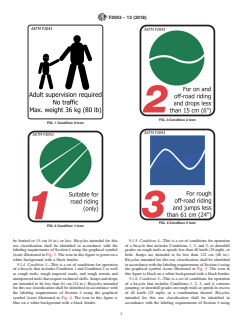
The standard outlines six distinct usage conditions-Condition 0 through Condition 5. Each condition defines the environment and riding intensity suitable for specific bicycle types, from children’s sidewalk bikes to extreme downhill mountain bikes.Terminology and Definitions
The document standardizes terminology, ensuring consistent communication regarding bicycles, components, riding conditions, jumps, drops, and technical skills.Graphical Icons for Identification
Graphical indicators corresponding to each usage condition must be displayed on bicycle frames, owner’s manuals, and packaging. These icons help to quickly identify the intended application for both buyers and sellers.Labeling Requirements
Bicycles and components must have permanent markings showing the appropriate usage level. Manuals and packaging must summarize the usage conditions and display the relevant graphical icon.
Applications
The ASTM F2043-13(2018) Classification for Bicycle Usage has a broad array of practical applications across the bicycle industry:
Manufacturers:
- Design bicycles and components according to clearly defined usage categories.
- Ensure compliance with industry safety and labeling requirements.
Retailers and Distributors:
- Accurately classify and display bicycles in store and online, allowing customers to make informed choices.
- Use graphical indicators to simplify customer education and reduce misuse.
Consumers:
- Easily identify the appropriate bicycle for intended riding style and terrain.
- Understand the limitations and safe usage guidelines for their bicycles or aftermarket components.
Regulatory Bodies:
- Reference a recognized system for safety and compliance assessments in the marketplace.
- Support product recalls, audits, or investigations related to bicycle safety.
Related Standards
When applying or referencing ASTM F2043-13(2018), consider the following related standards and regulatory documents:
- 16 CFR 1512 - U.S. Consumer Product Safety Commission's regulatory requirements for bicycles.
- ASTM F2043 - The principal standard providing the classification system itself.
- ISO Bicycle Standards - Other international standards on bicycle safety, component testing, and terminology.
- ASTM Bicycle Safety and Product Standards - Additional ASTM standards addressing testing, performance, and safety of bicycle products.
Practical Value
Using ASTM F2043-13(2018) helps promote safer bicycle use, reduces injury risks, and facilitates clear communication between manufacturers, retailers, and end-users. The inclusion of simple, highly visible graphical indicators improves transparency in the bicycle market and aligns product markings with international safety and quality practices. This standard plays a crucial role in harmonizing product labeling and ensuring that bicycles are used under conditions for which they were designed, ultimately enhancing both consumer confidence and overall industry safety.
Relations
- Effective Date
- 01-Nov-2018
- Effective Date
- 01-Nov-2018
- Effective Date
- 01-Nov-2018
- Effective Date
- 01-Nov-2018
- Effective Date
- 01-Nov-2018
- Referred By
ASTM F1447-18 - Standard Specification for Helmets Used in Recreational Bicycling or Roller Skating - Effective Date
- 01-Nov-2018
- Effective Date
- 01-Nov-2018
- Effective Date
- 01-Nov-2018
- Effective Date
- 01-Nov-2018
- Effective Date
- 01-Nov-2018
- Effective Date
- 01-Nov-2018
- Effective Date
- 01-Nov-2018
Get Certified
Connect with accredited certification bodies for this standard

TÜV Rheinland
TÜV Rheinland is a leading international provider of technical services.

TÜV SÜD
TÜV SÜD is a trusted partner of choice for safety, security and sustainability solutions.

DEKRA Certification Inc.
DEKRA US certification services.
Sponsored listings
Frequently Asked Questions
ASTM F2043-13(2018) is a standard published by ASTM International. Its full title is "Standard Classification for Bicycle Usage". This standard covers: SIGNIFICANCE AND USE 4.1 This classification provides a uniform set of usage definitions within the bicycle industry. Included within this classification is a set of graphical indicators to provide retailers and consumers with an indication of the intended use of a particular bicycle or aftermarket components. SCOPE 1.1 This classification covers bicycle usage conditions and a method of identifying bicycles and components for use within that system. 1.2 The values stated in SI units are to be regarded as the standard. The values in parentheses are for information only. 1.3 This international standard was developed in accordance with internationally recognized principles on standardization established in the Decision on Principles for the Development of International Standards, Guides and Recommendations issued by the World Trade Organization Technical Barriers to Trade (TBT) Committee.
SIGNIFICANCE AND USE 4.1 This classification provides a uniform set of usage definitions within the bicycle industry. Included within this classification is a set of graphical indicators to provide retailers and consumers with an indication of the intended use of a particular bicycle or aftermarket components. SCOPE 1.1 This classification covers bicycle usage conditions and a method of identifying bicycles and components for use within that system. 1.2 The values stated in SI units are to be regarded as the standard. The values in parentheses are for information only. 1.3 This international standard was developed in accordance with internationally recognized principles on standardization established in the Decision on Principles for the Development of International Standards, Guides and Recommendations issued by the World Trade Organization Technical Barriers to Trade (TBT) Committee.
ASTM F2043-13(2018) is classified under the following ICS (International Classification for Standards) categories: 43.150 - Cycles. The ICS classification helps identify the subject area and facilitates finding related standards.
ASTM F2043-13(2018) has the following relationships with other standards: It is inter standard links to ASTM F2043-13, ASTM F2273-11(2016), ASTM F2868-19, ASTM F2793-14(2023), ASTM F2268-03(2015), ASTM F1447-18, ASTM F2917-12(2018), ASTM F2843-19, ASTM F2802-19, ASTM F2274-11(2016), ASTM F2899-11(2016), ASTM F2614-19. Understanding these relationships helps ensure you are using the most current and applicable version of the standard.
ASTM F2043-13(2018) is available in PDF format for immediate download after purchase. The document can be added to your cart and obtained through the secure checkout process. Digital delivery ensures instant access to the complete standard document.
Standards Content (Sample)
This international standard was developed in accordance with internationally recognized principles on standardization established in the Decision on Principles for the
Development of International Standards, Guides and Recommendations issued by the World Trade Organization Technical Barriers to Trade (TBT) Committee.
Designation: F2043 −13 (Reapproved 2018) An American National Standard
Standard Classification for
Bicycle Usage
This standard is issued under the fixed designation F2043; the number immediately following the designation indicates the year of
original adoption or, in the case of revision, the year of last revision. A number in parentheses indicates the year of last reapproval. A
superscript epsilon (´) indicates an editorial change since the last revision or reapproval.
1. Scope drop is the maximum height above the landing surface of the
lowest spot on the tire.
1.1 This classification covers bicycle usage conditions and a
3.1.6 jump, n—event when both bicycle wheels leave the
method of identifying bicycles and components for use within
ground in which the height of a jump is the maximum height
that system.
above ground of the lowest point of the higher wheel when
1.2 The values stated in SI units are to be regarded as the
both wheels are off the ground.
standard. The values in parentheses are for information only.
3.1.7 sidewalk bicycle, n—bicycle meeting the definition of
1.3 This international standard was developed in accor-
a sidewalk bicycle as defined in 16 CFR 1512.
dance with internationally recognized principles on standard-
3.1.8 technical skill, n—advanced riding technique that
ization established in the Decision on Principles for the
requires rapid changes in speed, direction, and balance.
Development of International Standards, Guides and Recom-
mendations issued by the World Trade Organization Technical
4. Significance and Use
Barriers to Trade (TBT) Committee.
4.1 This classification provides a uniform set of usage
2. Referenced Documents
definitions within the bicycle industry. Included within this
classification is a set of graphical indicators to provide retailers
2.1 Federal Standard:
and consumers with an indication of the intended use of a
16 CFR 1512 Title 16—Commercial Practices, Chapter
particular bicycle or aftermarket components.
11—Consumer Product Safety Commission, Part 1512—
Requirements for Bicycles
5. Basis of Classification
5.1 Uses:
3. Terminology
5.1.1 Condition 0—This is a set of conditions for operation
3.1 Definitions:
of a children’s bicycle under appropriate parental supervision
3.1.1 aftermarket, n—components intended for use on a
in a manner consistent with the child’s bicycling skills.
bicyclebutnotincludedasoriginalequipmentwiththebicycle.
Bicycles intended for this use are “sidewalk bicycles.” In
3.1.2 bicycle, n—two-wheeled, single-track, articulated ve-
addition, bicycles intended for this condition are limited to
hicle with pedals and seat that is solely human powered.
riders at least three years old and weighing less than 36 kg (80
3.1.3 components, n—devices or equipment added to a lb). Bicycles intended for this use classification shall be
bicycle frame to render it a complete, functional unit (for identified in accordance with the labeling requirements of
Section 6 using the graphical symbol (icon) illustrated in Fig.
example, brakes, shifters, gears, and so forth).
1. The icon in this figure is black on a white background with
3.1.4 conditions, n—generalized description of surface en-
a black border.
vironments or speeds where a bicycle may be ridden.
5.1.2 Condition 1—This is a set of conditions for the
3.1.5 drop, n—event when only a single wheel leaves the
operation of a bicycle on a regular paved surface where the
groundatatimeforalowerelevationinwhichtheheightofthe
tires are intended to maintain ground contact. Bicycles in-
tended for this use classification shall be identified in accor-
dance with the labeling requirements of Section 6 using the
This classification is under the jurisdiction ofASTM Committee F08 on Sports
graphical symbol (icon) illustrated in Fig. 2. The icon in this
Equipment, Playing Surfaces, and Facilities and is the direct responsibility of
figure is green on a white background with a black border.
Subcommittee F08.10 on Bicycles.
5.1.3 Condition 2—This is a set of conditions for the
Current edition approved Nov. 1, 2018. Published December 2018. Originally
approved in 2000. Last previous edition approved in 2013 as F2043 – 13. DOI:
operation of a bicycle that includes Condition 1 as well as
10.1520/F2043-13R18.
unpaved and gravel roads and trails with moderate grades. In
Available from U.S. Government Printing Office Superintendent of Documents,
this set of conditions, contact with irregular terrain and loss of
732 N. Capitol St., NW, Mail Stop: SDE, Washington, DC 20401, http://
www.access.gpo.gov. tire contact with the ground may occur. Drops are intended to
Copyright © ASTM International, 100 Barr Harbor Drive, PO Box C700, West C
...