

ASTM F2843-19
(Specification)Standard Specification for Condition 0 Bicycle Frames
General Information
- Abstract
ABSTRACT
This specification establishes testing requirements for the structural performance properties of Condition 0 bicycle frames. Condition 0 is a vehicle usage classification defined in Classification F2043 indicating the type of riding and surface condition intended by design. Included are specifications for establishing loads and other criteria to be used with the matching test method. The bicycle frame shall be tested in accordance with Test Methods F2711, the Horizontal Loading Fatigue test, Vertical Loading Fatigue test, and the Impact Strength test.
SCOPE
1.1 This specification establishes testing requirements for the structural performance properties of Condition 0 bicycle frames.
1.2 The values stated in SI units are to be regarded as standard. No other units of measurement are included in this standard.
1.3 This international standard was developed in accordance with internationally recognized principles on standardization established in the Decision on Principles for the Development of International Standards, Guides and Recommendations issued by the World Trade Organization Technical Barriers to Trade (TBT) Committee.
- Status
- Published
- Publication Date
- 14-May-2019
- Technical Committee
- F08 - Sports Equipment, Playing Surfaces, and Facilities
- Drafting Committee
- F08.10 - Bicycles




Overview
ASTM F2843-19: Standard Specification for Condition 0 Bicycle Frames establishes comprehensive testing and performance requirements for Condition 0 bicycle frames. This standard is developed by ASTM International to ensure the safety and reliability of bicycle frames intended for a specific usage category-Condition 0-which is typically associated with very light-duty riding environments. Adhering to ASTM F2843-19 helps manufacturers, importers, and testing laboratories confirm that products meet consistent quality and safety expectations for the intended user base.
Key Topics
- Condition 0 Classification: Defined by ASTM F2043, Condition 0 covers bicycles designed for use by children or light riders, primarily on smooth, paved surfaces such as sidewalks. Understanding this classification is crucial for correct product design and user targeting.
- Structural Performance Requirements: The standard details required fatigue and impact tests to verify frame durability and integrity under light use.
- Horizontal Loading Fatigue Test: Frames must withstand specified cyclic tensile and compressive loads over a set number of cycles without cracking or fracturing.
- Vertical Loading Fatigue Test: Frames are tested under vertical compressive cycling loads to ensure sustained performance during typical use.
- Impact Strength Tests: Includes Falling Mass and Falling Frame tests, which simulate real-world accidents or misuse to ensure the frame does not fracture and retains structural shape within defined limits.
- Testing Methodology: All structural tests reference ASTM F2711 for procedures, ensuring repeatable and comparable results across laboratories.
- Certification and Compliance: The standard outlines requirements for product certification upon customer request, providing documented proof that frames meet specified performance criteria.
Applications
ASTM F2843-19 is primarily applied by:
- Bicycle Manufacturers: To design and test frames that are safe and suitable for Condition 0 category bicycles-typically children's bikes intended for sidewalk use.
- Testing Laboratories: For standardized assessment of bicycle frames to ensure they comply with international safety requirements.
- Purchasing and Regulatory Teams: When specifying minimum safety performance for imported or private-label bicycles.
- Retailers and Distributors: As a reference point for quality assurance and compliance with regional or international regulations.
By adhering to ASTM F2843-19, organizations can:
- Confirm product safety before market release
- Meet international and local child bicycle safety requirements
- Reduce warranty risks and potential liability
- Enhance consumer confidence in product durability and safety
Related Standards
- ASTM F2043: Classification for Bicycle Usage, which defines the Condition 0 category and other bicycle usage classes.
- ASTM F2711: Test Methods for Bicycle Frames, specifying methodologies used in performance evaluation as referenced by F2843-19.
- ISO and CEN Standards: Related international standards for bicycle safety and performance may also align with ASTM’s approach, supporting global marketability.
Keywords: ASTM F2843-19, Condition 0 bicycle frames, bicycle frame testing, children’s bicycle safety, sidewalk bike standard, structural performance, ASTM F2043, ASTM F2711, bicycle frame certification
For the latest version and technical details, always refer to the official ASTM F2843-19 document through ASTM International.
Relations
- Effective Date
- 15-May-2019
- Effective Date
- 01-Oct-2019
- Effective Date
- 01-Nov-2018
- Effective Date
- 01-Nov-2013
- Effective Date
- 01-Nov-2012
- Effective Date
- 01-Jan-2009
- Effective Date
- 01-Apr-2008
- Effective Date
- 10-Jul-2000
Get Certified
Connect with accredited certification bodies for this standard

TÜV Rheinland
TÜV Rheinland is a leading international provider of technical services.

TÜV SÜD
TÜV SÜD is a trusted partner of choice for safety, security and sustainability solutions.

DEKRA Certification Inc.
DEKRA US certification services.
Sponsored listings
Frequently Asked Questions
ASTM F2843-19 is a technical specification published by ASTM International. Its full title is "Standard Specification for Condition 0 Bicycle Frames". This standard covers: ABSTRACT This specification establishes testing requirements for the structural performance properties of Condition 0 bicycle frames. Condition 0 is a vehicle usage classification defined in Classification F2043 indicating the type of riding and surface condition intended by design. Included are specifications for establishing loads and other criteria to be used with the matching test method. The bicycle frame shall be tested in accordance with Test Methods F2711, the Horizontal Loading Fatigue test, Vertical Loading Fatigue test, and the Impact Strength test. SCOPE 1.1 This specification establishes testing requirements for the structural performance properties of Condition 0 bicycle frames. 1.2 The values stated in SI units are to be regarded as standard. No other units of measurement are included in this standard. 1.3 This international standard was developed in accordance with internationally recognized principles on standardization established in the Decision on Principles for the Development of International Standards, Guides and Recommendations issued by the World Trade Organization Technical Barriers to Trade (TBT) Committee.
ABSTRACT This specification establishes testing requirements for the structural performance properties of Condition 0 bicycle frames. Condition 0 is a vehicle usage classification defined in Classification F2043 indicating the type of riding and surface condition intended by design. Included are specifications for establishing loads and other criteria to be used with the matching test method. The bicycle frame shall be tested in accordance with Test Methods F2711, the Horizontal Loading Fatigue test, Vertical Loading Fatigue test, and the Impact Strength test. SCOPE 1.1 This specification establishes testing requirements for the structural performance properties of Condition 0 bicycle frames. 1.2 The values stated in SI units are to be regarded as standard. No other units of measurement are included in this standard. 1.3 This international standard was developed in accordance with internationally recognized principles on standardization established in the Decision on Principles for the Development of International Standards, Guides and Recommendations issued by the World Trade Organization Technical Barriers to Trade (TBT) Committee.
ASTM F2843-19 is classified under the following ICS (International Classification for Standards) categories: 43.150 - Cycles. The ICS classification helps identify the subject area and facilitates finding related standards.
ASTM F2843-19 has the following relationships with other standards: It is inter standard links to ASTM F2843-10a(2015), ASTM F2711-19, ASTM F2043-13(2018), ASTM F2043-13, ASTM F2711-08(2012), ASTM F2043-09, ASTM F2711-08, ASTM F2043-00. Understanding these relationships helps ensure you are using the most current and applicable version of the standard.
ASTM F2843-19 is available in PDF format for immediate download after purchase. The document can be added to your cart and obtained through the secure checkout process. Digital delivery ensures instant access to the complete standard document.
Standards Content (Sample)
This international standard was developed in accordance with internationally recognized principles on standardization established in the Decision on Principles for the
Development of International Standards, Guides and Recommendations issued by the World Trade Organization Technical Barriers to Trade (TBT) Committee.
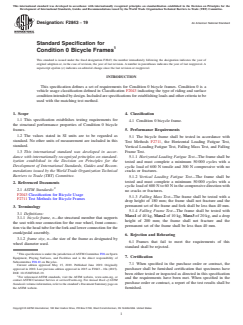
Designation: F2843 −19 An American National Standard
Standard Specification for
Condition 0 Bicycle Frames
This standard is issued under the fixed designation F2843; the number immediately following the designation indicates the year of
original adoption or, in the case of revision, the year of last revision. A number in parentheses indicates the year of last reapproval. A
superscript epsilon (´) indicates an editorial change since the last revision or reapproval.
INTRODUCTION
This specification defines a set of requirements for Condition 0 bicycle frames. Condition 0 is a
vehicle usage classification defined in Classification F2043 indicating the type of riding and surface
condition intended by design. Included are specifications for establishing loads and other criteria to be
used with the matching test method.
1. Scope 4. Classification
1.1 This specification establishes testing requirements for
4.1 Condition 0 bicycle frame.
the structural performance properties of Condition 0 bicycle
frames.
5. Performance Requirements
1.2 The values stated in SI units are to be regarded as
5.1 The bicycle frame shall be tested in accordance with
standard. No other units of measurement are included in this
Test Methods F2711, the Horizontal Loading Fatigue Test,
standard.
Vertical Loading Fatigue Test, Falling Mass Test, and Falling
1.3 This international standard was developed in accor- Frame Test.
dance with internationally recognized principles on standard-
5.1.1 Horizontal Loading Fatigue Test—The frame shall be
ization established in the Decision on Principles for the
tested and must complete a minimum 50 000 cycles with a
Development of International Standards, Guides and Recom-
cyclic load of 600 N tensile and 300 N compressive with no
mendations issued by the World Trade Organization Technical
cracks or fractures.
Barriers to Trade (TBT) Committee.
5.1.2 Vertical Loading Fatigue Test—The frame shall be
tested and must complete a minimum 50 000 cycles with a
2. Referenced Documents
cyclic load of 600 N to 60 N in the compressive direction with
2.1 ASTM Standards:
no cracks or fractures.
F2043 Classification for Bicycle Usage
5.1.3 Falling Mass Test—The frame shall be tested with a
F2711 Test Methods for Bicycle Frames
drop height of 180 mm; the frame shall not fracture and the
permanent set of the frame and fork shall be less than 40 mm.
3. Terminology
5.1.4 Falling Frame Test—The frame shall be tested with
3.1 Definitions:
Mass1 of 40 kg, Mass2 of 10 kg, Mass3 of 20 kg, and a drop
3.1.1 bicycle frame, n—the structural member that supports
height of 200 mm; the frame shall not fracture and the
the seat with rear connection for the rear wheel, front connec-
permanent set of the frame shall be
...
This document is not an ASTM standard and is intended only to provide the user of an ASTM standard an indication of what changes have been made to the previous version. Because
it may not be technically possible to adequately depict all changes accurately, ASTM recommends that users consult prior editions as appropriate. In all cases only the current version
of the standard as published by ASTM is to be considered the official document.
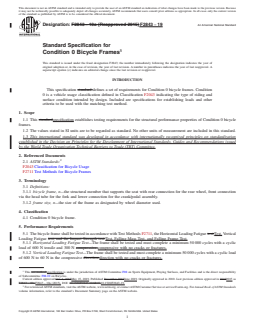
Designation: F2843 − 10a (Reapproved 2015) F2843 − 19 An American National Standard
Standard Specification for
Condition 0 Bicycle Frames
This standard is issued under the fixed designation F2843; the number immediately following the designation indicates the year of
original adoption or, in the case of revision, the year of last revision. A number in parentheses indicates the year of last reapproval. A
superscript epsilon (´) indicates an editorial change since the last revision or reapproval.
INTRODUCTION
This specification standard defines a set of requirements for Condition 0 bicycle frames. Condition
0 is a vehicle usage classification defined in Classification F2043 indicating the type of riding and
surface condition intended by design. Included are specifications for establishing loads and other
criteria to be used with the matching test method.
1. Scope
1.1 This standardspecification establishes testing requirements for the structural performance properties of Condition 0 bicycle
frames.
1.2 The values stated in SI units are to be regarded as standard. No other units of measurement are included in this standard.
1.3 This international standard was developed in accordance with internationally recognized principles on standardization
established in the Decision on Principles for the Development of International Standards, Guides and Recommendations issued
by the World Trade Organization Technical Barriers to Trade (TBT) Committee.
2. Referenced Documents
2.1 ASTM Standards:
F2043 Classification for Bicycle Usage
F2711 Test Methods for Bicycle Frames
3. Terminology
3.1 Definitions:
3.1.1 bicycle frame, n—the structural member that supports the seat with rear connection for the rear wheel, front connection
via the head tube for the fork and lower connection for the crank/pedal assembly.
3.1.2 frame size, n—the size of the frame as designated by wheel diameter used.
4. Classification
4.1 Condition 0 bicycle frame.
5. Performance Requirements
5.1 The bicycle frame shall be tested in accordance with Test Methods F2711, the Horizontal Loading Fatigue test,Test, Vertical
Loading Fatigue test, and the Impact Strength test.Test, Falling Mass Test, and Falling Frame Test.
5.1.1 Horizontal Loading Fatigue Test—The frame shall be tested and must complete a minimum 50 000 cycles with a cyclic
load of 600 N tensile and 300 N compressive.compressive with no cracks or fractures.
5.1.2 Vertical Loading Fatigue Test—The frame shall be tested and must complete a minimum 50 000 cycles with a cyclic load
of 600 N to 60 N in the compressive direction.direction with no cracks or fractures.
This test method specification is under the jurisdiction of ASTM Committee F08 on Sports Equipment, Playing Surfaces, and Facilities and is the direct responsibility
...