

ASTM F2793-14(2023)
(Specification)Standard Specification for Bicycle Grips
General Information
- Abstract
ABSTRACT
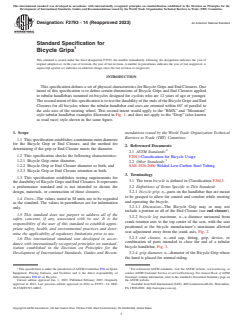
This specification establishes a minimum outer diameter for Bicycle Grips and End Closures applied to tubular handlebars mounted on bicycles designed for cyclists who are 12 years of age or younger. It specifies testing requirements for the durability of the ends of the Bicycle Grips and End Closures for all bicycles where the tubular handlebar end axes are oriented within 60 degrees of parallel to the axle axis of the steering wheel. This specification applies to the "BMX" and "Mountain" style tubular handlebars, but not to the "Drop" (also known as road race) style.
The following characteristics are covered by this specification: Bicycle Grip outer diameter; Bicycle Grip or End Closure diameter or both; and Bicycle Grip or End Closure retention or both. This specification is not intended to dictate the design, materials, or construction of Bicycle Grips and End Closures.
SIGNIFICANCE AND USE
6.1 These tests are intended to address the Bicycle Grip with regard to steering control, durability and potential reduction in injury during an accident.
SCOPE
1.1 This specification establishes a minimum outer diameter for the Bicycle Grip or End Closure, and the method for determining if the grip or End Closure meets the diameter.
1.2 This specification checks the following characteristics:
1.2.1 Bicycle Grip outer diameter,
1.2.2 Bicycle Grip or End Closure diameter or both, and
1.2.3 Bicycle Grip or End Closure retention or both.
1.3 This specification establishes testing requirements for the durability of Bicycle Grips and End Closures. It represents a performance standard and is not intended to dictate the design, materials, or construction of those closures.
1.4 Units—The values stated in SI units are to be regarded as the standard. The values in parentheses are for information only.
1.5 This standard does not purport to address all of the safety concerns, if any, associated with its use. It is the responsibility of the user of this standard to establish appropriate safety, health, and environmental practices and determine the applicability of regulatory limitations prior to use.
1.6 This international standard was developed in accordance with internationally recognized principles on standardization established in the Decision on Principles for the Development of International Standards, Guides and Recommendations issued by the World Trade Organization Technical Barriers to Trade (TBT) Committee.
- Status
- Published
- Publication Date
- 31-Dec-2022
- Technical Committee
- F08 - Sports Equipment, Playing Surfaces, and Facilities
- Drafting Committee
- F08.10 - Bicycles
Overview
ASTM F2793-14(2023), Standard Specification for Bicycle Grips, sets forth key requirements for the dimensions and durability of bicycle grips and end closures installed on tubular handlebars. This specification is specifically designed for bicycles intended for riders 12 years of age or younger, with a focus on "BMX" and "Mountain" style handlebars, excluding "Drop" or road race styles. By establishing minimum outer diameters and durability testing, the standard aims to enhance steering control, improve product lifespan, and minimize the risk of injury during an accident.
The specification is performance-based and is not prescriptive regarding the materials or design used for bicycle grips and end closures. Instead, it defines functional requirements and testing methods, providing manufacturers with flexibility in design while promoting safety and consistency in youth bicycles.
Key Topics
Minimum Outer Diameter Requirements
- Sets a minimum outer diameter for bicycle grips and end closures.
- Verification performed using a "go/no-go" gauge.
Durability and Impact Testing
- End closures must withstand repeated impact in a controlled test (punch-out test) without exposing excessive handlebar area.
- Ensures that the grip or end closure remains secured during typical and accidental impacts.
Retention Testing
- Specifies a minimum removal force (67 N or 15 lbf) to check that grips and end closures remain securely attached during use.
Applicability
- Applies to tubular handlebars with the axis within 60 degrees of parallel to the axle of the steering wheel.
- Focuses on "BMX" and "Mountain" handlebars; does not apply to road race ("Drop") handlebars.
Performance Standard
- Allows varied materials and designs, provided they pass the required tests.
- Measurements and tests are conducted on finished, production-ready parts.
Safety Considerations
- Addresses potential reduction of injury risk by ensuring secure and durable handlebar ends.
- Users must consider broader safety, health, and environmental practices as not all hazards are addressed by this standard alone.
Applications
Youth Bicycle Manufacturing
- Essential for designers and manufacturers of children's bicycles, especially those producing "BMX" and "Mountain" style bikes.
- Ensures compliance with internationally recognized safety and durability standards.
Product Testing and Quality Assurance
- Provides clear test procedures for in-house quality control and verification of product conformity prior to market release.
- Used by third-party testing organizations to independently certify product safety and performance.
Regulatory Compliance
- Assists companies in meeting both domestic and international trade and safety regulations, promoting global market access.
- Supports retailers and distributors in specifying compliant bicycle handlebar grips and closures.
Consumer Protection
- Reduces risk of injury associated with exposed handlebar ends or failed grips, which is vital for bicycles intended for children.
Related Standards
ASTM F2043 – Classification for Bicycle Usage
- Defines usage categories and related requirements for bicycles.
SAE J526 – Welded Low-Carbon Steel Tubing
- Material specification referenced for test equipment in durability testing.
Other Relevant ASTM Bicycle Component Standards
- Additional ASTM specifications for bicycle frames, components, and related safety aspects.
By adhering to ASTM F2793-14(2023), manufacturers, testing bodies, and regulators can ensure that bicycle grips and end closures for youth bicycles meet established safety and durability benchmarks, contributing to safer cycling experiences for children and peace of mind for guardians. This standard plays a key role in fostering product quality and compliance in the global bicycle industry.
Relations
- Effective Date
- 01-Nov-2018
- Effective Date
- 01-Nov-2013
- Effective Date
- 01-Jan-2009
- Effective Date
- 10-Jul-2000
Get Certified
Connect with accredited certification bodies for this standard

TÜV Rheinland
TÜV Rheinland is a leading international provider of technical services.

TÜV SÜD
TÜV SÜD is a trusted partner of choice for safety, security and sustainability solutions.

DEKRA Certification Inc.
DEKRA US certification services.
Sponsored listings
Frequently Asked Questions
ASTM F2793-14(2023) is a technical specification published by ASTM International. Its full title is "Standard Specification for Bicycle Grips". This standard covers: ABSTRACT This specification establishes a minimum outer diameter for Bicycle Grips and End Closures applied to tubular handlebars mounted on bicycles designed for cyclists who are 12 years of age or younger. It specifies testing requirements for the durability of the ends of the Bicycle Grips and End Closures for all bicycles where the tubular handlebar end axes are oriented within 60 degrees of parallel to the axle axis of the steering wheel. This specification applies to the "BMX" and "Mountain" style tubular handlebars, but not to the "Drop" (also known as road race) style. The following characteristics are covered by this specification: Bicycle Grip outer diameter; Bicycle Grip or End Closure diameter or both; and Bicycle Grip or End Closure retention or both. This specification is not intended to dictate the design, materials, or construction of Bicycle Grips and End Closures. SIGNIFICANCE AND USE 6.1 These tests are intended to address the Bicycle Grip with regard to steering control, durability and potential reduction in injury during an accident. SCOPE 1.1 This specification establishes a minimum outer diameter for the Bicycle Grip or End Closure, and the method for determining if the grip or End Closure meets the diameter. 1.2 This specification checks the following characteristics: 1.2.1 Bicycle Grip outer diameter, 1.2.2 Bicycle Grip or End Closure diameter or both, and 1.2.3 Bicycle Grip or End Closure retention or both. 1.3 This specification establishes testing requirements for the durability of Bicycle Grips and End Closures. It represents a performance standard and is not intended to dictate the design, materials, or construction of those closures. 1.4 Units—The values stated in SI units are to be regarded as the standard. The values in parentheses are for information only. 1.5 This standard does not purport to address all of the safety concerns, if any, associated with its use. It is the responsibility of the user of this standard to establish appropriate safety, health, and environmental practices and determine the applicability of regulatory limitations prior to use. 1.6 This international standard was developed in accordance with internationally recognized principles on standardization established in the Decision on Principles for the Development of International Standards, Guides and Recommendations issued by the World Trade Organization Technical Barriers to Trade (TBT) Committee.
ABSTRACT This specification establishes a minimum outer diameter for Bicycle Grips and End Closures applied to tubular handlebars mounted on bicycles designed for cyclists who are 12 years of age or younger. It specifies testing requirements for the durability of the ends of the Bicycle Grips and End Closures for all bicycles where the tubular handlebar end axes are oriented within 60 degrees of parallel to the axle axis of the steering wheel. This specification applies to the "BMX" and "Mountain" style tubular handlebars, but not to the "Drop" (also known as road race) style. The following characteristics are covered by this specification: Bicycle Grip outer diameter; Bicycle Grip or End Closure diameter or both; and Bicycle Grip or End Closure retention or both. This specification is not intended to dictate the design, materials, or construction of Bicycle Grips and End Closures. SIGNIFICANCE AND USE 6.1 These tests are intended to address the Bicycle Grip with regard to steering control, durability and potential reduction in injury during an accident. SCOPE 1.1 This specification establishes a minimum outer diameter for the Bicycle Grip or End Closure, and the method for determining if the grip or End Closure meets the diameter. 1.2 This specification checks the following characteristics: 1.2.1 Bicycle Grip outer diameter, 1.2.2 Bicycle Grip or End Closure diameter or both, and 1.2.3 Bicycle Grip or End Closure retention or both. 1.3 This specification establishes testing requirements for the durability of Bicycle Grips and End Closures. It represents a performance standard and is not intended to dictate the design, materials, or construction of those closures. 1.4 Units—The values stated in SI units are to be regarded as the standard. The values in parentheses are for information only. 1.5 This standard does not purport to address all of the safety concerns, if any, associated with its use. It is the responsibility of the user of this standard to establish appropriate safety, health, and environmental practices and determine the applicability of regulatory limitations prior to use. 1.6 This international standard was developed in accordance with internationally recognized principles on standardization established in the Decision on Principles for the Development of International Standards, Guides and Recommendations issued by the World Trade Organization Technical Barriers to Trade (TBT) Committee.
ASTM F2793-14(2023) is classified under the following ICS (International Classification for Standards) categories: 43.150 - Cycles. The ICS classification helps identify the subject area and facilitates finding related standards.
ASTM F2793-14(2023) has the following relationships with other standards: It is inter standard links to ASTM F2043-13(2018), ASTM F2043-13, ASTM F2043-09, ASTM F2043-00. Understanding these relationships helps ensure you are using the most current and applicable version of the standard.
ASTM F2793-14(2023) is available in PDF format for immediate download after purchase. The document can be added to your cart and obtained through the secure checkout process. Digital delivery ensures instant access to the complete standard document.
Standards Content (Sample)
This international standard was developed in accordance with internationally recognized principles on standardization established in the Decision on Principles for the
Development of International Standards, Guides and Recommendations issued by the World Trade Organization Technical Barriers to Trade (TBT) Committee.
Designation: F2793 − 14 (Reapproved 2023) An American National Standard
Standard Specification for
Bicycle Grips
This standard is issued under the fixed designation F2793; the number immediately following the designation indicates the year of
original adoption or, in the case of revision, the year of last revision. A number in parentheses indicates the year of last reapproval. A
superscript epsilon (´) indicates an editorial change since the last revision or reapproval.
INTRODUCTION
This specification defines a set of physical characteristics for Bicycle Grips and End Closures. One
intent of this specification is to define certain dimensions of Bicycle Grips and End Closures applied
to tubular handlebars mounted on bicycles designed for cyclists who are 12 years of age or younger.
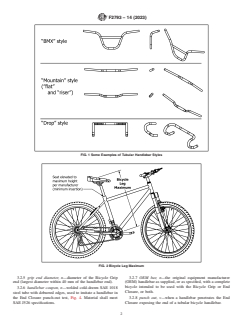
The second intent of this specification is to test the durability of the ends of the Bicycle Grips and End
Closures for all bicycles where the tubular handlebar end axes are oriented within 60° of parallel to
the axle axis of the steering wheel. This second intent would apply to the “BMX” and “Mountain”
style tubular handlebar examples illustrated in Fig. 1, and does not apply to the “Drop” (also known
as road race) style shown in the same figure.
1. Scope mendations issued by the World Trade Organization Technical
Barriers to Trade (TBT) Committee.
1.1 This specification establishes a minimum outer diameter
for the Bicycle Grip or End Closure, and the method for
2. Referenced Documents
determining if the grip or End Closure meets the diameter.
2.1 ASTM Standards:
1.2 This specification checks the following characteristics:
F2043 Classification for Bicycle Usage
1.2.1 Bicycle Grip outer diameter,
2.2 Other Standards:
1.2.2 Bicycle Grip or End Closure diameter or both, and
SAE J526:2000 Welded Low-Carbon Steel Tubing
1.2.3 Bicycle Grip or End Closure retention or both.
3. Terminology
1.3 This specification establishes testing requirements for
3.1 The term bicycle is defined in Classification F2043.
the durability of Bicycle Grips and End Closures. It represents
a performance standard and is not intended to dictate the
3.2 Definitions of Terms Specific to This Standard:
design, materials, or construction of those closures. 3.2.1 bicycle grip, n—parts on the handlebar that are meant
to be grasped to allow for control and comfort while steering
1.4 Units—The values stated in SI units are to be regarded
and operating the bicycle.
as the standard. The values in parentheses are for information
3.2.1.1 Discussion—The Bicycle Grip may or may not
only.
include a portion or all of the End Closure (see end closure).
1.5 This standard does not purport to address all of the
3.2.2 bicycle leg maximum, n—a distance measured from
safety concerns, if any, associated with its use. It is the
crank rotation axis to the top center of the seat, with the seat
responsibility of the user of this standard to establish appro-
positioned at the bicycle manufacturer’s maximum allowed
priate safety, health, and environmental practices and deter-
seat adjustment away from the crank axis, Fig. 2.
mine the applicability of regulatory limitations prior to use.
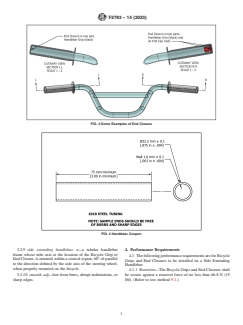
3.2.3 end closure, n—end cap, fitting, grip, device, or
1.6 This international standard was developed in accor-
combination of parts intended to close the end of a tubular
dance with internationally recognized principles on standard-
bicycle handlebar, Fig. 3.
ization established in the Decision on Principles for the
Development of International Standards, Guides and Recom-
3.2.4 grip diameter, n—diameter of the Bicycle Grip where
the hand is placed for normal riding.
1 2
This specification is under the jurisdiction of ASTM Committee F08 on Sports For referenced ASTM standards, visit the ASTM website, www.astm.org, or
Equipment, Playing Surfaces, and Facilities and is the direct responsibility of contact ASTM Customer Service at service@astm.org. For Annual Book of ASTM
Subcommittee F08.10 on Bicycles. Standards volume information, refer to the standard’s Document Summary page on
Current edition approved Jan. 1, 2023. Published February 2023. Originally the ASTM website.
approved in 2014. Last previous edition approved in 2014 as F2793 – 14. DOI: Available from SAE International (SAE), 400 Commonwealth Dr., Warrendale,
10.1520/F2793-14R23. PA 15096-0001, http://aerospace.sae.org.
Copyright © ASTM International, 100 Barr Harbor Drive, PO Box C700, West Conshohocken, PA 19428-2959. United States
F2793 − 14 (2023)
FIG. 1 Some Examples of Tubular Handlebar Styles
FIG. 2 Bicycle Leg Maximum
3.2.5 grip end diameter, n—diameter of the Bicycle Grip 3.2.7 OEM bar, n—the original equipment manufacturer
end (largest diameter within 40 mm of the handlebar end). (OEM) handlebar as supplied, or as specified, with a complete
bicycle intended to be used with the Bicycle Grip or End
3.2.6 handlebar coupon, n—welded cold-drawn SAE 1018
Closure, or both.
steel tube with deburred edges, used to imitate a handlebar in
the End Closure punch-out test, Fig. 4. Material shall meet 3.2.8 punch out, v—when a handlebar penetrates the End
SAE J526 specifications. Closure exposing the end of a tubular bicycle handlebar.
F2793 − 14 (2023)
FIG. 3 Some Examples of End Closure
FIG. 4 Handlebar Coupon
3.2.9 side extending handlebar, n—a tubular handlebar 4. Performance Requirements
frame whose tube axis at the location of the Bicycle Grip or
4.1 The following performance requirements are for Bicycle
End Closure, is oriented within a conical region, 60° of parallel
Grips and End Closures to be installed on a Side Extending
to the direction defined by the axle axis of the steering wheel,
Handlebar.
when properly mounted on the bicycle.
4.1.1 Retention—The Bicycle Grips and End Closures shall
3.2.10 smooth, adj—free from burrs, abrupt indentations, or be secure against a removal force of no less than 66.8 N (15
sharp edges. lbf). (Refer to test method 9.1.)
F2793 − 14 (2023)
4.1.2 Punch-Out—The End Closure shall withstand a drop components. The OEM bar shall be cut to utilize one complete
of 100 mm (3.94 in.) ten times loaded with a mass of 10 kg (22 end, including grip. The OEM bar shall be discarded after ten
lb) without having more than 270° of End Closure punched out (10) drops.
by the OEM bar or Handlebar Coupon. (Refer to the test 7.1.1.2 If the Handlebar Coupon is being used for the test,
method described in 9.2.) the end of the Handlebar Coupon inserted into the grip should
4.1.3 Dimensions—For bicycles with a Bicycle Leg Maxi- be smooth. After ten (10) drops are completed, the used
mum distance less than or equal to 500 mm (19.7 in.), the Handlebar Coupon shall be discarded.
appropriate dimensions of the Bicycle Grip and End Closure 7.1.2 The punch-out test fixture is a free-falling mass
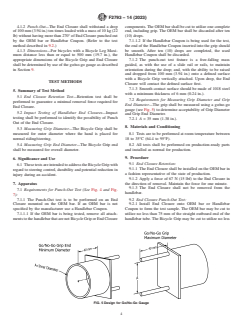
shall be determined by use of the go/no-go gauge as described guided, as with the use of a slide rail or rails, to maintain
in Section 9. orientation during the drop; and, with the ability to be raised
and dropped from 100 mm (3.94 in.) onto a defined surface
with a
...