

ASTM F2917-12(2018)
(Specification)Standard Specification for Bicycle Trailer Cycles Designed for Human Passengers
General Information
- Abstract
ABSTRACT
This specification covers trailer cycles, intended to be pulled behind bicycles, with seat post attachment, for transporting children. It includes test methods for confirming that this specification is satisfied.
SCOPE
1.1 This specification covers trailer cycles, intended to be pulled behind bicycles, with seat post attachment, in order to transport children. It includes test methods for confirming that this specification is satisfied.
1.2 The values stated in SI units are to be regarded as the standard. The units given in parentheses are for information only.
1.3 The following safety caveat applies to the chemical, mechanical, or physical, or a combination thereof, test methods described herein and is meant specifically for those performing the tests (in an effort to provide them with notice to take the appropriate precautions when conducting the tests). This standard does not purport to address all of the safety concerns, if any, associated with its use. It is the responsibility of the user of this standard to establish appropriate safety, health, and environmental practices and determine the applicability of regulatory limitations prior to use.
1.4 This international standard was developed in accordance with internationally recognized principles on standardization established in the Decision on Principles for the Development of International Standards, Guides and Recommendations issued by the World Trade Organization Technical Barriers to Trade (TBT) Committee.
- Status
- Published
- Publication Date
- 31-Mar-2018
- Technical Committee
- F08 - Sports Equipment, Playing Surfaces, and Facilities
- Drafting Committee
- F08.10 - Bicycles
Overview
ASTM F2917-12(2018) is the internationally recognized standard specification developed by ASTM International for bicycle trailer cycles designed to carry human passengers, specifically children. This standard defines safety, performance, labeling, and testing requirements for trailer cycles intended to be pulled by bicycles using a seat post attachment. It includes a range of mechanical and durability tests to ensure safety, particularly for the transportation of child passengers. The specification also covers critical marking, labeling, and instruction requirements for manufacturers.
Key Topics
Scope and Purpose
- Covers trailer cycles meant for transportation of children via bicycles.
- Focuses on trailer cycles attached to the seat post of the towing bicycle.
- Establishes mechanical, chemical, and structural safety requirements.
Testing Procedures
- Lean angle test: Ensures trailer pedals do not contact the ground when bicycle tilts.
- Torsion fatigue test: Evaluates structural durability under torsion for long-term safety.
- Bump fatigue test: Assesses frame and wheel integrity over simulated rough surfaces.
- All tests are structured to mimic realistic usage and stress over the trailer cycle’s lifecycle.
Materials and Construction
- Nonmetallic and painted materials must meet specific criteria for weathering and lead content.
- No hazardous substances as defined by U.S. regulations are permitted.
- Components within occupant reach must be free of sharp points, sharp edges, or small parts hazards.
- Reflectors and appropriate safety components are required for visibility and compliance.
Marking and Labeling
- Permanent labels for manufacturer identification, date of manufacture, maximum weight capacity, and recommended towing speed.
- Safety warnings, including helmet use and rider/passenger weight rules.
- Instructions for assembly, attachment, maintenance, and safe use, in the language(s) of sale regions.
Applications
Product Certification:
Manufacturers, importers, and distributors use ASTM F2917 to evaluate and certify bicycle trailer cycles for safety and regulatory compliance. Meeting this specification is often required for access to key markets and retail channels.Product Design and Manufacturing:
Design engineers apply the standard to select appropriate components, materials, and construction techniques, ensuring products withstand the required fatigue and safety tests. This helps prevent product recalls and liability.Consumer Safety:
Consumers benefit from a higher level of safety for children riding in trailer cycles, as the standard addresses critical concerns such as load stability, durability, and accident prevention.Regulatory Compliance:
Compliance helps manufacturers meet legal and consumer safety requirements in various jurisdictions, especially where reference to ASTM standards is mandated.
Related Standards
ANSI Z535.4 & ANSI Z535.6:
Standards for product safety signs, labels, and information in manuals, ensuring clear communication of risks and operational limits.ASTM F2043:
Classification for bicycle usage types, relevant for matching trailer design to appropriate user scenarios and environments.Various U.S. CFR Titles (16 CFR 1303, 1500, 1501, 1512):
Address hazardous substances, sharp points/edges, small parts, and bicycle requirements such as reflectors and structural specifications.ASTM D4329 & G23:
Practices for accelerated weathering and UV exposure testing, supporting durability requirements for nonmetallic materials.
By adhering to ASTM F2917-12(2018), manufacturers demonstrate commitment to child passenger safety and product quality in the rapidly growing bicycle trailer cycle market. This standard is essential for product development, market entry, and establishing consumer trust in family-oriented cycling products.
Relations
- Replaces
ASTM F2917-12 - Standard Specification for Bicycle Trailer Cycles Designed for Human Passengers - Effective Date
- 01-Apr-2018
- Effective Date
- 01-Nov-2018
- Effective Date
- 01-Apr-2016
- Effective Date
- 01-Nov-2013
- Effective Date
- 01-Oct-2011
- Effective Date
- 15-Jul-2010
- Effective Date
- 01-Jul-2009
- Effective Date
- 01-Jan-2009
- Effective Date
- 15-Dec-2007
- Effective Date
- 01-Mar-2007
- Effective Date
- 15-Jul-2005
- Effective Date
- 01-Oct-2003
- Effective Date
- 10-Oct-2002
- Effective Date
- 10-Jul-2000
- Effective Date
- 10-Jan-1999
Get Certified
Connect with accredited certification bodies for this standard

TÜV Rheinland
TÜV Rheinland is a leading international provider of technical services.

TÜV SÜD
TÜV SÜD is a trusted partner of choice for safety, security and sustainability solutions.

DEKRA Certification Inc.
DEKRA US certification services.
Sponsored listings
Frequently Asked Questions
ASTM F2917-12(2018) is a technical specification published by ASTM International. Its full title is "Standard Specification for Bicycle Trailer Cycles Designed for Human Passengers". This standard covers: ABSTRACT This specification covers trailer cycles, intended to be pulled behind bicycles, with seat post attachment, for transporting children. It includes test methods for confirming that this specification is satisfied. SCOPE 1.1 This specification covers trailer cycles, intended to be pulled behind bicycles, with seat post attachment, in order to transport children. It includes test methods for confirming that this specification is satisfied. 1.2 The values stated in SI units are to be regarded as the standard. The units given in parentheses are for information only. 1.3 The following safety caveat applies to the chemical, mechanical, or physical, or a combination thereof, test methods described herein and is meant specifically for those performing the tests (in an effort to provide them with notice to take the appropriate precautions when conducting the tests). This standard does not purport to address all of the safety concerns, if any, associated with its use. It is the responsibility of the user of this standard to establish appropriate safety, health, and environmental practices and determine the applicability of regulatory limitations prior to use. 1.4 This international standard was developed in accordance with internationally recognized principles on standardization established in the Decision on Principles for the Development of International Standards, Guides and Recommendations issued by the World Trade Organization Technical Barriers to Trade (TBT) Committee.
ABSTRACT This specification covers trailer cycles, intended to be pulled behind bicycles, with seat post attachment, for transporting children. It includes test methods for confirming that this specification is satisfied. SCOPE 1.1 This specification covers trailer cycles, intended to be pulled behind bicycles, with seat post attachment, in order to transport children. It includes test methods for confirming that this specification is satisfied. 1.2 The values stated in SI units are to be regarded as the standard. The units given in parentheses are for information only. 1.3 The following safety caveat applies to the chemical, mechanical, or physical, or a combination thereof, test methods described herein and is meant specifically for those performing the tests (in an effort to provide them with notice to take the appropriate precautions when conducting the tests). This standard does not purport to address all of the safety concerns, if any, associated with its use. It is the responsibility of the user of this standard to establish appropriate safety, health, and environmental practices and determine the applicability of regulatory limitations prior to use. 1.4 This international standard was developed in accordance with internationally recognized principles on standardization established in the Decision on Principles for the Development of International Standards, Guides and Recommendations issued by the World Trade Organization Technical Barriers to Trade (TBT) Committee.
ASTM F2917-12(2018) is classified under the following ICS (International Classification for Standards) categories: 43.150 - Cycles. The ICS classification helps identify the subject area and facilitates finding related standards.
ASTM F2917-12(2018) has the following relationships with other standards: It is inter standard links to ASTM F2917-12, ASTM F2043-13(2018), ASTM D1230-10(2016)e1, ASTM F2043-13, ASTM B117-11, ASTM D1230-10, ASTM B117-09, ASTM F2043-09, ASTM B117-07a, ASTM B117-07, ASTM D4329-05, ASTM B117-03, ASTM B117-02, ASTM F2043-00, ASTM D4329-99. Understanding these relationships helps ensure you are using the most current and applicable version of the standard.
ASTM F2917-12(2018) is available in PDF format for immediate download after purchase. The document can be added to your cart and obtained through the secure checkout process. Digital delivery ensures instant access to the complete standard document.
Standards Content (Sample)
This international standard was developed in accordance with internationally recognized principles on standardization established in the Decision on Principles for the
Development of International Standards, Guides and Recommendations issued by the World Trade Organization Technical Barriers to Trade (TBT) Committee.
Designation:F2917 −12 (Reapproved 2018) An American National Standard
Standard Specification for
Bicycle Trailer Cycles Designed for Human Passengers
This standard is issued under the fixed designation F2917; the number immediately following the designation indicates the year of
original adoption or, in the case of revision, the year of last revision. A number in parentheses indicates the year of last reapproval. A
superscript epsilon (´) indicates an editorial change since the last revision or reapproval.
1. Scope of Nonmetallic Materials (Withdrawn 2000)
2.2 ANSI Standards:
1.1 This specification covers trailer cycles, intended to be
ANSI Z535.4 Product Safety Signs and Labels
pulled behind bicycles, with seat post attachment, in order to
ANSI Z535.6 Product Safety Information in Product
transport children. It includes test methods for confirming that
Manuals, Instructions, and Other Collateral Materials
this specification is satisfied.
2.3 Federal Standards:
1.2 The values stated in SI units are to be regarded as the
Title 16, CFR 1303 Lead in Coatings
standard. The units given in parentheses are for information
Title 16, CFR 1500.3(b)(4)(i) Hazardous Substance
only.
Title 16, CFR 1500.48 Sharp Points
1.3 The following safety caveat applies to the chemical,
Title 16, CFR 1500.49 Sharp Edges
mechanical, or physical, or a combination thereof, test meth-
Title 16, CFR 1501 Small Parts
ods described herein and is meant specifically for those
Title 16, CFR 1512 Requirements for Bicycles, Sections:
performing the tests (in an effort to provide them with notice to
1512.18(n), Reflector Test
take the appropriate precautions when conducting the tests).
This standard does not purport to address all of the safety
3. Terminology
concerns, if any, associated with its use. It is the responsibility
3.1 Definitions of Terms Specific to This Standard:
of the user of this standard to establish appropriate safety,
3.1.1 lead bicycle—the bicycle used to tow the trailer cycle.
health, and environmental practices and determine the appli-
3.1.2 normal use—applications described as intended use
cability of regulatory limitations prior to use.
for the product found within the manufacturer’s instructional
1.4 This international standard was developed in accor-
literature.
dance with internationally recognized principles on standard-
3.1.3 normal use temperatures—temperature range within
ization established in the Decision on Principles for the
Development of International Standards, Guides and Recom- whichitshouldbeanticipatedthatthetrailercyclemaybeused
mendations issued by the World Trade Organization Technical to transport children. The range is from –7 to +50°C (62°).
Barriers to Trade (TBT) Committee.
3.1.4 occupant—a child or person who is riding the trailer
cycle.
2. Referenced Documents
3.1.5 rider—apersonwhocontrolstheleadbicycletowhich
2.1 ASTM Standards:
the trailer cycle is attached, and who is responsible for control
B117 Practice for Operating Salt Spray (Fog) Apparatus
of the trailer cycle.
D1230 Test Method for Flammability of Apparel Textiles
3.1.6 trailer cycle—a transporting device, with a single rear
D4329 Practice for Fluorescent Ultraviolet (UV) Lamp Ap-
wheel, designed to provide a tandem bicycle riding experience
paratus Exposure of Plastics
for one or two children. The device includes the fastening
F2043 Classification for Bicycle Usage
arrangements for attaching and towing it behind a lead bicycle.
G23 Practice for Operating Light-Exposure Apparatus
(Carbon-Arc Type) With and Without Water for Exposure 3.1.7 useful product lifecycle—allowable range of time for
continued use of a product from the date of manufacture as
described within the manufacturer’s instructional literature.
This specification is under the jurisdiction ofASTM Committee F08 on Sports
Equipment, Playing Surfaces, and Facilities and is the direct responsibility of
Subcommittee F08.10 on Bicycles.
Current edition approved April 1, 2018. Published May 2018. Originally The last approved version of this historical standard is referenced on
approved in 2011. Last previous edition approved in 2012 as F2917 – 12. DOI: www.astm.org.
10.1520/F2917-12R18. Available fromAmerican National Standards Institute (ANSI), 25 W. 43rd St.,
For referenced ASTM standards, visit the ASTM website, www.astm.org, or 4th Floor, New York, NY 10036, http://www.ansi.org.
contact ASTM Customer Service at service@astm.org. For Annual Book of ASTM AvailablefromU.S.GovernmentPrintingOfficeSuperintendentofDocuments,
Standards volume information, refer to the standard’s Document Summary page on 732 N. Capitol St., NW, Mail Stop: SDE, Washington, DC 20401, http://
the ASTM website. www.access.gpo.gov.
Copyright © ASTM International, 100 Barr Harbor Drive, PO Box C700, West Conshohocken, PA 19428-2959. United States
F2917−12 (2018)
4. Requirements 5. Test Methods
5.1 Test Order—Perform the lean angle test first, then
4.1 General—Trailer cycles shall be designed and manufac-
torsion fatigue test, and then the bump fatigue test on the same
tured such that components with which an occupant may come
sample.
in contact do not cause injury when used in accordance with
the manufacturer’s instructions. Exposed surfaces shall be free
5.2 Lean Angle Test:
from burrs, sharp edges, and points. Refer to Title 16, CFR
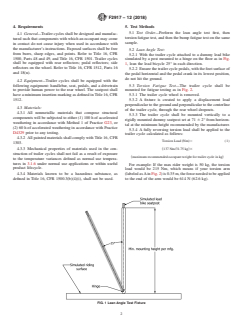
5.2.1 With the trailer cycle attached to a dummy lead bike
1500, Parts 48 and 49, and Title 16, CFR 1501. Trailer cycles
simulated by a post mounted to a hinge on the floor as in Fig.
shall be equipped with rear reflectors; pedal reflectors; side
1, lean the lead bicycle 25° in each direction.
reflectors on the wheel. Refer to Title 16, CFR 1512, Parts 16
5.2.2 Ensurethetrailercyclepedals,withthefootsurfaceof
and 18(n).
the pedal horizontal and the pedal crank in its lowest position,
do not hit the ground.
4.2 Equipment—Trailer cycles shall be equipped with the
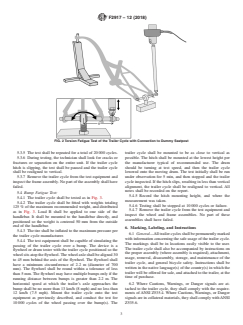
following equipment: handlebar, seat, pedals, and a drivetrain 5.3 Torsion Fatigue Test—The trailer cycle shall be
mounted for fatigue testing as in Fig. 2.
to provide human power to the rear wheel. The seatpost shall
have a minimum insertion marking as defined in Title 16, CFR
5.3.1 The trailer cycle wheel is removed.
1512.
5.3.2 A fixture is created to apply a displacement load
perpendicular to the ground and perpendicular to the centerline
4.3 Materials:
of the trailer cycle, through the rear wheel dropouts.
4.3.1 All nonmetallic materials that compose structural
5.3.3 The trailer cycle shall be mounted vertically to a
components will be subjected to either (1) 100 h of accelerated
rigidly mounted dummy seatpost set at 71 6 2° from horizon-
weathering in accordance with Method 1 of Practice G23,or
tal at the minimum height recommended by the manufacturer.
(2) 60 h of accelerated weathering in accordance with Practice
5.3.4 A fully reversing torsion load shall be applied to the
D4329 prior to any testing.
trailer cycle calculated as follows:
4.3.2 All painted materials shall comply with Title 16, CFR
Torsion Load ~Nm!5 (1)
1303.
4.3.3 Mechanical properties of materials used in the con- 137 Nm/31.75 kg 3
~ !
struction of trailer cycles shall not fail as a result of exposure
maximum recommended occupant weight for trailer cycle in kg
~ !
to the temperature variances defined as normal use tempera-
tures in 3.1.6 under normal use applications or within useful
For example: If the max rider weight is 50 kg, the torsion
product lifecycle.
load would be 215 Nm, which means if your torsion arm
4.3.4 Materials known to be a hazardous substance, as (labeledasAinFig.2)is0.35m,theforceneededtobeapplied
defined in Title 16, CFR 1500.3(b)(4)(i), shall not be used. to the end of the arm would be 614 N (62.6 kg).
FIG. 1Lean Angle Test Fixture
F2917−12 (2018)
FIG. 2Torsion Fatigue Test of the Trailer Cycle with Connection to Dummy Seatpost
5.3.5 The test shall be repeated for a total of 20 000 cycles. trailer cycle shall be mounted to be as close to vertical as
5.3.6 During testing, the technician shall look for cracks or possible. The hitch shall be mounted at the lowest height per
fractures or separation on the entire unit. If the trailer cycle the manufacturer typical of recommended use. The drum
hitch is slipping, the test shall be paused and the trailer cycle should be turning at test speed, and then the trailer cycle
shall be realigned to vertical. lowered onto the moving drum. The test initially shall be run
5.3.7 Remove the trailer cycle from the test equipment and under observation for 5 min, and then stopped and the trailer
inspect the frame assembly. No part of the assembly shall have cycle inspected. If the hitch slips, resulting in less than vertical
failed. alignment, the trailer cycle shall be realigned to vertical. All
notes shall be recorded on the report.
5.4 Bump Fatigue Test:
5.4.5 Record the hitch mounting height, and where the
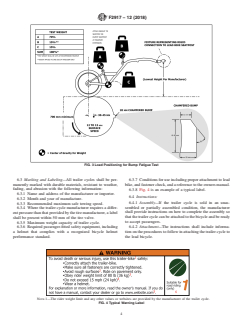
5.4.1 The trailer cycle shall be tested as in Fig. 3.
measurement was taken.
5.4.2 The trailer cycle shall be fitted with weights totaling
5.4.6 Testing shall be stopped at 10 000 cycles or failure.
125 % of the maximum recommended weight, and distributed
5.4.7 Remove the trailer cycle from the test equipment and
as in Fig. 3. Load B shall be applied to one side of the
inspect the wheel and frame assemblies. No part of these
handlebar. It shall be mounted to the handlebar directly, and
assemblies shall have failed.
positioned so the weight is centered 50 mm from the outside
end of the handlebar.
6. Marking, Labeling, and Instructions
5.4.3 The tire shall be inflated to the maximum pressure per
6.1 General—Alltrailercyclesshallbepermanentlymarked
the trailer cycle manufact
...