

ASTM D2649-20a
(Test Method)Standard Test Method for Corrosion Characteristics of Solid Film Lubricants
General Information
- Abstract
SIGNIFICANCE AND USE
5.1 Surfaces are examined for signs of corrosion. Any sign of corrosion is an indication of potential field failure.
SCOPE
1.1 This test method2 covers the evaluation of the galvanic and environmental corrosion interaction characteristics of dry solid film lubricants when in contact with an aluminum surface under conditions of high humidity.
1.2 The values stated in SI units are to be regarded as the standard. The inch-pound units given in parentheses are for information only.
1.3 This standard does not purport to address all of the safety concerns, if any, associated with its use. It is the responsibility of the user of this standard to establish appropriate safety, health, and environmental practices and determine the applicability of regulatory limitations prior to use.
1.4 This international standard was developed in accordance with internationally recognized principles on standardization established in the Decision on Principles for the Development of International Standards, Guides and Recommendations issued by the World Trade Organization Technical Barriers to Trade (TBT) Committee.
- Status
- Published
- Publication Date
- 30-Nov-2020
- Technical Committee
- D02 - Petroleum Products, Liquid Fuels, and Lubricants
- Drafting Committee
- D02.L0.05 - Solid Lubricants



Overview
ASTM D2649-20a is a critical international standard titled Standard Test Method for Corrosion Characteristics of Solid Film Lubricants. Developed by ASTM International, this test method focuses on evaluating the corrosion behavior of dry solid film lubricants when they are in contact with aluminum surfaces in environments of high humidity. The method assesses both galvanic and environmental corrosion interactions, providing essential data for industries that rely on the durability and protective qualities of solid film lubricants.
Surfaces treated with solid film lubricants are examined after exposure to high humidity conditions, and any sign of corrosion can indicate a potential for field failure. This test plays a significant role in quality assurance for components where long-term protection against corrosion is crucial.
Key Topics
- Corrosion Testing of Solid Film Lubricants: The standard outlines procedures for evaluating whether a solid film lubricant provides adequate corrosion resistance when applied to aluminum surfaces.
- Galvanic and Environmental Interactions: Focuses on how dry lubricants and metal surfaces interact under the influence of 95% relative humidity and elevated temperature.
- Test Method Overview:
- Application of solid film lubricant to aluminum panels.
- Assembling coated and uncoated panels under a defined load.
- Exposure of assemblies to controlled humidity and temperature for 500 hours.
- Visual inspection for signs of corrosion such as pitting, etching, or surface degradation.
- Reporting Requirements: All observed corrosion phenomena, conditions of application, and any deviations in materials or procedures are to be documented for compliance and traceability.
Applications
ASTM D2649-20a is widely used in industries that manufacture and test components exposed to harsh environments, especially where aluminum and solid film lubricants are utilized. Typical applications include:
- Aerospace Components: Ensuring aluminum aircraft parts coated with solid film lubricants resist corrosion and potential field failures.
- Automotive and Heavy Equipment: Protecting chassis, fasteners, and mechanical parts from galvanic corrosion.
- Defense and Military Equipment: Used to establish corrosion resistance standards for mission-critical systems, with alignment to U.S. Department of Defense requirements.
- Industrial Machinery: Validation of solid film lubricants in high-humidity production or operating environments.
- Quality Assurance: Part of routine material qualification protocols for suppliers and manufacturers of coated aluminum assemblies.
By following ASTM D2649-20a, organizations can minimize the risk of unexpected corrosion, prolong equipment service life, and prevent costly maintenance or replacements.
Related Standards
Numerous documents complement or are referenced within ASTM D2649-20a, enhancing its use and integration in broader corrosion testing or surface preparation programs:
- ASTM B209: Specification for Aluminum and Aluminum-Alloy Sheet and Plate.
- ASTM B308/B308M: Specification for Aluminum-Alloy 6061-T6 Standard Structural Profiles.
- ASTM D235: Specification for Mineral Spirits (Hydrocarbon Dry Cleaning Solvent).
- ASTM D1730: Practices for Preparation of Aluminum and Aluminum-Alloy Surfaces for Painting.
- ASTM D1748: Test Method for Rust Protection by Metal Preservatives in the Humidity Cabinet.
- ASTM D2247: Practice for Testing Water Resistance of Coatings in 100% Relative Humidity.
- SAE AS5272: Specification for solid film, heat-cured, corrosion-inhibiting lubricants.
- Military Specifications (MIL-PRF-3043, MIL-PRF-680): Related performance requirements for coatings and cleaning solvents.
Practical Value
Implementing ASTM D2649-20a ensures that solid film lubricants used for protecting aluminum surfaces are properly qualified for moisture-rich or demanding environments. This promotes reliable corrosion resistance, fewer failures, and greater operational safety across industries where metal components’ longevity is paramount.
Keywords: ASTM D2649-20a, solid film lubricant, corrosion characteristics, aluminum corrosion test, galvanic corrosion, high humidity testing, surface protection.
Relations
- Effective Date
- 01-Jun-2020
- Effective Date
- 01-May-2020
- Effective Date
- 01-Dec-2015
- Effective Date
- 01-Nov-2014
- Effective Date
- 01-Nov-2010
- Effective Date
- 01-Oct-2010
- Refers
ASTM D2247-10 - Standard Practice for Testing Water Resistance of Coatings in 100% Relative Humidity - Effective Date
- 01-Jul-2010
- Effective Date
- 01-May-2010
- Effective Date
- 15-Apr-2009
- Effective Date
- 01-May-2008
- Effective Date
- 01-Aug-2007
- Effective Date
- 01-Jun-2007
- Effective Date
- 01-Jul-2006
- Effective Date
- 01-Mar-2004
- Effective Date
- 10-Sep-2003
Get Certified
Connect with accredited certification bodies for this standard

Element Materials Technology
Materials testing and product certification.

ABS Group Brazil
ABS Group certification services in Brazil.

ABS Quality Evaluations Inc.
American Bureau of Shipping quality certification.
Sponsored listings
Frequently Asked Questions
ASTM D2649-20a is a standard published by ASTM International. Its full title is "Standard Test Method for Corrosion Characteristics of Solid Film Lubricants". This standard covers: SIGNIFICANCE AND USE 5.1 Surfaces are examined for signs of corrosion. Any sign of corrosion is an indication of potential field failure. SCOPE 1.1 This test method2 covers the evaluation of the galvanic and environmental corrosion interaction characteristics of dry solid film lubricants when in contact with an aluminum surface under conditions of high humidity. 1.2 The values stated in SI units are to be regarded as the standard. The inch-pound units given in parentheses are for information only. 1.3 This standard does not purport to address all of the safety concerns, if any, associated with its use. It is the responsibility of the user of this standard to establish appropriate safety, health, and environmental practices and determine the applicability of regulatory limitations prior to use. 1.4 This international standard was developed in accordance with internationally recognized principles on standardization established in the Decision on Principles for the Development of International Standards, Guides and Recommendations issued by the World Trade Organization Technical Barriers to Trade (TBT) Committee.
SIGNIFICANCE AND USE 5.1 Surfaces are examined for signs of corrosion. Any sign of corrosion is an indication of potential field failure. SCOPE 1.1 This test method2 covers the evaluation of the galvanic and environmental corrosion interaction characteristics of dry solid film lubricants when in contact with an aluminum surface under conditions of high humidity. 1.2 The values stated in SI units are to be regarded as the standard. The inch-pound units given in parentheses are for information only. 1.3 This standard does not purport to address all of the safety concerns, if any, associated with its use. It is the responsibility of the user of this standard to establish appropriate safety, health, and environmental practices and determine the applicability of regulatory limitations prior to use. 1.4 This international standard was developed in accordance with internationally recognized principles on standardization established in the Decision on Principles for the Development of International Standards, Guides and Recommendations issued by the World Trade Organization Technical Barriers to Trade (TBT) Committee.
ASTM D2649-20a is classified under the following ICS (International Classification for Standards) categories: 75.100 - Lubricants, industrial oils and related products. The ICS classification helps identify the subject area and facilitates finding related standards.
ASTM D2649-20a has the following relationships with other standards: It is inter standard links to ASTM D2247-15(2020), ASTM D1730-09(2020), ASTM D2247-15, ASTM D1730-09(2014), ASTM B209-10, ASTM D1748-10, ASTM D2247-10, ASTM B308/B308M-10, ASTM D1730-09, ASTM D1748-02(2008), ASTM B209-07, ASTM D235-02(2007), ASTM B209-06, ASTM B209-04, ASTM D1730-03. Understanding these relationships helps ensure you are using the most current and applicable version of the standard.
ASTM D2649-20a is available in PDF format for immediate download after purchase. The document can be added to your cart and obtained through the secure checkout process. Digital delivery ensures instant access to the complete standard document.
Standards Content (Sample)
This international standard was developed in accordance with internationally recognized principles on standardization established in the Decision on Principles for the
Development of International Standards, Guides and Recommendations issued by the World Trade Organization Technical Barriers to Trade (TBT) Committee.
Designation: D2649 − 20a
Standard Test Method for
Corrosion Characteristics of Solid Film Lubricants
This standard is issued under the fixed designation D2649; the number immediately following the designation indicates the year of
original adoption or, in the case of revision, the year of last revision. A number in parentheses indicates the year of last reapproval. A
superscript epsilon (´) indicates an editorial change since the last revision or reapproval.
This standard has been approved for use by agencies of the U.S. Department of Defense.
1. Scope* D1748 Test Method for Rust Protection by Metal Preserva-
2 tives in the Humidity Cabinet
1.1 This test method covers the evaluation of the galvanic
D2247 Practice for Testing Water Resistance of Coatings in
and environmental corrosion interaction characteristics of dry
100 % Relative Humidity
solid film lubricants when in contact with an aluminum surface
2.2 U. S. Military Specifications:
under conditions of high humidity.
MIL-PRF-680 Degreasing Solvent
1.2 The values stated in SI units are to be regarded as the
MIL-PRF-3043 Resin-Coating,Permanent,forEngineCom-
standard. The inch-pound units given in parentheses are for
ponents and Metal Parts
information only.
2.3 Other Standards:
1.3 This standard does not purport to address all of the
SAE AS5272 Lubricant, Solid Film, Heat Cured, Corrosion
safety concerns, if any, associated with its use. It is the
Inhibiting, Procurement Specification
responsibility of the user of this standard to establish appro-
priate safety, health, and environmental practices and deter- 3. Terminology
mine the applicability of regulatory limitations prior to use.
3.1 Definitions:
1.4 This international standard was developed in accor-
3.1.1 lubricant, n—any material interposed between two
dance with internationally recognized principles on standard-
surfaces that reduces the friction or wear, or both, between
ization established in the Decision on Principles for the
them.
Development of International Standards, Guides and Recom-
3.2 Definitions of Terms Specific to This Standard:
mendations issued by the World Trade Organization Technical
3.2.1 dry solid film lubricant, n—on an aluminum surface,
Barriers to Trade (TBT) Committee.
one consisting of friction-reducing powders bonded in tight
matrix to the surface of the metal.
2. Referenced Documents
2.1 ASTM Standards:
4. Summary of Test Method
B209 Specification for Aluminum and Aluminum-Alloy
4.1 An aluminum panel having solid film deposited on one
Sheet and Plate
surface is contacted under load with the surface of an unlubri-
B308/B308M Specification for Aluminum-Alloy 6061-T6
cated panel. The specimen is subjected to 95 % 6 3 % relative
Standard Structural Profiles
humidity at 49 °C (120 °F) for a period of 500 h. After this
D235 Specification for Mineral Spirits (Petroleum Spirits)
period, the surface of the unlubricated panel is examined for
(Hydrocarbon Dry Cleaning Solvent)
evidence of corrosion.
D1730 Practices for Preparation of Aluminum and
Aluminum-Alloy Surfaces for Painting
5. Significance and Use
5.1 Surfaces are examined for signs of corrosion. Any sign
of corrosion is an indication of potential field failure.
This test method is under the jurisdiction of ASTM Committee D02 on
Petroleum Products, Liquid Fuels, and Lubricantsand is the direct responsibility of
6. Apparatus
Subcommittee D02.L0.05 on Solid Lubricants.
Current edition approved Dec. 1, 2020. Published December 2020. Originally
6.1 BoltandNut,Finishedhexbolt, ⁄8-24,minimum19 mm
approved in 1967. Last previous edition approved in 2020 as D2649 – 20. DOI:
3 3
( ⁄4 in.) long and finished hex nut, ⁄8-24. Bolt and nut shall be
10.1520/D2649-20A.
Reference may be made to Military Specification MIL-L-8937 (ASG), Jan. 22,
1963, and Method 3814 of Federal Test Method Standard No. 791.
3 4
For referenced ASTM standards, visit the ASTM website, www.astm.org, or Available from Standardization Documents Order Desk, Bldg. 4 Section D, 700
contact ASTM Customer Service at service@astm.org. For Annual Book of ASTM Robbins Ave., Philadelphia, PA 19111-5094, Attn: NPODS.
Standards volume information, refer to the standard’s Document Summary page on Available from SAE International (SAE), 400 Commonwealth Dr.,Warrendale,
the ASTM website. PA 15096, http://www.sae.org.
*A Summary of Changes section appears at the end of this standard
Copyright © ASTM International, 100 Barr Harbor Drive, PO Box C700, West Conshohocken, PA 19428-2959. United States
D2649 − 20a
made of corrosion-resistant aluminum or stainless steel. Two 8. Sampling, Test Specimens, and Test Units
(2) nuts and two (2) bolts are required.
8.1 Be certain there is sufficient quantity of solid film
6.2 Channel, made of aluminum alloy 6061–T6, conform- lubricant mixture to perform the test.
ing to Specification B308/B308M, 76 mm (3 in.) wide, 36 mm
8.2 Prepare the apparatus and specimens as follows:
(1.41 in.) high, cut to 178 mm (7 in.) long. Holes for the bolts
8.2.1 Liquid degrease the aluminum channel, nuts, bolts,
to pass through are drilled on the centerline of the channel
and test panels with hydrocarbon dry cleaning solvent (see
25 mm (1 in.) from each end. Two (2) channels are required.
7.2).
8.2.2 Deposit a film of resin coating on the surface of the
6.3 Humidity Environmental Test Chamber, capable of pro-
ducing 95 % 6 3 % relative humidity, 49 °C 6 1 °C (120 °F 6 aluminum channel and cure in accordance with the manufac-
turer’s specification.
2 °F), and conforming to Test Method D1748, Annex A1 on
Humidity CabinetApparatus orTest Method D2247,AnnexA1 8.2.3 Apply so
...
This document is not an ASTM standard and is intended only to provide the user of an ASTM standard an indication of what changes have been made to the previous version. Because
it may not be technically possible to adequately depict all changes accurately, ASTM recommends that users consult prior editions as appropriate. In all cases only the current version
of the standard as published by ASTM is to be considered the official document.
Designation: D2649 − 20 D2649 − 20a
Standard Test Method for
Corrosion Characteristics of Solid Film Lubricants
This standard is issued under the fixed designation D2649; the number immediately following the designation indicates the year of
original adoption or, in the case of revision, the year of last revision. A number in parentheses indicates the year of last reapproval. A
superscript epsilon (´) indicates an editorial change since the last revision or reapproval.
This standard has been approved for use by agencies of the U.S. Department of Defense.
1. Scope*
1.1 This test method covers the evaluation of the galvanic and environmental corrosion interaction characteristics of dry solid film
lubricants when in contact with an aluminum surface under conditions of high humidity.
1.2 The values stated in SI units are to be regarded as the standard. The inch-pound units given in parentheses are for information
only.
1.3 This standard does not purport to address all of the safety concerns, if any, associated with its use. It is the responsibility
of the user of this standard to establish appropriate safety, health, and environmental practices and determine the applicability of
regulatory limitations prior to use.
1.4 This international standard was developed in accordance with internationally recognized principles on standardization
established in the Decision on Principles for the Development of International Standards, Guides and Recommendations issued
by the World Trade Organization Technical Barriers to Trade (TBT) Committee.
2. Referenced Documents
2.1 ASTM Standards:
B209 Specification for Aluminum and Aluminum-Alloy Sheet and Plate
B308/B308M Specification for Aluminum-Alloy 6061-T6 Standard Structural Profiles
D235 Specification for Mineral Spirits (Petroleum Spirits) (Hydrocarbon Dry Cleaning Solvent)
D1730 Practices for Preparation of Aluminum and Aluminum-Alloy Surfaces for Painting
D1748 Test Method for Rust Protection by Metal Preservatives in the Humidity Cabinet
D2247 Practice for Testing Water Resistance of Coatings in 100 % Relative Humidity
D4175 Terminology Relating to Petroleum Products, Liquid Fuels, and Lubricants
2.2 U. S. Military Specifications:
MIL-PRF-680 Degreasing Solvent
MIL-PRF-3043 Resin-Coating, Permanent, for Engine Components and Metal Parts
2.3 Other Standards:
SAE AS5272 Lubricant, Solid Film, Heat Cured, Corrosion Inhibiting, Procurement Specification
This test method is under the jurisdiction of ASTM Committee D02 on Petroleum Products, Liquid Fuels, and Lubricantsand is the direct responsibility of Subcommittee
D02.L0.05 on Solid Lubricants.
Current edition approved Sept. 1, 2020Dec. 1, 2020. Published October 2020December 2020. Originally approved in 1967. Last previous edition approved in 20142020
as D2649 – 04 (2014).D2649 – 20. DOI: 10.1520/D2649-20.10.1520/D2649-20A.
Reference may be made to Military Specification MIL-L-8937 (ASG), Jan. 22, 1963, and Method 3814 of Federal Test Method Standard No. 791.
For referenced ASTM standards, visit the ASTM website, www.astm.org, or contact ASTM Customer Service at service@astm.org. For Annual Book of ASTM Standards
volume information, refer to the standard’s Document Summary page on the ASTM website.
Available from Standardization Documents Order Desk, Bldg. 4 Section D, 700 Robbins Ave., Philadelphia, PA 19111-5094, Attn: NPODS.
Available from SAE International (SAE), 400 Commonwealth Dr., Warrendale, PA 15096, http://www.sae.org.
*A Summary of Changes section appears at the end of this standard
Copyright © ASTM International, 100 Barr Harbor Drive, PO Box C700, West Conshohocken, PA 19428-2959. United States
D2649 − 20a
3. Terminology
3.1 Definitions:
3.1.1 lubricant, n—any material interposed between two surfaces that reduces the friction or wear between them (see Test Method
wear, or both, between them.D4175).
3.2 Definitions of Terms Specific to This Standard:
3.2.1 dry solid film lubricant, n—on an aluminum surface, one consisting of friction-reducing powders bonded in tight matrix to
the surface of the metal.
4. Summary of Test Method
4.1 An aluminum panel having solid film deposited on one surface is contacted under load with the surface of an unlubricated
panel. The specimen is subjected to 95 % 6 3 % relative humidity at 49 °C (120 °F) for a period of 500 h. After this period, the
surface of the unlubricated panel is examined for evidence of corrosion.
5. Significance and Use
5.1 Surfaces are examined for signs of corrosion. Any sign of corrosion is an indication of potential field failure.
6. Apparatus
3 3 3
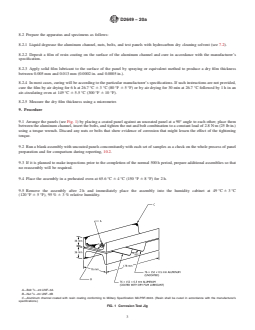
6.1 Bolt and Nut, Finished hex bolt, ⁄8-24, minimum 19 mm ( ⁄4 in.) long and finished hex nut, ⁄8-24. Bolt and nut shall be made
of corrosion-resistant aluminum or stainless steel. Two (2) nuts and two (2) bolts are required.
6.2 Channel, made of aluminum alloy 6061–T6, conforming to Specification B308/B308M, 76 mm (3 in.) wide, 36 mm (1.41 in.)
high, cut to 178 mm (7 in.) long. Holes for the bolts to pass through are drilled on the centerline of the channel 25 mm (1 in.) from
each end. Two (2) channels are required.
6.3 Humidity Environmental Test Chamber, capable of producing 95 % 6 3 % relative humidity, 49 °C 6 1 °C (120 °F 6 2 °F),
and conforming to Test Method D1748, Annex A1 on Humidity Cabinet Apparatus or Test Method D2247, Annex A1 on Apparatus.
6.4 Torque Wrench, with capacity of 2.8 N·m (25 lb·in.).
6.5 Micrometer, reading 0 mm to 25 mm 6 0.002 mm (0 in. to 1 in. 6 0.0001 in.) with a spherical anvil.
6.6 Forced-Circulation Oven, capable of maintaining a temperature of 66 °C 6 3 °C (150 °F 6 5 °F) and 149 °C 6 5.5 °C
(300 °F 6 10 °F).
7. Reagents and Materials
7.1 Panels, made of aluminum alloy 2024, conf
...