

ASTM E834-21
(Practice)Standard Practice for Determining Vacuum Chamber Gaseous Environment Using a Cold Finger
General Information
- Abstract
SIGNIFICANCE AND USE
5.1 When applied in the case in which there is no test item in the vacuum chamber (such as during bake-out operations), this procedure may be used to evaluate the performance of the vacuum chamber in relation to other data from the same or other chambers given that critical parameters (for example, length of exposure, temperature of the chamber and cold finger, anisotropy, and so forth) can be related.
5.2 The procedure can be used to evaluate the effects of materials found in the residue on items placed in the vacuum chamber.
5.3 The procedure can be used to describe the effect of a prior test on the residual gases within a vacuum chamber.
5.4 By selecting the time at which the coolant is introduced into the cold finger, the environment present during a selected portion of a test can be characterized. This can be used to determine the relative efficacy of certain vacuum chamber procedures such as bake-out.
5.5 The procedure may be used to define the outgassed products of a test item that condense on the cold finger.
5.6 The procedure may be used in defining the relative cleanliness of a vacuum chamber.
5.7 In applying the results of the procedure to the vacuum chamber in general, consideration must be given to the anisotropy of the molecular fluxes within the chamber.
5.8 The procedure is sensitive to both the partial pressures of the gases that form the condensibles and the time of exposure of the cold finger at coolant temperatures.
5.9 The procedure is sensitive to any losses of sample that may occur during the various transfer operations and during that procedure wherein the solvent is evaporated by heating it on a steam bath.
Note 1: Reactions between solvent and condensate can occur and would affect the analysis.
SCOPE
1.1 This practice covers a technique for collecting samples of materials that are part of the residual gas environment of an evacuated vacuum chamber. The practice uses a device designated as a “cold finger” that is placed within the environment to be sampled and is cooled so that constituents of the environment are retained on the cold-finger surface.
1.2 The practice covers a method for obtaining a sample from the cold finger and determining the weight of the material removed from the cold finger.
1.3 The practice contains recommendations as to ways in which the sample may be analyzed to identify the constituents that comprise the sample.
1.4 By determining the species that constitute the sample, the practice may be used to assist in defining the source of the constituents and whether the sample is generally representative of samples similarly obtained from the vacuum chamber itself.
1.5 This practice covers alternative approaches and usages to which the practice can be put.
1.6 The degree of molecular flux anisotropy significantly affects the assurance with which one can attribute characteristics determined by this procedure to the vacuum chamber environment in general.
1.7 The temperature of the cold finger significantly affects the quantity and species of materials collected.
1.8 Units—The values stated in SI units are to be regarded as standard. No other units of measurement are included in this standard.
1.9 This standard does not purport to address all of the safety concerns, if any, associated with its use. It is the responsibility of the user of this standard to establish appropriate safety, health, and environmental practices and determine the applicability of regulatory limitations prior to use. For specific warning statements, see Section 8.
1.10 This international standard was developed in accordance with internationally recognized principles on standardization established in the Decision on Principles for the Development of International Standards, Guides and Recommendations issued by the World Trade Organization Technical Barriers to Trade (TBT) Committee.
- Status
- Published
- Publication Date
- 31-Mar-2021
- Technical Committee
- E21 - Space Simulation and Applications of Space Technology
- Drafting Committee
- E21.05 - Contamination
Buy Documents
ASTM E834-21 - Standard Practice for Determining Vacuum Chamber Gaseous Environment Using a Cold Finger
REDLINE ASTM E834-21 - Standard Practice for Determining Vacuum Chamber Gaseous Environment Using a Cold Finger
Overview
ASTM E834-21: Standard Practice for Determining Vacuum Chamber Gaseous Environment Using a Cold Finger establishes a reliable technique for collecting and analyzing samples of residual gases present in evacuated vacuum chambers. The standard details procedures utilizing a "cold finger" - a cooled surface device that attracts and retains condensable molecules from the vacuum environment. This practice is essential for laboratories and industries seeking to monitor contamination, characterize residual gas compositions, and maintain the cleanliness and performance of vacuum systems used in applications such as space simulation, materials processing, and electronics manufacturing.
The method covers sample collection, mass determination, and recommendations for further analysis, supporting users in identifying and quantifying contaminants and evaluating vacuum chamber procedures.
Key Topics
- Cold Finger Technique: Provides a step-by-step method for cleaning, installing, and using a cold finger to collect condensable species from the vacuum chamber environment.
- Sample Collection & Analysis: Describes how pretest and posttest samples are taken, handled, evaporated, and weighed to determine the residue collected during vacuum exposure.
- Chamber Performance & Cleanliness: Offers guidelines for using the technique to assess chamber cleanliness, monitor the efficacy of chamber operations (like bake-outs), and evaluate the impact of prior tests or introduced materials.
- Critical Parameters: Emphasizes factors such as exposure duration, temperature control (of both chamber and cold finger), and the importance of accounting for molecular flux anisotropy.
- Interpretation of Results: Guides users in interpreting results relative to chamber operations, potential contamination sources, and the effect of procedural variables.
- Sensitivity & Limitations: Notes the procedure's sensitivity to partial pressure of condensables, exposure time, sample losses, and possible solvent-condensate reactions.
Applications
ASTM E834-21 is applicable across a variety of settings that demand controlled vacuum environments and rigorous contamination control, including:
- Vacuum Chamber Qualification: Comparing cleanliness and residual gas environment between chambers or over time, especially after maintenance or operational changes.
- Bake-Out Effectiveness: Verifying the removal of volatile contaminants during bake-out by analyzing what condenses on the cold finger.
- Material Compatibility Testing: Assessing gases outgassed by test items or chamber components, which is critical in high-purity manufacturing processes.
- Space Simulation Facilities: Supporting aerospace and satellite component testing where low outgassing and chamber cleanliness are crucial for mission success.
- Research and Development: Enabling detailed environmental characterization for material science, electronics, and nanotechnology studies where vacuum quality affects experimental outcomes.
Related Standards
ASTM E834-21 is closely associated with other standards in contamination and vacuum chamber performance:
- ASTM E177: Practice for Use of the Terms Precision and Bias in ASTM Test Methods, applicable for understanding and expressing measurement uncertainty and repeatability.
- ASTM E595: Outgassing properties of materials, important for material selection in vacuum environments.
- NASA-STD-6001: Often referenced for outgassing requirements in aerospace applications.
- ASTM E1559: Standard test method for contamination outgassing characteristics of space materials.
Practical Value
Implementing ASTM E834-21 provides organizations with a standardized, reproducible method to:
- Quantify and identify potential contaminants in vacuum chambers.
- Monitor and improve vacuum chamber cleanliness and operational procedures.
- Help ensure compliance with contamination control requirements in critical technological and scientific fields.
- Support root-cause analysis of test failures due to environmental contaminants.
This ASTM standard is essential for any facility operating with sensitive materials or test items in vacuum environments, ensuring reliable, high-purity results and maintaining integrity in demanding technical processes.
Relations
- Effective Date
- 01-May-2014
- Effective Date
- 01-May-2013
- Effective Date
- 01-Oct-2010
- Effective Date
- 01-Oct-2008
- Refers
ASTM E177-06b - Standard Practice for Use of the Terms Precision and Bias in ASTM Test Methods - Effective Date
- 15-Nov-2006
- Refers
ASTM E177-06a - Standard Practice for Use of the Terms Precision and Bias in ASTM Test Methods - Effective Date
- 01-Nov-2006
- Effective Date
- 01-Nov-2004
- Effective Date
- 01-Nov-2004
- Refers
ASTM E177-04e1 - Standard Practice for Use of the Terms Precision and Bias in ASTM Test Methods - Effective Date
- 01-Nov-2004
- Refers
ASTM E177-90a(2002) - Standard Practice for Use of the Terms Precision and Bias in ASTM Test Methods - Effective Date
- 10-Jan-2002
Buy Documents
ASTM E834-21 - Standard Practice for Determining Vacuum Chamber Gaseous Environment Using a Cold Finger
REDLINE ASTM E834-21 - Standard Practice for Determining Vacuum Chamber Gaseous Environment Using a Cold Finger
Get Certified
Connect with accredited certification bodies for this standard

Institut za varilstvo d.o.o. (Welding Institute)
Slovenia's leading welding institute since 1952. ISO 3834, EN 1090, pressure equipment certification, NDT personnel, welder qualification. Only IIW Au
Sponsored listings
Frequently Asked Questions
ASTM E834-21 is a standard published by ASTM International. Its full title is "Standard Practice for Determining Vacuum Chamber Gaseous Environment Using a Cold Finger". This standard covers: SIGNIFICANCE AND USE 5.1 When applied in the case in which there is no test item in the vacuum chamber (such as during bake-out operations), this procedure may be used to evaluate the performance of the vacuum chamber in relation to other data from the same or other chambers given that critical parameters (for example, length of exposure, temperature of the chamber and cold finger, anisotropy, and so forth) can be related. 5.2 The procedure can be used to evaluate the effects of materials found in the residue on items placed in the vacuum chamber. 5.3 The procedure can be used to describe the effect of a prior test on the residual gases within a vacuum chamber. 5.4 By selecting the time at which the coolant is introduced into the cold finger, the environment present during a selected portion of a test can be characterized. This can be used to determine the relative efficacy of certain vacuum chamber procedures such as bake-out. 5.5 The procedure may be used to define the outgassed products of a test item that condense on the cold finger. 5.6 The procedure may be used in defining the relative cleanliness of a vacuum chamber. 5.7 In applying the results of the procedure to the vacuum chamber in general, consideration must be given to the anisotropy of the molecular fluxes within the chamber. 5.8 The procedure is sensitive to both the partial pressures of the gases that form the condensibles and the time of exposure of the cold finger at coolant temperatures. 5.9 The procedure is sensitive to any losses of sample that may occur during the various transfer operations and during that procedure wherein the solvent is evaporated by heating it on a steam bath. Note 1: Reactions between solvent and condensate can occur and would affect the analysis. SCOPE 1.1 This practice covers a technique for collecting samples of materials that are part of the residual gas environment of an evacuated vacuum chamber. The practice uses a device designated as a “cold finger” that is placed within the environment to be sampled and is cooled so that constituents of the environment are retained on the cold-finger surface. 1.2 The practice covers a method for obtaining a sample from the cold finger and determining the weight of the material removed from the cold finger. 1.3 The practice contains recommendations as to ways in which the sample may be analyzed to identify the constituents that comprise the sample. 1.4 By determining the species that constitute the sample, the practice may be used to assist in defining the source of the constituents and whether the sample is generally representative of samples similarly obtained from the vacuum chamber itself. 1.5 This practice covers alternative approaches and usages to which the practice can be put. 1.6 The degree of molecular flux anisotropy significantly affects the assurance with which one can attribute characteristics determined by this procedure to the vacuum chamber environment in general. 1.7 The temperature of the cold finger significantly affects the quantity and species of materials collected. 1.8 Units—The values stated in SI units are to be regarded as standard. No other units of measurement are included in this standard. 1.9 This standard does not purport to address all of the safety concerns, if any, associated with its use. It is the responsibility of the user of this standard to establish appropriate safety, health, and environmental practices and determine the applicability of regulatory limitations prior to use. For specific warning statements, see Section 8. 1.10 This international standard was developed in accordance with internationally recognized principles on standardization established in the Decision on Principles for the Development of International Standards, Guides and Recommendations issued by the World Trade Organization Technical Barriers to Trade (TBT) Committee.
SIGNIFICANCE AND USE 5.1 When applied in the case in which there is no test item in the vacuum chamber (such as during bake-out operations), this procedure may be used to evaluate the performance of the vacuum chamber in relation to other data from the same or other chambers given that critical parameters (for example, length of exposure, temperature of the chamber and cold finger, anisotropy, and so forth) can be related. 5.2 The procedure can be used to evaluate the effects of materials found in the residue on items placed in the vacuum chamber. 5.3 The procedure can be used to describe the effect of a prior test on the residual gases within a vacuum chamber. 5.4 By selecting the time at which the coolant is introduced into the cold finger, the environment present during a selected portion of a test can be characterized. This can be used to determine the relative efficacy of certain vacuum chamber procedures such as bake-out. 5.5 The procedure may be used to define the outgassed products of a test item that condense on the cold finger. 5.6 The procedure may be used in defining the relative cleanliness of a vacuum chamber. 5.7 In applying the results of the procedure to the vacuum chamber in general, consideration must be given to the anisotropy of the molecular fluxes within the chamber. 5.8 The procedure is sensitive to both the partial pressures of the gases that form the condensibles and the time of exposure of the cold finger at coolant temperatures. 5.9 The procedure is sensitive to any losses of sample that may occur during the various transfer operations and during that procedure wherein the solvent is evaporated by heating it on a steam bath. Note 1: Reactions between solvent and condensate can occur and would affect the analysis. SCOPE 1.1 This practice covers a technique for collecting samples of materials that are part of the residual gas environment of an evacuated vacuum chamber. The practice uses a device designated as a “cold finger” that is placed within the environment to be sampled and is cooled so that constituents of the environment are retained on the cold-finger surface. 1.2 The practice covers a method for obtaining a sample from the cold finger and determining the weight of the material removed from the cold finger. 1.3 The practice contains recommendations as to ways in which the sample may be analyzed to identify the constituents that comprise the sample. 1.4 By determining the species that constitute the sample, the practice may be used to assist in defining the source of the constituents and whether the sample is generally representative of samples similarly obtained from the vacuum chamber itself. 1.5 This practice covers alternative approaches and usages to which the practice can be put. 1.6 The degree of molecular flux anisotropy significantly affects the assurance with which one can attribute characteristics determined by this procedure to the vacuum chamber environment in general. 1.7 The temperature of the cold finger significantly affects the quantity and species of materials collected. 1.8 Units—The values stated in SI units are to be regarded as standard. No other units of measurement are included in this standard. 1.9 This standard does not purport to address all of the safety concerns, if any, associated with its use. It is the responsibility of the user of this standard to establish appropriate safety, health, and environmental practices and determine the applicability of regulatory limitations prior to use. For specific warning statements, see Section 8. 1.10 This international standard was developed in accordance with internationally recognized principles on standardization established in the Decision on Principles for the Development of International Standards, Guides and Recommendations issued by the World Trade Organization Technical Barriers to Trade (TBT) Committee.
ASTM E834-21 is classified under the following ICS (International Classification for Standards) categories: 23.160 - Vacuum technology. The ICS classification helps identify the subject area and facilitates finding related standards.
ASTM E834-21 has the following relationships with other standards: It is inter standard links to ASTM E177-14, ASTM E177-13, ASTM E177-10, ASTM E177-08, ASTM E177-06b, ASTM E177-06a, ASTM E177-06, ASTM E177-04, ASTM E177-04e1, ASTM E177-90a(2002). Understanding these relationships helps ensure you are using the most current and applicable version of the standard.
ASTM E834-21 is available in PDF format for immediate download after purchase. The document can be added to your cart and obtained through the secure checkout process. Digital delivery ensures instant access to the complete standard document.
Standards Content (Sample)
This international standard was developed in accordance with internationally recognized principles on standardization established in the Decision on Principles for the
Development of International Standards, Guides and Recommendations issued by the World Trade Organization Technical Barriers to Trade (TBT) Committee.
Designation: E834 − 21
Standard Practice for
Determining Vacuum Chamber Gaseous Environment Using
a Cold Finger
This standard is issued under the fixed designation E834; the number immediately following the designation indicates the year of
original adoption or, in the case of revision, the year of last revision.Anumber in parentheses indicates the year of last reapproval.A
superscript epsilon (´) indicates an editorial change since the last revision or reapproval.
1. Scope mine the applicability of regulatory limitations prior to use.
For specific warning statements, see Section 8.
1.1 This practice covers a technique for collecting samples
1.10 This international standard was developed in accor-
of materials that are part of the residual gas environment of an
dance with internationally recognized principles on standard-
evacuated vacuum chamber. The practice uses a device desig-
ization established in the Decision on Principles for the
nated as a “cold finger” that is placed within the environment
Development of International Standards, Guides and Recom-
to be sampled and is cooled so that constituents of the
mendations issued by the World Trade Organization Technical
environment are retained on the cold-finger surface.
Barriers to Trade (TBT) Committee.
1.2 The practice covers a method for obtaining a sample
fromthecoldfingeranddeterminingtheweightofthematerial
2. Referenced Documents
removed from the cold finger. 2
2.1 ASTM Standards:
1.3 The practice contains recommendations as to ways in E177Practice for Use of the Terms Precision and Bias in
which the sample may be analyzed to identify the constituents ASTM Test Methods
that comprise the sample.
3. Terminology
1.4 By determining the species that constitute the sample,
3.1 CFR, n—the residue collected by the cold finger during
the practice may be used to assist in defining the source of the
the vacuum exposure given in milligrams.
constituentsandwhetherthesampleisgenerallyrepresentative
of samples similarly obtained from the vacuum chamber itself. 3.2 cold finger, n—the device that is used in collecting the
sample of the residual gases in an evacuated vacuum chamber
1.5 This practice covers alternative approaches and usages
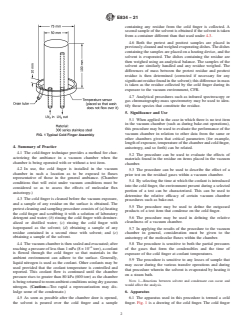
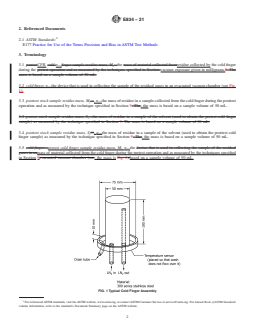
(see Fig. 1).
to which the practice can be put.
3.3 posttest stock sample residue mass, M,n—the mass of
f
1.6 The degree of molecular flux anisotropy significantly
residue in a sample collected from the cold finger during the
affects the assurance with which one can attribute characteris-
posttest operation and as measured by the technique specified
tics determined by this procedure to the vacuum chamber
in Section 9; the mass is based on a sample volume of 50 mL.
environment in general.
3.4 posttest stock sample residue mass, S,n—the mass of
f
1.7 The temperature of the cold finger significantly affects
residue in a sample of the solvent (used to obtain the posttest
the quantity and species of materials collected.
cold finger sample) as measured by the technique specified in
Section 9; the mass is based on a sample volume of 50 mL.
1.8 Units—The values stated in SI units are to be regarded
asstandard.Nootherunitsofmeasurementareincludedinthis
3.5 pretest cold finger sample residue mass, M,n—themass
i
standard.
of material collected from the cold finger during the pretest
operation and as measured by the techniques specified in
1.9 This standard does not purport to address all of the
Section 9; the mass is based on a sample volume of 50 mL.
safety concerns, if any, associated with its use. It is the
responsibility of the user of this standard to establish appro- 3.6 pretest stock sample residue mass, S,n—the mass of
i
priate safety, health, and environmental practices and deter-
residue in a sample of the solvent (used to obtain the pretest
cold finger sample) as measured by the technique specified in
Section 9; the mass is based on a sample volume of 50 mL.
This practice is under the jurisdiction of ASTM Committee E21 on Space
Simulation andApplications of SpaceTechnology and is the direct responsibility of
Subcommittee E21.05 on Contamination. For referenced ASTM standards, visit the ASTM website, www.astm.org, or
Current edition approved April 1, 2021. Published April 2021. Originally contact ASTM Customer Service at service@astm.org. For Annual Book of ASTM
approvedin1981.Lastpreviouseditionapprovedin2015asE834–09(2015).DOI: Standards volume information, refer to the standard’s Document Summary page on
10.1520/E0834-21. the ASTM website.
Copyright © ASTM International, 100 Barr Harbor Drive, PO Box C700, West Conshohocken, PA 19428-2959. United States
E834 − 21
containing any residue from the cold finger is collected. A
second sample of the solvent is obtained if the solvent is taken
from a container different than that used under 4.3.
4.6 Both the pretest and posttest samples are placed in
previouslycleanedandweighedevaporatingdishes.Thedishes
containing the samples are placed on a heating device, and the
solvent is evaporated. The dishes containing the residue are
then weighed using an analytical balance. The samples of the
solvent are similarly handled and any residue weighed. The
differences of mass between the pretest residue and posttest
residue is then determined (corrected if necessary for any
significantresiduefoundinthesolvent);thisdifferenceinmass
is taken as the residue collected by the cold finger during its
exposure to the vacuum environment, CFR.
4.7 Analytical procedures such as infrared spectroscopy or
gas chromatography-mass spectrometry may be used to iden-
tify those species that constitute the residue.
5. Significance and Use
5.1 When applied in the case in which there is no test item
in the vacuum chamber (such as during bake-out operations),
this procedure may be used to evaluate the performance of the
vacuum chamber in relation to other data from the same or
FIG. 1 Typical Cold Finger Assembly
other chambers given that critical parameters (for example,
lengthofexposure,temperatureofthechamberandcoldfinger,
4. Summary of Practice
anisotropy, and so forth) can be related.
4.1 The cold-finger technique provides a method for char-
5.2 The procedure can be used to evaluate the effects of
acterizing the ambiance in a vacuum chamber when the
materials found in the residue on items placed in the vacuum
chamber is being operated with or without a test item.
chamber.
4.2 In use, the cold finger is installed in the vacuum
5.3 The procedure can be used to describe the effect of a
chamber in such a location as to be exposed to fluxes
prior test on the residual gases within a vacuum chamber.
representative of those in the general ambiance. (Chamber
5.4 By selecting the time at which the coolant is introduced
conditions that will exist under vacuum conditions must be
into the cold finger, the environment present during a selected
considered so as to assess the effects of molecular flux
portion of a test can be characterized. This can be used to
anisotropy.)
determine the relative efficacy of certain vacuum chamber
4.3 The cold finger is cleaned before the vacuum exposure,
procedures such as bake-out.
and a sample of any residue on the surface is obtained. The
5.5 The procedure may be used to define the outgassed
pretestcleaningandsamplingprocedureconsistsof(a)heating
products of a test item that condense on the cold finger.
the cold finger and scrubbing it with a solution of laboratory
5.6 The procedure may be used in defining the relative
detergent and water; (b) rinsing the cold finger with deminer-
cleanliness of a vacuum chamber.
alized or distilled water; (c) rinsing the cold finger with
isopropanol as the solvent; (d) obtaining a sample of any
5.7 In applying the results of the procedure to the vacuum
residue contained in a second rinse with solvent; and (e)
chamber in general, consideration must be given to the
obtaining a sample of the solvent.
anisotropy of the molecular fluxes within the chamber.
4.4 Thevacuumchamberisthensealedandevacuated;after
5.8 The procedure is sensitive to both the partial pressures
−6
reachingapressureoflessthan1mPa(8×10 torr),acoolant
of the gases that form the condensibles and the time of
is flowed through the cold finger so that materials in the
exposure of the cold finger at coolant temperatures.
ambient environment can adhere to the surface. Generally,
5.9 The procedure is sensitive to any losses of sample that
liquid nitrogen is used as the coolant. Other coolants may be
may occur during the various transfer operations and during
used provided that the coolant temperature is controlled and
that procedure wherein the solvent is evaporated by heating it
reported. This coolant flow is continued until the chamber
on a steam bath.
pressure rises to greater than 80 kPa (600 torr) as the chamber
NOTE 1—Reactions between solvent and condensate can occur and
isbeingreturnedtoroomambientconditionsusingdrygaseous
would affect the analysis.
nitrogen. (Caution—Too rapid a repressurization may dis-
lodge some of the condensate.)
6. Apparatus
4.5 As soon as possible after the chamber door is opened, 6.1 The apparatus used in this procedure is termed a cold
the solvent is poured over the cold finger and a sample finger. Fig. 1 is a drawing of the cold finger. The cold finger
E834 − 21
consists of a stainless steel cylinder approximately 50 mm in 9.2 Taking the Pretest Cold Finger Sample:
diameter and 100 mm high. The base of the cylinder is
9.2.1 Pour approximately 100 mL of solvent over the cold
extended to form a lip or trap annulus approximately 10 mm
finger. (Do not splash alcohol on the chamber shroud.) Pour at
highwithadiameterof75mmsothatfluidpouredoverthetop
such a rate that the trap annulus is filled to overflowing. Catch
of the cylinder and running down the sides can be captured.A
this fluid in a basin or similar container and discard it.
small drain is provided in this lip, and the fluid can drain
9.2.2 Pour50mLofthesolventoverthecoldfinger.Donot
throughthisapertureintoareceptacle.Twotubesentert
...
This document is not an ASTM standard and is intended only to provide the user of an ASTM standard an indication of what changes have been made to the previous version. Because
it may not be technically possible to adequately depict all changes accurately, ASTM recommends that users consult prior editions as appropriate. In all cases only the current version
of the standard as published by ASTM is to be considered the official document.
Designation: E834 − 09 (Reapproved 2015) E834 − 21
Standard Practice for
Determining Vacuum Chamber Gaseous Environment Using
a Cold Finger
This standard is issued under the fixed designation E834; the number immediately following the designation indicates the year of
original adoption or, in the case of revision, the year of last revision. A number in parentheses indicates the year of last reapproval. A
superscript epsilon (´) indicates an editorial change since the last revision or reapproval.
1. Scope
1.1 This practice covers a technique for collecting samples of materials that are part of the residual gas environment of an
evacuated vacuum chamber. The practice uses a device designated as a “cold finger” that is placed within the environment to be
sampled and is cooled so that constituents of the environment are retained on the cold-finger surface.
1.2 The practice covers a method for obtaining a sample from the cold finger and determining the weight of the material removed
from the cold finger.
1.3 The practice contains recommendations as to ways in which the sample may be analyzed to identify the constituents that
comprise the sample.
1.4 By determining the species that constitute the sample, the practice may be used to assist in defining the source of the
constituents and whether the sample is generally representative of samples similarly obtained from the vacuum chamber itself.
1.5 This practice covers alternative approaches and usages to which the practice can be put.
1.6 The degree of molecular flux anisotropy significantly affects the assurance with which one can attribute characteristics
determined by this procedure to the vacuum chamber environment in general.
1.7 The temperature of the cold finger significantly affects the quantity and species of materials collected.
1.8 Units—The values stated in SI units are to be regarded as standard. No other units of measurement are included in this
standard.
1.9 This standard does not purport to address all of the safety concerns, if any, associated with its use. It is the responsibility
of the user of this standard to establish appropriate safety safety, health, and healthenvironmental practices and determine the
applicability of regulatory limitations prior to use. For specific warning statements, see Section 8.
1.10 This international standard was developed in accordance with internationally recognized principles on standardization
established in the Decision on Principles for the Development of International Standards, Guides and Recommendations issued
by the World Trade Organization Technical Barriers to Trade (TBT) Committee.
This practice is under the jurisdiction of ASTM Committee E21 on Space Simulation and Applications of Space Technology and is the direct responsibility of
Subcommittee E21.05 on Contamination.
Current edition approved Oct. 1, 2015April 1, 2021. Published November 2015April 2021. Originally approved in 1981. Last previous edition approved in 20092015 as
E834 – 09.E834 – 09(2015). DOI: 10.1520/E0834-09R15.10.1520/E0834-21.
Copyright © ASTM International, 100 Barr Harbor Drive, PO Box C700, West Conshohocken, PA 19428-2959. United States
E834 − 21
2. Referenced Documents
2.1 ASTM Standards:
E177 Practice for Use of the Terms Precision and Bias in ASTM Test Methods
3. Terminology
3.1 pretestCFR, cold n—finger sample residue mass, M —the mass of material collected fromresidue collected by the cold finger
i
during the pretest operation and as measured by the techniques specified in Section vacuum exposure given in milligrams.9. The
mass is based on a sample volume of 50 mL.
3.2 cold finger, n—the device that is used in collecting the sample of the residual gases in an evacuated vacuum chamber (see Fig.
1).
3.3 posttest stock sample residue mass, M —, n—the mass of residue in a sample collected from the cold finger during the posttest
f
operation and as measured by the technique specified in Section 9. The; the mass is based on a sample volume of 50 mL.
3.3 pretest stock sample residue mass, S —the mass of residue in a sample of the solvent (used to obtain the pretest cold finger
i
sample) as measured by the technique specified in Section 9. The mass is based on a sample volume of 50 mL.
3.4 posttest stock sample residue mass, S —, n—the mass of residue in a sample of the solvent (used to obtain the posttest cold
f
finger sample) as measured by the technique specified in Section 9. The; the mass is based on a sample volume of 50 mL.
3.5 cold finger—pretest cold finger sample residue mass, M , n—the device that is used in collecting the sample of the residual
i
gases in anmass of material collected from the cold finger during the pretest operation and as measured by the techniques specified
in Section 9evacuated vacuum chamber (see; the mass is Fig. 1).based on a sample volume of 50 mL.
FIG. 1 Typical Cold Finger Assembly
For referenced ASTM standards, visit the ASTM website, www.astm.org, or contact ASTM Customer Service at service@astm.org. For Annual Book of ASTM Standards
volume information, refer to the standard’s Document Summary page on the ASTM website.
E834 − 21
3.6 CFR—pretest stock sample residue mass, S , n—the residue collected by the cold finger during mass of residue in a sample
i
of the solvent (used to obtain the pretest cold finger sample) as measured by the technique specified in Section 9the vacuum
exposure given in milligrams.; the mass is based on a sample volume of 50 mL.
4. Summary of Practice
4.1 The cold-finger technique provides a method for characterizing the ambiance in a vacuum chamber when the chamber is being
operated with or without a test item.
4.2 In use, the cold finger is installed in the vacuum chamber in such a location as to be exposed to fluxes representative of those
in the general ambiance. (Chamber conditions that will exist under vacuum conditions must be considered so as to assess the effects
of molecular flux anisotropy.)
4.3 The cold finger is cleaned before the vacuum exposure, and a sample of any residue on the surface is obtained. The pretest
cleaning and sampling procedure consists of (a) heating the cold finger and scrubbing it with a solution of laboratory detergent
and water; (b) rinsing the cold finger with demineralized or distilled water; (c) rinsing the cold finger with isolpropanlisopropanol
as the solvent; (d) obtaining a sample of any residue contained in a second rinse with solvent; and (e) obtaining a sample of the
solvent.
−6
4.4 The vacuum chamber is then sealed and evacuated; after reaching a pressure of less than 1 mPa (8 × 10 torr), a coolant is
flowed through the cold finger so that materials in the ambient environment can adhere to the surface. Generally, liquid nitrogen
is used as the coolant. Other coolants may be used provided that the coolant temperature is controlled and reported. This coolant
flow is continued until the chamber pressure rises to greater than 80 kPa (600 torr) as the chamber is being returned to room
ambient conditions using dry gaseous nitrogen. (Warning—Caution—Too rapid a repressurization may dislodge some of the
condensate.)
4.5 As soon as possible after the chamber door is opened, the solvent is poured over the cold finger and a sample containing any
residue from the cold finger is collected. A second sample of the solvent is obtained if the solvent is taken from a container different
than that used under 4.3.
4.6 Both the pretest and posttest samples are placed in previously cleaned and weighed evaporating dishes. The dishes containing
the samples are placed on a steam bathheating device, and the solvent is evaporated. The dishes containing the residue are then
weighed using an analytical balance. The samples of the solvent are similarly handled and any residue weighed. The differences
of mass between the pretest residue and posttest residue is then determined (corrected if necessary for any significant residue found
in the solvent); this difference in mass is taken as the residue collected by the cold finger during its exposure to the vacuum
environment, CFR.
4.7 Analytical procedures such as infrared spectroscopy or gas chromatography-mass spectrometry may be used to identify those
species that constitute the residue.
5. Significance and Use
5.1 When applied in the case in which there is no test item in the vacuum chamber (such as during bake-out operations), this
procedure may be used to evaluate the performance of the vacuum chamber in relation to other data from the same or other
chambers given that critical parameters (for example, length of exposure, temperature of the chamber and cold finger, anisotropy,
and so forth) can be related.
5.2 The procedure can be used to evaluate the effects of materials found in the residue on items placed in the vacuum chamber.
5.3 The procedure can be used to describe the effect of a prior test on the residual gases within a vacuum chamber.
5.4 By selecting the time at which the coolant is introduced into the cold finger, the environment present during a selected portion
of a test can be characterized. This can be used to determine the relative efficacy of certain vacuum chamber procedures such as
bake-out.
E834 − 21
5.5 The procedure may be used to define the outgassed products of a test item that condense on the cold finger.
5.6 The procedure may be used in defining the relative cleanliness of a vacuum chamber.
5.7 In applying the results of the procedure to the vacuum chamber in general, consideration must be given to the anisotropy of
the molecular fluxes within the chamber.
5.8 The procedure is sensitive to both the partial pressures of the gases that form the condensibles and the time of exposure of
the cold finger at coolant temperatures.
5.9 The procedure is sensitive to any losses of sample that may occur during the various transfer operations and during that
procedure wherein the solvent is evaporated by heating it on a steam bath.
NOTE 1—Reactions between solvent and condensate can occur and would affect the analysis.
6. Apparatus
6.1 The apparatus used in this procedure is termed a cold finger. Fig. 1 is a drawing of the cold finger. The cold finger consists
of a stainless steel cylinder approximately 50 mm in diameter and 100 mm high. The base of the cylinder is extended to form a
lip or trap annulus approximately 10 mm high with a diameter of 75 mm so that fluid poured over the top of the cylinder and
running down the sides can be captured. A small drain is provided in this lip, and the fluid can drain through this aperture into a
receptacle. Two tub
...