

ASTM E2002-22
(Practice)Standard Practice for Determining Image Unsharpness and Basic Spatial Resolution in Radiography and Radioscopy
General Information
- Abstract
SIGNIFICANCE AND USE
5.1 The gauge is intended to provide a means for measuring image or detector unsharpness and basic spatial resolution of the image or detector as independently as practicable from the imaging system and contrast sensitivity limitations. When the duplex gauge is positioned directly on the film or the digital detector and not on the test object, then the determined unsharpness corresponds to the inherent film or detector unsharpness (Udetector) and the determined basic spatial resolution corresponds to the basic spatial detector resolution SRbdetector.
Note 1: The gauge, described in ISO 19232-5, is equivalent to this standard in the dimensions and the evaluation procedure.
5.2 Basis of Application
5.2.1 The following items are subject to contractual agreement between the parties using or referencing this practice.
5.2.1.1 Personnel Qualification—Personnel performing examinations to this practice shall be qualified in accordance with NAS410, EN 4179, ANSI/ASNT CP 189, ISO 9712, or SNT-TC-1A and certified by the employer or certifying agency as applicable. Other equivalent qualification documents may be used when specified on the contract or purchase order. The applicable revision shall be the latest unless otherwise specified in the contractual agreement between parties.
5.2.1.2 If specified in the contractual agreement, NDT agencies shall be qualified and evaluated as described in Specification E543. The applicable edition of Specification E543 shall be specified in the contract.
SCOPE
1.1 This practice covers the design and basic use of a gauge used to determine the image unsharpness and the basic spatial resolution of film radiographs or of digital images taken with CR imaging plates, digital detector arrays, or radioscopic systems.
1.2 This practice is applicable to radiographic and radioscopic imaging systems utilizing X-ray and gamma ray radiation sources.
1.3 Units—The values stated in SI units are to be regarded as standard. No other units of measurement are included in this standard.
1.4 The gauge described can be used effectively with tube voltages up to 600 kV.
1.5 When using source voltages in the megavolt range, the results may not be completely satisfactory. The gauge may be used in the MV range, preferably for characterization of detectors without object.
1.6 This standard does not purport to address all of the safety concerns, if any, associated with its use. It is the responsibility of the user of this standard to establish appropriate safety, health, and environmental practices and determine the applicability of regulatory limitations prior to use.
1.7 This international standard was developed in accordance with internationally recognized principles on standardization established in the Decision on Principles for the Development of International Standards, Guides and Recommendations issued by the World Trade Organization Technical Barriers to Trade (TBT) Committee.
- Status
- Published
- Publication Date
- 31-Jan-2022
- Technical Committee
- E07 - Nondestructive Testing
- Drafting Committee
- E07.01 - Radiography (X and Gamma) Method
Buy Documents
ASTM E2002-22 - Standard Practice for Determining Image Unsharpness and Basic Spatial Resolution in Radiography and Radioscopy
REDLINE ASTM E2002-22 - Standard Practice for Determining Image Unsharpness and Basic Spatial Resolution in Radiography and Radioscopy
Overview
ASTM E2002-22: Standard Practice for Determining Image Unsharpness and Basic Spatial Resolution in Radiography and Radioscopy establishes procedures for using a gauge, specifically the duplex wire image quality indicator (IQI), to evaluate image unsharpness and the basic spatial resolution of radiographic and radioscopic images. This standard is applicable to both film and digital imaging systems, including computed radiography (CR), digital detector arrays, and radioscopic systems using X-ray and gamma ray sources. Accurate measurement of image unsharpness and spatial resolution is essential for ensuring high-quality nondestructive testing (NDT) imaging, supporting quality assurance and system performance monitoring in industrial settings.
Key Topics
- Image Unsharpness and Basic Spatial Resolution: The standard provides methods for evaluating and quantifying total image unsharpness (U) and basic spatial resolution (SR) of film and digital radiographs, independently from contrast sensitivity.
- Duplex Wire Gauge Usage: Includes guidance on the placement and interpretation of duplex wire IQIs for different imaging modalities. When the gauge is placed directly on the film or detector, measurements reflect the inherent unsharpness and basic spatial resolution of the detector itself.
- Digital and Visual Evaluation: The practice outlines visual assessments (with up to 4x magnification) and digital evaluation using profile functions, including interpolation to determine modulation depth and calculate accurate spatial resolution and unsharpness values.
- Performance Monitoring: Regular measurements using this standard can detect changes in imaging system performance that could impact the detection of fine details or the overall reliability of radiographic inspection.
- Personnel Qualification: Specifies that examinations must be conducted by personnel qualified according to recognized NDT certification schemes such as NAS410, EN 4179, ANSI/ASNT CP 189, ISO 9712, or SNT-TC-1A.
Applications
ASTM E2002-22 delivers practical value in a variety of NDT settings, especially where the assessment of image clarity, sharpness, and minimum resolvable feature size are critical. Common applications include:
- Industrial Radiography: Ensures radiographic systems can reliably reveal critical features, flaws, or defects in materials, components, or assemblies.
- Digital Imaging System Characterization: Helps manufacturers and users of digital detector arrays, CR plates, and radioscopic systems to quantify and benchmark inherent system resolution, separate from object or contrast-related factors.
- Quality Assurance and Equipment Monitoring: Supports regular performance checks on radiographic equipment, detecting degradation in spatial resolution or system sharpness before significant quality issues arise.
- Procurement and Contractual Compliance: Confirms imaging system capabilities meet specified standards in supply agreements or quality control procedures.
- Research and Development: Assists in benchmarking new imaging technologies or evaluating improvements in detector design.
Related Standards
ASTM E2002-22 references and aligns with multiple international standards to ensure consistency and interoperability:
- ISO 19232-5: Describes an equivalent duplex wire IQI and procedures for image quality measurement, compatible with ASTM E2002-22.
- ASTM E543: Specifies requirements for NDT agency qualifications.
- ASTM E747 & E1025: Define requirements and use of conventional wire and hole-type IQIs for radiology.
- ISO 9712, EN 4179, NAS410, ANSI/ASNT CP 189, SNT-TC-1A: Outline qualification and certification requirements for NDT personnel.
- ISO/IEC 17050-1: Guides on supplier’s declaration of conformity.
Keywords: image unsharpness, basic spatial resolution, radiographic imaging, radioscopic systems, duplex wire IQI, nondestructive testing, X-ray, gamma ray, digital detector, ASTM E2002-22, spatial resolution measurement, quality assurance, NDT personnel qualification.
Relations
- Effective Date
- 01-Feb-2024
- Effective Date
- 01-Dec-2019
- Effective Date
- 01-Mar-2019
- Effective Date
- 01-Feb-2018
- Effective Date
- 01-Jan-2018
- Effective Date
- 15-Jun-2017
- Effective Date
- 01-Feb-2017
- Effective Date
- 01-Aug-2016
- Effective Date
- 01-Feb-2016
- Effective Date
- 01-Dec-2015
- Effective Date
- 01-Sep-2015
- Effective Date
- 01-Jun-2014
- Effective Date
- 01-Jun-2014
- Effective Date
- 01-Dec-2013
- Effective Date
- 15-Jun-2013
Buy Documents
ASTM E2002-22 - Standard Practice for Determining Image Unsharpness and Basic Spatial Resolution in Radiography and Radioscopy
REDLINE ASTM E2002-22 - Standard Practice for Determining Image Unsharpness and Basic Spatial Resolution in Radiography and Radioscopy
Get Certified
Connect with accredited certification bodies for this standard

BSMI (Bureau of Standards, Metrology and Inspection)
Taiwan's standards and inspection authority.
Sponsored listings
Frequently Asked Questions
ASTM E2002-22 is a standard published by ASTM International. Its full title is "Standard Practice for Determining Image Unsharpness and Basic Spatial Resolution in Radiography and Radioscopy". This standard covers: SIGNIFICANCE AND USE 5.1 The gauge is intended to provide a means for measuring image or detector unsharpness and basic spatial resolution of the image or detector as independently as practicable from the imaging system and contrast sensitivity limitations. When the duplex gauge is positioned directly on the film or the digital detector and not on the test object, then the determined unsharpness corresponds to the inherent film or detector unsharpness (Udetector) and the determined basic spatial resolution corresponds to the basic spatial detector resolution SRbdetector. Note 1: The gauge, described in ISO 19232-5, is equivalent to this standard in the dimensions and the evaluation procedure. 5.2 Basis of Application 5.2.1 The following items are subject to contractual agreement between the parties using or referencing this practice. 5.2.1.1 Personnel Qualification—Personnel performing examinations to this practice shall be qualified in accordance with NAS410, EN 4179, ANSI/ASNT CP 189, ISO 9712, or SNT-TC-1A and certified by the employer or certifying agency as applicable. Other equivalent qualification documents may be used when specified on the contract or purchase order. The applicable revision shall be the latest unless otherwise specified in the contractual agreement between parties. 5.2.1.2 If specified in the contractual agreement, NDT agencies shall be qualified and evaluated as described in Specification E543. The applicable edition of Specification E543 shall be specified in the contract. SCOPE 1.1 This practice covers the design and basic use of a gauge used to determine the image unsharpness and the basic spatial resolution of film radiographs or of digital images taken with CR imaging plates, digital detector arrays, or radioscopic systems. 1.2 This practice is applicable to radiographic and radioscopic imaging systems utilizing X-ray and gamma ray radiation sources. 1.3 Units—The values stated in SI units are to be regarded as standard. No other units of measurement are included in this standard. 1.4 The gauge described can be used effectively with tube voltages up to 600 kV. 1.5 When using source voltages in the megavolt range, the results may not be completely satisfactory. The gauge may be used in the MV range, preferably for characterization of detectors without object. 1.6 This standard does not purport to address all of the safety concerns, if any, associated with its use. It is the responsibility of the user of this standard to establish appropriate safety, health, and environmental practices and determine the applicability of regulatory limitations prior to use. 1.7 This international standard was developed in accordance with internationally recognized principles on standardization established in the Decision on Principles for the Development of International Standards, Guides and Recommendations issued by the World Trade Organization Technical Barriers to Trade (TBT) Committee.
SIGNIFICANCE AND USE 5.1 The gauge is intended to provide a means for measuring image or detector unsharpness and basic spatial resolution of the image or detector as independently as practicable from the imaging system and contrast sensitivity limitations. When the duplex gauge is positioned directly on the film or the digital detector and not on the test object, then the determined unsharpness corresponds to the inherent film or detector unsharpness (Udetector) and the determined basic spatial resolution corresponds to the basic spatial detector resolution SRbdetector. Note 1: The gauge, described in ISO 19232-5, is equivalent to this standard in the dimensions and the evaluation procedure. 5.2 Basis of Application 5.2.1 The following items are subject to contractual agreement between the parties using or referencing this practice. 5.2.1.1 Personnel Qualification—Personnel performing examinations to this practice shall be qualified in accordance with NAS410, EN 4179, ANSI/ASNT CP 189, ISO 9712, or SNT-TC-1A and certified by the employer or certifying agency as applicable. Other equivalent qualification documents may be used when specified on the contract or purchase order. The applicable revision shall be the latest unless otherwise specified in the contractual agreement between parties. 5.2.1.2 If specified in the contractual agreement, NDT agencies shall be qualified and evaluated as described in Specification E543. The applicable edition of Specification E543 shall be specified in the contract. SCOPE 1.1 This practice covers the design and basic use of a gauge used to determine the image unsharpness and the basic spatial resolution of film radiographs or of digital images taken with CR imaging plates, digital detector arrays, or radioscopic systems. 1.2 This practice is applicable to radiographic and radioscopic imaging systems utilizing X-ray and gamma ray radiation sources. 1.3 Units—The values stated in SI units are to be regarded as standard. No other units of measurement are included in this standard. 1.4 The gauge described can be used effectively with tube voltages up to 600 kV. 1.5 When using source voltages in the megavolt range, the results may not be completely satisfactory. The gauge may be used in the MV range, preferably for characterization of detectors without object. 1.6 This standard does not purport to address all of the safety concerns, if any, associated with its use. It is the responsibility of the user of this standard to establish appropriate safety, health, and environmental practices and determine the applicability of regulatory limitations prior to use. 1.7 This international standard was developed in accordance with internationally recognized principles on standardization established in the Decision on Principles for the Development of International Standards, Guides and Recommendations issued by the World Trade Organization Technical Barriers to Trade (TBT) Committee.
ASTM E2002-22 is classified under the following ICS (International Classification for Standards) categories: 17.180.01 - Optics and optical measurements in general. The ICS classification helps identify the subject area and facilitates finding related standards.
ASTM E2002-22 has the following relationships with other standards: It is inter standard links to ASTM E1316-24, ASTM E1316-19b, ASTM E1316-19, ASTM E1025-18, ASTM E1316-18, ASTM E1316-17a, ASTM E1316-17, ASTM E1316-16a, ASTM E1316-16, ASTM E1316-15a, ASTM E1316-15, ASTM E1316-14, ASTM E1316-14e1, ASTM E1316-13d, ASTM E1316-13c. Understanding these relationships helps ensure you are using the most current and applicable version of the standard.
ASTM E2002-22 is available in PDF format for immediate download after purchase. The document can be added to your cart and obtained through the secure checkout process. Digital delivery ensures instant access to the complete standard document.
Standards Content (Sample)
This international standard was developed in accordance with internationally recognized principles on standardization established in the Decision on Principles for the
Development of International Standards, Guides and Recommendations issued by the World Trade Organization Technical Barriers to Trade (TBT) Committee.
Designation: E2002 − 22
Standard Practice for
Determining Image Unsharpness and Basic Spatial
Resolution in Radiography and Radioscopy
This standard is issued under the fixed designation E2002; the number immediately following the designation indicates the year of
original adoption or, in the case of revision, the year of last revision. A number in parentheses indicates the year of last reapproval. A
superscript epsilon (´) indicates an editorial change since the last revision or reapproval.
1. Scope 2. Referenced Documents
2.1 ASTM Standards:
1.1 This practice covers the design and basic use of a gauge
E543 Specification forAgencies Performing Nondestructive
used to determine the image unsharpness and the basic spatial
Testing
resolution of film radiographs or of digital images taken with
E747 Practice for Design, Manufacture and Material Group-
CR imaging plates, digital detector arrays, or radioscopic
ing Classification of Wire Image Quality Indicators (IQI)
systems.
Used for Radiology
1.2 This practice is applicable to radiographic and radio-
E1025 Practice for Design, Manufacture, and Material
scopic imaging systems utilizing X-ray and gamma ray radia-
Grouping Classification of Hole-Type Image Quality In-
tion sources.
dicators (IQI) Used for Radiography
E1316 Terminology for Nondestructive Examinations
1.3 Units—The values stated in SI units are to be regarded
E1815 Test Method for Classification of Film Systems for
as standard. No other units of measurement are included in this
Industrial Radiography
standard.
2.2 ISO Standards
1.4 The gauge described can be used effectively with tube
ISO 9712 Non-Destructive Testing—Qualification and Cer-
voltages up to 600 kV.
tification Of NDT Personnel
1.5 When using source voltages in the megavolt range, the
ISO 19232–5 Non-destructive Testing—Image Quality of
results may not be completely satisfactory. The gauge may be
Radiographs—Part 5: Determination of Image Unsharp-
used in the MV range, preferably for characterization of
ness Value Using Duplex Wire Type Image Quality
detectors without object.
Indicators
ISO/IEC 17050–1 Conformity Assessment—Supplier’s
1.6 This standard does not purport to address all of the
Declaration of Conformity—Part 1: General Require-
safety concerns, if any, associated with its use. It is the
ments
responsibility of the user of this standard to establish appro-
priate safety, health, and environmental practices and deter-
2.3 CEN Standards:
mine the applicability of regulatory limitations prior to use. EN-462-5:1996 Nondestructive Testing—Image Quality of
Radiographs—Part 5: Image Quality Indicators (Duplex
1.7 This international standard was developed in accor-
Wire Type)—Determination of Total Image Unsharpness
dance with internationally recognized principles on standard-
Value
ization established in the Decision on Principles for the
Development of International Standards, Guides and Recom-
mendations issued by the World Trade Organization Technical
Barriers to Trade (TBT) Committee.
For referenced ASTM standards, visit the ASTM website, www.astm.org, or
contact ASTM Customer Service at service@astm.org. For Annual Book of ASTM
Standards volume information, refer to the standard’s Document Summary page on
the ASTM website.
1 3
This practice is under the jurisdiction of ASTM Committee E07 on Nonde- Available from International Organization for Standardization (ISO), ISO
structive Testing and is the direct responsibility of Subcommittee E07.01 on Central Secretariat Chemin de Blandonnet 8, CP 401, 1214 Vernier, Geneva,
Radiology (X and Gamma) Method. Switzerland, http://www.iso.org.
Current edition approved Feb. 1, 2022. Published March 2022. Originally Available from British Standards Institute (BSI), 389 Chiswick High Rd.,
approved in 1998. Last previous edition approved in 2015 as E2002 – 15. DOI: London W4 4AL, U.K., http://www.bsi-global.com.
10.1520/E2002-22. Not an active standard, but still used as a reference in companies’procedures.
Copyright © ASTM International, 100 Barr Harbor Drive, PO Box C700, West Conshohocken, PA 19428-2959. United States
E2002 − 22
EN 4179 Aerospace Series — Qualification andApproval of 3.2.5 duplex wire type image quality indicator—duplexwire
Personnel for Non-destructive Testing type IQI image quality indicator specifically designed to assess
the image unsharpness and basic spatial image resolution of a
2.4 ANSI/ASNT Standards:
radiograph or a digital image and composed of a series of pairs
ANSI/ASNT CP 189 Standard for Qualification and Certifi-
of wire elements made of high density metal.
cation of Nondestructive Testing Personnel
SNT-TC-1A Personnel Qualification and Certification in
3.2.6 image unsharpness - interpolated (iU )—two times
Im
Nondestructive Testing
the Basic Spatial Resolution of the imaging system - interpo-
image
2.5 AIA Standard:
lated (2 x iSR ).
b
NAS410 Certification & Qualification of Nondestructive
3.2.7 image unsharpness - visual (vU )—two times the
Im
Test Personnel
Basic Spatial Resolution of the imaging system - visual (2 x
image
vSR ).
b
3. Terminology
3.2.8 linearized profile—a graph, generated by an image
3.1 Definitions—Definitionsoftermsapplicabletothisprac-
processing software, which shows the pixel values, which are
tice may be found in Terminology E1316.
proportional to the radiation dose versus a spatial position as,
3.2 Definitions of Terms Specific to This Standard:
for example, duplex wire IQI length.
3.2.1 basic spatial resolution of the detector - visual
3.2.9 linepair per mm (lp/mm) value—determined from the
detector
(vSR )—determined from the smallest number of the
b
duplex wire pair values and corresponds to 1/U (IQI on the
Im
duplex wire pair that is visually not separable in a film
object or beside the object) or 1/U (IQI on the detector).
detector
radiographonaviewingstationoronamonitorimagewiththe
3.2.9.1 Discussion—The corresponding values are given in
duplex wire IQI directly on the detector with no object.
Table 1.
3.2.2 basic spatial resolution of the imaging system - visual
image
(vSR )—determined with the IQI on the object (side
4. Summary of Practice
b
closest to X-ray source) or beside the object from the smallest
4.1 When it is determined necessary to evaluate and mea-
number of the duplex wire pair, which is visually not separable
sure the image or detector unsharpness or the basic spatial
in a film radiograph on a viewing station or on a monitor.
resolution of an imaging system or a detector separately and
3.2.3 detector unsharpness – interpolated (iU )—two
detector apart from contrast sensitivity measurements, a tool or gauge
times the Basic Spatial Detector Resolution - interpolated (2 x
as described in this practice can be used. Conventional IQIs as
detector
iSR ).
b described in Practices E747 or E1025 combine the contrast
sensitivity and resolution measurements into an overall figure
3.2.4 detector unsharpness - visual (vU )—two times
detector
detector
of merit. Such figures of merit may not be adequate to detect
theBasicSpatialDetectorResolution-visual(2x vSR ).
b
subtle changes in the imaging system’s performance. For
example, in a high-contrast image, unsharpness can increase
with almost no noticeable effect upon the overall image
AvailablefromAmericanSocietyforNondestructiveTesting(ASNT),P.O.Box
28518, 1711 Arlingate Ln., Columbus, OH 43228-0518, http://www.asnt.org.
contrast, but the contrast sensitivity for fine details will be
Available from Aerospace Industries Association (AIA), 1000 Wilson Blvd.,
reduced. Similarly, in an application in which the imaging
Suite 1700, Arlington, VA 22209, http://www.aia-aerospace.org.
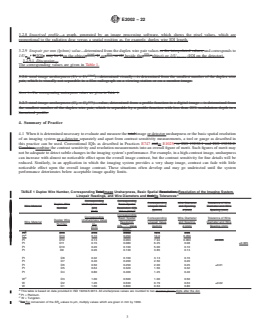
TABLE 1 Duplex Wire Number, Corresponding Image Unsharpness, Basic Spatial Resolution of the Imaging System, Linepair Readings,
A
and Wire Diameters and Its Tolerances
Corresponding
Corresponding
Basic Spatial Corresponding Wire Diameter Tolerance of Wire
Duplex Wire Unsharpness Value
Wire Material Resolution Linepair Value and Spacing, Diameter and Wire
Number U
Im image
SR Value (lp/mm) d (mm) Spacing (mm)
b
(mm)
D
(mm)
B
Pt D13 0.10 0.050 10.0 0.050
Pt D12 0.13 0.063 7.94 0.063
Pt D11 0.16 0.080 6.25 0.08 ±0.005
Pt D10 0.20 0.100 5.00 0.10
Pt D9 0.26 0.130 3.85 0.13
Pt D8 0.32 0.160 3.13 0.16
Pt D7 0.40 0.200 2.50 0.20
Pt D6 0.50 0.250 2.00 0.25 ±0.01
Pt D5 0.64 0.320 1.56 0.32
Pt D4 0.80 0.400 1.25 0.40
C
W D3 1.00 0.500 1.00 0.50
W D2 1.26 0.630 0.79 0.63 ±0.02
W D1 1.60 0.800 0.63 0.80
A
This table is based on data provided in ISO 19232-5:2013. All unsharpness values are rounded to two digits after the dot.
B
Pt = Platinum.
C
W = Tungsten.
D
For conversion of the SR -values to µm, multiply values which are given in mm by 1000.
b
E2002 − 22
system provides a very sharp image, contrast can fade with 5.2.1.1 Personnel Qualification—Personnel performing ex-
little noticeable effect upon the overall image contrast. These aminationstothispracticeshallbequalifiedinaccordancewith
situations often develop and may go undetected until the NAS410, EN 4179, ANSI/ASNT CP 189, ISO 9712, or
system performance deteriorates below acceptable image qual- SNT-TC-1A and certified by the employer or certifying agency
ity limits. asapplicable.Otherequivalentqualificationdocumentsmaybe
used when specified on the contract or purchase order. The
5. Significance and Use
applicablerevisionshallbethelatestunlessotherwisespecified
5.1 The gauge is intended to provide a means for measuring in the contractual agreement between parties.
5.2.1.2 If specified in the contractual agreement, NDT
image or detector unsharpness and basic spatial resolution of
the image or detector as independently as practicable from the agencies shall be qualified and evaluated as described in
Specification E543. The applicable edition of Specification
imaging system and contrast sensitivity limitations. When the
duplex gauge is positioned directly on the film or the digital E543 shall be specified in the contract.
detector and not on the test object, then the determined
6. Gauge Construction
unsharpness corresponds to the inherent film or detector
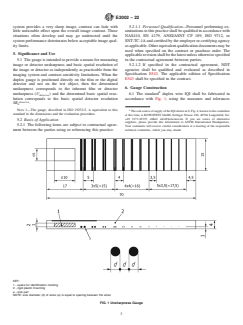
unsharpness (U ) and the determined basic spatial reso- 6.1 The standard duplex wire IQI shall be fabricated in
detector
lution corresponds to the basic spatial detector resolution
accordance with Fig. 1, using the measures and tolerances
detector
SR .
b
NOTE 1—The gauge, described in ISO 19232-5, is equivalent to this
ThesolesourceofsupplyoftheIQIshownin8,Fig.4,knowntothecommittee
standard in the dimensions and the evaluation procedure.
at this time, is KOWOTEST GmbH, Solinger Strasse 186, 40764 Langenfeld, fax:
+49 2173-22335, eMail: info@kowotest.de. If you are aware of alternative
5.2 Basis of Application
suppliers, please provide this information to ASTM International Headquarters.
5.2.1 The following items are subject to contractual agree-
Your comments will receive careful consideration at a meeting of the responsible
ment between the parties using or referencing this practice. technical committee, which you may attend.
KEY:
1 - space for identification marking
2 - rigid plastic mounting
a - wire pair
NOTE: wire diameter (d) of wires (a) is equal to spacing between the wires
FIG. 1 Unsharpness Gauge
E2002 − 22
NOTE 6—The visual determination of the first unresolved wire pair may
given in Table 1.
depend on the signal-to-noise ratio (SNR) of analog radioscopic systems,
NOTE 2—This gauge is identical to that described in ISO 19232-5 and
or may depend on the film system class and tube kV or used gamma
if necessary, ISO 19232-5 may be reviewed for further information.
source, respectively.
NOTE 3—ISO 19232-5 describes an equivalent IQI which is compatible
7.2.1.1 The resulting visual basic spatial resolution value
to the requirements of Fig. 1.
image detector
shall be documented as visual SR or visual SR
NOTE 4—If the IQI is located on the detector without object, the
b b
image detector image detector
determined SR value is identical with the SR value and the
-value or vSR or vSR . The resulting visual un-
b b
b b
image unsharpness U corresponds to the inherent detector unsharpness
Im sharpness value shall be documented as “visual U -value or
Im
U
detector.
visual U -value” or vU or vU .
detecor Im detector
6.2 The gauge shall consist of 13 elements. Each element
7.2.2 Evaluation of Digital Images With Profile
shall consist of a pair of wires with circular cross-section.
Function—If digital images are evaluated with a profile
Elements 1 through 3 are of tungsten material and elements 4
function, the element with the first duplex wire number
through 13 are of platinum material. The 13 elements are
(smallest number), of the duplex wire pair, which is separable
mounted in a rigid plastic holder. Gauges with more elements
by a profile function with less than 20 % modulation depth, is
than 13 can be used (see 8).These shall be used if unsharpness
taken as the limit of discernibility for digital radiography. See
values lower than 0.1 mm or basic spatial resolution values
Fig. 2. The profile function shall be evaluated from linearized
lower than 0.05 mm need to be determined (see also 7 and 8).
pixel profiles.
7.2.2.1 The duplex wire IQI shall be positioned at an angle
6.3 The gauge shall be identified by marking “ISO D (or
of approximately 2° to 5° towards the pixel line or column
ISO 19232-5) orASTM E2002 and a serial number.” Marking
orientation as shown in Fig. 2a in order to reduce aliasing
shall be performed by any suitable means. IQIs with the letters
effects in the digital images.
“EN D (or EN 462-5)” are considered to be identical to IQIs
7.2.2.2 Th
...
This document is not an ASTM standard and is intended only to provide the user of an ASTM standard an indication of what changes have been made to the previous version. Because
it may not be technically possible to adequately depict all changes accurately, ASTM recommends that users consult prior editions as appropriate. In all cases only the current version
of the standard as published by ASTM is to be considered the official document.
Designation: E2002 − 15 E2002 − 22
Standard Practice for
Determining Total Image Unsharpness and Basic Spatial
Resolution in Radiography and Radioscopy
This standard is issued under the fixed designation E2002; the number immediately following the designation indicates the year of
original adoption or, in the case of revision, the year of last revision. A number in parentheses indicates the year of last reapproval. A
superscript epsilon (´) indicates an editorial change since the last revision or reapproval.
1. Scope
1.1 This practice covers the design and basic use of a gauge used to determine the total image unsharpness and the basic spatial
resolution of film radiographs or of digital images taken with CR imaging plates, digital detector arrays, or radioscopic systems.
1.2 This practice is applicable to radiographic and radioscopic imaging systems utilizing X-ray and gamma ray radiation sources.
1.3 Units—The values stated in SI units are to be regarded as standard. No other units of measurement are included in this
standard.
1.4 The gauge described can be used effectively with tube voltages up to 600 kV. When using source voltages in the megavolt
range the results may not be completely satisfactory.
1.5 When using source voltages in the megavolt range, the results may not be completely satisfactory. The gauge may be used
in the MV range, preferably for characterization of detectors without object.
1.6 This standard does not purport to address all of the safety concerns, if any, associated with its use. It is the responsibility
of the user of this standard to establish appropriate safety safety, health, and healthenvironmental practices and determine the
applicability of regulatory limitations prior to use.
1.7 This international standard was developed in accordance with internationally recognized principles on standardization
established in the Decision on Principles for the Development of International Standards, Guides and Recommendations issued
by the World Trade Organization Technical Barriers to Trade (TBT) Committee.
2. Referenced Documents
2.1 ASTM Standards:
E543 Specification for Agencies Performing Nondestructive Testing
E747 Practice for Design, Manufacture and Material Grouping Classification of Wire Image Quality Indicators (IQI) Used for
Radiology
E1025 Practice for Design, Manufacture, and Material Grouping Classification of Hole-Type Image Quality Indicators (IQI)
Used for Radiography
E1316 Terminology for Nondestructive Examinations
This practice is under the jurisdiction of ASTM Committee E07 on Nondestructive Testing and is the direct responsibility of Subcommittee E07.01 on Radiology (X and
Gamma) Method.
Current edition approved July 1, 2015Feb. 1, 2022. Published September 2015March 2022. Originally approved in 1998. Last previous edition approved in 20092015 as
E2002 - 98 (2009).E2002 – 15. DOI: 10.1520/E2002-15.10.1520/E2002-22.
For referenced ASTM standards, visit the ASTM website, www.astm.org, or contact ASTM Customer Service at service@astm.org. For Annual Book of ASTM Standards
volume information, refer to the standard’s Document Summary page on the ASTM website.
Copyright © ASTM International, 100 Barr Harbor Drive, PO Box C700, West Conshohocken, PA 19428-2959. United States
E2002 − 22
E1815 Test Method for Classification of Film Systems for Industrial Radiography
2.2 ISO Standards
ISO 19232–19712 Non-destructive Testing—Image Quality of Radiographs—Part 1: Image Quality Indicators (Wire Type)—
Determination of Image Quality ValueNon-Destructive Testing—Qualification and Certification Of NDT Personnel
ISO 19232–2 Non-destructive Testing—Image Quality of Radiographs—Part 2: Image Quality Indicators (Step/Hole Type)—
Determination of Image Quality Value
ISO 19232–5 Non-destructive Testing—Image Quality of Radiographs—Part 5: Determination of Image Unsharpness Value
Using Duplex Wire Type Image Quality Indicators
ISO/IEC 17050–1 Conformity Assessment—Supplier’s Declaration of Conformity—Part 1: General Requirements
2.3 CEN Standard:Standards:
EN-462-5:1996 Nondestructive Testing—Image Quality of Radiographs—Part 5: Image Quality Indicators (Duplex Wire
Type)—Determination of Total Image Unsharpness Value
EN 4179 Aerospace Series — Qualification and Approval of Personnel for Non-destructive Testing
2.4 ANSI/ASNT Standards:
ANSI/ASNT CP 189 Standard for Qualification and Certification of Nondestructive Testing Personnel
SNT-TC-1A Personnel Qualification and Certification in Nondestructive Testing
2.5 AIA Standard:
NAS410 Certification & Qualification of Nondestructive Test Personnel
3. Terminology
3.1 Definitions—Definitions of terms applicable to this practice may be found in Terminology E1316.
3.2 Definitions of Terms Specific to This Standard:
detector
3.2.1 basic spatial resolution of the detector - visual (vSR )—determined from the smallest number of the duplex wire pair
b
that is visually not separable in a film radiograph on a viewing station or on a monitor image with the duplex wire IQI directly
on the detector with no object.
image
3.2.2 basic spatial image resolution (SRresolution of the imaging system - visual (vSR ) value—)—determined with the IQI
b
on the object (side closest to X-ray source) or beside the object from the smallest number of the duplex wire pair, which is not
separable by visual inspection or from the smallest number of the duplex wire pair with less than 20% modulation depth in a
visual
linearized profile, and corresponds tovisually not separable in a film radiograph on a viewing ⁄2 ·Ustation . U may be U or
T T T
20%
Uon . a monitor.
T
3.2.3 detector unsharpness – interpolated (iU )—two times the Basic Spatial Detector Resolution - interpolated (2 x
detector
detector
iSR ).
b
detector
3.2.4 detector unsharpness - visual (vU )—two times the Basic Spatial Detector Resolution - visual (2 x vSR ).
detector b
3.2.5 duplex wire type image quality indicator—duplex wire type IQI image quality indicator (IQI) specifically designed to assess
the total image unsharpness and basic spatial image resolution of a radiograph or a digital image and composed of a series of pairs
of wire elements made of high density metal.
image
3.2.6 interpolated basic spatial image resolution (iSRimage unsharpness - ) value— interpolated (iU )—determined from
b Im
the modulation values of different neighbored duplex wire pairs by interpolation,two times the Basic Spatial Resolution of the
20%image
imaging system - interpolated (2 x which corresponds to iSR ⁄2 · iU . ).
Tb
20%
3.2.7 interpolated total image unsharpness (iU- = iUvisual (vU )—value determined from a profile function in a digital
T TIm
image
image by interpolation – istwo times the Basic Spatial Resolution of the imaging system - visual (2 x determined vSR from
b
a linearized profile function and obtained by interpolation to 20% modulation depth from neighbored element modulations.).
Available from International Organization for Standardization (ISO), ISO Central Secretariat Chemin de Blandonnet 8, CP 401, 1214 Vernier, Geneva, Switzerland,
http://www.iso.org.
Available from British Standards Institute (BSI), 389 Chiswick High Rd., London W4 4AL, U.K., http://www.bsi-global.com.
Not an active standard, but still used as a reference in companies’ procedures.
Available from American Society for Nondestructive Testing (ASNT), P.O. Box 28518, 1711 Arlingate Ln., Columbus, OH 43228-0518, http://www.asnt.org.
Available from Aerospace Industries Association (AIA), 1000 Wilson Blvd., Suite 1700, Arlington, VA 22209, http://www.aia-aerospace.org.
E2002 − 22
3.2.8 linearized profile—a graph, generated by an image processing software, which shows the pixel values, which are
proportional to the radiation dose versus a spatial position as, for example, duplex wire IQI length.
3.2.9 linepair per mm (lp/mm) value—determined from the duplex wire pair values or the interpolated values, and corresponds to
visual 20% 20%
1/U . U(IQI may be Uon the object , U or , or iU beside the . object) or 1/U (IQI on the detector).
TIm T T T T detector
3.2.9.1 Discussion—
The corresponding values are given in Table 1.
visual
3.2.6 total image unsharpness (U = U )—determined visually—is determined from the smallest number of the duplex wire
T T
pair, which is visually not separable in a film radiograph on a viewing station or on a monitor image.
NOTE 1—The corresponding unsharpness values are given in Table 1.
20%
3.2.7 total image unsharpness (U = U )—value, determined from a profile function in a digital image – is determined from
T T
the smallest number of the duplex wire pair, which is separable by a profile function with less than 20% modulation depth in a
linearized profile.
4. Summary of Practice
4.1 When it is determined necessary to evaluate and measure the total image or detector unsharpness or the basic spatial resolution
of an imaging system or a detector separately and apart from contrast sensitivity measurements, a tool or gauge as described in
this practice can be used. Conventional IQIs as described in Practices E747 andor E1025, or ISO 19232-1 and ISO 19232-2.
Combine combine the contrast sensitivity and resolution measurements into an overall figure of merit. Such figures of merit may
not be adequate to detect subtle changes in the imaging system’s performance. For example, in a high-contrast image, unsharpness
can increase with almost no noticeable effect upon the overall image contrast, but the contrast sensitivity for fine details will be
reduced. Similarly, in an application in which the imaging system provides a very sharp image, contrast can fade with little
noticeable effect upon the overall image contrast. These situations often develop and may go undetected until the system
performance deteriorates below acceptable image quality limits.
TABLE 1 Duplex Wire Number, Corresponding TotalImage Unsharpness, Basic Spatial Resolution, Resolution of the Imaging System,
A
Linepair Readings, and Wire Diameters and theirIts Tolerances
Corresponding Corresponding
Corresponding Wire Diameter Tolerance of Wire
Duplex Wire Unsharpness Value Basic Spatial
Wire Material Linepair Value and Spacing, Diameter and Wire
Number (U ) Resolution SR
T b
(lp/mm) d (mm) Spacing (mm)
D
(mm) Value (mm)
Corresponding
Corresponding
Basic Spatial Corresponding Wire Diameter Tolerance of Wire
Duplex Wire Unsharpness Value
Wire Material Resolution Linepair Value and Spacing, Diameter and Wire
Number U
Im image
SR Value (lp/mm) d (mm) Spacing (mm)
b
(mm)
D
(mm)
B
Pt D13 0.10 0.050 10.0 0.05
B
Pt D13 0.10 0.050 10.0 0.050
Pt D12 0.13 0.063 7.94 0.063 ±0.005
Pt D11 0.16 0.080 6.25 0.08 ±0.005
Pt D10 0.20 0.100 5.00 0.10
Pt D9 0.26 0.130 3.85 0.13
Pt D8 0.32 0.160 3.13 0.16
Pt D7 0.40 0.200 2.50 0.20
Pt D6 0.50 0.250 2.00 0.25 ±0.01
Pt D5 0.64 0.320 1.56 0.32
Pt D4 0.80 0.400 1.25 0.40
C
W D3 1.00 0.500 1.00 0.50
W D2 1.26 0.630 0.79 0.63 ±0.02
W D1 1.60 0.800 0.63 0.80
A
This table is based on data provided in ISO 19232-5:2013. All unsharpness values are rounded to two decimal places.digits after the dot.
B
Pt = Platinum.
C
W = Tungsten.
D
For For conversion of the SR -values to μm, multiply values which are given in mm by 1000.
b
E2002 − 22
5. Significance and Use
5.1 The gauge is intended to provide a means for measuring total image or detector unsharpness and basic spatial image resolution
resolution of the image or detector as independently as practicable from the imaging system and contrast sensitivity limitations.
A similar description of the gauge’s construction may be found in ISO 19232-5. When the duplex gauge is positioned directly on
the film or the digital detector without any test object between them, the total image unsharpness or basic spatial image resolution
is equivalent and not on the test object, then the determined unsharpness corresponds to the inherent film or detector unsharpness
detector
(U(U ) and the determined basic spatial resolution corresponds to the basic spatial detector resolution (SRSR ).
idetector b
.Alternatively, line pair gauges with constant bar thickness of high attenuating material can be used to determine total image
unsharpness and basic spatial resolution of radiologic imaging systems. They may produce different results up to one wire pair as
compared to duplex wire measurements as described in this standard.
NOTE 1—The gauge, described in ISO 19232-5, is equivalent to this standard in the dimensions and the evaluation procedure.
5.2 Basis of Application
5.2.1 The following items are subject to contractual agreement between the parties using or referencing this practice.
5.2.1.1 Personnel Qualification—Personnel performing examinations to this practice shall be qualified in accordance with
NAS410, EN 4179, ANSI/ASNT CP 189, ISO 9712, or SNT-TC-1A and certified by the employer or certifying agency as
applicable. Other equivalent qualification documents may be used when specified on the contract or purchase order. The applicable
revision shall be the latest unless otherwise specified in the contractual agreement between parties.
5.2.1.2 If specified in the contractual agreement, NDT agencies shall be qualified and evaluated as described in Specification E543.
The applicable edition of Specification E543 shall be specified in the contract.
6. Gauge Construction
6.1 The standard duplex wire IQI shall be fabricated in accordance with Fig. 1, using the measures and tolerances given in Table
1. This gauge is identical to that described in ISO 19232-5: 2013, and if necessary, ISO 19232-5: 2013 may be reviewed for
additional information.
NOTE 2—This gauge is identical to that described in ISO 19232-5 and if necessary, ISO 19232-5 may be reviewed for further information.
NOTE 3—ISO 19232-5 describes an equivalent IQI which is compatible to the requirements of Fig. 1.
image detector
NOTE 4—If the IQI is located on the detector without object, the determined SR value is identical with the SR value and the image unsharpness
b b
U corresponds to the inherent detector unsharpness U
Im detector.
6.2 The gauge shall consist of 13 elements. Each element shall consist of a pair of wires with circular cross-section. Elements 1
through 3 are of tungsten material and elements 4 through 13 are of platinum material. The 13 elements are mounted in a rigid
plastic holder. Gauges with more elements than 13 can be used (see Section8). 8). These shall be used if unsharpness values lower
than 0.1 mm or basic spatial resolution values lower than 0.05 mm need to be determined (see Sectionsalso 7 and 8).8).
6.3 The gauge shall be identified by marking “ISO D (or ISO 19232-519232-5) or ASTM E2002)E2002 and a serial number.”
Marking shall be performed by any suitable means. IQIs with the letters “EN D (or EN 462-5)” are considered to be identical to
IQIs with the letters “ISO”ISO or “ASTM.”ASTM.
6.4 The gauge manufacturer shall provide a certificate of conformance with each gauge. Each IQI should be delivered with a
declaration of conformity according to ISO/IEC 1750-1.17050-1. For identification, the IQI should be numbered and marked by
the producer.
The sole source of supply of the IQI shown in 8, Fig. 4, known to the committee at this time, is KOWOTEST GmbH, Solinger Strasse 186, 40764 Langenfeld, fax: +49
2173-22335, eMail: info@kowotest.de. If you are aware of alternative suppliers, please provide this information to ASTM International Headquarters. Your comments will
receive careful consideration at a meeting of the responsible technical committee, which you may attend.
E2002 − 22
NOTE 1—Not to Scale.
1 space for identification marking
2 rigid plastic mounting
wire diameter (d) equals spacing between the wires
KEY:
1 - space for identification marking
2 - rigid plastic mounting
a - wire pair
NOTE: wire diameter (d) of wires (a) is equal to spacing between the wires
FIG. 1 Total Image Unsharpness Gauge (see ISO 19232-5: 2013)
7. Application
7.1 A radiograph shall be made or an image displayed on a monitor with the duplex wire placed on the source side of the item
being examined, or the gauge may be placed on a block representing the material and total thickness of the item being examined.
The duplex wire IQI should be aligned, as closely as possible, normal to the axis of the radiation beam.
detector
NOTE 2—If the IQI is placed directly on the detector, the inherent detector unsharpness and SR is measured.
b
detector
NOTE 5—If the IQI is placed directly on the detector, the inherent detector unsharpness U and the basic spatial resolution of the detector SR
detector b
is measured.
7.2 The evaluation of the duplex wire pair images areis based on a visual evaluation by an operator of films on a viewing station
or images on a monitor,monitor or by measurement with a profile function if digital images are available. The total image
...