

ASTM C1904-22
(Test Method)Standard Test Methods for Determination of the Effects of Biogenic Acidification on Concrete Antimicrobial Additives and/or Concrete Products
General Information
- Abstract
SIGNIFICANCE AND USE
4.1 As described in Guide C1894, the MIC of concrete is considered to be a three-stage process with the reduction in pH (Stage I) (for example, 12.5 > pH > 9-10), the establishment of biofilms which further lowers the pH (Stage II) (for example, 9-10 > pH > 4-6) and eventual deterioration due to biogenic acid exposure (Stage III) (for example,
4.2 The tests are performed in simulated exposure solutions containing well-controlled bacterial strains that are grown in the laboratory. These tests do not require an environmental chamber and are intended to be performed as benchtop tests in biosafety level 1 laboratory conditions. These tests are suitable for simulation of the Stage II and III of MIC because the pH range of the solution can be controlled within the ranges of each stage.
4.3 This standard provides three test methods.
4.3.1 Test Method A is suitable for assessing the efficacy of antimicrobial admixtures in delaying or preventing biogenic acidification in a nutrient-rich simulated wastewater exposure solution.
4.3.2 Test Method B is suitable for assessing the effectiveness of antimicrobial admixtures in a prescribed cementitious system (Option B1) or assessing the performance of different cementitious systems (Option B2) in delaying or preventing microbially-induced corrosion of concrete in the Stage II of MIC.
4.3.3 Test Method C is suitable for assessing the suitability of cementitious systems in delaying or preventing microbially-induced corrosion of concrete in the Stage III of MIC.
4.4 The results obtained by these test methods should serve as information to be used with Guide C1894 in, but not as the sole basis for, selection of a biologically-resistant material for a particular application. No attempt has been made to incorporate into these test methods all the various factors that may affect the performance of a material when subjected to actual service.
SCOPE
1.1 This standard presents test methods for the determination of the effects of biogenic acidification on concrete products and/or efficacy of antimicrobial products to resist microbially-induced corrosion (MIC) of concrete. In these tests, the biogenic acidification is achieved by sulfur-oxidizing bacteria (SOB) that can convert elemental sulfur or thiosulfate to sulfuric acid without the use of H2S gas.
1.2 This standard is referenced in the guideline document for MIC of concrete products. Guide C1894 provides guidance for microbially-induced corrosion of concrete products and an overview of where this test, and its options, can and should be used. This document is not intended to be a guideline document for MIC of concrete products.
1.3 This standard does not cover controlled breeding chamber tests, in which H2S gas is produced by bacterial activity and acidification is the result of the conversion of this H2S gas to sulfuric acid.
1.4 This standard does not cover chemical acid immersion tests, in which acidification is achieved by chemical sulfuric acid addition, not by bacterial activity. Testing protocols for chemical acid immersion are described in Test Methods C267 and C1898.
1.5 This standard does not cover tests that assess field exposure conditions or sewage pipe, concrete tank, or concrete riser network design.
1.6 This standard does not cover live trial tests where concrete coupons or other specimens are monitored in sewers.
1.7 The tests described in this standard should not be performed on concrete samples that have already been exposed to MIC conditions.
1.8 This standard does not cover concrete deterioration due to chemical sulfate attack, which is caused by the reaction of sulfate compounds that exist in wastewater with the hydration products of cement. Test methods for assessing sulfate attack are provided by Test Methods C452 and C1012/C1012M.
1.9 The values stated in SI units are to be regarded as standard. No other units of measurement are included in this ...
- Status
- Published
- Publication Date
- 31-Aug-2022
- Technical Committee
- C13 - Concrete Pipe
Buy Documents
ASTM C1904-22 - Standard Test Methods for Determination of the Effects of Biogenic Acidification on Concrete Antimicrobial Additives and/or Concrete Products
REDLINE ASTM C1904-22 - Standard Test Methods for Determination of the Effects of Biogenic Acidification on Concrete Antimicrobial Additives and/or Concrete Products
Overview
ASTM C1904-22: Standard Test Methods for Determination of the Effects of Biogenic Acidification on Concrete Antimicrobial Additives and/or Concrete Products guides laboratory procedures to assess the corrosion of concrete products caused by microbially-induced acidification (commonly known as MIC, or microbiologically influenced corrosion). This international standard establishes appropriate testing protocols to measure the effectiveness of antimicrobial additives or concrete systems in resisting biogenic sulfate attack under controlled conditions using sulfur-oxidizing bacteria.
These methods provide reliable, benchtop testing for manufacturers, researchers, and infrastructure stakeholders evaluating new concrete products, antimicrobial admixtures, or cementitious systems intended for use in corrosive wastewater, sewer, and similar environments.
Key Topics
- MIC (Microbially-Induced Corrosion) Process: The standard describes a three-stage process of MIC as referenced in ASTM Guide C1894:
- Stage I: Initial pH reduction (12.5 > pH > 9-10)
- Stage II: Biofilm establishment and further pH drop (9-10 > pH > 4-6)
- Stage III: Concrete deterioration due to acid exposure (pH < ~4)
- Test Environment: Uses laboratory-grown, well-controlled sulfur-oxidizing bacterial cultures to simulate biogenic acidification-no environmental chamber required, suitable for standard biosafety level 1 labs.
- Test Methods:
- Method A: Evaluates effectiveness of antimicrobial admixtures in preventing acidification in simulated wastewater.
- Method B: Assesses antimicrobial admixtures (B1) or different cementitious systems (B2) in resisting MIC during Stage II.
- Method C: Examines suitability of cementitious systems in resisting MIC during Stage III.
- Exclusions: The standard does not address field exposure, in-situ live trials, chemical immersion methods, or sulfate attack not caused by bacteria. Tests are only for concrete samples not previously exposed to MIC.
Applications
ASTM C1904-22 provides practical value for various industries and stakeholders:
- Manufacturers of Concrete Additives and Products: Quantitatively evaluate the performance of antimicrobial admixtures or biologically-resistant concrete mixes before market release.
- Wastewater and Sewer Infrastructure Design: Supports material selection for pipes, tanks, and other structures likely to experience MIC, contributing to longer-lasting, low-maintenance infrastructure.
- Research and Development: Offers universities and R&D labs a standard protocol for simulating and studying biogenic acidification, leading to innovation in durable concrete technologies.
- Quality Assurance and Compliance: Enables independent or third-party testing organizations to verify compliance with durability criteria specified for critical infrastructure projects.
- Specification Development: Results from these standard test methods can inform project specifications, but should be used alongside broader guidelines such as ASTM Guide C1894.
Testing helps stakeholders mitigate MIC risk and select optimal materials, reducing maintenance costs and enhancing the service life of concrete exposed to aggressive microbial environments.
Related Standards
Integration and reference to other standards ensure comprehensive assessment:
- ASTM C1894: Guide for Microbially Induced Corrosion of Concrete Products
- ASTM C267, C1898: Chemical resistance test methods (for acid immersion, not biogenic attack)
- ASTM C452, C1012/C1012M: Test methods for sulfate resistance (distinct from biogenic corrosion)
- ASTM C150, C595, C1600, C618, C989, C1240: Specifications for cements and supplementary materials
- ASTM C494, C260: Chemical and air-entraining admixtures
- ISO 20391-1: Cell counting methods
- EPA 375.4: Sulfate determination in water
ASTM C1904-22 is an important reference for laboratories and professionals involved in the durability assessment of concrete products, particularly where microbial acidification is a concern. By providing clear, reproducible methods, it supports the advancement of resilient infrastructure globally.
Relations
- Effective Date
- 01-Apr-2024
- Effective Date
- 01-Feb-2024
- Effective Date
- 01-May-2020
- Effective Date
- 15-Dec-2019
- Effective Date
- 15-Jun-2019
- Effective Date
- 01-Apr-2019
- Effective Date
- 01-Jan-2019
- Effective Date
- 15-Dec-2018
- Effective Date
- 15-Dec-2018
- Effective Date
- 01-Oct-2018
- Effective Date
- 01-Jul-2018
- Effective Date
- 01-Feb-2018
- Effective Date
- 01-Jan-2018
- Effective Date
- 01-Jan-2018
- Effective Date
- 01-Jan-2018
Buy Documents
ASTM C1904-22 - Standard Test Methods for Determination of the Effects of Biogenic Acidification on Concrete Antimicrobial Additives and/or Concrete Products
REDLINE ASTM C1904-22 - Standard Test Methods for Determination of the Effects of Biogenic Acidification on Concrete Antimicrobial Additives and/or Concrete Products
Get Certified
Connect with accredited certification bodies for this standard

DIBt (Deutsches Institut für Bautechnik)
German Institute for Building Technology.
DIN CERTCO
DIN Group product certification.

Aboma Certification B.V.
Specialized in construction, metal, and transport sectors.
Sponsored listings
Frequently Asked Questions
ASTM C1904-22 is a standard published by ASTM International. Its full title is "Standard Test Methods for Determination of the Effects of Biogenic Acidification on Concrete Antimicrobial Additives and/or Concrete Products". This standard covers: SIGNIFICANCE AND USE 4.1 As described in Guide C1894, the MIC of concrete is considered to be a three-stage process with the reduction in pH (Stage I) (for example, 12.5 > pH > 9-10), the establishment of biofilms which further lowers the pH (Stage II) (for example, 9-10 > pH > 4-6) and eventual deterioration due to biogenic acid exposure (Stage III) (for example, 4.2 The tests are performed in simulated exposure solutions containing well-controlled bacterial strains that are grown in the laboratory. These tests do not require an environmental chamber and are intended to be performed as benchtop tests in biosafety level 1 laboratory conditions. These tests are suitable for simulation of the Stage II and III of MIC because the pH range of the solution can be controlled within the ranges of each stage. 4.3 This standard provides three test methods. 4.3.1 Test Method A is suitable for assessing the efficacy of antimicrobial admixtures in delaying or preventing biogenic acidification in a nutrient-rich simulated wastewater exposure solution. 4.3.2 Test Method B is suitable for assessing the effectiveness of antimicrobial admixtures in a prescribed cementitious system (Option B1) or assessing the performance of different cementitious systems (Option B2) in delaying or preventing microbially-induced corrosion of concrete in the Stage II of MIC. 4.3.3 Test Method C is suitable for assessing the suitability of cementitious systems in delaying or preventing microbially-induced corrosion of concrete in the Stage III of MIC. 4.4 The results obtained by these test methods should serve as information to be used with Guide C1894 in, but not as the sole basis for, selection of a biologically-resistant material for a particular application. No attempt has been made to incorporate into these test methods all the various factors that may affect the performance of a material when subjected to actual service. SCOPE 1.1 This standard presents test methods for the determination of the effects of biogenic acidification on concrete products and/or efficacy of antimicrobial products to resist microbially-induced corrosion (MIC) of concrete. In these tests, the biogenic acidification is achieved by sulfur-oxidizing bacteria (SOB) that can convert elemental sulfur or thiosulfate to sulfuric acid without the use of H2S gas. 1.2 This standard is referenced in the guideline document for MIC of concrete products. Guide C1894 provides guidance for microbially-induced corrosion of concrete products and an overview of where this test, and its options, can and should be used. This document is not intended to be a guideline document for MIC of concrete products. 1.3 This standard does not cover controlled breeding chamber tests, in which H2S gas is produced by bacterial activity and acidification is the result of the conversion of this H2S gas to sulfuric acid. 1.4 This standard does not cover chemical acid immersion tests, in which acidification is achieved by chemical sulfuric acid addition, not by bacterial activity. Testing protocols for chemical acid immersion are described in Test Methods C267 and C1898. 1.5 This standard does not cover tests that assess field exposure conditions or sewage pipe, concrete tank, or concrete riser network design. 1.6 This standard does not cover live trial tests where concrete coupons or other specimens are monitored in sewers. 1.7 The tests described in this standard should not be performed on concrete samples that have already been exposed to MIC conditions. 1.8 This standard does not cover concrete deterioration due to chemical sulfate attack, which is caused by the reaction of sulfate compounds that exist in wastewater with the hydration products of cement. Test methods for assessing sulfate attack are provided by Test Methods C452 and C1012/C1012M. 1.9 The values stated in SI units are to be regarded as standard. No other units of measurement are included in this ...
SIGNIFICANCE AND USE 4.1 As described in Guide C1894, the MIC of concrete is considered to be a three-stage process with the reduction in pH (Stage I) (for example, 12.5 > pH > 9-10), the establishment of biofilms which further lowers the pH (Stage II) (for example, 9-10 > pH > 4-6) and eventual deterioration due to biogenic acid exposure (Stage III) (for example, 4.2 The tests are performed in simulated exposure solutions containing well-controlled bacterial strains that are grown in the laboratory. These tests do not require an environmental chamber and are intended to be performed as benchtop tests in biosafety level 1 laboratory conditions. These tests are suitable for simulation of the Stage II and III of MIC because the pH range of the solution can be controlled within the ranges of each stage. 4.3 This standard provides three test methods. 4.3.1 Test Method A is suitable for assessing the efficacy of antimicrobial admixtures in delaying or preventing biogenic acidification in a nutrient-rich simulated wastewater exposure solution. 4.3.2 Test Method B is suitable for assessing the effectiveness of antimicrobial admixtures in a prescribed cementitious system (Option B1) or assessing the performance of different cementitious systems (Option B2) in delaying or preventing microbially-induced corrosion of concrete in the Stage II of MIC. 4.3.3 Test Method C is suitable for assessing the suitability of cementitious systems in delaying or preventing microbially-induced corrosion of concrete in the Stage III of MIC. 4.4 The results obtained by these test methods should serve as information to be used with Guide C1894 in, but not as the sole basis for, selection of a biologically-resistant material for a particular application. No attempt has been made to incorporate into these test methods all the various factors that may affect the performance of a material when subjected to actual service. SCOPE 1.1 This standard presents test methods for the determination of the effects of biogenic acidification on concrete products and/or efficacy of antimicrobial products to resist microbially-induced corrosion (MIC) of concrete. In these tests, the biogenic acidification is achieved by sulfur-oxidizing bacteria (SOB) that can convert elemental sulfur or thiosulfate to sulfuric acid without the use of H2S gas. 1.2 This standard is referenced in the guideline document for MIC of concrete products. Guide C1894 provides guidance for microbially-induced corrosion of concrete products and an overview of where this test, and its options, can and should be used. This document is not intended to be a guideline document for MIC of concrete products. 1.3 This standard does not cover controlled breeding chamber tests, in which H2S gas is produced by bacterial activity and acidification is the result of the conversion of this H2S gas to sulfuric acid. 1.4 This standard does not cover chemical acid immersion tests, in which acidification is achieved by chemical sulfuric acid addition, not by bacterial activity. Testing protocols for chemical acid immersion are described in Test Methods C267 and C1898. 1.5 This standard does not cover tests that assess field exposure conditions or sewage pipe, concrete tank, or concrete riser network design. 1.6 This standard does not cover live trial tests where concrete coupons or other specimens are monitored in sewers. 1.7 The tests described in this standard should not be performed on concrete samples that have already been exposed to MIC conditions. 1.8 This standard does not cover concrete deterioration due to chemical sulfate attack, which is caused by the reaction of sulfate compounds that exist in wastewater with the hydration products of cement. Test methods for assessing sulfate attack are provided by Test Methods C452 and C1012/C1012M. 1.9 The values stated in SI units are to be regarded as standard. No other units of measurement are included in this ...
ASTM C1904-22 is classified under the following ICS (International Classification for Standards) categories: 91.100.30 - Concrete and concrete products. The ICS classification helps identify the subject area and facilitates finding related standards.
ASTM C1904-22 has the following relationships with other standards: It is inter standard links to ASTM C1012/C1012M-24, ASTM C989/C989M-24, ASTM C1898-20, ASTM C125-19a, ASTM C452-19, ASTM C150/C150M-19, ASTM C125-19, ASTM C1012/C1012M-18b, ASTM C1600/C1600M-18, ASTM C125-18b, ASTM C125-18a, ASTM C1012/C1012M-18a, ASTM C822-18, ASTM C125-18, ASTM C1012/C1012M-18. Understanding these relationships helps ensure you are using the most current and applicable version of the standard.
ASTM C1904-22 is available in PDF format for immediate download after purchase. The document can be added to your cart and obtained through the secure checkout process. Digital delivery ensures instant access to the complete standard document.
Standards Content (Sample)
This international standard was developed in accordance with internationally recognized principles on standardization established in the Decision on Principles for the
Development of International Standards, Guides and Recommendations issued by the World Trade Organization Technical Barriers to Trade (TBT) Committee.
Designation:C1904 −22
Standard Test Methods for
Determination of the Effects of Biogenic Acidification on
Concrete Antimicrobial Additives and/or Concrete Products
This standard is issued under the fixed designation C1904; the number immediately following the designation indicates the year of
original adoption or, in the case of revision, the year of last revision.Anumber in parentheses indicates the year of last reapproval.A
superscript epsilon (´) indicates an editorial change since the last revision or reapproval.
1. Scope sulfate compounds that exist in wastewater with the hydration
products of cement. Test methods for assessing sulfate attack
1.1 This standard presents test methods for the determina-
are provided by Test Methods C452 and C1012/C1012M.
tion of the effects of biogenic acidification on concrete prod-
ucts and/or efficacy of antimicrobial products to resist 1.9 The values stated in SI units are to be regarded as
microbially-induced corrosion (MIC) of concrete. In these standard. No other units of measurement are included in this
tests, the biogenic acidification is achieved by sulfur-oxidizing standard.
bacteria (SOB) that can convert elemental sulfur or thiosulfate
1.10 This standard does not purport to address all of the
to sulfuric acid without the use of H S gas.
2 safety concerns, if any, associated with its use. It is the
responsibility of the user of this standard to establish appro-
1.2 This standard is referenced in the guideline document
priate safety, health, and environmental practices and deter-
forMICofconcreteproducts.GuideC1894providesguidance
mine the applicability of regulatory limitations prior to use.
for microbially-induced corrosion of concrete products and an
1.11 This international standard was developed in accor-
overview of where this test, and its options, can and should be
dance with internationally recognized principles on standard-
used. This document is not intended to be a guideline docu-
ization established in the Decision on Principles for the
ment for MIC of concrete products.
Development of International Standards, Guides and Recom-
1.3 This standard does not cover controlled breeding cham-
mendations issued by the World Trade Organization Technical
bertests,inwhichH Sgasisproducedbybacterialactivityand
Barriers to Trade (TBT) Committee.
acidification is the result of the conversion of this H S gas to
sulfuric acid.
2. Referenced Documents
1.4 This standard does not cover chemical acid immersion
2.1 ASTM Standards:
tests, in which acidification is achieved by chemical sulfuric
C125Terminology Relating to Concrete and Concrete Ag-
acid addition, not by bacterial activity. Testing protocols for
gregates
chemical acid immersion are described in Test Methods C267
C150/C150MSpecification for Portland Cement
and C1898.
C192/C192MPracticeforMakingandCuringConcreteTest
Specimens in the Laboratory
1.5 This standard does not cover tests that assess field
C260/C260MSpecification for Air-Entraining Admixtures
exposure conditions or sewage pipe, concrete tank, or concrete
for Concrete
riser network design.
C267Test Methods for Chemical Resistance of Mortars,
1.6 This standard does not cover live trial tests where
Grouts,andMonolithicSurfacingsandPolymerConcretes
concrete coupons or other specimens are monitored in sewers.
C452Test Method for Potential Expansion of Portland-
1.7 The tests described in this standard should not be
Cement Mortars Exposed to Sulfate
performedonconcretesamplesthathavealreadybeenexposed
C494/C494MSpecification for Chemical Admixtures for
to MIC conditions.
Concrete
C595/C595MSpecification for Blended Hydraulic Cements
1.8 This standard does not cover concrete deterioration due
C618Specification for Coal Fly Ash and Raw or Calcined
to chemical sulfate attack, which is caused by the reaction of
Natural Pozzolan for Use in Concrete
C822Terminology Relating to Concrete Pipe and Related
Products
These test methods are under the jurisdiction of ASTM Committee C13 on
Concrete Pipe and is the direct responsibility of Subcommittee C13.03 on
DeterminingtheEffectsofBiogenicSulfuricAcidonConcretePipeandStructures. For referenced ASTM standards, visit the ASTM website, www.astm.org, or
Current edition approved Sept. 1, 2022. Published October 2022. Originally contact ASTM Customer Service at service@astm.org. For Annual Book of ASTM
approved in 1920. Last previous edition approved in 2020 as C1904–20. DOI: Standards volume information, refer to the standard’s Document Summary page on
10.1520/C1904-22. the ASTM website.
Copyright © ASTM International, 100 Barr Harbor Drive, PO Box C700, West Conshohocken, PA 19428-2959. United States
C1904−22
C989/C989MSpecification for Slag Cement for Use in the laboratory. These tests do not require an environmental
Concrete and Mortars chamber and are intended to be performed as benchtop tests in
C1012/C1012M Test Method for Length Change of biosafetylevel1laboratoryconditions.Thesetestsaresuitable
Hydraulic-Cement Mortars Exposed to a Sulfate Solution for simulation of the Stage II and III of MIC because the pH
C1017/C1017MSpecification for Chemical Admixtures for range of the solution can be controlled within the ranges of
Use in Producing Flowing Concrete (Withdrawn 2022) each stage.
C1157/C1157MPerformance Specification for Hydraulic
4.3 This standard provides three test methods.
Cement
4.3.1 Test MethodAis suitable for assessing the efficacy of
C1240Specification for Silica Fume Used in Cementitious
antimicrobial admixtures in delaying or preventing biogenic
Mixtures
acidification in a nutrient-rich simulated wastewater exposure
C1600/C1600MSpecification for Rapid Hardening Hydrau-
solution.
lic Cement
4.3.2 Test Method B is suitable for assessing the effective-
C1768/C1768MPracticeforAcceleratedCuringofConcrete
ness of antimicrobial admixtures in a prescribed cementitious
Cylinders
system (Option B1) or assessing the performance of different
C1894GuideforMicrobiallyInducedCorrosionofConcrete
cementitious systems (Option B2) in delaying or preventing
Products
microbially-induced corrosion of concrete in the Stage II of
C1898Test Methods for Determining the Chemical Resis-
MIC.
tance of Concrete Products to Acid Attack
4.3.3 Test Method C is suitable for assessing the suitability
D1193Specification for Reagent Water
ofcementitioussystemsindelayingorpreventingmicrobially-
2.2 Other Standards:
induced corrosion of concrete in the Stage III of MIC.
AASHTOTP119-20Standard Method ofTest for Electrical
Resistivity of a Concrete Cylinder Tested in a Uniaxial 4.4 The results obtained by these test methods should serve
Resistance Test as information to be used with Guide C1894 in, but not as the
ATCC (American Type Culture Collection) Bacterial Cul- sole basis for, selection of a biologically-resistant material for
ture Guide a particular application. No attempt has been made to incor-
ATCC Microbial Media Formulations porate into these test methods all the various factors that may
EPA 375.4Sulfate (Turbidimetric)
affect the performance of a material when subjected to actual
ISO 20391-1Biotechnology—Cell counting—Part 1: Gen- service.
eral guidance on cell counting methods
5. Apparatus
3. Terminology
5.1 Analytical Balance, accurate to at least 60.0001 g.
3.1 Definitions:
5.2 Controlled-Temperature Laboratory or Chamber—The
3.1.1 For definitions of terms used in this practice, refer to
laboratory or chamber shall maintain the temperature of 25 6
Terminology standards C125 and C822, and Guide C1894.
2°C.
4. Significance and Use
5.3 Autoclave, capable of maintaining 121-123°C, to be
4.1 As described in Guide C1894, the MIC of concrete is
used in sterilization and waste disposal stages (Note 1).
consideredtobeathree-stageprocesswiththereductioninpH
NOTE 1—Sterilization is important to avoid cross contamination and to
(StageI)(forexample,12.5>pH>9-10),theestablishmentof
dispose of waste properly. An autoclave shall be used to sterilize all
biofilms which further lowers the pH (Stage II) (for example,
media/solution and borosilicate glass media bottles used to promote
9-10 > pH > 4-6) and eventual deterioration due to biogenic
bacterial growth to prevent cross-contamination by other species. Steril-
acidexposure(StageIII)(forexample,<~4pH).Thisstandard ization shall be performed prior to commencement of any bacterial
inoculationortesting,andbeforewastedisposalafterthetests.Additional
providesstandardtestmethodstoassesstheeffectsofdifferent
guidance on sterilization and waste disposal is provided in Section 6.
stages of MIC on concrete products and efficacy of antimicro-
5.4 Incubator—capable of maintaining temperature in the
bial products used in or on concrete.
range of 23-30 6 2°C.
4.2 The tests are performed in simulated exposure solutions
containing well-controlled bacterial strains that are grown in 5.5 Orbital Shaker, capable of achieving at least 80 rpm.
5.6 Pipets and Syringes, 1 mL, 5 mL, and 10 mL.
The last approved version of this historical standard is referenced on
5.7 Automatic Pipetor, capable of delivering 10 mL 6 0.05
www.astm.org.
mL liquid.
Available from American Association of State Highway and Transportation
Officials (AASHTO), 444 N. Capitol St., NW, Suite 249, Washington, DC 20001,
5.8 Petri Dishes, sterile 15 mm by 100 mm.
http://www.transportation.org.
Available from American Type Culture Collection (ATCC) 10801 University
5.9 Inoculating Loop.
Boulevard Manassas, VA 20110, http://www.atcc.org
Available from U.S. Government Printing Office, Superintendent of
5.10 Borosilicate Glass Media Bottles,ofsufficientcapacity
Documents, 732 N. Capitol St., NW, Washington, DC 20401-0001, http://
to prepare nutrient media and bacteria cultures in all test
www.access.gpo.gov.
methods. These are also used to perform tests using the Test
Available fromAmerican National Standards Institute (ANSI), 25 W. 43rd St.,
4th Floor, New York, NY 10036, http://www.ansi.org. MethodA.Thesizeofthebottlesshouldbedecideddepending
C1904−22
on the size of the nutrient media and bacterial cultures to be Health Safety Guidelines (2). Laboratory personnel conduct-
prepared. Guidance is provided in the relevant sections. ing the testing must have proper training to perform standard
microbiological procedures. Personal protective equipment
5.11 Containers—The containers are used to immerse the
(PPE) should be worn during testing to prevent contamination
paste or mortar specimens used in Methods B and C in the
as required by BSL-1 criteria.
exposure media. They shall be chemically compatible with
sulfuric acid. Soda-lime glasses should not be used since they 6.2 Sterilize all apparatus and media prior to perform any
are prone to decalcification under acidic conditions. Polypro- bacterial inoculation to prevent cross-contamination.
pylene containers are suggested. Since most of the plastic 6.2.1 For autoclavable apparatus and liquid media (for
containersarenotautoclavable,othersterilizationmethods(for example, borosilicate glass, nutrient media, water), perform
example, 70% ethanol solution) must be used to sterilize the sterilization by autoclaving at 121-123°C for a minimum of 15
container. The size of the bottles should be decided depending minutes.
on the size of the nutrient media and bacterial cultures to be 6.2.2 For non-autoclavable materials and apparatus, (for
prepared.Guidanceisprovidedintherelevantsectionsregard- example,polypropylenecontainers,pasteormortarspecimens,
ing the size of the containers depending on the number of pH electrode, calcium ISE), use other sterilization/disinfection
samples to be tested. methods, such as rinsing with 70% ethanol solution.
6.2.3 To prevent cross contamination of simultaneously
5.12 Mixer, Bowl, and Paddle, vacuum unit will minimize
tested cells, particularly the cells without bacterial inoculation
entrapped air formation and dust.
(for example, those used on control tests without biogenic
5.13 Diamond Blade Wet-Saw, to cut cylindrical paste or
acidification),itisrecommendedthatseparatesetsofapparatus
mortar specimens into 2.65 6 0.15 mm thick disks.
be used for cells with and without bacterial cultures.
5.14 Flat Surface pH Electrode, with a precision of 60.02
6.3 During testing, care must be taken to prevent contami-
pH.
nation of the laboratory spaces, apparatus and supplies by
5.15 pH Electrode, with a precision of 60.02 pH. proper sterilization and disinfection. After completion of the
tests, sterilize all apparatus and supplies coming into contact
5.16 Calcium Combination Ion Selective Electrode (ISE),
with the bacteria media and all liquid waste, by autoclaving at
which can detect 0.15 6 0.05 mg/L to 40,000 6 1000 mg/L
+2 121-123°Cforaminimumof15minutes.Sterilizedwastemust
Ca , and can work in a pH range from 2.5 to 11.
be disposed in accordance with related regulations mandated
5.17 Multiparameter Meter, compatible with pH electrodes
by related federal, state and local agencies.
and ISE.
7. Nutrient Media
5.18 Loading Machine,whichisequippedwiththe-Ball-on-
7.1 The nutrient media (NM) is used to promote bacterial
Three-Ball (B3B) test apparatus (Fig. 1) (1) and a loading
system that can provide the prescribed capacity and rates of growth in all test methods.
7.1.1 In Test Method A, the NM represents the simulated
loading. It shall have been verified to have an accuracy of 1.0
wastewater solution.
%, or better, within twelve months of the time prior to use.
7.1.2 In Test Method B, the NM is used as the exposure
5.19 Digital Caliper, with a precision of 60.02 mm.
solution for the paste or mortar specimens.
6. Sterilization and Disposal of Waste
7.1.3 In Test Method C, the NM is inoculated with the
bacterialculturestoprepareabiogenicsulfuricacidsolutionas
6.1 Bacteria used in the tests covered by this standard are
described in 8.2.2.
classified as biosafety level 1 (BSL-1) based on U.S. Public
The boldface numbers in parentheses refer to a list of references at the end of 9
It is the responsibility of the testing facility to comply with biosafety
this standard.
regulations for their own country.
FIG. 1Schematic Sketch of a B3B Test Apparatus
C1904−22
7.2 Prepare the NM by adding the following compounds to (SL) 1, 2 and 3, as described in 8.2.3, 8.2.4, and 8.2.5,
SpecificationD1193Type2de-ionizedwater:10g/LNa S O , respectively (Note 4).
2 2 3
0.25 g/L CaCl , 3 g/L KH PO , 3 g/L K HPO , 0.8 g/L
2 2 4 2 4
NOTE 4—Regarding the order of testing that a lab may want to use if
MgCl ×6H O, 0.1 g/L(NH ) SO , and 5 mg/LFeSO where
2 2 4 2 4 4
tests cannot be run simultaneously, if an antimicrobial product shows
Specification D1193 Type 2 de-ionized water is to be used as
efficacyinSL3,itdoesnotneedtobetestedforotherseveritylevels.More
the solvent.
information is provided in Section 10.
7.3 It is normal for the NM to have a cloudy appearance, as
8.2.3 Severity Level 1 (SL1) is described as the environ-
it will contain some undissolved solids. The NM should be
ment with reduced bacterial population by dilution and low
stirredbeforeitistransferredtothetestcelltohomogenizethe
bacterial activity due to keeping them in nutrient-deficient
suspended solids in the liquid phase.
mediaforanextendedperiod.Inthesetests,freshNMshallbe
acidifiedbyactivelygrowingbacteriauntilthepHdropsbelow
7.4 Measured pH of the NM should be 6.55 6 0.05.
3. Then, the acidified media shall be maintained in static
7.5 The amount of prepared NM depends on the number of
condition in closed bottles for six weeks. During this period,
tests to be performed. The ratio between the NM volume and
the bacterial population and activity are expected to decrease
the total surface area of the paste or mortar specimens during
due to diminishing nutrient concentration. After six weeks of
3 2
tests shall be 7.0 6 0.5 cm /cm .This corresponds to approxi-
waiting period, the pH of the bacterial suspension shall be
mately 300 mL of NM per paste or mortar specimen (disc) as
measured.ThesuspensionshallthenbedilutedusingfreshNM
described in Section 8 (Note 2).
to obtain several suspensions with specific pH values to
NOTE 2—For seven specimens and solutions, 2500 mLof NM needs to
determinethepHrangewithinwhichtheantimicrobialproduct
be prepared.
is effective. Soon after the preparation of these solutions,
7.6 Additional NM is required for the conditioning of the testing should start (Note 5).
specimens as described in 9.3.
NOTE 5— It is recommended to prepare five to ten diluted solutions
7.7 To avoid possible bacterial and/or fungal contamination
within the pH range from 6.5 to 2 (for example, 6.25, 6.00, 5.75, 5.10,
4.10,3.00,and2.00).Theincreasednumberofsolutionswithinthisrange
duringextendedstorageperiods,theNMshouldbepreparedas
will allow more accurate determination of effective pH range of the
needed.
antimicrobial product.
8. Bacterial Cultures and Exposure Media 8.2.4 Severity Level 2 (SL2) is described as the environ-
ment with reduced bacterial population by dilution and me-
8.1 The methods involve the use of bacteria that can
dium bacterial activity due to keeping them in nutrient-
consume elemental sulfur or thiosulfate, instead of H S, to
deficient media for a period shorter than the waiting period
acidify biogenically the exposure environment for concrete.
specific for SL1. To prepare this environment, fresh NM shall
These bacteria can be cultivated, preserved and reproduced as
be acidified with actively growing bacteria until the pH drops
needed using conventional microbiological techniques such as
below3.Theacidifiedmediashallbekeptinthisconditionfor
agar plates, agar slants, and glycerol stock strains. Follow
three weeks. During this period, the bacterial population and
standard microbiological techniques to prepare all bacteria
activity is expected to decrease due to diminishing nutrient
cultures described below.
concentration.After the waiting period, the pH of the bacterial
8.2 Test Method A—This method uses Halothiobacillus
suspension shall be measured. The suspension shall be diluted
Neapolitanus (ATCC 23641) and Acidithiobacillus Thiooxi-
by fresh NM to obtain several bacterial suspensions with
dans (ATCC 19703) as seed for biogenic sulfuric acid produc-
specific pH values (see Note 5). Soon after the preparation of
tion.H.Neapolitanusisaneutrophilicsulfur-oxidizingbacteria
these solutions, testing should start.
(NSOB); and A. Thiooxidans is an acidophilic sulfur-oxidizing
8.2.5 Severity Level 3 (SL3) is the environment that is
bacteria (ASOB).
expected to have high bacterial population and activity. These
8.2.1 Cultivate H. Neapolitanus in the ATCC Medium 290
tests shall be performed on media acidified by highly active
S6 for Thiobacilli as described by theATCC Microbial Media
bacterialculturesinfreshNM.Atotalof5%v/voftheculture
Formulations guide. Cultivate A. Thiooxidans in the ATCC
of H. Neapolitanusandatotalof5%v/vofthepurecultureof
Medium 125 for Thiobacilli as described by theATCC Micro-
A. Thiooxidans at their exponential growth rate shall be
bial Media Formulations guide. The bacterial inoculation
injectedtofreshNM(Note6).ThepHoftheenvironmentshall
cultures are ready for the preparation of biogenic sulfuric acid
notbemodifiedthroughdilutionofalreadyacidifiedmedia;the
whentheyreachtheirexponentialgrowthratesasperbyATCC
bacteria are expected to reduce the pH naturally by biogenic
290S6andATCC125.Recordtheaveragelivecolonyforming
acidification. The testing should start when target pH levels
units per milliliter (cfu/mL) of both bacterial cultures by
(see Note 5), as decided by the tester, are reached.
performing a viable cell count (ISO 20391-1) (Note 3).
NOTE6—Asanexample,5mLofpurebacterialculturewillbeinjected
NOTE 3—For bacterial counting, a solid growth media that is suitable
into 100 mL of fresh NM.
for non-fastidious bacteria (for example, TSA agar) can be used.
8.2.2 In order to test the effect of bacterial population- 8.3 Test Method B—This method uses Halothiobacillus
Neapolitanus (ATCC 23641) to inoculate paste or mortar
activity,threedifferentacidificationenvironmentswithvarious
pH levels are created, which are designated as Severity Levels specimens. H. Neapolitanus is a neutrophilic sulfur-oxidizing
C1904−22
bacteria (NSOB) and can be cultivated, preserved and repro- fineness, and specific gravity shall be part of the report. The
duced as needed using conventional microbiological tech- water-to-cementitiousmaterialratio(w/cm)ofthepastewillbe
niques such as agar plates, agar slants, and glycerol stock 0.42.
strains. 9.2.2 In Option B2, hardened cement paste or mortar
8.3.1 CultivatethebacteriaintheATCCMedium290S6for specimens will be prepared following the required mixture
proportions. The cementitious system may contain Specifica-
Thiobacilli as described by the ATCC Microbial Media For-
mulations guide. The bacterial inoculation cultures are ready tionC150/C150Mportlandcements(non-airentrained),Speci-
fication C595/C595M blended portland cements, or C1600/
for the inoculation of paste or mortar specimen when they
reach their exponential growth rate. Record the average live C1600M rapid hardening hydraulic cements. Additionally,
supplementary cementitious materials (SCM) may be added to
colony forming units per milliliter (cfu/mL) of the bacterial
inoculation cultures by performing a viable cell count (ISO non-air entrained portland cements following Specification
C150/C150M.These SCM include Specification C618 coal fly
20391-1).
ashandrawandcalcinednaturalpozzolansforuseinconcrete,
8.4 Test Method C—This method uses Halothiobacillus
SpecificationC989/C989Mslagcementforuseinconcreteand
Neapolitanus (ATCC 23641) and Acidithiobacillus Thiooxi-
mortars, and C1240 silica fume used in cementitious mixtures.
dans (ATCC 19703) as seed for biogenic sulfuric acid produc-
MaterialspecificationreportsforallcementsandSCMshallbe
tion.H.Neapolitanusisaneutrophilicsulfur-oxidizingbacteria
part of the reporting process. Specimens may also contain
(NSOB); and A. Thiooxidans is an acidophilic sulfur-oxidizing
admixtures including those that are intended to increase the
bacteria (ASOB).
resistance of concrete to MIC. The type, dosage and applica-
8.4.1 Cultivate H. Neapolitanus in the ATCC Medium 290
tion procedure must be specified as part of the reporting
S6 for Thiobacilli as described by theATCC Microbial Media
process (Specifications C260/C260M, C494/C494M, and
Formulations guide. Cultivate A. Thiooxidans in the ATCC
C1017/C1017M). Available material specification reports for
Medium 125 for Thiobacilli as described by theATCC Micro-
the admixtures should be provided.
bial Media Formulations guide. The bacterial inoculation
9.2.3 Mixing shall be performed using a mixer with a 500
cultures are ready for the preparation of biogenic sulfuric acid
mL (or greater) bowl. If a vacuum mixer is used, it shall be
whentheyreachtheirexponentialgrowthratesasperbyATCC
operated at 400 rpm under 70% vacuum.
290 S6 and ATCC 125 (see Note 3). Record the average live
9.2.4 If applicable, add the antimicrobial admixture to the
colony forming units per milliliter (cfu/mL) of both bacterial
required amount of Specification D1193 Type 2 de-ionized
cultures by performing a viable cell count (ISO 20391-1).
water at the desired dosage as specified by the product’s
8.4.2 At their estimated exponential growth rate, inoculate
manufacturer. Mix for 30 seconds.
the NM with 5% (v/v) H. Neapolitanus and A. Thiooxidans
9.2.5 Add the required amount of cement (and fine aggre-
(50 mL of bacteria in the growth media per 1 L of NM) to
gate for mortar specimens) and mix for 90 seconds. Scrape the
obtain biogenic sulfuric acid. Monitor pH of the inoculated
inner surfaces of the mixing bowl and the mixing blade using
media. The solution is ready for testing when the pH = 2 6
a spatula. Mix for an additional 90 seconds or until mixture
0.05.
appears homogeneous.
9.2.6 Castthemixedfreshpasteormortarinplasticcylinder
9. Test Specimens
molds with 50.8 mm diameter and 101.6 mm height. Follow
9.1 Test Method A—This test method examines the effec- casting procedure described in Practice C192/C192M.
tivenessoftheantimicrobialproductswithoutthecementitious 9.2.7 Seal-cure the specimens at 23 62°C for 28 days
matrix.Thedosageofthetestedantimicrobialproductcouldbe following the procedure described in AASHTO TP 119.
based on manufacturer’s recommendations or decided by the
9.2.8 After curing, cut the specimens into 2.65 60.15 mm
tester based on other consideration.
thick disks using a diamond blade wet saw. Only the disks
obtained from the middle 60 mm part shall be used for testing.
9.2 Test Method B—This test method is performed on paste
Discard the cut ends of specimens.
or mortar samples and examines either the effectiveness of
9.2.9 Visually inspect the specimens to discard the ones
cementitious materials for resisting Stage II MIC deterioration
withvisiblecrackingthatwascausedbythesawingprocess,or
or the effectiveness of antimicrobial additives for resisting
voids, defects, and heterogeneities that might be artifacts of
Stage II MIC deterioration in cementitious materials. This
poor mixing and consolidation during casting.
method has two options. Option B1 is used to determine the
suitability of antimicrobial admixtures in delaying or prevent- 9.3 Test Method C—Hardened cement paste or mortar
ing microbially-induced corrosion of cementitious systems in
specimens will be prepared following the required mixture
the Stage II of MIC. Option B2 is used to determine the
proportions.
resistance of a cementitious system in delaying or preventing
9.3.1 The cementitious system may contain Specification
microbially-induced corrosion of concrete in the Stage II of
C150/C150M portland cements (non-air entrained), Specifica-
MIC.
tion C595/C595M blended port
...
This document is not an ASTM standard and is intended only to provide the user of an ASTM standard an indication of what changes have been made to the previous version. Because
it may not be technically possible to adequately depict all changes accurately, ASTM recommends that users consult prior editions as appropriate. In all cases only the current version
of the standard as published by ASTM is to be considered the official document.
Designation: C1904 − 20 C1904 − 22
Standard Test Methods for
Determination of the Effects of Biogenic Acidification on
Concrete Antimicrobial Additives and/or Concrete Products
This standard is issued under the fixed designation C1904; the number immediately following the designation indicates the year of
original adoption or, in the case of revision, the year of last revision. A number in parentheses indicates the year of last reapproval. A
superscript epsilon (´) indicates an editorial change since the last revision or reapproval.
1. Scope
1.1 This standard presents test methods for the determination of the effects of biogenic acidification on concrete products and/or
efficacy of antimicrobial products to resist microbially-induced corrosion (MIC) of concrete. In these tests, the biogenic
acidification is achieved by sulfur-oxidizing bacteria (SOB) that can convert elemental sulfur or thiosulfate to sulfuric acid without
the use of H S gas.
1.2 This standard is referenced in the guideline document for MIC of concrete products. Guide C1894 provides guidance for
microbially-induced corrosion of concrete products and an overview of where this test, and its options, can and should be used.
This document is not intended to be a guideline document for MIC of concrete products.
1.3 This standard does not cover controlled breeding chamber tests, in which H S gas is produced by bacterial activity and
acidification is the result of the conversion of this H S gas to sulfuric acid.
1.4 This standard does not cover chemical acid immersion tests, in which acidification is achieved by chemical sulfuric acid
addition, not by bacterial activity. Testing protocols for chemical acid immersion are described in Test Methods C267 and C1898.
1.5 This standard does not cover tests that assess field exposure conditions or sewage pipe, concrete tank, or concrete riser network
design.
1.6 This standard does not cover live trial tests where concrete coupons or other specimens are monitored in sewers.
1.7 The tests described in this standard should not be performed on concrete samples that have already been exposed to MIC
conditions.
1.8 This standard does not cover concrete deterioration due to chemical sulfate attack, which is caused by the reaction of sulfate
compounds that exist in wastewater with the hydration products of cement. Test methods for assessing sulfate attack are provided
by Test Methods C452 and C1012/C1012M.
1.9 The values stated in SI units are to be regarded as standard. No other units of measurement are included in this standard.
These test methods are under the jurisdiction of ASTM Committee C13 on Concrete Pipe and is the direct responsibility of Subcommittee C13.03 on Determining the
Effects of Biogenic Sulfuric Acid on Concrete Pipe and Structures.
Current edition approved Oct. 1, 2020Sept. 1, 2022. Published October 2020October 2022. Originally approved in 1920. Last previous edition approved in 2020 as
C1904 – 20. DOI: 10.1520/C1904_C1904M-2010.1520/C1904-22.
Copyright © ASTM International, 100 Barr Harbor Drive, PO Box C700, West Conshohocken, PA 19428-2959. United States
C1904 − 22
1.10 This standard does not purport to address all of the safety concerns, if any, associated with its use. It is the responsibility
of the user of this standard to establish appropriate safety, health, and environmental practices and determine the applicability of
regulatory limitations prior to use.
1.11 This international standard was developed in accordance with internationally recognized principles on standardization
established in the Decision on Principles for the Development of International Standards, Guides and Recommendations issued
by the World Trade Organization Technical Barriers to Trade (TBT) Committee.
2. Referenced Documents
2.1 ASTM Standards:
C125 Terminology Relating to Concrete and Concrete Aggregates
C150/C150M Specification for Portland Cement
C192/C192M Practice for Making and Curing Concrete Test Specimens in the Laboratory
C260/C260M Specification for Air-Entraining Admixtures for Concrete
C267 Test Methods for Chemical Resistance of Mortars, Grouts, and Monolithic Surfacings and Polymer Concretes
C452 Test Method for Potential Expansion of Portland-Cement Mortars Exposed to Sulfate
C494/C494M Specification for Chemical Admixtures for Concrete
C595/C595M Specification for Blended Hydraulic Cements
C618 Specification for Coal Fly Ash and Raw or Calcined Natural Pozzolan for Use in Concrete
C822 Terminology Relating to Concrete Pipe and Related Products
C989/C989M Specification for Slag Cement for Use in Concrete and Mortars
C1012/C1012M Test Method for Length Change of Hydraulic-Cement Mortars Exposed to a Sulfate Solution
C1017/C1017M Specification for Chemical Admixtures for Use in Producing Flowing Concrete (Withdrawn 2022)
C1157/C1157M Performance Specification for Hydraulic Cement
C1240 Specification for Silica Fume Used in Cementitious Mixtures
C1600/C1600M Specification for Rapid Hardening Hydraulic Cement
C1768/C1768M Practice for Accelerated Curing of Concrete Cylinders
C1894 Guide for Microbially Induced Corrosion of Concrete Products
C1898 Test Methods for Determining the Chemical Resistance of Concrete Products to Acid Attack
D1193 Specification for Reagent Water
2.2 Other Standards:
AASHTO TP 119-20 Standard Method of Test for Electrical Resistivity of a Concrete Cylinder Tested in a Uniaxial Resistance
Test
ATCC (American Type Culture Collection) Bacterial Culture Guide
ATCC Microbial Media Formulations
EPA 375.4 Sulfate (Turbidimetric)
ISO 20391-1 Biotechnology—Cell counting—Part 1: General guidance on cell counting methods
3. Terminology
3.1 Definitions:
3.1.1 For definitions of terms used in this practice, refer to Terminology standards C125 and C822, and Guide C1894.
4. Significance and Use
4.1 As described in Guide C1894, the MIC of concrete is considered to be a three-stage process with the reduction in pH (Stage
I) (for example, 12.5 > pH > 9-10), the establishment of biofilms which further lowers the pH (Stage II) (for example, 9-10 > pH
> 4-6) and eventual deterioration due to biogenic acid exposure (Stage III) (for example, < ~4 pH). This standard provides standard
test methods to assess the effects of different stages of MIC on concrete products and efficacy of antimicrobial products used in
or on concrete.
For referenced ASTM standards, visit the ASTM website, www.astm.org, or contact ASTM Customer Service at service@astm.org. For Annual Book of ASTM Standards
volume information, refer to the standard’s Document Summary page on the ASTM website.
The last approved version of this historical standard is referenced on www.astm.org.
Available from American Association of State Highway and Transportation Officials (AASHTO), 444 N. Capitol St., NW, Suite 249, Washington, DC 20001,
http://www.transportation.org.
Available from American Type Culture Collection (ATCC) 10801 University Boulevard Manassas, VA 20110, http://www.atcc.org
Available from U.S. Government Printing Office, Superintendent of Documents, 732 N. Capitol St., NW, Washington, DC 20401-0001, http://www.access.gpo.gov.
Available from American National Standards Institute (ANSI), 25 W. 43rd St., 4th Floor, New York, NY 10036, http://www.ansi.org.
C1904 − 22
4.2 The tests are performed in simulated exposure solutions containing well-controlled bacterial strains that are grown in the
laboratory. These tests do not require an environmental chamber and are intended to be performed as benchtop tests in biosafety
level 1 laboratory conditions. These tests are suitable for simulation of the Stage II and III of MIC because the pH range of the
solution can be controlled within the ranges of each stage.
4.3 This standard provides three test methods.
4.3.1 Test Method A is suitable for assessing the efficacy of antimicrobial admixtures in delaying or preventing biogenic
acidification in a nutrient-rich simulated wastewater exposure solution.
4.3.2 Test Method B is suitable for assessing the effectiveness of antimicrobial admixtures in a prescribed cementitious system
(Option B1) or assessing the performance of different cementitious systems (Option B2) in delaying or preventing microbially-
induced corrosion of concrete in the Stage II of MIC.
4.3.3 Test Method C is suitable for assessing the suitability of cementitious systems in delaying or preventing microbially-induced
corrosion of concrete in the Stage III of MIC.
4.4 The results obtained by these test methods should serve as information to be used with Guide C1894 in, but not as the sole
basis for, selection of a biologically-resistant material for a particular application. No attempt has been made to incorporate into
these test methods all the various factors that may affect the performance of a material when subjected to actual service.
5. Apparatus
5.1 Analytical Balance, accurate to at least 60.0001 g.
5.2 Controlled-Temperature Laboratory or Chamber—The laboratory or chamber shall maintain the temperature of 25 6 2°C.
5.3 Autoclave, capable of maintaining 121-123°C, to be used in sterilization and waste disposal stages (Note 1).
NOTE 1—Sterilization is important to avoid cross contamination and to dispose of waste properly. An autoclave shall be used to sterilize all media/solution
and borosilicate glass media bottles used to promote bacterial growth to prevent cross-contamination by other species. Sterilization shall be performed
prior to commencement of any bacterial inoculation or testing, and before waste disposal after the tests. Additional guidance on sterilization and waste
disposal is provided in Section 6.
5.4 Incubator—capable of maintaining temperature in the range of 23-30 6 2°C.
5.5 Orbital Shaker, capable of achieving at least 80 rpm.
5.6 Pipets and Syringes, 1 mL, 5 mL, and 10 mL.
5.7 Automatic Pipetor, capable of delivering 10 mL 6 0.05 mL liquid.
5.8 Petri Dishes, sterile 15 mm by 100 mm.
5.9 Inoculating Loop.
5.10 Borosilicate Glass Media Bottles, of sufficient capacity to prepare nutrient media and bacteria cultures in all test methods.
These are also used to perform tests using the Test Method A. The size of the bottles should be decided depending on the size of
the nutrient media and bacterial cultures to be prepared. Guidance is provided in the relevant sections.
5.11 Containers—The containers are used to immerse the paste or mortar specimens used in Methods B and C in the exposure
media. They shall be chemically compatible with sulfuric acid. Soda-lime glasses should not be used since they are prone to
decalcification under acidic conditions. Polypropylene containers are suggested. Since most of the plastic containers are not
C1904 − 22
autoclavable, other sterilization methods (for example, 70 % ethanol solution) must be used to sterilize the container. The size of
the bottles should be decided depending on the size of the nutrient media and bacterial cultures to be prepared. Guidance is
provided in the relevant sections regarding the size of the containers depending on the number of samples to be tested.
5.12 Vacuum Mixer, Bowl, and Paddle, to vacuum unit will minimize entrapped air formation.formation and dust.
5.13 Diamond Blade Wet-Saw, to cut cylindrical paste or mortar specimens into 2.65 6 0.15 mm thick disks.
5.14 Flat Surface pH Electrode, with a precision of 60.02 pH.
5.15 pH Electrode, with a precision of 60.02 pH.
+2
5.16 Calcium Combination Ion Selective Electrode (ISE), which can detect 0.15 6 0.05 mg/L to 40,000 6 1000 mg/L Ca , and
can work in a pH range from 2.5 to 11.
5.17 Multiparameter Meter, compatible with pH electrodes and ISE.
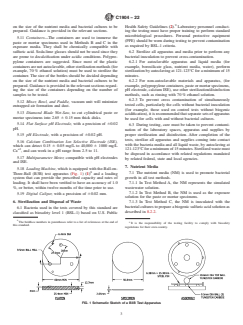
5.18 Loading Machine, which is equipped with the-Ball-on-Three-Ball (B3B) test apparatus (Fig. 1) (1) and a loading system that
can provide the prescribed capacity and rates of loading. It shall have been verified to have an accuracy of 1.0 %, or better, within
twelve months of the time prior to use.
5.19 Digital Caliper, with a precision of 60.02 mm.
6. Sterilization and Disposal of Waste
6.1 Bacteria used in the tests covered by this standard are classified as biosafety level 1 (BSL-1) based on U.S. Public Health
Safety Guidelines (2). Laboratory personnel conducting the testing must have proper training to perform standard microbiological
procedures. Personal protective equipment (PPE) should be worn during testing to prevent contamination as required by BSL-1
criteria.
6.2 Sterilize all apparatus and media prior to perform any bacterial inoculation to prevent cross-contamination.
6.2.1 For autoclavable apparatus and liquid media (for example, borosilicate glass, nutrient media, water), perform sterilization
by autoclaving at 121-123°C for a minimum of 15 minutes.
FIG. 1 Schematic Sketch of a B3B Test Apparatus
The boldface numbers in parentheses refer to a list of references at the end of this standard.
It is the responsibility of the testing facility to comply with biosafety regulations for their own country.
C1904 − 22
6.2.2 For non-autoclavable materials and apparatus, (for example, polypropylene containers, paste or mortar specimens, pH
electrode, calcium ISE), use other sterilization/disinfection methods, such as rinsing with 70 % ethanol solution.
6.2.3 To prevent cross contamination of simultaneously tested cells, particularly the cells without bacterial inoculation (for
example, those used on control tests without biogenic acidification), it is recommended that separate sets of apparatus be used for
cells with and without bacterial cultures.
6.3 During testing, care must be taken to prevent contamination of the laboratory spaces, apparatus and supplies by proper
sterilization and disinfection. After completion of the tests, sterilize all apparatus and supplies coming into contact with the bacteria
media and all liquid waste, by autoclaving at 121-123°C for a minimum of 15 minutes. Sterilized waste must be disposed in
accordance with related regulations mandated by related federal, state and local agencies.
7. Nutrient Media
7.1 The nutrient media (NM) is used to promote bacterial growth in all test methods.
7.1.1 In Test Method A, the NM represents the simulated wastewater solution.
7.1.2 In Test Method B, the NM is used as the exposure solution for the paste or mortar specimens.
7.1.3 In Test Method C, the NM is inoculated with the bacterial cultures to prepare a biogenic sulfuric acid solution as described
in 8.2.2.
7.2 Prepare the NM by adding the following compounds to Specification D1193 Type 2 de-ionized water: 10 g/L Na S O , 0.25
2 2 3
g/L CaCl , 3 g/L KH PO , 3 g/L K HPO , 0.8 g/L MgCl × 6H O, 0.1 g/L (NH ) SO , and 5 mg/L FeSO where Specification
2 2 4 2 4 2 2 4 2 4 4
D1193 Type 2 de-ionized water is to be used as the solvent.
7.3 It is normal for the NM to have a cloudy appearance, as it will contain some undissolved solids. The NM should be stirred
before it is transferred to the test cell to homogenize the suspended solids in the liquid phase.
7.4 Measured pH of the NM should be 6.55 6 0.05.
7.5 The amount of prepared NM depends on the number of tests to be performed. The ratio between the NM volume and the total
3 2
surface area of the paste or mortar specimens during tests shall be 7.0 6 0.5 cm /cm . This corresponds to approximately 300 mL
of NM per paste or mortar specimen (disc) as described in Section 8 (Note 2).
NOTE 2—For seven specimens and solutions, 2500 mL of NM needs to be prepared.
7.6 Additional NM is required for the conditioning of the specimens as described in 9.3.
7.7 To avoid possible bacterial and/or fungal contamination during extended storage periods, the NM should be prepared as
needed.
8. Bacterial Cultures and Exposure Media
8.1 The methods involve the use of bacteria that can consume elemental sulfur or thiosulfate, instead of H S, to acidify
biogenically the exposure environment for concrete. These bacteria can be cultivated, preserved and reproduced as needed using
conventional microbiological techniques such as agar plates, agar slants, and glycerol stock strains. Follow standard
microbiological techniques to prepare all bacteria cultures described below.
8.2 Test Method A—This method uses Halothiobacillus Neapolitanus (ATCC 23641) and Acidithiobacillus Thiooxidans (ATCC
19703) as seed for biogenic sulfuric acid production. H. Neapolitanus is a neutrophilic sulfur-oxidizing bacteria (NSOB); and A.
Thiooxidans is an acidophilic sulfur-oxidizing bacteria (ASOB).
8.2.1 Cultivate H. Neapolitanus in the ATCC Medium 290 S6 for Thiobacilli as described by the ATCC Microbial Media
C1904 − 22
Formulations guide. Cultivate A. Thiooxidans in the ATCC Medium 125 for Thiobacilli as described by the ATCC Microbial Media
Formulations guide. The bacterial inoculation cultures are ready for the preparation of biogenic sulfuric acid when they reach their
exponential growth rates as per by ATCC 290 S6 and ATCC 125. Record the average live colony forming units per milliliter
(cfu/mL) of both bacterial cultures by performing a viable cell count (ISO 20391-1) (Note 3).
NOTE 3—For bacterial counting, a solid growth media that is suitable for non-fastidious bacteria (for example, TSA agar) can be used.
8.2.2 In order to test the effect of bacterial population-activity, three different acidification environments with various pH levels
are created, which are designated as Severity Levels (SL) 1, 2 and 3, as described in 8.2.3, 8.2.4, and 8.2.5, respectively (Note 4).
NOTE 4—Regarding the order of testing that a lab may want to use if tests cannot be run simultaneously, if an antimicrobial product shows efficacy in
SL3, it does not need to be tested for other severity levels. More information is provided in Section 10.
8.2.3 Severity Level 1 (SL1) is described as the environment with reduced bacterial population by dilution and low bacterial
activity due to keeping them in nutrient-deficient media for an extended period. In these tests, fresh NM shall be acidified by
actively growing bacteria until the pH drops below 3. Then, the acidified media shall be maintained in static condition in closed
bottles for six weeks. During this period, the bacterial population and activity are expected to decrease due to diminishing nutrient
concentration. After six weeks of waiting period, the pH of the bacterial suspension shall be measured. The suspension shall then
be diluted using fresh NM to obtain several suspensions with specific pH values to determine the pH range within which the
antimicrobial product is effective. Soon after the preparation of these solutions, testing should start (Note 5).
NOTE 5— It is recommended to prepare five to ten diluted solutions within the pH range from 6.5 to 2 (for example, 6.25, 6.00, 5.75, 5.10, 4.10, 3.00,
and 2.00). The increased number of solutions within this range will allow more accurate determination of effective pH range of the antimicrobial product.
8.2.4 Severity Level 2 (SL2) is described as the environment with reduced bacterial population by dilution and medium bacterial
activity due to keeping them in nutrient-deficient media for a period shorter than the waiting period specific for SL1. To prepare
this environment, fresh NM shall be acidified with actively growing bacteria until the pH drops below 3. The acidified media shall
be kept in this condition for three weeks. During this period, the bacterial population and activity is expected to decrease due to
diminishing nutrient concentration. After the waiting period, the pH of the bacterial suspension shall be measured. The suspension
shall be diluted by fresh NM to obtain several bacterial suspensions with specific pH values (see Note 5). Soon after the preparation
of these solutions, testing should start.
8.2.5 Severity Level 3 (SL3) is the environment that is expected to have high bacterial population and activity. These tests shall
be performed on media acidified by highly active bacterial cultures in fresh NM. A total of 5 % v/v of the culture of H.
Neapolitanus and a total of 5 % v/v of the pure culture of A. Thiooxidans at their exponential growth rate shall be injected to fresh
NM (Note 6). The pH of the environment shall not be modified through dilution of already acidified media; the bacteria are
expected to reduce the pH naturally by biogenic acidification. The testing should start when target pH levels (see Note 5), as
decided by the tester, are reached.
NOTE 6—As an example, 5 mL of pure bacterial culture will be injected into 100 mL of fresh NM.
8.3 Test Method B—This method uses Halothiobacillus Neapolitanus (ATCC 23641) to inoculate paste or mortar specimens. H.
Neapolitanus is a neutrophilic sulfur-oxidizing bacteria (NSOB) and can be cultivated, preserved and reproduced as needed using
conventional microbiological techniques such as agar plates, agar slants, and glycerol stock strains.
8.3.1 Cultivate the bacteria in the ATCC Medium 290 S6 for Thiobacilli as described by the ATCC Microbial Media Formulations
guide. The bacterial inoculation cultures are ready for the inoculation of paste or mortar specimen when they reach their
exponential growth rate. Record the average live colony forming units per milliliter (cfu/mL) of the bacterial inoculation cultures
by performing a viable cell count (ISO 20391-1).
8.4 Test Method C—This method uses Halothiobacillus Neapolitanus (ATCC 23641) and Acidithiobacillus Thiooxidans (ATCC
19703) as seed for biogenic sulfuric acid production. H. Neapolitanus is a neutrophilic sulfur-oxidizing bacteria (NSOB); and A.
Thiooxidans is an acidophilic sulfur-oxidizing bacteria (ASOB).
8.4.1 Cultivate H. Neapolitanus in the ATCC Medium 290 S6 for Thiobacilli as described by the ATCC Microbial Media
Formulations guide. Cultivate A. Thiooxidans in the ATCC Medium 125 for Thiobacilli as described by the ATCC Microbial Media
C1904 − 22
Formulations guide. The bacterial inoculation cultures are ready for the preparation of biogenic sulfuric acid when they reach their
exponential growth rates as per by ATCC 290 S6 and ATCC 125 (see Note 3). Record the average live colony forming units per
milliliter (cfu/mL) of both bacterial cultures by performing a viable cell count (ISO 20391-1).
8.4.2 At their estimated exponential growth rate, inoculate the NM with 5 % (v/v) H. Neapolitanus and A. Thiooxidans (50 mL
of bacteria in the growth media per 1 L of NM) to obtain biogenic sulfuric acid. Monitor pH of the inoculated media. The solution
is ready for testing when the pH = 2 6 0.05.
9. Test Specimens
9.1 Test Method A—This test method examines the effectiveness of the antimicrobial products without the cementitious matrix.
The dosage of the tested antimicrobial product could be based on manufacturer’s recommendations or decided by the tester based
on other consideration.
9.2 Test Method B—This test method is performed on paste or mortar samples and examines either the effectiveness of
cementitious materials for resisting Stage II MIC deterioration or the effectiveness of antimicrobial additives for resisting Stage
II MIC deterioration in cementitious materials. This method has two options. Option B1 is used to determine the suitability of
antimicrobial admixtures in delaying or preventing microbially-induced corrosion of cementitious systems in the Stage II of MIC.
Option B2 is used to determine the resistance of a cementitious system in delaying or preventing microbially-induced corrosion
of concrete in the Stage II of MIC.
9.2.1 In Option B1, hardened cement paste specimens will be prepared using Type I/II ordinary portland cement manufactured in
compliance with Specification C150/C150M. Mill certificate of the cement including its oxide composition, fineness, and specific
gravity shall be part of the report. The water-to-cementitious material ratio (w/cm) of the paste will be 0.42.
9.2.2 In Option B2, hardened cement paste or mortar specimens will be prepared following the required mixture proportions. The
cementitious system may contain Specification C150/C150M portland cements (non-air entrained), Specification C595/C595M
blended portland cements, or C1600/C1600M rapid hardening hydraulic cements. Additionally, supplementary cementitious
materials (SCM) may be added to non-air entrained portland cements following Specification C150/C150M. These SCM include
Specification C618 coal fly ash and raw and calcined natural pozzolans for use in concrete, Specification C989/C989M slag cement
for use in concrete and mortars, and C1240 silica fume used in cementitious mixtures. Material specification reports for all cements
and SCM shall be part of the reporting process. Specimens may also contain admixtures including those that are intended to
increase the resistance of concrete to MIC. The type, dosage and application procedure must be specified as part of the reporting
process (Specifications C260/C260M, C494/C494M, and C1017/C1017M). Available material specification reports for the
admixtures should be provided.
9.2.3 Mixing shall be performed using a vacuum mixer with a 500 mL (or greater) bowl to minimize entrapped air formation and
increase mixture consistency. The vacuum mixer bowl. If a vacuum mixer is used, it shall be operated at 400 rpm under 70 %
vacuum.
9.2.4 If applicable, add the antimicrobial admixture to the required amount of Specification D1193 Type 2 de-ionized water at the
desired dosage as specified by the product’s manufacturer. Mix for 30 seconds.
9.2.5 Add the required amount of cement (and fine aggregate for mortar specimens) and mix for 90 seconds. Scrape the inner
surfaces of the mixing bowl and the mixing blade using a spatula. Mix for an additional 90 seconds or until mixture appears
homogeneous.
9.2.6 Cast the mixed fresh paste or mortar in plastic cylinder molds with 50.8 mm diameter and 101.6 mm height. Follow casting
procedure described in Practice C192/C192M.
9.2.7 Seal-cure the specimens at 23 6 2°C for 28 days following the procedure described in AASHTO TP 119.
9.2.8 After curing, cut the specimens into 2.65 6 0.15 mm thick disks using a diamond blade wet saw. Only the disks obtained
from the middle 60 mm part shall be used for testing. Discard the cut ends of specimens.
9.2.9 Visually inspect the specimens to discard the ones with visible cracking that was caused by the sawing process, or voids,
defects, and heterogeneities that might be artifacts of poor mixing and consolidation during casting.
--
...