

ASTM A291/A291M-19
(Specification)Standard Specification for Steel Forgings, Carbon and Alloy, for Pinions, Gears and Shafts for Reduction Gears
General Information
- Abstract
ABSTRACT
This specification covers normalized and tempered carbon steel, and liquid quenched and tempered alloy steel forgings for pinions, gears, and shafts for reduction gears. Prior to heat treatment for mechanical properties testing , steel materials may undergo machining and boring, after which specimens shall be stress relieved. Tensile, impact and Brinell hardness tests shall be performed wherein forgings shall conform to the following mechanical properties: tensile strength, yield strength, elongation, reduction of area, Charpy V-notch, and Brinell hardness. Specimens shall also conform to chemical requirements for carbon, manganese, phosphorus, sulfur, silicon, nickel, chromium, molybdenum, vanadium, copper, and aluminum.
SCOPE
1.1 This specification covers normalized and tempered carbon steel and quenched and tempered alloy steel forgings for pinions, gears, and shafts.
1.2 Several grades of steel are covered as follows:
1.2.1 Grade 1, Class A, is normalized and tempered carbon steel.
1.2.2 Grade 2, Class B, Grade 3, Class C, Grade 3A, Class D, Grades 4 to 7, Classes E, F, G, and H, Grade 8, Class I, and Grade 9, Class J, are liquid quenched and tempered alloy steel.
1.3 All grades and classes are considered weldable under proper conditions. Welding technique is of fundamental importance and it is presupposed that welding procedure and inspection shall be in accordance with approved methods for the class of material used.
1.4 The values stated in either SI units or inch-pound units are to be regarded separately as standard. The values stated in each system may not be exact equivalents; therefore, each system shall be used independently of the other. Combining values from the two systems may result in non-conformance with the standard.
1.5 This standard does not purport to address all of the safety concerns, if any, associated with its use. It is the responsibility of the user of this standard to establish appropriate safety, health, and environmental practices and determine the applicability of regulatory limitations prior to use.
1.6 This international standard was developed in accordance with internationally recognized principles on standardization established in the Decision on Principles for the Development of International Standards, Guides and Recommendations issued by the World Trade Organization Technical Barriers to Trade (TBT) Committee.
- Status
- Published
- Publication Date
- 31-Oct-2019
- Technical Committee
- A01 - Steel, Stainless Steel and Related Alloys
- Drafting Committee
- A01.06 - Steel Forgings and Billets
Buy Documents
ASTM A291/A291M-19 - Standard Specification for Steel Forgings, Carbon and Alloy, for Pinions, Gears and Shafts for Reduction Gears
REDLINE ASTM A291/A291M-19 - Standard Specification for Steel Forgings, Carbon and Alloy, for Pinions, Gears and Shafts for Reduction Gears
Overview
ASTM A291/A291M-19 is an international standard developed by ASTM International that specifies the requirements for forged carbon and alloy steel components-including pinions, gears, and shafts-for use in reduction gear assemblies. The standard applies to both normalized and tempered carbon steels as well as quenched and tempered alloy steels, covering multiple grades and classes to ensure the steel forgings meet strict mechanical and chemical property requirements. This specification is vital for ensuring the quality, reliability, and performance of steel forgings used in demanding mechanical power transmission applications.
Key Topics
Material Grades and Classes:
- Covers various grades, including both carbon and alloy steels, each with specific mechanical and chemical properties suited for gear manufacture.
- Classifies products based on their heat treatment method, such as normalized and tempered or liquid quenched and tempered.
Heat Treatment:
- Detailed procedures for preliminary and final heat treatment to achieve required mechanical properties.
- Includes requirements for tempering, austenitizing, and stress relieving after machining.
Mechanical and Chemical Requirements:
- Mechanical properties such as tensile strength, yield strength, elongation, reduction of area, Charpy V-notch impact values, and Brinell hardness must be verified through testing.
- Strict chemical composition limits for elements like carbon, manganese, phosphorus, sulfur, silicon, nickel, chromium, molybdenum, vanadium, copper, and aluminum.
Testing and Inspection:
- Methods and frequency of mechanical, impact, and hardness testing.
- Allows for supplementary non-destructive testing like magnetic particle and ultrasonic examination if specified by the purchaser.
Certification and Traceability:
- Requires material test reports, detailed certification, and traceable stamping for each forging.
- Ensures full traceability from raw material to finished component.
Applications
Reduction Gears:
- Primary use is for steel forgings in reduction gears, including pinions, gears, and gear shafts that handle power transmission in heavy-duty machinery.
- Utilized in industries such as power generation, mining, marine, and industrial equipment where durable and high-performance forged gears are essential.
Mechanical Power Transmission:
- Well-suited for use in any system where robust, precision-forged gears and shafts are critical to performance and safety.
- Ensures components operate reliably under dynamic load and harsh service conditions.
Custom Forged Components:
- Supports manufacture of custom components by allowing for specific ordering instructions, drawings, and supplementary requirements to address unique design or service needs.
Related Standards
- ASTM A788/A788M: General requirements for steel forgings, which apply unless otherwise specified in ASTM A291/A291M.
- ASTM A275/A275M: Practice for magnetic particle examination of steel forgings.
- ASTM A388/A388M: Practice for ultrasonic examination of steel forgings.
Practical Value
ASTM A291/A291M-19 offers manufacturers, purchasers, and end users a comprehensive specification for the procurement and verification of steel forgings for pinion and gear applications. Following this standard ensures:
- Consistent quality and performance of reduction gear components.
- Increased reliability and lifespan of gear systems.
- Compliance with internationally recognized best practices and safety requirements.
This standard is widely used in the manufacture and procurement of steel forgings for high-performance gear systems, supporting robust supply chains and ensuring end-product excellence. By referencing ASTM A291/A291M-19, organizations can minimize risk, maximize operational efficiency, and meet the stringent requirements of modern mechanical engineering.
Relations
- Effective Date
- 01-Nov-2019
- Effective Date
- 01-Nov-2023
- Effective Date
- 01-Nov-2023
- Effective Date
- 01-May-2019
- Effective Date
- 01-Nov-2018
- Effective Date
- 01-Sep-2018
- Effective Date
- 01-Mar-2018
- Effective Date
- 01-Nov-2017
- Effective Date
- 01-May-2017
- Effective Date
- 01-Dec-2016
- Effective Date
- 01-May-2015
- Effective Date
- 01-Oct-2014
- Effective Date
- 15-May-2014
- Effective Date
- 01-Nov-2013
- Refers
ASTM A275/A275M-08(2013) - Standard Practice for Magnetic Particle Examination of Steel Forgings - Effective Date
- 01-Apr-2013
Buy Documents
ASTM A291/A291M-19 - Standard Specification for Steel Forgings, Carbon and Alloy, for Pinions, Gears and Shafts for Reduction Gears
REDLINE ASTM A291/A291M-19 - Standard Specification for Steel Forgings, Carbon and Alloy, for Pinions, Gears and Shafts for Reduction Gears
Get Certified
Connect with accredited certification bodies for this standard

Element Materials Technology
Materials testing and product certification.

Inštitut za kovinske materiale in tehnologije
Institute of Metals and Technology. Materials testing, metallurgical analysis, NDT.
Sponsored listings
Frequently Asked Questions
ASTM A291/A291M-19 is a technical specification published by ASTM International. Its full title is "Standard Specification for Steel Forgings, Carbon and Alloy, for Pinions, Gears and Shafts for Reduction Gears". This standard covers: ABSTRACT This specification covers normalized and tempered carbon steel, and liquid quenched and tempered alloy steel forgings for pinions, gears, and shafts for reduction gears. Prior to heat treatment for mechanical properties testing , steel materials may undergo machining and boring, after which specimens shall be stress relieved. Tensile, impact and Brinell hardness tests shall be performed wherein forgings shall conform to the following mechanical properties: tensile strength, yield strength, elongation, reduction of area, Charpy V-notch, and Brinell hardness. Specimens shall also conform to chemical requirements for carbon, manganese, phosphorus, sulfur, silicon, nickel, chromium, molybdenum, vanadium, copper, and aluminum. SCOPE 1.1 This specification covers normalized and tempered carbon steel and quenched and tempered alloy steel forgings for pinions, gears, and shafts. 1.2 Several grades of steel are covered as follows: 1.2.1 Grade 1, Class A, is normalized and tempered carbon steel. 1.2.2 Grade 2, Class B, Grade 3, Class C, Grade 3A, Class D, Grades 4 to 7, Classes E, F, G, and H, Grade 8, Class I, and Grade 9, Class J, are liquid quenched and tempered alloy steel. 1.3 All grades and classes are considered weldable under proper conditions. Welding technique is of fundamental importance and it is presupposed that welding procedure and inspection shall be in accordance with approved methods for the class of material used. 1.4 The values stated in either SI units or inch-pound units are to be regarded separately as standard. The values stated in each system may not be exact equivalents; therefore, each system shall be used independently of the other. Combining values from the two systems may result in non-conformance with the standard. 1.5 This standard does not purport to address all of the safety concerns, if any, associated with its use. It is the responsibility of the user of this standard to establish appropriate safety, health, and environmental practices and determine the applicability of regulatory limitations prior to use. 1.6 This international standard was developed in accordance with internationally recognized principles on standardization established in the Decision on Principles for the Development of International Standards, Guides and Recommendations issued by the World Trade Organization Technical Barriers to Trade (TBT) Committee.
ABSTRACT This specification covers normalized and tempered carbon steel, and liquid quenched and tempered alloy steel forgings for pinions, gears, and shafts for reduction gears. Prior to heat treatment for mechanical properties testing , steel materials may undergo machining and boring, after which specimens shall be stress relieved. Tensile, impact and Brinell hardness tests shall be performed wherein forgings shall conform to the following mechanical properties: tensile strength, yield strength, elongation, reduction of area, Charpy V-notch, and Brinell hardness. Specimens shall also conform to chemical requirements for carbon, manganese, phosphorus, sulfur, silicon, nickel, chromium, molybdenum, vanadium, copper, and aluminum. SCOPE 1.1 This specification covers normalized and tempered carbon steel and quenched and tempered alloy steel forgings for pinions, gears, and shafts. 1.2 Several grades of steel are covered as follows: 1.2.1 Grade 1, Class A, is normalized and tempered carbon steel. 1.2.2 Grade 2, Class B, Grade 3, Class C, Grade 3A, Class D, Grades 4 to 7, Classes E, F, G, and H, Grade 8, Class I, and Grade 9, Class J, are liquid quenched and tempered alloy steel. 1.3 All grades and classes are considered weldable under proper conditions. Welding technique is of fundamental importance and it is presupposed that welding procedure and inspection shall be in accordance with approved methods for the class of material used. 1.4 The values stated in either SI units or inch-pound units are to be regarded separately as standard. The values stated in each system may not be exact equivalents; therefore, each system shall be used independently of the other. Combining values from the two systems may result in non-conformance with the standard. 1.5 This standard does not purport to address all of the safety concerns, if any, associated with its use. It is the responsibility of the user of this standard to establish appropriate safety, health, and environmental practices and determine the applicability of regulatory limitations prior to use. 1.6 This international standard was developed in accordance with internationally recognized principles on standardization established in the Decision on Principles for the Development of International Standards, Guides and Recommendations issued by the World Trade Organization Technical Barriers to Trade (TBT) Committee.
ASTM A291/A291M-19 is classified under the following ICS (International Classification for Standards) categories: 77.140.85 - Iron and steel forgings. The ICS classification helps identify the subject area and facilitates finding related standards.
ASTM A291/A291M-19 has the following relationships with other standards: It is inter standard links to ASTM A291/A291M-18a, ASTM A275/A275M-23, ASTM A388/A388M-23, ASTM A788/A788M-19, ASTM A788/A788M-18b, ASTM A788/A788M-18a, ASTM A788/A788M-18, ASTM A788/A788M-17a, ASTM A788/A788M-17, ASTM A788/A788M-16a, ASTM A788/A788M-15, ASTM A788/A788M-14a, ASTM A788/A788M-14, ASTM A788/A788M-13, ASTM A275/A275M-08(2013). Understanding these relationships helps ensure you are using the most current and applicable version of the standard.
ASTM A291/A291M-19 is available in PDF format for immediate download after purchase. The document can be added to your cart and obtained through the secure checkout process. Digital delivery ensures instant access to the complete standard document.
Standards Content (Sample)
This international standard was developed in accordance with internationally recognized principles on standardization established in the Decision on Principles for the
Development of International Standards, Guides and Recommendations issued by the World Trade Organization Technical Barriers to Trade (TBT) Committee.
Designation:A291/A291M −19
Standard Specification for
Steel Forgings, Carbon and Alloy, for Pinions, Gears and
Shafts for Reduction Gears
This standard is issued under the fixed designationA291/A291M; the number immediately following the designation indicates the year
of original adoption or, in the case of revision, the year of last revision. A number in parentheses indicates the year of last reapproval.
A superscript epsilon (´) indicates an editorial change since the last revision or reapproval.
1. Scope* 2. Referenced Documents
2.1 ASTM Standards:
1.1 This specification covers normalized and tempered car-
A275/A275M Practice for Magnetic Particle Examination of
bon steel and quenched and tempered alloy steel forgings for
Steel Forgings
pinions, gears, and shafts.
A388/A388M Practice for Ultrasonic Examination of Steel
1.2 Several grades of steel are covered as follows:
Forgings
1.2.1 Grade 1, Class A, is normalized and tempered carbon A788/A788M Specification for Steel Forgings, General Re-
quirements
steel.
1.2.2 Grade 2, Class B, Grade 3, Class C, Grade 3A, Class
3. Terminology
D, Grades 4 to 7, Classes E, F, G, and H, Grade 8, Class I, and
3.1 Definitions:
Grade 9, Class J, are liquid quenched and tempered alloy steel.
3.1.1 controlling cross section thickness (T )—the diameter
C
1.3 All grades and classes are considered weldable under
of the largest theoretical sphere which can be inscribed within
proper conditions.Welding technique is of fundamental impor-
the volume of the forging.
tance and it is presupposed that welding procedure and
3.1.2 gears—rings, disks, cylinders or rectangular bars hav-
inspection shall be in accordance with approved methods for
ing gear teeth.
the class of material used.
3.1.3 pinions—circular cross section forgings of multiple
1.4 The values stated in either SI units or inch-pound units
diameter with gear teeth on one or more diameters.
are to be regarded separately as standard. The values stated in
3.1.4 shafts—circular cross section forgings of one or more
each system may not be exact equivalents; therefore, each
diameters which do not have integral gear teeth.
system shall be used independently of the other. Combining
values from the two systems may result in non-conformance
4. Ordering Information
with the standard.
4.1 Instructions for purchasing forgings to this specification
1.5 This standard does not purport to address all of the
should be in accordance with Specification A788/A788M.In
safety concerns, if any, associated with its use. It is the
addition, a detailed drawing, sketch, or written description of
responsibility of the user of this standard to establish appro-
the forging should be included with the inquiry or order.
priate safety, health, and environmental practices and deter-
4.2 Supplementary requirements are provided and shall
mine the applicability of regulatory limitations prior to use.
apply only when specified in the purchase order.
1.6 This international standard was developed in accor-
dance with internationally recognized principles on standard- 5. Heat Treatment
ization established in the Decision on Principles for the
5.1 Preliminary Heat Treatment:
Development of International Standards, Guides and Recom-
5.1.1 The forgings shall be given such preliminary heat
mendations issued by the World Trade Organization Technical
treatment as is proper for the design and composition. The
Barriers to Trade (TBT) Committee.
forgings shall be heated to a suitable temperature for a
sufficientlengthoftimeforaustenitizationandshallbesuitably
cooled to bring about complete transformation.
This specification is under the jurisdiction of ASTM Committee A01 on Steel,
Stainless Steel and Related Alloys and is the direct responsibility of Subcommittee
A01.06 on Steel Forgings and Billets. For referenced ASTM standards, visit the ASTM website, www.astm.org, or
Current edition approved Nov. 1, 2019. Published November 2019. Originally contact ASTM Customer Service at service@astm.org. For Annual Book of ASTM
approved in 1946. Last previous edition approved in 2018 as A291/A291M – 18a. Standards volume information, refer to the standard’s Document Summary page on
DOI: 10.1520/A0291_A0291M-19. the ASTM website.
*A Summary of Changes section appears at the end of this standard
Copyright © ASTM International, 100 Barr Harbor Drive, PO Box C700, West Conshohocken, PA 19428-2959. United States
A291/A291M−19
5.1.2 Forgings may be immediately treated for mechanical 6. General Requirements
properties after preliminary heat treatment or they may be
6.1 Unless otherwise specified herein, the requirements of
preliminarily machined prior to treatment for mechanical
Specification A788/A788M shall apply to forgings supplied to
properties.
this specification.
5.2 Heat Treatment for Mechanical Properties—The forg-
7. Chemical Requirements
ing shall be reheated to a temperature above the upper critical
temperature and held a sufficient length of time for complete
7.1 Thesteelshallconformtotherequirementsforchemical
austenitization. Grade 1 shall be air cooled while Grades 2
composition prescribed in Table 1.
through 9 shall be liquid quenched.
7.2 The limits for elements other than carbon, manganese,
5.3 Tempering—The forgings shall be tempered to develop phosphorus, sulfur, and silicon in Grade 2 alloy shall be agreed
upon between the manufacturer and purchaser.
the specified properties. Minimum tempering temperatures
shall be as follows:
8. Mechanical Requirements
Minimum Tempering Temperature
Grade Class °F [°C]
8.1 Tensile and Impact Requirements:
1 and 2 A and B 1150 [620]
8.1.1 The material shall conform to the requirements for
3, 3A, and 4 C, D, and E 1075 [580]
5, 6, 7 F, G, and H 1050 [565] tensile and impact properties prescribed in Table 2 and impact
8 I 1100 [595]
properties (see Supplementary Requirement S2) when agreed
9 J 1000 [540]
upon between the purchaser and the supplier.
For all grades except Grade 1 Class A, the forgings shall be
8.1.2 Classification—The dimensions of the controlling
cooled under uniform conditions in the furnace at a maximum
cross section thickness (T ) of the forging at the time of heat
C
rate of 100 °F [55 °C] per h to 600 °F [315 °C].
treatment determine the mechanical properties to be met within
each class (see Table 2).
5.4 Stress Relief—If the manufacturer elects to heat treat for
8.1.3 Number, Location, and Orientation of Test Specimens:
mechanical properties prior to machining, the forgings shall be
8.1.3.1 Atleastonetensiontestspecimeneitherlongitudinal
stress relieved after machining (see 5.5) at a temperature that is
or tangential at the option of the manufacturer shall be taken
50 to 100 °F [30 to 55 °C] below the last previous tempering
from each forging unless a number of forgings are forged and
temperature but in no case below 1000 °F [540 °C]. For all
treated in multiple, in which case one tension test specimen
grades except Grade 1, Class A, the forgings shall be cooled
shall be taken from each end of the multiple forging. When
under uniform conditions in the furnace at a maximum rate of
impact tests are specified in accordance with Supplementary
100 °F [55 °C]⁄h to 600 °F [315 °C].
Requirement S2, one set of impact tests shall also be taken
5.5 Machining:
from each end of the multiple forging. When agreed upon
5.5.1 Machining before heat treatment for mechanical prop-
between the manufacturer and the purchaser, forgings weigh-
erties may be performed at the option of the manufacturer.
inglessthan500lb[225kg]eachattimeofheattreatmentmay
5.5.2 If the producer elects to heat treat for mechanical
be tested in lots; the number of forgings to make up a lot shall
properties prior to machining, the forgings shall be stress
be by mutual agreement.
relieved after machining.
8.1.3.2 Tension and impact test specimens shall be taken
5.5.3 Boring—Forgings, after being heat treated for me- from an extension of the main body of the forging, or from a
chanical properties and subsequently bored, shall be stress full-size prolongation left on one end of each individual
relieved. forging or on both ends of the multiple forging if the forgings
TABLE 1 Chemical Requirements
Element Composition, %
Grade 1 Grade 2 Grade 3 Grade 3A Grades 4 to 7 Grade 8 Grade 9
Classes E, F, G,
Class A Class B Class C Class D and H Class I Class J
Carbon 0.55 max 0.50 max 0.45 max 0.45 max 0.35–0.50 0.38–0.45 0.25–0.39
Manganese 0.60–0.90 0.40–0.90 0.40–0.90 0.40–0.90 0.40–0.90 0.40–0.70 0.20–0.60
Phosphorus, max 0.040 0.040 0.040 0.040 0.040 0.040 0.015
Sulfur, max 0.040 0.040 0.040 0.040 0.040 0.040 0.015
A
Silicon, max 0.35 0.35 0.35 0.35 0.35 0.40 0.35
B
Nickel 0.30 max 0.50 max 1.00–3.00 1.65 min 0.30 max 3.25–4.00
B
Chromium 0.25 max 1.25 max 1.5
...
This document is not an ASTM standard and is intended only to provide the user of an ASTM standard an indication of what changes have been made to the previous version. Because
it may not be technically possible to adequately depict all changes accurately, ASTM recommends that users consult prior editions as appropriate. In all cases only the current version
of the standard as published by ASTM is to be considered the official document.
Designation: A291/A291M − 18a A291/A291M − 19
Standard Specification for
Steel Forgings, Carbon and Alloy, for Pinions, Gears and
Shafts for Reduction Gears
This standard is issued under the fixed designation A291/A291M; the number immediately following the designation indicates the year
of original adoption or, in the case of revision, the year of last revision. A number in parentheses indicates the year of last reapproval.
A superscript epsilon (´) indicates an editorial change since the last revision or reapproval.
1. Scope*
1.1 This specification covers normalized and tempered carbon steel and quenched and tempered alloy steel forgings for pinions,
gears, and shafts.
1.2 Several grades of steel are covered as follows:
1.2.1 Grade 1, Class A, is normalized and tempered carbon steel.
1.2.2 Grade 2, Class B, Grade 3, Class C, Grade 3A, Class D, Grades 4 to 7, Classes E, F, G, and H, Grade 8, Class I, and
Grade 9, Class J, are liquid quenched and tempered alloy steel.
1.3 All grades and classes are considered weldable under proper conditions. Welding technique is of fundamental importance
and it is presupposed that welding procedure and inspection shall be in accordance with approved methods for the class of material
used.
1.4 The values stated in either SI units or inch-pound units are to be regarded separately as standard. The values stated in each
system may not be exact equivalents; therefore, each system shall be used independently of the other. Combining values from the
two systems may result in non-conformance with the standard.
1.5 This standard does not purport to address all of the safety concerns, if any, associated with its use. It is the responsibility
of the user of this standard to establish appropriate safety, health, and environmental practices and determine the applicability of
regulatory limitations prior to use.
1.6 This international standard was developed in accordance with internationally recognized principles on standardization
established in the Decision on Principles for the Development of International Standards, Guides and Recommendations issued
by the World Trade Organization Technical Barriers to Trade (TBT) Committee.
2. Referenced Documents
2.1 ASTM Standards:
A275/A275M Practice for Magnetic Particle Examination of Steel Forgings
A388/A388M Practice for Ultrasonic Examination of Steel Forgings
A788/A788M Specification for Steel Forgings, General Requirements
3. Terminology
3.1 Definitions:
3.1.1 controlling cross section thickness (T )—the diameter of the largest theoretical sphere which can be inscribed within the
C
volume of the forging.
3.1.2 gears—rings, disks, cylinders or rectangular bars having gear teeth.
3.1.3 pinions—circular cross section forgings of multiple diameter with gear teeth on one or more diameters.
3.1.4 shafts—circular cross section forgings of one or more diameters which do not have integral gear teeth.
This specification is under the jurisdiction of ASTM Committee A01 on Steel, Stainless Steel and Related Alloys and is the direct responsibility of Subcommittee A01.06
on Steel Forgings and Billets.
Current edition approved Nov. 1, 2018Nov. 1, 2019. Published November 2018November 2019. Originally approved in 1946. Last previous edition approved in 2018 as
A291/A291MA291/A291M – 18a.–18. DOI: 10.1520/A0291_A0291M–18A.10.1520/A0291_A0291M-19.
For referenced ASTM standards, visit the ASTM website, www.astm.org, or contact ASTM Customer Service at service@astm.org. For Annual Book of ASTM Standards
volume information, refer to the standard’s Document Summary page on the ASTM website.
*A Summary of Changes section appears at the end of this standard
Copyright © ASTM International, 100 Barr Harbor Drive, PO Box C700, West Conshohocken, PA 19428-2959. United States
A291/A291M − 19
4. Ordering Information
4.1 Instructions for purchasing forgings to this specification should be in accordance with Specification A788/A788M. In
addition, a detailed drawing, sketch, or written description of the forging should be included with the inquiry or order.
4.2 Supplementary requirements are provided and shall apply only when specified in the purchase order.
5. Heat Treatment
5.1 Preliminary Heat Treatment:
5.1.1 The forgings shall be given such preliminary heat treatment as is proper for the design and composition. The forgings shall
be heated to a suitable temperature for a sufficient length of time for austenitization and shall be suitably cooled to bring about
complete transformation.
5.1.2 Forgings may be immediately treated for mechanical properties after preliminary heat treatment or they may be
preliminarily machined prior to treatment for mechanical properties.
5.2 Heat Treatment for Mechanical Properties—The forging shall be reheated to a temperature above the upper critical
temperature and held a sufficient length of time for complete austenitization. Grade 1 shall be air cooled while Grades 2 through
9 shall be liquid quenched.
5.3 Tempering—The forgings shall be tempered to develop the specified properties. Minimum tempering temperatures shall be
as follows:
Minimum Tempering Temperature
Grade Class °F [°C]
1 and 2 A and B 1150 [620]
3, 3A, and 4 C, D, and E 1075 [580]
5, 6, 7 F, G, and H 1050 [565]
8 I 1100 [595]
9 J 1000 [540]
The charge For all grades except Grade 1 Class A, the forgings shall be cooled under uniform conditions in the furnace at a
maximum rate of 100 °F [55 °C] per h to 600 °F [315 °C].
5.4 Stress Relief—If the manufacturer elects to heat treat for mechanical properties prior to machining, the forgings shall be
stress relieved after machining (see 5.5) at a temperature that is 50 to 100 °F [30 to 55 °C] below the last previous tempering
temperature but in no case below 1000 °F [540 °C]. The For all grades except Grade 1, Class A, the forgings shall be cooled under
uniform conditions in the furnace at a maximum rate of 100 °F [55 °C] ⁄h to 600 °F [315 °C].
5.5 Machining:
5.5.1 Machining before heat treatment for mechanical properties may be performed at the option of the manufacturer.
5.5.2 If the producer elects to heat treat for mechanical properties prior to machining, the forgings shall be stress relieved after
machining.
5.5.3 Boring—Forgings, after being heat treated for mechanical properties and subsequently bored, shall be stress relieved.
6. General Requirements
6.1 Unless otherwise specified herein, the requirements of Specification A788/A788M shall apply to forgings supplied to this
specification.
7. Chemical Requirements
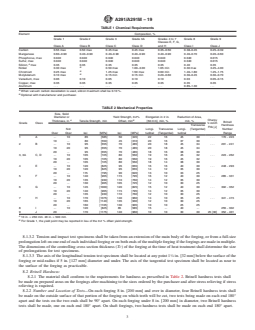
7.1 The steel shall conform to the requirements for chemical composition prescribed in Table 1.
7.2 The limits for elements other than carbon, manganese, phosphorus, sulfur, and silicon in Grade 2 alloy shall be agreed upon
between the manufacturer and purchaser.
8. Mechanical Requirements
8.1 Tensile and Impact Requirements:
8.1.1 The material shall conform to the requirements for tensile and impact properties prescribed in Table 2 and impact
properties (see Supplementary Requirement S2) when agreed upon between the purchaser and the supplier.
8.1.2 Classification—The dimensions of the controlling cross section thickness (T ) of the forging at the time of heat treatment
C
determine the mechanical properties to be met within each class (see Table 2).
8.1.3 Number, Location, and Orientation of Test Specimens:
8.1.3.1 At least one tension test specimen either longitudinal or tangential at the option of the manufacturer shall be taken from
each forging unless a number of forgings are forged and treated in multiple, in which case one tension test specimen shall be taken
from each end of the multiple forging. When impact tests are specified in accordance with Supplementary Requirement S2, one
set of impact tests shall also be taken from each end of the multiple forging. When agreed upon between the manufacturer and the
purchaser, forgings weighing less than 500 lb [225 kg] each at time of heat treatment may be tested in lots; the number of forgings
to make up a lot shall be by mutual agreement.
A291/A291M − 19
TABLE 1 Chemical Requirements
Element Composition, %
Grade 1 Grade 2 Grade 3 Grade 3A Grades 4 to 7 Grade 8 Grade 9
Classes E, F, G,
Class A Class B Class C Class D and H Class I Class J
Carbon 0.55 max 0.50 max 0.45 max 0.45 max 0.35–0.50 0.38–0.45 0.25–0.39
Manganese 0.60–0.90 0.40–0.90 0.40–0.90 0.40–0.90 0.40–0.90 0.40–0.70 0.20–0.60
Phosphorus, max 0.040 0.040 0.040 0.040 0.040 0.040 0.015
Sulfur, max 0.040 0.040 0.040 0.040 0.040 0.040 0.015
A
Silicon, max 0.35 0.35 0.35 0.35 0.35 0.40 0.35
B
Nickel 0.30 max 0.50 max 1.00–3.00 1.65 min 0.30 max 3.25–4.00
B
Chromium 0.25 max 1.25 max 1.50 max 0.60 min 1.40–1.80 1.25–1.75
B
Molybdenum 0.10 max 0.15 min 0.15 min 0.20–0.60 0.30–0.45 0.30–0.70
Vanadium, max 0.06 0.10 0.05 0.10 0.10 0.03 0.05–0.15
Copper, max 0.35 0.35 0.35 0.35 0.35 0.35 0.35
Aluminum . . . . . . . . . . . . . . . 0.85–1.30 . . .
A
When vacuum carbon deoxidation is used, silicon maximum shall be 0.10 %.
B
Optional with manufacturer and purchaser.
TABLE 2 Mechanical Properties
Size, Solid
Diameter or Yield Strength, 0.2% Elongation in 2 in. Reduction
...