

ASTM A635/A635M-22
(Specification)Standard Specification for Steel, Sheet and Strip, Heavy-Thickness Coils, Hot-Rolled, Alloy, Carbon, Structural, High-Strength Low-Alloy, and High-Strength Low-Alloy with Improved Formability, General Requirements for
General Information
- Abstract
ABSTRACT
This specification covers the general requirements for hot-rolled, heavy-thickness, and high-strength low-alloy with improved formability sheet and strip coils. These coils are normally produced from rimmed, capped, or semi-killed steel. Steels may be produced as ingot-cast or strand-cast. Cast or heat analysis shall be made to determine the conformance with the requirements. For steels other than non-killed (capped or rimmed), product analysis may be made. The chemical analysis shall conform to the specified amounts of carbon, manganese, phosphorus, sulfur, silicon, and copper. Steels may or may not be subjected to tension test requirement. Specimen preparation and test methods are discussed. The mechanical property requirements, number of specimens, test locations, and specimen orientation shall be in accordance with the applicable product specification. Tolerances for the dimensions of sheet and strip coils are specified.
SCOPE
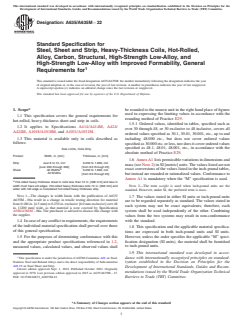
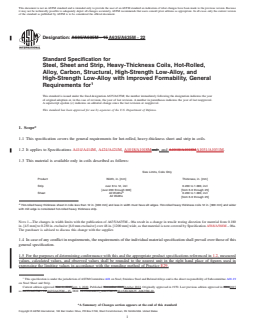
1.1 This specification covers the general requirements for hot-rolled, heavy-thickness sheet and strip in coils.
1.2 It applies to Specifications A414/A414M, A424/A424M, A1018/A1018M, and A1031/A1031M.
1.3 This material is available only in coils described as follows:
Size Limits, Coils Only
Product
Width, in. [mm]
Thickness, in. [mm]
Strip
over 8 to 12, incl
[over 200 through 300]
0.230 to 1.000, incl
[from 6.0 through 25]
Sheet
All WidthsA
All Widths
0.230 to 1.000, incl
[from 6.0 through 25]
Note 1: The changes in width limits with the publication of A635/A635M – 06a result in a change in tensile testing direction for material from 0.180 in. [4.5 mm] to 0.230 in. exclusive [6.0 mm exclusive] over 48 in. [1200 mm] wide, as that material is now covered by Specification A568/A568M – 06a. The purchaser is advised to discuss this change with the supplier.
1.4 In case of any conflict in requirements, the requirements of the individual material specification shall prevail over those of this general specification.
1.5 For the purposes of determining conformance with this and the appropriate product specifications referenced in 1.2, measured values, calculated values, and observed values shall be rounded to the nearest unit in the right hand place of figures used in expressing the limiting values in accordance with the rounding method of Practice E29.
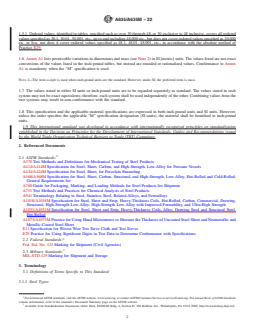
1.5.1 Ordered values, identified in tables, specified such as over 30 through 48, or 30 exclusive to 48 inclusive, covers all ordered values specified as 30.1, 30.01, 30.001, etc., up to and including 48.000 etc., but does not cover ordered values specified as 30.000 etc. or less, nor does it cover ordered values specified as 48.1, 48.01, 48.001, etc., in accordance with the absolute method of Practice E29.
1.6 Annex A1 lists permissible variations in dimensions and mass (see Note 2) in SI [metric] units. The values listed are not exact conversions of the values listed in the inch-pound tables, but instead are rounded or rationalized values. Conformance to Annex A1 is mandatory when the “M” specification is used.
Note 2: The term weight is used when inch-pound units are the standard. However, under SI, the preferred term is mass.
1.7 The values stated in either SI units or inch-pound units are to be regarded separately as standard. The values stated in each system may not be exact equivalents; therefore, each system shall be used independently of the other. Combining values from the two systems may result in non-conformance with the standard.
1.8 This specification and the applicable material specifications are expressed in both inch-pound units and SI units. However, unless the order specifies the applicable “M” specification designation (SI units), the material shall be furnished to inch-pound units.
1.9 This international standard was developed in accordance with internationally recognized principles on standardiza...
- Status
- Published
- Publication Date
- 31-Aug-2022
- Technical Committee
- A01 - Steel, Stainless Steel and Related Alloys
- Drafting Committee
- A01.19 - Steel Sheet and Strip
Buy Documents
ASTM A635/A635M-22 - Standard Specification for Steel, Sheet and Strip, Heavy-Thickness Coils, Hot-Rolled, Alloy, Carbon, Structural, High-Strength Low-Alloy, and High-Strength Low-Alloy with Improved Formability, General Requirements for
REDLINE ASTM A635/A635M-22 - Standard Specification for Steel, Sheet and Strip, Heavy-Thickness Coils, Hot-Rolled, Alloy, Carbon, Structural, High-Strength Low-Alloy, and High-Strength Low-Alloy with Improved Formability, General Requirements for
Overview
ASTM A635/A635M-22 is the ASTM International standard that establishes the general requirements for hot-rolled, heavy-thickness sheet and strip in coils. This specification applies to a wide range of steel types, including alloy steel, carbon steel, structural steel, high-strength low-alloy (HSLA) steel, and HSLA types with improved formability. The standard is intended for coils produced by either the ingot-cast or strand-cast processes and covers dimensions, tolerances, chemical composition, mechanical properties, marking, and packaging.
This specification is referenced by and applicable to other ASTM product specifications, such as ASTM A414/A414M, A424/A424M, A1018/A1018M, and A1031/A1031M.
Key Topics
- Product Coverage: Applies to hot-rolled sheet and strip in coils with thickness from 0.230 to 1.000 inches (6.0 to 25 mm), with specific size and width limits depending on the product type.
- Steel Types: Includes carbon, alloy, structural, high-strength low-alloy, and high-strength low-alloy with improved formability.
- Manufacturing Methods: Steel can be rimmed, capped, killed, or semi-killed, and produced as either ingot-cast or strand-cast.
- Chemical Composition: Specifies requirements for elements such as carbon, manganese, phosphorus, sulfur, silicon, and copper, as well as requirements for heat and product analysis.
- Mechanical Properties: Addresses the need for specimens, testing methods, and alignment with specific product specifications for tension and other mechanical tests.
- Tolerances: Provides clear tolerances for thickness, width, camber, and crown in both inch-pound and SI units. Specific tables are referenced for these tolerances.
- Surface and Edge Condition: Covers requirements for finish, oiling, and edge type (mill edge or cut edge) depending on the manufacturing and purchasing specifications.
- Marking and Packaging: Outlines requirements for coil identification, barcoding, and packaging in accordance with recognized ASTM and industry practices.
Applications
Hot-rolled, heavy-thickness steel coils produced under ASTM A635/A635M-22 are integral in numerous industries and applications, including:
- Automotive manufacturing: Used for structural components, chassis, wheels, and truck frames.
- Construction: Applied in bridge building, construction equipment, structural members, and heavy machinery.
- Pressure vessels: Utilized in fabrication of tanks, boilers, and vessels where high strength and durability are required.
- Rail and transportation: Serves as material for railway cars, ships, and transportation infrastructure.
- General fabrication: Suitable for stamping, forming, and fabrication of large steel parts that demand high strength and dimensional consistency.
The heavy thickness and mechanical properties covered by this standard make these coils suitable for applications requiring enhanced performance under load, improved formability, and resistance to wear and fatigue.
Related Standards
Understanding ASTM A635/A635M-22 is often necessary in conjunction with compliance to related product and testing standards, including:
- ASTM A414/A414M: Steel, Sheet, Carbon, and High-Strength, Low-Alloy for Pressure Vessels
- ASTM A424/A424M: Steel, Sheet, for Porcelain Enameling
- ASTM A1018/A1018M: Steel, Sheet and Strip, Heavy-Thickness Coils, Hot-Rolled, Carbon, Structural, and High-Strength Low-Alloy
- ASTM A1031/A1031M: Steel, Sheet and Strip, Alloy, Drawing Steel and Structural Steel, Hot-Rolled
- ASTM A568/A568M: General Requirements for Steel Sheet, Carbon, Structural, and High-Strength Low-Alloy, Hot-Rolled and Cold-Rolled
- ASTM A370: Standard Test Methods and Definitions for Mechanical Testing of Steel Products
- ASTM A700: Guide for Packaging, Marking, and Loading Methods for Steel Products for Shipment
Practical Value
Implementing ASTM A635/A635M-22 ensures consistent quality, dimensional accuracy, and performance, facilitating:
- Compliance with industry and governmental requirements
- Interchangeability of steel products worldwide
- Efficient supply chain management due to standardized marking, packaging, and documentation
- Confidence in material selection for large structural projects and demanding applications
By specifying ASTM A635/A635M-22 for steel sheet and strip in coils, manufacturers and end-users benefit from a globally recognized framework for material quality and performance.
Relations
- Effective Date
- 01-Mar-2024
- Effective Date
- 01-Mar-2024
- Effective Date
- 01-Nov-2023
- Effective Date
- 01-Nov-2023
- Effective Date
- 01-Nov-2019
- Effective Date
- 01-Nov-2019
- Effective Date
- 01-Jul-2019
- Refers
ASTM A370-17a - Standard Test Methods and Definitions for Mechanical Testing of Steel Products - Effective Date
- 15-Nov-2017
- Effective Date
- 01-Nov-2017
- Effective Date
- 01-Sep-2017
- Effective Date
- 01-Sep-2017
- Effective Date
- 01-Sep-2017
- Effective Date
- 01-Jan-2017
- Effective Date
- 01-Sep-2016
- Effective Date
- 01-May-2016
Buy Documents
ASTM A635/A635M-22 - Standard Specification for Steel, Sheet and Strip, Heavy-Thickness Coils, Hot-Rolled, Alloy, Carbon, Structural, High-Strength Low-Alloy, and High-Strength Low-Alloy with Improved Formability, General Requirements for
REDLINE ASTM A635/A635M-22 - Standard Specification for Steel, Sheet and Strip, Heavy-Thickness Coils, Hot-Rolled, Alloy, Carbon, Structural, High-Strength Low-Alloy, and High-Strength Low-Alloy with Improved Formability, General Requirements for
Get Certified
Connect with accredited certification bodies for this standard

Element Materials Technology
Materials testing and product certification.

Inštitut za kovinske materiale in tehnologije
Institute of Metals and Technology. Materials testing, metallurgical analysis, NDT.
Sponsored listings
Frequently Asked Questions
ASTM A635/A635M-22 is a technical specification published by ASTM International. Its full title is "Standard Specification for Steel, Sheet and Strip, Heavy-Thickness Coils, Hot-Rolled, Alloy, Carbon, Structural, High-Strength Low-Alloy, and High-Strength Low-Alloy with Improved Formability, General Requirements for". This standard covers: ABSTRACT This specification covers the general requirements for hot-rolled, heavy-thickness, and high-strength low-alloy with improved formability sheet and strip coils. These coils are normally produced from rimmed, capped, or semi-killed steel. Steels may be produced as ingot-cast or strand-cast. Cast or heat analysis shall be made to determine the conformance with the requirements. For steels other than non-killed (capped or rimmed), product analysis may be made. The chemical analysis shall conform to the specified amounts of carbon, manganese, phosphorus, sulfur, silicon, and copper. Steels may or may not be subjected to tension test requirement. Specimen preparation and test methods are discussed. The mechanical property requirements, number of specimens, test locations, and specimen orientation shall be in accordance with the applicable product specification. Tolerances for the dimensions of sheet and strip coils are specified. SCOPE 1.1 This specification covers the general requirements for hot-rolled, heavy-thickness sheet and strip in coils. 1.2 It applies to Specifications A414/A414M, A424/A424M, A1018/A1018M, and A1031/A1031M. 1.3 This material is available only in coils described as follows: Size Limits, Coils Only Product Width, in. [mm] Thickness, in. [mm] Strip over 8 to 12, incl [over 200 through 300] 0.230 to 1.000, incl [from 6.0 through 25] Sheet All WidthsA All Widths 0.230 to 1.000, incl [from 6.0 through 25] Note 1: The changes in width limits with the publication of A635/A635M – 06a result in a change in tensile testing direction for material from 0.180 in. [4.5 mm] to 0.230 in. exclusive [6.0 mm exclusive] over 48 in. [1200 mm] wide, as that material is now covered by Specification A568/A568M – 06a. The purchaser is advised to discuss this change with the supplier. 1.4 In case of any conflict in requirements, the requirements of the individual material specification shall prevail over those of this general specification. 1.5 For the purposes of determining conformance with this and the appropriate product specifications referenced in 1.2, measured values, calculated values, and observed values shall be rounded to the nearest unit in the right hand place of figures used in expressing the limiting values in accordance with the rounding method of Practice E29. 1.5.1 Ordered values, identified in tables, specified such as over 30 through 48, or 30 exclusive to 48 inclusive, covers all ordered values specified as 30.1, 30.01, 30.001, etc., up to and including 48.000 etc., but does not cover ordered values specified as 30.000 etc. or less, nor does it cover ordered values specified as 48.1, 48.01, 48.001, etc., in accordance with the absolute method of Practice E29. 1.6 Annex A1 lists permissible variations in dimensions and mass (see Note 2) in SI [metric] units. The values listed are not exact conversions of the values listed in the inch-pound tables, but instead are rounded or rationalized values. Conformance to Annex A1 is mandatory when the “M” specification is used. Note 2: The term weight is used when inch-pound units are the standard. However, under SI, the preferred term is mass. 1.7 The values stated in either SI units or inch-pound units are to be regarded separately as standard. The values stated in each system may not be exact equivalents; therefore, each system shall be used independently of the other. Combining values from the two systems may result in non-conformance with the standard. 1.8 This specification and the applicable material specifications are expressed in both inch-pound units and SI units. However, unless the order specifies the applicable “M” specification designation (SI units), the material shall be furnished to inch-pound units. 1.9 This international standard was developed in accordance with internationally recognized principles on standardiza...
ABSTRACT This specification covers the general requirements for hot-rolled, heavy-thickness, and high-strength low-alloy with improved formability sheet and strip coils. These coils are normally produced from rimmed, capped, or semi-killed steel. Steels may be produced as ingot-cast or strand-cast. Cast or heat analysis shall be made to determine the conformance with the requirements. For steels other than non-killed (capped or rimmed), product analysis may be made. The chemical analysis shall conform to the specified amounts of carbon, manganese, phosphorus, sulfur, silicon, and copper. Steels may or may not be subjected to tension test requirement. Specimen preparation and test methods are discussed. The mechanical property requirements, number of specimens, test locations, and specimen orientation shall be in accordance with the applicable product specification. Tolerances for the dimensions of sheet and strip coils are specified. SCOPE 1.1 This specification covers the general requirements for hot-rolled, heavy-thickness sheet and strip in coils. 1.2 It applies to Specifications A414/A414M, A424/A424M, A1018/A1018M, and A1031/A1031M. 1.3 This material is available only in coils described as follows: Size Limits, Coils Only Product Width, in. [mm] Thickness, in. [mm] Strip over 8 to 12, incl [over 200 through 300] 0.230 to 1.000, incl [from 6.0 through 25] Sheet All WidthsA All Widths 0.230 to 1.000, incl [from 6.0 through 25] Note 1: The changes in width limits with the publication of A635/A635M – 06a result in a change in tensile testing direction for material from 0.180 in. [4.5 mm] to 0.230 in. exclusive [6.0 mm exclusive] over 48 in. [1200 mm] wide, as that material is now covered by Specification A568/A568M – 06a. The purchaser is advised to discuss this change with the supplier. 1.4 In case of any conflict in requirements, the requirements of the individual material specification shall prevail over those of this general specification. 1.5 For the purposes of determining conformance with this and the appropriate product specifications referenced in 1.2, measured values, calculated values, and observed values shall be rounded to the nearest unit in the right hand place of figures used in expressing the limiting values in accordance with the rounding method of Practice E29. 1.5.1 Ordered values, identified in tables, specified such as over 30 through 48, or 30 exclusive to 48 inclusive, covers all ordered values specified as 30.1, 30.01, 30.001, etc., up to and including 48.000 etc., but does not cover ordered values specified as 30.000 etc. or less, nor does it cover ordered values specified as 48.1, 48.01, 48.001, etc., in accordance with the absolute method of Practice E29. 1.6 Annex A1 lists permissible variations in dimensions and mass (see Note 2) in SI [metric] units. The values listed are not exact conversions of the values listed in the inch-pound tables, but instead are rounded or rationalized values. Conformance to Annex A1 is mandatory when the “M” specification is used. Note 2: The term weight is used when inch-pound units are the standard. However, under SI, the preferred term is mass. 1.7 The values stated in either SI units or inch-pound units are to be regarded separately as standard. The values stated in each system may not be exact equivalents; therefore, each system shall be used independently of the other. Combining values from the two systems may result in non-conformance with the standard. 1.8 This specification and the applicable material specifications are expressed in both inch-pound units and SI units. However, unless the order specifies the applicable “M” specification designation (SI units), the material shall be furnished to inch-pound units. 1.9 This international standard was developed in accordance with internationally recognized principles on standardiza...
ASTM A635/A635M-22 is classified under the following ICS (International Classification for Standards) categories: 77.140.50 - Flat steel products and semi-products. The ICS classification helps identify the subject area and facilitates finding related standards.
ASTM A635/A635M-22 has the following relationships with other standards: It is inter standard links to ASTM A370-24, ASTM A941-24, ASTM A414/A414M-23, ASTM A1018/A1018M-23a, ASTM A568/A568M-19a, ASTM A700-14(2019), ASTM A370-19, ASTM A370-17a, ASTM A568/A568M-17a, ASTM A941-17, ASTM A568/A568M-17, ASTM A1031/A1031M-12(2017), ASTM A370-17, ASTM A1018/A1018M-16a, ASTM A424/A424M-09a(2016). Understanding these relationships helps ensure you are using the most current and applicable version of the standard.
ASTM A635/A635M-22 is available in PDF format for immediate download after purchase. The document can be added to your cart and obtained through the secure checkout process. Digital delivery ensures instant access to the complete standard document.
Standards Content (Sample)
This international standard was developed in accordance with internationally recognized principles on standardization established in the Decision on Principles for the
Development of International Standards, Guides and Recommendations issued by the World Trade Organization Technical Barriers to Trade (TBT) Committee.
Designation:A635/A635M −22
Standard Specification for
Steel, Sheet and Strip, Heavy-Thickness Coils, Hot-Rolled,
Alloy, Carbon, Structural, High-Strength Low-Alloy, and
High-Strength Low-Alloy with Improved Formability, General
Requirements for
This standard is issued under the fixed designationA635/A635M; the number immediately following the designation indicates the year
of original adoption or, in the case of revision, the year of last revision. A number in parentheses indicates the year of last reapproval.
A superscript epsilon (´) indicates an editorial change since the last revision or reapproval.
This standard has been approved for use by agencies of the U.S. Department of Defense.
1. Scope* be rounded to the nearest unit in the right hand place of figures
used in expressing the limiting values in accordance with the
1.1 This specification covers the general requirements for
rounding method of Practice E29.
hot-rolled, heavy-thickness sheet and strip in coils.
1.5.1 Ordered values, identified in tables, specified such as
1.2 It applies to Specifications A414/A414M, A424/
over 30 through 48, or 30 exclusive to 48 inclusive, covers all
A424M, A1018/A1018M, and A1031/A1031M.
ordered values specified as 30.1, 30.01, 30.001, etc., up to and
1.3 This material is available only in coils described as
including 48.000 etc., but does not cover ordered values
follows: specifiedas30.000etc.orless,nordoesitcoverorderedvalues
specified as 48.1, 48.01, 48.001, etc., in accordance with the
Size Limits, Coils Only
absolute method of Practice E29.
Product Width, in. [mm] Thickness, in. [mm]
1.6 AnnexA1 lists permissible variations in dimensions and
Strip over 8 to 12, incl 0.230 to 1.000, incl
mass (see Note 2) in SI [metric] units.The values listed are not
[over 200 through 300] [from 6.0 through 25]
A
exact conversions of the values listed in the inch-pound tables,
Sheet All Widths 0.230 to 1.000, incl
All Widths
[from 6.0 through 25]
but instead are rounded or rationalized values. Conformance to
Annex A1 is mandatory when the “M” specification is used.
A
Hot-rolled heavy thickness sheet in coils less than 12 in. [300 mm] and less in
width must have slit edges. Hot-rolled heavy thickness coils 12 in. [300 mm] and
NOTE 2—The term weight is used when inch-pound units are the
wider with mill edge is considered hot-rolled heavy thickness strip.
standard. However, under SI, the preferred term is mass.
NOTE 1—The changes in width limits with the publication of A635/
1.7 The values stated in either SI units or inch-pound units
A635M – 06a result in a change in tensile testing direction for material
are to be regarded separately as standard. The values stated in
from 0.180 in. [4.5 mm] to 0.230 in. exclusive [6.0 mm exclusive] over 48
each system may not be exact equivalents; therefore, each
in. [1200 mm] wide, as that material is now covered by Specification
system shall be used independently of the other. Combining
A568/A568M – 06a. The purchaser is advised to discuss this change with
the supplier.
values from the two systems may result in non-conformance
with the standard.
1.4 In case of any conflict in requirements, the requirements
of the individual material specification shall prevail over those
1.8 This specification and the applicable material specifica-
of this general specification.
tions are expressed in both inch-pound units and SI units.
However, unless the order specifies the applicable “M” speci-
1.5 For the purposes of determining conformance with this
fication designation (SI units), the material shall be furnished
and the appropriate product specifications referenced in 1.2,
to inch-pound units.
measured values, calculated values, and observed values shall
1.9 This international standard was developed in accor-
dance with internationally recognized principles on standard-
This specification is under the jurisdiction of ASTM Committee A01 on Steel,
Stainless Steel and Related Alloys and is the direct responsibility of Subcommittee
ization established in the Decision on Principles for the
A01.19 on Steel Sheet and Strip.
Development of International Standards, Guides and Recom-
Current edition approved Sept. 1, 2022. Published October 2022. Originally
mendations issued by the World Trade Organization Technical
approved in 1970. Last previous edition approved in 2015 as A635/A635M – 15.
DOI: 10.1520/A0635_A0635M-22. Barriers to Trade (TBT) Committee.
*A Summary of Changes section appears at the end of this standard
Copyright © ASTM International, 100 Barr Harbor Drive, PO Box C700, West Conshohocken, PA 19428-2959. United States
A635/A635M−22
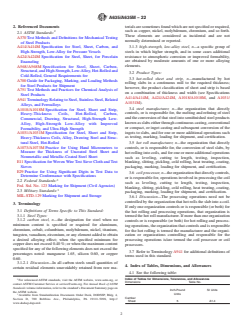
2. Referenced Documents terialsaresometimesfoundwhicharenotspecifiedorrequired,
2 such as copper, nickel, molybdenum, chromium, and so forth.
2.1 ASTM Standards:
These elements are considered as incidental and are not
A370 Test Methods and Definitions for Mechanical Testing
normally determined or reported.
of Steel Products
3.1.3 high-strength, low-alloy steel, n—a specific group of
A414/A414M Specification for Steel, Sheet, Carbon, and
steels in which higher strength, and in some cases additional
High-Strength, Low-Alloy for Pressure Vessels
resistance to atmospheric corrosion or improved formability,
A424/A424M Specification for Steel, Sheet, for Porcelain
are obtained by moderate amounts of one or more alloying
Enameling
elements.
A568/A568M Specification for Steel, Sheet, Carbon,
Structural,andHigh-Strength,Low-Alloy,Hot-Rolledand
3.2 Product Types:
Cold-Rolled, General Requirements for
3.3 hot-rolled sheet and strip, n—manufactured by hot
A700 Guide for Packaging, Marking, and Loading Methods
rolling slabs in a continuous mill to the required thickness;
for Steel Products for Shipment
however, the product classification of sheet and strip is based
A751 Test Methods and Practices for Chemical Analysis of
on a combination of thickness and width (see Specifications
Steel Products
A414/A414M, A424/A424M, A1018/A1018M, and A1031/
A941 TerminologyRelatingtoSteel,StainlessSteel,Related
A1031M).
Alloys, and Ferroalloys
3.4 steel manufacturer, n—the organization that directly
A1018/A1018M Specification for Steel, Sheet and Strip,
controls, or is responsible for, the melting and refining of steel
Heavy-Thickness Coils, Hot-Rolled, Carbon,
andtheconversionofthatsteelintosemifinishedsteelproducts
Commercial, Drawing, Structural, High-Strength Low-
knownasslabseitherthroughcontinuouscasting,conventional
Alloy, High-Strength Low-Alloy with Improved
or compact, or ingot casting and subsequent conversion of the
Formability, and Ultra-High Strength
ingots to slabs, and for one or more additional operations such
A1031/A1031M Specification for Steel, Sheet and Strip,
as testing, marking, loading for shipment, and certification.
Heavy-Thickness Coils, Alloy, Drawing Steel and Struc-
tural Steel, Hot-Rolled
3.5 hot roll manufacturer, n—the organization that directly
A1073/A1073M Practice for Using Hand Micrometers to
controls, or is responsible for, the conversion of steel slabs, by
Measure the Thickness of Uncoated Steel Sheet and
hot rolling into coils, and for one or more additional operations
Nonmetallic and Metallic-Coated Steel Sheet
such as leveling, cutting to length, testing, inspection,
E11 Specification for Woven Wire Test Sieve Cloth and Test
blanking, slitting, pickling, cold rolling, heat treating, coating,
Sieves
packaging, marking, loading for shipment, and certification.
E29 Practice for Using Significant Digits in Test Data to
3.6 coilprocessor,n—theorganizationthatdirectlycontrols,
Determine Conformance with Specifications
or is responsible for, operations involved in processing the coil
2.2 Federal Standards:
such as leveling, cutting to length, testing, inspection,
Fed. Std. No. 123 Marking for Shipment (Civil Agencies)
blanking, slitting, pickling, cold rolling, heat treating, coating,
2.3 Military Standards:
packaging, marking, loading for shipment, and certification.
MIL-STD-129 Marking for Shipment and Storage
3.6.1 Discussion—The processing operations need not be
controlled by the organization that hot rolls the slab into a coil.
3. Terminology
If only one organization controls or is responsible (or both) for
3.1 Definitions of Terms Specific to This Standard:
the hot rolling and processing operations, that organization is
3.1.1 Steel Types:
termed the hot roll manufacturer. If more than one organization
3.1.2 carbon steel, n—the designation for steel when no
controls or is responsible (or both) for hot rolling and process-
minimum content is specified or required for aluminum,
ing operations, the organization that controls and is responsible
chromium, cobalt, columbium, molybdenum, nickel, titanium,
for the hot rolling is termed the manufacturer and the organi-
tungsten, vanadium, zirconium, or any element added to obtain
zation or organizations controlling and responsible for the
a desired alloying effect; when the specified minimum for
processing operations is/are termed the coil processor or coil
copper does not exceed 0.40 %; or when the maximum content
processors.
specified for any of the following elements does not exceed the
3.7 Refer to Terminology A941 for additional definitions of
percentages noted: manganese 1.65, silicon 0.60, or copper
terms used in this standard.
0.60.
3.1.2.1 Discussion—In all carbon steels small quantities of
4. Index of Tables, Dimensions, and Allowances
certain residual elements unavoidably retained from raw ma-
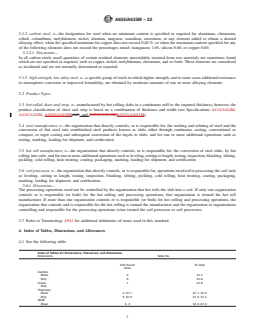
4.1 See the following table:
Index of Tables for Dimensions, Tolerances, and Allowances
For referenced ASTM standards, visit the ASTM website, www.astm.org, or
Dimensions Table No.
contact ASTM Customer Service at service@astm.org. For Annual Book of ASTM
Standards volume information, refer to the standard’s Document Summary page on
Inch-Pound SI Units
the ASTM website.
3 Units
Available from Standardization Documents Order Desk, DODSSP, Bldg. 4,
Camber
Section D, 700 Robbins Ave., Philadelphia, PA 19111-5098, http://
Sheet 5 A1.4
www.dodssp.daps.mil.
A635/A635M−22
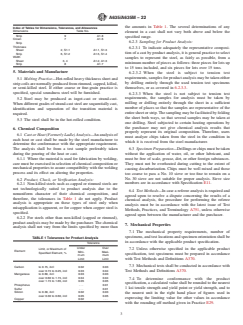
the amounts in Table 1. The several determinations of any
Index of Tables for Dimensions, Tolerances, and Allowances
Dimensions Table No.
element in a cast shall not vary both above and below the
Strip 9 A1.8
specified range.
Crown 7 A1.6
6.2.3 Sampling for Product Analysis:
Strip
Thickness
6.2.3.1 To indicate adequately the representative composi-
Sheet 2, S1.1 A1.1, S1.3
tion of a cast by product analysis, it is general practice to select
Strip 6, S1.2 A1.5, S1.4
Width
samples to represent the steel, as fairly as possible, from a
Sheet 3, 4 A1.2, A1.3
minimum number of pieces as follows: three pieces for lots up
Strip 8 A1.7
to 15 tons included, and six pieces for lots over 15 tons.
5. Materials and Manufacture
6.2.3.2 When the steel is subject to tension test
requirements, samples for product analysis may be taken either
5.1 Melting Practice—Hot-rolled heavy thickness sheet and
by drilling entirely through the used tension test specimens
strip coils are normally produced from rimmed, capped, killed,
themselves, or as covered in 6.2.3.3.
or semi-killed steel. If either coarse or fine-grain practice is
specified, special soundness steel will be furnished.
6.2.3.3 When the steel is not subject to tension test
requirements, the samples for analysis must be taken by
5.2 Steel may be produced as ingot-cast or strand-cast.
milling or drilling entirely through the sheet in a sufficient
When different grades of strand-cast steel are sequentially cast,
number of places so that the samples are representative of the
identification and separation of the transition material is
entiresheetorstrip.Thesamplingmaybefacilitatedbyfolding
required.
the sheet both ways, so that several samples may be taken at
5.3 The steel shall be in the hot-rolled condition.
one drilling. Steel subjected to certain heating operations by
the purchaser may not give chemical analysis results that
6. Chemical Composition
properly represent its original composition. Therefore, users
6.1 CastorHeat(FormerlyLadle)Analysis—Ananalysisof
must analyze chips taken from the steel in the condition in
each heat or cast shall be made by the steel manufacturer to
which it is received from the steel manufacturer.
determine the conformance with the appropriate requirement.
The analysis shall be from a test sample preferably taken 6.3 Specimen Preparation—Drillingsorchipsmustbetaken
during the pouring of the heat or cast.
without the application of water, oil, or other lubricant, and
6.1.1 Where the material is used for fabrication by welding,
must be free of scale, grease, dirt, or other foreign substances.
care must be exercised in selection of chemical composition or
They must not be overheated during cutting to the extent of
mechanical properties to assure compatibility with the welding
causing decarburization. Chips must be well mixed and those
process and its effect on altering the properties.
too coarse to pass a No. 10 sieve or too fine to remain on a
No. 30 sieve are not suitable for proper analysis. Sieve size
6.2 Product, Check, or Verification Analysis:
numbers are in accordance with Specification E11.
6.2.1 Non-killed steels such as capped or rimmed steels are
not technologically suited to product analysis due to the
6.4 Test Methods—In case a referee analysis is required and
nonuniform character of their chemical composition, and
agreed upon to resolve a dispute concerning the results of a
therefore, the tolerances in Table 1 do not apply. Product
chemical analysis, the procedure for performing the referee
analysis is appropriate on these types of steel only when
analysis must be in accordance with the latest issue of Test
misapplication is apparent, or for copper when copper steel is
Methods, Practices, and Terminology A751, unless otherwise
specified.
agreed upon between the manufacturer and the purchaser.
6.2.2 For steels other than non-killed (capped or rimmed),
product analysis may be made by the purchaser. The chemical
7. Mechanical Properties
analysis shall not vary from the limits specified by more than
7.1 The mechanical property requirements, number of
specimens, and test locations and specimen orientation shall be
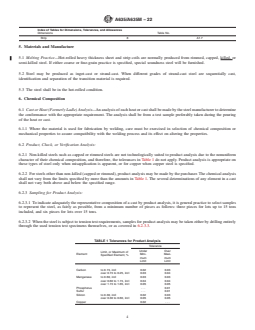
TABLE 1 Tolerances for Product Analysis
in accordance with the applicable product specification.
Tolerance
Under Over
Limit, or Maximum of 7.2 Unless otherwise specified in the applicable product
Element
Mini- Maxi-
Specified Element, %
specification, test specimens must be prepared in accordance
mum mum
Limit Limit
with Test Methods and Definitions A370.
7.3 Mechanical tests shall be conducted in accordance with
Carbon to 0.15, incl 0.02 0.03
over 0.15 to 0.25, incl 0.03 0.04
Test Methods and Definitions A370.
Manganese to 0.60, incl 0.03 0.03
over 0.60 to 1.15, incl 0.04 0.04
7.4 To determine conformance with the product
over 1.15 to 1.65, incl 0.05 0.05
specification, a calculated value shall be rounded to the nearest
Phosphorus . . . 0.01
1 ksi tensile strength and yield point or yield strength, and to
Sulfur . . . 0.01
Silicon to 0.30, incl 0.02 0.03
the nearest unit in the right hand place of figures used in
over 0.30 to 0.60, incl 0.05 0.05
expressing the limiting value for other values in accordance
Copper 0.02 . . .
with the rounding off method given in Practice E29.
A635/A635M−22
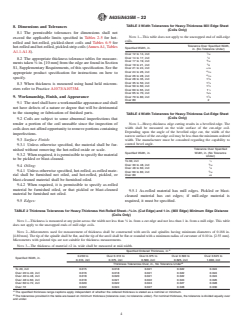
TABLE 3 Width Tolerances for Heavy-Thickness Mill Edge Sheet
8. Dimensions and Tolerances
(Coils Only)
8.1 The permissible tolerances for dimensions shall not
NOTE 1—This table does not apply to the uncropped end of mill-edge
exceed the applicable limits specified in Tables 2-5 for hot-
coils.
rolled and hot-rolled, pickled-sheet coils and Tables 6-9 for
Tolerance Over Specified Width,
hot-rolled and hot-rolled, pickled-strip coils (AnnexA1, Tables Specified Width, in.
in. (No Tolerance Under)
A1.1-A1.8).
Over 12 to 14, incl ⁄16
Over 14 to 17, incl ⁄2
8.2 The appropriate thickness tolerance tables for measure-
Over 17 to 19, incl ⁄16
ments taken ⁄8 in. [10 mm] from the edge are found in Section
Over 19 to 21, incl ⁄8
S1, Supplementary Requirements, of this specification. See the
Over 21 to 24, incl ⁄16
Over 24 to 26, incl ⁄16
appropriate product specification for instructions on how to
Over 26 to 28, incl ⁄16
specify.
Over 28 to 35, incl 1 ⁄8
Over 35 to 50, incl 1 ⁄4
8.3 When thickness is measured using hand held microm-
Over 50 to 60, incl 1 ⁄2
eters refer to Practice A1073/A1073M.
Over 60 to 65, incl 1#
Over 65 to 70, incl 1 ⁄4
9. Workmanship, Finish, and Appearance Over 70 to 80, incl 1 ⁄8
Over 80 2
9.1 Thesteelshallhaveaworkmanlikeappearanceandshall
not have defects of a nature or degree that will be detrimental
to the stamping or fabrication of finished parts.
TABLE 4 Width Tolerances for Heavy-Thickness Cut-Edge Sheet
(Coils Only)
9.2 Coils are subject to some abnormal imperfections that
render a portion of the coil unusable since the inspection of NOTE 1—Heavy-thickness edge cutting results in a bevelled edge. The
width shall be measured on the wide surface of the cut-edge coil.
coilsdoesnotaffordopportunitytoremoveportionscontaining
Depending upon the angle of the bevelled edge cut, the width of the
imperfections.
narrow surface of the cut-edge coil may be less than the minimum ordered
9.3 Surface Finish: width. The manufacturer must be consulted regarding the capability to
control bevel angle.
9.3.1 Unless otherwise specified, the material shall be fur-
Tolerance Over Specified
nished without removing the hot-rolled oxide or scale.
Specified Width, in. Width, in. (No Tolerance
9.3.2 Whenrequired,itispermissibletospecifythematerial
Under)
to be pickled or blast-cleaned.
To 30, incl !
Over 30 to 48, incl ⁄16
9.4 Oiling:
Over 48 to 60, incl ⁄4
9.4.1 Unless otherwise specified, hot-rolled, as-rolled mate-
Over 60 to 80, incl ⁄16
rial shall be furnished not oiled, and hot-rolled, pickled, or Over 80 ⁄8
blast-cleaned material shall be furnished oiled.
9.4.2 When required, it is permissible to specify as-rolled
material be furnished oiled, or that pickled or blast-cleaned
9.5.1 As-rolled material has mill edges. Pickled or blast-
material be furnished not oiled.
cleaned material has cut edges; if mill-edge material is
9.5 Edges: required, it must be specified.
TABLE 2 Thickness Tolerances for Heavy-Thickness Hot-Rolled Sheet— ⁄8-in. (Cut Edge) and 1-in. (Mill Edge) Minimum Edge Distance
(Coils Only)
NOTE 1—Thickness is measured at any point across the width not less than ⁄8 in. from a cut edge and not less than 1 in. from a mill edge. This table
does not apply to the uncropped ends of mill edge coils.
NOTE 2—Micrometers used for measurement of thickness shall be constructed with anvils and spindles having minimum diameters of 0.188 in.
[4.80 mm]. The tip of the spindle shall be flat, and the tip of the anvil shall be flat or rounded with a minimum radius of curvature of 0.10 in. [2.55 mm].
Micrometers with pointed tips are not suitable for thickness measurements.
NOTE 3—The thickness of material <2 in. wide shall be measured at mid-width.
A
Specified Ordered Thickness, in.
0.230 to Over 0.313 to Over 0.375 to Over 0.500 to Over 0.625 to
Specified Width, in.
0.313, incl 0.375, incl 0.500, incl 0.625, incl 1.000, incl
B
Thickness Tolerances Over, in., No Tolerance Under
To 20, incl 0.015 0.018 0.021 0.022 0.024
Over 20 to 40, incl 0.016 0.018 0.021 0.022 0.024
Over 40 to 48, incl 0.018 0.020 0.021 0.022 0.024
Over 48 to 60, incl 0.018 0.021 0.022 0.024 0.026
Over 60 to 72, incl 0.020 0.022 0.024 0.027 0.028
Over 72 0.022 0.024 0.027 0.028 0.030
A
The specified thickness range captions apply independent of whether the ordered thickness is stated as a nominal or minimum.
B
The tolerances provided in the table are based on minimum thickness (tolerance over, no tolerance under). For nominal thickness, the tolerance is divided equally over
and under.
A635/A635M−22
TABLE 5 Camber Tolerances for Heavy-Thickness Sheet TABLE 9 Camber Tolerances for Heavy-Thickness Strip
(Coils Only) (Coils Only)
NOTE 1—Camber is the deviation of a side edge from a straight line. NOTE 1—Camber is the deviation of a side edge from a straight line.
Such a deviation is measured by placing a straightedge on the concave Suchadeviationisobtainedbyplacingan8-ftstraightedgeontheconcave
side and measuring the greatest distance between the sheet edge and the side and measuring the greatest distance between the strip edge and the
straightedge. straightedge.
Camber should not exceed 1 in. in any 20 ft of length. For strip over 8 in. to 12 in., incl ⁄4in.inany8ft
TABLE 6 Thickness Tolerances for Heavy-Thickness Hot-Rolled
Strip— ⁄8-in. Minimum Edge Distance (Coils Only)
NOTE 1—Thickness measurements are taken ⁄8 in. from edge of strip. 10.1.1.1 If any tension test specimen shows defective ma-
These tolerances do not include crown, and, therefore, the tolerances
chining or develops flaws, it must be discarded and another
given in Table 7 are in addition to this table.
specimen substituted.
NOTE 2—Micrometers used for measurement of thickness shall be
10.1.1.2 If the percent elongation of any tension test speci-
constructed with anvils and spindles having minimum diameters of
men is less than that specified and any part of the fracture is
0.188 in. [4.80 mm]. The tip of the spindle shall be flat, and the tip of the
more than ⁄4 in. [20 mm] from the center of the gauge length
anvil shall be flat or rounded with a minimum radius of curvature of 0.10
ofa2in.[50mm]specimen,orisoutsidethemiddlehalfofthe
in.[2.55mm].Micrometerswithpointedtipsarenotsuitableforthickness
measurements. gauge length of an 8 in. [200 mm] specimen as indicated by
A
scribescratchesmarkedonthespecimenbeforetesting,aretest
Specified Minimum Thickness, in.
Specified 0.230 to Over 0.313 Over 0.375 Over 0.500 Over
is allowed.
Width, 0.313, to 0.375, to 0.500, to 0.625, 0.0625 to
10.1.1.3 If the test result of any tension test specimen fails
in. incl incl incl incl 1.000, incl
B
Thickness Tolerances, in., No Tolerance Under to meet the specification requirements and the failure is the
Over 8 to 0.012 0.014 0.015 0.016 0.018
result of improper adherence to tensiontest procedures, a retest
12, incl
is permitted.
A
The specified thickness range captions apply independent of whether the
10.1.1.4 Ifthetestresultofanoriginaltensiontestspecimen
ordered thickness is stated as a nominal or minimum.
B
fails to meet the specification requirements and the failure is
The tolerances provided in the table are based on minimum thickness (tolerance
over, no tolerance under). For nominal thickness, the tolerance is divided equally
not related to the conditions described in 10.1.1.1 – 10.1.1.3,
over and under.
but the results are within 2 ksi [14 MPa] of the required yield
strength, within 2 ksi [14 MPa] of the required tensile strength,
or within 2 percentage points of the required elongation, one
TABLE 7 Crown Tolerances for Heavy-Thickness Strip
retest shall be permitted to replace the failing test.
(Coils Only)
10.1.2 The retest specimen shall be taken either adjacent to
NOTE 1—Strip may be thicker at the center than at a point ⁄8 in. from
the first failed specimen or selected at random from the
the edge by the amount given in this table.
material to be certified to the specification.
Crown Tolerances for Specified
Specified Width, in. Thickness and Width Given, in.
10.1.3 If the results of a retest satisfy the specified tension
0.2300 to 0.750, incl
test requirements, and all other requirements of the applicable
Over 8 to 12, incl 0.002
specification are satisfied, the material shall be accepted.
10.2 Disposition of Non-Conforming Material:
TABLE 8 Width Tolerances for Heavy-Thickness Strip
10.2.1 In those cases where the lot is found to be non-
(Coils Only)
conforming, and resampling of non-conforming material is not
Tolerances for Specified Width for Thickness
prohibited by the specification, resampling is permitted under
Given, Over and Under, in.
the following circumstances and using the following practices:
Mill Edge Slit or Cut
Specified Width, in.
and Square Edge
10.2.1.1 If the retest results of an original tension test or
Edge All
retest specimen fail to satisfy the specification requirements,
Thicknesses
A
and the failed test results are not related to the conditions
Over 8 to 12 ⁄16
A
described in 10.1, the lot shall be quarantined and resampled
The manufacturer must be consulted.
for certification of the non-conforming material to the specifi-
cation requirements.
10.2.1.2 Resampling for certification of the non-conforming
9.5.2 When required, it is permissible to specify as-rolled
material shall include the discarding of out-of-specification
material to have cut edges.
material and the resampling of the lot. The resampling shall be
appropriate to the specific out-of-specification condition and
10. Retests and Disposition of Non-Conforming Material
the processing history of the lot.
10.1 Retests: 10.2.1.3 A maximum of two resampling efforts shall be
10.1.1 Unless otherwise prohibited by the product permitted. If after conducting two resampling efforts, the
specification, retests are permitted under the following circum- material does not satisfy the specification requirements, the lot
stances: shall be rejected.
A635/A635M−22
11. Inspection regarded as having the same validity as a counterpart printed in
the certifier’s facility. The content of the EDI transmitted
11.1 When the purchaser’s order stipulates that inspection
document must meet the requirements of the invoked ASTM
and chemical tests (except product analyses) for acceptance of
standard(s) and conform to any existing EDI agreement be-
the steel be made prior to sh
...
This document is not an ASTM standard and is intended only to provide the user of an ASTM standard an indication of what changes have been made to the previous version. Because
it may not be technically possible to adequately depict all changes accurately, ASTM recommends that users consult prior editions as appropriate. In all cases only the current version
of the standard as published by ASTM is to be considered the official document.
Designation: A635/A635M − 15 A635/A635M − 22
Standard Specification for
Steel, Sheet and Strip, Heavy-Thickness Coils, Hot-Rolled,
Alloy, Carbon, Structural, High-Strength Low-Alloy, and
High-Strength Low-Alloy with Improved Formability, General
Requirements for
This standard is issued under the fixed designation A635/A635M; the number immediately following the designation indicates the year
of original adoption or, in the case of revision, the year of last revision. A number in parentheses indicates the year of last reapproval.
A superscript epsilon (´) indicates an editorial change since the last revision or reapproval.
This standard has been approved for use by agencies of the U.S. Department of Defense.
1. Scope*
1.1 This specification covers the general requirements for hot-rolled, heavy-thickness sheet and strip in coils.
1.2 It applies to Specifications A414/A414M, A424/A424M, A1018/A1018Mand , and A1018/A1018MA1031/A1031M.
1.3 This material is available only in coils described as follows:
Size Limits, Coils Only
Product Width, in. [mm] Thickness, in. [mm]
Strip over 8 to 12, incl 0.230 to 1.000, incl
[over 200 through 300] [from 6.0 through 25]
A
Sheet All Widths 0.230 to 1.000, incl
All Widths
[from 6.0 through 25]
A
Hot-rolled heavy thickness sheet in coils less than 12 in. [300 mm] and less in width must have slit edges. Hot-rolled heavy thickness coils 12 in. [300 mm] and wider
with mill edge is considered hot-rolled heavy thickness strip.
NOTE 1—The changes in width limits with the publication of A635/A635M – 06a result in a change in tensile testing direction for material from 0.180
in. [4.5 mm] to 0.230 in. exclusive [6.0 mm exclusive] over 48 in. [1200 mm] wide, as that material is now covered by Specification A568/A568M – 06a.
The purchaser is advised to discuss this change with the supplier.
1.4 In case of any conflict in requirements, the requirements of the individual material specification shall prevail over those of this
general specification.
1.5 For the purposes of determining conformance with this and the appropriate product specifications referenced in 1.2, measured
values, calculated values, and observed values shall be rounded to the nearest unit in the right hand place of figures used in
expressing the limiting values in accordance with the rounding method of Practice E29.
This specification is under the jurisdiction of ASTM Committee A01 on Steel, Stainless Steel and Related Alloys and is the direct responsibility of Subcommittee A01.19
on Steel Sheet and Strip.
Current edition approved Nov. 1, 2015Sept. 1, 2022. Published November 2015October 2022. Originally approved in 1970. Last previous edition approved in 20142015
as A635/A635M – 14.A635/A635M – 15. DOI: 10.1520/A0635_A0635M-15.10.1520/A0635_A0635M-22.
*A Summary of Changes section appears at the end of this standard
Copyright © ASTM International, 100 Barr Harbor Drive, PO Box C700, West Conshohocken, PA 19428-2959. United States
A635/A635M − 22
1.5.1 Ordered values, identified in tables, specified such as over 30 through 48, or 30 exclusive to 48 inclusive, covers all ordered
values specified as 30.1, 30.01, 30.001, etc., up to and including 48.000 etc., but does not cover ordered values specified as 30.000
etc. or less, nor does it cover ordered values specified as 48.1, 48.01, 48.001, etc., in accordance with the absolute method of
Practice E29.
1.6 Annex A1 lists permissible variations in dimensions and mass (see Note 2) in SI [metric] units. The values listed are not exact
conversions of the values listed in the inch-pound tables, but instead are rounded or rationalized values. Conformance to Annex
A1 is mandatory when the “M” specification is used.
NOTE 2—The term weight is used when inch-pound units are the standard. However, under SI, the preferred term is mass.
1.7 The values stated in either SI units or inch-pound units are to be regarded separately as standard. The values stated in each
system may not be exact equivalents; therefore, each system shall be used independently of the other. Combining values from the
two systems may result in non-conformance with the standard.
1.8 This specification and the applicable material specifications are expressed in both inch-pound units and SI units. However,
unless the order specifies the applicable “M” specification designation (SI units), the material shall be furnished to inch-pound
units.
1.9 This international standard was developed in accordance with internationally recognized principles on standardization
established in the Decision on Principles for the Development of International Standards, Guides and Recommendations issued
by the World Trade Organization Technical Barriers to Trade (TBT) Committee.
2. Referenced Documents
2.1 ASTM Standards:
A370 Test Methods and Definitions for Mechanical Testing of Steel Products
A414/A414M Specification for Steel, Sheet, Carbon, and High-Strength, Low-Alloy for Pressure Vessels
A424/A424M Specification for Steel, Sheet, for Porcelain Enameling
A568/A568M Specification for Steel, Sheet, Carbon, Structural, and High-Strength, Low-Alloy, Hot-Rolled and Cold-Rolled,
General Requirements for
A700 Guide for Packaging, Marking, and Loading Methods for Steel Products for Shipment
A751 Test Methods and Practices for Chemical Analysis of Steel Products
A941 Terminology Relating to Steel, Stainless Steel, Related Alloys, and Ferroalloys
A1018/A1018M Specification for Steel, Sheet and Strip, Heavy-Thickness Coils, Hot-Rolled, Carbon, Commercial, Drawing,
Structural, High-Strength Low-Alloy, High-Strength Low-Alloy with Improved Formability, and Ultra-High Strength
A1031/A1031M Specification for Steel, Sheet and Strip, Heavy-Thickness Coils, Alloy, Drawing Steel and Structural Steel,
Hot-Rolled
A1073/A1073M Practice for Using Hand Micrometers to Measure the Thickness of Uncoated Steel Sheet and Nonmetallic and
Metallic-Coated Steel Sheet
E11 Specification for Woven Wire Test Sieve Cloth and Test Sieves
E29 Practice for Using Significant Digits in Test Data to Determine Conformance with Specifications
2.2 Federal Standards:
Fed. Std. No. 123 Marking for Shipment (Civil Agencies)
2.3 Military Standards:
MIL-STD-129 Marking for Shipment and Storage
3. Terminology
3.1 Definitions of Terms Specific to This Standard:
3.1.1 Steel Types:
For referenced ASTM standards, visit the ASTM website, www.astm.org, or contact ASTM Customer Service at service@astm.org. For Annual Book of ASTM Standards
volume information, refer to the standard’s Document Summary page on the ASTM website.
Available from Standardization Documents Order Desk, DODSSP, Bldg. 4, Section D, 700 Robbins Ave., Philadelphia, PA 19111-5098, http://www.dodssp.daps.mil.
A635/A635M − 22
3.1.2 carbon steel, n—the designation for steel when no minimum content is specified or required for aluminum, chromium,
cobalt, columbium, molybdenum, nickel, titanium, tungsten, vanadium, zirconium, or any element added to obtain a desired
alloying effect; when the specified minimum for copper does not exceed 0.40 %; or when the maximum content specified for any
of the following elements does not exceed the percentages noted: manganese 1.65, silicon 0.60, or copper 0.60.
3.1.2.1 Discussion—
In all carbon steels small quantities of certain residual elements unavoidably retained from raw materials are sometimes found
which are not specified or required, such as copper, nickel, molybdenum, chromium, and so forth. These elements are considered
as incidental and are not normally determined or reported.
3.1.3 high-strength, low-alloy steel, n—a specific group of steels in which higher strength, and in some cases additional resistance
to atmospheric corrosion or improved formability, are obtained by moderate amounts of one or more alloying elements.
3.2 Product Types:
3.3 hot-rolled sheet and strip, n—manufactured by hot rolling slabs in a continuous mill to the required thickness; however, the
product classification of sheet and strip is based on a combination of thickness and width (see Specifications A414/A414M,
A424/A424M, A1018/A1018Mand , and A1018/A1018MA1031/A1031M).
3.4 steel manufacturer, n—the organization that directly controls, or is responsible for, the melting and refining of steel and the
conversion of that steel into semifinished steel products known as slabs either through continuous casting, conventional or
compact, or ingot casting and subsequent conversion of the ingots to slabs, and for one or more additional operations such as
testing, marking, loading for shipment, and certification.
3.5 hot roll manufacturer, n—the organization that directly controls, or is responsible for, the conversion of steel slabs, by hot
rolling into coils, and for one or more additional operations such as leveling, cutting to length, testing, inspection, blanking, slitting,
pickling, cold rolling, heat treating, coating, packaging, marking, loading for shipment, and certification.
3.6 coil processor, n—the organization that directly controls, or is responsible for, operations involved in processing the coil such
as leveling, cutting to length, testing, inspection, blanking, slitting, pickling, cold rolling, heat treating, coating, packaging,
marking, loading for shipment, and certification.
3.6.1 Discussion—
The processing operations need not be controlled by the organization that hot rolls the slab into a coil. If only one organization
controls or is responsible (or both) for the hot rolling and processing operations, that organization is termed the hot roll
manufacturer. If more than one organization controls or is responsible (or both) for hot rolling and processing operations, the
organization that controls and is responsible for the hot rolling is termed the manufacturer and the organization or organizations
controlling and responsible for the processing operations is/are termed the coil processor or coil processors.
3.7 Refer to Terminology A941 for additional definitions of terms used in this standard.
4. Index of Tables, Dimensions, and Allowances
4.1 See the following table:
Index of Tables for Dimensions, Tolerances, and Allowances
Dimensions Table No.
Inch-Pound SI Units
Units
Camber
Sheet 5 A1.4
Strip 9 A1.8
Crown 7 A1.6
Strip
Thickness
Sheet 2, S1.1 A1.1, S1.3
Strip 6, S1.2 A1.5, S1.4
Width
Sheet 3, 4 A1.2, A1.3
A635/A635M − 22
Index of Tables for Dimensions, Tolerances, and Allowances
Dimensions Table No.
Strip 8 A1.7
5. Materials and Manufacture
5.1 Melting Practice—Hot-rolled heavy thickness sheet and strip coils are normally produced from rimmed, capped, killed, or
semi-killed steel. If either coarse or fine-grain practice is specified, special soundness steel will be furnished.
5.2 Steel may be produced as ingot-cast or strand-cast. When different grades of strand-cast steel are sequentially cast,
identification and separation of the transition material is required.
5.3 The steel shall be in the hot-rolled condition.
6. Chemical Composition
6.1 Cast or Heat (Formerly Ladle) Analysis—An analysis of each heat or cast shall be made by the steel manufacturer to determine
the conformance with the appropriate requirement. The analysis shall be from a test sample preferably taken during the pouring
of the heat or cast.
6.1.1 Where the material is used for fabrication by welding, care must be exercised in selection of chemical composition or
mechanical properties to assure compatibility with the welding process and its effect on altering the properties.
6.2 Product, Check, or Verification Analysis:
6.2.1 Non-killed steels such as capped or rimmed steels are not technologically suited to product analysis due to the nonuniform
character of their chemical composition, and therefore, the tolerances in Table 1 do not apply. Product analysis is appropriate on
these types of steel only when misapplication is apparent, or for copper when copper steel is specified.
6.2.2 For steels other than non-killed (capped or rimmed), product analysis may be made by the purchaser. The chemical analysis
shall not vary from the limits specified by more than the amounts in Table 1. The several determinations of any element in a cast
shall not vary both above and below the specified range.
6.2.3 Sampling for Product Analysis:
6.2.3.1 To indicate adequately the representative composition of a cast by product analysis, it is general practice to select samples
to represent the steel, as fairly as possible, from a minimum number of pieces as follows: three pieces for lots up to 15 tons
included, and six pieces for lots over 15 tons.
6.2.3.2 When the steel is subject to tension test requirements, samples for product analysis may be taken either by drilling entirely
through the used tension test specimens themselves, or as covered in 6.2.3.3.
TABLE 1 Tolerances for Product Analysis
Tolerance
Under Over
Limit, or Maximum of
Element
Mini- Maxi-
Specified Element, %
mum mum
Limit Limit
Carbon to 0.15, incl 0.02 0.03
over 0.15 to 0.25, incl 0.03 0.04
Manganese to 0.60, incl 0.03 0.03
over 0.60 to 1.15, incl 0.04 0.04
over 1.15 to 1.65, incl 0.05 0.05
Phosphorus . . . 0.01
Sulfur . . . 0.01
Silicon to 0.30, incl 0.02 0.03
over 0.30 to 0.60, incl 0.05 0.05
Copper 0.02 . . .
A635/A635M − 22
6.2.3.3 When the steel is not subject to tension test requirements, the samples for analysis must be taken by milling or drilling
entirely through the sheet in a sufficient number of places so that the samples are representative of the entire sheet or strip. The
sampling may be facilitated by folding the sheet both ways, so that several samples may be taken at one drilling. Steel subjected
to certain heating operations by the purchaser may not give chemical analysis results that properly represent its original
composition. Therefore, users must analyze chips taken from the steel in the condition in which it is received from the steel
manufacturer.
6.3 Specimen Preparation—Drillings or chips must be taken without the application of water, oil, or other lubricant, and must be
free of scale, grease, dirt, or other foreign substances. They must not be overheated during cutting to the extent of causing
decarburization. Chips must be well mixed and those too coarse to pass a No. 10 sieve or too fine to remain on a No. 30 sieve are
not suitable for proper analysis. Sieve size numbers are in accordance with Specification E11.
6.4 Test Methods—In case a referee analysis is required and agreed upon to resolve a dispute concerning the results of a chemical
analysis, the procedure for performing the referee analysis must be in accordance with the latest issue of Test Methods, Practices,
and Terminology A751, unless otherwise agreed upon between the manufacturer and the purchaser.
7. Mechanical Properties
7.1 The mechanical property requirements, number of specimens, and test locations and specimen orientation shall be in
accordance with the applicable product specification.
7.2 Unless otherwise specified in the applicable product specification, test specimens must be prepared in accordance with Test
Methods and Definitions A370.
7.3 Mechanical tests shall be conducted in accordance with Test Methods and Definitions A370.
7.4 To determine conformance with the product specification, a calculated value shall be rounded to the nearest 1 ksi tensile
strength and yield point or yield strength, and to the nearest unit in the right hand place of figures used in expressing the limiting
value for other values in accordance with the rounding off method given in Practice E29.
8. Dimensions and Tolerances
8.1 The permissible tolerances for dimensions shall not exceed the applicable limits specified in Tables 2-5 for hot-rolled and
hot-rolled, pickled-sheet coils and Tables 6-9 for hot-rolled and hot-rolled, pickled-strip coils (Annex A1, Tables A1.1-A1.8).
TABLE 2 Thickness Tolerances for Heavy-Thickness Hot-Rolled Sheet— ⁄8-in. (Cut Edge) and 1-in. (Mill Edge) Minimum Edge Distance
(Coils Only)
NOTE 1—Thickness is measured at any point across the width not less than ⁄8 in. from a cut edge and not less than 1 in. from a mill edge. This table
does not apply to the uncropped ends of mill edge coils.
NOTE 2—Micrometers used for measurement of thickness shall be constructed with anvils and spindles having minimum diameters of 0.188 in.
[4.80 mm]. The tip of the spindle shall be flat, and the tip of the anvil shall be flat or rounded with a minimum radius of curvature of 0.10 in. [2.55 mm].
Micrometers with pointed tips are not suitable for thickness measurements.
NOTE 3—The thickness of material <2 in. wide shall be measured at mid-width.
A
Specified Ordered Thickness, in.
0.230 to Over 0.313 to Over 0.375 to Over 0.500 to Over 0.625 to
Specified Width, in.
0.313, incl 0.375, incl 0.500, incl 0.625, incl 1.000, incl
B
Thickness Tolerances Over, in., No Tolerance Under
To 20, incl 0.015 0.018 0.021 0.022 0.024
Over 20 to 40, incl 0.016 0.018 0.021 0.022 0.024
Over 40 to 48, incl 0.018 0.020 0.021 0.022 0.024
Over 48 to 60, incl 0.018 0.021 0.022 0.024 0.026
Over 60 to 72, incl 0.020 0.022 0.024 0.027 0.028
Over 72 0.022 0.024 0.027 0.028 0.030
A
The specified thickness range captions apply independent of whether the ordered thickness is stated as a nominal or minimum.
B
The tolerances provided in the table are based on minimum thickness (tolerance over, no tolerance under). For nominal thickness, the tolerance is divided equally over
and under.
A635/A635M − 22
TABLE 3 Width Tolerances for Heavy-Thickness Mill Edge Sheet
(Coils Only)
NOTE 1—This table does not apply to the uncropped end of mill-edge
coils.
Tolerance Over Specified Width,
Specified Width, in.
in. (No Tolerance Under)
Over 12 to 14, incl ⁄16
Over 14 to 17, incl ⁄2
Over 17 to 19, incl ⁄16
Over 19 to 21, incl ⁄8
Over 21 to 24, incl ⁄16
Over 24 to 26, incl ⁄16
Over 26 to 28, incl ⁄16
Over 28 to 35, incl 1 ⁄8
Over 35 to 50, incl 1 ⁄4
Over 50 to 60, incl 1 ⁄2
Over 60 to 65, incl 1#
Over 65 to 70, incl 1 ⁄4
Over 70 to 80, incl 1 ⁄8
Over 80 2
TABLE 4 Width Tolerances for Heavy-Thickness Cut-Edge Sheet
(Coils Only)
NOTE 1—Heavy-thickness edge cutting results in a bevelled edge. The
width shall be measured on the wide surface of the cut-edge coil.
Depending upon the angle of the bevelled edge cut, the width of the
narrow surface of the cut-edge coil may be less than the minimum ordered
width. The manufacturer must be consulted regarding the capability to
control bevel angle.
Tolerance Over Specified
Specified Width, in. Width, in. (No Tolerance
Under)
To 30, incl !
Over 30 to 48, incl ⁄16
Over 48 to 60, incl ⁄4
Over 60 to 80, incl ⁄16
Over 80 ⁄8
TABLE 5 Camber Tolerances for Heavy-Thickness Sheet
(Coils Only)
NOTE 1—Camber is the deviation of a side edge from a straight line.
Such a deviation is measured by placing a straightedge on the concave
side and measuring the greatest distance between the sheet edge and the
straightedge.
Camber should not exceed 1 in. in any 20 ft of length.
8.2 The appropriate thickness tolerance tables for measurements taken ⁄8 in. [10 mm] from the edge are found in Section S1,
Supplementary Requirements, of this specification. See the appropriate product specification for instructions on how to specify.
8.3 When thickness is measured using hand held micrometers refer to Practice A1073/A1073M.
9. Workmanship, Finish, and Appearance
9.1 The steel shall have a workmanlike appearance and shall not have defects of a nature or degree that will be detrimental to the
stamping or fabrication of finished parts.
9.2 Coils are subject to some abnormal imperfections that render a portion of the coil unusable since the inspection of coils does
not afford opportunity to remove portions containing imperfections.
A635/A635M − 22
TABLE 6 Thickness Tolerances for Heavy-Thickness Hot-Rolled
Strip— ⁄8-in. Minimum Edge Distance (Coils Only)
NOTE 1—Thickness measurements are taken ⁄8 in. from edge of strip.
These tolerances do not include crown, and, therefore, the tolerances
given in Table 7 are in addition to this table.
NOTE 2—Micrometers used for measurement of thickness shall be
constructed with anvils and spindles having minimum diameters of
0.188 in. [4.80 mm]. The tip of the spindle shall be flat, and the tip of the
anvil shall be flat or rounded with a minimum radius of curvature of 0.10
in. [2.55 mm]. Micrometers with pointed tips are not suitable for thickness
measurements.
A
Specified Minimum Thickness, in.
Specified 0.230 to Over 0.313 Over 0.375 Over 0.500 Over
Width, 0.313, to 0.375, to 0.500, to 0.625, 0.0625 to
in. incl incl incl incl 1.000, incl
B
Thickness Tolerances, in., No Tolerance Under
Over 8 to 0.012 0.014 0.015 0.016 0.018
12, incl
A
The specified thickness range captions apply independent of whether the
ordered thickness is stated as a nominal or minimum.
B
The tolerances provided in the table are based on minimum thickness (tolerance
over, no tolerance under). For nominal thickness, the tolerance is divided equally
over and under.
TABLE 7 Crown Tolerances for Heavy-Thickness Strip
(Coils Only)
NOTE 1—Strip may be thicker at the center than at a point ⁄8 in. from
the edge by the amount given in this table.
Crown Tolerances for Specified
Specified Width, in. Thickness and Width Given, in.
0.2300 to 0.750, incl
Over 8 to 12, incl 0.002
TABLE 8 Width Tolerances for Heavy-Thickness Strip
(Coils Only)
Tolerances for Specified Width for Thickness
Given, Over and Under, in.
Mill Edge Slit or Cut
Specified Width, in.
and Square Edge
Edge All
Thicknesses
A
Over 8 to 12 ⁄16
A
The manufacturer must be consulted.
TABLE 9 Camber Tolerances for Heavy-Thickness Strip
(Coils Only)
NOTE 1—Camber is the deviation of a side edge from a straight line.
Such a deviation is obtained by placing an 8-ft straightedge on the concave
side and measuring the greatest distance between the strip edge and the
straightedge.
For strip over 8 in. to 12 in., incl ⁄4 in. in any 8 ft
9.3 Surface Finish:
9.3.1 Unless otherwise specified, the material shall be furnished without removing the hot-rolled oxide or scale.
9.3.2 When required, it is permissible to specify the material to be pickled or blast-cleaned.
9.4 Oiling:
A635/A635M − 22
9.4.1 Unless otherwise specified, hot-rolled, as-rolled material shall be furnished not oiled, and hot-rolled, pickled, or
blast-cleaned material shall be furnished oiled.
9.4.2 When required, it is permissible to specify as-rolled material be furnished oiled, or that pickled or blast-cleaned material be
furnished not oiled.
9.5 Edges:
9.5.1 As-rolled material has mill edges. Pickled or blast-cleaned material has cut edges; if mill-edge material is required, it must
be specified.
9.5.2 When required, it is permissible to specify as-rolled material to have cut edges.
10. Retests and Disposition of Non-Conforming Material
10.1 Retests:
10.1.1 Unless otherwise prohibited by the product specification, retests are permitted under the following circumstances:
10.1.1.1 If any tension test specimen shows defective machining or develops flaws, it must be discarded and another specimen
substituted.
10.1.1.2 If the percent elongation of any tension test specimen is less than that specified and any part of the fracture is more than
⁄4 in. [20 mm] from the center of the gauge length of a 2 in. [50 mm] specimen, or is outside the middle half of the gauge length
of an 8 in. [200 mm] specimen as indicated by scribe scratches marked on the specimen before testing, a retest is allowed.
10.1.1.3 If the test result of any tension test specimen fails to meet the specification requirements and the failure is the result of
improper adherence to tension test procedures, a retest is permitted.
10.1.1.4 If the test result of an original tension test specimen fails to meet the specification requirements and the failure is not
related to the conditions described in 10.1.1.1 – 10.1.1.3, but the results are within 2 ksi [14 MPa] of the required yield strength,
within 2 ksi [14 MPa] of the required tensile strength, or within 2 percentage points of the required elongation, one retest shall
be permitted to replace the failing test.
10.1.2 The retest specimen shall be taken either adjacent to the first failed specimen or selected at random from the material to
be certified to the specification.
10.1.3 If the results of a retest satisfy the specified tension test requirements, and all other requirements of the applicable
specification are satisfied, the material shall be accepted.
10.2 Disposition of Non-Conforming Material:
10.2.1 In those cases where the lot is found to be non-conforming, and resampling of non-conforming material is not prohibited
by the specification, resampling is permitted under the following circumstances and using the following practices:
10.2.1.1 If the retest results of an original tension test or retest specimen fail to satisfy the specification requirements, and the failed
test results are not related to the conditions described in 10.1, the lot shall be quarantined and resampled for certification of the
non-conforming material to the specification requirements.
10.2.1.2 Resampling for certification of the non-conforming material shall include the discarding of out-of-specification material
and the resampling of the lot. The resampling shall be appropriate to the specific out-of-specification condition and the processing
history of the lot.
10.2.1.3 A maximum of two resampling efforts shall be permitted. If after conducting two resampling efforts, the material does
not satisfy the specification requirements, the lot shall be rejected.
A635/A635M − 22
11. Inspection
11.1 When the purchaser’s order stipulates that inspection and chemical tests (except product analyses) for acceptance of the steel
be made prior to shipment from the mill, the manufacturer shall afford the purchaser’s inspector all reasonable facilities to
determine that the steel is being furnish
...