

ASTM C1767M-21
(Specification)Standard Specification for Stainless Steel Jacketing for Insulation
General Information
- Abstract
ABSTRACT
This specification applies to stainless steel jacketing for thermal, acoustical, and fire protective insulation operating at either above or below ambient temperatures and in both indoor and outdoor locations. It provides physical requirements for stainless steel jacketing for thermal and acoustical insulation, but does not cover insulation jacketing made from other materials such as mastics, fiber reinforced plastic, PVC, aluminum, or coated carbon steel (for example, aluminum-zinc, galvanized steel, or aluminized steel). This specification also covers the classification of stainless steel jacketing, stainless steel jacketing materials and manufacture, required physical properties, workmanship, finish and appearance, sampling, inspection, certification, product marking, and packaging.
SCOPE
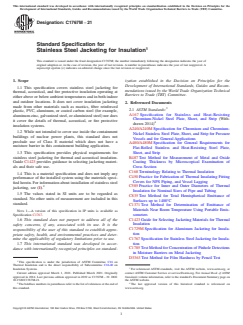
1.1 This specification covers stainless steel jacketing for thermal, acoustical, and fire protective insulation operating at either above or below ambient temperatures and in both indoor and outdoor locations. It does not cover insulation jacketing made from other materials such as mastics, fiber reinforced plastic, PVC, aluminum, or coated carbon steel (for example, aluminum-zinc, galvanized steel, or aluminized steel) nor does it cover the details of thermal, acoustical, or fire protective insulation systems.
1.2 While not intended to cover use inside the containment buildings of nuclear power plants, this standard does not preclude use of Class E material which does not have a moisture barrier in this containment building application.
1.3 This specification provides physical requirements for stainless steel jacketing for thermal and acoustical insulation. Guide C1423 provides guidance in selecting jacketing materials and their safe use.
1.4 This is a material specification and does not imply any performance of the installed system using the materials specified herein. For information about installation of stainless steel jacketing, see (1).2
1.5 The values stated in SI units are to be regarded as standard. No other units of measurement are included in this standard.
Note 1: A version of this specification in IP units is available as Specification C1767.
1.6 This standard does not purport to address all of the safety concerns, if any, associated with its use. It is the responsibility of the user of this standard to establish appropriate safety, health, and environmental practices and determine the applicability of regulatory limitations prior to use.
1.7 This international standard was developed in accordance with internationally recognized principles on standardization established in the Decision on Principles for the Development of International Standards, Guides and Recommendations issued by the World Trade Organization Technical Barriers to Trade (TBT) Committee.
- Status
- Published
- Publication Date
- 28-Feb-2021
- Technical Committee
- C16 - Thermal Insulation
- Drafting Committee
- C16.40 - Insulation Systems
Buy Documents
ASTM C1767M-21 - Standard Specification for Stainless Steel Jacketing for Insulation
REDLINE ASTM C1767M-21 - Standard Specification for Stainless Steel Jacketing for Insulation
Overview
ASTM C1767M-21: Standard Specification for Stainless Steel Jacketing for Insulation provides comprehensive requirements for stainless steel jacketing used on thermal, acoustical, and fire-protective insulation systems. The specification applies to installations operating above or below ambient temperatures in both indoor and outdoor environments, ensuring robust protection, durability, and long-term performance of insulation systems.
This standard covers the classification, material requirements, physical properties, workmanship, finish, and appearance for stainless steel jacketing but does not address other jacketing materials such as mastics, fiber-reinforced plastic, PVC, aluminum, or coated carbon steels. ASTM C1767M-21 provides vital guidance for manufacturers, specifiers, and end-users striving for reliable and consistent insulation jacketing.
Key Topics
- Material Requirements: Stainless steel jacketing must be made from alloys T-304, T-304L, T-316, or T-316L in an annealed temper, as specified by ASTM A240/A240M.
- Classification: Jacketing is classified by:
- Outer surface treatment and emittance (bare, painted, PVF film, PVdF-based paint)
- Alloy grade
- Use of moisture retarders (polyfilm, polykraft, or none)
- Physical Properties: The standard specifies:
- Thickness ranges (generally 0.25 to 1.25 mm)
- Minimum emittance values based on surface treatment
- Fire resistance (flame spread ≤ 25, smoke developed ≤ 50)
- Moisture retarder requirements, including pinhole and water vapor transmission rate limits
- Workmanship and Appearance: Products must be free from defects that affect performance or appearance; surface finishes (mill, embossed, or corrugated) must meet specific criteria.
- Dimensions & Tolerances: Provides guidelines for permissible variations in sheet and roll size, as well as tolerances for different product forms such as pre-curved, box rib, or deep corrugated sheets.
Applications
Stainless steel jacketing for insulation is used in a variety of industrial and commercial environments where insulation systems require robust mechanical, fire, and weather protection:
- Piping Systems: Protects insulation on straight pipes and fittings from physical damage and weather exposure.
- Equipment and Vessels: Provides corrosion-resistant and durable protection for insulation on tanks, vessels, columns, and process equipment, especially in outdoor or corrosive environments.
- Acoustic and Fire-Protective Systems: Stainless steel jacketing ensures integrity where fire protection or noise reduction is a priority.
- Moisture Protection: The use of moisture retarders within jacketing systems assists in preventing corrosion of both the jacket and underlying components.
Jacketing types and thicknesses are specified according to application requirements, anticipated physical abuse, and environmental conditions.
Related Standards
When specifying or selecting stainless steel jacketing, the following ASTM standards are commonly referenced:
- ASTM A240/A240M: Specifies chromium and chromium-nickel stainless steel plate, sheet, and strip requirements.
- ASTM A480/A480M: Covers general requirements for flat-rolled stainless and heat-resisting steel plate, sheet, and strip.
- ASTM C168: Establishes thermal insulation terminology.
- ASTM C1423: Provides a guide for selecting jacketing materials for thermal insulation.
- ASTM C1729M: Standard for aluminum jacketing for insulation.
- ASTM E84: Details test methods for surface burning characteristics of building materials.
- ASTM C1371, C835: Methods for determining emittance of materials.
- ASTM F1249, C1785: Test methods applicable to moisture retarder evaluation.
Practical Value
Implementing ASTM C1767M-21 ensures that insulation systems wrapped with stainless steel jacketing have a high level of performance, are protected from external risks, and meet critical regulatory and safety requirements. This standard supports effective design, procurement, and construction practices in a broad range of industries, including power generation, petrochemical processing, HVAC, and marine applications.
For reliable thermal, fire, and corrosion protection in demanding environments, adherence to this specification is crucial. Stainless steel jacketing specified and installed per ASTM C1767M-21 offers proven protection and enhances the lifespan and safety of insulation systems.
Relations
- Effective Date
- 15-Apr-2024
- Effective Date
- 01-Dec-2023
- Effective Date
- 01-Nov-2023
- Effective Date
- 01-Nov-2023
- Effective Date
- 01-Sep-2023
- Effective Date
- 01-Jun-2020
- Effective Date
- 01-Mar-2020
- Effective Date
- 01-Sep-2019
- Effective Date
- 01-Jul-2019
- Effective Date
- 15-Apr-2019
- Effective Date
- 01-Mar-2019
- Effective Date
- 01-Oct-2018
- Effective Date
- 01-Sep-2018
- Effective Date
- 01-Jul-2018
- Effective Date
- 15-Apr-2018
Buy Documents
ASTM C1767M-21 - Standard Specification for Stainless Steel Jacketing for Insulation
REDLINE ASTM C1767M-21 - Standard Specification for Stainless Steel Jacketing for Insulation
Get Certified
Connect with accredited certification bodies for this standard

DIBt (Deutsches Institut für Bautechnik)
German Institute for Building Technology.
DIN CERTCO
DIN Group product certification.

Aboma Certification B.V.
Specialized in construction, metal, and transport sectors.
Sponsored listings
Frequently Asked Questions
ASTM C1767M-21 is a technical specification published by ASTM International. Its full title is "Standard Specification for Stainless Steel Jacketing for Insulation". This standard covers: ABSTRACT This specification applies to stainless steel jacketing for thermal, acoustical, and fire protective insulation operating at either above or below ambient temperatures and in both indoor and outdoor locations. It provides physical requirements for stainless steel jacketing for thermal and acoustical insulation, but does not cover insulation jacketing made from other materials such as mastics, fiber reinforced plastic, PVC, aluminum, or coated carbon steel (for example, aluminum-zinc, galvanized steel, or aluminized steel). This specification also covers the classification of stainless steel jacketing, stainless steel jacketing materials and manufacture, required physical properties, workmanship, finish and appearance, sampling, inspection, certification, product marking, and packaging. SCOPE 1.1 This specification covers stainless steel jacketing for thermal, acoustical, and fire protective insulation operating at either above or below ambient temperatures and in both indoor and outdoor locations. It does not cover insulation jacketing made from other materials such as mastics, fiber reinforced plastic, PVC, aluminum, or coated carbon steel (for example, aluminum-zinc, galvanized steel, or aluminized steel) nor does it cover the details of thermal, acoustical, or fire protective insulation systems. 1.2 While not intended to cover use inside the containment buildings of nuclear power plants, this standard does not preclude use of Class E material which does not have a moisture barrier in this containment building application. 1.3 This specification provides physical requirements for stainless steel jacketing for thermal and acoustical insulation. Guide C1423 provides guidance in selecting jacketing materials and their safe use. 1.4 This is a material specification and does not imply any performance of the installed system using the materials specified herein. For information about installation of stainless steel jacketing, see (1).2 1.5 The values stated in SI units are to be regarded as standard. No other units of measurement are included in this standard. Note 1: A version of this specification in IP units is available as Specification C1767. 1.6 This standard does not purport to address all of the safety concerns, if any, associated with its use. It is the responsibility of the user of this standard to establish appropriate safety, health, and environmental practices and determine the applicability of regulatory limitations prior to use. 1.7 This international standard was developed in accordance with internationally recognized principles on standardization established in the Decision on Principles for the Development of International Standards, Guides and Recommendations issued by the World Trade Organization Technical Barriers to Trade (TBT) Committee.
ABSTRACT This specification applies to stainless steel jacketing for thermal, acoustical, and fire protective insulation operating at either above or below ambient temperatures and in both indoor and outdoor locations. It provides physical requirements for stainless steel jacketing for thermal and acoustical insulation, but does not cover insulation jacketing made from other materials such as mastics, fiber reinforced plastic, PVC, aluminum, or coated carbon steel (for example, aluminum-zinc, galvanized steel, or aluminized steel). This specification also covers the classification of stainless steel jacketing, stainless steel jacketing materials and manufacture, required physical properties, workmanship, finish and appearance, sampling, inspection, certification, product marking, and packaging. SCOPE 1.1 This specification covers stainless steel jacketing for thermal, acoustical, and fire protective insulation operating at either above or below ambient temperatures and in both indoor and outdoor locations. It does not cover insulation jacketing made from other materials such as mastics, fiber reinforced plastic, PVC, aluminum, or coated carbon steel (for example, aluminum-zinc, galvanized steel, or aluminized steel) nor does it cover the details of thermal, acoustical, or fire protective insulation systems. 1.2 While not intended to cover use inside the containment buildings of nuclear power plants, this standard does not preclude use of Class E material which does not have a moisture barrier in this containment building application. 1.3 This specification provides physical requirements for stainless steel jacketing for thermal and acoustical insulation. Guide C1423 provides guidance in selecting jacketing materials and their safe use. 1.4 This is a material specification and does not imply any performance of the installed system using the materials specified herein. For information about installation of stainless steel jacketing, see (1).2 1.5 The values stated in SI units are to be regarded as standard. No other units of measurement are included in this standard. Note 1: A version of this specification in IP units is available as Specification C1767. 1.6 This standard does not purport to address all of the safety concerns, if any, associated with its use. It is the responsibility of the user of this standard to establish appropriate safety, health, and environmental practices and determine the applicability of regulatory limitations prior to use. 1.7 This international standard was developed in accordance with internationally recognized principles on standardization established in the Decision on Principles for the Development of International Standards, Guides and Recommendations issued by the World Trade Organization Technical Barriers to Trade (TBT) Committee.
ASTM C1767M-21 is classified under the following ICS (International Classification for Standards) categories: 91.100.60 - Thermal and sound insulating materials. The ICS classification helps identify the subject area and facilitates finding related standards.
ASTM C1767M-21 has the following relationships with other standards: It is inter standard links to ASTM C168-24, ASTM E84-23d, ASTM A480/A480M-23b, ASTM A240/A240M-23a, ASTM E84-23c, ASTM F1249-20, ASTM C835-06(2020), ASTM A480/A480M-19, ASTM E84-19b, ASTM E84-19a, ASTM E84-19, ASTM E84-18b, ASTM A480/A480M-18, ASTM E84-18a, ASTM C168-18. Understanding these relationships helps ensure you are using the most current and applicable version of the standard.
ASTM C1767M-21 is available in PDF format for immediate download after purchase. The document can be added to your cart and obtained through the secure checkout process. Digital delivery ensures instant access to the complete standard document.
Standards Content (Sample)
This international standard was developed in accordance with internationally recognized principles on standardization established in the Decision on Principles for the
Development of International Standards, Guides and Recommendations issued by the World Trade Organization Technical Barriers to Trade (TBT) Committee.
Designation:C1767M −21
Standard Specification for
Stainless Steel Jacketing for Insulation
This standard is issued under the fixed designation C1767M; the number immediately following the designation indicates the year of
original adoption or, in the case of revision, the year of last revision. A number in parentheses indicates the year of last reapproval. A
superscript epsilon (´) indicates an editorial change since the last revision or reapproval.
1. Scope ization established in the Decision on Principles for the
Development of International Standards, Guides and Recom-
1.1 This specification covers stainless steel jacketing for
mendations issued by the World Trade Organization Technical
thermal, acoustical, and fire protective insulation operating at
Barriers to Trade (TBT) Committee.
either above or below ambient temperatures and in both indoor
and outdoor locations. It does not cover insulation jacketing
2. Referenced Documents
made from other materials such as mastics, fiber reinforced
2.1 ASTM Standards:
plastic, PVC, aluminum, or coated carbon steel (for example,
A167 Specification for Stainless and Heat-Resisting
aluminum-zinc, galvanized steel, or aluminized steel) nor does
Chromium-Nickel Steel Plate, Sheet, and Strip (With-
it cover the details of thermal, acoustical, or fire protective
drawn 2014)
insulation systems.
A240/A240M Specification for Chromium and Chromium-
1.2 While not intended to cover use inside the containment
Nickel Stainless Steel Plate, Sheet, and Strip for Pressure
buildings of nuclear power plants, this standard does not
Vessels and for General Applications
preclude use of Class E material which does not have a
A480/A480M Specification for General Requirements for
moisture barrier in this containment building application.
Flat-Rolled Stainless and Heat-Resisting Steel Plate,
1.3 This specification provides physical requirements for Sheet, and Strip
stainless steel jacketing for thermal and acoustical insulation. B487 Test Method for Measurement of Metal and Oxide
Guide C1423 provides guidance in selecting jacketing materi- Coating Thickness by Microscopical Examination of
als and their safe use. Cross Section
C168 Terminology Relating to Thermal Insulation
1.4 This is a material specification and does not imply any
C450 Practice for Fabrication of Thermal Insulating Fitting
performance of the installed system using the materials speci-
Covers for NPS Piping, and Vessel Lagging
fied herein. For information about installation of stainless steel
2 C585 Practice for Inner and Outer Diameters of Thermal
jacketing, see (1).
Insulation for Nominal Sizes of Pipe and Tubing
1.5 The values stated in SI units are to be regarded as
C835 Test Method for Total Hemispherical Emittance of
standard. No other units of measurement are included in this
Surfaces up to 1400°C
standard.
C1371 Test Method for Determination of Emittance of
Materials Near Room Temperature Using Portable Emis-
NOTE 1—A version of this specification in IP units is available as
Specification C1767.
someters
C1423 Guide for Selecting Jacketing Materials for Thermal
1.6 This standard does not purport to address all of the
Insulation
safety concerns, if any, associated with its use. It is the
C1729M Specification for Aluminum Jacketing for Insula-
responsibility of the user of this standard to establish appro-
tion
priate safety, health, and environmental practices and deter-
C1767 Specification for Stainless Steel Jacketing for Insula-
mine the applicability of regulatory limitations prior to use.
tion
1.7 This international standard was developed in accor-
C1785 Test Method for Concentration of Pinhole Detections
dance with internationally recognized principles on standard-
in Moisture Barriers on Metal Jacketing
D3363 Test Method for Film Hardness by Pencil Test
This specification is under the jurisdiction of ASTM Committee C16 on
Thermal Insulation and is the direct responsibility of Subcommittee C16.40 on
Insulation Systems. For referenced ASTM standards, visit the ASTM website, www.astm.org, or
Current edition approved March 1, 2021. Published March 2021. Originally contact ASTM Customer Service at service@astm.org. For Annual Book of ASTM
approved in 2014. Last previous edition approved in 2019 as C1767M – 19. DOI: Standards volume information, refer to the standard’s Document Summary page on
10.1520/C1767M-21. the ASTM website.
2 4
The boldface numbers in parentheses refer to the list of references at the end of The last approved version of this historical standard is referenced on
this standard. www.astm.org.
Copyright © ASTM International, 100 Barr Harbor Drive, PO Box C700, West Conshohocken, PA 19428-2959. United States
C1767M−21
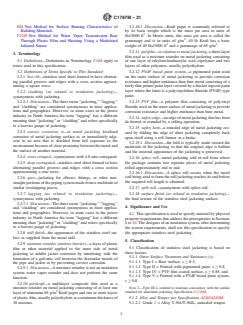
E84 Test Method for Surface Burning Characteristics of 3.2.10.1 Discussion—Kraft paper is commonly referred to
Building Materials by its basis weight which is the mass per area in units of
F1249 Test Method for Water Vapor Transmission Rate lbs/3000 ft . In Metric units, this mass per area is called the
Through Plastic Film and Sheeting Using a Modulated grammage and is in units of g/m . 40 lb Kraft has a basis
2 2
Infrared Sensor weight of 40 lbs/3000 ft and a grammage of 65 g/m .
3.2.11 polyfilm—in relation to metal jacketing, a three-layer
3. Terminology
film used as a moisture retarder on metal jacketing consisting
3.1 Definitions—Definitions in Terminology C168 apply to
of one layer of ethylene/methacrylic acid copolymer and two
terms used in this specification.
layers of other polymers, usually polyethylene.
3.2 Definitions of Terms Specific to This Standard:
3.2.12 PVdF based paint system—a pigmented paint used
3.2.1 box rib—stainless steel sheet formed to have alternat- on the outer surface of metal jacketing to provide corrosion
ing parallel grooves and ridges with a cross section approxi-
resistance and higher emittance than bare metal consisting of a
mating a square wave. fairly thin primer paint layer covered by a thicker topcoat paint
layer where the latter is a polyvinylidene fluoride (PVdF) type
3.2.2 cladding (as related to insulation jacketing)—
paint.
synonymous with jacketing.
3.2.2.1 Discussion—The three terms “jacketing,” “lagging,” 3.2.13 PVF film—a polymer film consisting of polyvinyl
and “cladding” are considered synonymous in most applica- fluoride used on the outer surface of metal jacketing to provide
tions and geographies. However, in some cases in the power corrosion resistance and higher emittance than bare metal.
industry in North America the term “lagging” has a different
3.2.14 safety edge—anedgeofmetaljacketingthathasbeen
meaning than “jacketing” or “cladding” and refers specifically
de-burred or rounded by a rolling operation.
to a heavier gauge of jacketing.
3.2.15 safety hem—a rounded edge of metal jacketing cre-
3.2.3 crevice corrosion, n—in metal jacketing localized
ated by folding the edge of sheet jacketing completely back
corrosion of metal jacketing surface at, or immediately adja-
upon itself using a roll former or a brake.
cent to an area that is shielded from full exposure to the
3.2.15.1 Discussion—the fold is typically made toward the
environment because of close proximity between the metal and
underside of the jacketing so that the original edge is hidden
the surface of another material.
and the external appearance of the jacketing is preserved
3.2.4 cross crimped—synonymous with 4.8 mm corrugated.
3.2.16 splice roll—metal jacketing sold in roll form where
3.2.5 deep corrugated—stainless steel sheet formed to have the package contains two separate pieces of metal jacketing
alternating parallel grooves and ridges with a cross section
rolled approximately end to end.
approximating a sine wave. 3.2.16.1 Discussion—A splice roll occurs when the metal
coil being used to form the roll jacketing reaches its end before
3.2.6 gore—jacketing for elbows, fittings, or other non-
the required roll length is obtained.
straightportionsofthepipingsystemmadefromamultitudeof
similar overlapping pieces. 3.2.17 split roll—synonymous with splice roll.
3.2.7 lagging (as related to insulation jacketing)— 3.2.18 surface finish (as related to insulation jacketing)—
synonymous with jacketing. the final texture of the stainless steel jacketing surface.
3.2.7.1 Discussion—The three terms “jacketing,” “lagging,”
4. Significance and Use
and “cladding” are considered synonymous in most applica-
tions and geographies. However, in some cases in the power
4.1 Thisspecificationisusedtospecifymaterialbyphysical
industry in North America the term “lagging” has a different
propertyrequirementsthataddresstheprerequisitesinSections
meaning than “jacketing” or “cladding” and refers specifically
6to10.Thedesignerofaninsulationsystem,afterdetermining
to a heavier gauge of jacketing.
the system requirements, shall use this specification to specify
the appropriate stainless steel jacketing.
3.2.8 mill finish—the appearance of the stainless steel sur-
face as supplied from the metal mill.
5. Classification
3.2.9 moisture retarder (moister barrier)—a layer of plastic
5.1 Classification of stainless steel jacketing is based on
film or other material applied to the inner side of metal
three factors:
jacketing to inhibit jacket corrosion by interfering with the
5.1.1 Outer Surface Treatment and Emittance (ε):
formation of a galvanic cell between the dissimilar metals of
5.1.1.1 Type I = Bare surface,ε≥ 0.3,
the pipe and jacket or by preventing crevice corrosion.
5.1.1.2 Type II = Painted with pigmented paint,ε≥ 0.8,
3.2.9.1 Discussion—Amoisture retarder is not an insulation
5.1.1.3 Type IV = PVF film coated surface,ε≥ 0.85, and
system water vapor retarder and does not perform the same
5.1.1.4 Type V = Painted with a PVdF based paint system,
function.
ε≥ 0.8.
3.2.10 polykraft—a multilayer composite film used as a
NOTE 2—Type III is omitted to maintain consistency with the similar
moisture retarder on metal jacketing consisting of at least one
standard for aluminum jacketing, Specification C1729M.
layer of minimum 65 g/m Kraft paper and one or more layers
of plastic film, usually polyethylene at a minimum thickness of 5.1.2 Alloy and Temper per Specification A240/A240M:
38 microns. 5.1.2.1 Grade 1 = Alloy T-304/T-304L, annealed temper
C1767M−21
5.1.2.2 Grade 2 = Alloy T-316/T-316L, annealed temper 6.6 For highly corrosive ambient conditions or to increase
emittance, the purchaser shall consider specifying that the
NOTE 3—The four allowable alloys shown in 5.1.2 are of the austenitic
outer surface of the stainless steel be coated with a pigmented
type of stainless steel.
paint (Type II), PVF film (Type IV), or with a PVdF based
NOTE 4—The “L” in the alloy is an indication of low carbon content.
Since the low carbon alloy will avoid corrosion problems caused by
paint system (Type V).
welding, a low carbon alloy is required on those rare occasions when the
6.7 Pigmented paint (Type II) and PVdF based paint sys-
stainless steel jacketing will be subjected to direct welding or the heat
from welding nearby metal. The low carbon and standard alloys are tems (Type V) must be factory applied and baked on to the
considered interchangeable for use as insulation jacketing.
outer surface.
5.1.3 Moisture Retarder:
6.8 Unless agreed to otherwise by purchaser and seller of
5.1.3.1 Class A = polyfilm, 76 microns thick
the metal jacketing, the primer layer for Type V outer surface
5.1.3.2 Class C = polykraft per section 3.2.10
treatment must have a minimum dry thickness of 5 µm and the
5.1.3.3 ClassE=no moisture retarder
PVdF topcoat must have a minimum dry thickness of 18 µm.
NOTE 5—ClassesB&Dare omitted to maintain consistency with the
NOTE 6—It is important to be aware that the minimum 18 µm thickness
similar standard for aluminum jacketing, Specification C1729M.
requirement in Table 1 applies to the topcoat of the Type V PVdF based
paint system and not to the total outer surface paint thickness.
6. Materials and Manufacture
6.9 PVF film for Type IV must be factory applied to the
6.1 Stainless steel jacketing materials are composed of a
metal jacketing outer surface using heat lamination with a
single material or a lamination of several components. The
thermally activated adhesive.
materials are supplied in the form of rolls or sheets or
6.10 PVF film for Type IV must be a minimum of 38 µm
preformedtofitthesurfacetowhichtheyaretobeapplied.The
thick.
materials are applied in the field or as a factory-applied
composite with the insulation.
6.11 Polyfilm (Class A) and polykraft (Class C) must be
6.2 Material shall be stainless steel with a mill finish of factory applied and heat laminated to the interior surface of the
metal jacketing.
either 2B or 2D per Specification A240/A240M unless an
alternative finish is agreed to by both buyer and seller.
6.12 The stainless steel used in this jacketing shall comply
6.3 Material shall be stainless steel and shall have a surface with the general, chemical composition, and mechanical prop-
finish that is smooth, 4.8 mm corrugated, or stucco embossed.
erty requirements of Specification A240/A240M—alloys
The dimensions of corrugations (pitch and depth) must be T-304, T-304L, T-316, or T316L with annealed temper—
agreed to by manufacturer and purchaser to achieve
Grades 1 or 2 per 5.1.2.
interchangeability, constant rigidity, and appearance. NOTE 7—In some cases, compliance to Specification A480/A480M is
requested for stainless steel jacketing. Specification A240/A240M re-
6.4 When agreed upon by purchaser and seller, stainless
quires compliance to a number of general requirements contained within
steel sheets used as pipe insulation jacketing (see 8.2) shall
A480/A480Mandadditionallyhasrequirementsforchemicalcomposition
have a safety edge or a 10 to 13 mm safety hem along one and mechanical properties so it is preferred and more thorough to require
compliance with Specification A240/A240M.
entire width edge of the sheet. Stainless steel jacketing with a
NOTE 8—In some cases, compliance to Specification A167 is requested
safetyedgeorsafetyhemmuststillmeetthelengthdimensions
for stainless steel jacketing. Specification A167-99(2009) contains the
specified in 8.2.1.Asafety hem shall not be specified when the
following: “Grades that were previously covered in both Specifications
finish is 4.8 mm corrugated.
A167 and A240/A240M have been removed from this specification and
may now be supplied and purchased in compliance with Specification
6.5 In most cases, the inner surface of stainless steel
A240/A240M. The chemical and mechanical property requirements of
jacketing material is coated or covered with a moisture
these grades were identical in Specifications A167 and A240/A240M at
resistant film to retard possible galvanic or chemical corrosion,
the time of removal from Specification A167.” Since the grades used for
or both, of the jacketing and underlying pipe or equipment. stainless steel jacketing have effectively been transferred to and are now
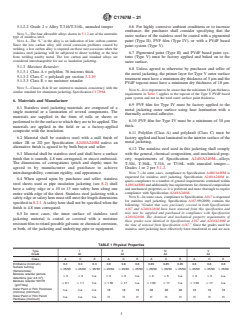
TABLE 1 Physical Properties
Type I II IV V
Grade All All All All
Class A C E A C E A C E A C E
Emittance (minimum) 0.3 0.3 0.3 0.8 0.8 0.8 0.85 0.85 0.85 0.8 0.8 0.8
Surface burning
# 25/50 # 25/50 # 25/50 # 25/50 # 25/50 # 25/50 # 25/50 # 25/50 # 25/50 # 25/50 # 25/50 # 25/50
(flame/smoke)
Moisture retarder pinhole
# 5 # 5 n.a. # 5 # 5 n.a. # 5 # 5 n.a. # 5 # 5 n.a.
detections (per 4.6 m )
Moisture retarder WVTR
# 0.1 # 1.1 n.a. # 1.55 # 17 n.a. # 1.55 # 17 n.a. # 1.55 # 17 n.a.
(g/m /day)
Outer Paint or Film Thickness
n.a. n.a. n.a. 18 18 18 38 38 38 18 18 18
(microns) (minimum)
Outer Paint or Film Pencil
n.a. n.a. n.a. H H H H H H H H H
Hardness (minimum)
C1767M−21
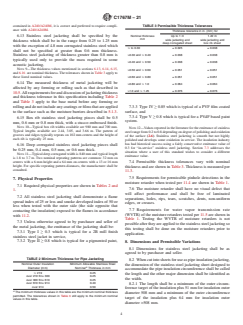
contained in A240/A240M, it is correct and preferred to require compli- TABLE 3 Permissible Thickness Tolerances
ance with A240/A240M.
Thickness tolerance in in. (mm) for
Nominal thickness
6.13 Stainless steel jacketing shall be specified by the Upto1m 1.22 m
mm
wide jacketing and wide jacketing and
thickness which shall be in the range from 0.25 to 1.25 mm
deep corrugated sheet box rib sheet
with the exception of 4.8 mm corrugated stainless steel which
# to 0.30 ± 0.025 ± 0.038
shall not be specified at greater than 0.6 mm thickness.
Stainless steel jacketing of thickness greater than 0.8 mm is >0.30 and# 0.40 ± 0.038 ± 0.038
typically used only to provide the mass required in some
>0.40 and# 0.50 ± 0.038 ± 0.038
acoustic jacketing.
NOTE 9—The thickness values mentioned in sections 6.13, 6.14, 6.15, >0.50 and# 0.60 ± 0.051 ± 0.051
and 6.16 are nominal thickness.The tolerances shown in Table 3 apply to
>0.60 and# 0.80 ± 0.051 ± 0.051
these listed nominal values.
6.14 The measured thickness of metal jacketing will be
>0.80 and# 1.0 ± 0.064 ± 0.064
affected by any forming or rolling such as that described in
>1.0 and# 1.25 ± 0.076 ± 0.076
10.5.Allrequirementsforanddiscussionofjacketingthickness
and thickness tolerance in this specification including Table 2
and Table 3 apply to the base metal before any forming or
rollinganddonotincludeanycoatingsorfilmsthatareapplied
7.3.3 Type IV ≥ 0.85 which is typical of a PVF film coated
to the surface such as the moisture barriers described in 5.1.3. surface, and
7.3.4 Type V ≥ 0.8 which is typical for a PVdF based paint
6.15 Box rib stainless steel jacketin
...
This document is not an ASTM standard and is intended only to provide the user of an ASTM standard an indication of what changes have been made to the previous version. Because
it may not be technically possible to adequately depict all changes accurately, ASTM recommends that users consult prior editions as appropriate. In all cases only the current version
of the standard as published by ASTM is to be considered the official document.
Designation: C1767M − 19 C1767M − 21
Standard Specification for
Stainless Steel Jacketing for Insulation
This standard is issued under the fixed designation C1767M; the number immediately following the designation indicates the year of
original adoption or, in the case of revision, the year of last revision. A number in parentheses indicates the year of last reapproval. A
superscript epsilon (´) indicates an editorial change since the last revision or reapproval.
1. Scope
1.1 This specification covers stainless steel jacketing for thermal, acoustical, and fire protective insulation operating at either above
or below ambient temperatures and in both indoor and outdoor locations. It does not cover insulation jacketing made from other
materials such as mastics, fiber reinforced plastic, PVC, aluminum, or coated carbon steel (for example, aluminum-zinc, galvanized
steel, or aluminized steel) nor does it cover the details of thermal, acoustical, or fire protective insulation systems.
1.2 While not intended to cover use inside the containment buildings of nuclear power plants, this standard does not preclude use
of Class E material which does not have a moisture barrier in this containment building application.
1.3 This specification provides physical requirements for stainless steel jacketing for thermal and acoustical insulation. Guide
C1423 provides guidance in selecting jacketing materials and their safe use.
1.4 This is a material specification and does not imply any performance of the installed system using the materials specified herein.
For information about installation of stainless steel jacketing, see (1).
1.5 The values stated in SI units are to be regarded as standard. No other units of measurement are included in this standard.
NOTE 1—A version of this specification in IP units is available as Specification C1767.
1.6 This standard does not purport to address all of the safety concerns, if any, associated with its use. It is the responsibility
of the user of this standard to establish appropriate safety, health, and environmental practices and determine the applicability of
regulatory limitations prior to use.
1.7 This international standard was developed in accordance with internationally recognized principles on standardization
established in the Decision on Principles for the Development of International Standards, Guides and Recommendations issued
by the World Trade Organization Technical Barriers to Trade (TBT) Committee.
2. Referenced Documents
2.1 ASTM Standards:
A167 Specification for Stainless and Heat-Resisting Chromium-Nickel Steel Plate, Sheet, and Strip (Withdrawn 2014)
This specification is under the jurisdiction of ASTM Committee C16 on Thermal Insulation and is the direct responsibility of Subcommittee C16.40 on Insulation
Systems.
Current edition approved Sept. 1, 2019March 1, 2021. Published September 2019March 2021. Originally approved in 2014. Last previous edition approved in 20162019
as C1767M – 16a.C1767M – 19. DOI: 10.1520/C1767M-19.10.1520/C1767M-21.
The boldface numbers in parentheses refer to the list of references at the end of this standard.
For referenced ASTM standards, visit the ASTM website, www.astm.org, or contact ASTM Customer Service at service@astm.org. For Annual Book of ASTM Standards
volume information, refer to the standard’s Document Summary page on the ASTM website.
The last approved version of this historical standard is referenced on www.astm.org.
Copyright © ASTM International, 100 Barr Harbor Drive, PO Box C700, West Conshohocken, PA 19428-2959. United States
C1767M − 21
A240/A240M Specification for Chromium and Chromium-Nickel Stainless Steel Plate, Sheet, and Strip for Pressure Vessels and
for General Applications
A480/A480M Specification for General Requirements for Flat-Rolled Stainless and Heat-Resisting Steel Plate, Sheet, and Strip
B487 Test Method for Measurement of Metal and Oxide Coating Thickness by Microscopical Examination of Cross Section
C168 Terminology Relating to Thermal Insulation
C450 Practice for Fabrication of Thermal Insulating Fitting Covers for NPS Piping, and Vessel Lagging
C585 Practice for Inner and Outer Diameters of Thermal Insulation for Nominal Sizes of Pipe and Tubing
C835 Test Method for Total Hemispherical Emittance of Surfaces up to 1400°C
C1371 Test Method for Determination of Emittance of Materials Near Room Temperature Using Portable Emissometers
C1423 Guide for Selecting Jacketing Materials for Thermal Insulation
C1729M Specification for Aluminum Jacketing for Insulation
C1767 Specification for Stainless Steel Jacketing for Insulation
C1785 Test Method for Concentration of Pinhole Detections in Moisture Barriers on Metal Jacketing
D3363 Test Method for Film Hardness by Pencil Test
E84 Test Method for Surface Burning Characteristics of Building Materials
F1249 Test Method for Water Vapor Transmission Rate Through Plastic Film and Sheeting Using a Modulated Infrared Sensor
3. Terminology
3.1 Definitions—Definitions in Terminology C168 apply to terms used in this specification.
3.2 Definitions of Terms Specific to This Standard:
3.2.1 box rib—stainless steel sheet formed to have alternating parallel grooves and ridges with a cross section approximating a
square wave.
3.2.2 cladding (as related to insulation jacketing)—synonymous with jacketing.
3.2.2.1 Discussion—
The three terms “jacketing,” “lagging,” and “cladding” are considered synonymous in most applications and geographies.
However, in some cases in the power industry in North America the term “lagging” has a different meaning than “jacketing” or
“cladding” and refers specifically to a heavier gauge of jacketing.
3.2.3 crevice corrosion, n—in metal jacketing localized corrosion of metal jacketing surface at, or immediately adjacent to an area
that is shielded from full exposure to the environment because of close proximity between the metal and the surface of another
material.
3.2.4 cross crimped—synonymous with 4.8 mm corrugated.
3.2.5 deep corrugated—stainless steel sheet formed to have alternating parallel grooves and ridges with a cross section
approximating a sine wave.
3.2.6 gore—jacketing for elbows, fittings, or other non-straight portions of the piping system made from a multitude of similar
overlapping pieces.
3.2.7 lagging (as related to insulation jacketing)—synonymous with jacketing.
3.2.7.1 Discussion—
The three terms “jacketing,” “lagging,” and “cladding” are considered synonymous in most applications and geographies.
However, in some cases in the power industry in North America the term “lagging” has a different meaning than “jacketing” or
“cladding” and refers specifically to a heavier gauge of jacketing.
3.2.8 mill finish—the appearance of the stainless steel surface as supplied from the metal mill.
3.2.9 moisture retarder (moister barrier)—a layer of plastic film or other material applied to the inner side of metal jacketing to
inhibit jacket corrosion by interfering with the formation of a galvanic cell between the dissimilar metals of the pipe and jacket
or by preventing crevice corrosion.
3.2.9.1 Discussion—
A moisture retarder is not an insulation system water vapor retarder and does not perform the same function.
C1767M − 21
3.2.10 polykraft—a multilayer composite film used as a moisture retarder on metal jacketing consisting of at least one layer of
minimum 65 g/m Kraft paper and one or more layers of plastic film, usually polyethylene at a minimum thickness of 38 microns.
3.2.10.1 Discussion—
Kraft paper is commonly referred to by its basis weight which is the mass per area in units of lbs/3000 ft . In Metric units, this
2 2
mass per area is called the grammage and is in units of g/m . 40 lb Kraft has a basis weight of 40 lbs/3000 ft and a grammage
of 65 g/m .
3.2.11 polyfilm—in relation to metal jacketing, a three-layer film used as a moisture retarder on metal jacketing consisting of one
layer of ethylene/methacrylic acid copolymer and two layers of other polymers, usually polyethylene.
3.2.12 PVdF based paint system—a pigmented paint used on the outer surface of metal jacketing to provide corrosion resistance
and higher emittance than bare metal consisting of a fairly thin primer paint layer covered by a thicker topcoat paint layer where
the latter is a polyvinylidene fluoride (PVdF) type paint.
3.2.13 PVF film—a polymer film consisting of polyvinyl fluoride used on the outer surface of metal jacketing to provide corrosion
resistance and higher emittance than bare metal.
3.2.14 safety edge—an edge of metal jacketing that has been de-burred or rounded by a rolling operation.
3.2.15 safety hem—a rounded edge of metal jacketing created by folding the edge of sheet jacketing completely back upon itself
using a roll former or a brake.
3.2.15.1 Discussion—
the fold is typically made toward the underside of the jacketing so that the original edge is hidden and the external appearance of
the jacketing is preserved
3.2.16 splice roll—metal jacketing sold in roll form where the package contains two separate pieces of metal jacketing rolled
approximately end to end.
3.2.16.1 Discussion—
A splice roll occurs when the metal coil being used to form the roll jacketing reaches its end before the required roll length is
obtained.
3.2.17 split roll—synonymous with splice roll.
3.2.18 surface finish (as related to insulation jacketing)—the final texture of the stainless steel jacketing surface.
4. Significance and Use
4.1 This specification is used to specify material by physical property requirements that address the prerequisites in Sections 6 to
10. The designer of an insulation system, after determining the system requirements, shall use this specification to specify the
appropriate stainless steel jacketing.
5. Classification
5.1 Classification of stainless steel jacketing is based on three factors:
5.1.1 Outer Surface Treatment and Emittance (ε):
5.1.1.1 Type I = Bare surface, ε ≥ 0.3,
5.1.1.2 Type II = Painted with pigmented paint, ε ≥ 0.8,
5.1.1.3 Type IV = PVF film coated surface, ε ≥ 0.85, and
5.1.1.4 Type V = Painted with a PVdF based paint system, ε ≥ 0.8.
C1767M − 21
NOTE 2—Type III is omitted to maintain consistency with the similar standard for aluminum jacketing, Specification C1729M.
5.1.2 Alloy and Temper per Specification A240/A240M:
5.1.2.1 Grade 1 = Alloy T-304/T-304L, annealed temper
5.1.2.2 Grade 2 = Alloy T-316/T-316L, annealed temper
NOTE 3—The four allowable alloys shown in 5.1.2 are of the austenitic type of stainless steel.
NOTE 4—The “L” in the alloy is an indication of low carbon content. Since the low carbon alloy will avoid corrosion problems caused by welding, a low
carbon alloy is required on those rare occasions when the stainless steel jacketing will be subjected to direct welding or the heat from welding nearby
metal. The low carbon and standard alloys are considered interchangeable for use as insulation jacketing.
5.1.3 Moisture Retarder:
5.1.3.1 Class A = polyfilm, 76 microns thick
5.1.3.2 Class C = polykraft per section 3.2.10
5.1.3.3 Class E = no moisture retarder
NOTE 5—Classes B & D are omitted to maintain consistency with the similar standard for aluminum jacketing, Specification C1729M.
6. Materials and Manufacture
6.1 Stainless steel jacketing materials are composed of a single material or a lamination of several components. The materials are
supplied in the form of rolls or sheets or preformed to fit the surface to which they are to be applied. The materials are applied
in the field or as a factory-applied composite with the insulation.
6.2 Material shall be stainless steel with a mill finish of either 2B or 2D per Specification A240/A240M unless an alternative finish
is agreed to by both buyer and seller.
6.3 Material shall be stainless steel and shall have a surface finish that is smooth, 4.8 mm corrugated, or stucco embossed. The
dimensions of corrugations (pitch and depth) must be agreed to by manufacturer and purchaser to achieve interchangeability,
constant rigidity, and appearance.
6.4 When agreed upon by purchaser and seller, stainless steel sheets used as pipe insulation jacketing (see 8.2) shall have a safety
edge or a 10 to 13 mm safety hem along one entire width edge of the sheet. Stainless steel jacketing with a safety edge or safety
hem must still meet the length dimensions specified in 8.2.1. A safety hem shall not be specified when the finish is 4.8 mm
corrugated.
6.5 In most cases, the inner surface of stainless steel jacketing material is coated or covered with a moisture resistant film to retard
possible galvanic or chemical corrosion, or both, of the jacketing and underlying pipe or equipment.
6.6 For highly corrosive ambient conditions or to increase emittance, the purchaser shall consider specifying that the outer surface
of the stainless steel be coated with a pigmented paint (Type II), PVF film (Type IV), or with a PVdF based paint system (Type
V).
6.7 Pigmented paint (Type II) and PVdF based paint systems (Type V) must be factory applied and baked on to the outer surface.
6.8 Unless agreed to otherwise by purchaser and seller of the metal jacketing, the primer layer for Type V outer surface treatment
must have a minimum dry thickness of 5 μm and the PVdF topcoat must have a minimum dry thickness of 18 μm.
NOTE 6—It is important to be aware that the minimum 18 μm thickness requirement in Table 1 applies to the topcoat of the Type V PVdF based paint
system and not to the total outer surface paint thickness.
C1767M − 21
TABLE 1 Physical Properties
Type I II IV V
Grade All All All All
Class A C E A C E A C E A C E
Emittance (minimum) 0.3 0.3 0.3 0.8 0.8 0.8 0.85 0.85 0.85 0.8 0.8 0.8
Surface burning
# 25/50 # 25/50 # 25/50 # 25/50 # 25/50 # 25/50 # 25/50 # 25/50 # 25/50 # 25/50 # 25/50 # 25/50
(flame/smoke)
Moisture retarder pinhole
# 5 # 5 n.a. # 5 # 5 n.a. # 5 # 5 n.a. # 5 # 5 n.a.
detections (per 4.6 m )
Moisture retarder WVTR
# 0.1 # 1.1 n.a. # 1.55 # 17 n.a. # 1.55 # 17 n.a. # 1.55 # 17 n.a.
(g/m /day)
Outer Paint or Film Thickness
n.a. n.a. n.a. 18 18 18 38 38 38 18 18 18
(microns) (minimum)
Outer Paint or Film Pencil
n.a. n.a. n.a. H H H H H H H H H
Hardness (minimum)
6.9 PVF film for Type IV must be factory applied to the metal jacketing outer surface using heat lamination with a thermally
activated adhesive.
6.10 PVF film for Type IV must be a minimum of 38 μm thick.
6.11 Polyfilm (Class A) and polykraft (Class C) must be factory applied and heat laminated to the interior surface of the metal
jacketing.
6.12 The stainless steel used in this jacketing shall comply with the general, chemical composition, and mechanical property
requirements of Specification A240/A240M—alloys T-304, T-304L, T-316, or T316L with annealed temper—Grades 1 or 2 per
5.1.2.
NOTE 7—In some cases, compliance to Specification A480/A480M is requested for stainless steel jacketing. Specification A240/A240M requires
compliance to a number of general requirements contained within A480/A480M and additionally has requirements for chemical composition and
mechanical properties so it is preferred and more thorough to require compliance with Specification A240/A240M.
NOTE 8—In some cases, compliance to Specification A167 is requested for stainless steel jacketing. Specification A167-99(2009) contains the following:
“Grades that were previously covered in both Specifications A167 and A240/A240M have been removed from this specification and may now be supplied
and purchased in compliance with Specification A240/A240M. The chemical and mechanical property requirements of these grades were identical in
Specifications A167 and A240/A240M at the time of removal from Specification A167.” Since the grades used for stainless steel jacketing have effectively
been transferred to and are now contained in A240/A240M, it is correct and preferred to require compliance with A240/A240M.
6.13 Stainless steel jacketing shall be specified by the thickness which shall be in the range from 0.25 to 1.25 mm with the
exception of 4.8 mm corrugated stainless steel which shall not be specified at greater than 0.6 mm thickness. Stainless steel
jacketing of thickness greater than 0.8 mm is typically used only to provide the mass required in some acoustic jacketing.
NOTE 9—The thickness values mentioned in sections 6.13, 6.14, 6.15, and 6.16 are nominal thickness. The tolerances shown in Table 3 apply to these
listed nominal values.
6.14 The measured thickness of metal jacketing will be affected by any forming or rolling such as that described in 10.5. All
TABLE 2 Minimum Thickness for Pipe Jacketing
Nominal Outer Insulation Minimum Allowable Stainless Steel
A
Diameter (mm) Nominal Thickness in mm
# 219 0.25
over 219 thru 300 0.25
over 300 thru 610 0.25
over 610 thru 914 0.40
over 914 0.50
A
The minimum thickness values in this table are the minimum nominal thickness
permitted. The tolerances shown in Table 3 still apply to the minimum nominal
values in this table.
C1767M − 21
TABLE 3 Permissible Thickness Tolerances
Thickness tolerance in in. (mm) for
Nominal thickness
Up to 1 m 1.22 m
mm
wide jacketing and wide jacketing and
deep corrugated sheet box rib sheet
# to 0.30 ± 0.025 ± 0.038
>0.30 and # 0.40 ± 0.038 ± 0.038
>0.40 and # 0.50 ± 0.038 ± 0.038
>0.50 and # 0.60 ± 0.051 ± 0.051
>0.60 and # 0.80 ± 0.051 ± 0.051
>0.80 and # 1.0 ± 0.064 ± 0.064
>1.0 and # 1.25 ± 0.076
...