

ASTM C835-06(2020)
(Test Method)Standard Test Method for Total Hemispherical Emittance of Surfaces up to 1400°C
General Information
- Abstract
SIGNIFICANCE AND USE
5.1 The emittance as measured by this test method can be used in the calculation of radiant heat transfer from surfaces that are representative of the tested specimens, and that are within the temperature range of the tested specimens.
5.2 This test method can be used to determine the effect of service conditions on the emittance of materials. In particular, the use of this test method with furnace exposure (time at temperature) of the materials commonly used in all-metallic insulations can determine the effects of oxidation on emittance.
5.3 The measurements described in this test method are conducted in a vacuum environment. Usually this condition will provide emittance values that are applicable to materials used under other conditions, such as in an air environment. However, it must be recognized that surface properties of materials used in air or other atmospheres may be different. In addition, preconditioned surfaces, as described in 5.2, may be altered in a vacuum environment because of vacuum stripping of absorbed gases and other associated vacuum effects. Thus, emittances measured under vacuum may have values that differ from those that exist in air, and the user must be aware of this situation. With these qualifications in mind, emittance obtained by this test method may be applied to predictions of thermal transference.
5.4 Several assumptions are made in the derivation of the emittance calculation as described in this test method. They are that:
5.4.1 The enclosure is a blackbody emitter at a uniform temperature,
5.4.2 The total hemispherical absorptance of the completely diffuse blackbody radiation at the temperature of the enclosure is equal to the total hemispherical emittance of the specimen at its temperature, and
5.4.3 There is no heat loss from the test section by convection or conduction. For most materials tested by the procedures as described in this test method, the effects of these assumptions are small and either neglected...
SCOPE
1.1 This calorimetric test method covers the determination of total hemispherical emittance of metal and graphite surfaces and coated metal surfaces up to approximately 1400°C. The upper-use temperature is limited only by the characteristics (for example, melting temperature, vapor pressure) of the specimen and the design limits of the test facility. This test method has been demonstrated for use up to 1400 °C. The lower-use temperature is limited by the temperature of the bell jar.
1.2 The values stated in SI units are to be regarded as standard. No other units of measurement are included in this standard.
1.3 This standard does not purport to address all of the safety concerns, if any, associated with its use. It is the responsibility of the user of this standard to establish appropriate safety, health, and environmental practices and determine the applicability of regulatory limitations prior to use. For specific hazard statements, see Section 7.
1.4 This international standard was developed in accordance with internationally recognized principles on standardization established in the Decision on Principles for the Development of International Standards, Guides and Recommendations issued by the World Trade Organization Technical Barriers to Trade (TBT) Committee.
- Status
- Published
- Publication Date
- 29-Feb-2020
- Technical Committee
- C16 - Thermal Insulation
- Drafting Committee
- C16.30 - Thermal Measurement
Overview
ASTM C835-06(2020): Standard Test Method for Total Hemispherical Emittance of Surfaces up to 1400°C provides a reliable calorimetric method for determining the total hemispherical emittance of metal and graphite surfaces, including coated metals, at high temperatures. The standard is significant for assessing how surfaces emit thermal radiation, which is crucial for thermal management, heat transfer calculations, and material performance evaluation in various industries. Emittance values determined by this method are essential inputs for predicting radiant heat transfer, analyzing thermal insulation performance, and evaluating the effects of environmental exposure, such as oxidation, on material properties.
This test method is performed in a vacuum environment to ensure measurement accuracy by minimizing heat loss through convection and conduction. While primarily referenced for metallic and graphite samples up to 1400°C, the practical upper temperature is dictated by sample and equipment limits.
Key Topics
- Total Hemispherical Emittance: This metric quantifies how much thermal radiation a surface emits compared to an ideal blackbody, integrating over all wavelengths and angles.
- Calorimetric Test Procedure: A sample is heated resistively in a vacuum, and emitted energy is measured using thermocouples and power input data to calculate emittance.
- Vacuum Testing Environment: Conducting the test in a vacuum reduces error from gas convection and conduction, although surface properties may differ versus tests in other atmospheres.
- Apparatus and Safety: The method outlines the need for specific equipment, including a coated bell jar, accurate power measurement devices, thermocouples, and proper vacuum systems. Safety measures include protective shielding for glass bell jars and careful handling of thin metal samples.
- Material and Surface Conditioning: The method accounts for changes in surface emittance due to service exposure, such as furnace aging and oxidation, reflecting real-world applications.
- Calculation Assumptions: The method assumes a uniform blackbody enclosure, negligible conduction and convection, and direct radiant exchange, allowing for corrections if these are not strictly met.
Applications
- Thermal Insulation Evaluation: Supports the development and quality control of thermal insulation materials, particularly all-metallic insulation used at elevated temperatures.
- High-Temperature Engineering: Useful for aerospace, industrial furnaces, power generation, and any system requiring precise heat transfer calculations for surfaces at elevated temperatures.
- Material Performance Analysis: Determines how extended service conditions (e.g., high-temperature oxidation) alter surface radiative properties, informing maintenance cycles and material selection.
- Research and Development: Assists in comparing emittance properties of new materials or coatings, especially those designed for thermal control or energy efficiency.
- Predictive Modeling: Data obtained enables engineers and scientists to simulate real-world thermal systems with greater fidelity by applying accurate emittance values.
Related Standards
The following standards are referenced within ASTM C835-06(2020) or provide related methods and terminology:
- ASTM C168: Terminology Relating to Thermal Insulation
- ASTM E230: Specification for Temperature-Electromotive Force (emf) Tables for Standardized Thermocouples
- ASTM E691: Practice for Conducting an Interlaboratory Study to Determine the Precision of a Test Method
Additional information and related best practices can be found in standards for thermal conductivity, material property testing at elevated temperatures, and thermal radiation measurement protocols.
Keywords: hemispherical emittance, thermal emittance testing, ASTM C835, high temperature surfaces, vacuum calorimetry, thermal insulation, oxidation effects, radiant heat transfer, metal emittance, graphite emittance, blackbody radiation.
Relations
- Effective Date
- 01-Mar-2020
- Effective Date
- 15-Apr-2024
- Effective Date
- 15-Apr-2018
- Effective Date
- 01-Jun-2017
- Effective Date
- 15-Oct-2015
- Effective Date
- 01-Jun-2015
- Effective Date
- 01-May-2013
- Effective Date
- 01-Apr-2013
- Effective Date
- 01-Nov-2011
- Effective Date
- 01-Jan-2010
- Effective Date
- 15-Dec-2008
- Effective Date
- 01-Oct-2008
- Effective Date
- 01-Sep-2008
- Effective Date
- 01-Jun-2008
- Effective Date
- 01-Nov-2005
Get Certified
Connect with accredited certification bodies for this standard

BSMI (Bureau of Standards, Metrology and Inspection)
Taiwan's standards and inspection authority.
Sponsored listings
Frequently Asked Questions
ASTM C835-06(2020) is a standard published by ASTM International. Its full title is "Standard Test Method for Total Hemispherical Emittance of Surfaces up to 1400°C". This standard covers: SIGNIFICANCE AND USE 5.1 The emittance as measured by this test method can be used in the calculation of radiant heat transfer from surfaces that are representative of the tested specimens, and that are within the temperature range of the tested specimens. 5.2 This test method can be used to determine the effect of service conditions on the emittance of materials. In particular, the use of this test method with furnace exposure (time at temperature) of the materials commonly used in all-metallic insulations can determine the effects of oxidation on emittance. 5.3 The measurements described in this test method are conducted in a vacuum environment. Usually this condition will provide emittance values that are applicable to materials used under other conditions, such as in an air environment. However, it must be recognized that surface properties of materials used in air or other atmospheres may be different. In addition, preconditioned surfaces, as described in 5.2, may be altered in a vacuum environment because of vacuum stripping of absorbed gases and other associated vacuum effects. Thus, emittances measured under vacuum may have values that differ from those that exist in air, and the user must be aware of this situation. With these qualifications in mind, emittance obtained by this test method may be applied to predictions of thermal transference. 5.4 Several assumptions are made in the derivation of the emittance calculation as described in this test method. They are that: 5.4.1 The enclosure is a blackbody emitter at a uniform temperature, 5.4.2 The total hemispherical absorptance of the completely diffuse blackbody radiation at the temperature of the enclosure is equal to the total hemispherical emittance of the specimen at its temperature, and 5.4.3 There is no heat loss from the test section by convection or conduction. For most materials tested by the procedures as described in this test method, the effects of these assumptions are small and either neglected... SCOPE 1.1 This calorimetric test method covers the determination of total hemispherical emittance of metal and graphite surfaces and coated metal surfaces up to approximately 1400°C. The upper-use temperature is limited only by the characteristics (for example, melting temperature, vapor pressure) of the specimen and the design limits of the test facility. This test method has been demonstrated for use up to 1400 °C. The lower-use temperature is limited by the temperature of the bell jar. 1.2 The values stated in SI units are to be regarded as standard. No other units of measurement are included in this standard. 1.3 This standard does not purport to address all of the safety concerns, if any, associated with its use. It is the responsibility of the user of this standard to establish appropriate safety, health, and environmental practices and determine the applicability of regulatory limitations prior to use. For specific hazard statements, see Section 7. 1.4 This international standard was developed in accordance with internationally recognized principles on standardization established in the Decision on Principles for the Development of International Standards, Guides and Recommendations issued by the World Trade Organization Technical Barriers to Trade (TBT) Committee.
SIGNIFICANCE AND USE 5.1 The emittance as measured by this test method can be used in the calculation of radiant heat transfer from surfaces that are representative of the tested specimens, and that are within the temperature range of the tested specimens. 5.2 This test method can be used to determine the effect of service conditions on the emittance of materials. In particular, the use of this test method with furnace exposure (time at temperature) of the materials commonly used in all-metallic insulations can determine the effects of oxidation on emittance. 5.3 The measurements described in this test method are conducted in a vacuum environment. Usually this condition will provide emittance values that are applicable to materials used under other conditions, such as in an air environment. However, it must be recognized that surface properties of materials used in air or other atmospheres may be different. In addition, preconditioned surfaces, as described in 5.2, may be altered in a vacuum environment because of vacuum stripping of absorbed gases and other associated vacuum effects. Thus, emittances measured under vacuum may have values that differ from those that exist in air, and the user must be aware of this situation. With these qualifications in mind, emittance obtained by this test method may be applied to predictions of thermal transference. 5.4 Several assumptions are made in the derivation of the emittance calculation as described in this test method. They are that: 5.4.1 The enclosure is a blackbody emitter at a uniform temperature, 5.4.2 The total hemispherical absorptance of the completely diffuse blackbody radiation at the temperature of the enclosure is equal to the total hemispherical emittance of the specimen at its temperature, and 5.4.3 There is no heat loss from the test section by convection or conduction. For most materials tested by the procedures as described in this test method, the effects of these assumptions are small and either neglected... SCOPE 1.1 This calorimetric test method covers the determination of total hemispherical emittance of metal and graphite surfaces and coated metal surfaces up to approximately 1400°C. The upper-use temperature is limited only by the characteristics (for example, melting temperature, vapor pressure) of the specimen and the design limits of the test facility. This test method has been demonstrated for use up to 1400 °C. The lower-use temperature is limited by the temperature of the bell jar. 1.2 The values stated in SI units are to be regarded as standard. No other units of measurement are included in this standard. 1.3 This standard does not purport to address all of the safety concerns, if any, associated with its use. It is the responsibility of the user of this standard to establish appropriate safety, health, and environmental practices and determine the applicability of regulatory limitations prior to use. For specific hazard statements, see Section 7. 1.4 This international standard was developed in accordance with internationally recognized principles on standardization established in the Decision on Principles for the Development of International Standards, Guides and Recommendations issued by the World Trade Organization Technical Barriers to Trade (TBT) Committee.
ASTM C835-06(2020) is classified under the following ICS (International Classification for Standards) categories: 17.040.20 - Properties of surfaces. The ICS classification helps identify the subject area and facilitates finding related standards.
ASTM C835-06(2020) has the following relationships with other standards: It is inter standard links to ASTM C835-06(2013)e1, ASTM C168-24, ASTM C168-18, ASTM C168-17, ASTM C168-15a, ASTM C168-15, ASTM E691-13, ASTM C168-13, ASTM E691-11, ASTM C168-10, ASTM C168-08b, ASTM E691-08, ASTM C168-08a, ASTM C168-08, ASTM C168-05a. Understanding these relationships helps ensure you are using the most current and applicable version of the standard.
ASTM C835-06(2020) is available in PDF format for immediate download after purchase. The document can be added to your cart and obtained through the secure checkout process. Digital delivery ensures instant access to the complete standard document.
Standards Content (Sample)
This international standard was developed in accordance with internationally recognized principles on standardization established in the Decision on Principles for the
Development of International Standards, Guides and Recommendations issued by the World Trade Organization Technical Barriers to Trade (TBT) Committee.
Designation: C835 − 06 (Reapproved 2020)
Standard Test Method for
Total Hemispherical Emittance of Surfaces up to 1400°C
This standard is issued under the fixed designation C835; the number immediately following the designation indicates the year of
original adoption or, in the case of revision, the year of last revision.Anumber in parentheses indicates the year of last reapproval.A
superscript epsilon (´) indicates an editorial change since the last revision or reapproval.
1. Scope 3. Terminology
3.1 Definitions—The terms and symbols are as defined in
1.1 This calorimetric test method covers the determination
Terminology C168 with exceptions included as appropriate.
oftotalhemisphericalemittanceofmetalandgraphitesurfaces
3.2 Symbols:
and coated metal surfaces up to approximately 1400°C. The
upper-usetemperatureislimitedonlybythecharacteristics(for
e = error in the variable i, 6 %,
i
example,meltingtemperature,vaporpressure)ofthespecimen
ε = total hemispherical emittance of heated specimen,
and the design limits of the test facility. This test method has
dimensionless,
been demonstrated for use up to 1400°C. The lower-use
ε = total hemispherical emittance of bell jar inner surface,
temperature is limited by the temperature of the bell jar.
dimensionless,
σ = Stefan-Boltzmann constant,
1.2 The values stated in SI units are to be regarded as
−8 2 4
= 5.669×10 W/m ·K ,
standard. No other units of measurement are included in this
Q = heat flow rate, W,
standard.
T = temperature of heated specimen, K,
1.3 This standard does not purport to address all of the
T = temperature of bell jar inner surface, K,
safety concerns, if any, associated with its use. It is the
A = surfaceareaofspecimenoverwhichheatgenerationis
responsibility of the user of this standard to establish appro-
measured, m ,
priate safety, health, and environmental practices and deter-
A = surface area of bell jar inner surface, m ,
mine the applicability of regulatory limitations prior to use.
F = the gray body shape factor, which includes the effect
For specific hazard statements, see Section 7.
of geometry and the departure of real surfaces from
1.4 This international standard was developed in accor- blackbody conditions, dimensionless, and
Pa = absolute pressure, pascal (N/m ). One pascal is
dance with internationally recognized principles on standard-
ization established in the Decision on Principles for the equivalent to 0.00750 mm Hg.
Development of International Standards, Guides and Recom-
mendations issued by the World Trade Organization Technical 4. Summary of Test Method
Barriers to Trade (TBT) Committee.
4.1 Astrip specimen of the material, approximately 13 mm
wide and 250 mm long, is placed in an evacuated chamber and
2. Referenced Documents
is directly heated with an electric current to the temperature at
which the emittance measurement is desired. The power
2.1 ASTM Standards:
dissipated over a small central region of the specimen and the
C168Terminology Relating to Thermal Insulation
temperature of this region are measured. Using the Stefan-
E230Specification for Temperature-Electromotive Force
Boltzmannequation,thispowerisequatedtotheradiativeheat
(emf) Tables for Standardized Thermocouples
transfer to the surroundings and, with the measured
E691Practice for Conducting an Interlaboratory Study to
temperature, is used to calculate the value of the total hemi-
Determine the Precision of a Test Method
spherical emittance of the specimen surface.
5. Significance and Use
ThistestmethodisunderthejurisdictionofASTMCommitteeC16onThermal
5.1 The emittance as measured by this test method can be
Insulation and is the direct responsibility of Subcommittee C16.30 on Thermal
Measurement.
used in the calculation of radiant heat transfer from surfaces
Current edition approved March 1, 2020. Published March 2020. Originally
that are representative of the tested specimens, and that are
ε1
approved in 1976. Last previous edition approved in 2013 as C835–06 (2013) .
within the temperature range of the tested specimens.
DOI: 10.1520/C0835-06R20.
For referenced ASTM standards, visit the ASTM website, www.astm.org, or
5.2 This test method can be used to determine the effect of
contact ASTM Customer Service at service@astm.org. For Annual Book of ASTM
service conditions on the emittance of materials. In particular,
Standards volume information, refer to the standard’s Document Summary page on
the ASTM website. the use of this test method with furnace exposure (time at
Copyright © ASTM International, 100 Barr Harbor Drive, PO Box C700, West Conshohocken, PA 19428-2959. United States
C835 − 06 (2020)
FIG. 1 System Arrangement
temperature) of the materials commonly used in all-metallic contingencies that might offer difficulties to a person without
insulationscandeterminetheeffectsofoxidationonemittance. technical knowledge concerning the theory of heat transfer,
temperaturemeasurements,andgeneraltestingpractices.Stan-
5.3 The measurements described in this test method are
dardization of this test method does not reduce the need for
conducted in a vacuum environment. Usually this condition
suchtechnicalknowledge.Itisrecognizedalsothatitwouldbe
will provide emittance values that are applicable to materials
unwise to restrict in any way the development of improved or
used under other conditions, such as in an air environment.
new methods or procedures by research workers because of
However, it must be recognized that surface properties of
standardization of this test method.
materials used in air or other atmospheres may be different. In
addition, preconditioned surfaces, as described in 5.2, may be
6. Apparatus
altered in a vacuum environment because of vacuum stripping
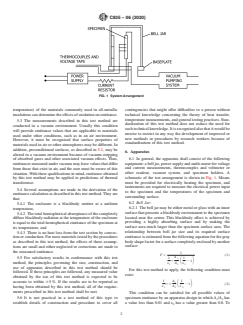
6.1 In general, the apparatus shall consist of the following
of absorbed gases and other associated vacuum effects. Thus,
equipment:abelljar,powersupplyandmulti-meterforvoltage
emittancesmeasuredundervacuummayhavevaluesthatdiffer
and current measurements, thermocouples and voltmeter or
from those that exist in air, and the user must be aware of this
other readout, vacuum system, and specimen holders. A
situation.Withthesequalificationsinmind,emittanceobtained
schematic of the test arrangement is shown in Fig. 1. Means
by this test method may be applied to predictions of thermal
must be provided for electrically heating the specimen, and
transference.
instruments are required to measure the electrical power input
5.4 Several assumptions are made in the derivation of the
to the specimen and the temperatures of the specimen and
emittancecalculationasdescribedinthistestmethod.Theyare
surrounding surface.
that:
6.2 Bell Jar:
5.4.1 The enclosure is a blackbody emitter at a uniform
6.2.1 The bell jar may be either metal or glass with an inner
temperature,
surface that presents a blackbody environment to the specimen
5.4.2 Thetotalhemisphericalabsorptanceofthecompletely
located near the center. This blackbody effect is achieved by
diffuse blackbody radiation at the temperature of the enclosure
providing a highly absorbing surface and by making the
isequaltothetotalhemisphericalemittanceofthespecimenat
surface area much larger than the specimen surface area. The
its temperature, and
relationship between bell jar size and its required surface
5.4.3 There is no heat loss from the test section by convec-
emittanceisestimatedfromthefollowingequationforthegray
tionorconduction.Formostmaterialstestedbytheprocedures
bodyshapefactorforasurfacecompletelyenclosedbyanother
as described in this test method, the effects of these assump-
surface:
tions are small and either neglected or corrections are made to
the measured emittance.
F 5 (1)
A
1 1
5.5 For satisfactory results in conformance with this test 1
1 2 1
S D
method, the principles governing the size, construction, and ε A ε
1 2 2
use of apparatus described in this test method should be
For this test method to apply, the following condition must
followed. If these principles are followed, any measured value
exist:
obtained by the use of this test method is expected to be
1 A 1
accurate to within 65%. If the results are to be reported as 1
.. 2 1 (2)
S D
ε A ε
1 2 2
having been obtained by this test method, all of the require-
ments prescribed in this test method shall be met.
This condition can be satisfied for all possible values of
5.6 It is not practical in a test method of this type to specimen emittance by an apparatus design in which A /A has
1 2
establish details of construction and procedure to cover all a value less than 0.01 and ε has a value greater than 0.8. To
C835 − 06 (2020)
FIG. 2 Example of Effect of Air Pressure on Measured Emittance of Oxidized Inconel
ensure that the inner surface has an emittance greater than 0.8, minimum practical. Experience indicates that diameters less
metalandglassbelljarsshallbecoatedwithablackpaint (1). than 0.13 mm provide acceptable results.
It is permissible to leave small areas in the glass bell jars
6.4.1 The test section is defined by two thermocouples
uncoated for visual monitoring of the specimen during a test.
equally spaced from the specimen holders. A third thermo-
Metal bell jars can be provided with small-area glass view
couple is located at the center of the specimen. Spot welding
ports for sample observation.
hasbeenfoundtobethemostacceptablemethodofattachment
6.2.2 The bell jar must be opaque to external high energy
because it results in minimum disturbance of the specimen
radiation sources (such as open furnaces, sunlight, and other
surface. Swaging and peening are alternative methods pre-
emittance apparatuses) if they are in view of the specimen.
scribed for specimens that do not permit spot welding.
Both the coated metal and coated glass bell jars meet this
6.4.2 The number of thermocouples used to measure the
requirement.
temperature of the absorbing surface shall be sufficient to
6.2.3 The need for bell jar cooling is determined by the
provide a representative average. Four thermocouples have
lower-use temperature of the particular apparatus and by the
been found to be sufficient for the system shown in Fig. 1.
maximum natural heat dissipation of the bell jar. A bell jar
Thermocouple locations include three on the bell jar and one
operating at room temperature (20°C) may be used for speci-
on the baseplate.
men temperatures down to about 120°C. At least a 100°C
6.4.3 The voltage drop in the measurement area of the
difference between the specimen and the bell jar is recom-
specimenismeasuredbytappingtosimilarelementsofeachof
mendedtoachievethedesiredmethodaccuracy.Therefore,for
the two thermocouples that bound the test section. A
lowerspecimentemperatures,belljarcoolingisrequired.Ifthe
potentiometer,orequivalentinstrument,havingasensitivityof
natural heat dissipation of the bell jar is not sufficient to
2µV or less is required for measuring the thermocouple emf’s
maintain its temperature at the desired level for any other
from which the test section temperatures are obtained.
operating condition, auxiliary cooling of the bell jar is also
6.4.4 Temperature sensors must be calibrated to within the
required.Analternativetobelljarcoolingistheuseofacooled
uncertainty allowed by the apparatus design accuracy. For
shroud (for example, cooled by liquid nitrogen) between the
information concerning sensitivity and accuracy of
specimen and the bell jar.
thermocouples, see Table1 of Tables E230. For a comprehen-
6.3 Power Supply— The power supply may be either ac or
sive discussion on the use of thermocouples, see Ref (2). For
dc and is used to heat the test specimen electrically by making
low temperature thermocouple reference tables, see Ref (3).
it a resistive part of the circuit.The true electrical power to the
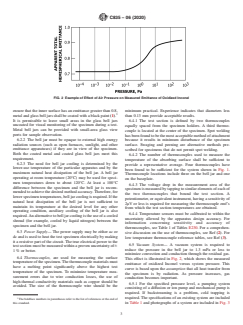
6.5 Vacuum System— A vacuum system is required to
testsectionmustbemeasuredwithinaprovenuncertaintyof6
reduce the pressure in the bell jar to 1.3 mPa or less to
1% or better.
minimize convection and conduction through the residual gas.
6.4 Thermocouples, are used for measuring the surface
This effect is illustrated in Fig. 2, which shows the measured
temperatureofthespecimen.Thethermocouplematerialsmust
emittance of oxidized Inconel versus system pressure. This
have a melting point significantly above the highest test
curve is based upon the assumption that all heat transfer from
temperature of the specimen. To minimize temperature mea-
the specimen is by radiation. As pressure increases, gas
surement errors due to wire conduction losses, the use of
conduction becomes important.
high-thermal conductivity materials such as copper should be
6.5.1 For the specified pressure level, a pumping system
avoided. The size of the thermocouple wire should be the
consisting of a diffusion or ion pump and mechanical pump is
required. If backstreaming is a problem, cold trapping is
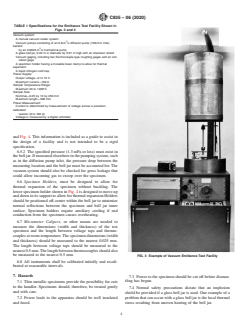
required. The specifications of an existing system are included
Theboldfacenumbersinparenthesesrefertothelistofreferencesattheendof
this standard. in Table 1 and photographs of a system are included in Fig. 3
C835 − 06 (2020)
TABLE 1 Specifications for the Emittance Test Facility Shown in
Figs. 3 and 4
Vacuum system:
A manual vacuum coater system
Vacuum pumps consisting of an 0.8-m /s diffusion pump (100-mm inlet)
backed
by an 0.0023-m /s mechanical pump
A glass bell jar, 0.46 m in diameter by 0.91 m high with an implosion shield
Vacuum gaging, including two thermocouple-type roughing gages and an ioni-
zation gage
A specimen holder having a movable lower clamp to allow for thermal
expansion
A liquid nitrogen cold trap
Power Supply:
Output voltage—0 to 16 V
Maximum current—100 A
Sample Temperature Range:
Maximum 20 to 1400°C
Sample Size:
Nominal—0.25 by 13 by 250 mm
Maximum length—500 mm
Power Measurement:
Current is determined by measurement of voltage across a precision-
calibrated
resistor (0 to 100 A)
Voltage is measured by a digital voltmeter.
and Fig. 4. This information is included as a guide to assist in
the design of a facility and is not intended to be a rigid
specification.
6.5.2 The specified pressure (1.3 mPa or less) must exist in
thebelljar.Ifmeasuredelsewhereinthepumpingsystem,such
as in the diffusion pump inlet, the pressure drop between the
measuring location and the bell jar must be accounted for.The
vacuum system should also be checked for gross leakage that
could allow incoming gas to sweep over the specimen.
6.6 Specimen Holders, must be designed to allow for
thermal expansion of the specimen without buckling. The
lower specimen holder shown in Fig. 4 is designed to move up
anddowninitssupporttoallowforthermalexpansion.Holders
should be positioned off-center within the bell jar to minimize
normal reflections between the specimen and bell jar inner
surface. Specimen holders require auxiliary cooling if end
conduction from the specimen causes overheating.
6.7 Micrometer Calipers, or other means are needed to
measure the dimensions (width and thickness) of the test
specimen and the length between voltage taps and thermo-
couples at room temperature.The specimen dimensions (width
and thickness) should be measured to the nearest 0.025 mm.
The length between voltage taps should be measured to the
nearest0.5mm.Thelengthbetweenthermocouplesshouldalso
be measured to the nearest 0.5 mm.
FIG. 3 Example of Vacuum Emittance Test Facility
6.8 All instruments shall be calibrated initially and recali-
brated at reasonable intervals.
7. Hazards
7.3 Power to the specimen should be cut off before disman-
tling has begun.
7.1 Thin metallic specimens provide the possibility for cuts
to the handler. Specimens should, therefore, be treated gently
7.4 Normal safety precautions dictate that an implosion
and with care.
shield be provided if a glass bell jar is used. One example of a
7.2 Power leads to the apparatus should be well insulated problemthatcanoccurwithaglassbelljaristhelocalthermal
and fused. stress resulting from uneven heating of the bell jar.
C835 − 06 (2020)
FIG. 4 Example of Emittance Sample in the Test Fixture
Standard Reference Materials Program at NIST.
8. Test Specimen
8.1 The specimen used for a test must be sufficiently
8.3 Three thermocouples shall be fastened to the specimen
uniforminsurfacetorepresentthesamplematerialfromwhich
overthetestlengthasindicatedinFig.5.Asuitabletestsection
itistaken.Cautionmustbeexercisedtopreventcontamination
length, L, compatible with the requirements of 8.2, has been
of the specimen surface from all sources, and especially from
found to be about 75 mm. The two wires that comprise a
fingerprints.
thermocouple should be spot-welded to the specimen surface
separately. They can be attached either along a line normal to
8.2 The size of the test specimen must be compatible with
the specimen axis or displaced slightly (within 0.5 mm) along
the power supply and desired maximum test temperature. Fig.
the axis. These two arrangements are illustrated in Fig. 6. The
5 shows acceptable overall test specimen dimensions for three
first arrangement allows a small displacement between the
materials in use with a 16-V, 100-A ac power supply. Speci-
thermocouple wires and can be used with an ac power supply.
mensshouldbepreparedsothatedgesarestraight,smooth,and
parallel. Edges should have the same surface condition as the Anyacpickupcaneasilyberejectedwhenthethermocoupledc
rest of the specimen. voltage output is measured. The second arrangement would
positionthethermocouplewiresalonganequipotentiallineand
NOTE 1—Previous editions of Test Method C835 described reference
is required when a dc power supply is used. In this way, the
emittance specimens available from the National Institute of Standards
and Technology (NIST). These specimens have been discontinued by the specimen dc voltage drop will not influence the thermocouple
C835 − 06 (2020)
NOTE 1—All dimensions are in millimetres.
FIG. 5 Typical Test Specimen Dimensions
FIG. 6 Thermocouple Attachment
output. Thermocouple wire alignment should be checked by shouldbeinstalledabout6mmoutsideoneorbothendsofthe
reversing the power supply polarity at each reading. If the test section. These extra thermocouples are used to better
wires are properly aligned, the thermoc
...