

ASTM G129-21
(Practice)Standard Practice for Slow Strain Rate Testing to Evaluate the Susceptibility of Metallic Materials to Environmentally Assisted Cracking
General Information
- Abstract
SIGNIFICANCE AND USE
5.1 The slow strain rate test is used for relatively rapid screening or comparative evaluation, or both, of environmental, processing or metallurgical variables, or both, that can affect the resistance of a material to EAC. For example, this testing technique has been used to evaluate materials, heat treatments, chemical constituents in the environment, and temperature and chemical inhibitors.
5.2 Where possible, the application of the SSR test and data derived from its use should be used in combination with service experience or long-term EAC data, or both, obtained through literature sources or additional testing using other testing techniques. In applications where there has been little or no prior experience with SSR testing or little EAC data on the particular material/environment combination of interest, the following steps are recommended:
5.2.1 The SSR tests should be conducted over a range of applied extension rates (that is, usually at least one order of magnitude in applied extension rate above and below 10−6 in./s (2.54 × 10⁻⁵ mm/s) to determine the effect of strain rate or rate of increase of the stress or stress intensity factor on susceptibility to EAC.
5.2.2 Constant load or strain EAC tests should also be conducted in simulated service environments, and service experience should be obtained so that a correlation between SSR test results and anticipated service performance can be developed.
5.3 In many cases the SSR test has been found to be a conservative test for EAC. Therefore, it may produce failures in the laboratory under conditions which do not necessarily cause EAC under service application. Additionally, in some limited cases, EAC indications are not found in smooth tension SSR tests even when service failures have been observed. This effect usually occurs when there is a delay in the initiation of localized corrosion processes. Therefore, the suggestions given in 5.2 are strongly encouraged.
5.4 In some cases, EAC will only o...
SCOPE
1.1 This practice covers procedures for the design, preparation, and use of axially loaded, tension test specimens and fatigue pre-cracked (fracture mechanics) specimens for use in slow strain rate (SSR) tests to investigate the resistance of metallic materials to environmentally assisted cracking (EAC). While some investigators utilize SSR test techniques in combination with cyclic or fatigue loading, no attempt has been made to incorporate such techniques into this practice.
1.2 Slow strain rate testing is applicable to the evaluation of a wide variety of metallic materials in test environments which simulate aqueous, nonaqueous, and gaseous service environments over a wide range of temperatures and pressures that may cause EAC of susceptible materials.
1.3 The primary use of this practice is to furnish accepted procedures for the accelerated testing of the resistance of metallic materials to EAC under various environmental conditions. In many cases, the initiation of EAC is accelerated through the application of a dynamic strain in the gauge section or at a notch tip or crack tip, or both, of a specimen. Due to the accelerated nature of this test, the results are not intended to necessarily represent service performance, but rather to provide a basis for screening, for detection of an environmental interaction with a material, and for comparative evaluation of the effects of metallurgical and environmental variables on sensitivity to known environmental cracking problems.
1.4 Further information on SSR test methods is available in ISO 7539 and in the references provided with this practice (1-6).2
1.5 The values stated in SI units are to be regarded as standard. The values given in parentheses after SI units are provided for information only and are not considered standard.
1.6 This standard does not purport to address all of the safety concerns, if any, associated with its use. It is the responsibility ...
- Status
- Published
- Publication Date
- 30-Apr-2021
- Technical Committee
- G01 - Corrosion of Metals
- Drafting Committee
- G01.06 - Environmentally Assisted Cracking
Buy Documents
ASTM G129-21 - Standard Practice for Slow Strain Rate Testing to Evaluate the Susceptibility of Metallic Materials to Environmentally Assisted Cracking
REDLINE ASTM G129-21 - Standard Practice for Slow Strain Rate Testing to Evaluate the Susceptibility of Metallic Materials to Environmentally Assisted Cracking
Overview
ASTM G129-21: Standard Practice for Slow Strain Rate Testing to Evaluate the Susceptibility of Metallic Materials to Environmentally Assisted Cracking provides standardized procedures for using slow strain rate testing (SSR) to assess how susceptible metallic materials are to environmentally assisted cracking (EAC). Issued by ASTM International, this practice covers the design, preparation, and use of test specimens under tension, including fatigue pre-cracked types, in controlled environments that simulate real-world conditions.
SSR testing is widely applied for rapid screening and comparative evaluation of materials, metallurgical states, environmental influences, and process variables that can impact a material’s resistance to EAC, such as stress corrosion cracking, hydrogen embrittlement, and liquid metal embrittlement. The outcomes of SSR tests are particularly valuable when used in conjunction with service experience and long-term EAC data.
Key Topics
- Environmentally Assisted Cracking (EAC): Considers stress corrosion cracking, hydrogen embrittlement, sulfide stress cracking, and liquid metal embrittlement in metallic materials.
- Test Methodologies: Guides on preparing and testing axially loaded and fatigue pre-cracked specimens using slow, controlled extension rates to accelerate the evaluation of EAC behavior.
- Test Environments: Applicable in various simulated aqueous, nonaqueous, and gaseous environments across wide temperature and pressure ranges.
- Evaluation Metrics: Uses ratios such as time-to-failure, plastic elongation, reduction in area, notch tensile strength, and threshold stress intensity factor to compare material behavior in test and control environments.
- Best Practices: Emphasizes combining SSR test results with service data and other EAC tests for a more comprehensive assessment.
Applications
ASTM G129-21 is fundamental for industries concerned with the integrity of metallic components exposed to potentially aggressive environments. Its practical applications include:
- Material Qualification and Selection: Supports engineers and researchers in identifying materials with superior resistance to EAC for use in corrosive environments, such as those found in chemical processing, oil and gas, power generation, and transportation.
- Process Evaluation: Assesses the influence of heat treatments, alloy composition, and chemical inhibitors on EAC resistance, informing process optimization and quality control.
- Failure Analysis: Provides forensic support by comparing service failures with laboratory test results, aiding in root cause identification and corrective actions.
- Regulatory and Safety Compliance: Assists organizations in meeting safety, durability, and life-cycle requirements for metallic equipment that must perform under demanding environmental conditions.
Related Standards
To provide a robust framework for EAC testing and results interpretation, ASTM G129-21 references several related standards, including:
- ASTM A370 - Mechanical Testing of Steel Products
- ASTM B557 - Tension Testing Wrought and Cast Aluminum- and Magnesium-Alloy Products
- ASTM E8/E8M - Tension Testing of Metallic Materials
- ASTM E399 - Linear-Elastic Plane-Strain Fracture Toughness of Metallic Materials
- ASTM G49 - Direct Tension Stress-Corrosion Test Specimens
- ASTM G193 - Terminology on Corrosion and Corrosion Testing
- ISO 7539-7 - Slow Strain Rate Testing (international context)
Practical Value
By following ASTM G129-21, organizations strengthen confidence in the resistance of metallic materials to environmentally assisted cracking. SSR testing provides a cost-effective, accelerated way to screen materials or compare variables before costly service failures occur. The practice ensures systematic specimen preparation, testing procedures, and data reporting, helping industries achieve high standards of reliability, safety, and performance in critical applications.
Keywords: slow strain rate testing, SSR, environmentally assisted cracking, EAC, stress corrosion cracking, hydrogen embrittlement, metallic materials, ASTM G129, corrosion testing, material qualification, fracture mechanics, comparative evaluation.
Relations
- Effective Date
- 01-Mar-2024
- Effective Date
- 01-Jan-2024
- Effective Date
- 15-Nov-2023
- Effective Date
- 01-Nov-2023
- Effective Date
- 01-May-2023
- Effective Date
- 01-Jul-2019
- Refers
ASTM A370-17a - Standard Test Methods and Definitions for Mechanical Testing of Steel Products - Effective Date
- 15-Nov-2017
- Effective Date
- 01-Jan-2017
- Effective Date
- 15-Jul-2016
- Effective Date
- 01-Nov-2015
- Effective Date
- 01-Feb-2015
- Effective Date
- 01-Jun-2014
- Effective Date
- 15-May-2014
- Effective Date
- 15-May-2014
- Effective Date
- 15-Nov-2013
Buy Documents
ASTM G129-21 - Standard Practice for Slow Strain Rate Testing to Evaluate the Susceptibility of Metallic Materials to Environmentally Assisted Cracking
REDLINE ASTM G129-21 - Standard Practice for Slow Strain Rate Testing to Evaluate the Susceptibility of Metallic Materials to Environmentally Assisted Cracking
Get Certified
Connect with accredited certification bodies for this standard

Element Materials Technology
Materials testing and product certification.

Inštitut za kovinske materiale in tehnologije
Institute of Metals and Technology. Materials testing, metallurgical analysis, NDT.
Sponsored listings
Frequently Asked Questions
ASTM G129-21 is a standard published by ASTM International. Its full title is "Standard Practice for Slow Strain Rate Testing to Evaluate the Susceptibility of Metallic Materials to Environmentally Assisted Cracking". This standard covers: SIGNIFICANCE AND USE 5.1 The slow strain rate test is used for relatively rapid screening or comparative evaluation, or both, of environmental, processing or metallurgical variables, or both, that can affect the resistance of a material to EAC. For example, this testing technique has been used to evaluate materials, heat treatments, chemical constituents in the environment, and temperature and chemical inhibitors. 5.2 Where possible, the application of the SSR test and data derived from its use should be used in combination with service experience or long-term EAC data, or both, obtained through literature sources or additional testing using other testing techniques. In applications where there has been little or no prior experience with SSR testing or little EAC data on the particular material/environment combination of interest, the following steps are recommended: 5.2.1 The SSR tests should be conducted over a range of applied extension rates (that is, usually at least one order of magnitude in applied extension rate above and below 10−6 in./s (2.54 × 10⁻⁵ mm/s) to determine the effect of strain rate or rate of increase of the stress or stress intensity factor on susceptibility to EAC. 5.2.2 Constant load or strain EAC tests should also be conducted in simulated service environments, and service experience should be obtained so that a correlation between SSR test results and anticipated service performance can be developed. 5.3 In many cases the SSR test has been found to be a conservative test for EAC. Therefore, it may produce failures in the laboratory under conditions which do not necessarily cause EAC under service application. Additionally, in some limited cases, EAC indications are not found in smooth tension SSR tests even when service failures have been observed. This effect usually occurs when there is a delay in the initiation of localized corrosion processes. Therefore, the suggestions given in 5.2 are strongly encouraged. 5.4 In some cases, EAC will only o... SCOPE 1.1 This practice covers procedures for the design, preparation, and use of axially loaded, tension test specimens and fatigue pre-cracked (fracture mechanics) specimens for use in slow strain rate (SSR) tests to investigate the resistance of metallic materials to environmentally assisted cracking (EAC). While some investigators utilize SSR test techniques in combination with cyclic or fatigue loading, no attempt has been made to incorporate such techniques into this practice. 1.2 Slow strain rate testing is applicable to the evaluation of a wide variety of metallic materials in test environments which simulate aqueous, nonaqueous, and gaseous service environments over a wide range of temperatures and pressures that may cause EAC of susceptible materials. 1.3 The primary use of this practice is to furnish accepted procedures for the accelerated testing of the resistance of metallic materials to EAC under various environmental conditions. In many cases, the initiation of EAC is accelerated through the application of a dynamic strain in the gauge section or at a notch tip or crack tip, or both, of a specimen. Due to the accelerated nature of this test, the results are not intended to necessarily represent service performance, but rather to provide a basis for screening, for detection of an environmental interaction with a material, and for comparative evaluation of the effects of metallurgical and environmental variables on sensitivity to known environmental cracking problems. 1.4 Further information on SSR test methods is available in ISO 7539 and in the references provided with this practice (1-6).2 1.5 The values stated in SI units are to be regarded as standard. The values given in parentheses after SI units are provided for information only and are not considered standard. 1.6 This standard does not purport to address all of the safety concerns, if any, associated with its use. It is the responsibility ...
SIGNIFICANCE AND USE 5.1 The slow strain rate test is used for relatively rapid screening or comparative evaluation, or both, of environmental, processing or metallurgical variables, or both, that can affect the resistance of a material to EAC. For example, this testing technique has been used to evaluate materials, heat treatments, chemical constituents in the environment, and temperature and chemical inhibitors. 5.2 Where possible, the application of the SSR test and data derived from its use should be used in combination with service experience or long-term EAC data, or both, obtained through literature sources or additional testing using other testing techniques. In applications where there has been little or no prior experience with SSR testing or little EAC data on the particular material/environment combination of interest, the following steps are recommended: 5.2.1 The SSR tests should be conducted over a range of applied extension rates (that is, usually at least one order of magnitude in applied extension rate above and below 10−6 in./s (2.54 × 10⁻⁵ mm/s) to determine the effect of strain rate or rate of increase of the stress or stress intensity factor on susceptibility to EAC. 5.2.2 Constant load or strain EAC tests should also be conducted in simulated service environments, and service experience should be obtained so that a correlation between SSR test results and anticipated service performance can be developed. 5.3 In many cases the SSR test has been found to be a conservative test for EAC. Therefore, it may produce failures in the laboratory under conditions which do not necessarily cause EAC under service application. Additionally, in some limited cases, EAC indications are not found in smooth tension SSR tests even when service failures have been observed. This effect usually occurs when there is a delay in the initiation of localized corrosion processes. Therefore, the suggestions given in 5.2 are strongly encouraged. 5.4 In some cases, EAC will only o... SCOPE 1.1 This practice covers procedures for the design, preparation, and use of axially loaded, tension test specimens and fatigue pre-cracked (fracture mechanics) specimens for use in slow strain rate (SSR) tests to investigate the resistance of metallic materials to environmentally assisted cracking (EAC). While some investigators utilize SSR test techniques in combination with cyclic or fatigue loading, no attempt has been made to incorporate such techniques into this practice. 1.2 Slow strain rate testing is applicable to the evaluation of a wide variety of metallic materials in test environments which simulate aqueous, nonaqueous, and gaseous service environments over a wide range of temperatures and pressures that may cause EAC of susceptible materials. 1.3 The primary use of this practice is to furnish accepted procedures for the accelerated testing of the resistance of metallic materials to EAC under various environmental conditions. In many cases, the initiation of EAC is accelerated through the application of a dynamic strain in the gauge section or at a notch tip or crack tip, or both, of a specimen. Due to the accelerated nature of this test, the results are not intended to necessarily represent service performance, but rather to provide a basis for screening, for detection of an environmental interaction with a material, and for comparative evaluation of the effects of metallurgical and environmental variables on sensitivity to known environmental cracking problems. 1.4 Further information on SSR test methods is available in ISO 7539 and in the references provided with this practice (1-6).2 1.5 The values stated in SI units are to be regarded as standard. The values given in parentheses after SI units are provided for information only and are not considered standard. 1.6 This standard does not purport to address all of the safety concerns, if any, associated with its use. It is the responsibility ...
ASTM G129-21 is classified under the following ICS (International Classification for Standards) categories: 77.040.99 - Other methods of testing of metals. The ICS classification helps identify the subject area and facilitates finding related standards.
ASTM G129-21 has the following relationships with other standards: It is inter standard links to ASTM A370-24, ASTM E8/E8M-24, ASTM E647-23b, ASTM G49-85(2023)e1, ASTM E1681-23e1, ASTM A370-19, ASTM A370-17a, ASTM A370-17, ASTM E8/E8M-16, ASTM A370-15, ASTM E8/E8M-15, ASTM E4-14, ASTM A370-14, ASTM B557-14, ASTM A370-13. Understanding these relationships helps ensure you are using the most current and applicable version of the standard.
ASTM G129-21 is available in PDF format for immediate download after purchase. The document can be added to your cart and obtained through the secure checkout process. Digital delivery ensures instant access to the complete standard document.
Standards Content (Sample)
This international standard was developed in accordance with internationally recognized principles on standardization established in the Decision on Principles for the
Development of International Standards, Guides and Recommendations issued by the World Trade Organization Technical Barriers to Trade (TBT) Committee.
Designation: G129 − 21
Standard Practice for
Slow Strain Rate Testing to Evaluate the Susceptibility of
Metallic Materials to Environmentally Assisted Cracking
This standard is issued under the fixed designation G129; the number immediately following the designation indicates the year of
original adoption or, in the case of revision, the year of last revision.Anumber in parentheses indicates the year of last reapproval.A
superscript epsilon (´) indicates an editorial change since the last revision or reapproval.
1. Scope 1.6 This standard does not purport to address all of the
safety concerns, if any, associated with its use. It is the
1.1 This practice covers procedures for the design,
responsibility of the user of this standard to establish appro-
preparation, and use of axially loaded, tension test specimens
priate safety, health, and environmental practices and deter-
andfatiguepre-cracked(fracturemechanics)specimensforuse
mine the applicability of regulatory limitations prior to use.
in slow strain rate (SSR) tests to investigate the resistance of
Furthermore, in some cases, special facilities will be required
metallicmaterialstoenvironmentallyassistedcracking(EAC).
to isolate these tests from laboratory personnel if high pres-
While some investigators utilize SSR test techniques in com-
sures or toxic chemical environments, or both, are utilized in
bination with cyclic or fatigue loading, no attempt has been
SSR testing.
made to incorporate such techniques into this practice.
1.7 This international standard was developed in accor-
1.2 Slowstrainratetestingisapplicabletotheevaluationof
dance with internationally recognized principles on standard-
awidevarietyofmetallicmaterialsintestenvironmentswhich
ization established in the Decision on Principles for the
simulate aqueous, nonaqueous, and gaseous service environ-
Development of International Standards, Guides and Recom-
ments over a wide range of temperatures and pressures that
mendations issued by the World Trade Organization Technical
may cause EAC of susceptible materials.
Barriers to Trade (TBT) Committee.
1.3 The primary use of this practice is to furnish accepted
2. Referenced Documents
procedures for the accelerated testing of the resistance of
metallic materials to EAC under various environmental condi- 3
2.1 ASTM Standards:
tions. In many cases, the initiation of EAC is accelerated
A370Test Methods and Definitions for Mechanical Testing
throughtheapplicationofadynamicstraininthegaugesection
of Steel Products
oratanotchtiporcracktip,orboth,ofaspecimen.Duetothe
B557Test Methods for Tension Testing Wrought and Cast
accelerated nature of this test, the results are not intended to
Aluminum- and Magnesium-Alloy Products
necessarily represent service performance, but rather to pro-
D1193Specification for Reagent Water
vide a basis for screening, for detection of an environmental
E4Practices for Force Verification of Testing Machines
interaction with a material, and for comparative evaluation of
E6Terminology Relating to Methods of Mechanical Testing
the effects of metallurgical and environmental variables on
E8/E8MTest Methods for Tension Testing of Metallic Ma-
sensitivity to known environmental cracking problems.
terials
1.4 Further information on SSR test methods is available in E399Test Method for Linear-Elastic Plane-Strain Fracture
ISO 7539 and in the references provided with this practice Toughness of Metallic Materials
(1-6). E602Test Method for Sharp-Notch Tension Testing with
(Withdrawn 2010)
Cylindrical Specimens
1.5 The values stated in SI units are to be regarded as
E616Terminology Relating to Fracture Testing (Withdrawn
standard. The values given in parentheses after SI units are
1996)
provided for information only and are not considered standard.
E647 Test Method for Measurement of Fatigue Crack
Growth Rates
This practice is under the jurisdiction ofASTM Committee G01 on Corrosion
of Metals and is the direct responsibility of Subcommittee G01.06 on Environmen-
tally Assisted Cracking. For referenced ASTM standards, visit the ASTM website, www.astm.org, or
Current edition approved May 1, 2021. Published June 2021. Originally contact ASTM Customer Service at service@astm.org. For Annual Book of ASTM
approved in 1995. Last previous edition approved in 2013 as G129–00 (2013). Standards volume information, refer to the standard’s Document Summary page on
DOI: 10.1520/G0129-21. the ASTM website.
2 4
The boldface numbers in parentheses refer to a list of references at the end of The last approved version of this historical standard is referenced on
this standard. www.astm.org.
Copyright © ASTM International, 100 Barr Harbor Drive, PO Box C700, West Conshohocken, PA 19428-2959. United States
G129 − 21
E1681Test Method for DeterminingThreshold Stress Inten- the definitions given in Terminologies E6, E616, and G193
sityFactorforEnvironment-AssistedCrackingofMetallic shall apply to the terms used in this practice.
Materials
4. Summary of Practice
G49Practice for Preparation and Use of Direct Tension
Stress-Corrosion Test Specimens
4.1 This practice describes the use of tension and fatigue
G111Guide for Corrosion Tests in High Temperature or
pre-cracked specimens for the determination of resistance to
High Pressure Environment, or Both
EAC of metallic materials. The procedure involves the appli-
G142Test Method for Determination of Susceptibility of cation of very slow strain rates, which are achieved by a
Metals to Embrittlement in Hydrogen Containing Envi-
constant extension rate on the specimen while monitoring load
ronments at High Pressure, High Temperature, or Both and extension of the specimen. The SSR test always produces
G193Terminology and Acronyms Relating to Corrosion
fracture of the test specimen. Typically, the results from tests
conductedinthetestenvironmentarecomparedtocorrespond-
2.2 ISO Standard:
ISO 7539Part 7, Slow Strain Rate Testing ing test results for the same material in a control environment.
The degree of susceptibility to EAC is generally assessed
3. Terminology
through observation of the differences in the behavior of the
material in tests conducted in a test environment from that
3.1 For purposes of this practice the following terms are
obtained from tests conducted in the control environment. For
defined:
smoothtensionspecimens,eitherchangesintime-to-failure,or
3.2 control environment—an environment in which SSR
specimenductility,orvisualindicationsofEAC,oroftensome
specimens are tested that has been shown not to cause EAC or
combination of these methods, are utilized in determining
excessive corrosion of the material. The results of tests
susceptibilitytoEAC.Fornotchedtensionspecimens,changes
conducted in this environment may be used as a basis for
in the notch tensile strength and visual indications of EAC on
comparison with corresponding tests conducted in the test
the primary fracture surface are used in determining suscepti-
environment(s), usually at the same temperature as the test
bility to EAC. For fatigue pre-cracked specimens, changes in
environment.
the threshold stress intensity factor and visual indications of
3.3 environmentallyassistedcracking(EAC)—crackingofa
EAC on the primary fracture surface are used in determining
material caused by the combined effects of stress and the
susceptibility to EAC.
surrounding environment, for example, stress corrosion
cracking, hydrogen embrittlement cracking, sulfide stress 5. Significance and Use
cracking and liquid metal embrittlement.
5.1 The slow strain rate test is used for relatively rapid
3.4 slow strain rate (SSR)—a dynamic slowly increasing
screening or comparative evaluation, or both, of
strain imposed by an external means on the gauge section or
environmental, processing or metallurgical variables, or both,
notchtipofauniaxialtensionspecimenorcracktipofafatigue
that can affect the resistance of a material to EAC. For
pre-cracked specimen for purposes of materials evaluation.
example, this testing technique has been used to evaluate
The strain rate for a plain or smooth specimen (given in units
materials, heat treatments, chemical constituents in the
of extension divided by the gauge length per unit time) or the
environment, and temperature and chemical inhibitors.
strainrateatanotchtipofanotchedtensionspecimenorcrack
5.2 Where possible, the application of the SSR test and data
tip of a fatigue pre-cracked specimen is applied through the
derived from its use should be used in combination with
application of a slow constant extension rate (given in units of
service experience or long-term EAC data, or both, obtained
extension per unit time). The slow constant extension rate
through literature sources or additional testing using other
produces a gauge section strain rate, which is usually in the
testingtechniques.Inapplicationswheretherehasbeenlittleor
−4 −1 −7 −1
range from 10 /s to 10 /s . Rigorous analytical solutions
no prior experience with SSR testing or little EAC data on the
of the local strain rate at a notch tip of a tension specimen or
particular material/environment combination of interest, the
at a crack tip of a fatigue pre-cracked specimen are not
following steps are recommended:
available. The average or local strain rate should be slow
5.2.1 The SSR tests should be conducted over a range of
enough to allow time for certain corrosion processes to take
applied extension rates (that is, usually at least one order of
place, but fast enough to produce failure or cracking of the
−6
magnitudeinappliedextensionrateaboveandbelow10 in./s
specimen in a reasonable period of time for evaluation pur-
–5
(2.54 × 10 mm/s) to determine the effect of strain rate or rate
poses. In cases where extremely slow strain rates are being
of increase of the stress or stress intensity factor on suscepti-
−7 −1 −8 −1
utilized (that is, 10 /s to 10 /s for smooth tension
bility to EAC.
specimens), an interrupted SSR test can be employed whereby
5.2.2 Constant load or strain EAC tests should also be
the specimen is strained into the plastic range at the intended
conducted in simulated service environments, and service
strain rate followed by more rapid straining to failure.
experience should be obtained so that a correlation between
3.5 The terminology found in Test Methods and Definitions
SSR test results and anticipated service performance can be
A370, Test Methods B557, and Test Method E602 along with
developed.
5.3 In many cases the SSR test has been found to be a
conservative test for EAC. Therefore, it may produce failures
Available fromAmerican National Standards Institute (ANSI), 25 W. 43rd St.,
4th Floor, New York, NY 10036, http://www.ansi.org. in the laboratory under conditions which do not necessarily
G129 − 21
cause EAC under service application. Additionally, in some
limitedcases,EACindicationsarenotfoundinsmoothtension
SSR tests even when service failures have been observed.This
effect usually occurs when there is a delay in the initiation of
localizedcorrosionprocesses.Therefore,thesuggestionsgiven
in 5.2 are strongly encouraged.
5.4 In some cases, EAC will only occur in a specific range
ofstrainrates.Therefore,wherethereislittlepriorinformation
available,testsshouldbeconductedoverarangeofstrainrates
as discussed in 5.2.
6. Apparatus
6.1 Testing Machines:
6.1.1 Tension testing machines used for SSR testing shall
conform to the requirements of Practices E4.
6.1.2 The loads used in SSR testing shall be within the
calibrated load ranges of the testing machine in accordance
with Practices E4.
6.1.3 The testing machines used for SSR testing shall be
capable of accurate application of extension rates in the range
of interest for evaluation of EAC. These extension rates are
−4 −7 –3
usually between 10 in.⁄s and 10 in./s (2.54 × 10 mm⁄s
–6
and 2.54 × 10 mm/s).
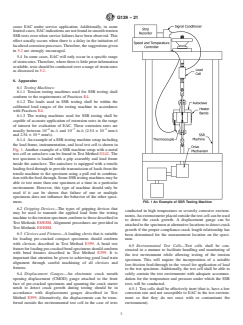
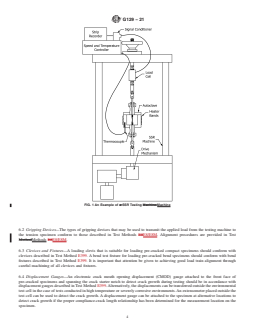
6.1.4 An example of a SSR testing machine setup including
the load frame, instrumentation, and local test cell is shown in
Fig. 1.Another example of a SSR machine setup with a metal
test cell or autoclave can be found in Test Method G142. The
test specimen is loaded with a grip assembly and load frame
inside the autoclave. The autoclave is equipped with a tensile
loadingfeed-throughtoprovidetransmissionofloadsfromthe
tensile machine to the specimen using a pull rod in combina-
tionwiththefeed-through.SomeSSRtestingmachinesmaybe
able to test more than one specimen at a time in a particular
environment. However, this type of machine should only be
used if it can be shown that failure of one or multiple
specimens does not influence the behavior of the other speci-
mens.
FIG. 1 An Example of SSR Testing Machine
6.2 Gripping Devices—The types of gripping devices that
conducted in high temperature or severely corrosive environ-
may be used to transmit the applied load from the testing
ments.Anextensometerplacedoutsidethetestcellcanbeused
machinetothetensionspecimenconformtothosedescribedin
to detect the crack growth. A displacement gauge can be
Test Methods E8/E8M. Alignment procedures are provided in
attachedtothespecimenatalternativelocationstodetectcrack
Test Methods E8/E8M.
growth if the proper compliance-crack length relationship has
6.3 Clevices and Fixtures—Aloading clevis that is suitable
been determined for the measurement location on the speci-
for loading pre-cracked compact specimens should conform
men.
with clevices described in Test Method E399. A bend test
6.5 Environmental Test Cells—Test cells shall be con-
fixtureforloadingpre-crackedbendspecimensshouldconform
structed in a manner to facilitate handling and monitoring of
with bend fixtures described in Test Method E399.Itis
the test environment while allowing testing of the tension
important that attention be given to achieving good load train
specimen. This will require the incorporation of a suitable
alignment through careful machining of all clevices and
low-friction feed-through in the vessel for application of load
fixtures.
to the test specimen.Additionally, the test cell shall be able to
6.4 Displacement Gauges—An electronic crack mouth safely contain the test environment with adequate accommo-
opening displacement (CMOD) gauge attached to the front dation for the temperature and pressure under which the SSR
face of pre-cracked specimens and spanning the crack starter tests will be conducted.
notch to detect crack growth during testing should be in 6.5.1 Test cells shall be effectively inert (that is, have a low
accordance with displacement gauges described in Test corrosion rate and not susceptible to EAC in the test environ-
Method E399. Alternatively, the displacements can be trans- ment so that they do not react with or contaminate the
ferred outside the environmental test cell in the case of tests environment).
G129 − 21
6.5.2 The test cell size should be such that a solution pletelyavoidlocalizedgroovesandcold-workedareas.Special
volume-to-exposed specimen surface area is not less than care should be taken to machine specimens with minimum
30mL⁄cm . run-out to minimize bending stresses during testing.
8.3 Insomecases,notchedtensiontestspecimenshavebeen
6.6 Galvanic Effects—Eliminate galvanic effects between
used (1) to localize the failure in regions of microstructural
the test specimen and various metallic components of the
interest such as welds or heat-affected zones, (2) to induce
gripping fixtures and test cell by electrically insulating or
local crevice sites for acceleration of EAC or (3) to accelerate
isolating these components unless it is specifically desired to
hydrogen entry into the specimen due to high hydrostatic
simulate galvanic interactions found in service conditions and
stresses for acceleration of hydrogen embrittlement or sulfide
their effects on EAC. Check electrical isolation with an
stress cracking. In addition, notched tension specimens have
ohmmeter, if required, prior to testing. It should be noted that,
been used in SSR tests to provide an estimate of the threshold
in some cases, electrical insulation may be bridged by deposits
stress intensity factor for EAC (3). In using such specimens, it
of conductive or semiconductive solid corrosion products
is important to conduct the control environment tests using the
during the test, thereby introducing galvanic effects into the
same specimen geometry and design.
SSR test.
8.4 With the exception of the procedures for minimization
7. Reagents
of the effects of cold working as given in 8.2.1, the tension
specimens should be prepared for testing in accordance with
7.1 As is the case with most types of corrosion testing, it is
necessary to provide a reproducible chemical environment so procedures specified in Practice G49 and Test Methods E8/
that consistent test results can be obtained. This is particularly E8M.
trueintheevaluationforEACofmetallicmaterials.Therefore,
8.5 Thefatiguepre-crackedspecimensusedforEACevalu-
where a test environment is being established from laboratory
ationwiththeSSRtestshouldconformtothesizerequirements
chemicals, chemicals of reagent grade purity with known
and guidelines developed for plane strain conditions in Test
contaminant levels are recommended.
MethodE399orthesizerequirementsforpredominatelylinear
7.1.1 When aqueous test environments are being prepared,
elastic conditions as stated in Test Method E647. However, in
only
...
This document is not an ASTM standard and is intended only to provide the user of an ASTM standard an indication of what changes have been made to the previous version. Because
it may not be technically possible to adequately depict all changes accurately, ASTM recommends that users consult prior editions as appropriate. In all cases only the current version
of the standard as published by ASTM is to be considered the official document.
Designation: G129 − 00 (Reapproved 2013) G129 − 21
Standard Practice for
Slow Strain Rate Testing to Evaluate the Susceptibility of
Metallic Materials to Environmentally Assisted Cracking
This standard is issued under the fixed designation G129; the number immediately following the designation indicates the year of
original adoption or, in the case of revision, the year of last revision. A number in parentheses indicates the year of last reapproval. A
superscript epsilon (´) indicates an editorial change since the last revision or reapproval.
1. Scope
1.1 This practice covers procedures for the design, preparation, and use of axially loaded, tension test specimens and fatigue
pre-cracked (fracture mechanics) specimens for use in slow strain rate (SSR) tests to investigate the resistance of metallic materials
to environmentally assisted cracking (EAC). While some investigators utilize SSR test techniques in combination with cyclic or
fatigue loading, no attempt has been made to incorporate such techniques into this practice.
1.2 Slow strain rate testing is applicable to the evaluation of a wide variety of metallic materials in test environments which
simulate aqueous, nonaqueous, and gaseous service environments over a wide range of temperatures and pressures that may cause
EAC of susceptible materials.
1.3 The primary use of this practice is to furnish accepted procedures for the accelerated testing of the resistance of metallic
materials to EAC under various environmental conditions. In many cases, the initiation of EAC is accelerated through the
application of a dynamic strain in the gauge section or at a notch tip or crack tip, or both, of a specimen. Due to the accelerated
nature of this test, the results are not intended to necessarily represent service performance, but rather to provide a basis for
screening, for detection of an environmental interaction with a material, and for comparative evaluation of the effects of
metallurgical and environmental variables on sensitivity to known environmental cracking problems.
1.4 Further information on SSR test methods is available in ISO 7539 and in the references provided with this practice (1-6).
1.5 The values stated in SI units are to be regarded as standard. The values given in parentheses are for information only. after
SI units are provided for information only and are not considered standard.
1.6 This standard does not purport to address all of the safety concerns, if any, associated with its use. It is the responsibility
of the user of this standard to establish appropriate safety safety, health, and healthenvironmental practices and determine the
applicability of regulatory limitations prior to use. Furthermore, in some cases, special facilities will be required to isolate these
tests from laboratory personnel if high pressures or toxic chemical environments, or both, are utilized in SSR testing.
1.7 This international standard was developed in accordance with internationally recognized principles on standardization
established in the Decision on Principles for the Development of International Standards, Guides and Recommendations issued
by the World Trade Organization Technical Barriers to Trade (TBT) Committee.
This practice is under the jurisdiction of ASTM Committee G01 on Corrosion of Metals and is the direct responsibility of Subcommittee G01.06 on Environmentally
Assisted Cracking.
Current edition approved May 1, 2013May 1, 2021. Published July 2013June 2021. Originally approved in 1995. Last previous edition approved in 20062013 as G129 – 00
(2006).(2013). DOI: 10.1520/G0129-00R13.10.1520/G0129-21.
The boldface numbers in parentheses refer to a list of references at the end of this standard.
Copyright © ASTM International, 100 Barr Harbor Drive, PO Box C700, West Conshohocken, PA 19428-2959. United States
G129 − 21
2. Referenced Documents
2.1 ASTM Standards:
A370 Test Methods and Definitions for Mechanical Testing of Steel Products
B557 Test Methods for Tension Testing Wrought and Cast Aluminum- and Magnesium-Alloy Products
D1193 Specification for Reagent Water
E4 Practices for Force Verification of Testing Machines
E6 Terminology Relating to Methods of Mechanical Testing
E8E8/E8M Test Methods for Tension Testing of Metallic Materials [Metric] E0008_E0008M
E399 Test Method for Linear-Elastic Plane-Strain Fracture Toughness of Metallic Materials
E602 Test Method for Sharp-Notch Tension Testing with Cylindrical Specimens (Withdrawn 2010)
E616 Terminology Relating to Fracture Testing (Withdrawn 1996)
E647 Test Method for Measurement of Fatigue Crack Growth Rates
E1681 Test Method for Determining Threshold Stress Intensity Factor for Environment-Assisted Cracking of Metallic Materials
G15 Terminology Relating to Corrosion and Corrosion Testing (Withdrawn 2010)
G49 Practice for Preparation and Use of Direct Tension Stress-Corrosion Test Specimens
G111 Guide for Corrosion Tests in High Temperature or High Pressure Environment, or Both
G142 Test Method for Determination of Susceptibility of Metals to Embrittlement in Hydrogen Containing Environments at
High Pressure, High Temperature, or Both
G193 Terminology and Acronyms Relating to Corrosion
2.2 ISO Standard:
ISO 7539 Part 7, Slow Strain Rate Testing
3. Terminology
3.1 For purposes of this practice the following terms are defined:
3.2 control environment—an environment in which SSR specimens are tested that has been shown not to cause EAC or excessive
corrosion of the material. The results of tests conducted in this environment may be used as a basis for comparison with
corresponding tests conducted in the test environment(s), usually at the same temperature as the test environment.
3.3 environmentally assisted cracking (EAC)—cracking of a material caused by the combined effects of stress and the surrounding
environment, for example, stress corrosion cracking, hydrogen embrittlement cracking, sulfide stress cracking and liquid metal
embrittlement.
3.4 slow strain rate (SSR)—a dynamic slowly increasing strain imposed by an external means on the gauge section or notch tip
of a uniaxial tension specimen or crack tip of a fatigue pre-cracked specimen for purposes of materials evaluation. The strain rate
for a plain or smooth specimen (given in units of extension divided by the gagegauge length per unit time) or the strain rate at
a notch tip of a notched tension specimen or crack tip of a fatigue pre-cracked specimen is applied through the application of a
slow constant extension rate (given in units of extension per unit time). The slow constant extension rate produces a gauge section
−4 −1 −7 −1
strain rate, which is usually in the range from 10 /s to 10 /s . Rigorous analytical solutions of the local strain rate at a notch
tip of a tension specimen or at a crack tip of a fatigue pre-cracked specimen are not available. The average or local strain rate
should be slow enough to allow time for certain corrosion processes to take place, but fast enough to produce failure or cracking
of the specimen in a reasonable period of time for evaluation purposes. In cases where extremely slow strain rates are being utilized
−7 −1 −8 −1
(that is, 10 /s to 10 /s for smooth tension specimens), an interrupted SSR test can be employed whereby the specimen is
strained into the plastic range at the intended strain rate followed by more rapid straining to failure.
3.5 The terminology found in Test Methods and Definitions A370, Test MethodMethods B557, and Test Method E602 along with
the definitions given in Terminologies E6, E616, and G15G193 shall apply to the terms used in this practice.
4. Summary of Practice
4.1 This practice describes the use of tension and fatigue pre-cracked specimens for the determination of resistance to EAC of
For referenced ASTM standards, visit the ASTM website, www.astm.org, or contact ASTM Customer Service at service@astm.org. For Annual Book of ASTM Standards
volume information, refer to the standard’sstandard’s Document Summary page on the ASTM website.
The last approved version of this historical standard is referenced on www.astm.org.
Available from American National Standards Institute (ANSI), 25 W. 43rd St., 4th Floor, New York, NY 10036, http://www.ansi.org.
G129 − 21
metallic materials. The procedure involves the application of very slow strain rates, which are achieved by a constant extension
rate on the specimen while monitoring load and extension of the specimen. The SSR test always produces fracture of the test
specimen. Typically, the results from tests conducted in the test environment are compared to corresponding test results for the
same material in a control environment. The degree of susceptibility to EAC is generally assessed through observation of the
differences in the behavior of the material in tests conducted in a test environment from that obtained from tests conducted in the
control environment. For smooth tension specimens, either changes in time-to-failure, or specimen ductility, or visual indications
of EAC, or often some combination of these methods, are utilized in determining susceptibility to EAC. For notched tension
specimens, changes in the notch tensile strength and visual indications of EAC on the primary fracture surface are used in
determining susceptibility to EAC. For fatigue pre-cracked specimens, changes in the threshold stress intensity factor and visual
indications of EAC on the primary fracture surface are used in determining susceptibility to EAC.
5. Significance and Use
5.1 The slow strain rate test is used for relatively rapid screening or comparative evaluation, or both, of environmental, processing
or metallurgical variables, or both, that can affect the resistance of a material to EAC. For example, this testing technique has been
used to evaluate materials, heat treatments, chemical constituents in the environment, and temperature and chemical inhibitors.
5.2 Where possible, the application of the SSR test and data derived from its use should be used in combination with service
experience or long-term EAC data, or both, obtained through literature sources or additional testing using other testing techniques.
In applications where there has been little or no prior experience with SSR testing or little EAC data on the particular
material/environment combination of interest, the following steps are recommended:
5.2.1 The SSR tests should be conducted over a range of applied extension rates (that is, usually at least one order of magnitude
−6 –5
in applied extension rate above and below 10 in/sin./s (2.54 × 10 mm/s) to determine the effect of strain rate or rate of increase
of the stress or stress intensity factor on susceptibility to EAC.
5.2.2 Constant load or strain EAC tests should also be conducted in simulated service environments, and service experience should
be obtained so that a correlation between SSR test results and anticipated service performance can be developed.
5.3 In many cases the SSR test has been found to be a conservative test for EAC. Therefore, it may produce failures in the
laboratory under conditions which do not necessarily cause EAC under service application. Additionally, in some limited cases,
EAC indications are not found in smooth tension SSR tests even when service failures have been observed. This effect usually
occurs when there is a delay in the initiation of localized corrosion processes. Therefore, the suggestions given in 5.2 are strongly
encouraged.
5.4 In some cases, EAC will only occur in a specific range of strain rates. Therefore, where there is little prior information
available, tests should be conducted over a range of strain rates as discussed in 5.2.
6. Apparatus
6.1 Testing Machines:
6.1.1 Tension testing machines used for SSR testing shall conform to the requirements of Practices E4.
6.1.2 The loads used in SSR testing shall be within the calibrated load ranges of the testing machine in accordance with Practices
E4.
6.1.3 The testing machines used for SSR testing shall be capable of accurate application of extension rates in the range of interest
−4 −7 –3 –6
for evaluation of EAC. These extension rates are usually between 10 in. ⁄s and 10 in/sin./s (2.54 × 10 mm ⁄s and 2.54 × 10
mm/s).
6.1.4 An example of a SSR testing machine setup including the load frame, instrumentation, and local test cell is shown in Fig.
1. Another example of a SSR machine setup with a metal test cell or autoclave can be found in Test Method G142. The test
specimen is loaded with a grip assembly and load frame inside the autoclave. The autoclave is equipped with a tensile loading
feed-through to provide transmission of loads from the tensile machine to the specimen using a pull rod in combination with the
feed-through. Some SSR testing machines may be able to test more than one specimen at a time in a particular environment.
However, this type of machine should only be used if it can be shown that failure of one or multiple specimens does not influence
the behavior of the other specimens.
G129 − 21
FIG. 1 An Example of a SSR Testing Machine.Machine
6.2 Gripping Devices—The types of gripping devices that may be used to transmit the applied load from the testing machine to
the tension specimen conform to those described in Test Methods E8E8/E8M. Alignment procedures are provided in Test
MethodMethods E8E8/E8M.
6.3 Clevices and Fixtures—A loading clevis that is suitable for loading pre-cracked compact specimens should conform with
clevices described in Test Method E399. A bend test fixture for loading pre-cracked bend specimens should conform with bend
fixtures described in Test Method E399. It is important that attention be given to achieving good load train alignment through
careful machining of all clevices and fixtures.
6.4 Displacement Gauges—An electronic crack mouth opening displacement (CMOD) gauge attached to the front face of
pre-cracked specimens and spanning the crack starter notch to detect crack growth during testing should be in accordance with
displacement gauges described in Test Method E399. Alternatively, the displacements can be transferred outside the environmental
test cell in the case of tests conducted in high temperature or severely corrosive environments. An extensometer placed outside the
test cell can be used to detect the crack growth. A displacement gauge can be attached to the specimen at alternative locations to
detect crack growth if the proper compliance-crack length relationship has been determined for the measurement location on the
specimen.
G129 − 21
6.5 Environmental Test Cells—Test cells shall be constructed in a manner to facilitate handling and monitoring of the test
environment while allowing testing of the tension specimen. This will require the incorporation of a suitable low-friction
feed-through in the vessel for application of load to the test specimen. Additionally, the test cell shall be able to safely contain the
test environment with adequate accommodation for the temperature and pressure under which the SSR tests will be conducted.
6.5.1 Test cells shall be effectively inert (that is, have a low corrosion rate and not susceptible to EAC in the test environment so
that they do not react with or contaminate the environment).
6.5.2 The test cell size should be such that a solution volume-to-exposed specimen surface area is not less than 30
30 mL mL/cm⁄cm .
6.6 Galvanic Effects—Eliminate galvanic effects between the test specimen and various metallic components of the gripping
fixtures and test cell by electrically insulating or isolating these components unless it is specifically desired to simulate galvanic
interactions found in service conditions and their effects on EAC. Check electrical isolation with an ohmmeter, if required, prior
to testing. It should be noted that, in some cases, electrical insulation may be bridged by deposits of conductive or semiconductive
solid corrosion products during the test, thereby introducing galvanic effects into the SSR test.
7. Reagents
7.1 As is the case with most types of corrosion testing, it is necessary to provide a reproducible chemical environment so that
consistent test results can be obtained. This is particularly true in the evaluation for EAC of metallic materials. Therefore, where
a test environment is being established from laboratory chemicals, chemicals of reagent grade purity with known contaminant
levels are recommended.
7.1.1 When aqueous test environments are being prepared, only distilled or deionized water described in Specification D1193
(Type IV) should be used.
7.2 In some cases, it is also necessary to conduct SSR tests in actual service environments in situ, in retrieved samples of service
environments, or in simulations of service environments.
7.3 When conducting SSR tests, the chemical nature of the test environment should be characterized with respect to its chemical
composition, impurity content, and other necessary information to characterize the possible role of its constituents on EAC
behavior.
8. Test Specimens
8.1 The tension specimens used for EAC evaluation with the SSR test should conform to the dimensions and guidelines provided
in Test MethodMethods E8E8/E8M. However, in some cases, the material size, configuration and form, or the confines of various
environmental test cells may limit the actual dimensions of the test specimens. In such cases, where non-standard specimens must
be utilized, the specimen geometry and dimensions shall be fully described. Care should be taken to only compare the results
obtained from specimens with similar geometries.
8.2 In most cases, subsize tension specimens are utilized for SSR tests. Therefore, extreme care must be taken in machining these
specimens and surface finish is extremely critical to SSR test results.
8.2.1 To produce tension specimens which have surfaces with minimal cold working, it is recommended that the total metal
removed in the last two machining passes be limited to a total of 0.05 mm and have a surf
...