

ASTM A1033-18(2023)
(Practice)Standard Practice for Quantitative Measurement and Reporting of Hypoeutectoid Carbon and Low-Alloy Steel Phase Transformations
General Information
- Abstract
SIGNIFICANCE AND USE
5.1 This practice is used to provide steel phase transformation data required for use in numerical models for the prediction of microstructures, properties, and distortion during steel manufacturing, forging, casting, heat treatment, and welding. Alternatively, the practice provides end users of steel and fabricated steel products the phase transformation data required for selecting steel grades for a given application by determining the microstructure resulting from a prescribed thermal cycle.
5.1.1 There are available several computer models designed to predict the microstructures, mechanical properties, and distortion of steels as a function of thermal processing cycle. Their use is predicated on the availability of accurate and consistent thermal and transformation strain data. Strain, both thermal and transformation, developed during thermal cycling is the parameter used in predicting both microstructure and properties, and for estimating distortion. It should be noted that these models are undergoing continued development. This process is aimed, among other things, at establishing a direct link between discrete values of strain and specific microstructure constituents in steels. This practice describes a standardized method for measuring strain during a defined thermal cycle.
5.1.2 This practice is suitable for providing data for computer models used in the control of steel manufacturing, forging, casting, heat-treating, and welding processes. It is also useful in providing data for the prediction of microstructures and properties to assist in steel alloy selection for end-use applications.
5.1.3 This practice is suitable for providing the data needed for the construction of transformation diagrams that depict the microstructures developed during the thermal processing of steels as functions of time and temperature. Such diagrams provide a qualitative assessment of the effects of changes in thermal cycle on steel microstructure. Appendix X2 describes ...
SCOPE
1.1 This practice covers the determination of hypoeutectoid steel phase transformation behavior by using high-speed dilatometry techniques for measuring linear dimensional change as a function of time and temperature, and reporting the results as linear strain in either a numerical or graphical format.
1.2 The practice is applicable to high-speed dilatometry equipment capable of programmable thermal profiles and with digital data storage and output capability.
1.3 This practice is applicable to the determination of steel phase transformation behavior under both isothermal and continuous cooling conditions.
1.4 This practice includes requirements for obtaining metallographic information to be used as a supplement to the dilatometry measurements.
1.5 The values stated in SI units are to be regarded as standard. No other units of measurement are included in this standard.
1.6 This standard does not purport to address all of the safety concerns, if any, associated with its use. It is the responsibility of the user of this standard to establish appropriate safety, health, and environmental practices and determine the applicability of regulatory limitations prior to use.
1.7 This international standard was developed in accordance with internationally recognized principles on standardization established in the Decision on Principles for the Development of International Standards, Guides and Recommendations issued by the World Trade Organization Technical Barriers to Trade (TBT) Committee.
- Status
- Published
- Publication Date
- 31-Aug-2023
- Technical Committee
- A01 - Steel, Stainless Steel and Related Alloys
Overview
ASTM A1033-18(2023) is the standard practice for the quantitative measurement and reporting of phase transformations in hypoeutectoid carbon and low-alloy steels. Developed by ASTM International, this standard outlines procedures using high-speed dilatometry to measure linear dimensional changes during controlled thermal cycles. The resulting linear strain data, reported both numerically and graphically, are essential for predicting microstructures and properties of steels during manufacturing, forging, casting, heat treatment, and welding. This practice provides a consistent framework for generating transformation data applicable to both isothermal and continuous cooling conditions, supporting steel producers, fabricators, and end users in selecting optimal steel grades for varied applications.
Key Topics
- Steel Phase Transformation Measurement: Outlines the use of high-speed dilatometry to detect changes in steel dimensions as a function of temperature and time, allowing for the accurate determination of phase changes such as from ferrite or pearlite to austenite, and vice versa.
- Test Applicability: The procedure can be applied to various forms of steel (bars, plates, sheets) and is compatible with commercially available dilatometry equipment featuring programmable thermal profiles and digital data output.
- Data for Predictive Modeling: Provides the necessary phase transformation data required by modern numerical models to predict steel microstructure evolution, mechanical properties, and distortion during processing.
- Reporting Standards: Defines standardized reporting formats for documenting chemical composition, specimen orientation, machining details, apparatus settings, and results, facilitating reproducibility and data exchange.
- Supplementary Metallographic Requirements: Recommends integrating metallographic information (using referenced ASTM methods) to visually corroborate dilatometric measurements.
- Calibration and Quality Control: Specifies calibration procedures using reference materials, ensuring measurement accuracy and reliability.
Applications
ASTM A1033-18(2023) is highly relevant for organizations involved in:
- Steel Manufacturing and Processing: Essential for monitoring and controlling phase transformations during production processes such as rolling, forging, and heat treatment.
- Product Development and Alloy Selection: Used by engineers and materials scientists to select appropriate steel grades and processing cycles to achieve desired microstructures and properties for specific end uses.
- Quality Assurance and Material Certification: Supports consistent reporting and traceability of steel transformation behavior, aiding in compliance and certification requirements.
- Research and Predictive Modeling: Enables the creation of accurate transformation diagrams and provides data inputs for sophisticated computer simulations of steel behavior, optimizing both process control and product performance.
- Welding and Casting Operations: Facilitates understanding and reduction of distortion, residual stresses, and other phase-transformation-related issues in welded or cast components.
Related Standards
Organizations referencing ASTM A1033-18(2023) may also consider:
- ASTM E3 - Guide for Preparation of Metallographic Specimens
- ASTM E112 - Test Methods for Determining Average Grain Size
- ASTM E407 - Practice for Microetching Metals and Alloys
These standards support specimen preparation, microstructure analysis, and measurement consistency, complementing the main requirements detailed in ASTM A1033-18(2023).
Keywords: ASTM A1033, hypoeutectoid steel, low-alloy steel, phase transformation, dilatometry, thermal cycle, steel microstructure, transformation diagrams, predictive modeling, metallographic analysis.
Relations
- Effective Date
- 01-Nov-2023
- Effective Date
- 01-Jun-2015
- Effective Date
- 15-Nov-2012
- Effective Date
- 01-Nov-2010
- Effective Date
- 01-Jul-2007
- Effective Date
- 01-Jul-2007
- Effective Date
- 01-May-2007
- Effective Date
- 23-Oct-2006
- Effective Date
- 01-Nov-2004
- Effective Date
- 01-Nov-2004
- Effective Date
- 10-Apr-2001
- Effective Date
- 10-Apr-2001
- Effective Date
- 10-Oct-1999
- Effective Date
- 01-Jan-1996
- Effective Date
- 01-Jan-1996
Get Certified
Connect with accredited certification bodies for this standard

Element Materials Technology
Materials testing and product certification.

Inštitut za kovinske materiale in tehnologije
Institute of Metals and Technology. Materials testing, metallurgical analysis, NDT.
Sponsored listings
Frequently Asked Questions
ASTM A1033-18(2023) is a standard published by ASTM International. Its full title is "Standard Practice for Quantitative Measurement and Reporting of Hypoeutectoid Carbon and Low-Alloy Steel Phase Transformations". This standard covers: SIGNIFICANCE AND USE 5.1 This practice is used to provide steel phase transformation data required for use in numerical models for the prediction of microstructures, properties, and distortion during steel manufacturing, forging, casting, heat treatment, and welding. Alternatively, the practice provides end users of steel and fabricated steel products the phase transformation data required for selecting steel grades for a given application by determining the microstructure resulting from a prescribed thermal cycle. 5.1.1 There are available several computer models designed to predict the microstructures, mechanical properties, and distortion of steels as a function of thermal processing cycle. Their use is predicated on the availability of accurate and consistent thermal and transformation strain data. Strain, both thermal and transformation, developed during thermal cycling is the parameter used in predicting both microstructure and properties, and for estimating distortion. It should be noted that these models are undergoing continued development. This process is aimed, among other things, at establishing a direct link between discrete values of strain and specific microstructure constituents in steels. This practice describes a standardized method for measuring strain during a defined thermal cycle. 5.1.2 This practice is suitable for providing data for computer models used in the control of steel manufacturing, forging, casting, heat-treating, and welding processes. It is also useful in providing data for the prediction of microstructures and properties to assist in steel alloy selection for end-use applications. 5.1.3 This practice is suitable for providing the data needed for the construction of transformation diagrams that depict the microstructures developed during the thermal processing of steels as functions of time and temperature. Such diagrams provide a qualitative assessment of the effects of changes in thermal cycle on steel microstructure. Appendix X2 describes ... SCOPE 1.1 This practice covers the determination of hypoeutectoid steel phase transformation behavior by using high-speed dilatometry techniques for measuring linear dimensional change as a function of time and temperature, and reporting the results as linear strain in either a numerical or graphical format. 1.2 The practice is applicable to high-speed dilatometry equipment capable of programmable thermal profiles and with digital data storage and output capability. 1.3 This practice is applicable to the determination of steel phase transformation behavior under both isothermal and continuous cooling conditions. 1.4 This practice includes requirements for obtaining metallographic information to be used as a supplement to the dilatometry measurements. 1.5 The values stated in SI units are to be regarded as standard. No other units of measurement are included in this standard. 1.6 This standard does not purport to address all of the safety concerns, if any, associated with its use. It is the responsibility of the user of this standard to establish appropriate safety, health, and environmental practices and determine the applicability of regulatory limitations prior to use. 1.7 This international standard was developed in accordance with internationally recognized principles on standardization established in the Decision on Principles for the Development of International Standards, Guides and Recommendations issued by the World Trade Organization Technical Barriers to Trade (TBT) Committee.
SIGNIFICANCE AND USE 5.1 This practice is used to provide steel phase transformation data required for use in numerical models for the prediction of microstructures, properties, and distortion during steel manufacturing, forging, casting, heat treatment, and welding. Alternatively, the practice provides end users of steel and fabricated steel products the phase transformation data required for selecting steel grades for a given application by determining the microstructure resulting from a prescribed thermal cycle. 5.1.1 There are available several computer models designed to predict the microstructures, mechanical properties, and distortion of steels as a function of thermal processing cycle. Their use is predicated on the availability of accurate and consistent thermal and transformation strain data. Strain, both thermal and transformation, developed during thermal cycling is the parameter used in predicting both microstructure and properties, and for estimating distortion. It should be noted that these models are undergoing continued development. This process is aimed, among other things, at establishing a direct link between discrete values of strain and specific microstructure constituents in steels. This practice describes a standardized method for measuring strain during a defined thermal cycle. 5.1.2 This practice is suitable for providing data for computer models used in the control of steel manufacturing, forging, casting, heat-treating, and welding processes. It is also useful in providing data for the prediction of microstructures and properties to assist in steel alloy selection for end-use applications. 5.1.3 This practice is suitable for providing the data needed for the construction of transformation diagrams that depict the microstructures developed during the thermal processing of steels as functions of time and temperature. Such diagrams provide a qualitative assessment of the effects of changes in thermal cycle on steel microstructure. Appendix X2 describes ... SCOPE 1.1 This practice covers the determination of hypoeutectoid steel phase transformation behavior by using high-speed dilatometry techniques for measuring linear dimensional change as a function of time and temperature, and reporting the results as linear strain in either a numerical or graphical format. 1.2 The practice is applicable to high-speed dilatometry equipment capable of programmable thermal profiles and with digital data storage and output capability. 1.3 This practice is applicable to the determination of steel phase transformation behavior under both isothermal and continuous cooling conditions. 1.4 This practice includes requirements for obtaining metallographic information to be used as a supplement to the dilatometry measurements. 1.5 The values stated in SI units are to be regarded as standard. No other units of measurement are included in this standard. 1.6 This standard does not purport to address all of the safety concerns, if any, associated with its use. It is the responsibility of the user of this standard to establish appropriate safety, health, and environmental practices and determine the applicability of regulatory limitations prior to use. 1.7 This international standard was developed in accordance with internationally recognized principles on standardization established in the Decision on Principles for the Development of International Standards, Guides and Recommendations issued by the World Trade Organization Technical Barriers to Trade (TBT) Committee.
ASTM A1033-18(2023) is classified under the following ICS (International Classification for Standards) categories: 77.040.99 - Other methods of testing of metals. The ICS classification helps identify the subject area and facilitates finding related standards.
ASTM A1033-18(2023) has the following relationships with other standards: It is inter standard links to ASTM E407-23, ASTM E407-07(2015)e1, ASTM E112-12, ASTM E112-10, ASTM E3-01(2007), ASTM E3-01(2007)e1, ASTM E407-07, ASTM E112-96(2004)e2, ASTM E112-96(2004)e1, ASTM E112-96(2004), ASTM E3-01, ASTM E3-95, ASTM E407-99, ASTM E112-96e2, ASTM E112-96e3. Understanding these relationships helps ensure you are using the most current and applicable version of the standard.
ASTM A1033-18(2023) is available in PDF format for immediate download after purchase. The document can be added to your cart and obtained through the secure checkout process. Digital delivery ensures instant access to the complete standard document.
Standards Content (Sample)
This international standard was developed in accordance with internationally recognized principles on standardization established in the Decision on Principles for the
Development of International Standards, Guides and Recommendations issued by the World Trade Organization Technical Barriers to Trade (TBT) Committee.
Designation: A1033 − 18 (Reapproved 2023)
Standard Practice for
Quantitative Measurement and Reporting of Hypoeutectoid
Carbon and Low-Alloy Steel Phase Transformations
This standard is issued under the fixed designation A1033; the number immediately following the designation indicates the year of
original adoption or, in the case of revision, the year of last revision. A number in parentheses indicates the year of last reapproval. A
superscript epsilon (´) indicates an editorial change since the last revision or reapproval.
1. Scope 2. Referenced Documents
2.1 ASTM Standards:
1.1 This practice covers the determination of hypoeutectoid
steel phase transformation behavior by using high-speed E3 Guide for Preparation of Metallographic Specimens
E112 Test Methods for Determining Average Grain Size
dilatometry techniques for measuring linear dimensional
change as a function of time and temperature, and reporting the E407 Practice for Microetching Metals and Alloys
results as linear strain in either a numerical or graphical format.
3. Terminology
1.2 The practice is applicable to high-speed dilatometry
3.1 Definitions of Terms Specific to This Standard:
equipment capable of programmable thermal profiles and with
3.1.1 diametrical linear engineering strain—the strain, ei-
digital data storage and output capability.
ther thermal or resulting from phase transformation, that is
1.3 This practice is applicable to the determination of steel
determined from a change in diameter as a result of a change
phase transformation behavior under both isothermal and
in temperature, or over a period of time, and which is expressed
continuous cooling conditions.
as follows:
1.4 This practice includes requirements for obtaining met-
e 5 Δd/d 5 ~d 2 d !/d
D 0 1 0 0
allographic information to be used as a supplement to the
3.1.2 hypoeutectoid steel—a term used to describe a group
dilatometry measurements.
of carbon steels with a carbon content less than the eutectoid
composition (0.8 % by weight).
1.5 The values stated in SI units are to be regarded as
standard. No other units of measurement are included in this
3.1.3 longitudinal linear engineering strain—the strain, ei-
standard.
ther thermal or resulting from phase transformation, that is
determined from a change in length as a result of a change in
1.6 This standard does not purport to address all of the
temperature, or over a period of time, and which is expressed
safety concerns, if any, associated with its use. It is the
as follows:
responsibility of the user of this standard to establish appro-
priate safety, health, and environmental practices and deter-
e 5 Δl/L 5 l 2 l /l
~ !
L 0 1 0 0
mine the applicability of regulatory limitations prior to use.
3.1.4 steel phase transformation—during heating, the crys-
1.7 This international standard was developed in accor-
tallographic transformation from ferrite, pearlite, bainite, mar-
dance with internationally recognized principles on standard-
tensite or combinations of these constituents to austenite.
ization established in the Decision on Principles for the
During cooling, the crystallographic transformation from aus-
Development of International Standards, Guides and Recom-
tenite to ferrite, pearlite, bainite, or martensite or a combination
mendations issued by the World Trade Organization Technical
thereof.
Barriers to Trade (TBT) Committee.
3.1.5 volumetric engineering strain—the strain, either ther-
mal or resulting from phase transformation, that is determined
from a change in volume as a result of a change in temperature,
This practice is under the jurisdiction of ASTM Committee A01 on Steel,
or over a period of time, and which is expressed as follows:
Stainless Steel and Related Alloys and is the direct responsibility of Subcommittee
A01.13 on Mechanical and Chemical Testing and Processing Methods of Steel
Products and Processes. For referenced ASTM standards, visit the ASTM website, www.astm.org, or
Current edition approved Sept. 1, 2023. Published September 2023. Originally contact ASTM Customer Service at service@astm.org. For Annual Book of ASTM
approved in 2004. Last previous edition approved in 2018 as A1033 – 18. DOI: Standards volume information, refer to the standard’s Document Summary page on
10.1520/A1033-18R23. the ASTM website.
Copyright © ASTM International, 100 Barr Harbor Drive, PO Box C700, West Conshohocken, PA 19428-2959. United States
A1033 − 18 (2023)
e 5 Δv/v 5 v 2 v /v link between discrete values of strain and specific microstruc-
~ !
V 0 1 0 0
e '3e '3e
ture constituents in steels. This practice describes a standard-
V L D
ized method for measuring strain during a defined thermal
3.2 Symbols: e = longitudinal linear engineering strain
L
cycle.
e = diametrical linear engineering strain
D
5.1.2 This practice is suitable for providing data for com-
e = volumetric engineering strain
V
puter models used in the control of steel manufacturing,
Δl = change in test specimen length
forging, casting, heat-treating, and welding processes. It is also
l = test specimen length at specific temperature or time, or
useful in providing data for the prediction of microstructures
both
and properties to assist in steel alloy selection for end-use
l = initial test specimen length
applications.
Δd = change in test specimen diameter
5.1.3 This practice is suitable for providing the data needed
d = test specimen diameter at specific temperature or time,
for the construction of transformation diagrams that depict the
or both
microstructures developed during the thermal processing of
d = initial test specimen diameter
steels as functions of time and temperature. Such diagrams
Δv = change in test specimen volume
provide a qualitative assessment of the effects of changes in
v = test specimen volume at a specific temperature or time,
thermal cycle on steel microstructure. Appendix X2 describes
or both
construction of these diagrams.
v = initial test specimen volume
Ac = the temperature at which austenite begins to form on
5.2 It should be recognized that thermal and transformation
heating
strains, which develop in steels during thermal cycling, are
Ac = the temperature at which the transformation of ferrite
sensitive to chemical composition. Thus, anisotropy in chemi-
to austenite is complete on heating
cal composition can result in variability in strain, and can affect
M = the temperature at which the transformation of austen-
the results of strain determinations, especially determination of
s
ite to martensite starts during cooling
volumetric strain. Strains determined during cooling are sen-
sitive to the grain size of austenite, which is determined by the
4. Summary of Practice
heating cycle. The most consistent results are obtained when
austenite grain size is maintained between ASTM grain sizes of
4.1 This practice is based upon the principle that, during
5 to 8. Finally, the eutectoid carbon content is defined as 0.8 %
heating and cooling of steels, dimensional changes occur as a
for carbon steels. Additions of alloying elements can change
result of both thermal expansion associated with temperature
this value, along with Ac and Ac temperatures. Heating
change and phase transformation. In this practice, sensitive 1 3
cycles need to be employed, as described below, to ensure
high-speed dilatometer equipment is used to detect and mea-
complete formation of austenite preceding strain measurements
sure the changes in dimension that occur as functions of both
during cooling.
time and temperature during defined thermal cycles. The
resulting data are converted to discrete values of strain for
6. Ordering Information
specific values of time and temperature during the thermal
cycle. Strain as a function of time or temperature, or both, can 6.1 When this practice is to be applied to an inquiry,
then be used to determine the beginning and completion of one
contract, or order, the purchaser shall so state and should
or more phase transformations. furnish the following information:
6.1.1 The steel grades to be evaluated,
5. Significance and Use
6.1.2 The test apparatus to be used,
6.1.3 The specimen configuration and dimensions to be
5.1 This practice is used to provide steel phase transforma-
used,
tion data required for use in numerical models for the predic-
6.1.4 The thermal cycles to be used, and
tion of microstructures, properties, and distortion during steel
6.1.5 The supplementary requirements desired.
manufacturing, forging, casting, heat treatment, and welding.
Alternatively, the practice provides end users of steel and
7. Apparatus
fabricated steel products the phase transformation data required
for selecting steel grades for a given application by determin- 7.1 This practice is applicable to several types of commer-
ing the microstructure resulting from a prescribed thermal cially available high-speed dilatometer apparatus, which have
cycle. certain common features. These include the capabilities for:
5.1.1 There are available several computer models designed heating and cooling a steel specimen in vacuum or other
to predict the microstructures, mechanical properties, and controlled atmosphere; programmable thermal cycles; inert gas
distortion of steels as a function of thermal processing cycle. or liquid injection for rapid cooling; continuous measurement
Their use is predicated on the availability of accurate and of specimen dimension and temperature; and digital data
consistent thermal and transformation strain data. Strain, both storage and output. The apparatus differ in terms of method of
thermal and transformation, developed during thermal cycling specimen heating and test specimen design.
is the parameter used in predicting both microstructure and 7.1.1 Dilatometer Apparatus Using Induction Heating—The
properties, and for estimating distortion. It should be noted that test specimen is heated by suspending it inside an induction-
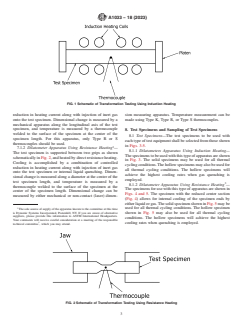
these models are undergoing continued development. This heating coil between two platens as shown schematically in
process is aimed, among other things, at establishing a direct Fig. 1. Cooling is accomplished by a combination of controlled
A1033 − 18 (2023)
FIG. 1 Schematic of Transformation Testing Using Induction Heating
reduction in heating current along with injection of inert gas sion measuring apparatus. Temperature measurement can be
onto the test specimen. Dimensional change is measured by a made using Type K, Type R, or Type S thermocouples.
mechanical apparatus along the longitudinal axis of the test
specimen, and temperature is measured by a thermocouple
8. Test Specimens and Sampling of Test Specimens
welded to the surface of the specimen at the center of the
8.1 Test Specimens—The test specimens to be used with
specimen length. For this apparatus, only Type R or S
each type of test equipment shall be selected from those shown
thermocouples should be used.
in Figs. 3-5.
7.1.2 Dilatometer Apparatus Using Resistance Heating —
8.1.1 Dilatometers Apparatus Using Induction Heating—
The test specimen is supported between two grips as shown
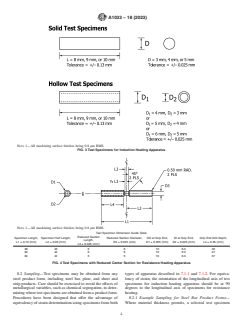
The specimens to be used with this type of apparatus are shown
schematically in Fig. 2, and heated by direct resistance heating.
in Fig. 3. The solid specimens may be used for all thermal
Cooling is accomplished by a combination of controlled
cycling conditions. The hollow specimens may also be used for
reduction in heating current along with injection of inert gas
all thermal cycling conditions. The hollow specimens will
onto the test specimen or internal liquid quenching. Dimen-
achieve the highest cooling rates when gas quenching is
sional change is measured along a diameter at the center of the
employed.
test specimen length, and temperature is measured by a
8.1.2 Dilatometer Apparatus Using Resistance Heating —
thermocouple welded to the surface of the specimen at the
The specimens for use with this type of apparatus are shown in
center of the specimen length. Dimensional change can be
Figs. 4 and 5. The specimen with the reduced center section
measured by either mechanical or non-contact (laser) dimen-
(Fig. 4) allows for internal cooling of the specimen ends by
either liquid or gas. The solid specimen shown in Fig. 5 may be
used for all thermal cycling conditions. The hollow specimen
The sole source of supply of the apparatus known to the committee at this time
is Dynamic Systems Incorporated, Postenkill, NY. If you are aware of alternative
shown in Fig. 5 may also be used for all thermal cycling
suppliers, please provide this information to ASTM International Headquarters.
conditions. The hollow specimens will achieve the highest
Your comments will receive careful consideration at a meeting of the responsible
cooling rates when quenching is employed.
technical committee , which you may attend.
FIG. 2 Schematic of Transformation Testing Using Resistance Heating
A1033 − 18 (2023)
NOTE 1—All machining surface finishes being 0.8 μm RMS.
FIG. 3 Test Specimens for Induction Heating Apparatus
NOTE 1—All machining surface finishes being 0.8 μm RMS.
Test Specimen Dimension Guide Table
Reduced Section
Specimen Length, Specimen Half Length, Reduced Section Diameter, OD at Grip End, ID at Grip End, Grip End Drill Depth,
Length,
L1 ± 0.10 (mm) L2 ± 0.05 (mm) D3 ± 0.025 (mm) D1 ± 0.025 (mm) D2 ± 0.025 (mm) L4 ± 0.05 (mm)
L3 ± 0.025 (mm)
90 45 6 6 10 6.3 40
84 42 6 6 10 6.3 37
84 42 5 5 10 6.3 37
FIG. 4 Test Specimens with Reduced Center Section for Resistance Heating Apparatus
8.2 Sampling—Test specimens may be obtained from any types of apparatus described in 7.1.1 and 7.1.2. For equiva-
steel product form, including steel bar, plate, and sheet and lency of strain, the orientation of the longitudinal axis of test
strip products. Care should be exercised to avoid the effects of specimens for induction heating apparatus should be at 90
metallurgical variables, such as chemical segregation, in deter- degrees to the longitudinal axis of specimens for resistance
mining where test specimens are obtained from a product form. heating.
Procedures have been designed that offer the advantage of 8.2.1 Example Sampling for Steel Bar Product Forms—
equivalency of strain determination using specimens from both Where material thickness permits, a selected test specimen
A1033 − 18 (2023)
NOTE 1—All machining surface finishes being 0.8 μm RMS.
Test Specimen Dimension Guide Table
Reduced Section
Specimen Length, Specimen Half Length, Reduced Section Diameter, OD at Grip End, ID at Grip End, Grip End Drill Depth,
Length,
L1 ± 0.10 (mm) L2 ± 0.05 (mm) D3 ± 0.025 (mm) D1 ± 0.025 (mm) D2 ± 0.025 (mm) L4 ± 0.05 (mm)
L3 ± 0.025 (mm)
90 45 6 6 10 6.3 40
84 42 6 6 10 6.3 37
84 42 5 5 10 6.3 37
FIG. 5 Test Specimens for Resistance Heating Apparatus
should be machined from the mid-radius position. Where specimen should be prepared from a standard reference mate-
material thickness is insufficient to permit machining a selected rial for which thermal expansion data has been documented.
test specimen from the mid-radius position but sufficient to The test specimen should be heated to 1000 °C 6 5 °C, at a
permit machining the test specimen from the mid-diameter nominal rate of 1 °C ⁄s, held at temperature for 60 s and then
position, the test specimen may be obtained from the mid- cooled at a nominal rate of 1 °C ⁄s to room temperature. This is
diameter position. In all cases, material thickness must be to be followed by a second thermal cycle whereby the test
sufficient to permit machining a fully dimensioned test speci- specimen is heated to 1000 °C 6 5 °C, at a nominal rate of
men. 10 °C ⁄s and then cooled at a nominal rate of 10 °C ⁄s to room
8.2.1.1 Dilatometer Apparatus Using Induction Heating— temperature. The appropriate specimen dimension is to be
The test specimens are to be machined with the longitudinal continuously measured during each thermal cycle.
axis of the test specimen perpendicular to the rolling direction
9.3 Standard Reference Material—The standard reference
of the bar. Fig. 6 shows example orientations.
material recommended for calibration is high purity nickel
8.2.1.2 Dilatometer Apparatus Using Resistance Heating—
(99.995 %).
The test specimens are to be machined with the longitudinal
9.4 Calibration Curves—Curves of strain versus tempera-
axis of the test specimen parallel to the rolling direction of the
ture are to be prepared from the dimension measurements for
bar. Fig. 6 shows example orientations.
both thermal cycles. Such curves must compare favorably with
an accepted strain-temperature curve for the selected reference
9. Calibration
material. A recommended strain-temperature curve for high
9.1 Apparatus and Components—Individually calibrate the
purity nickel is shown in Fig. 7. The band describes an error
temperature, time (sampling rate), and length change signals
band of 63 % strain calculated at 800 °C. The curves deter-
according to appropriate manufacturer’s recommendations.
mined by the user of this practice must fall within this band.
9.2 Use of Standard Reference Material—To ensure accu-
10. Procedure
rate test results, a calibration procedure must be followed
which involves using the apparatus to measure strain as a 10.1 Test Environment—All thermal cycles employed shall
–3
function of temperature for a standard reference material. A test be carried out under a vacuum of 1.33 × 10 PA maximum.
A1033 − 18 (2023)
FIG. 6 Machining Orientations for Bar Steel Product Forms
FIG. 7 Strain versus Temperature for High Purity Nickel
10.2 Test Specimen Preparation—Test specimens are to be 10.2.1 Dilatometer Apparatus Using Induction Heating—
machined from steel product stock to the dimensions and The test specimen must be degreased using a solvent such as
tolerances shown in Figs. 3-5. Test specimens must be properly acetone or methyl alcohol. To achieve a proper connection of
prepared and thermocouples must be properly attached to the the thermocouple to the test specimen, the surface of the test
specimens to ensure reliable and repeatable results. Care must specimen, at the point of thermocouple attachment, must be
also be taken to properly install specimens in the dilatometer lightly sanded using a 600 grit paper to remove any surface
apparatus. Procedures for specimen preparation and installa- oxide. Significant removal of metal must be avoided. The
tion are described below. length and diameter of the test specimen must then be
A1033 − 18 (2023)
measured with a micrometer. The diameter must be measured and aligned such that the thermocouple will not interfere with
at a point away from the sanded region to avoid any error in the dimension measuring apparatus. The specimen must then
measuring actual diameter. These measurements will aid in be tightened in the jaws or grips while maintaining alignment
verifying dimensional changes that occur during thermal cy-
of the thermocouple and positioning of the specimen. The jaws
cling. The thermocouple must then be welded to the surface of or grips must be tightened evenly to avoid mechanical stresses
the test specimen. Sheathed thermocouple wires with a nomi- on the test specimen. The jaws or grips must allow for free
nal diameter of 0.13 mm must be used. The thermocouple
expansion and contraction of the test specimen during heating
wires must be individually welded to the specimen surface at
and cooling. Once the specimen has been subjected to thermal
the point of attachment, and separated from each other by two
cycling as described below, and has been removed from the
wire diameters. The welding procedure must result in a secure
apparatus, the thermocouple leads may be cut away. The
attachment of each wire, but must avoid excessive melting of
specimen diameter must then be re-measured as described
either wire. This will weaken the interface between unwelded
above.
and welded sections of each wire, and could also cause metal
10.3 Test Specimen Stabilization—Remove residual stresses
flow between the wires, which will result in an erroneous
and stabilize the position of the test specimen within the
voltage output from the thermocouple. The specimen must be
apparatus. Carry out a preliminary thermal treatment of each
then placed between the holding platens in the dilatometer
test specimen prior to measuring dimensional change during
apparatus giving attention to achieving the best possible
thermal cycling. This treatment consists of heating the test
alignment. For maximum accuracy, the length change measur-
specimen to 650 °C 6 5 °C, at a nominal rate of 10 °C ⁄s,
ing device, for example, the linear variable differential trans-
holding the test specimen at 650 °C for 10 min and then
former (LVDT), must be adjusted so that it will not pass
cooling to room temperature at a cooling rate not exceeding
through its natural zero point during thermal cycling. Once the
20 °C ⁄s. The test specimen must not be removed from the
specimen is in place, the insulating sheaths on the thermo-
apparatus prior to conducting dimensional measurements.
couple wires must be moved along the thermocouple wires
until they contact the specimen surface. This will prevent
10.4 Determination of Critical Temperatures—The critical
undesirable heat loss, and will avoid contact between the two
temperatures, Ac and Ac , shall be determined from a test
1 3
thermocouple wires. Once the specimen has been subjected to
specimen separate from those used for other transformation
thermal cycling as described below, and has been removed
measurements. The thermal cycle to be used is to heat the test
from the apparatus, the thermocouple sheaths may be moved
specimen to 700 °C 6 5 °C, at a nominal rate of 10 °C ⁄s.
away from the test specimen surface, and the thermocouple
Heating must then be continued at a nominal rate of 28 °C ⁄h
leads cut away. The specimen diameter and length must then be
while strain is continuously measured until the Ac and Ac
1 3
re-measured as described above.
temperatures are identified. Strain increases with temperature
10.2.2 Dilatometer Apparatus Using Resistance Heating—
until Ac is reached. Ac is the temperature at which austenite
1 1
The test specimen must be degreased using a solvent such as
begins to form on heating, and strain will begin to decrease
acetone or methyl alcohol. To achieve a proper connection of
with increasing temperature. Ac is the temperature at which
the thermocouple to the test specimen, the surface of the test
the transformation from ferrite to austenite is completed and
specimen, at the point of thermocouple attachment, must be
strain will again begin to increase with increasing temperature.
lightly sanded using a 600 grit paper to remove any surface
Both critical temperatures can be determined from changes in
oxide. Significant removal of metal is to be avoided. The
the slope of a strain versus temperature plot as shown in Fig. 8.
diameter of the test specimen must then be measured with a
10.5 Continuous Cooling Transformation Data Sets—Each
micrometer. The diameter must be measured at a point away
continuous cooling transformation thermal cycle shall consist
from the sanded region to avoid any error in measuring actual
of heating a test specimen to an austenitizing temperature of
diameter. These measurements will aid in verifying dimen-
Ac + (50 °C 6 5 °C) at a nominal rate of 10 °C ⁄s. The test
sional changes that occur during thermal cycling. The thermo- 3
specimen shall be held at the austenitizing temperature for
couple must then be welded to the surface of the test specimen.
5 min and then cooled to room temperature at nominal rates of
Thermocouple wires with a nominal diameter of 0.2 mm must
0.05 °C ⁄s to 250 °C ⁄s. Data must be sampled and recorded at
be used. The thermocouple wires must be individually welded
the rate of one dimension measurement per degree Celsius.
to the specimen surface at the mid-span of the specimen and
Linea
...