

ASTM D8468-23
(Practice)Standard Practice for Data Recording Procedure for Welding Devices Used to Produce Thermal Fusion Welds in Geomembrane Systems
General Information
- Abstract
SIGNIFICANCE AND USE
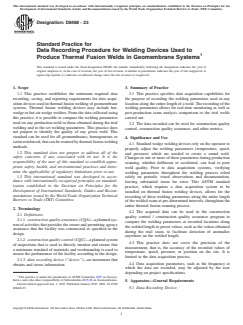
4.1 Standard wedge welding devices rely on the operator to properly adjust the welding parameters (temperature, speed, and pressure) which are needed to create a sound weld. Changes in one or more of these parameters during production seaming, whether deliberate or accidental, can lead to poor weld quality. Prior to data acquisition systems, verifying welding parameters throughout the welding process relied solely on periodic visual observations and documentation, leaving substantial room for error. This ASTM standard practice, which requires a data acquisition system to be installed on thermal fusion welding devices, allows for the recording of these welding parameters along the entire length of the welded seam at pre-determined intervals, throughout the entire thermal fusion seaming process.
4.2 The acquired data can be used in the construction quality control / construction quality assurance program to compare the welding parameters at recorded locations along the welded length to preset values, such as the values obtained during the trial seam, to facilitate detection of anomalies anywhere on the welded length.
4.3 This practice does not cover the precision of the measurement, that is, the accuracy of the recorded values of temperature, speed, pressure, or position on the site. It is limited to the data acquisition process.
4.4 Data acquisition parameters, such as the frequency at which the data are recorded, may be adjusted by the user depending on project specifications.
SCOPE
1.1 This practice establishes the minimum required data recording, saving, and reporting requirements for data acquisition devices used in thermal fusion welding of geomembrane systems. Thermal fusion welding devices may include hot-wedge or hot-air wedge welders. From the data collected using this practice, it is possible to compare the welding parameters used on any production weld to those obtained during the trial welding and to the set welding parameters. This practice does not purport to identify the quality of any given weld. This standard can be used for all geomembranes, homogeneous or scrim reinforced, that can be seamed by thermal fusion welding methods.
1.2 This standard does not purport to address all of the safety concerns, if any, associated with its use. It is the responsibility of the user of this standard to establish appropriate safety, health, and environmental practices and determine the applicability of regulatory limitations prior to use.
1.3 This international standard was developed in accordance with internationally recognized principles on standardization established in the Decision on Principles for the Development of International Standards, Guides and Recommendations issued by the World Trade Organization Technical Barriers to Trade (TBT) Committee.
- Status
- Published
- Publication Date
- 31-Dec-2022
- Technical Committee
- D35 - Geosynthetics
- Drafting Committee
- D35.10 - Geomembranes


Overview
ASTM D8468-23: Standard Practice for Data Recording Procedure for Welding Devices Used to Produce Thermal Fusion Welds in Geomembrane Systems provides a comprehensive framework for the use of data acquisition systems in thermal fusion welding of geomembrane materials. This standard specifies minimum requirements for recording, saving, and reporting critical welding parameters-such as temperature, speed, and pressure-along the entire welded seam. The purpose is to ensure greater reliability and quality assurance in the construction and maintenance of geomembrane systems, which are widely used for environmental containment, landfill liners, and similar applications.
Key Topics
- Data Acquisition Requirements
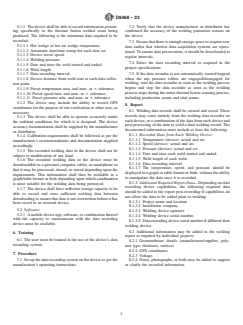
- Establishes the essential parameters to be recorded, including hot wedge or hot air wedge temperature, device travel speed, welding pressure, date/time stamps, weld length, and recording intervals.
- Devices must maintain data integrity by preventing post-recording modifications and ensuring data can be securely downloaded to external platforms without data loss.
- Device Performance and Calibration
- Devices must operate accurately within intended environmental conditions, following manufacturer calibration recommendations.
- Data acquisition systems may also allow for GPS location recording for site verification.
- Data Utilization in Quality Programs
- Facilitates real-time monitoring and post-production analysis for construction quality assurance (CQA) and construction quality control (CQC) through comparison against preset parameters from trial seams.
- Enables detection of anomalies that could impact seam performance, promoting higher standards of workmanship and safety.
- Reporting and Documentation
- Specifies minimum reporting elements, such as actual and set welding parameters, weld start/end times, weld lengths, project details, and operator information.
- Reporting can be enhanced with graphical representations, GPS data, and supporting documentation, such as photographs and additional project notes.
Applications
- Geomembrane System Installation
- Essential for contractors and installers engaged in thermal fusion welding of geomembranes, whether homogeneous or scrim-reinforced, ensuring consistency across large-scale projects.
- Construction and Civil Engineering
- Used in infrastructure projects requiring stringent containment measures, such as landfill liners, mining operations, water reservoirs, or secondary containment systems.
- Quality Assurance and Control
- Supports quality documentation for regulatory agencies, site owners, and project managers by providing transparent data trails from production to final acceptance.
- Project Documentation and Compliance
- Assists in meeting project-specific specifications and international standardization requirements, facilitating regulatory approval and audit processes.
Related Standards
- ASTM D4437 - Practice for Determining the Integrity of Field Seams Used in Joining Flexible Polymeric Sheet Geomembranes.
- ASTM D6103 - Guide for Quality Assurance and Quality Control During the Installation of Geomembranes.
- ASTM D6392 - Test Method for Determining the Integrity of Nonreinforced Polymeric Geomembrane Seams.
- ISO 5636 - Related international standards on data acquisitions and environmental containment solutions.
- World Trade Organization TBT Principles - Reinforces global harmonization through compliance with internationally recognized standardization protocols.
By establishing a standardized procedure for data recording during thermal fusion welding, ASTM D8468-23 enhances reliability, safety, and accountability in geomembrane system installations. Adopting this standard helps ensure that critical welding parameters are consistently monitored, accurately documented, and readily accessible, laying the foundation for robust construction quality control and assurance across the geosynthetics industry.
Get Certified
Connect with accredited certification bodies for this standard

Control Union Certifications
Global certification for agriculture and sustainability.

DVS-ZERT GmbH
German welding certification society.
Hohenstein Institut
Textile testing and certification.
Sponsored listings
Frequently Asked Questions
ASTM D8468-23 is a standard published by ASTM International. Its full title is "Standard Practice for Data Recording Procedure for Welding Devices Used to Produce Thermal Fusion Welds in Geomembrane Systems". This standard covers: SIGNIFICANCE AND USE 4.1 Standard wedge welding devices rely on the operator to properly adjust the welding parameters (temperature, speed, and pressure) which are needed to create a sound weld. Changes in one or more of these parameters during production seaming, whether deliberate or accidental, can lead to poor weld quality. Prior to data acquisition systems, verifying welding parameters throughout the welding process relied solely on periodic visual observations and documentation, leaving substantial room for error. This ASTM standard practice, which requires a data acquisition system to be installed on thermal fusion welding devices, allows for the recording of these welding parameters along the entire length of the welded seam at pre-determined intervals, throughout the entire thermal fusion seaming process. 4.2 The acquired data can be used in the construction quality control / construction quality assurance program to compare the welding parameters at recorded locations along the welded length to preset values, such as the values obtained during the trial seam, to facilitate detection of anomalies anywhere on the welded length. 4.3 This practice does not cover the precision of the measurement, that is, the accuracy of the recorded values of temperature, speed, pressure, or position on the site. It is limited to the data acquisition process. 4.4 Data acquisition parameters, such as the frequency at which the data are recorded, may be adjusted by the user depending on project specifications. SCOPE 1.1 This practice establishes the minimum required data recording, saving, and reporting requirements for data acquisition devices used in thermal fusion welding of geomembrane systems. Thermal fusion welding devices may include hot-wedge or hot-air wedge welders. From the data collected using this practice, it is possible to compare the welding parameters used on any production weld to those obtained during the trial welding and to the set welding parameters. This practice does not purport to identify the quality of any given weld. This standard can be used for all geomembranes, homogeneous or scrim reinforced, that can be seamed by thermal fusion welding methods. 1.2 This standard does not purport to address all of the safety concerns, if any, associated with its use. It is the responsibility of the user of this standard to establish appropriate safety, health, and environmental practices and determine the applicability of regulatory limitations prior to use. 1.3 This international standard was developed in accordance with internationally recognized principles on standardization established in the Decision on Principles for the Development of International Standards, Guides and Recommendations issued by the World Trade Organization Technical Barriers to Trade (TBT) Committee.
SIGNIFICANCE AND USE 4.1 Standard wedge welding devices rely on the operator to properly adjust the welding parameters (temperature, speed, and pressure) which are needed to create a sound weld. Changes in one or more of these parameters during production seaming, whether deliberate or accidental, can lead to poor weld quality. Prior to data acquisition systems, verifying welding parameters throughout the welding process relied solely on periodic visual observations and documentation, leaving substantial room for error. This ASTM standard practice, which requires a data acquisition system to be installed on thermal fusion welding devices, allows for the recording of these welding parameters along the entire length of the welded seam at pre-determined intervals, throughout the entire thermal fusion seaming process. 4.2 The acquired data can be used in the construction quality control / construction quality assurance program to compare the welding parameters at recorded locations along the welded length to preset values, such as the values obtained during the trial seam, to facilitate detection of anomalies anywhere on the welded length. 4.3 This practice does not cover the precision of the measurement, that is, the accuracy of the recorded values of temperature, speed, pressure, or position on the site. It is limited to the data acquisition process. 4.4 Data acquisition parameters, such as the frequency at which the data are recorded, may be adjusted by the user depending on project specifications. SCOPE 1.1 This practice establishes the minimum required data recording, saving, and reporting requirements for data acquisition devices used in thermal fusion welding of geomembrane systems. Thermal fusion welding devices may include hot-wedge or hot-air wedge welders. From the data collected using this practice, it is possible to compare the welding parameters used on any production weld to those obtained during the trial welding and to the set welding parameters. This practice does not purport to identify the quality of any given weld. This standard can be used for all geomembranes, homogeneous or scrim reinforced, that can be seamed by thermal fusion welding methods. 1.2 This standard does not purport to address all of the safety concerns, if any, associated with its use. It is the responsibility of the user of this standard to establish appropriate safety, health, and environmental practices and determine the applicability of regulatory limitations prior to use. 1.3 This international standard was developed in accordance with internationally recognized principles on standardization established in the Decision on Principles for the Development of International Standards, Guides and Recommendations issued by the World Trade Organization Technical Barriers to Trade (TBT) Committee.
ASTM D8468-23 is classified under the following ICS (International Classification for Standards) categories: 25.160.30 - Welding equipment; 59.080.70 - Geotextiles. The ICS classification helps identify the subject area and facilitates finding related standards.
ASTM D8468-23 is available in PDF format for immediate download after purchase. The document can be added to your cart and obtained through the secure checkout process. Digital delivery ensures instant access to the complete standard document.
Standards Content (Sample)
This international standard was developed in accordance with internationally recognized principles on standardization established in the Decision on Principles for the
Development of International Standards, Guides and Recommendations issued by the World Trade Organization Technical Barriers to Trade (TBT) Committee.
Designation: D8468 − 23
Standard Practice for
Data Recording Procedure for Welding Devices Used to
Produce Thermal Fusion Welds in Geomembrane Systems
This standard is issued under the fixed designation D8468; the number immediately following the designation indicates the year of
original adoption or, in the case of revision, the year of last revision. A number in parentheses indicates the year of last reapproval. A
superscript epsilon (´) indicates an editorial change since the last revision or reapproval.
1. Scope 3. Summary of Practice
1.1 This practice establishes the minimum required data 3.1 This practice specifies data acquisition capabilities for
recording, saving, and reporting requirements for data acqui- the purpose of recording the welding parameters used in any
sition devices used in thermal fusion welding of geomembrane location along the entire length of a weld. The recording of the
systems. Thermal fusion welding devices may include hot- welding parameters allows for real-time monitoring as well as
wedge or hot-air wedge welders. From the data collected using post-production seam analysis comparison to the trial welds
this practice, it is possible to compare the welding parameters carried out.
used on any production weld to those obtained during the trial
3.2 The data recorded can be used for construction quality
welding and to the set welding parameters. This practice does
control, construction quality assurance, and other metrics.
not purport to identify the quality of any given weld. This
standard can be used for all geomembranes, homogeneous or
4. Significance and Use
scrimreinforced, that can be seamed by thermal fusion welding
4.1 Standard wedge welding devices rely on the operator to
methods.
properly adjust the welding parameters (temperature, speed,
1.2 This standard does not purport to address all of the
and pressure) which are needed to create a sound weld.
safety concerns, if any, associated with its use. It is the
Changes in one or more of these parameters during production
responsibility of the user of this standard to establish appro-
seaming, whether deliberate or accidental, can lead to poor
priate safety, health, and environmental practices and deter-
weld quality. Prior to data acquisition systems, verifying
mine the applicability of regulatory limitations prior to use.
welding parameters throughout the welding process relied
1.3 This international standard was developed in accor-
solely on periodic visual observations and documentation,
dance with internationally recognized principles on standard-
leaving substantial room for error. This ASTM standard
ization established in the Decision on Principles for the
practice, which requires a data acquisition system to be
Development of International Standards, Guides and Recom-
installed on thermal fusion welding devices, allows for the
mendations issued by the World Trade Organization Technical
recording of these welding parameters along the entire length
Barriers to Trade (TBT) Committee.
of the welded seam at pre-determined intervals, throughout the
entire thermal fusion seaming process.
2. Terminology
4.2 The acquired data can be used in the construction
2.1 Definitions:
quality control / construction quality assurance program to
2.1.1 construction quality assurance (CQA)—a planned sys-
compare the welding parameters at recorded locations along
tem of activities that provides the owner and permitting agency
the welded length to preset values, such as the values obtained
assurance that the facility was constructed as specified in the
during the trial seam, to facilitate detection of anomalies
design.
anywhere on the welded length.
2.1.2 construction quality control (CQC)—a planned system
4.3 This practice does not cover the precision of the
of inspections that is used to directly monitor and ensure that
measurement, that is, the accuracy of the recorded values of
a minimum standard of materials and workmanship is used to
temperature, speed, pressure, or position on the site. It is
ensure the performance of the facility according to the design.
limited to the data acquisition process.
2.1.3 data recording device (“device”)—an instrument that
4.4 Data acquisition parameters, such as the frequency at
obtains and stores information.
which the data are recorded, may be adjusted by the user
depending on project specifications.
This practice is under the jurisdiction of ASTM Committee D35 on Geosyn-
thetics and is the direct responsibility of Subcommittee D35.10 on Geomembranes.
5. Apparatus—General Requirements
Current edition approved Jan. 1, 2023. Published January 2023. DOI: 10.1520/
D8468-23. 5.1 Data Recording Device:
Copyright © ASTM International, 100 Barr Harbor Drive, PO Box C700, West Conshohocken, PA 19428-2959. United States
D8468 − 23
5.1.1 The device shall be able to record information pertain- 7.2 Verify that the device manufacturer or distributor has
ing specifically to the thermal fusion welded seam being confirmed the accuracy of the welding parameter sensors on
produced. The following is the minimum data required to be the device.
recorded:
7.3 Ensure that there is enough storage space to acquire new
5.1.1.1 Hot wedge or hot air wedge temperature.
data and/or that wireless d
...