

ASTM D7031-11(2019)
(Guide)Standard Guide for Evaluating Mechanical and Physical Properties of Wood-Plastic Composite Products
General Information
- Abstract
SIGNIFICANCE AND USE
4.1 WPCs are intended for use in both structural and non-structural applications. The test methods described within are intended to address products that are manufactured from virgin or recycled wood and thermoplastic sources. These methods provide a reference for the evaluation of several mechanical and physical properties important for structural and non-structural uses of WPCs.
SCOPE
1.1 This guide covers test methods appropriate for evaluating a wide range of performance properties for wood-plastic composite (WPC) products. It was developed from evaluations of both experimental and currently manufactured products, and is not intended to suggest that all the tests listed are necessary or appropriate for each application of a WPC. The user must determine which test methods apply to the particular application being evaluated (see Appendix X1).
1.2 Details of manufacturing processes may be proprietary and are beyond the scope of this guide.
1.3 This standard does not purport to address all of the safety concerns, if any, associated with its use. It is the responsibility of the user of this standard to establish appropriate safety, health, and environmental practices and determine the applicability of regulatory limitations prior to use.
1.4 This international standard was developed in accordance with internationally recognized principles on standardization established in the Decision on Principles for the Development of International Standards, Guides and Recommendations issued by the World Trade Organization Technical Barriers to Trade (TBT) Committee.
- Status
- Published
- Publication Date
- 14-Jul-2019
- Technical Committee
- D07 - Wood
- Drafting Committee
- D07.02 - Lumber and Engineered Wood Products
Overview
ASTM D7031-11(2019): Standard Guide for Evaluating Mechanical and Physical Properties of Wood-Plastic Composite Products provides a comprehensive framework for assessing the performance characteristics of wood-plastic composites (WPCs). Developed by ASTM International, this guide is applicable to WPC products manufactured from virgin or recycled wood and thermoplastic sources, and is intended for both structural and non-structural applications. The document encompasses a broad spectrum of test methods, allowing users to select those most relevant to their specific product application.
Key Topics
Purpose and Scope:
- Serves as a reference for evaluating mechanical and physical properties of WPCs.
- Applies to products made from both virgin and recycled materials.
- Encompasses both experimental and commercially available WPC products.
Test Methods Selection:
- The guide lists numerous appropriate test methods but does not mandate all for every application.
- Users are responsible for determining which tests suit their specific end-use scenario.
Mechanical and Physical Properties:
- Addresses properties such as bending strength, tension, compression, shear strength, creep, impact resistance, fastener holding, abrasion, slip resistance, thermal expansion, moisture absorption, and fire performance.
- Considers important factors like sample size, conditioning, and environmental exposure (e.g., freeze-thaw, ultraviolet, moisture).
Significance:
- Enables reliable comparison across products and supports regulatory compliance.
- Provides vital data for manufacturers, engineers, and quality assurance professionals evaluating WPCs for safe and effective application.
Applications
Wood-plastic composites are used in a diverse range of applications, and ASTM D7031-11(2019) guides their evaluation for areas such as:
- Decking and Outdoor Structures: WPCs are widely utilized for decking, fencing, and landscape applications due to their resistance to rot and decay. Evaluating bending, slip resistance, and weatherability ensures safety and longevity.
- Building Components: Structural and non-structural products such as railings, trim, and paneling benefit from testing for mechanical strength, thermal expansion, and fire performance to meet building codes.
- Industrial uses: WPCs are used for pallets, packaging, and transportation due to durability and customizable properties. Mechanical fastener holding and abrasion resistance tests are key for these applications.
- Public Spaces and Marine: Resistance to fungi, termites, and marine borers is crucial for WPCs used in parks, docks, and waterfront installations.
Manufacturers, specifiers, and regulatory bodies rely on this standard to ensure products are fit for purpose, meet safety and environmental requirements, and provide consistent quality over time.
Related Standards
Several ASTM and AWPA standards are referenced within ASTM D7031-11(2019) to support comprehensive testing and terminology:
- ASTM D4761: Methods for mechanical properties of lumber and wood-based structural materials.
- ASTM D6109: Flexural properties of unreinforced and reinforced plastic lumber.
- ASTM D143: Testing for small clear specimens of timber.
- ASTM D2395, D4442, D792: Methods for measuring density, moisture content, and specific gravity.
- ASTM E84, E108, E1354: Fire tests for surface burning and ignition.
- ASTM D1037: Physical property evaluation of wood-base fiber and particle panel materials.
- AWPA E1, E7, E10 & D3345: Evaluation of resistance to termites and fungal decay.
Practical Value
By using ASTM D7031-11(2019), stakeholders can:
- Standardize Evaluation: Ensure consistency in product testing and reporting, facilitating specification, design, and regulatory compliance.
- Verify Product Performance: Address quality assurance and determine suitability for structural and non-structural uses.
- Support Innovation: Provide a framework for testing new formulations or recycled content in wood-plastic composites.
- Meet International Standards: Align product evaluation with globally recognized principles, reducing trade barriers and facilitating global commerce.
Keywords: ASTM D7031, wood-plastic composite, WPC, mechanical properties, physical properties, test methods, product evaluation, structural applications, standardization, building materials.
Relations
- Effective Date
- 15-Jul-2019
- Effective Date
- 01-Feb-2024
- Effective Date
- 01-Feb-2024
- Effective Date
- 01-Dec-2023
- Effective Date
- 15-Nov-2023
- Effective Date
- 01-Nov-2023
- Effective Date
- 01-Oct-2023
- Effective Date
- 01-Sep-2023
- Refers
ASTM D1761-20 - Standard Test Methods for Mechanical Fasteners in Wood and Wood-Based Materials - Effective Date
- 15-Apr-2020
- Effective Date
- 01-Apr-2020
- Effective Date
- 15-Mar-2020
- Effective Date
- 01-Mar-2020
- Effective Date
- 01-Jan-2020
- Effective Date
- 01-Dec-2019
- Effective Date
- 01-Aug-2019
Get Certified
Connect with accredited certification bodies for this standard

BSMI (Bureau of Standards, Metrology and Inspection)
Taiwan's standards and inspection authority.
Sponsored listings
Frequently Asked Questions
ASTM D7031-11(2019) is a guide published by ASTM International. Its full title is "Standard Guide for Evaluating Mechanical and Physical Properties of Wood-Plastic Composite Products". This standard covers: SIGNIFICANCE AND USE 4.1 WPCs are intended for use in both structural and non-structural applications. The test methods described within are intended to address products that are manufactured from virgin or recycled wood and thermoplastic sources. These methods provide a reference for the evaluation of several mechanical and physical properties important for structural and non-structural uses of WPCs. SCOPE 1.1 This guide covers test methods appropriate for evaluating a wide range of performance properties for wood-plastic composite (WPC) products. It was developed from evaluations of both experimental and currently manufactured products, and is not intended to suggest that all the tests listed are necessary or appropriate for each application of a WPC. The user must determine which test methods apply to the particular application being evaluated (see Appendix X1). 1.2 Details of manufacturing processes may be proprietary and are beyond the scope of this guide. 1.3 This standard does not purport to address all of the safety concerns, if any, associated with its use. It is the responsibility of the user of this standard to establish appropriate safety, health, and environmental practices and determine the applicability of regulatory limitations prior to use. 1.4 This international standard was developed in accordance with internationally recognized principles on standardization established in the Decision on Principles for the Development of International Standards, Guides and Recommendations issued by the World Trade Organization Technical Barriers to Trade (TBT) Committee.
SIGNIFICANCE AND USE 4.1 WPCs are intended for use in both structural and non-structural applications. The test methods described within are intended to address products that are manufactured from virgin or recycled wood and thermoplastic sources. These methods provide a reference for the evaluation of several mechanical and physical properties important for structural and non-structural uses of WPCs. SCOPE 1.1 This guide covers test methods appropriate for evaluating a wide range of performance properties for wood-plastic composite (WPC) products. It was developed from evaluations of both experimental and currently manufactured products, and is not intended to suggest that all the tests listed are necessary or appropriate for each application of a WPC. The user must determine which test methods apply to the particular application being evaluated (see Appendix X1). 1.2 Details of manufacturing processes may be proprietary and are beyond the scope of this guide. 1.3 This standard does not purport to address all of the safety concerns, if any, associated with its use. It is the responsibility of the user of this standard to establish appropriate safety, health, and environmental practices and determine the applicability of regulatory limitations prior to use. 1.4 This international standard was developed in accordance with internationally recognized principles on standardization established in the Decision on Principles for the Development of International Standards, Guides and Recommendations issued by the World Trade Organization Technical Barriers to Trade (TBT) Committee.
ASTM D7031-11(2019) is classified under the following ICS (International Classification for Standards) categories: 17.040.20 - Properties of surfaces. The ICS classification helps identify the subject area and facilitates finding related standards.
ASTM D7031-11(2019) has the following relationships with other standards: It is inter standard links to ASTM D7031-11, ASTM D6109-24, ASTM D883-24, ASTM E84-23d, ASTM D143-23, ASTM D883-23, ASTM D2565-23, ASTM E84-23c, ASTM D1761-20, ASTM E108-20a, ASTM E108-20, ASTM D4442-20, ASTM D883-20, ASTM D1929-19, ASTM D883-19c. Understanding these relationships helps ensure you are using the most current and applicable version of the standard.
ASTM D7031-11(2019) is available in PDF format for immediate download after purchase. The document can be added to your cart and obtained through the secure checkout process. Digital delivery ensures instant access to the complete standard document.
Standards Content (Sample)
This international standard was developed in accordance with internationally recognized principles on standardization established in the Decision on Principles for the
Development of International Standards, Guides and Recommendations issued by the World Trade Organization Technical Barriers to Trade (TBT) Committee.
Designation: D7031 − 11 (Reapproved 2019)
Standard Guide for
Evaluating Mechanical and Physical Properties of Wood-
Plastic Composite Products
This standard is issued under the fixed designation D7031; the number immediately following the designation indicates the year of
original adoption or, in the case of revision, the year of last revision. A number in parentheses indicates the year of last reapproval. A
superscript epsilon (´) indicates an editorial change since the last revision or reapproval.
1. Scope D792 Test Methods for Density and Specific Gravity (Rela-
tive Density) of Plastics by Displacement
1.1 This guide covers test methods appropriate for evaluat-
D883 Terminology Relating to Plastics
ing a wide range of performance properties for wood-plastic
D1037 Test Methods for Evaluating Properties of Wood-
composite (WPC) products. It was developed from evaluations
Base Fiber and Particle Panel Materials
of both experimental and currently manufactured products, and
D1038 TerminologyRelatingtoVeneer,Plywood,andWood
is not intended to suggest that all the tests listed are necessary
Structural Panels
or appropriate for each application of a WPC. The user must
D1413 Test Method for Wood Preservatives by Laboratory
determine which test methods apply to the particular applica-
Soil-Block Cultures (Withdrawn 2016)
tion being evaluated (see Appendix X1).
D1554 Terminology Relating to Wood-Base Fiber and Par-
1.2 Details of manufacturing processes may be proprietary
ticle Panel Materials
and are beyond the scope of this guide.
D1761 Test Methods for Mechanical Fasteners in Wood
1.3 This standard does not purport to address all of the
D1929 Test Method for Determining Ignition Temperature
safety concerns, if any, associated with its use. It is the of Plastics
responsibility of the user of this standard to establish appro-
D2017 Test Method ofAccelerated LaboratoryTest of Natu-
priate safety, health, and environmental practices and deter- ral Decay Resistance of Woods (Withdrawn 2014)
mine the applicability of regulatory limitations prior to use.
D2047 Test Method for Static Coefficient of Friction of
1.4 This international standard was developed in accor- Polish-Coated Flooring Surfaces as Measured by the
dance with internationally recognized principles on standard-
James Machine
ization established in the Decision on Principles for the D2394 Test Methods for Simulated Service Testing of Wood
Development of International Standards, Guides and Recom-
and Wood-Based Finish Flooring
mendations issued by the World Trade Organization Technical
D2395 TestMethodsforDensityandSpecificGravity(Rela-
Barriers to Trade (TBT) Committee. tive Density) of Wood and Wood-Based Materials
D2481 Test Method for Accelerated Evaluation of Wood
2. Referenced Documents
Preservatives for Marine Services by Means of Small Size
Specimens (Withdrawn 2014)
2.1 ASTM Standards:
D2565 Practice for Xenon-Arc Exposure of Plastics In-
C1308 Test Method forAccelerated LeachTest for Diffusive
tended for Outdoor Applications
Releases from Solidified Waste and a Computer Program
D2915 Practice for Sampling and Data-Analysis for Struc-
to Model Diffusive, Fractional Leaching from Cylindrical
tural Wood and Wood-Based Products
Waste Forms
D3345 Test Method for Laboratory Evaluation of Solid
D9 Terminology Relating to Wood and Wood-Based Prod-
Wood for Resistance to Termites
ucts
D4000 Classification System for Specifying Plastic Materi-
D143 Test Methods for Small Clear Specimens of Timber
als
D4060 Test Method for Abrasion Resistance of Organic
This guide is under the jurisdiction of ASTM Committee D07 on Wood and is
Coatings by the Taber Abraser
the direct responsibility of Subcommittee D07.02 on Lumber and Engineered Wood
D4092 Terminology for Plastics: Dynamic Mechanical
Products.
Properties
Current edition approved July 15, 2019. Published August 2019. Originally
approved in 2004. Last previous edition approved in 2011 as D7031 – 11. DOI: D4442 Test Methods for Direct Moisture Content Measure-
10.1520/D7031-11R19.
ment of Wood and Wood-Based Materials
For referenced ASTM standards, visit the ASTM website, www.astm.org, or
contact ASTM Customer Service at service@astm.org. For Annual Book of ASTM
Standards volume information, refer to the standard’s Document Summary page on The last approved version of this historical standard is referenced on
the ASTM website. www.astm.org.
Copyright © ASTM International, 100 Barr Harbor Drive, PO Box C700, West Conshohocken, PA 19428-2959. United States
D7031 − 11 (2019)
D4495 Test Method for Impact Resistance of Poly(Vinyl 3.2.4 width—the greater dimension perpendicular to the
Chloride) (PVC) Rigid Profiles by Means of a Falling long axis.
Weight 3.2.5 wood-plastic composite (WPC)—a composite made
D4761 Test Methods for Mechanical Properties of Lumber primarily from wood- or cellulose-based materials and plas-
and Wood-Based Structural Materials tic(s).
D5379/D5379M Test Method for Shear Properties of Com-
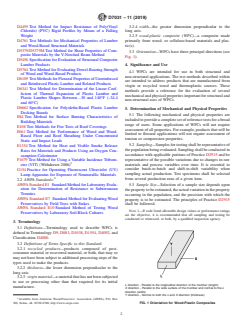
3.3 Orientation—WPCs have three principal directions (see
posite Materials by the V-Notched Beam Method
Fig. 1).
D5456 Specification for Evaluation of Structural Composite
Lumber Products
4. Significance and Use
D5764 Test Method for Evaluating Dowel-Bearing Strength
4.1 WPCs are intended for use in both structural and
of Wood and Wood-Based Products
non-structural applications. The test methods described within
D6109 TestMethodsforFlexuralPropertiesofUnreinforced
are intended to address products that are manufactured from
and Reinforced Plastic Lumber and Related Products
virgin or recycled wood and thermoplastic sources. These
D6341 Test Method for Determination of the Linear Coef-
methods provide a reference for the evaluation of several
ficient of Thermal Expansion of Plastic Lumber and
mechanicalandphysicalpropertiesimportantforstructuraland
Plastic Lumber Shapes Between –30 and 140°F (–34.4
non-structural uses of WPCs.
and 60°C)
D6662 Specification for Polyolefin-Based Plastic Lumber
5. Determination of Mechanical and Physical Properties
Decking Boards
5.1 The following mechanical and physical properties are
E84 Test Method for Surface Burning Characteristics of
includedtoprovideacompletesetofreferencetestsforabroad
Building Materials
range of users. Some applications of WPCs will not require
E108 Test Methods for Fire Tests of Roof Coverings
assessment of all properties. For example, products that will be
E661 Test Method for Performance of Wood and Wood-
limited to flexural applications will not require assessment of
Based Floor and Roof Sheathing Under Concentrated
tension or compression properties.
Static and Impact Loads
5.2 Sampling—Samplesfortestingshallberepresentativeof
E1354 Test Method for Heat and Visible Smoke Release
thepopulationbeingevaluated.Samplingshallbeconductedin
Rates for Materials and Products Using an Oxygen Con-
accordance with applicable portions of Practice D2915 and be
sumption Calorimeter
representative of the possible variations due to changes in raw
F1679 Test Method for Using a Variable Incidence Tribom-
materials and process variables over time. It is essential to
eter (VIT) (Withdrawn 2006)
consider batch-to-batch and shift-to-shift variability when
G154 Practice for Operating Fluorescent Ultraviolet (UV)
sampling actual production. Test specimens shall be selected
Lamp Apparatus for Exposure of Nonmetallic Materials
from several production runs of a given item.
2.2 AWPA Standards:
AWPAStandard E1 Standard Method for Laboratory Evalu-
5.3 Sample Size—Selection of a sample size depends upon
ation for Determination of Resistance to Subterranean
thepropertytobeestimated,theactualvariationintheproperty
Termites
occurring in the population, and the precision with which the
AWPA Standard E7 Standard Method for Evaluating Wood
property is to be estimated. The principles of Practice D2915
Preservatives by Field Tests with Stakes
shall be followed.
AWPA Standard E10 Standard Method of Testing Wood
NOTE 1—If code listed allowable design values or performance ratings
Preservatives by Laboratory Soil-Block Cultures
are the objective, it is recommended that all sampling and testing be
conducted or witnessed, or both, by a qualified inspection agency.
3. Terminology
3.1 Definitions—Terminology used to describe WPCs is
defined inTerminology D9, D883, D1038, D1554, D4092, and
Classification D4000.
3.2 Definitions of Terms Specific to this Standard:
3.2.1 recycled products—products composed of post-
consumer material or recovered material, or both, that may or
may not have been subject to additional processing steps of the
types used to make the products.
3.2.2 thickness—the lesser dimension perpendicular to the
long axis.
3.2.3 virgin material—amaterialthathasnotbeensubjected
to use or processing other than that required for its initial
L direction - Parallel to the longitudinal direction of the member (length)
manufacture.
X direction - Parallel to the wide surface of the member and normal to the L
direction (width)
Y direction - Normal to both the L and X direction (thickness)
Available from American Wood-Preservers’ Association (AWPA), P.O. Box
388, Selma, AL 36702-0388, http://www.awpa.com. FIG. 1 Orientation for Wood-Plastic Composites
D7031 − 11 (2019)
5.4 Conditioning—Prior to testing, all specimens shall be minute (610 %).Average time to failure for each test configu-
conditioned to environmental conditions appropriate for the ration shall be recorded. If required, selection of specimen
intended end use of the product. dimensions establishes the unit volume for the analysis of
5.4.1 Whentemperatureandrelativehumidityareimportant volume effects per Specification D5456.
considerations, the test specimens shall be conditioned for a
5.7 Compression Parallel to the L Direction—Short column
period of time such that the average daily mass change of the
compression strength parallel to the L direction shall be
test specimen is less than 2 % of the mass at time of measure.
determined in accordance with the principles of Test Methods
5.4.2 When the product is to be subjected to a water soak
D4761.Tests shall be conducted on a cross section no less than
environment, the test specimens shall be tested within 30 min
the minimum anticipated structural size. Length of the speci-
upon removal from the treatment.
men shall be such that l/d is less than 4.5 and greater than 3.0,
5.5 Bending—Modulus of rupture (MOR) or moment capac-
where l is the effective unsupported length and d is the
ity and apparent modulus of elasticity (E) or flexural stiffness
minimum cross-sectional dimension. For non-solid cross-
shall be determined in accordance with principles of Test
section materials, the actual cross-sectional area shall be
Methods D4761 or D6109. For some applications and
calculated.
products, moment capacity and flexural stiffness are preferable
5.8 Compression Perpendicular to the L Direction—
performance measures. Whenever possible, the test specimen
Compression strength perpendicular to the L direction shall be
shall be the full cross section of the as-manufactured product.
determined following the measurement and bearing require-
Selection of specimen dimensions establishes the unit volume
ments of Test Method D143, except that the specimen dimen-
for analysis of volume effects in accordance with Specification
sions shall be the full cross-section dimension of theWPC, and
D5456, when applicable.Aspan-to-depth ratio of not less than
the length shall be three times the depth. Load shall be applied
16 shall be used. The specimens shall be loaded at a constant
through a metal bearing plate across the full width of the test
strain rate of 1 % per minute (610 %).Average time to failure
specimen. Stress at both 0.02 and 0.04 in. (0.5 and 1.0 mm) of
for each test configuration shall be recorded (see X1.5). A
deformation shall be reported. Testing shall be conducted with
constant strain rate of 1 % per minute is achieved by using a
stresses applied normal to the L-X or L-Y plane, or both, when
constant rate of test machine cross-head motion, R, (inches/
required for general product application. The objective of this
minute) computed in terms of the test span, L, and the member
test is to determine the load carrying capacity of the as-
depth, d, by the following equation:
manufactured product. The allowable stress derived from this
L
test will only apply to the actual cross section tested.
R 5 0.00185 3
d
5.9 Shear Strength:
NOTE 2—WPCs often exhibit exceptionally large deformations prior to
failure in bending. Users are cautioned to take particular care in test
5.9.1 Shear Parallel to the L Direction (Longitudinal
machine set-up to accommodate large deflections, both in terms of
Shear)—Shear strength parallel to the L direction shall be
deflection measuring devices and support conditions.
determined in accordance with the principles of Test Method
5.5.1 MOR—Maximum load for the calculation of MOR
D143 using the shear block test. Testing shall be done to
shall be reported for each specimen. If the calculation is based
produce shear failure in the L-X or L-Y plane, or both. For solid
on a load other than the maximum load, the load basis shall be
cross-section products, a minimum dimension of 1.0 in. (25
reported.
mm)intheshearareaisacceptableprovidedthatthetotalshear
areaisatleast1.0in .Fornon-solidcross-sectionproducts,the
NOTE 3—For products that exhibit large deformations, the MOR value
is commonly based on the load at 3 % strain. fullcrosssectionshallbetestedusingtheshearblocktestswith
theactualshearareabasedonwallthickness(s)subjectedtothe
5.5.2 E—Apparent flexural modulus of elasticity and its
shearing stress.
calculation basis shall be reported for each specimen. Charac-
5.9.2 Shear Perpendicular to the L Direction—Shear
terization of the modulus of elasticity depends upon the use of
strength perpendicular to the L direction shall be determined in
thedata.Formaterialpropertyinformation,Ecanbecalculated
accordance with the principles of Test Method D143 using the
in a variety of ways. For design value assignment purposes
shear block test. The Test Method D143 shear block test has
linear least squares fit of the stress-strain curve over an
been shown to provide a conservative estimate of the shear
appropriate range of stress shall be used.
strength of wood-based materials. Other test methods may be
NOTE 4—To assign design values to structural members the least
applicable.Testing shall be done to produce shear failure in the
squares fit over a range of 10 to 40 % of ultimate stress is commonly
X-Y plane. For solid cross-section products a minimum dimen-
chosen as representative for service loadings. An alternative calculation
method based on the secant modulus to 1 % strain is commonly used for sion of 1.0 in. (25 mm) in the shear area is acceptable provided
all-plastic products.
that the total shear area is at least 1.0 in .
5.6 Tension Parallel to the L Direction—Tension strength
NOTE 5—For non-solid cross-section products, a shear block test
parallel to the L direction shall be evaluated by testing in
perpendicular to the L direction may not be practical. For some special
accordance with the principles of Test Methods D4761. Speci-
cases, such as nonhomogeneous materials or non-solid cross-section
products, alternative test methods such as Test Method D5379/D5379M,
men cross section shall not be less than the minimum antici-
will provide additional insight into actual shear strength material proper-
pated structural size. Specimen length between grips shall be a
ties.
minimum of 12 times the actual test specimen width. The
specimens shall be loaded at a constant strain rate of 1 % per 5.10 Creep-Recovery and Creep-Rupture:
D7031 − 11 (2019)
NOTE 6—When building code listed design values are the objective of the cross-section geometry.
the investigation, consideration of creep-recovery and creep-rupture are
5.13 Fire Performance:
generally required.
5.13.1 Flame spread shall be determined using Test Method
5.10.1 Creep-Recovery—A minimum of ten specimens rep-
E84.
resentative of the population being sampled shall be loaded in
5.13.2 Otherfireperformancepropertiesmaybedetermined
flexure in accordance with 5.5 to a bending stress appropriate
usingTestMethodsE1354orD1929,asappropriate.Thesetest
for the intended end use. The test specimens are loaded for 24
methodsprovideanassessmentofoneormoreofthefollowing
h, unloaded, and allowed to recover with no load for 24 h.
properties: smoke release rate, mass loss rate, heat release rate,
Deflection at mid-span is measured a minimum of four times:
and ignition temperatures.
(1) prior to the application of load, (2) at 24 h with load on, (3)
5.14 Specific Gravity—Specific gravity specimens may be
within one minute after the load is removed, and (4) after the
taken from an undamaged portion of each bending test speci-
24-h recovery period. Total deflection is the amount of deflec-
men and measured in accordance with Test Method D2395 or
tion that occurred during the first 24-h period. The percent
D792.
recovery for each test specimen is defined as the recovered
deflection times 100, divided by the total deflection. The
5.15 Moisture Content—Moisturecontentshallbemeasured
average percent recovery, rounded to the nearest percent shall
in accordance with Test Method D4442. Using the specific
be reported.
gravity specimens (from 5.14) to measure moisture content is
5.10.2 Creep-Rupture—A minimum of ten specimens rep-
permissible.
resentative of the population being sampled shall be loaded in
5.16 Slip Resistance—The coefficient of friction shall be
flexure in accordance with 5.5 to a stress level appropriate for
determined in accordance with accepted test methods. Test
the intended end use. Prior to loading, the test specimens shall
Method F1679 has proven to be useful for this purpose.
be allowed to equilibrate to the test temperature conditions (for
Alternatively, Test Method D2394 and D2047 have long been
example, 68 6 4°F (20 6 2°C)) and be maintained throughout
used as a historical benchmark. Wet and dry slip resistance
theexperiment.Theloadshallbemaintainedforaminimumof
both parallel and perpendicular to the L direction shall be
90dayswithdeflectionmeasurementstakenatregularintervals
evaluated.
to adequately describe the creep curve. It is recommended that
for the first eight hours, measurements be taken hourly, for the
NOTE 10—Choice of an appropriate test method depends on the specific
needs of the end user. Recently developed methods are usable both in the
following 24 h, measurements at eight-hour intervals are
laboratory and under a range of field conditions, and are believed to
suggested, followed by daily measurements for the next seven
provide more reliable friction property estimates than historical methods.
days. Weekly measurements should be adequate for the re-
ASTM is currently coordinating slip resistance specification issues at the
mainder of the 90-day period unless there is evidence of
Society level. The results of this effort, when available, will be incorpo-
tertiary creep (increasing creep rate).
rated into this document. See Appendix X1 for additional discussion.
5.17 Abrasion—Test Methods D2394 or D4060 shall be
NOTE 7—It is recognized that maintaining a constant temperature for a
long period of time may be difficult. It is, therefore, recommended that used to compare wear properties to solid wood.
temperature be recorded with a frequency sufficient to establish the
5.18 Thermal Expansion—The procedures specified in Test
magnitude and duration of temperature fluctuations.
Method D1037 for linear expansion of panel products shall be
5.11 Mechanical Fastener Holding Tests—When testing
used to determine the thermal dimensional change character-
WPC materials for fastener holding properties, the principles
istics of the as-manufactured product. The temperature range
of Test Methods D1037, D1761,or D5764 shall be followed
evaluated shall represent typical in-service conditions.Amini-
with the following exception: conditioning of the test material
mum of ten (10) full cross-section test specimens, no less than
prior to specimen preparation shall be conducted in accordance
12 inches in length, shall be cut from the actual product. The
with 5.4. Testing with nails, screws, and staples, when
test specimens shall be equilibrated to a reference condition
required, shall be performed in accordance with Test Methods
(forexample,68 64ºF(20 62ºC)).Aminimumofonelength,
D1037 or D1761.Testing with bolts, when required, shall be in
width, and thickness measurement for each test specimen shall
accordance with Test Method D5764.
be recorded. The specimens shall be placed in a temperature
controlledchamberatthedesiredtemperature(higherorlower)
NOTE 8—The procedures of Annex A2 on Establishing Equivalent
Sawn Lumber Species Connection Properties for SCL of Specification
and allowed to equilibrate. The dimensions for each test
D5456 have been accepted by model code evaluation services for WPCs
specimen shall be measured and recorded within 2 min after
as an alternative method of establishing connection properties.
removal from the chamber. Care shall be taken to assure that
5.12 Impact Resistance—Depending upon the objective of
subsequent measurements are taken at exactly the same loca-
thetestingprogram,TestMethodsD4495orE661shallbeused
tion as the previous measurement. The deformation measuring
todeterminetheimpactresistanceofWPCs.Whenrequiredfor
equipment shall have an accuracy of 60.001 in. (60.025 mm).
a specific product application, this test shall be conducted on
When comparing the thermal expansion properties of various
each surface where impacts are possible in service. The
products, the user is alerted to the potential influence of
diameter of the impact weight in Test Metho
...