

ASTM F1130-99(2020)
(Practice)Standard Practice for Inspecting the Coating System of a Ship
General Information
- Abstract
SIGNIFICANCE AND USE
3.1 This practice establishes the procedure for the inspection of coating systems on board ships. It contains a series of diagrams to be used to report the extent of damage to coatings.
SCOPE
1.1 This practice covers a standard procedure for inspecting the coating system of a ship's topside and superstructure, tanks and voids, decks and deck machinery, and underwater hull and boottop during drydocking. Included are a standard inspection form to be used for reporting the inspection data, a diagram that divides topside and superstructure individual inspection areas, and a series of diagrams that are used to report the extent of damage to the coating system.
1.2 This practice is intended for use only by an experienced marine coating inspector.
1.3 The values stated in inch-pound units are to be regarded as standard. The values given in parentheses are mathematical conversions to SI units that are provided for information only and are not considered standard.
1.4 This standard does not purport to address all of the safety concerns, if any, associated with its use. It is the responsibility of the user of this standard to establish appropriate safety, health, and environmental practices and determine the applicability of regulatory limitations prior to use.
1.5 This international standard was developed in accordance with internationally recognized principles on standardization established in the Decision on Principles for the Development of International Standards, Guides and Recommendations issued by the World Trade Organization Technical Barriers to Trade (TBT) Committee.
- Status
- Published
- Publication Date
- 31-Jan-2020
- Technical Committee
- F25 - Ships and Marine Technology
- Drafting Committee
- F25.01 - Structures
Overview
ASTM F1130-99(2020) – Standard Practice for Inspecting the Coating System of a Ship provides a comprehensive, standardized procedure for the inspection of marine coating systems. Developed by ASTM Committee F25 on Ships and Marine Technology, this practice is crucial for ensuring the integrity and longevity of coatings applied to ships’ topsides, superstructures, tanks, decks, deck machinery, underwater hulls, and boottops during drydocking. The standard features detailed inspection methods, reporting formats, and reference diagrams to accurately assess coating conditions and the extent of damage.
This practice is essential for experienced marine coating inspectors and supports consistency and reproducibility in inspection results, promoting regulatory compliance and optimal maintenance scheduling.
Key Topics
Scope of Application
The standard covers inspection of all major ship areas, including: topside and superstructure, tanks and voids, decks and deck machinery, underwater hull, and boottop. It provides area codes and diagrams for logical segmentation of inspection areas.Inspection Process
A standardized inspection form is used to record observations, ensuring all relevant coating conditions are documented systematically.Damage Identification and Classification
The standard utilizes diagrams and photographic references to assess:- Corrosion Types: General corrosion, pitting corrosion, pin-point corrosion, galvanic corrosion/coating undercutting, rust staining, and corrosion along welds.
- Mechanical Damage: Scrapes, impacts, abrasion, and damage from anchor chains or cables.
- Paint Failures: Blistering, flaking, delamination, checking, cracking, sags, chalking, discoloration, fading, and erosion.
- Fouling: Slime, grass, barnacles, tubeworms, and other marine growth.
Reporting and Documentation
Instructions are provided for completing inspection forms, including required photographs (with proper scale) and detailed notes on the extent and types of observed failures.Inspector Requirements
Inspectors must be qualified to use measurement equipment, identify failure types, and follow safety, health, and environmental practices.
Applications
ASTM F1130-99(2020) is widely applied by shipping companies, maritime maintenance teams, coatings manufacturers, and regulatory authorities to:
- Assess Coating Performance: Determine effectiveness of existing coating systems, identify failures, and plan maintenance or recoating schedules.
- Quality Assurance: Ensure newly applied coating systems meet specified standards and identify defects early.
- Regulatory Compliance: Satisfy international maritime regulations and requirements set forth by organizations such as the IMO.
- Safety and Asset Protection: Prevent corrosion-related failures that can lead to structural compromise, environmental incidents, or costly repairs.
- Documentation for Audits and Surveys: Provide structured, consistent inspection records during class society surveys or insurance audits.
Related Standards
- ASTM D660 – Test Method for Evaluating Degree of Checking of Exterior Paints
- ASTM D714 – Test Method for Evaluating Degree of Blistering of Paints
- ASTM D772 – Test Method for Evaluating Degree of Flaking (Scaling) of Exterior Paints
- SSPC-PA 2 – Measurement of Dry Coating Thickness with Magnetic Gages (by Society for Protective Coatings)
These documents, along with ASTM F1130-99(2020), provide a robust framework for comprehensive inspection and evaluation of marine coating systems, ensuring shipboard asset longevity and operational safety.
Keywords: ship coating inspection, ASTM F1130, marine coatings, corrosion assessment, paint failure diagnosis, ship drydocking standards, fouling evaluation, coating system documentation, maritime maintenance standards, protective coating inspection.
Relations
- Effective Date
- 01-Feb-2020
- Refers
ASTM D660-93(2019) - Standard Test Method for Evaluating Degree of Checking of Exterior Paints - Effective Date
- 01-Oct-2019
- Refers
ASTM D772-18 - Standard Test Method for Evaluating Degree of Flaking (Scaling) of Exterior Paints - Effective Date
- 01-Sep-2018
- Effective Date
- 01-Nov-2011
- Refers
ASTM D660-93(2011) - Standard Test Method for Evaluating Degree of Checking of Exterior Paints - Effective Date
- 01-Nov-2011
- Effective Date
- 01-Jul-2009
- Effective Date
- 01-Sep-2005
- Refers
ASTM D660-93(2005) - Standard Test Method for Evaluating Degree of Checking of Exterior Paints - Effective Date
- 01-Sep-2005
- Effective Date
- 10-Dec-2002
- Effective Date
- 10-Dec-2002
- Effective Date
- 10-Nov-2000
- Effective Date
- 01-Jan-2000
- Effective Date
- 01-Jan-2000
- Refers
ASTM D660-93(2000) - Standard Test Method for Evaluating Degree of Checking of Exterior Paints - Effective Date
- 01-Jan-2000
- Effective Date
- 01-Jan-2000
Frequently Asked Questions
ASTM F1130-99(2020) is a standard published by ASTM International. Its full title is "Standard Practice for Inspecting the Coating System of a Ship". This standard covers: SIGNIFICANCE AND USE 3.1 This practice establishes the procedure for the inspection of coating systems on board ships. It contains a series of diagrams to be used to report the extent of damage to coatings. SCOPE 1.1 This practice covers a standard procedure for inspecting the coating system of a ship's topside and superstructure, tanks and voids, decks and deck machinery, and underwater hull and boottop during drydocking. Included are a standard inspection form to be used for reporting the inspection data, a diagram that divides topside and superstructure individual inspection areas, and a series of diagrams that are used to report the extent of damage to the coating system. 1.2 This practice is intended for use only by an experienced marine coating inspector. 1.3 The values stated in inch-pound units are to be regarded as standard. The values given in parentheses are mathematical conversions to SI units that are provided for information only and are not considered standard. 1.4 This standard does not purport to address all of the safety concerns, if any, associated with its use. It is the responsibility of the user of this standard to establish appropriate safety, health, and environmental practices and determine the applicability of regulatory limitations prior to use. 1.5 This international standard was developed in accordance with internationally recognized principles on standardization established in the Decision on Principles for the Development of International Standards, Guides and Recommendations issued by the World Trade Organization Technical Barriers to Trade (TBT) Committee.
SIGNIFICANCE AND USE 3.1 This practice establishes the procedure for the inspection of coating systems on board ships. It contains a series of diagrams to be used to report the extent of damage to coatings. SCOPE 1.1 This practice covers a standard procedure for inspecting the coating system of a ship's topside and superstructure, tanks and voids, decks and deck machinery, and underwater hull and boottop during drydocking. Included are a standard inspection form to be used for reporting the inspection data, a diagram that divides topside and superstructure individual inspection areas, and a series of diagrams that are used to report the extent of damage to the coating system. 1.2 This practice is intended for use only by an experienced marine coating inspector. 1.3 The values stated in inch-pound units are to be regarded as standard. The values given in parentheses are mathematical conversions to SI units that are provided for information only and are not considered standard. 1.4 This standard does not purport to address all of the safety concerns, if any, associated with its use. It is the responsibility of the user of this standard to establish appropriate safety, health, and environmental practices and determine the applicability of regulatory limitations prior to use. 1.5 This international standard was developed in accordance with internationally recognized principles on standardization established in the Decision on Principles for the Development of International Standards, Guides and Recommendations issued by the World Trade Organization Technical Barriers to Trade (TBT) Committee.
ASTM F1130-99(2020) is classified under the following ICS (International Classification for Standards) categories: 87.040 - Paints and varnishes. The ICS classification helps identify the subject area and facilitates finding related standards.
ASTM F1130-99(2020) has the following relationships with other standards: It is inter standard links to ASTM F1130-99(2014), ASTM D660-93(2019), ASTM D772-18, ASTM D772-86(2011), ASTM D660-93(2011), ASTM D714-02(2009), ASTM D772-86(2005), ASTM D660-93(2005), ASTM D714-02e1, ASTM D714-02, ASTM D714-87(2000), ASTM D772-86(2000), ASTM D772-86(1993), ASTM D660-93(2000), ASTM D660-93. Understanding these relationships helps ensure you are using the most current and applicable version of the standard.
ASTM F1130-99(2020) is available in PDF format for immediate download after purchase. The document can be added to your cart and obtained through the secure checkout process. Digital delivery ensures instant access to the complete standard document.
Standards Content (Sample)
This international standard was developed in accordance with internationally recognized principles on standardization established in the Decision on Principles for the
Development of International Standards, Guides and Recommendations issued by the World Trade Organization Technical Barriers to Trade (TBT) Committee.
Designation: F1130 − 99 (Reapproved 2020) An American National Standard
Standard Practice for
Inspecting the Coating System of a Ship
This standard is issued under the fixed designation F1130; the number immediately following the designation indicates the year of
original adoption or, in the case of revision, the year of last revision. A number in parentheses indicates the year of last reapproval. A
superscript epsilon (´) indicates an editorial change since the last revision or reapproval.
1. Scope D772 Test Method for Evaluating Degree of Flaking (Scal-
ing) of Exterior Paints
1.1 This practice covers a standard procedure for inspecting
2.2 Steel Structures Painting Council:
the coating system of a ship’s topside and superstructure, tanks
SSPC-PA-2 Measurement of Dry Coating Thickness with
and voids, decks and deck machinery, and underwater hull and
Magnetic Gages
boottop during drydocking. Included are a standard inspection
form to be used for reporting the inspection data, a diagram
3. Significance and Use
that divides topside and superstructure individual inspection
areas,andaseriesofdiagramsthatareusedtoreporttheextent
3.1 This practice establishes the procedure for the inspec-
of damage to the coating system.
tion of coating systems on board ships. It contains a series of
diagrams to be used to report the extent of damage to coatings.
1.2 This practice is intended for use only by an experienced
marine coating inspector.
4. Reference Standards
1.3 The values stated in inch-pound units are to be regarded
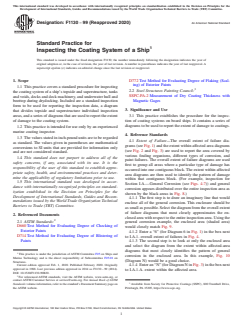
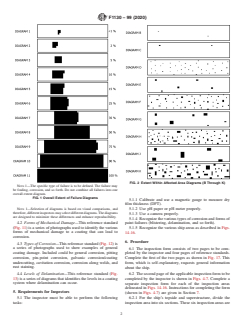
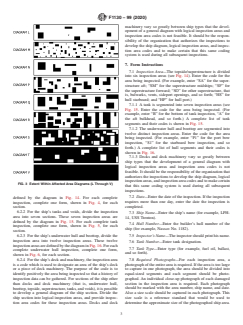
4.1 Extent of Failure—The overall extent of failure dia-
as standard. The values given in parentheses are mathematical
grams (see Fig. 1) and the extent within affected area diagrams
conversions to SI units that are provided for information only
(see Fig. 2 and Fig. 3) are used to report the area covered by
and are not considered standard.
various fouling organisms, different types of corrosion, and
1.4 This standard does not purport to address all of the
paint failures. The overall extent of failure diagrams are used
safety concerns, if any, associated with its use. It is the
first to group all areas where a particular type of damage has
responsibility of the user of this standard to establish appro-
occurred into one contiguous block. The extent within affected
priate safety, health, and environmental practices and deter-
area diagrams are then used to identify the pattern of damage
mine the applicability of regulatory limitations prior to use.
within that contiguous block. (For example, inspection for
1.5 This international standard was developed in accor-
Section I.A.—General Corrosion (see Figs. 4-7)) and general
dance with internationally recognized principles on standard-
corrosion appears distributed over the entire inspection area as
ization established in the Decision on Principles for the
shown by the black areas in Fig. 8.)
Development of International Standards, Guides and Recom-
4.1.1 The first step is to draw an imaginary line that would
mendations issued by the World Trade Organization Technical
enclose all of the general corrosion. This enclosure should be
Barriers to Trade (TBT) Committee.
as small as possible. Select the diagram from the overall extent
of failure diagrams that most closely approximates the en-
2. Referenced Documents
closed area with respect to the entire inspection area. Using the
2.1 ASTM Standards:
general corrosion example, the enclosed area (shaded area)
D660 Test Method for Evaluating Degree of Checking of
would closely match Fig. 9.
Exterior Paints
4.1.2 Enter a “6” (for Diagram 6 in Fig. 1) in the box next
D714 Test Method for Evaluating Degree of Blistering of
to I.A.1. overall extent of failures in Fig. 4.
Paints
4.1.3 The second step is to look at only the enclosed area
and select the diagram from the extent within affected-area
diagrams that most closely identifies the pattern of general
This practice is under the jurisdiction of ASTM Committee F25 on Ships and
corrosion in the enclosed area. In this example, Fig. 10
Marine Technology and is the direct responsibility of Subcommittee F25.01 on
(Diagram N) would be a good choice.
Structures.
Current edition approved Feb. 1, 2020. Published February 2020. Originally 4.1.4 Enter an “N” (for Diagram N inFig. 3) in the box next
approved in 1988. Last previous edition approved in 2014 as F1130 – 99 (2014).
to I.A.1.A. extent within the affected area.
DOI: 10.1520/F1130-99R20.
For referenced ASTM standards, visit the ASTM website, www.astm.org, or
contact ASTM Customer Service at service@astm.org. For Annual Book of ASTM
Standards volume information, refer to the standard’s Document Summary page on Available from Society for Protective Coatings (SSPC), 800 Trumbull Drive,
the ASTM website. Pittsburgh, PA 15205, https://www.sspc.org.
Copyright © ASTM International, 100 Barr Harbor Drive, PO Box C700, West Conshohocken, PA 19428-2959. United States
F1130 − 99 (2020)
FIG. 2 Extent Within Affected Area Diagrams (B Through K)
NOTE 1—The specific type of failure is to be defined. The failure may
be fouling, corrosion, and so forth. Do not combine all failures into one
overall extent diagram.
FIG. 1 Overall Extent of Failure Diagrams
5.1.1 Calibrate and use a magnetic gauge to measure dry
film thickness (DFT).
NOTE 1—Selection of diagrams is based on visual comparisons, and
5.1.2 Use pH paper or pH meter properly.
therefore,differentinspectorsmayselectdifferentdiagrams.Thediagrams
5.1.3 Use a camera properly.
are designed to minimize these differences and enhance reproducibility.
5.1.4 Recognize the various types of corrosion and forms of
4.2 FormsofMechanicalDamage—This reference standard
paint failures (blistering, delamination, and so forth).
(Fig. 11) is a series of photographs used to identify the various
5.1.5 Recognize the various ship areas as described in Figs.
forms of mechanical damage to a coating that can lead to
14-16.
corrosion.
6. Procedure
4.3 TypesofCorrosion—This reference standard (Fig. 12)is
a series of photographs used to show examples of general
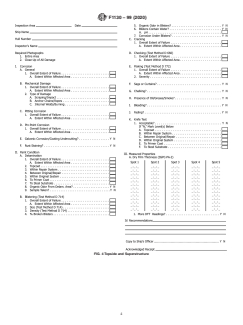
6.1 The inspection form consists of two pages to be com-
coating damage. Included could be general corrosion, pitting pleted by the inspector and four pages of reference standards.
corrosion, pin-point corrosion, galvanic corrosion/coating
Complete the first of the two pages as shown in Fig. 17. This
undercutting, cavitation corrosion, corrosion along welds, and
form, which is self-explanatory, requests general information
rust staining.
about the ship.
4.4 Levels of Delamination—This reference standard (Fig.
6.2 The second page of the applicable inspection form to be
13) is a series of diagrams that identifies the levels in a coating
completed by the inspector is shown in Figs. 4-7. Complete a
system where delamination can occur.
separate inspection form for each of the inspection areas
delineated in Figs. 14-16. Instructions for completing the form
5. Requirements for Inspectors
(shown in Figs. 4-7) are given in Section 7.
5.1 The inspector must be able to perform the following 6.2.1 For the ship’s topside and superstructure, divide the
tasks: inspection area into six sections.These six inspection areas are
F1130 − 99 (2020)
machinery vary so greatly between ship types that the devel-
opment of a general diagram with logical inspection areas and
inspection area codes is not feasible. It should be the respon-
sibility of the organization that authorizes the inspections to
develop the ship diagram, logical inspection areas, and inspec-
tion area codes and to make certain that this same coding
system is used during all subsequent inspections.
7. Form Instructions
7.1 Inspection Area—The topside/superstructure is divided
into six inspection areas (see Fig. 14). Enter the code for the
area being inspected. (For example, enter “SA” for the super-
structure aft; “SM” for the superstructure midships; “SF” for
the superstructure forward; “SO” for other superstructure, that
is, bulwarks, vents, sideport openings, and so forth; “HS” for
hull starboard; and “HP” for hull port.)
7.1.1 A tank is segmented into seven inspection areas (see
Fig. 15. Enter the code for the area being inspected. (For
example, enter “B” for the bottom of tank inspection, “A” for
the aft bulkhead, and so forth.) A complete list of tank
segments and their codes is shown in Fig. 15.
7.1.2 The underwater hull and boottop are segmented into
twelve distinct inspection areas. Enter the code for the area
being inspected. (For example, enter “P1” for the port bow
inspection, “S1” for the starboard bow inspection, and so
forth.) A complete list of hull segments and their codes is
shown in Fig. 16.
7.1.3 Decks and deck machinery vary so greatly between
ship types that the development of a general diagram with
logical inspection areas and inspection area codes is not
feasible. It should be the responsibility of the organization that
authorizes the inspections to develop the ship diagram, logical
inspection areas, and inspection area codes and to make certain
FIG. 3 Extent Within Affected Area Diagrams (L Through V)
that this same coding system is used during all subsequent
inspections.
7.2 Date—Enter the date of the inspection. If the inspection
defined by the diagram in Fig. 14. For each complete
requires more than one day, enter the date the inspection is
inspection, complete one form, shown in Fig. 4, for each
completed.
section.
6.2.2 For the ship’s tanks and voids, divide the inspection
7.3 Ship Name—Enter the ship’s name (for example, LPH-
area into seven sections. These seven inspection areas are
14, USS Trenton).
defined by the diagram in Fig. 15. For each complete tank
7.4 Hull Number—Enter the builder’s hull number of the
inspection, complete one form, shown in Fig. 5, for each
ship (for example, Nassco No. 1182).
section.
6.2.3 For the ship’s underwater hull and boottop, divide the 7.5 Inspector’sName—The inspector should print his name.
inspection area into twelve inspection areas. These twelve
7.6 Tank Number—Enter tank designation.
inspectionareasaredefinedbythediagraminFig.16.Foreach
7.7 Tank Type—Enter type (for example, fuel oil, ballast,
complete underwater hull inspection, complete one form,
and so forth).
shown in Fig. 6, for each section.
6.2.4 For the ship’s deck and machinery, the inspection area 7.8 Required Photographs—For each inspection area, a
is a code which is used to designate an area of the ship’s deck photograph of the entire area is required. If the area is too large
or a piece of deck machinery. The purpose of the code is to to capture in one photograph, the area should be divided into
identify positively the area being inspected so that a history of equal-sized segments and each segment should be photo-
inspection data can be gathered. For sections of the ship other graphed. An individual close-up photograph of each damaged
than decks and deck machinery (that is, underwater hull, section in the inspection area is required. Each photograph
boottop,topside,superstructure,tanks,andvoids),itispossible should be marked with the area number, ship name, and date.
to develop a general diagram of the ship section. Divide the Also a size scale should be captured in each photograph. This
ship section into logical inspection areas, and provide inspec- size scale is a reference standard that would be used to
tion area codes for these inspection areas. Decks and deck determine the approximate size of the photographed ship area.
F1130 − 99 (2020)
FIG. 4 Topside and Superstructure
F1130 − 99 (2020)
FIG. 5 Tanks and Voids
F1130 − 99 (2020)
FIG. 6 Underwater Hull and Boottop
F1130 − 99 (2020)
FIG. 7 Decks and Deck Machinery
F1130 − 99 (2020)
8.1.3 Pitting Corrosion—Pitting corrosion is a more ad-
vanced form of localized corrosion. Pitting corrosion is char-
acterized by visible indentations or pits that have penetrated
into the steel hull surface. These pits distinguish between
pitting corrosion and general corrosion, the latter being char-
acterized by a layer of rust that does not penetrate locally into
the surface but is more uniform in extent. A photographic
example of pitting corrosion is shown in Fig. 12.
8.1.4 Pin-Point Corrosion—Pin-point corrosion is charac-
FIG. 8 General Corrosion
terized by a pattern of small spots (pin-points) of rust. A
photographic example of pin-point corrosion is shown in Fig.
12.
8.1.5 Galvanic Corrosion/Coating Undercutting—Galvanic
corrosion is characterized by the rapid deterioration of one
metal at or near a bimetallic joint. Galvanic corrosion some-
times results in coating removal or undercutting. A photo-
graphic example is shown in Fig. 12.
FIG. 9 Overall Extent of Failure—General Corrosion
8.1.6 Rust Staining—Rust staining occurs on top of the
coating with no penetration to the substrate. A photographic
example is shown in Fig. 12.
FOULING
9. Examination of Fouling (Underwater Hull and
Boottop)
FIG. 10 Extent Within Affected Area—General Corrosion 9.1 Slime:
9.1.1 Overall Extent of Failure—Using the overall extent of
failurediagrams(diagramsandinstructionforusein4.1),enter
the number of the diagram that most closely approximates the
(For example, a 12-in. (304.8-mm) rule might be an appropri-
overall extent of slime fouling. If there is no slime fouling in
ate size scale for a relatively small ship area.)
this inspection area, enter the number “0” (zero), and leave the
7.9 Inspection Area Obscured—If the inspection area is
next box (extent within affected area) blank.
completely obscured and cannot be inspected, circle the “Y.”
9.1.2 Extent Within Affected Area—Using the extent within
This condition of being completely obscured will probably
affected area diagrams (diagrams and instructions for use in
occur most frequently in the bottom inspection area (“B”)
4.1), enter the letter of the diagram that most closely approxi-
where dirt and other contaminants have settled. If the inspec-
matestheextentofslimefoulingwithintheaffectedarea.Ifthe
tion area is not completely obscured, circle the “N.”
overallextentoffailureboxasspecifiedin9.1.1ismarkedwith
a “0” (zero), leave the extent within affected area box blank.
CORROSION
9.2 Grass:
8. Classification of Corrosion
9.2.1 Overall Extent of Failure—Using the overall extent of
8.1 The inspector should distinguish between six types of
failure diagrams (diagrams and instructions for use in 4.1),
corrosion and report each type separately. The six types of
enter the number of the diagram that most closely approxi-
corrosion are as follows:
mates the overall extent of grass fouling. If there is no grass
8.1.1 General Corrosion—General corrosion, for the pur-
foulinginthisinspectionarea,enterthenumber“0”(zero),and
poses of this inspection form, is all corrosion that is not
leave the next box (extent within affected area) blank.
covered in the mechanical damage, pitting corrosion, pinpoint
9.2.2 Extent Within Affected Area—Using the extent within
corrosion, galvanic corrosion/coating undercutting, or rust
affected area diagrams (diagrams and instructions for use in
staining in 8.1.2, 8.1.3, 8.1.4, 8.1.5, and 8.1.6. Patches of
4.1), enter the letter of the diagram that most closely approxi-
common, ordinary rusting are classified as general corrosion.
mates the extent of grass fouling within the affected area. If the
8.1.2 Mechanical Damage—Mechanical damage corrosion
overallextentoffailureboxasspecifiedin9.2.1ismarkedwith
is corrosion that occurred because the paint was removed from
a “0” (zero), leave the extent within affected area box blank.
the hull by some type of scraping or impact against the hull.
9.3 Barnacles:
With the paint removed and the steel hull exposed to sea water,
corrosion occurred. Photographic examples of corrosion 9.3.1 Overall Extent of Failure—Using the overall extent of
caused by various forms of mechanical damage (that is, failure diagrams (diagrams and instructions for use in 4.1),
scraping/impact, anchor chains/ropes, and internal welds/ enter the number of the diagram that most closely approxi-
burning) are shown in Fig. 8. mates the overall extent of barnacle fouling. If there is no
F1130 − 99 (2020)
FIG. 11 Forms of Mechanical Damage
barnacle fouling in this inspection area, enter the number “0” overall extent of fouling other than slime, grass, barnacles, or
(zero), and leave the next box (extent within affected area) tubewormfouling.Ifthereisnofoulingotherthanslime,grass,
blank. barnacles, or tubeworms in this inspection area, enter the
9.3.2 Extent Within Affected Area—Using the extent within number “0” (zero), and leave the next box (extent within
affected area diagrams (diagrams and instructions for use in affected area) blank.
4.1), enter the letter of the diagram that most closely approxi- 9.5.2 Extent Within Affected Area—Using the extent within
mates the extent of barnacle fouling within the affected area. If affected area diagrams (diagrams and instructions for use in
the overall extent of failure box as specified in 9.3.1 is marked 4.1), enter the letter of the diagram that most closely approxi-
with a “0” (zero), leave the extent within affected area box mates the extent of fouling other than slime, grass, barnacles,
blank. or tubeworms within the affected area. If the overall extent of
failure box is marked with a “0” (zero), leave the extent within
9.4 Tubeworms:
affected area box blank.
9.4.1 Overall Extent of Failure—Using the overall extent of
failure diagrams (diagrams and instructions for use in 4.1), NOTE 2—Combinations of Fouling on the Same Area—To evaluate
antifouling performance properly, the total fouling in any inspection area
enter the number of the diagram that most closely approxi-
must not exceed 100 %. From a technical standpoint, barnacle, tubeworm,
mates the overall extent of tubeworm fouling. If there is no
and grass fouling are more significant than slime fouling. Therefore, any
tubeworm fouling in this inspection area, enter the number “0”
slime fouling present on top of or underneath barnacles, tubeworms, or
(zero), and leave the next box (extent within affected area)
grass should not be reported so that the combined foulings percentage is
blank. not greater than 100 %. However, if slime fouling alone is present
elsewhere in the inspection area, this slime fouling should be reported.
9.4.2 Extent Within Affected Area—Using the extent within
affected area diagrams (diagrams and instructions for use in
9.6 Corrosion/Paint Failures Obscured by Fouling.
4.1), enter the letter of the diagram that most closely approxi-
9.7 Pitting Under Fouling—In each fouled area, the inspec-
mates the extent of tubeworm fouling within the affected area.
tor should remove the fouling (by brushing or scraping) in a 4-
If the overall extent of failure box as specified in 9.4.1 is
by4-in.patchdowntothepaintedsurface.Ifcorrosionorpaint
marked with a “0” (zero), leave the extent within affected area
failures (for example, blistering, cracking, and so forth) are
box blank.
present beneath the fouling, circle the “Y” after I.F. on Fig. 6.
9.5 Other: If no corrosion or paint failures are present, circle the “N.” If
9.5.1 Overall Extent of Failure—Using the overall extent of the metal substrate has indentations or pits, circle the “Y” after
failurediagrams(diagramsandinstructionforusein4.1),enter I.G. on Fig. 6. If the metal substrate is relatively smooth and
the number of the diagram that most closely approximates the free of indentations and pit corrosion, circle the “N.”
F1130 − 99 (2020)
FIG. 12 Types of Corrosion
10. Examination of Corrosion mates the overall extent of corrosion caused by mechanical
damage. If there is no corrosion caused by mechanical damage
10.1 General:
in this inspection area, enter the number “0” (zero) and leave
10.1.1 Overall Extent of Failure—Using the overall extent
the next box (extent within affected area) blank.
4.1),
of failure diagrams (diagrams and instructions for use in
10.2.2 ExtentWithinAffectedArea—Using the extent within
enter the number of the diagram that most closely approxi-
affected area diagrams (diagrams and instructions for use in
mates the overall extent of general corrosion. If there is no
4.1), enter the letter of the diagram that most closely approxi-
general corrosion in this inspection area, enter the number “0”
mates the extent of corrosion as a result of mechanical damage
(zero), and leave the next box (extent within affected area)
within the affected area. If the overall extent of failure box as
blank.
specified in 10.1.1 is marked with a “0” (zero), leave the extent
10.1.2 ExtentWithinAffectedArea—Using the extent within
within affected area box blank.
affected area diagrams (diagrams and instructions for use in
10.2.3 Type of Damage—If corrosion caused by mechanical
4.1), enter the letter of the diagram that most closely approxi-
damagehasoccurred,usethephotographicexamplesinFig.11
mates the extent of general corrosion within the affected area.
to identify the type of mechanical damage that has occurred.
If the overall extent of failure box as specified in 10.1.1 is
Ontheinspectionform,markan“X”intheboxnexttothetype
marked with a “0” (zero), leave the extent within affected area
of damage (that is, scraping/impact, internal welds/burning,
box blank.
anchor chains/ropes/cables) that has occurred.
10.2 Mechanical Damage:
10.3 Pitting Corrosion:
10.2.1 Overall Extent of Failure—Using the overall extent
of failure diagrams (diagrams and instructions for use in 4.1), 10.3.1 Overall Extent of Failure—Using the overall extent
enter the number of the diagram that most closely approxi- of failure diagrams (diagrams and instructions for use in 4.1),
F1130 − 99 (2020)
NOTE 1—Each inspection area is to be inspected for all the properties
listed on the accompanying inspection form (Fig. 5).
FIG. 15 Standardized Inspection—Tanks and Voids
10.3.2 ExtentWithinAffectedArea—Using the extent within
affected area diagrams (diagrams and instructions for use in
4.1), enter the letter of the diagram that most closely approxi-
mates the extent of pitting corrosion within the affected area. If
FIG. 13 Levels of Delamination
theoverallextentoffailureboxasspecifiedin10.3.1ismarked
with a “0” (zero), leave the extent within affected area box
blank.
10.4 Pin-Point Corrosion:
10.4.1 Overall Extent of Failure—Using the overall extent
of failure diagrams (diagrams and instructions for use in 4.1),
enter the number of the diagram that most closely approxi-
mates the overall extent of pin-point corrosion. If there is no
pin-point corrosion in this inspection area, enter the number
“0” (zero), and leave the next box (extent within affected area)
blank.
10.4.2 ExtentWithinAffectedArea—Using the extent within
affected area diagrams (diagrams and instructions for use in
NOTE 1—The topside is defined as the areas from the maximum load
line to the rail and the superstructure.
4.1), enter the letter of the diagram that most closely approxi-
NOTE 2—Inspection Areas:
matestheextentofpin-pointcorrosionwithintheaffectedarea.
The topside and superstructure are divided into six distinct inspection
If the overall extent of failure box above is marked with a “0”
areas as follows:
(zero), leave the extent within affected area box blank.
SA—Superstructure AFT.
SM—Superstructure Midsection.
10.5 Gal
...