


ASTM E1977-18
(Specification)Standard Specification for Shelter, Tactical, Expandable, One-Side
Standard Specification for Shelter, Tactical, Expandable, One-Side
ABSTRACT
This specification covers a rigid wall, one-side expandable shelter constructed of aluminum-faced, nonmetallic honeycomb sandwich panels. Design and construction requirements of the expandable shelter shall conform to the requirements on the drawings, all subsidiary drawings and parts lists. Also, design and construction requirements for panels, inserts, payload, corner fittings, exterior lighting, and shelter electrical systems shall be met. The following test shall be conducted for each panel: electrical continuity test, water leakage test, performance test, paint adhesion test, packaging examination, thermal shock test, panel interchange test, insert proof load test, floor load test, roof load test, door load test, step test, airtightness test, low temperature test, high temperature test, humidity test, aging test, blackout test, panel watertightness test, insert working load test, rail transportability test, impact resistance test, drop test, towing test, fluorescent light temperature test, solar load test, operational test, lifting test, six high stacking test, longitudinal restraint test, racking test, lashing test, end wall strength test, sidewall strength test, lifting from fork lift pockets test, heat transfer test, panel delamination test, thickness test, and electrical system test.
SCOPE
1.1 This specification covers a rigid wall, one-side expandable shelter constructed of aluminum-faced, nonmetallic honeycomb sandwich panels, and meeting the International Organization for Standardization (ISO) Cargo Container specification in the transport mode. Nominal dimensions when closed (container mode) are: height 8 ft, width 8 ft, and length 20 ft (2.4 by 2.4 by 6.1 m) Approximate dimensions, when expanded (shelter mode) are: height 8 ft, width 15 ft, and length 20 ft (2.4 by 4.6 by 6.1 m).
1.2 The values stated in inch-pound units are to be regarded as standard. The values given in parentheses are mathematical conversions to SI units that are provided for information only and are not considered standard.
1.3 The following precautionary statement pertains to the test method portion only. Section 7, of this specification; This standard does not purport to address all of the safety concerns, if any, associated with its use. It is the responsibility of the user of this standard to establish appropriate safety, health, and environmental practices and determines the applicability of regulatory limitations prior to use.
1.4 This international standard was developed in accordance with internationally recognized principles on standardization established in the Decision on Principles for the Development of International Standards, Guides and Recommendations issued by the World Trade Organization Technical Barriers to Trade (TBT) Committee.
General Information
- Status
- Published
- Publication Date
- 31-Aug-2018
- Technical Committee
- E06 - Performance of Buildings
Relations
- Effective Date
- 01-Sep-2018
- Effective Date
- 01-Jul-2019
- Effective Date
- 01-Oct-2018
- Effective Date
- 01-Oct-2018
- Effective Date
- 01-Oct-2018
- Effective Date
- 01-Sep-2011
- Effective Date
- 01-May-2011
- Effective Date
- 01-May-2011
- Effective Date
- 01-Nov-2010
- Effective Date
- 01-Nov-2010
- Effective Date
- 01-Nov-2010
- Effective Date
- 01-Oct-2010
- Effective Date
- 01-Oct-2010
- Refers
ASTM E990-09 - Standard Specification for Core-Splice Adhesive for Honeycomb Sandwich Shelter Panels - Effective Date
- 01-Nov-2009
- Refers
ASTM E865-08 - Standard Specification for Structural Film Adhesives for Honeycomb Sandwich Panels - Effective Date
- 01-Nov-2008
Overview
ASTM E1977-18 is the Standard Specification for Shelter, Tactical, Expandable, One-Side, developed by ASTM International. This standard defines requirements for a rigid wall, one-side expandable shelter, primarily intended for tactical, military, and emergency applications. The shelter is constructed from aluminum-faced, nonmetallic honeycomb sandwich panels, designed to be lightweight, robust, and capable of expanding laterally for increased operational space.
The specification ensures that the shelter meets key structural and environmental requirements, as well as compatibility with ISO cargo container standards for ease of transport and deployment. Detailed procedures for design, materials, construction, testing, and inspection are outlined to guarantee reliability and performance in demanding conditions.
Key Topics
- Design & Construction: The shelter uses aluminum-faced honeycomb panels that must meet stringent quality, durability, and interchangeability requirements.
- ISO Container Compatibility: When closed, the shelter matches ISO cargo container specifications (8 ft x 8 ft x 20 ft), allowing straightforward transport via standard logistics networks.
- Operational Flexibility: The unit expands onsite, providing increased width (up to 15 ft) while retaining the benefits of a robust transport container.
- Comprehensive Testing: Each component is subjected to a rigorous set of tests, such as:
- Electrical continuity
- Water leakage
- Load performance (floor, roof, door)
- Paint adhesion and thickness
- Thermal shock and temperature extremes
- Airtightness and blackout conditions
- Impact, drop, and transportability
- Aging, humidity, and environmental resistance
- Electrical Systems: Shelters are fitted with electrical systems designed for three-phase, 120/208V, 60Hz power, supporting lighting, outlets, HVAC, and communications.
Applications
ASTM E1977-18 shelters serve a wide array of practical applications, including:
- Military Operations: Used as command posts, field hospitals, communication centers, or storage units.
- Disaster Response: Rapid deployment as emergency medical stations, command centers, or temporary accommodation in crisis zones.
- Field Laboratories & Offices: Robust, weather-resistant structure supports science, engineering, or administrative work in remote locations.
- Industrial & Commercial Use: Temporary workspaces, storage, or control rooms on construction sites or industrial facilities requiring on-site protection and flexibility.
The shelter’s compliance with ISO standards ensures it can be transported and stacked like standard containers, maximizing logistic efficiency. The expandable capability means greater usable space at the deployment site without increasing shipping footprint.
Related Standards
ASTM E1977-18 references and aligns with several international and industry standards, enhancing interoperability and quality assurance:
- ISO Standards
- ISO 1161: Freight Containers - Corner Fittings Specification
- ISO 1496-1: General Cargo Containers - Specifications and Testing
- ISO 9001: Quality Management Systems
- ASTM Standards
- E864: Surface Preparation of Aluminum Alloys
- E865: Structural Film Adhesives for Honeycomb Panels
- E990: Core-Splice Adhesives
- E1091: Nonmetallic Honeycomb Cores
- E1749: Terminology for Rigid Wall Relocatable Shelters
- E1925: Design Criteria for Rigid Wall Structures
- E1773: Sealing with Polysulfide-Based Sealants
- ANSI/ASQ & AWS Standards
- ANSI/ASQ Z1.4: Sampling Procedures for Inspection
- AWS D17.1: Fusion Welding for Aerospace Applications
- Military & SAE Standards
- MIL-STD-810: Environmental Engineering for Military Equipment
- SAE-AMS-STD-1595: Qualification of Fusion Welders
Conclusion
ASTM E1977-18 delivers comprehensive, internationally recognized criteria for the design, construction, and testing of tactical, expandable shelters. Its focus on quality, performance under extreme conditions, and compatibility with global transport standards makes it invaluable for organizations involved in defense, emergency response, and field operations. By adhering to this specification, users can ensure safe, functional, and easily deployable shelter solutions anywhere in the world.
Buy Documents
ASTM E1977-18 - Standard Specification for Shelter, Tactical, Expandable, One-Side
REDLINE ASTM E1977-18 - Standard Specification for Shelter, Tactical, Expandable, One-Side
Get Certified
Connect with accredited certification bodies for this standard

Element Materials Technology
Materials testing and product certification.

Inštitut za kovinske materiale in tehnologije
Institute of Metals and Technology. Materials testing, metallurgical analysis, NDT.
Sponsored listings
Frequently Asked Questions
ASTM E1977-18 is a technical specification published by ASTM International. Its full title is "Standard Specification for Shelter, Tactical, Expandable, One-Side". This standard covers: ABSTRACT This specification covers a rigid wall, one-side expandable shelter constructed of aluminum-faced, nonmetallic honeycomb sandwich panels. Design and construction requirements of the expandable shelter shall conform to the requirements on the drawings, all subsidiary drawings and parts lists. Also, design and construction requirements for panels, inserts, payload, corner fittings, exterior lighting, and shelter electrical systems shall be met. The following test shall be conducted for each panel: electrical continuity test, water leakage test, performance test, paint adhesion test, packaging examination, thermal shock test, panel interchange test, insert proof load test, floor load test, roof load test, door load test, step test, airtightness test, low temperature test, high temperature test, humidity test, aging test, blackout test, panel watertightness test, insert working load test, rail transportability test, impact resistance test, drop test, towing test, fluorescent light temperature test, solar load test, operational test, lifting test, six high stacking test, longitudinal restraint test, racking test, lashing test, end wall strength test, sidewall strength test, lifting from fork lift pockets test, heat transfer test, panel delamination test, thickness test, and electrical system test. SCOPE 1.1 This specification covers a rigid wall, one-side expandable shelter constructed of aluminum-faced, nonmetallic honeycomb sandwich panels, and meeting the International Organization for Standardization (ISO) Cargo Container specification in the transport mode. Nominal dimensions when closed (container mode) are: height 8 ft, width 8 ft, and length 20 ft (2.4 by 2.4 by 6.1 m) Approximate dimensions, when expanded (shelter mode) are: height 8 ft, width 15 ft, and length 20 ft (2.4 by 4.6 by 6.1 m). 1.2 The values stated in inch-pound units are to be regarded as standard. The values given in parentheses are mathematical conversions to SI units that are provided for information only and are not considered standard. 1.3 The following precautionary statement pertains to the test method portion only. Section 7, of this specification; This standard does not purport to address all of the safety concerns, if any, associated with its use. It is the responsibility of the user of this standard to establish appropriate safety, health, and environmental practices and determines the applicability of regulatory limitations prior to use. 1.4 This international standard was developed in accordance with internationally recognized principles on standardization established in the Decision on Principles for the Development of International Standards, Guides and Recommendations issued by the World Trade Organization Technical Barriers to Trade (TBT) Committee.
ABSTRACT This specification covers a rigid wall, one-side expandable shelter constructed of aluminum-faced, nonmetallic honeycomb sandwich panels. Design and construction requirements of the expandable shelter shall conform to the requirements on the drawings, all subsidiary drawings and parts lists. Also, design and construction requirements for panels, inserts, payload, corner fittings, exterior lighting, and shelter electrical systems shall be met. The following test shall be conducted for each panel: electrical continuity test, water leakage test, performance test, paint adhesion test, packaging examination, thermal shock test, panel interchange test, insert proof load test, floor load test, roof load test, door load test, step test, airtightness test, low temperature test, high temperature test, humidity test, aging test, blackout test, panel watertightness test, insert working load test, rail transportability test, impact resistance test, drop test, towing test, fluorescent light temperature test, solar load test, operational test, lifting test, six high stacking test, longitudinal restraint test, racking test, lashing test, end wall strength test, sidewall strength test, lifting from fork lift pockets test, heat transfer test, panel delamination test, thickness test, and electrical system test. SCOPE 1.1 This specification covers a rigid wall, one-side expandable shelter constructed of aluminum-faced, nonmetallic honeycomb sandwich panels, and meeting the International Organization for Standardization (ISO) Cargo Container specification in the transport mode. Nominal dimensions when closed (container mode) are: height 8 ft, width 8 ft, and length 20 ft (2.4 by 2.4 by 6.1 m) Approximate dimensions, when expanded (shelter mode) are: height 8 ft, width 15 ft, and length 20 ft (2.4 by 4.6 by 6.1 m). 1.2 The values stated in inch-pound units are to be regarded as standard. The values given in parentheses are mathematical conversions to SI units that are provided for information only and are not considered standard. 1.3 The following precautionary statement pertains to the test method portion only. Section 7, of this specification; This standard does not purport to address all of the safety concerns, if any, associated with its use. It is the responsibility of the user of this standard to establish appropriate safety, health, and environmental practices and determines the applicability of regulatory limitations prior to use. 1.4 This international standard was developed in accordance with internationally recognized principles on standardization established in the Decision on Principles for the Development of International Standards, Guides and Recommendations issued by the World Trade Organization Technical Barriers to Trade (TBT) Committee.
ASTM E1977-18 is classified under the following ICS (International Classification for Standards) categories: 77.150.10 - Aluminium products. The ICS classification helps identify the subject area and facilitates finding related standards.
ASTM E1977-18 has the following relationships with other standards: It is inter standard links to ASTM E1977-11, ASTM E874-19, ASTM E1925-18, ASTM E1749-18, ASTM E1773-18, ASTM E874-11, ASTM E866-11, ASTM E1826-11, ASTM E1773-10, ASTM E1749-10, ASTM E874-10a, ASTM E1925-10, ASTM E874-10, ASTM E990-09, ASTM E865-08. Understanding these relationships helps ensure you are using the most current and applicable version of the standard.
ASTM E1977-18 is available in PDF format for immediate download after purchase. The document can be added to your cart and obtained through the secure checkout process. Digital delivery ensures instant access to the complete standard document.
Standards Content (Sample)
This international standard was developed in accordance with internationally recognized principles on standardization established in the Decision on Principles for the
Development of International Standards, Guides and Recommendations issued by the World Trade Organization Technical Barriers to Trade (TBT) Committee.
Designation: E1977 −18
Standard Specification for
Shelter, Tactical, Expandable, One-Side
This standard is issued under the fixed designation E1977; the number immediately following the designation indicates the year of
original adoption or, in the case of revision, the year of last revision. A number in parentheses indicates the year of last reapproval. A
superscript epsilon (´) indicates an editorial change since the last revision or reapproval.
This standard has been approved for use by agencies of the U.S. Department of Defense.
1. Scope E865 Specification for Structural Film Adhesives for Hon-
eycomb Sandwich Panels
1.1 This specification covers a rigid wall, one-side expand-
E866 Specification for Corrosion-Inhibiting Adhesive
able shelter constructed of aluminum-faced, nonmetallic hon-
Primer forAluminumAlloys to BeAdhesively Bonded in
eycomb sandwich panels, and meeting the International Orga-
Honeycomb Shelter Panels
nization for Standardization (ISO) Cargo Container
E874 Practice for Adhesive Bonding of Aluminum Facings
specification in the transport mode. Nominal dimensions when
to Nonmetallic Honeycomb Core for Shelter Panels
closed (container mode) are: height 8 ft, width 8 ft, and length
E990 Specification for Core-Splice Adhesive for Honey-
20 ft (2.4 by 2.4 by 6.1 m) Approximate dimensions, when
comb Sandwich Structural Panels
expanded (shelter mode) are: height 8 ft, width 15 ft, and
E1091 Specification for Nonmetallic Honeycomb Core for
length 20 ft (2.4 by 4.6 by 6.1 m).
Use in Shelter Panels
1.2 The values stated in inch-pound units are to be regarded
E1749 Terminology Relating to Rigid Wall Relocatable
as standard. The values given in parentheses are mathematical
Shelters
conversions to SI units that are provided for information only
E1773 Practice for Sealing RigidWallTactical Shelters with
and are not considered standard.
Polysulfide Based Sealants
1.3 The following precautionary statement pertains to the
E1826 Specification for Low Volatile Organic Compound
test method portion only. Section 7, of this specification; This
(VOC) Corrosion-Inhibiting Adhesive Primer for Alumi-
standard does not purport to address all of the safety concerns,
num Alloys to Be Adhesively Bonded
if any, associated with its use. It is the responsibility of the user
E1925 Specification for Engineering and Design Criteria for
of this standard to establish appropriate safety, health, and
Rigid Wall Relocatable Structures
environmental practices and determines the applicability of
2.2 ANSI/ASQ Standard:
regulatory limitations prior to use.
ANSI/ASQ Z1.4-2003 (R2013) Sampling Procedures and
1.4 This international standard was developed in accor-
Tables for Inspection by Attributes
dance with internationally recognized principles on standard-
ization established in the Decision on Principles for the
2.3 AWS Standard:
Development of International Standards, Guides and Recom-
AWS D17.1/D17.1M Specification for Fusion Welding of
mendations issued by the World Trade Organization Technical
Aerospace Applications
Barriers to Trade (TBT) Committee.
2.4 ISO Standards:
ISO 1161-1980 Series 1-Freight Containers-Corner Fittings,
2. Referenced Documents
Specification
2.1 ASTM Standards:
ISO 1496/I Series 1-Freight Containers-Specification and
E864 Practice for Surface Preparation of Aluminum Alloys
Testing Part I-General Cargo Containers
to Be Adhesively Bonded in Honeycomb Shelter Panels
ISO9001 QualitySystems—ModelforQualityAssurancein
Design, Development, Production, Installation, and Ser-
vicing
This specification is under the jurisdiction of ASTM Committee E06 on
Performance of Buildings and is the direct responsibility of Subcommittee E06.53
on Materials and Processes for Durable Rigidwall Relocatable Structures.
Current edition approved Sept. 1, 2018. Published September 2018. Originally
approved in 1998. Last previous edition approved in 2011 as E1977–11. DOI: Available from American Society for Quality (ASQ), 600 N. Plankinton Ave.,
10.1520/E1977–18. Milwaukee, WI 53203, https://www.asq.org.
2 4
For referenced ASTM standards, visit the ASTM website, www.astm.org, or Available from American Welding Society (AWS), 8669 NW 36 St., #130,
contact ASTM Customer Service at service@astm.org. For Annual Book of ASTM Miami, FL 33166-6672, http://www.aws.org.
Standards volume information, refer to the standard’s Document Summary page on Available fromAmerican National Standards Institute (ANSI), 25 W. 43rd St.,
the ASTM website. 4th Floor, New York, NY 10036, http://www.ansi.org.
Copyright © ASTM International, 100 Barr Harbor Drive, PO Box C700, West Conshohocken, PA 19428-2959. United States
E1977 − 18
2.5 Military Standards: 3.6 Welding—Welded joints shall be such that grinding of
MIL-STD-129 Marking for Shipping and Storage the finished weld shall not be a requirement, except when
MIL-STD-810G Environmental Engineering Considerations specified on the drawing. Spot, stitch, and seam welds shall be
and Laboratory Tests asindicatedonthedrawings.Allsurfacestobeweldedshallbe
2.6 Drawings: cleaned and free from scale, paint, grease, and other foreign
5-4-2828 Shelter, Assembly, One-Side Expandable-60 amp materials. Welds shall have thorough penetration, good fusion
5-4-3200 Shelter,Assembly, One-Side Expandable-100 amp and shall be free from scabs, blisters, abnormal pock marks,
cracks, voids, slag inclusions, and other harmful defects.
3. General Requirements
Welded assemblies shall be cleaned to remove any scale,
3.1 Alternate Components—When this specification or the oxidation products, and excess flux.Any acid used in cleaning
referenced drawings specify use of a specific component “or shall be completely neutralized and removed. Welders shall be
equal,” the contractor may substitute a component equal to the certified in accordance with AWS D17.1/D17.1M. Welding
specified component provided that the contractor complies equipment and procedures shall conform to AWS D17.1/
with the following requirements. Prior to manufacture of the D17.1M.
first article, or if none is required, prior to commencing
3.7 Finish—Coatingsshalllevelouttoanadherent,continu-
production, the contractor shall submit for the purchaser’s
ous and uniform film without runs, wrinkles, streaks, or areas
approvalalistidentifyingeachproposed“orequal”component
of no film. Any coating damaged during assembly or exami-
together with proof that each listed component is functionally
nation shall be touched up. There shall be no areas of rust.
equal to the specified component and is compatible with the
Finish shall be free of blistering, peeling and chips.
end item covered by this specification. The purchaser, at his
3.7.1 Adhesion of Paint—The shelter shall be capable of
option, may require a physical sample of any “or equal”
withstanding, without degradation to the finish, the tests as
component. Approval of the submitted listing and supporting
specified in 7.37. After top coat application, the shelter in the
data authorizes the commencement of fabrication of the first
deployed mode shall be stored for a minimum of 168 h at a
article or of production, as applicable, but does not relieve the
minimum of 70 °F (21 °C) prior to performing this test.
contractor of the responsibility that the “or equal” components
3.7.2 Color—The color of the paint film shall be compared
perform in accordance with specified requirements when
with an appropriate color chip for the paint specified.
incorporated into the end item.
3.7.3 Thickness—Thickness of the paint film shall be
3.2 Materials and Components—Materials and components checked as specified in 7.39.
shall conform to the documents listed in Section 2 and as
3.8 Finish and Color—Surfaces shall be of the color,
specified herein. Any change to the proposed materials or
treatment, and finish as shown on the drawings. Top coat
processes must be approved by the purchaser. It is encouraged
paintingshallbeperformedonthefullyassembledsheltersoas
that recycled material be used when practical as long as it
to prevent mismatch of color shading, unless other control
meets the requirements of this specification.
techniques are approved by the purchaser. After top coat
3.3 Workmanship—The shelter, including all parts and application, the shelter in the deployed mode (that is, ex-
panded) shall be stored in a 70 °F (21 °C) minimum tempera-
accessories,shallbeconstructedandfinishedinaworkmanlike
manner with particular attention given to removal of burrs and ture indoor facility for a minimum of 36 h to ensure adequate
coating(s) cure. During this storage period the shelter doors
sharp edges, accuracy of dimensions, thoroughness of
soldering, welding, painting, alignment of parts of assemblies, and vents shall be opened to permit air circulation within the
shelter.
and the tightness of screws, bolts, and so forth. Gaskets shall
not be torn or split and shall be free of finish. Cloth compo-
3.9 Manuals—Unless otherwise specified (see 13.2), tech-
nents shall be clean and free of holes, cuts, or tears.All latches
nical manuals shall be provided with each shelter. Stowage
utilized for erection and closing of the shelter shall be properly
provision for the manuals shall be located as shown on the
adjusted before the shelter is prepared for delivery to the
applicable drawings.
purchaser.
3.10 Terminology related to this specification is defined in
3.4 Riveting—Riveting joints shall be tight.The joined parts
Terminology E1749.
shall be undamaged, and the rivet heads shall be properly
seated and tight against the bearing surfaces. All the rivets,
4. Design and Construction Requirements
except those used in panel bonding, shall be dipped in
4.1 Design and Construction—Design and construction of
polysulfide sealant just prior to insertion, however, a dab of
the expandable shelter shall conform to the requirements
polysulfide sealant shall be applied to the head of each rivet.
specified on the drawings, all subsidiary drawings and parts
3.5 Cleaning—After fabrication, parts shall be cleaned in
lists and hereinafter. The shelter shall be free of panel delami-
accordance with the drawings.
nations and shall meet all physical and environmental require-
ments specified herein.
Available from DLA Document Services, Building 4/D, 700 Robbins Ave.,
4.2 Container Mode—The shelter in the closed or transport
Philadelphia, PA 19111-5094, http://quicksearch.dla.mil.
mode shall be referred to as a container, hereinafter, for the
Copies of drawings are available from U.S. Army Natick Soldier Research,
purpose of definition. The shelter, in the container mode, shall
Development, and Engineering Center, ATTN: RDNS-SEE-T, 15 General Greene
Avenue, Natick, MA 01760-5018, https://www.army.mil/info/organization/natick. be an article of transport equipment meeting ISO freight
E1977 − 18
TABLE 1 Container Overall Dimensions
Height Width Length
Type
ft in. Tol. in. ft in. Tol. in. ft in. Tol. in.
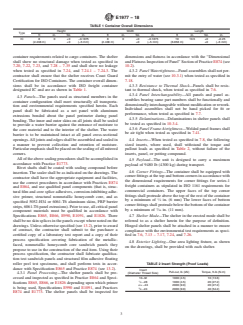
IC 8 0 +0 –0.1875 8 0 +0 –0.1875 19 10.5 +0 –0.25
(2.438 m) +0 (–5 mm) (2.438 m) +0 (–5 mm) (6.058 m) +0 (–6 mm)
container requirements related to cargo containers. The shelter dimensions and flatness in accordance with the “Dimensional
shall show no structural damage when tested as specified in andFlatnessInspectionofPanel”SectionofPracticeE874(see
7.20, 7.22, 7.23, and 7.28 – 7.35 and shall show no leakage 10.2).
when tested as specified in 7.24, and 7.24.1 – 7.24.3. The 4.3.2 Panel Watertightness—Panel assemblies shall not per-
contractor shall ensure that the shelter receives Coast Guard mit the entry of water (see 10.3.1) when tested as specified in
Certification for ISO Containers. The container overall dimen- 7.18.
sions shall be in accordance with ISO freight container 4.3.3 Resistance to Thermal Shock—Panels shall be resis-
designated IC and are as shown in Table 1. tant to thermal shock, when tested as specified in 7.6.
4.3.4 Panel Interchangeability—All panels and panel as-
4.3 Panels—The panels used as structural members in the
semblies bearing same part numbers shall be functionally and
container configuration shall meet structurally all transporta-
dimensionallyinterchangeablewithoutmodificationorrework.
tion and environmental requirements specified herein. Each
Individual assemblies shall not be hand picked for fit or
panel shall be fabricated as a net panel with aluminum
performance, when tested as specified in 7.7.
extrusions bonded about the panel perimeter during panel
4.3.5 Delaminations—Delaminations in shelter panels shall
bonding. The inner and outer skins on all joints shall be sealed
be tested as specified in 10.3.4.
to provide a water barrier against the entrance of moisture to
4.3.6 Panel Frame Airtightness—Welded panel frames shall
the core material and to the interior of the shelter. The water
be air tight when tested as specified in 7.41.
barrier is to be maintained intact at all panel cross-sectional
openings.All joints and edges shall be assembled and sealed in 4.4 Inserts—When tested as specified in 7.8, the following
a manner to prevent collection and retention of moisture. sized inserts, where used, shall withstand the torque and
Particularemphasisshallbeplacedonthesealingofallmitered pullout loads as specified in Table 2, without failure of the
corners. inserts, panel, or potting compound.
All of the above sealing procedures shall be accomplished in
4.5 Payload—The unit is designed to carry a maximum
accordance with Practice E1773.
payload of 9480 lb (4300 kg) during transport.
Rivet shafts shall be coated with sealing compound before
4.6 Corner Fittings—The container shall be equipped with
insertion.The sealer shall be as indicated on the drawings.The
cornerfittingsatthetopandbottomcornersinaccordancewith
contractor shall have the appropriate equipment and facilities,
the dimensional requirements for corner fittings for series-1
use the correct procedures in accordance with Practices E874
freight containers as stipulated in ISO 1161 requirements for
and E864, and use qualified panel components (that is, struc-
commercial containers. The upper faces of the top corner
tural film and core splice adhesives, corrosion-inhibiting adhe-
fittings shall protrude above the top of the rest of the container
sive primer, structural nonmetallic honeycomb core, and as
by a minimum of ⁄4 in. (6 mm) The lower faces of bottom
specified 5052-H34 or 6061-T6 aluminum skins, FRP barrier
corner fittings shall protrude below the bottom of the container
strips, 6061-T6 panel extrusions). Prior to use, all critical panel
by a minimum of ⁄16 in. (11 mm).
component materials must be qualified in accordance with
Specifications E865, E866, E990, E1091, and E1826. There 4.7 Shelter Mode—The shelter in the erected mode shall be
shall be no skin splices in the panels except where noted on the
referred to as a shelter herein for the purpose of definition.
drawings. Unless otherwise specified (see 13.2), prior to award Hinged shelter panels shall be attached in a manner to ensure
of contract, the contractor shall submit to the purchaser a
compliance with the environmental test requirements as speci-
certified copy of a laboratory test report and a copy of their fied in 7.6, 7.13 – 7.17, 7.24, and 7.26.
process specification covering fabrication of the metallic-
4.8 Exterior Lighting—One area lighting fixture, as shown
faced, nonmetallic honeycomb core sandwich panels they
on the drawings, shall be provided with each shelter.
propose to use in the construction of the end item. Using their
process specification, the contractor shall fabricate qualifica-
tion test sandwich panels and structural film adhesive floating
roller peel test specimens, and shall perform tests in accor-
TABLE 2 Insert Strength (Proof Loads)
dance with Specification E865 and Practice E874 (see 13.2).
Insert
Pull-out, lb (kN) Torque, ft-lb (N·m)
4.3.1 Panel Processing—The shelter panels shall be pro- (Diameter Thread Size)
cessed and inspected as specified in Practice E864 and Speci- 10–32 1000 (4.5) 10 (13.6)
⁄4 –28 1000 (4.5) 20 (27.2)
fications E865, E866,or E1826 depending upon which primer
⁄16 –24 2000 (9.0) 20 (27.2)
is being used, Specifications E990 and E1091, and Practices
⁄8 –24 2000 (9.0) 40 (54.2)
E874 and E1773. The shelter panels shall be inspected for
E1977 − 18
4.9 Shelter Electrical System: shelter to an electrical connector mounted in the service
4.9.1 General—The system shall have all equipment, ca- entrance recessed pan on the outside of the shelter as indicated
bling and other hardware necessary to receive three phase on the drawings.
120/208 V, 60 Hz power from the base electrical distribution 4.9.9.4 External Outlets—Power distribution shall be pro-
systems, and distribute it to lighting fixtures and receptacles as
vided from the distribution panel box in the shelter to outlets
indicated on the drawings. The 60 A shelters shall be in mounted in the service entrance recessed pan on the outside of
accordancewithDrawing5-4-2828andallsubsidiarydrawings
the shelter as indicated on the drawings.
and parts lists. The 100 A shelters shall be in accordance with
4.9.10 Communications—The shelter shall have four (two
Drawing 5-4-3200 and all subsidiary drawings and parts lists.
pairs) circuits through the wall telephone and intercom utility
All parts of the electrical system shall operate when tested for
connections terminating in four protected terminals inside and
electrical continuity as specified in 7.40.
outside the shelter, as indicated on the drawings.
4.9.2 Operating Temperature—The wiring system and all
4.9.11 Tools—Tools provided with the shelter shall be read-
individual hardware items shall be capable of operating at their
ily accessible to personnel when the shelter is in both the
required capacity within an ambient temperature range of –60
container and shelter configuration.
to125 °F(–51to52 °C),exceptthatthefluorescentlightsshall
4.10 Nameplates and Product Marking—All markings shall
operate from 0 to 125 °F (–18 to 52 °C), when tested as
conform to the drawings. Each shelter shall be serially num-
specified in 7.14 and 7.15.
bered and provided with a nameplate in accordance with
4.9.3 Current Rating—All conductors and appropriate hard-
applicable drawings (see 13.2).
ware shall be rated for current carrying in accordance with the
4.10.1 Interior Markings—Interior markings shall be as
applicable industry standards as specified on the drawings.
shown and in the locations shown on the applicable drawings.
Derating of components may be necessary for an operating
4.10.2 Exterior Markings—The shelter shall be provided
ambient temperature of 125 °F (52 °C).
with specific exterior markings as shown on the applicable
4.9.4 Finish—Panel boards and all other exposed metallic
drawings.
itemsshallhavefinishesasindicatedonthedrawings(see3.7).
4.9.5 Panel Board—The panel board used shall be as
5. Performance Requirements
indicatedonthedrawings.Itshallbeofdeadfrontconstruction
and have a solid neutral bus, a ground bus, and a 60 A or 100
5.1 Floor Loads—The shelter floor shall be capable of
2 2
A three phase main breaker as specified (see 13.2). The panel
supporting a uniform load of 65 lb/ft (320 kg/m ). The shelter
will have a NEMA-1 enclosure with conduit hubs as necessary
floor shall be capable of supporting a concentrated load of
2 2
and at least 18 breaker spaces excluding the main breaker. The
2000 lb (910 kg) overa4ft (0.4 m ) are at the center of the
panel board bus feed shall be by rigid conduit and conductors;
floor. The floor shall also be capable of supporting a point load
2 2
the conductors having a current carrying capacity of at least
of 125 lb/in. (9 kg/cm ). Loads shall not cause any permanent
100 A at 125 °F (52 °C) ambient temperature. The bus feed
deformation of the floors or cause any deflection that interferes
cablesshallterminateinaconnectormountedontheexteriorof
with proper shelter operation, when tested as specified in 7.9.
the shelter. Conductors running from panel board circuits to
5.2 Roof Loads—The roof assembly of the shelter shall
fixturesorreceptaclesshallbeenclosedinrigidconduitorshall
2 2
withstand a snow load of 40 lb/ft (200 kg/m ) and a personnel
be specified flexible cable for the expandable portion of the
2 2
load of 660 lb (300 kg) static over 2 ft (0.2 m ) when tested
shelter.Thecurrentcarryingcapacityoftheconductorsshallbe
as specified in 7.10.
20 A minimum, based upon an ambient temperature of 125 °F
(52 °C)andNECratingprocedures.Allcircuitbreakersusedin 5.3 Door Loads—Container doors shall be tested to with-
the system shall be bolt-on type and have a minimum inter-
stand the following loads without deformation or impairment
rupting capacity of 10 000 A RMS symmetrical. of function:
4.9.6 Cabling—Flexible cables shall be used to feed all
5.3.1 Static Door (Hinge) Load—The doors, frames, and
relocatable lighting fixtures and receptacles. These cables shall
hardware shall be capable of supporting 200 lb (90 kg) applied
be as indicated on the drawings.
to the door at the edge opposite the hinge pivot line with the
4.9.7 Switches—Switches used shall be as indicated on the
door open to approximately 90 when tested as specified 7.11.
drawings.
5.3.2 Wind Gust Door (Stop) Load—The doors, frames, and
4.9.8 Grounding—All noncurrent carrying metal compo-
hardware shall withstand a wind gust of 60 mph (100 km/h) in
nents shall be solidly grounded using the green ground wire
any direction when the door is secured in its open position by
within the wiring system, as indicated on the drawings.
its door stop device when tested as specified in 7.11.
4.9.9 Receptacles:
5.4 Step Assembly—The completely mounted step assembly
4.9.9.1 Electrical Power Service Entrance—The electrical
shall withstand a vertical load of 500 lb (225 kg) applied to the
power service entrance shall be as shown on the drawings.
outer section without deformation of the assembly of support-
4.9.9.2 Convenience Outlets—The shelter shall contain du-
ing structure when tested as specified in 7.12.
plex convenience outlets as indicated on the drawings. All
outlets shall be electrically grounded. 5.5 Airtightness—The shelter shall not permit air leakage
4.9.9.3 Air Conditioning—Power for heating and cooling beyond specified limits in either container or shelter configu-
equipment shall be provided from the distribution panel in the ration when tested as specified in 7.13.
E1977 − 18
5.6 Temperature Range: wallstrength,andliftingfromforkliftpocketsshallconformto
5.6.1 Non-operating Temperature—The container mode ISO 1496-1 when tested as specified in 7.28 – 7.35.
configuration shall withstand exposure to a temperature range
6.2 First Article—When specified, a sample shall be sub-
of –60 to 160 °F (–51 to 71 °C).
jected to first article inspection (see 8.1, 13.1, and 13.3).
5.6.2 Operational Temperature—The shelter shall be de-
6.3 Inspection Comparison Testing Sample—When speci-
pendable and operable in an ambient temperature range of –60
fied (see 13.2), the contractor shall furnish a sample for
to 125 °F (–51 to 52 °C) plus a solar load such that the outer
comparison inspection and approval (see 8.1 and 13.4).
skin reaches a temperature of 200 °F (93 °C), when tested as
specified in 7.14, 7.15, and 7.26.
6.4 Manuals—Unless otherwise specified (see 13.2), tech-
nical manuals shall be provided with each shelter. Stowage
5.7 Humidity and Temperature Aging (Components)—The
provisions for the manuals shall be located as shown on the
shelter components shall be capable of withstanding the
applicable drawings.
conditions of a minimum 95 % relative humidity at 200 °F
(93 °C). There shall be no evidence of delamination, cracking,
7. Test Methods
corrosion, or deterioration when tested as specified in 7.16.
7.1 Electrical Continuity Testing—Test every end item as
5.8 Blackout—There shall be no internal light visible from
specified in 7.40.Any test failure shall be cause for rejection of
outside of the unit in the shelter mode when tested as specified
the end item.
in 7.17.
7.2 Water Leakage and Operational Testing—Test the first
5.9 Insert Strength—When tested as specified in 7.19, the
ten production units as specified in 7.24, 7.24.1 and 7.24.3.If
inserts indicated in Table 2 shall withstand loads equal to 80 %
no failures are experienced, five of the next ten production
oftheapplicablestrengthsshowninTable2withoutfailureand
units shall be tested. If no failures are experienced on the 50 %
as indicated in Table 3.
sample, one of each 25 production units shall be tested
5.10 Rail Transportability—The shelter when tested as
thereafter. Any failure on sampled units shall be cause for
specified (see 7.20) shall be capable of withstanding, without
rejection of the lot and return to 1008 testing; repeat the above
damage, the shocks normally induced by rail transport.
procedure (starting with the units of that lot).
5.11 Impact Resistance—The shelter panel shall be impact 7.2.1 Water Leakage (Fully Loaded)—Test one out of every
resistant when tested as specified in 7.21.
50productionunitsasspecifiedin7.24.2and7.24.3.Notifythe
purchaser of any test failure within 72 h. Prepare a failure
5.12 Drop Test—Theshelterwhentestedasspecifiedin7.22
analysis report with corrective action defined, and test one out
shall show no evidence of damage as a result of the drop test.
ofthenexttenproductionunitsfollowedbyoneoutofthenext
5.13 Towing—The shelter shall show no evidence of dam-
fifty if no failures occur.
age when tested as specified in 7.23.
7.3 Performance Testing—Test one end item from each
5.14 Water Leakage—The shelter shall show no evidence of
inspectionlotasspecifiedin7.13(sheltermodeonly)and7.26.
leakage when tested as specified in 7.24.
After successful completion of these tests, test the end item
5.15 Fluorescent Light Temperature—Shelter fluorescent sample as specified in 7.17. The size of the inspection lot shall
light assemblies shall show no failure when tested as specified not exceed 25 shelters. Any test failure shall be cause for
in 7.25. rejection of the lot.
5.16 Solar Load—The shelter shall withstand a solar load 7.4 Paint Adhesion Testing—Test one of every forty produc-
test when tested as specified in 7.26. tion units as specified in 7.37. Test this unit in the deployed
mode only after storage in a 70 °F (21 °C) minimum tempera-
5.17 Operational Fitness—The shelter shall prove func-
ture indoor environment for 168 h minimum, after topcoat
tional when tested as specified in 7.27.
painting. Notify the purchaser of any test failure within 72 h.
5.18 Heat Transfer—The overall coefficient of heat transfer
Prepare a failure analysis report with corrective action defined,
of the shelter shall not exceed 0.35 BTU per hour per square
and test one out of the next ten production units, followed by
foot per degree Fahrenheit (2.0 watts per square metre per
one out of the next forty if no failures occur.
degree Kelvin) (see 7.36).
7.5 Packaging Examination—Make an examination to de-
6. Other Requirements termine that preservation and packing comply with the Perfor-
mance Requirements section. Score defects in accordance with
6.1 Requirements and testing for lifting, six-high stacking,
Table 4. The sample unit shall be one shelter fully packaged
longitudinal restraint, racking, lashing, endwall strength, side-
except the mechanical seals on the doors may be omitted to
facilitate inspection. When omitted for internal inspection,
TABLE 3 Insert Strength (Working Loads)
after acceptance of the lot for preservation, apply mechanical
Insert
Pull-out, lb (kg) Torque, ft-lb (J)
(Diameter Thread Size) door seals to the shelters and then inspect the lot of shelters
10–32 800 (360) 8 (11) subsequently for sealing. The lot shall be the number of
⁄4 –28 800 (360) 16 (22)
shelters offered for inspection at one time.The inspection level
⁄16 –24 1600 (725) 16 (22)
shall be II and the AQL, expressed in terms of defects per
⁄8 –24 1600 (725) 32 (43)
hundred units, shall be 2.6.
E1977 − 18
TABLE 4 Packaging Defects
each size (1-H, 1-V) potted in the test specimen panel cited in
Examine Defect 8.1.1 and 9.2. Torque load applied shall be equal to torque
Workmanship Doors are not closed, latched, and mechanically sealed strength cited in Table 2 for applicable size. Inability of any
Exterior Exterior electrical connections are not covered and covers are
insert to meet specification requirement shall constitute a
not secure (hand pressure)
failure of the test.
Expandable wall corner post cam latch handles are not in
locked position with pin in retaining hole
7.8.2 Insert Pull-Out—To determine compliance with the
Puncture in exterior skin
pull-out requirements of 4.4, a tensile pull load equal to
Damage (such as bending, gouging, or denting) to frame ends
pull-out strength cited in Table 2 shall be applied to two
or to fork lift opening
Steps are not folded closed
identical inserts of each size (1-H, 1-V) potted into the test
Any other protruding or not stowed part
specimen cited in 8.1.1 and 9.2. Failure of the potting com-
Workmanship Equipment container is not secured in place
pound to hold the insert firmly in panel shall constitute failure
Interior Parts in the equipment container are not in accordance with
the list of the parts
of the test.
The four lift jacks are not secured on the doors
The two leveling jacks are not secured on the cargo door 7.9 Floor Loads Test-Static Load—The floor loads test-
The support struts are not secured with lock pin in place
static load shall be as specified in Specification E1925.
The removable light fixtures are not secured to the fixed ceiling
by four captive studs with stowage bracket plunger locked
7.10 Roof Load Test—Theroofloadtestshallbeasspecified
The movable utility outlets are not secured to the hinged
in Specification E1925.
endwalls by their captive screws
The area light and cable are not secured to the interior of the
7.11 Door Load Test—The door load test shall be as
personnel end panel with the retaining wing nuts secured
specified in Specification E1925.
(hand pressure)
The area light does contain a bulb (bulb should be packaged
7.12 Step Test—Suspend a 500 lb (225 kg) weight from the
and packed in the equipment container)
Any circuit breaker not in the OFF position outer end of a step assembly for 5 min and remove the load.
The circuit breaker box keys are not inside the box
Any permanent deformation or local delamination (see 7.38),
Air vents are not secured closed
shall constitute failure of this test.
Environmental control units (ECU), panels are not stowed
securely on the fixed ceiling
7.13 Airtightness Test—The shelter airtightness test shall be
Any other loose or not stowed part
as specified in Specification E1925.
7.14 Low Temperature Test—Cold soak the shelter in its
container mode, with shelter components and maximum pay-
7.6 Thermal Shock Test—Within 30 min after the exposure
load packaged within, first at –60 °F (–51 °C) temperature for
cycling of 7.16 has been completed, subject the panel speci-
a minimum of 24 h in a mechanically refrigerated cold cham-
mens to a –65 °F (–54 °C) environment for4hto evaluate the
ber.At the end of the 24 h period and while at –60 °F (–51 °C),
effects of thermal shock.After thermal shock, inspect the panel
erect the shelter. Operate all hardware (for example, latches,
specimens for delamination (see 7.38), corrosion, and material
doors, knockout panels, and so forth) and examine the shelter
degradation. Any delamination, corrosion, or material degra-
and its components for any damage. Do not move lights or
dation shall constitute a failure of the test.
electrical receptacles into position at this time. Return the
sheltertotheclosed/containermodeandthenraisethechamber
7.7 Panel Interchange Test—Interchange the folding walls
temperature to –25 °F (–32 °C).Allow the chamber to stabilize
with the same part number and two fixed walls with the same
at –25 °F (–32 °C) for 4 h. Next, erect the shelter and hook up
part number randomly selected from the first article or produc-
power source to shelter. Position the ceiling fluorescent lights
tion lot of completed shelters, as applicable. Accomplish the
and electrical receptacles on expanded shelter section. Operate
interchange by removing the hinge pins or bolts, as applicable,
circuit breakers, blackout emergency switch, and emergency
interchanging walls, and reinstalling the hinge pins or bolts
(see 4.3.4). Any wall that cannot be fully interchanged shall incandescent lights. The fluorescent ceiling lights shall not be
operated at –25 °F (–32 °C), since they are rated for a
constitute a failure of the test.
minimumof0 °F(–18 °C)operation.Next,returntheshelterto
7.8 Insert Proof Load Test—The test fixtures shall be
normal operating conditions and cycle all doors, electrical
fashioned by the contractor and approved by the purchaser
components, and hardware. After operation and inspection of
prior to use, to evaluate the inserts using bolts of the applicable
all components, close the shelter for shipment and re-examine
thread size. Apply loads to the insert in a tightening and
for component damage and material degradation. The finding
loosening direction and hold at the specified torque for a
of any material or panel degradation or the inability of any
minimum of 5 s. Fashion the test fixtures to induce only a
hardware to function properly during this test shall constitute
twisting load to the insert for the torque test and, primarily,
failure of the low temperature test.
onlyonaxialtensileloadthroughthecenterlineoftheinsertfor
the pull-out test. Apply the reaction load from the insert 7.15 High Temperature Test—Subject the shelter, in its
pull-out fixture onto the test specimen panel, to the panel container mode, with shelter components and maximum pay-
outside of a 3 in. (75 mm) radius measured from the centerline load packaged within, to a 160 °F (71 °C) storage test cycle
of the insert. and a 125 °F (52 °C) operational test cycle. Soak the shelter in
7.8.1 Insert Torque—To determine compliance with the achamberforatleast6 hatthestoragetesttemperatureandfor
torque requirements of 4.4, apply a torque load equal to the 24 h at the operational test temperature prior to initiation of the
torque strength cited in Table 2 to the two identical inserts of operation phase of the operational test cycle. At 125 °F
E1977 − 18
(52 °C), erect the shelter and operate circuit breakers, blackout 7.21 Impact Resistance Test—Test as specified in Specifica-
emergency switch, emergency incandescent light, and fluores- tion E1925, except that the panel shall meet the following
cent lights. All doors, vent openings, panel closeouts, and acceptance criteria: No rupture of the impacting or opposite
operational hardware shall be functional. Return the shelter to skin, or both, is allowed. No delamination of the opposite skin
normal atmospheric conditions and cycle all doors, electrical to core is allowed. Outside a 3 in. (75 mm) radius (except 3 ⁄2
components, and hardware. After operation and inspection of in. (90 mm) radius for fixed floor panel) from the “center of
all components, close the shelter for shipment and then impact” (which shall coincide with the approximate center of
examine for component damage and material and panel deg- the test panel specimen), no delamination of impacting skin to
radation. The finding of any material or panel degradation or core shall be allowed and crushing or collapsing of the core
the inability of any hardware to function properly shall shall not be allowed. Outside a 5 in. (125 mm) radius from the
constitute failure of the high temperature test. “center of impact” (which shall coincide with the approximate
center of the test panel specimen), core shear failure shall not
7.16 Humidity and Temperature Aging Test—Subject all
be allowed.
hardware (latches, handles, hinges, jacks, tools, struts, light
fixtures, and so forth) anda4by8ft (1.2 by 2.4 m) specimen
7.22 Drop Test—The shelter, in the container mode, and
of each thickness composite panel (without edge members) to
withauniformlydistributedpayloadsuchthatthegrossweight
fifteen continuous 48 h cycles of the moisture resistance test in
equals 15 000 lb (6875 kg) shall withstand drops of 6 in. (150
accordance with Method 507.6 of MIL-STD-810G. After
mm) onto a level concrete type surface. Utilize a quick release
cycling has been completed, any evidence of delamination,
hook to ensure the shelter falls freely the full 6 in. (150 mm)
cracking, corrosion, or deterioration to any component, and
Any evidence of splits or tears on the bottom, deformation,
any malfunction of any hardware or panel specimen shall
buckling, delamination (see 7.38), or structural weakness to
constitute a failure of the test.
any part of the shelter, and doors and panels not operating
properly during erection and striking shall constitute failure of
7.17 Blackout Test—Placetheshelterinadarkenvironment.
the test.
Suspend a light source of two 100 W bulbs operating at rated
7.22.1 Flat Drop—Lifttheshelter6in.(150mm)highusing
voltage from the ceiling brackets of the shelter.With all covers
a four cable sling and allow the shelter to fall freely so that the
in place and doors closed, observe the unit at a 25 ft (7.6 m)
bottom impacts onto a hard concrete surface.
distance to ensure that no rays of lighting are visible to normal
unaided eyesight. Visibility of any light at specified distance
7.22.2 Rotational Drop—Place a 4 in. (100 mm) high
shall constitute failure of the test.
(nominal) board under the ISO fittings at one edge of the
shelter.Lifttheoppositeedgeoftheshelter6+ ⁄4in.(160mm)
7.18 Panel Watertightness Test—Weight and then float the
from the ground. Take measurements from the outer edge of
shelter panel horizontally, with the sealed side down, in a tank
the ISO fittings at the two raised corners of the shelter. The
of water. Submerge approximately three-fourths of the thick-
range of the two measurements shall not exceed ⁄4 in. (6 mm).
ness of the floating panel in water, using hold down devices if
Release the shelter and allow to fall freely such that the ISO
necessary. Seal the panel on the surface that is located on the
fittings impact onto a hard concrete surface. After all four
shelter exterior when the shelter is in its open configuration.
rotational drops, the requirements of 5.12 shall be met.
Panel sealing for the test panel shall be equivalent to the
sealing performed on all production panels, excess sealant on
7.23 Towing Test—Loadtheshelter,initscontainermode,to
rivet heads, panel edges, or areas not normally sealed in
a gross weight of 15 000 lb (6875 kg) and then tow from the
productionshallnotbeallowed.Submergethepanelfor6 h.At
leading edge; lower ISO fittings for a minimum of 200 ft (61
the end of this period remove it from the water, hand dry, and
m) forward and 200 ft (61 m) backward over rough plowed
reweigh within 15 min. The panel shall not gain more than
ground at a speed of 3 to 5 mph (5 to 8 km/h). Perform two
0.1 % of its original weight upon reweighing. If a failure
right angle turns on soft dirt while the shelter is being towed.
occurs,determinethesourceoftheleakandfix.Thenretestthe
The initial position before each of the turns shall be such that
panel using the above procedure. Upon passing this test, check
the direction of travel of the towing vehicle is perpendicular to
all panels in the lot for similar deficiencies and repair in the
the longitudinal axis of the 20-ft (6.1 m) side and the towing
same manner as the sample panel. The scale for determining
eye of the vehicle is in line with the leading edge of the shelter.
panel weight shall be accurate to 0.1 lb (50 g).
Any panel delamination or structural deformation, except
superficialbaseframedentsandscratches,asaresultoftowing
7.19 Insert Working Load Test—Apply a working torque
shall constitute a failure of the test.
load and pull-out load to all inserts incorporated in the shelter
panels. Perform this test using torque and pull-out loads as
7.24 Water Leakage Test (Shelter Mode)—Expose the shel-
specified in Table 3. Use the same devices used to perform the
ter in its expanded mode with jacks raised a minimum of 2 in.
test specified in 7.8, for this test. Failure of potting compound
(50 mm) from ground level to a simulated rainfall of 5 6 1
to hold any insert firmly in panel shall constitute failure of this
in./h (125 6 25 mm/h), as measured by a U.S.Weather Bureau
test.
typegage.Angledirectionoftherainfallat45fromthevertical
7.20 Rail Transportability Test—Test the shelter at a gross and so space the nozzles to ensure even dispersion over the test
weight of 15 000 lb (6875 kg) for rail transport as specified in area.Exposetheroofwitheachofthemajorsidesoftheshelter
Method 526.1 of MIL-STD-810G. Secure the test payload to in succession, to this angled rainfall for periods of 30 min.
prevent shelter damage due to the load shifting on impact. Disperse the rainfall uniformly, over the entire test area.
E1977 − 18
Perform this test for 2 h with the shelter in the closed ground by means of a four-cable sling having cable lengths
configuration, and for 2 h with the shelter in the erected (about 15 ft (4.5 m)) such as to form a single apex over the CG
configuration. Close and latch all openings and doors. Upon with the sling legs at 45 angles minimum to the roof plane
completion of the test, any evidence of penetration of water when attached to the top corner fitting of the unit. Hoist the
into the shelter shall constitute a failure of the test.Alternately, shelter off the ground by means of a four cable sling with a
expose the whole shelter for 30 min to the above test in lieu of spreader bar such as to form a 45° angle to the roof plane when
exposing each section separately. attached to the lower corner fittings of the shelter. Hold the
7.24.1 Water Leakage Test (Container Mode)—Test the container suspended for 5 min for each lift. Any structural
damage (cracks, deformation, delamination (see 7.38) incurred
shelter as specified in 7.24, except that it shall be in the
container mode. in the shelter as a result of this test, shall constitute a failure of
the test.
7.24.2 Water Leakage Test (Shelter Mode Fully Loaded)—
Testtheshelterasspecifiedin7.24.1,exceptthatthemaximum
7.29 Six High Stacking Test—Place the shelter, in its con-
payload for the shelter shall be distributed uniformly on the
tainermode,loadedtoatotalgrossweightof30000lb(13600
fixed floor.
kg), on four level pads, one under each bottom corner fitting.
7.24.3 Water Leakage Test (Container Mode Fully
The pads shall be centered under the fittings and be substan-
Loaded)—Test the shelter as specified in 7.24; except that the
tially of the same plan dimensions (that is, shelter fitting
maximumpayloadforthesheltershallbeuniformlydistributed
dimensions as taken in a plan view) as the fittings. Apply a
on the fixed floor.
stacking load of 476 190 lb (2118.2 kN) through four pads of
the same plan area as the corner fittings, the load being equally
7.25 Fluorescent Light Temperature Test—Randomly select
divided among the four top corner fittings. Offset each pad in
three fluorescent light assemblies from all of the light assem-
thesamedirection,1.5in.(38mm)inthelongitudinaldirection
blies of the sample shelters. Test these sample fluorescent light
and 1.0 in. (25 mm) in the lateral direction. Conduct four tests
assembliesforperformanceat0°Fand125 °F(–18and52 °C)
for offsets in each of the four longitudinal and lateral combi-
temperature extremes. Note that this light test may be per-
nations. Alternatively, the corner structures on one end of the
formed as an extension of the high and low temperature shelter
shelter may be tested simultaneously, and then the corner
tests of this specification. Test all of the sample lights at one
structures on the opposite end. In all cases, apply the loads for
temperature extreme, normalize at ambient if acceptable, and
not less than 5 min and any structural damage incurred in the
then test at the other extreme. Soak and performance test the
shelter and the container dimensional requirements (see 4.2)
sample lights in a chamber at no more than 0 °F (–18 °C) for
not maintained as a result of this test shall constitute a failure
the low temperature phase and at no less than 125 °F (52 °C)
of the test.
for the high temperature phase. Each soak period
...
This document is not an ASTM standard and is intended only to provide the user of an ASTM standard an indication of what changes have been made to the previous version. Because
it may not be technically possible to adequately depict all changes accurately, ASTM recommends that users consult prior editions as appropriate. In all cases only the current version
of the standard as published by ASTM is to be considered the official document.
Designation: E1977 − 11 E1977 − 18
Standard Specification for
Shelter, Tactical, Expandable, One-Side
This standard is issued under the fixed designation E1977; the number immediately following the designation indicates the year of
original adoption or, in the case of revision, the year of last revision. A number in parentheses indicates the year of last reapproval. A
superscript epsilon (´) indicates an editorial change since the last revision or reapproval.
This standard has been approved for use by agencies of the U.S. Department of Defense.
1. Scope
1.1 This specification covers a rigid wall, one-side expandable shelter constructed of aluminum-faced, nonmetallic honeycomb
sandwich panels, and meeting the International Organization for Standardization (ISO) Cargo Container specification in the
transport mode. Nominal dimensions when closed (container mode) are: height 8 ft, width 8 ft, and length 20 ft (2.4 by 2.4 by 6.1
m) Approximate dimensions, when expanded (shelter mode) are: height 8 ft, width 15 ft, and length 20 ft (2.4 by 4.6 by 6.1 m).
1.2 The values stated in inch-pound units are to be regarded as standard. The values given in parentheses are mathematical
conversions to SI units that are provided for information only and are not considered standard.
1.3 The following precautionary statement pertains to the test method portion only. Section 7, of this specification; This
standard does not purport to address all of the safety concerns, if any, associated with its use. It is the responsibility of the user
of this standard to establish appropriate safety safety, health, and healthenvironmental practices and determines the applicability
of regulatory limitations prior to use.
1.4 This international standard was developed in accordance with internationally recognized principles on standardization
established in the Decision on Principles for the Development of International Standards, Guides and Recommendations issued
by the World Trade Organization Technical Barriers to Trade (TBT) Committee.
2. Referenced Documents
2.1 ASTM Standards:
E864 Practice for Surface Preparation of Aluminum Alloys to Be Adhesively Bonded in Honeycomb Shelter Panels
E865 Specification for Structural Film Adhesives for Honeycomb Sandwich Panels
E866 Specification for Corrosion-Inhibiting Adhesive Primer for Aluminum Alloys to Be Adhesively Bonded in Honeycomb
Shelter Panels
E874 Practice for Adhesive Bonding of Aluminum Facings to Nonmetallic Honeycomb Core for Shelter Panels
E990 Specification for Core-Splice Adhesive for Honeycomb Sandwich Structural Panels
E1091 Specification for Nonmetallic Honeycomb Core for Use in Shelter Panels
E1749 Terminology Relating to Rigid Wall Relocatable Shelters
E1773 Practice for Sealing Rigid Wall Tactical Shelters with Polysulfide Based Sealants
E1826 Specification for Low Volatile Organic Compound (VOC) Corrosion-Inhibiting Adhesive Primer for Aluminum Alloys
to Be Adhesively Bonded
E1925 Specification for Engineering and Design Criteria for Rigid Wall Relocatable Structures
2.2 ANSI/ASQ Standard:
ANSI/ASQ Z1.4-2003 (R2013) Sampling Procedures and Tables for Inspection by Attributes
2.3 AWS Standard:
AWS D17.1/D17.1M Specification for Fusion Welding of Aerospace Applications
This specification is under the jurisdiction of ASTM Committee E06 on Performance of Buildings and is the direct responsibility of Subcommittee E06.53 on Materials
and Processes for Durable Rigidwall Relocatable Structures.
Current edition approved Sept. 1, 2011Sept. 1, 2018. Published October 2011September 2018. Originally approved in 1998. Last previous edition approved in 20052011
as E1977 – 05.E1977–11. DOI: 10.1520/E1977-11.10.1520/E1977–18.
For referenced ASTM standards, visit the ASTM website, www.astm.org, or contact ASTM Customer Service at service@astm.org. For Annual Book of ASTM Standards
volume information, refer to the standard’sstandard’s Document Summary page on the ASTM website.
Available from American Welding Society (AWS), 8669 NW 36 St., #130, Miami, FL 33166-6672, http://www.aws.org.
Copyright © ASTM International, 100 Barr Harbor Drive, PO Box C700, West Conshohocken, PA 19428-2959. United States
E1977 − 18
2.4 ISO Standards:
ISO 1161-1980 Series 1-Freight Containers-Corner Fittings, Specification
ISO 1496/I Series 1-Freight Containers-Specification and Testing Part I-General Cargo Containers
ISO 9001 Quality Systems—Model for Quality Assurance in Design, Development, Production, Installation, and Servicing
2.5 Military Standards:
MIL-STD-129 Marking for Shipping and Storage
MIL-STD-810 MIL-STD-810G Environmental Engineering Considerations and Laboratory Tests
2.4 ANSI/ASQC Standards:
ANSI/ASQC 21.4-1993 Sampling Procedures and Tables for Inspection by Attributes
2.6 Drawings:
5-4-2828 Shelter, Assembly, One-Side Expandable-60 amp
5-4-3200 Shelter, Assembly, One-Side Expandable-100 amp
Available from American National Standards Institute (ANSI), 25 W. 43rd St., 4th Floor, New York, NY 10036, http://www.ansi.org.
Available from Standardization Documents Order Desk, DODSSP, Bldg. 4, Section D, DLA Document Services, Building 4/D, 700 Robbins Ave., Philadelphia, PA
19111-5098, http://dodssp.daps.dla.mil.19111-5094, http://quicksearch.dla.mil.
Available from American Society for Quality (ASQ), 600 N. Plankinton Ave., Milwaukee, WI 53203, https://www.asq.org.
Copies of drawings are available from U.S. Army Natick Soldier Center, ATTN: AMSRD-NSC-CP-CS, Kansas Street, Research, Development, and Engineering Center,
ATTN: RDNS-SEE-T, 15 General Greene Avenue, Natick, MA 01760-5018, http://www.natick.army.mil.https://www.army.mil/info/organization/natick.
E1977 − 18
2.6 SAE Standards:
SAE-AMS-STD-1595 Qualification of Aircraft, Missile, and Aerospace Fusion Welding
SAE-AMS-STD-2219 Fusion Welding for Aerospace Applications
3. General Requirements
3.1 Alternate Components—When this specification or the referenced drawings specify use of a specific component “or equal,”
the contractor may substitute a component equal to the specified component provided that the contractor complies with the
following requirements. Prior to manufacture of the first article, or if none is required, prior to commencing production, the
contractor shall submit for the purchaser’s approval a list identifying each proposed “or equal” component together with proof that
each listed component is functionally equal to the specified component and is compatible with the end item covered by this
specification. The purchaser, at his option, may require a physical sample of any “or equal” component. Approval of the submitted
listing and supporting data authorizes the commencement of fabrication of the first article or of production, as applicable, but does
not relieve the contractor of the responsibility that the “or equal” components perform in accordance with specified requirements
when incorporated into the end item.
3.2 Materials and Components—Materials and components shall conform to the documents listed in Section 2 and as specified
herein. Any change to the proposed materials or processes must be approved by the purchaser. It is encouraged that recycled
material be used when practical as long as it meets the requirements of this specification.
3.3 Workmanship—The shelter, including all parts and accessories, shall be constructed and finished in a workmanlike manner
with particular attention given to removal of burrs and sharp edges, accuracy of dimensions, thoroughness of soldering, welding,
painting, alignment of parts of assemblies, and the tightness of screws, bolts, and so forth. Gaskets shall not be torn or split and
shall be free of finish. Cloth components shall be clean and free of holes, cuts, or tears. All latches utilized for erection and closing
of the shelter shall be properly adjusted before the shelter is prepared for delivery to the purchaser.
3.4 Riveting—Riveting joints shall be tight. The joined parts shall be undamaged, and the rivet heads shall be properly seated
and tight against the bearing surfaces. All the rivets, except those used in panel bonding, shall be dipped in polysulfide sealant just
prior to insertion, however, a dab of polysulfide sealant shall be applied to the head of each rivet.
3.5 Cleaning—After fabrication, parts shall be cleaned in accordance with the drawings.
3.6 Welding—Welded joints shall be such that grinding of the finished weld shall not be a requirement, except when specified
on the drawing. Spot, stitch, and seam welds shall be as indicated on the drawings. All surfaces to be welded shall be cleaned and
free from scale, paint, grease, and other foreign materials. Welds shall have thorough penetration, good fusion and shall be free
from scabs, blisters, abnormal pock marks, cracks, voids, slag inclusions, and other harmful defects. Welded assemblies shall be
cleaned to remove any scale, oxidation products, and excess flux. Any acid used in cleaning shall be completely neutralized and
removed. Welders shall be certified in accordance with SAE-AMS-STD-1595. AWS D17.1/D17.1M. Welding equipment and
procedures shall conform to SAE-AMS-STD-2219.AWS D17.1/D17.1M.
3.7 Finish—Coatings shall level out to an adherent, continuous and uniform film without runs, wrinkles, streaks, or areas of no
film. Any coating damaged during assembly or examination shall be touched up. There shall be no areas of rust. Finish shall be
free of blistering, peeling and chips.
3.7.1 Adhesion of Paint—The shelter shall be capable of withstanding, without degradation to the finish, the tests as specified
in 7.37. After top coat application, the shelter in the deployed mode shall be stored for a minimum of 168 h at a minimum of 70°F
(21°C)70 °F (21 °C) prior to performing this test.
3.7.2 Color—The color of the paint film shall be compared with an appropriate color chip for the paint specified.
3.7.3 Thickness—Thickness of the paint film shall be checked as specified in 7.39.
3.8 Finish and Color—Surfaces shall be of the color, treatment, and finish as shown on the drawings. Top coat painting shall
be performed on the fully assembled shelter so as to prevent mismatch of color shading, unless other control techniques are
approved by the purchaser. After top coat application, the shelter in the deployed mode (that is, expanded) shall be stored in a 70°F
(21°C)70 °F (21 °C) minimum temperature indoor facility for a minimum of 36 h to ensure adequate coating(s) cure. During this
storage period the shelter doors and vents shall be opened to permit air circulation within the shelter.
3.9 Manuals—Unless otherwise specified (see 13.2), technical manuals shall be provided with each shelter. Stowage provision
for the manuals shall be located as shown on the applicable drawings.
3.10 Terminology related to this specification is defined in Terminology E1749.
4. Design and Construction Requirements
4.1 Design and Construction—Design and construction of the expandable shelter shall conform to the requirements specified
on the drawings, all subsidiary drawings and parts lists and hereinafter. The shelter shall be free of panel delaminations and shall
meet all physical and environmental requirements specified herein.
E1977 − 18
4.2 Container Mode—The shelter in the closed or transport mode shall be referred to as a container, hereinafter, for the purpose
of definition. The shelter, in the container mode, shall be an article of transport equipment meeting ISO freight container
requirements related to cargo containers. The shelter shall show no structural damage when tested as specified in 7.20, 7.22, 7.23,
and 7.28 – 7.35 and shall show no leakage when tested as specified in 7.24, and 7.24.1 – 7.24.3. The contractor shall ensure that
the shelter receives Coast Guard Certification for ISO Containers. The container overall dimensions shall be in accordance with
ISO freight container designated IC and are as shown in Table 1.
4.3 Panels—The panels used as structural members in the container configuration shall meet structurally all transportation and
environmental requirements specified herein. Each panel shall be fabricated as a net panel with aluminum extrusions bonded about
the panel perimeter during panel bonding. The inner and outer skins on all joints shall be sealed to provide a water barrier against
the entrance of moisture to the core material and to the interior of the shelter. The water barrier is to be maintained intact at all
panel cross-sectional openings. All joints and edges shall be assembled and sealed in a manner to prevent collection and retention
of moisture. Particular emphasis shall be placed on the sealing of all mitered corners.
All of the above sealing procedures shall be accomplished in accordance with Practice E1773.
Rivet shafts shall be coated with sealing compound before insertion. The sealer shall be as indicated on the drawings. The
contractor shall have the appropriate equipment and facilities, use the correct procedures in accordance with SpecificationsPrac-
tices E874 and E864, and use qualified panel components (that is, structural film and core splice adhesives, corrosion-inhibiting
adhesive primer, structural nonmetallic honeycomb core, and as specified 5052-H34 or 6061-T6 aluminum skins, FRP barrier
strips, 6061-T6 panel extrusions). Prior to use, all critical panel component materials must be qualified in accordance with
Specifications E865, E866, E990, E1091, and E1826. There shall be no skin splices in the panels except where noted on the
drawings. Unless otherwise specified (see 13.2), prior to award of contract, the contractor shall submit to the purchaser a certified
copy of a laboratory test report and a copy of their process specification covering fabrication of the metallic-faced, nonmetallic
honeycomb core sandwich panels they propose to use in the construction of the end item. Using their process specification, the
contractor shall fabricate qualification test sandwich panels and structural film adhesive floating roller peel test specimens, and
shall perform tests in accordance with Specification E865 and Practice E874 (see 13.2).
4.3.1 Panel Processing—The shelter panels shall be processed and inspected as specified in SpecificationsPractice E864, and
Specifications E865, E866, or E1826 depending upon which primer is being used, E874,Specifications E990, and E1091, and
PracticePractices E874 and E1773. The shelter panels shall be inspected for dimensions and flatness in accordance with the
“Dimensional and Flatness Inspection of Panel” Section of Practice E874 (see 10.2).
4.3.2 Panel Watertightness—Panel assemblies shall not permit the entry of water (see 10.3.1) when tested as specified in 7.18.
4.3.3 Resistance to Thermal Shock—Panels shall be resistant to thermal shock, when tested as specified in 7.6.
4.3.4 Panel Interchangeability—All panels and panel assemblies bearing same part numbers shall be functionally and
dimensionally interchangeable without modification or rework. Individual assemblies shall not be hand picked for fit or
performance, when tested as specified in 7.7.
4.3.5 Delaminations—Delaminations in shelter panels shall be tested as specified in 10.3.4.
4.3.6 Panel Frame Airtightness—Welded panel frames shall be air tight when tested as specified in 7.41.
4.4 Inserts—When tested as specified in 7.8, the following sized inserts, where used, shall withstand the torque and pullout loads
as specified in Table 2, without failure of the inserts, panel, or potting compound.
4.5 Payload—The unit is designed to carry a maximum payload of 9480 lb (4300 kg) during transport.
4.6 Corner Fittings—The container shall be equipped with corner fittings at the top and bottom corners in accordance with the
dimensional requirements for corner fittings for series-1 freight containers as stipulated in ISO 1161 requirements for commercial
containers. The upper faces of the top corner fittings shall protrude above the top of the rest of the container by a minimum of ⁄4
in. (6 mm) The lower faces of bottom corner fittings shall protrude below the bottom of the container by a minimum of ⁄16 in.
(11 mm).
4.7 Shelter Mode—The shelter in the erected mode shall be referred to as a shelter herein for the purpose of definition. Hinged
shelter panels shall be attached in a manner to ensure compliance with the environmental test requirements as specified in 7.6, 7.13
– 7.17, 7.24, and 7.26.
4.8 Exterior Lighting—One area lighting fixture, as shown on the drawings, shall be provided with each shelter.
TABLE 1 Container Overall Dimensions
Height Width Length
Type
ft in. Tol. in. ft in. Tol. in. ft in. Tol. in.
Height Width Length
Type
ft in. Tol. in. ft in. Tol. in. ft in. Tol. in.
IC 8 0 +0 –0.1875 8 0 +0 –0.1875 19 10.5 +0 –0.25
(2.438 m) +0 (–5 mm) (2.438 m) +0 (–5 mm) (6.058 m) +0 (–6 mm)
E1977 − 18
TABLE 2 Insert Strength (Proof Loads)
Insert (Diameter Thread
Pull-out, lb (kN) Torque, ft-lb (N·m)
Size)
10-32 1000 (4.5) 10 (13.6)
⁄4-28 1000 (4.5) 20 (27.2)
⁄16-24 2000 (9.0) 20 (27.2)
⁄8-24 2000 (9.0) 40 (54.2)
TABLE 2 Insert Strength (Proof Loads)
Insert
Pull-out, lb (kN) Torque, ft-lb (N·m)
(Diameter Thread Size)
10–32 1000 (4.5) 10 (13.6)
⁄4 –28 1000 (4.5) 20 (27.2)
⁄16 –24 2000 (9.0) 20 (27.2)
⁄8 –24 2000 (9.0) 40 (54.2)
4.9 Shelter Electrical System:
4.9.1 General—The system shall have all equipment, cabling and other hardware necessary to receive three phase 120/208 V,
60 Hz power from the base electrical distribution systems, and distribute it to lighting fixtures and receptacles as indicated on the
drawings. The 60 A shelters shall be in accordance with Drawing 5-4-2828 and all subsidiary drawings and parts lists. The 100
A shelters shall be in accordance with Drawing 5-4-3200 and all subsidiary drawings and parts lists. All parts of the electrical
system shall operate when tested for electrical continuity as specified in 7.40.
4.9.2 Operating Temperature—The wiring system and all individual hardware items shall be capable of operating at their
required capacity within an ambient temperature range of –60 to 125°F125 °F (–51 to 52°C),52 °C), except that the fluorescent
lights shall operate from 0 to 125°F125 °F (–18 to 52°C),52 °C), when tested as specified in 7.14 and 7.15.
4.9.3 Current Rating—All conductors and appropriate hardware shall be rated for current carrying in accordance with the
applicable industry standards as specified on the drawings. Derating of components may be necessary for an operating ambient
temperature of 125°F (52°C).125 °F (52 °C).
4.9.4 Finish—Panel boards and all other exposed metallic items shall have finishes as indicated on the drawings (see 3.7).
4.9.5 Panel Board—The panel board used shall be as indicated on the drawings. It shall be of dead front construction and have
a solid neutral bus, a ground bus, and a 60 A or 100 A three phase main breaker as specified (see 13.2). The panel will have a
NEMA-1 enclosure with conduit hubs as necessary and at least 18 breaker spaces excluding the main breaker. The panel board
bus feed shall be by rigid conduit and conductors; the conductors having a current carrying capacity of at least 100 A at 125°F
(52°C)125 °F (52 °C) ambient temperature. The bus feed cables shall terminate in a connector mounted on the exterior of the
shelter. Conductors running from panel board circuits to fixtures or receptacles shall be enclosed in rigid conduit or shall be
specified flexible cable for the expandable portion of the shelter. The current carrying capacity of the conductors shall be 20 A
minimum, based upon an ambient temperature of 125°F (52°C)125 °F (52 °C) and NEC rating procedures. All circuit breakers
used in the system shall be bolt-on type and have a minimum interrupting capacity of 10 000 A RMS symmetrical.
4.9.6 Cabling—Flexible cables shall be used to feed all relocatable lighting fixtures and receptacles. These cables shall be as
indicated on the drawings.
4.9.7 Switches—Switches used shall be as indicated on the drawings.
4.9.8 Grounding—All noncurrent carrying metal components shall be solidly grounded using the green ground wire within the
wiring system, as indicated on the drawings.
4.9.9 Receptacles:
4.9.9.1 Electrical Power Service Entrance—The electrical power service entrance shall be as shown on the drawings.
4.9.9.2 Convenience Outlets—The shelter shall contain duplex convenience outlets as indicated on the drawings. All outlets
shall be electrically grounded.
4.9.9.3 Air Conditioning—Power for heating and cooling equipment shall be provided from the distribution panel in the shelter
to an electrical connector mounted in the service entrance recessed pan on the outside of the shelter as indicated on the drawings.
4.9.9.4 External Outlets—Power distribution shall be provided from the distribution panel box in the shelter to outlets mounted
in the service entrance recessed pan on the outside of the shelter as indicated on the drawings.
4.9.10 Communications—The shelter shall have four (two pairs) circuits through the wall telephone and intercom utility
connections terminating in four protected terminals inside and outside the shelter, as indicated on the drawings.
4.9.11 Tools—Tools provided with the shelter shall be readily accessible to personnel when the shelter is in both the container
and shelter configuration.
4.10 Nameplates and Product Marking—All markings shall conform to the drawings. Each shelter shall be serially numbered
and provided with a nameplate in accordance with applicable drawings (see 13.2).
4.10.1 Interior Markings—Interior markings shall be as shown and in the locations shown on the applicable drawings.
4.10.2 Exterior Markings—The shelter shall be provided with specific exterior markings as shown on the applicable drawings.
E1977 − 18
5. Performance Requirements
2 2
5.1 Floor Loads—The shelter floor shall be capable of supporting a uniform load of 65 lb/ft (320 kg/m ). The shelter floor shall
2 2
be capable of supporting a concentrated load of 2000 lb 2000 lb (910 kg) over a 4 ft (0.4 m ) are at the center of the floor. The
2 2
floor shall also be capable of supporting a point load of 125 lb/in. (9 kg/cm ). Loads shall not cause any permanent deformation
of the floors or cause any deflection that interferes with proper shelter operation, when tested as specified in 7.9.
2 2
5.2 Roof Loads—The roof assembly of the shelter shall withstand a snow load of 40 lb/ft (200 kg/m ) and a personnel load
2 2
of 660 lb (300 kg) static over 2 ft (0.2 m ) when tested as specified in 7.10.
5.3 Door Loads—Container doors shall be tested to withstand the following loads without deformation or impairment of
function:
5.3.1 Static Door (Hinge) Load—The doors, frames, and hardware shall be capable of supporting 200 lb (90 kg) applied to the
door at the edge opposite the hinge pivot line with the door open to approximately 90 when tested as specified 7.11.
5.3.2 Wind Gust Door (Stop) Load—The doors, frames, and hardware shall withstand a wind gust of 60 mph (100 km/h) in any
direction when the door is secured in its open position by its door stop device when tested as specified in 7.11.
5.4 Step Assembly—The completely mounted step assembly shall withstand a vertical load of 500 lb (225 kg) applied to the
outer section without deformation of the assembly of supporting structure when tested as specified in 7.12.
5.5 Airtightness—The shelter shall not permit air leakage beyond specified limits in either container or shelter configuration
when tested as specified in 7.13.
E1977 − 18
5.6 Temperature Range:
5.6.1 Non-operating Temperature—The container mode configuration shall withstand exposure to a temperature range of
–60°F–60 to 160°F160 °F (–51 to 71°C).71 °C).
5.6.2 Operational Temperature—The shelter shall be dependable and operable in an ambient temperature range of –60°F–60 to
125°F125 °F (–51 to 52°C)52 °C) plus a solar load such that the outer skin reaches a temperature of 200°F (93°C),200 °F (93 °C),
when tested as specified in 7.14, 7.15, and 7.26.
5.7 Humidity and Temperature Aging (Components)—The shelter components shall be capable of withstanding the conditions
of a minimum 95 % relative humidity at 200°F (93°C).200 °F (93 °C). There shall be no evidence of delamination, cracking,
corrosion, or deterioration when tested as specified in 7.16.
5.8 Blackout—There shall be no internal light visible from outside of the unit in the shelter mode when tested as specified in
7.17.
5.9 Insert Strength—When tested as specified in 7.19, the inserts indicated in Table 2 shall withstand loads equal to 80 % of
the applicable strengths shown in Table 2 without failure and as indicated in Table 3.
5.10 Rail Transportability—The shelter when tested as specified (see 7.20) shall be capable of withstanding, without damage,
the shocks normally induced by rail transport.
5.11 Impact Resistance—The shelter panel shall be impact resistant when tested as specified in 7.21.
5.12 Drop Test—The shelter when tested as specified in 7.22 shall show no evidence of damage as a result of the drop test.
5.13 Towing—The shelter shall show no evidence of damage when tested as specified in 7.23.
5.14 Water Leakage—The shelter shall show no evidence of leakage when tested as specified in 7.24.
5.15 Fluorescent Light Temperature—Shelter fluorescent light assemblies shall show no failure when tested as specified in 7.25.
5.16 Solar Load—The shelter shall withstand a solar load test when tested as specified in 7.26.
5.17 Operational Fitness—The shelter shall prove functional when tested as specified in 7.27.
5.18 Heat Transfer—The overall coefficient of heat transfer of the shelter shall not exceed 0.35 BTU per hour per square foot
per degree Fahrenheit (2.0 watts per square metre per degree Kelvin) (see 7.36).
6. Other Requirements
6.1 Requirements and testing for lifting, six-high stacking, longitudinal restraint, racking, lashing, endwall strength, sidewall
strength, and lifting from fork lift pockets shall conform to ISO 1496-1 when tested as specified in 7.28 – 7.35.
6.2 First Article—When specified, a sample shall be subjected to first article inspection (see 8.1, 13.1, and 13.3).
6.3 Inspection Comparison Testing Sample—When specified (see 13.2), the contractor shall furnish a sample for comparison
inspection and approval (see 8.1 and 13.4).
6.4 Manuals—Unless otherwise specified (see 13.2), technical manuals shall be provided with each shelter. Stowage provisions
for the manuals shall be located as shown on the applicable drawings.
7. Test Methods
7.1 Electrical Continuity Testing—Test every end item as specified in 7.40. Any test failure shall be cause for rejection of the
end item.
TABLE 3 Insert Strength (Working Loads)
Insert (Diameter Thread
Pull-out, lb (Kg) Torque, ft-lb (J)
Size)
10-32 800 (360) 8 (11)
⁄4-28 800 (360) 16 (22)
⁄16-24 1600 (725) 16 (22)
⁄8-24 1600 (725) 32 (43)
TABLE 3 Insert Strength (Working Loads)
Insert
Pull-out, lb (kg) Torque, ft-lb (J)
(Diameter Thread Size)
10–32 800 (360) 8 (11)
⁄4 –28 800 (360) 16 (22)
⁄16 –24 1600 (725) 16 (22)
⁄8 –24 1600 (725) 32 (43)
E1977 − 18
7.2 Water Leakage and Operational Testing—Test the first ten production units as specified in 7.24, 7.24.1 and 7.24.3. If no
failures are experienced, five of the next ten production units shall be tested. If no failures are experienced on the 50 % sample,
one of each 25 production units shall be tested thereafter. Any failure on sampled units shall be cause for rejection of the lot and
return to 1008 testing; repeat the above procedure (starting with the units of that lot).
7.2.1 Water Leakage (Fully Loaded)—Test one out of every 50 production units as specified in 7.24.2 and 7.24.3. Notify the
purchaser of any test failure within 72 h. Prepare a failure analysis report with corrective action defined, and test one out of the
next ten production units followed by one out of the next fifty if no failures occur.
7.3 Performance Testing—Test one end item from each inspection lot as specified in 7.13 (shelter mode only) and 7.26. After
successful completion of these tests, test the end item sample as specified in 7.17. The size of the inspection lot shall not exceed
25 shelters. Any test failure shall be cause for rejection of the lot.
7.4 Paint Adhesion Testing—Test one of every forty production units as specified in 7.37. Test this unit in the deployed mode
only after storage in a 70°F (21°C)70 °F (21 °C) minimum temperature indoor environment for 168 h minimum, after topcoat
painting. Notify the purchaser of any test failure within 72 h. 72 h. Prepare a failure analysis report with corrective action defined,
and test one out of the next ten production units, followed by one out of the next forty if no failures occur.
7.5 Packaging Examination—Make an examination to determine that preservation and packing comply with the Performance
Requirements section. Score defects in accordance with Table 4. The sample unit shall be one shelter fully packaged except the
mechanical seals on the doors may be omitted to facilitate inspection. When omitted for internal inspection, after acceptance of
the lot for preservation, apply mechanical door seals to the shelters and then inspect the lot of shelters subsequently for sealing.
The lot shall be the number of shelters offered for inspection at one time. The inspection level shall be II and the AQL, expressed
in terms of defects per hundred units, shall be 2.52.6.
7.6 Thermal Shock Test—Within 30 min after the exposure cycling of 7.16 has been completed, subject the panel specimens to
a –65°F (–54°C)–65 °F (–54 °C) environment for 4 h to evaluate the effects of thermal shock. After thermal shock, inspect the
panel specimens for delamination (see 7.38), corrosion, and material degradation. Any delamination, corrosion, or material
degradation shall constitute a failure of the test.
7.7 Panel Interchange Test—Interchange the folding walls with the same part number and two fixed walls with the same part
number randomly selected from the first article or production lot of completed shelters, as applicable. Accomplish the interchange
by removing the hinge pins or bolts, as applicable, interchanging walls, and reinstalling the hinge pins or bolts (see 4.3.4). Any
wall that cannot be fully interchanged shall constitute a failure of the test.
TABLE 4 Packaging Defects
Examine Defect
Examine Defect
Workmanship Doors are not closed, latched, and mechanically sealed
Exterior Exterior electrical connections are not covered and covers are
not secure (hand pressure)
Expandable wall corner post cam latch handles are not in
locked position with pin in retaining hole
Puncture in exterior skin
Damage (such as bending, gouging, or denting) to frame ends
or to fork lift opening
Steps are not folded closed
Any other protruding or not stowed part
Workmanship Equipment container is not secured in place
Interior Parts in the equipment container are not in accordance with
the list of the parts
The four lift jacks are not secured on the doors
The two leveling jacks are not secured on the cargo door
The support struts are not secured with lock pin in place
The removable light fixtures are not secured to the fixed ceiling
by four captive studs with stowage bracket plunger locked
The movable utility outlets are not secured to the hinged
endwalls by their captive screws
The area light and cable are not secured to the interior of the
personnel end panel with the retaining wing nuts secured
(hand pressure)
The area light does contain a bulb (bulb should be packaged
and packed in the equipment container)
Any circuit breaker not in the OFF position
The circuit breaker box keys are not inside the box
Air vents are not secured closed
Environmental control units (ECU), panels are not stowed
securely on the fixed ceiling
Any other loose or not stowed part
E1977 − 18
7.8 Insert Proof Load Test—The test fixtures shall be fashioned by the contractor and approved by the purchaser prior to use,
to evaluate the inserts using bolts of the applicable thread size. Apply loads to the insert in a tightening and loosening direction
and hold at the specified torque for a minimum of 5 s. Fashion the test fixtures to induce only a twisting load to the insert for the
torque test and, primarily, only on axial tensile load through the centerline of the insert for the pull-out test. Apply the reaction
load from the insert pull-out fixture onto the test specimen panel, to the panel outside of a 3 in. (75 mm) radius measured from
the centerline of the insert.
7.8.1 Insert Torque—To determine compliance with the torque requirements of 4.4, apply a torque load equal to the torque
strength cited in Table 2 to the two identical inserts of each size (1-H, 1-V) potted in the test specimen panel cited in 8.1.1 and
9.2. Torque load applied shall be equal to torque strength cited in Table 2 for applicable size. Inability of any insert to meet
specification requirement shall constitute a failure of the test.
7.8.2 Insert Pull-Out—To determine compliance with the pull-out requirements of 4.4, a tensile pull load equal to pull-out
strength cited in Table 2 shall be applied to two identical inserts of each size (1-H, 1-V) potted into the test specimen cited in 8.1.1
and 9.2. Failure of the potting compound to hold the insert firmly in panel shall constitute failure of the test.
7.9 Floor Loads Test-Static Load—The floor loads test-static load shall be as specified in Specification E1925.
7.10 Roof Load Test—The roof load test shall be as specified in Specification E1925.
7.11 Door Load Test—The door load test shall be as specified in Specification E1925.
7.12 Step Test—Suspend a 500 lb (225 kg) weight from the outer end of a step assembly for 5 min and remove the load. Any
permanent deformation or local delamination (see 7.38), shall constitute failure of this test.
7.13 Airtightness Test—The shelter airtightness test shall be as specified in Specification E1925.
7.14 Low Temperature Test—Cold soak the shelter in its container mode, with shelter components and maximum payload
packaged within, first at –60°F (–51°C)–60 °F (–51 °C) temperature for a minimum of 24 h 24 h in a mechanically refrigerated
cold chamber. At the end of the 24 h 24 h period and while at –60°F (–51°C),–60 °F (–51 °C), erect the shelter. Operate all
hardware (for example, latches, doors, knockout panels, and so forth) and examine the shelter and its components for any damage.
Do not move lights or electrical receptacles into position at this time. Return the shelter to the closed/container mode and then raise
the chamber temperature to –25°F (–32°C).–25 °F (–32 °C). Allow the chamber to stabilize at –25°F (–32°C) for 4 h. –25 °F
(–32 °C) for 4 h. Next, erect the shelter and hook up power source to shelter. Position the ceiling fluorescent lights and electrical
receptacles on expanded shelter section. Operate circuit breakers, blackout emergency switch, and emergency incandescent lights.
The fluorescent ceiling lights shall not be operated at –25°F (–32°C),–25 °F (–32 °C), since they are rated for a minimum of 0°F
(–18°C)0 °F (–18 °C) operation. Next, return the shelter to normal operating conditions and cycle all doors, electrical components,
and hardware. After operation and inspection of all components, close the shelter for shipment and re-examine for component
damage and material degradation. The finding of any material or panel degradation or the inability of any hardware to function
properly during this test shall constitute failure of the low temperature test.
7.15 High Temperature Test—Subject the shelter, in its container mode, with shelter components and maximum payload
packaged within, to a 160°F (71°C)160 °F (71 °C) storage test cycle and a 125°F (52°C)125 °F (52 °C) operational test cycle. Soak
the shelter in a chamber for at least 6 h 6 h at the storage test temperature and for 24 h 24 h at the operational test temperature
prior to initiation of the operation phase of the operational test cycle. At 125°F (52°C),125 °F (52 °C), erect the shelter and operate
circuit breakers, blackout emergency switch, emergency incandescent light, and fluorescent lights. All doors, vent openings, panel
closeouts, and operational hardware shall be functional. Return the shelter to normal atmospheric conditions and cycle all doors,
electrical components, and hardware. After operation and inspection of all components, close the shelter for shipment and then
examine for component damage and material and panel degradation. The finding of any material or panel degradation or the
inability of any hardware to function properly shall constitute failure of the high temperature test.
7.16 Humidity and Temperature Aging Test—Subject all hardware (latches, handles, hinges, jacks, tools, struts, light fixtures,
and so forth) and a 4 by 8 ft (1.2 by 2.4 m) specimen of each thickness composite panel (without edge members) to fifteen
continuous 48 h 48 h cycles of the moisture resistance test in accordance with Method 507507.6 of MIL-STD-810.MIL-STD-
810G. After cycling has been completed, any evidence of delamination, cracking, corrosion, or deterioration to any component,
and any malfunction of any hardware or panel specimen shall constitute a failure of the test.
7.17 Blackout Test—Place the shelter in a dark environment. Suspend a light source of two 100 W bulbs operating at rated
voltage from the ceiling brackets of the shelter. With all covers in place and doors closed, observe the unit at a 25 ft (7.6 m) distance
to ensure that no rays of lighting are visible to normal unaided eyesight. Visibility of any light at specified distance shall constitute
failure of the test.
7.18 Panel Watertightness Test—Weight and then float the shelter panel horizontally, with the sealed side down, in a tank of
water. Submerge approximately three-fourths of the thickness of the floating panel in water, using hold down devices if necessary.
Seal the panel on the surface that is located on the shelter exterior when the shelter is in its open configuration. Panel sealing for
the test panel shall be equivalent to the sealing performed on all production panels, excess sealant on rivet heads, panel edges, or
areas not normally sealed in production shall not be allowed. Submerge the panel for 6 h. 6 h. At the end of this period remove
E1977 − 18
it from the water, hand dry, and reweigh within 15 min. The panel shall not gain more than 0.1 % of its original weight upon
reweighing. If a failure occurs, determine the source of the leak and fix. Then retest the panel using the above procedure. Upon
passing this test, check all panels in the lot for similar deficiencies and repair in the same manner as the sample panel. The scale
for determining panel weight shall be accurate to 0.1 lb (50 g).
7.19 Insert Working Load Test—Apply a working torque load and pull-out load to all inserts incorporated in the shelter panels.
Perform this test using torque and pull-out loads as specified in Table 3. Use the same devices used to perform the test specified
in 7.8, for this test. Failure of potting compound to hold any insert firmly in panel shall constitute failure of this test.
7.20 Rail Transportability Test—Test the shelter at a gross weight of 15 000 lb (6875 kg) for rail transport as specified in
MIL-STD-810. Method 526.1 of MIL-STD-810G. Secure the test payload to prevent shelter damage due to the load shifting on
impact.
7.21 Impact Resistance Test—Test as specified in Specification E1925, except that the panel shall meet the following acceptance
criteria: No rupture of the impacting or opposite skin, or both, is allowed. No delamination of the opposite skin to core is allowed.
Outside a 3 in. (75 mm) radius (except 3 ⁄2 in. (90 mm) radius for fixed floor panel) from the “center of impact” (which shall
coincide with the approximate center of the test panel specimen), no delamination of impacting skin to core shall be allowed and
crushing or collapsing of the core shall not be allowed. Outside a 5 in. (125 mm) radius from the “center of impact” (which shall
coincide with the approximate center of the test panel specimen), core shear failure shall not be allowed.
7.22 Drop Test—The shelter, in the container mode, and with a uniformly distributed payload such that the gross weight equals
15 000 lb (6875 kg) shall withstand drops of 6 in. (150 mm) onto a level concrete type surface. Utilize a quick release hook to
ensure the shelter falls freely the full 6 in. (150 mm) Any evidence of splits or tears on the bottom, deformation, buckling,
delamination (see 7.38), or structural weakness to any part of the shelter, and doors and panels not operating properly during
erection and striking shall constitute failure of the test.
7.22.1 Flat Drop—Lift the shelter 6 in. (150 mm) high using a four cable sling and allow the shelter to fall freely so that the
bottom impacts onto a hard concrete surface.
7.22.2 Rotational Drop—Place a 4 in. (100 mm) high (nominal) board under the ISO fittings at one edge of the shelter. Lift the
opposite edge of the shelter 6 + ⁄4 in. (160 mm) from the ground. Take measurements from the outer edge of the ISO fittings at
the two raised corners of the shelter. The range of the two measurements shall not exceed ⁄4 in. (6 mm). Release the shelter and
allow to fall freely such that the ISO fittings impact onto a hard concrete surface. After all four rotational drops, the requirements
of 5.12 shall be met.
7.23 Towing Test—Load the shelter, in its container mode, to a gross weight of 15 000 lb (6875 kg) and then tow from the
leading edge; lower ISO fittings for a minimum of 200 ft (61 m) forward and 200 ft (61 m) backward over rough plowed ground
at a speed of 3 to 5 mph (5 to 8 km/h). Perform two right angle turns on soft dirt while the shelter is being towed. The initial
position before each of the turns shall be such that the direction of travel of the towing vehicle is perpendicular to the longitudinal
axis of the 20-ft (6.1 m) side and the towing eye of the vehicle is in line with the leading edge of the shelter. Any panel delamination
or structural deformation, except superficial base frame dents and scratches, as a result of towing shall constitute a failure of the
test.
7.24 Water Leakage Test (Shelter Mode)—Expose the shelter in its expanded mode with jacks raised a minimum of 2 in. (50
mm) from ground level to a simulated rainfall of 5 6 1 in./h (125 6 25 mm/h), as measured by a U.S. Weather Bureau type gage.
Angle direction of the rainfall at 45 from the vertical and so space the nozzles to ensure even dispersion over the test area. Expose
the roof with each of the major sides of the shelter in succession, to this angled rainfall for periods of 30 min. Disperse the rainfall
uniformly, over the entire test area. Perform this test for 2 h with the shelter in the closed configuration, and for 2 h with the shelter
in the erected configuration. Close and latch all openings and doors. Upon completion of the test, any evidence of penetration of
water into the shelter shall constitute a failure of the test. Alternately, expose the whole shelter for 30 min to the above test in lieu
of exposing each section separately.
7.24.1 Water Leakage Test (Container Mode)—Test the shelter as specified in 7.24, except that it shall be in the container mode.
7.24.2 Water Leakage Test (Shelter Mode Fully Loaded)—Test the shelter as specified in 7.24.1, except that the maximum
payload for the shelter shall be distributed uniformly on the fixed floor.
7.24.3 Water Leakage Test (Container Mode Fully Loaded)—Test the shelter as specified in 7.24; except that the maximum
payload for the shelter shall be uniformly distributed on the fixed floor.
7.25 Fluorescent Light Temperature Test—Randomly select three fluorescent light assemblies from all of the light assemblies
of the sample shelters. Test these sample fluorescent light assemblies for performance at 0 F°F and 125°F125 °F (–18 and
52°C)52 °C) temperature extremes. Note that this light test may be performed as an extension of the high and low temperature
shelter tests of this specification. Test all o
...
Questions, Comments and Discussion
Ask us and Technical Secretary will try to provide an answer. You can facilitate discussion about the standard in here.
Loading comments...