

ASTM D3617/D3617M-17(2022)
(Practice)Standard Practice for Sampling and Analysis of Built-Up Roof Systems During Application
General Information
- Abstract
ABSTRACT
This practice describes the standard procedure for sampling, analysis, and removal of specimens in built-up bituminous roof systems during application, but before the application of flood coating and top surfacing, for determining the approximate quantities of the components and the possible presence of moisture, or dry spots between plies, in the field. These components may be composed of insulation (when part of the roof membrane system), plies of roofing felt, interply layers of bituminous material, and top coating (if present, before any surfacing aggregate has been applied). Appropriate calculation procedures are also indicated herein.
SCOPE
1.1 This practice is a guide for removing specimens for built-up bituminous roof systems during application, but before the application of flood coating and top surfacing, for determining the approximate quantities of the components and the possible presence of moisture, or dry spots between plies, in the field. Components may consist of:
1.1.1 Insulation, when part of the roof membrane system,
1.1.2 Plies of roofing felt,
1.1.3 Interply layers of bituminous material, and
1.1.4 Top coating, if present, before any surfacing aggregate has been applied.
1.2 This practice is applicable to both 914 mm [36 in.] and 1000 mm [393/8 in.] wide felt rolls.
1.3 The values stated in either SI units or inch-pound units are to be regarded separately as standard. The values stated in each system may not be exact equivalents; therefore, each system shall be used independently of the other. Combining values from the two systems may result in nonconformance with the standard.
1.4 This standard does not purport to address all of the safety concerns, if any, associated with its use. It is the responsibility of the user of this standard to establish appropriate safety, health, and environmental practices and determine the applicability of regulatory limitations prior to use.
1.5 This international standard was developed in accordance with internationally recognized principles on standardization established in the Decision on Principles for the Development of International Standards, Guides and Recommendations issued by the World Trade Organization Technical Barriers to Trade (TBT) Committee.
- Status
- Published
- Publication Date
- 31-Oct-2022
- Technical Committee
- D08 - Roofing and Waterproofing
- Drafting Committee
- D08.20 - Roofing Membrane Systems


Overview
ASTM D3617/D3617M-17(2022) is an international standard practice developed by ASTM International that guides the sampling and analysis of built-up bituminous roof systems during application, specifically before the flood coating and top surfacing stages. The main goal is to determine the approximate quantities of roofing system components-such as insulation, roofing felts, interply bituminous layers, and any pre-surfacing top coatings-and to identify possible moisture or dry spots between plies in field applications. This practice ensures quality assurance and conformance during the roofing installation process, helping to detect construction deficiencies early.
Key Topics
- Sampling Techniques: The standard outlines when and how to remove specimens from built-up roofing systems. It specifies specimen size, placement, and randomization methods to ensure representative sampling.
- Component Quantification: Users can quantify the amount of roofing felts, bituminous material, insulation, and top coating prior to the application of the final surfacing.
- Moisture Detection: The practice includes procedures for visually inspecting and recording the presence of moisture or dry spots between membrane plies.
- Specimen Analysis and Reporting: Guidelines are provided for identifying specimen location, dimensions, material quantities, and condition reporting, as well as methods for returning and repairing the test areas.
- Calculation Procedures: Calculation methods for determining the mass per unit area, number of plies, interply bituminous content, and overall membrane composition are presented, relevant for both SI and inch-pound units.
- Safety and Compliance: The standard highlights the need for users to assess and implement appropriate safety, health, and environmental practices during roof sampling.
Applications
ASTM D3617/D3617M-17(2022) is broadly applicable to professionals involved with the installation and inspection of built-up bituminous roofing systems, including:
- Quality Control in Roofing Construction: Enables roofing contractors, consultants, and building inspectors to verify installation practices prior to the application of flood coating and aggregates.
- Moisture and Defect Detection: Facilitates early identification of trapped moisture or dry spots between plies, improving the integrity and longevity of commercial and industrial roof systems.
- Material Conformance Verification: Helps ensure specified quantities and types of felts, bitumen, and insulation are correctly incorporated according to project requirements.
- Field Testing Protocols: Offers a standardized method for extracting, testing, and analyzing roofing specimens, essential for compliance with regulatory and project specifications.
- Documentation and Reporting: Provides templates and methodology for thorough recordkeeping, essential for warranty claims, dispute resolution, or compliance audits.
The practice applies to both 914 mm (36 in.) and 1000 mm (39 3/8 in.) felt roll roofs. Results from this practice aid in optimizing application techniques and ensuring that installed roof assemblies meet industry requirements for moisture resistance and material composition.
Related Standards
The ASTM D3617/D3617M-17(2022) practice references several other key ASTM standards for roofing and waterproofing, including:
- ASTM D226/D226M - Specification for Asphalt-Saturated Organic Felt Used in Roofing and Waterproofing
- ASTM D227/D227M - Specification for Coal-Tar-Saturated Organic Felt Used in Roofing and Waterproofing
- ASTM D2178/D2178M - Specification for Asphalt Glass Felt Used in Roofing and Waterproofing
- ASTM D2626/D2626M - Specification for Asphalt-Saturated and Coated Organic Felt Base Sheet Used in Roofing
For a comprehensive approach to roofing system assessment and compliance, users are encouraged to reference these standards alongside ASTM D3617/D3617M.
Keywords: built-up roofing, bituminous roof, roofing felts, interply bitumen, moisture detection, roof inspection, ASTM roofing standards, roof system analysis, insulation, field sampling, lap spacing.
Relations
- Effective Date
- 01-May-2020
- Effective Date
- 01-Sep-2018
- Effective Date
- 01-May-2015
- Effective Date
- 01-Nov-2014
- Effective Date
- 15-Dec-2013
- Effective Date
- 15-Jun-2013
- Effective Date
- 01-May-2012
- Effective Date
- 01-Nov-2011
- Effective Date
- 01-Jul-2009
Get Certified
Connect with accredited certification bodies for this standard

DIBt (Deutsches Institut für Bautechnik)
German Institute for Building Technology.
DIN CERTCO
DIN Group product certification.

Aboma Certification B.V.
Specialized in construction, metal, and transport sectors.
Sponsored listings
Frequently Asked Questions
ASTM D3617/D3617M-17(2022) is a standard published by ASTM International. Its full title is "Standard Practice for Sampling and Analysis of Built-Up Roof Systems During Application". This standard covers: ABSTRACT This practice describes the standard procedure for sampling, analysis, and removal of specimens in built-up bituminous roof systems during application, but before the application of flood coating and top surfacing, for determining the approximate quantities of the components and the possible presence of moisture, or dry spots between plies, in the field. These components may be composed of insulation (when part of the roof membrane system), plies of roofing felt, interply layers of bituminous material, and top coating (if present, before any surfacing aggregate has been applied). Appropriate calculation procedures are also indicated herein. SCOPE 1.1 This practice is a guide for removing specimens for built-up bituminous roof systems during application, but before the application of flood coating and top surfacing, for determining the approximate quantities of the components and the possible presence of moisture, or dry spots between plies, in the field. Components may consist of: 1.1.1 Insulation, when part of the roof membrane system, 1.1.2 Plies of roofing felt, 1.1.3 Interply layers of bituminous material, and 1.1.4 Top coating, if present, before any surfacing aggregate has been applied. 1.2 This practice is applicable to both 914 mm [36 in.] and 1000 mm [393/8 in.] wide felt rolls. 1.3 The values stated in either SI units or inch-pound units are to be regarded separately as standard. The values stated in each system may not be exact equivalents; therefore, each system shall be used independently of the other. Combining values from the two systems may result in nonconformance with the standard. 1.4 This standard does not purport to address all of the safety concerns, if any, associated with its use. It is the responsibility of the user of this standard to establish appropriate safety, health, and environmental practices and determine the applicability of regulatory limitations prior to use. 1.5 This international standard was developed in accordance with internationally recognized principles on standardization established in the Decision on Principles for the Development of International Standards, Guides and Recommendations issued by the World Trade Organization Technical Barriers to Trade (TBT) Committee.
ABSTRACT This practice describes the standard procedure for sampling, analysis, and removal of specimens in built-up bituminous roof systems during application, but before the application of flood coating and top surfacing, for determining the approximate quantities of the components and the possible presence of moisture, or dry spots between plies, in the field. These components may be composed of insulation (when part of the roof membrane system), plies of roofing felt, interply layers of bituminous material, and top coating (if present, before any surfacing aggregate has been applied). Appropriate calculation procedures are also indicated herein. SCOPE 1.1 This practice is a guide for removing specimens for built-up bituminous roof systems during application, but before the application of flood coating and top surfacing, for determining the approximate quantities of the components and the possible presence of moisture, or dry spots between plies, in the field. Components may consist of: 1.1.1 Insulation, when part of the roof membrane system, 1.1.2 Plies of roofing felt, 1.1.3 Interply layers of bituminous material, and 1.1.4 Top coating, if present, before any surfacing aggregate has been applied. 1.2 This practice is applicable to both 914 mm [36 in.] and 1000 mm [393/8 in.] wide felt rolls. 1.3 The values stated in either SI units or inch-pound units are to be regarded separately as standard. The values stated in each system may not be exact equivalents; therefore, each system shall be used independently of the other. Combining values from the two systems may result in nonconformance with the standard. 1.4 This standard does not purport to address all of the safety concerns, if any, associated with its use. It is the responsibility of the user of this standard to establish appropriate safety, health, and environmental practices and determine the applicability of regulatory limitations prior to use. 1.5 This international standard was developed in accordance with internationally recognized principles on standardization established in the Decision on Principles for the Development of International Standards, Guides and Recommendations issued by the World Trade Organization Technical Barriers to Trade (TBT) Committee.
ASTM D3617/D3617M-17(2022) is classified under the following ICS (International Classification for Standards) categories: 91.100.50 - Binders. Sealing materials. The ICS classification helps identify the subject area and facilitates finding related standards.
ASTM D3617/D3617M-17(2022) has the following relationships with other standards: It is inter standard links to ASTM D2626/D2626M-04(2020), ASTM D227/D227M-03(2018), ASTM D2178/D2178M-15, ASTM D2178/D2178M-14, ASTM D2178/D2178M-13a, ASTM D2178/D2178M-13, ASTM D2626/D2626M-04(2012)e1, ASTM D227/D227M-03(2011)e1, ASTM D226/D226M-09. Understanding these relationships helps ensure you are using the most current and applicable version of the standard.
ASTM D3617/D3617M-17(2022) is available in PDF format for immediate download after purchase. The document can be added to your cart and obtained through the secure checkout process. Digital delivery ensures instant access to the complete standard document.
Standards Content (Sample)
This international standard was developed in accordance with internationally recognized principles on standardization established in the Decision on Principles for the
Development of International Standards, Guides and Recommendations issued by the World Trade Organization Technical Barriers to Trade (TBT) Committee.
Designation: D3617/D3617M − 17 (Reapproved 2022)
Standard Practice for
Sampling and Analysis of Built-Up Roof Systems During
Application
This standard is issued under the fixed designation D3617/D3617M; the number immediately following the designation indicates the
year of original adoption or, in the case of revision, the year of last revision. A number in parentheses indicates the year of last
reapproval. A superscript epsilon (´) indicates an editorial change since the last revision or reapproval.
This standard has been approved for use by agencies of the U.S. Department of Defense.
1. Scope 2. Referenced Documents
2.1 ASTM Standards:
1.1 This practice is a guide for removing specimens for
D226/D226M Specification for Asphalt-Saturated Organic
built-upbituminousroofsystemsduringapplication,butbefore
Felt Used in Roofing and Waterproofing
the application of flood coating and top surfacing, for deter-
D227/D227M Specification for Coal-Tar-Saturated Organic
mining the approximate quantities of the components and the
Felt Used in Roofing and Waterproofing
possible presence of moisture, or dry spots between plies, in
D250 Standard Specification forAsphalt-SaturatedAsbestos
the field. Components may consist of:
Felt Used in Roofing and Waterproofing (Withdrawn
1.1.1 Insulation, when part of the roof membrane system,
1991)
1.1.2 Plies of roofing felt,
D2178/D2178M SpecificationforAsphaltGlassFeltUsedin
1.1.3 Interply layers of bituminous material, and
Roofing and Waterproofing
D2626/D2626M Specification for Asphalt-Saturated and
1.1.4 Top coating, if present, before any surfacing aggregate
has been applied. Coated Organic Felt Base Sheet Used in Roofing
D3158 Specification for Asphalt Saturated and Coated Or-
1.2 This practice is applicable to both 914 mm [36 in.] and 3
ganic Felt Used in Roofing (Withdrawn 1983)
1000 mm [39 ⁄8 in.] wide felt rolls.
D3378 Specification for Asphalt-Saturated and Coated As-
bestos Felt Base Sheet Used in Roofing (Withdrawn
1.3 The values stated in either SI units or inch-pound units
1985)
are to be regarded separately as standard. The values stated in
each system may not be exact equivalents; therefore, each
3. Sampling
system shall be used independently of the other. Combining
3.1 Unless otherwise specified, take at least one specimen
values from the two systems may result in nonconformance
2 2
for each separate roof, plus one for each 929 m [10 000 ft ];
with the standard.
take specimens at random.
1.4 This standard does not purport to address all of the
3.2 If deficiencies are indicated in the membrane, additional
safety concerns, if any, associated with its use. It is the
Practice D3617/D3617M test cuts shall be taken at four
responsibility of the user of this standard to establish appro-
locations diagonally—3 m [10 ft] in each direction—from the
priate safety, health, and environmental practices and deter-
original test cut and examined in the same manner as the
mine the applicability of regulatory limitations prior to use.
original test cut was examined.
1.5 This international standard was developed in accor-
4. Test Specimen
dance with internationally recognized principles on standard-
ization established in the Decision on Principles for the
4.1 Sweep the surface of the membrane clean where each
Development of International Standards, Guides and Recom-
test specimen will be taken.
mendations issued by the World Trade Organization Technical
4.2 For determining approximate quantities of components,
Barriers to Trade (TBT) Committee.
cut a 300 by 300 mm [12 by 12 in.] specimen from the
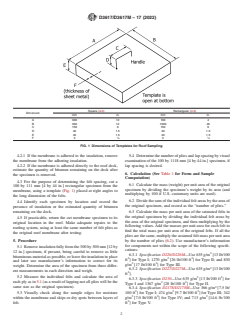
membrane using a template (Fig. 1).
1 2
ThispracticeisunderthejurisdictionofASTMCommitteeD08onRoofingand For referenced ASTM standards, visit the ASTM website, www.astm.org, or
Waterproofing and is the direct responsibility of Subcommittee D08.20 on Roofing contact ASTM Customer Service at service@astm.org. For Annual Book of ASTM
Membrane Systems. Standards volume information, refer to the standard’s Document Summary page on
Current edition approved Nov. 1, 2022. Published November 2022. Originally the ASTM website.
approved in 1977. Last previous edition approved in 2017 as D3617/D3617M – 17. The last approved version of this historical standard is referenced on
DOI: 10.1520/D3617_D3617M-17R22. www.astm.org.
Copyright © ASTM International, 100 Barr Harbor Drive, PO Box C700, West Conshohocken, PA 19428-2959. United States
D3617/D3617M − 17 (2022)
Square (4.2) Rectangular (4.3)
Dimension
mm in. mm in.
A 300 12 100 4
B 300 12 1000 40
C 150 6 150 6
D 40 1.5 40 1.5
E 40 1.5 40 1.5
1 1
F3 ⁄8 3 ⁄8
FIG. 1 Dimensions of Templates for Roof Sampling
4.2.1 If the membrane is adhered to the insulation, remove 5.4 Determine the number of plies and lap spacing by visual
the membrane from the adhering insulation. examination of the 100 by 1118 mm [4 by 44 in.] specimen, if
4.2.2 If the membrane is adhered directly to the roof deck, lap spacing is desired.
estimate the quantity of bitumen remaining on the deck after
6. Calculation (See Table 1 for Form and Sample
the specimen is removed.
Computation)
4.3 For the purpose of determining the felt spacing, cut a
6.1 Calculate the mass (weight) per unit area of the original
100 by 111 mm [4 by 44 in.] rectangular specimen from the
specimen by dividing the specimen’s weight by its area (and
membrane, using a template (Fig. 1) placed at right angles to
multiplying by 100 if U.S. customary units are used).
the long dimension of the felts.
6.2 Divide the sum of the individual felt areas by the area of
4.4 Identify each specimen by location and record the
the original specimen, and record as the “number of plies.”
presence of insulation or the estimated quantity of bitumen
remaining on the deck.
6.3 Calculate the mass per unit area of the saturated felts in
the original specimen by dividing the individual felt areas by
4.5 If practicable, return the cut membrane specimen to its
the area of the original specimen, and then multiplying by the
original location in the roof. Make adequate repairs to the
following values. Add the masses per unit area for each felt to
roofing system, using at least the same number of felt plies as
find the total mass per unit area of the original felts. If all the
the original roof membrane after testing.
plies are the same, multiply
...