

ASTM G168-17
(Practice)Standard Practice for Making and Using Precracked Double Beam Stress Corrosion Specimens
General Information
- Abstract
SIGNIFICANCE AND USE
5.1 Precracked specimens offer the opportunity to use the principles of linear elastic fracture mechanics (1)4 to evaluate resistance to stress corrosion cracking in the presence of a pre-existing crack. This type of evaluation is not included in conventional bent beam, C-ring, U-bend, and tension specimens. The precracked double beam specimen is particularly useful for evaluation of materials that display a strong dependence on grain orientation. Since the specimen dimension in the direction of applied stress is small for the precracked double beam specimen, it can be successfully used to evaluate short transverse stress corrosion cracking of wrought products, such as rolled plate or extrusions. The research applications and analysis of precracked specimens in general, and the precracked double beam specimen in particular, are discussed in Appendix X1.
5.2 The precracked double beam specimen may be stressed in either constant displacement or constant load. Constant displacement specimens stressed by loading bolts or wedges are compact and self-contained. By comparison, constant load specimens stressed with springs (for example, proof rings, discussed in Test Method G49, 7.2.1.2) or by deadweight loading require additional fixtures that remain with the specimen during exposure.
5.3 The recommendations of this practice are based on the results of interlaboratory programs to evaluate precracked specimen test procedures (2, 3) as well as considerable industrial experience with the precracked double beam specimen and other precracked specimen geometries (4-8).
SCOPE
1.1 This practice covers procedures for fabricating, preparing, and using precracked double beam stress corrosion test specimens. This specimen configuration was formerly designated the double cantilever beam (DCB) specimen. Guidelines are given for methods of exposure and inspection.
1.2 The precracked double beam specimen, as described in this practice, is applicable for evaluation of a wide variety of metals exposed to corrosive environments. It is particularly suited to evaluation of products having a highly directional grain structure, such as rolled plate, forgings, and extrusions, when stressed in the short transverse direction.
1.3 The precracked double beam specimen may be stressed in constant displacement by bolt or wedge loading or in constant load by use of proof rings or dead weight loading. The precracked double beam specimen is amenable to exposure to aqueous or other liquid solutions by specimen immersion or by periodic dropwise addition of solution to the crack tip, or exposure to the atmosphere.
1.4 This practice is concerned only with precracked double beam specimen and not with the detailed environmental aspects of stress corrosion testing, which are covered in Practices G35, G36, G37, G41, G44, and G50.
1.5 This standard does not purport to address all of the safety concerns, if any, associated with its use. It is the responsibility of the user of this standard to establish appropriate safety, health, and environmental practices and determine the applicability of regulatory limitations prior to use.
1.6 This international standard was developed in accordance with internationally recognized principles on standardization established in the Decision on Principles for the Development of International Standards, Guides and Recommendations issued by the World Trade Organization Technical Barriers to Trade (TBT) Committee.
- Status
- Published
- Publication Date
- 31-Oct-2017
- Technical Committee
- G01 - Corrosion of Metals
- Drafting Committee
- G01.06 - Environmentally Assisted Cracking
Buy Documents
ASTM G168-17 - Standard Practice for Making and Using Precracked Double Beam Stress Corrosion Specimens
REDLINE ASTM G168-17 - Standard Practice for Making and Using Precracked Double Beam Stress Corrosion Specimens
Overview
ASTM G168-17: Standard Practice for Making and Using Precracked Double Beam Stress Corrosion Specimens provides guidelines for fabricating, preparing, and utilizing precracked double beam specimens-also known as double cantilever beam (DCB) specimens-to evaluate the resistance of metallic materials to stress corrosion cracking (SCC). The standard is especially valuable for analyzing metals with pronounced grain orientation, such as rolled plates, forgings, and extrusions, under corrosive environments. This practice enables the application of linear elastic fracture mechanics principles to investigate SCC in the presence of a pre-existing crack, delivering insights that are not attainable through conventional testing methods like bent beam or C-ring specimens.
Key Topics
- Precracking Techniques: Outlines procedures for precracking specimens using either fatigue loading or mechanical overload, ensuring a sharp and controlled initial crack.
- Stress Application Methods:
- Constant Displacement: Achieved with bolts or wedges, providing a compact, self-contained testing configuration.
- Constant Load: Utilizes springs or deadweight, requiring additional fixtures to maintain load during exposure.
- Exposure and Inspection: Recommendations for specimen immersion in corrosive solutions, periodic dropwise application at the crack tip, or atmospheric exposure. Includes guidelines for environmental monitoring such as temperature and pH.
- Specimen Geometry and Preparation: Details on recommended dimensions, machining practices, and maintenance of plane strain conditions for consistent and reliable fracture mechanics analysis.
- Crack Measurement and Analysis: Procedures for interim and final crack length measurements using both visual and ultrasonic techniques, including criteria for reporting and evaluating symmetry of crack fronts.
- Residual Stress Effects: Recognizes the influence of residual stresses on crack growth and suggests monitoring for irregular crack development as an indicator.
Applications
ASTM G168-17 is highly relevant for industries and research organizations engaged in:
- Material Qualification: Evaluating the SCC resistance of metals in products like plates, extrusions, and forgings before deployment in critical environments (such as chemical processing, marine, and aerospace sectors).
- Failure Analysis: Identifying susceptibility to SCC in service-exposed components, enabling improved material selection or treatment recommendations.
- Quality Control: Routine assessment of metallic materials for short-transverse SCC to ensure conformance to performance specifications.
- Research and Development: Investigating the fundamental mechanisms of SCC under controlled laboratory conditions, facilitating the development of new alloys and protective treatments.
- Process Optimization: Validating manufacturing and heat-treating processes to minimize residual stresses that can exacerbate SCC.
By providing a standardized approach, this practice helps ensure the comparability and repeatability of SCC test results across different laboratories and materials, leading to informed material selection and improved structural reliability in corrosive environments.
Related Standards
For comprehensive stress corrosion testing and complementary methodologies, consider the following ASTM standards:
- ASTM G35: Practice for Determining the Susceptibility of Stainless Steels and Related Nickel-Chromium-Iron Alloys to SCC in Polythionic Acids
- ASTM G36: Practice for Evaluating SCC Resistance of Metals and Alloys in Boiling Magnesium Chloride Solution
- ASTM G37: Practice for Use of Mattsson’s Solution to Evaluate SCC Susceptibility of Copper-Zinc Alloys
- ASTM G41: Practice for Determining Cracking Susceptibility of Metals Exposed Under Stress to Hot Salt Environment
- ASTM G44: Practice for Exposure of Metals and Alloys by Alternate Immersion in Neutral 3.5% Sodium Chloride Solution
- ASTM G49: Practice for Preparation and Use of Direct Tension Stress-Corrosion Test Specimens
- ASTM G50: Practice for Conducting Atmospheric Corrosion Tests on Metals
- ASTM E399: Test Method for Linear-Elastic Plane-Strain Fracture Toughness of Metallic Materials
- ASTM E8/E8M: Test Methods for Tension Testing of Metallic Materials
ASTM G168-17 thus offers a robust protocol for the assessment of SCC using precracked double beam specimens, facilitating research, quality assurance, and engineering design with a focus on real-world material performance under corrosive stress.
Relations
- Effective Date
- 01-Nov-2017
- Effective Date
- 15-Feb-2024
- Effective Date
- 01-Feb-2024
- Effective Date
- 01-Jan-2024
- Effective Date
- 01-Nov-2023
- Effective Date
- 01-Feb-2020
- Effective Date
- 01-Oct-2018
- Effective Date
- 01-Oct-2018
- Effective Date
- 15-Jul-2016
- Effective Date
- 01-Feb-2015
- Effective Date
- 01-Jun-2013
- Effective Date
- 01-May-2013
- Effective Date
- 01-May-2013
- Effective Date
- 15-Dec-2012
- Effective Date
- 15-Nov-2012
Buy Documents
ASTM G168-17 - Standard Practice for Making and Using Precracked Double Beam Stress Corrosion Specimens
REDLINE ASTM G168-17 - Standard Practice for Making and Using Precracked Double Beam Stress Corrosion Specimens
Get Certified
Connect with accredited certification bodies for this standard

Element Materials Technology
Materials testing and product certification.

Inštitut za kovinske materiale in tehnologije
Institute of Metals and Technology. Materials testing, metallurgical analysis, NDT.
Sponsored listings
Frequently Asked Questions
ASTM G168-17 is a standard published by ASTM International. Its full title is "Standard Practice for Making and Using Precracked Double Beam Stress Corrosion Specimens". This standard covers: SIGNIFICANCE AND USE 5.1 Precracked specimens offer the opportunity to use the principles of linear elastic fracture mechanics (1)4 to evaluate resistance to stress corrosion cracking in the presence of a pre-existing crack. This type of evaluation is not included in conventional bent beam, C-ring, U-bend, and tension specimens. The precracked double beam specimen is particularly useful for evaluation of materials that display a strong dependence on grain orientation. Since the specimen dimension in the direction of applied stress is small for the precracked double beam specimen, it can be successfully used to evaluate short transverse stress corrosion cracking of wrought products, such as rolled plate or extrusions. The research applications and analysis of precracked specimens in general, and the precracked double beam specimen in particular, are discussed in Appendix X1. 5.2 The precracked double beam specimen may be stressed in either constant displacement or constant load. Constant displacement specimens stressed by loading bolts or wedges are compact and self-contained. By comparison, constant load specimens stressed with springs (for example, proof rings, discussed in Test Method G49, 7.2.1.2) or by deadweight loading require additional fixtures that remain with the specimen during exposure. 5.3 The recommendations of this practice are based on the results of interlaboratory programs to evaluate precracked specimen test procedures (2, 3) as well as considerable industrial experience with the precracked double beam specimen and other precracked specimen geometries (4-8). SCOPE 1.1 This practice covers procedures for fabricating, preparing, and using precracked double beam stress corrosion test specimens. This specimen configuration was formerly designated the double cantilever beam (DCB) specimen. Guidelines are given for methods of exposure and inspection. 1.2 The precracked double beam specimen, as described in this practice, is applicable for evaluation of a wide variety of metals exposed to corrosive environments. It is particularly suited to evaluation of products having a highly directional grain structure, such as rolled plate, forgings, and extrusions, when stressed in the short transverse direction. 1.3 The precracked double beam specimen may be stressed in constant displacement by bolt or wedge loading or in constant load by use of proof rings or dead weight loading. The precracked double beam specimen is amenable to exposure to aqueous or other liquid solutions by specimen immersion or by periodic dropwise addition of solution to the crack tip, or exposure to the atmosphere. 1.4 This practice is concerned only with precracked double beam specimen and not with the detailed environmental aspects of stress corrosion testing, which are covered in Practices G35, G36, G37, G41, G44, and G50. 1.5 This standard does not purport to address all of the safety concerns, if any, associated with its use. It is the responsibility of the user of this standard to establish appropriate safety, health, and environmental practices and determine the applicability of regulatory limitations prior to use. 1.6 This international standard was developed in accordance with internationally recognized principles on standardization established in the Decision on Principles for the Development of International Standards, Guides and Recommendations issued by the World Trade Organization Technical Barriers to Trade (TBT) Committee.
SIGNIFICANCE AND USE 5.1 Precracked specimens offer the opportunity to use the principles of linear elastic fracture mechanics (1)4 to evaluate resistance to stress corrosion cracking in the presence of a pre-existing crack. This type of evaluation is not included in conventional bent beam, C-ring, U-bend, and tension specimens. The precracked double beam specimen is particularly useful for evaluation of materials that display a strong dependence on grain orientation. Since the specimen dimension in the direction of applied stress is small for the precracked double beam specimen, it can be successfully used to evaluate short transverse stress corrosion cracking of wrought products, such as rolled plate or extrusions. The research applications and analysis of precracked specimens in general, and the precracked double beam specimen in particular, are discussed in Appendix X1. 5.2 The precracked double beam specimen may be stressed in either constant displacement or constant load. Constant displacement specimens stressed by loading bolts or wedges are compact and self-contained. By comparison, constant load specimens stressed with springs (for example, proof rings, discussed in Test Method G49, 7.2.1.2) or by deadweight loading require additional fixtures that remain with the specimen during exposure. 5.3 The recommendations of this practice are based on the results of interlaboratory programs to evaluate precracked specimen test procedures (2, 3) as well as considerable industrial experience with the precracked double beam specimen and other precracked specimen geometries (4-8). SCOPE 1.1 This practice covers procedures for fabricating, preparing, and using precracked double beam stress corrosion test specimens. This specimen configuration was formerly designated the double cantilever beam (DCB) specimen. Guidelines are given for methods of exposure and inspection. 1.2 The precracked double beam specimen, as described in this practice, is applicable for evaluation of a wide variety of metals exposed to corrosive environments. It is particularly suited to evaluation of products having a highly directional grain structure, such as rolled plate, forgings, and extrusions, when stressed in the short transverse direction. 1.3 The precracked double beam specimen may be stressed in constant displacement by bolt or wedge loading or in constant load by use of proof rings or dead weight loading. The precracked double beam specimen is amenable to exposure to aqueous or other liquid solutions by specimen immersion or by periodic dropwise addition of solution to the crack tip, or exposure to the atmosphere. 1.4 This practice is concerned only with precracked double beam specimen and not with the detailed environmental aspects of stress corrosion testing, which are covered in Practices G35, G36, G37, G41, G44, and G50. 1.5 This standard does not purport to address all of the safety concerns, if any, associated with its use. It is the responsibility of the user of this standard to establish appropriate safety, health, and environmental practices and determine the applicability of regulatory limitations prior to use. 1.6 This international standard was developed in accordance with internationally recognized principles on standardization established in the Decision on Principles for the Development of International Standards, Guides and Recommendations issued by the World Trade Organization Technical Barriers to Trade (TBT) Committee.
ASTM G168-17 is classified under the following ICS (International Classification for Standards) categories: 77.060 - Corrosion of metals. The ICS classification helps identify the subject area and facilitates finding related standards.
ASTM G168-17 has the following relationships with other standards: It is inter standard links to ASTM G168-00(2013), ASTM E1823-24a, ASTM E1823-24, ASTM E8/E8M-24, ASTM G49-85(2023)e1, ASTM E1823-20, ASTM G41-90(2018), ASTM G36-94(2018), ASTM E8/E8M-16, ASTM E8/E8M-15, ASTM E8/E8M-13, ASTM G36-94(2013), ASTM G41-90(2013), ASTM E1823-12e, ASTM E399-12. Understanding these relationships helps ensure you are using the most current and applicable version of the standard.
ASTM G168-17 is available in PDF format for immediate download after purchase. The document can be added to your cart and obtained through the secure checkout process. Digital delivery ensures instant access to the complete standard document.
Standards Content (Sample)
This international standard was developed in accordance with internationally recognized principles on standardization established in the Decision on Principles for the
Development of International Standards, Guides and Recommendations issued by the World Trade Organization Technical Barriers to Trade (TBT) Committee.
Designation: G168 − 17
Standard Practice for
Making and Using Precracked Double Beam Stress
Corrosion Specimens
This standard is issued under the fixed designation G168; the number immediately following the designation indicates the year of
original adoption or, in the case of revision, the year of last revision. A number in parentheses indicates the year of last reapproval. A
superscript epsilon (´) indicates an editorial change since the last revision or reapproval.
1. Scope* 2. Referenced Documents
1.1 This practice covers procedures for fabricating, 2.1 ASTM Standards:
preparing, and using precracked double beam stress corrosion D1193 Specification for Reagent Water
test specimens. This specimen configuration was formerly E8/E8M Test Methods for Tension Testing of Metallic Ma-
designated the double cantilever beam (DCB) specimen. terials
Guidelines are given for methods of exposure and inspection. E399 Test Method for Linear-Elastic Plane-Strain Fracture
Toughness K of Metallic Materials
Ic
1.2 The precracked double beam specimen, as described in
E1823 TerminologyRelatingtoFatigueandFractureTesting
this practice, is applicable for evaluation of a wide variety of
G15 Terminology Relating to Corrosion and Corrosion Test-
metals exposed to corrosive environments. It is particularly
ing (Withdrawn 2010)
suited to evaluation of products having a highly directional
G35 Practice for Determining the Susceptibility of Stainless
grain structure, such as rolled plate, forgings, and extrusions,
Steels and Related Nickel-Chromium-Iron Alloys to
when stressed in the short transverse direction.
Stress-Corrosion Cracking in Polythionic Acids
1.3 The precracked double beam specimen may be stressed
G36 Practice for Evaluating Stress-Corrosion-Cracking Re-
in constant displacement by bolt or wedge loading or in
sistance of Metals and Alloys in a Boiling Magnesium
constantloadbyuseofproofringsordeadweightloading.The
Chloride Solution
precracked double beam specimen is amenable to exposure to
G37 Practice for Use of Mattsson’s Solution of pH 7.2 to
aqueous or other liquid solutions by specimen immersion or by
Evaluate the Stress-Corrosion Cracking Susceptibility of
periodic dropwise addition of solution to the crack tip, or
Copper-Zinc Alloys
exposure to the atmosphere.
G41 Practice for Determining Cracking Susceptibility of
Metals Exposed Under Stress to a Hot Salt Environment
1.4 This practice is concerned only with precracked double
beam specimen and not with the detailed environmental G44 PracticeforExposureofMetalsandAlloysbyAlternate
Immersion in Neutral 3.5 % Sodium Chloride Solution
aspects of stress corrosion testing, which are covered in
Practices G35, G36, G37, G41, G44, and G50. G49 Practice for Preparation and Use of Direct Tension
Stress-Corrosion Test Specimens
1.5 This standard does not purport to address all of the
G50 Practice for Conducting Atmospheric Corrosion Tests
safety concerns, if any, associated with its use. It is the
on Metals
responsibility of the user of this standard to establish appro-
priate safety, health, and environmental practices and deter-
3. Terminology
mine the applicability of regulatory limitations prior to use.
1.6 This international standard was developed in accor-
3.1 Definitions of Terms Specific to This Standard:
dance with internationally recognized principles on standard- 3.1.1 stress corrosion cracking (SCC) threshold stress
ization established in the Decision on Principles for the
intensity, K —the stress intensity level below which stress
Iscc
Development of International Standards, Guides and Recom- corrosioncrackingdoesnotoccurforaspecificcombinationof
mendations issued by the World Trade Organization Technical
material and environment when plane strain conditions are
Barriers to Trade (TBT) Committee. satisfied.
1 2
This practice is under the jurisdiction of ASTM Committee G01 on Corrosion For referenced ASTM standards, visit the ASTM website, www.astm.org, or
of Metals and is the direct responsibility of Subcommittee G01.06 on Environmen- contact ASTM Customer Service at service@astm.org. For Annual Book of ASTM
tally Assisted Cracking. Standards volume information, refer to the standard’s Document Summary page on
Current edition approved Nov. 1, 2017. Published December 2017. Originally the ASTM website.
approved in 2000. Last previous edition approved in 2013 as G168 – 00 (2013). The last approved version of this historical standard is referenced on
DOI: 10.1520/G0168-17. www.astm.org.
*A Summary of Changes section appears at the end of this standard
Copyright © ASTM International, 100 Barr Harbor Drive, PO Box C700, West Conshohocken, PA 19428-2959. United States
G168 − 17
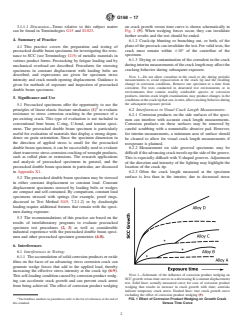
3.1.1.1 Discussion—Terms relative to this subject matter on crack growth versus time curve is shown schematically in
can be found in Terminologies G15 and E1823. Fig. 1 (9). When wedging forces occur, they can invalidate
further results and the test should be ended.
4. Summary of Practice
6.1.2 Crack-tip blunting or branching out, or both, of the
plane of the precrack can invalidate the test. For valid tests, the
4.1 This practice covers the preparation and testing of
crack must remain within 610° of the centerline of the
precracked double beam specimens for investigating the resis-
specimen.
tance to SCC (see Terminology G15) of metallic materials in
6.1.3 Drying or contamination of the corrodent in the crack
various product forms. Precracking by fatigue loading and by
duringinterimmeasurementsofthecracklengthmayaffectthe
mechanical overload are described. Procedures for stressing
cracking behavior during subsequent exposure.
specimens in constant displacement with loading bolts are
described, and expressions are given for specimen stress
NOTE 1—Do not allow corrodent in the crack to dry during periodic
intensity and crack mouth opening displacement. Guidance is
measurements to avoid repassivation at the crack tip and the resulting
change in corrosion conditions. Remove one specimen at a time from
given for methods of exposure and inspection of precracked
corrodent. For tests conducted in deaerated test environments or in
double beam specimens.
environments that contain readily oxidizable species or corrosion
products, interim crack length examinations may produce changes in the
5. Significance and Use
conditionsatthecracktipthatcan,inturn,affectcrackingbehaviorduring
the subsequent exposure period.
5.1 Precracked specimens offer the opportunity to use the
principles of linear elastic fracture mechanics (1) to evaluate
6.2 Interferences in Visual Crack Length Measurements:
resistance to stress corrosion cracking in the presence of a
6.2.1 Corrosion products on the side surfaces of the speci-
pre-existing crack. This type of evaluation is not included in
men can interfere with accurate crack length measurements.
conventional bent beam, C-ring, U-bend, and tension speci-
Corrosion products on these surfaces may be removed by
mens. The precracked double beam specimen is particularly
careful scrubbing with a nonmetallic abrasive pad. However,
useful for evaluation of materials that display a strong depen-
for interim measurements, a minimum area of surface should
dence on grain orientation. Since the specimen dimension in
be cleaned to allow for visual crack length measurements if
the direction of applied stress is small for the precracked
reexposure is planned.
double beam specimen, it can be successfully used to evaluate
6.2.2 Measurement on side grooved specimens may be
short transverse stress corrosion cracking of wrought products,
difficultiftheadvancingcracktravelsupthesideofthegroove.
such as rolled plate or extrusions. The research applications
This is especially difficult with V-shaped grooves. Adjustment
and analysis of precracked specimens in general, and the
of the direction and intensity of the lighting may highlight the
precracked double beam specimen in particular, are discussed
location of the crack tip.
in Appendix X1.
6.2.3 Often the crack length measured at the specimen
surface is less than in the interior, due to decreased stress
5.2 The precracked double beam specimen may be stressed
in either constant displacement or constant load. Constant
displacement specimens stressed by loading bolts or wedges
are compact and self-contained. By comparison, constant load
specimens stressed with springs (for example, proof rings,
discussed in Test Method G49, 7.2.1.2) or by deadweight
loading require additional fixtures that remain with the speci-
men during exposure.
5.3 The recommendations of this practice are based on the
results of interlaboratory programs to evaluate precracked
specimen test procedures (2, 3) as well as considerable
industrial experience with the precracked double beam speci-
men and other precracked specimen geometries (4-8).
6. Interferences
6.1 Interferences in Testing:
6.1.1 The accumulation of solid corrosion products or oxide
films on the faces of an advancing stress corrosion crack can
generate wedge forces that add to the applied load, thereby
increasing the effective stress intensity at the crack tip (6-9).
NOTE 1—Schematic of the influence of corrosion product wedging on
This self-loading condition caused by corrosion product wedg-
SCC growth versus time curves in a decreasing K (constant displacement)
ing can accelerate crack growth and can prevent crack arrest
test. Solid lines: actually measured curve for case of corrosion product
from being achieved. The effect of corrosion product wedging
wedging that results in increase in crack growth with time; asterisks
indicate temporary crack arrest. Dashed lines: true crack growth curve
excluding the effect of corrosion product wedging (9).
The boldface numbers in parentheses refer to the list of references at the end of FIG. 1 Effect of Corrosion Product Wedging on Growth Crack
this standard. Versus Time Curve
G168 − 17
triaxiality at the specimen surface. Alternatively, some condi- specimen should be parallel; the machined notch should be
tions produce an increase in crack length at the surface due to centered; and the bolt holes should be aligned and centered.A
availabilityofthecorrodent.Ultrasonicmethodscanbeusedto typical bolt loaded specimen is shown in Fig. 4.
obtain interim crack length measurements at the interior of the 7.1.3 Recommendations for determining the minimum
specimen but not near the specimen surface. specimen thickness, B, which will ensure that plane strain
6.2.4 Transport of species in solution in the through- conditions are maintained at the tip of an SCC crack, are
thickness direction can be important for precracked double discussed in Brown (1) and Dorward and Helfrich (8). Based
beam specimens. This may affect measurement of crack length on a conservative estimate for plane strain conditions, the
since it can produce curvature of the crack front (that is, minimum specimen thickness shall be calculated as B ≥ 2.5
variation in crack length from the edge to the center of the (K /σ ) , where K is determined per Test Method E399 and
Ic YS Ic
specimen). σ is the 0.2 % offset yield strength in tension per Test
YS
Method E8/E8M. For bolt loaded precracked double beam
7. Specimen Size, Configuration, and Preparation
specimens, the thickness, B, may also be influenced by the size
of the loading bolts and the minimum thickness needed to
7.1 Specimen Dimensions and Fabrication:
support the bolt loading.
7.1.1 Dimensions for the recommended specimen are given
7.1.4 The specimen half-height, H, may be reduced for
in Figs. 2 and 3. As a general guideline, specimen dimensions
material under 25 mm (1 in.) thick. The minimum H that can
should ensure that plane strain conditions are maintained at the
be used is constrained by the onset of plastic deformation upon
crack tip (1, 10). While there are no established criteria for
precracking or stresses in the leg of the specimen since this
ensuring adequate constraint for a plane strain SCC test, some
influences the calculation of K. Outer fiber stresses shall not
guidelines are given herein regarding specimen dimensions
exceed the yield strength of the test material during precrack-
(see 7.1.3).
ing or stressing.
7.1.2 Specimen machining shall be in accordance with the
standards outlined in Test Method E399. The principal consid-
NOTE 2—The effect of notch geometry on specimen compliance and
erations in machining are that the sides, top, and bottom of the stress intensity solutions, noted in 7.3.4.4, Note 4, 8.1.3, and Note 5,is
NOTE 1—All dimensions in mm (in.). Top and front views are shown for smooth specimen only; side view is shown for both smooth and side grooved
configuration.
NOTE 2—For Chevron notch crack starter, cutter tip angle 90° max.
NOTE 3—Radius at notch bottom to be 0.25 mm (0.01 in.) or less.
NOTE 4—Crack starter to be perpendicular to specimen length and thickness to within 62°.
NOTE 5—Initial COD (∆) may be increased to 12.7 mm (0.5 in.) to accommodate COD gage.
NOTE 6—All surfaces 32 µin. or better, tolerances not specified 60.127 (0.005).
NOTE 7—ForV-shape side groove, continue with Chevron cutter on surface to machine grooves. For U-shape side groove, machine groove with radius
cutting tool such as a ball end mill, size equal to notch height.
NOTE 8—Loading bolt holes shall be perpendicular to specimen center lines within 65°.
NOTE 9—Center line of holes shall be parallel and perpendicular to specimen surfaces within 62°.
NOTE 10—Center line of holes shall be coincident within 60.127 mm (0.005 in.).
NOTE 11—The crack length at the start of the exposure test (a ) is achieved by fatigue or mechanical precracking. Precracking length shall extend 2.5
to 3.8 mm (0.10 to 0.15 in.) from the tip of the machine notch at the specimen surface, see 7.3.4.3.
FIG. 2 Detailed Machine Drawing for Smooth Face and Side Grooved DCB Specimen
G168 − 17
susceptible material that are loaded in constant deflection to
high starting stress intensities may require additional crack
growth to achieve crack arrest as defined in 10.1.
7.2 Specimen Configuration:
7.2.1 The recommended specimen configuration includes a
sharp starter notch, which may be either a straight through or
chevron configuration. The chevron configuration is recom-
mended for both the fatigue and the mechanical overload
precracking operations (see Fig. 2).
7.2.2 The use of side grooves is optional. They may be
helpful if any difficulty is experienced in keeping the crack in
the center of the specimen. The side groove configuration may
be machined with the chevron V-shaped cutter or with a
U-shaped radius cutting tool. The depth of each side groove
shouldnotexceed5 %ofB,suchthatthenetthickness,B ,will
n
be at least 90 % of B.
7.2.3 Specimens machined from rectangular product can
have six possible orientations (see Test Method E399) relative
to the direction of loading and the direction of crack
propagation, namely, S-L, S-T, T-L, T-S, L-T, and L-S. In
wrought products, the S-L orientation is usually the most
critical and is the most frequently used to avoid crack branch-
ing
7.2.4 More detailed discussions of the factors described in
this section are given in Brown (1), Sprowls et al (6), and
NOTE 1—All dimensions in mm (in). Tolerances not specified 60.127
Sprowls (9).
(60.005).
NOTE 2—Suggested material: Strong enough not to fail in tension
7.3 Specimen Preparation:
during loading or mechanical precracking.
7.3.1 Specimen surfaces along the path of expected crack
NOTE 3—Bolt head design optional. Commercial stainless steel socket
propagation may be polished to assist in crack measurement.
head cap screws or hex head bolts are satisfactory.
7.3.2 Specimens shall be cleaned and degreased prior to
NOTE 4—Use one rounded end and one flat end bolt for loading each
specimen. Commercial bolts or screws should be modified accordingly. precracking and testing. Successive ultrasonic cleaning in
NOTE 5—To avoid galvanic corrosion between dissimilar bolt and acetone and methyl alcohol is suggested. Specimens shall not
specimen metals, see 8.2.
be recleaned after precracking to prevent contamination of the
FIG. 3 Machine Drawing for DCB Loading Bolts
crack with cleaning or degreasing chemicals. If cleaning of the
side surfaces of the specimen following precracking is
necessary, then this should be performed by lightly wiping
these surfaces and not by immersion of the specimen into the
cleaning or degreasing media.
NOTE 3—Only chemicals appropriate for the metal or alloy of interest
shall be used. All chemicals shall be of reagent grade purity.
7.3.3 Specimens shall be fully machined, including surface
grooves, prior to precracking. Precracked specimens shall be
stored in a dry atmosphere prior to environmental exposure.
7.3.4 Fatigue Precracking:
7.3.4.1 Fatigue precracking shall be performed under sinu-
soidal cyclic loading with a stress ratio 0.05 < R < 0.2, where
R=P /P . Any convenient cyclic load frequency may be
min max
used for precracking.
7.3.4.2 The maximum stress intensity factor (K )tobe
max
applied during fatigue precracking shall not exceed two thirds
of the target starting stress intensity for the environmental
NOTE 1—An optional bolt is shown which has a recessed hexagonal
socket to accept an Allen wrench. exposure.
FIG. 4 Bolt Loaded Precracked Double Beam Specimen
7.3.4.3 The fatigue precrack shall extend 2.5 to 3.8 mm
(0.10 to 0.15 in.) from the tip of the machined notch at the
magnified as H is reduced.
specimen surface. The plane of the crack shall be within 610°
7.1.5 The overall length of the specimen, L, can be in- of the centerline of the specimen. The resulting crack length,
creased to allow for more crack growth. Specimens of SCC a , shall be measured on both specimen surfaces, and the two
o
G168 − 17
values averaged. The measuring instrument shall have an V ·E
o
K 5
Ia 2 2
accuracy of 0.025 mm (0.001 in.). a C c
0 0 0
1⁄2
2.309·H · 1 0.673 · 1 1 1.5 · 2 1.15·
S D F S D S D G
H a a
7.3.4.4 The stress intensity factor during precracking shall
0 0
be computed from the following equation (2, 11): (2)
H
where:
3.464·P·a· 1 1 0.673
S D
a
1/2
K = stress intensity factor at crack arrest, Mpa-m (ksi-
K 5 (1) Ia
I 1⁄2 3⁄2
B · B ·H 1/2
~ !
n
in. ),
V = crack mouth opening displacement, m (in.),
where: o
1/2 1/2 E = Young’s Modulus, MPa (ksi),
K = stress intensity factor, MPa-m (ksi-in. ),
I
a = starting crack length at start of exposure test, m (in.),
o
P = applied load, MN (klbf),
C = distance from load line to COD gage attachment
o
a = crack length, m (in.),
location, m (in.), and
B = specimen thickness, m (in.),
H = specimen half height, m (in.).
B = specimen thickness at the machined notch for face
n
grooved specimens, m (in.) (B =B for smooth face
n
7.4 Residual Stress Effects—Residual stresses can have an
specimens), and
influence on SCC. The effect can be significant when test
H = specimen half height, m (in.).
specimens are removed from material in which complete stress
NOTE 4—The stress intensity solutions provided by Eq 1, Eq 2, and Eq
relief is impractical, such as weldments, as-heat treated
X1.2 are based on theoretical compliance of specimens of the recom-
materials, complex wrought parts, and parts with intentionally
mended configuration in Fig. 2. They have been validated by the work of
produced residual stresses. Residual stresses superimposed on
Fichter (11). However, significant deviation in starter notch geometry and
specimen half height may result in inaccurate K values (12, 13).
the applied stress can cause the local crack-tip stress intensity
I
factor to be different from that calculated from externally
7.3.5 Mechanical Precracking:
applied forces or displacements. Irregular crack growth during
7.3.5.1 Specimens that are precracked by mechanical over-
precracking, such as excessive crack front curvature or out-of-
load shall be precracked immediately prior to, and as the initial
plane crack growth, often indicates that residual stresses will
step of, the environmental exposure test initiation. It may be
affect subsequent SCC growth behavior. Changes in the zero-
convenient to support the specimen in a vise during the
force value of crack mouth opening displacement as a result of
mechanical precracking procedure. Mechanical precracking
precrack growth is another indication that residual stresses will
may be difficult on higher toughness materials; for example,
1/2
affect the subsequent SCC growth.
aluminum alloys with K > 25 MPa-m . Regardless of the
IC
material toughness, mechanical precracking is also difficult for
8. General Procedure
specimens that are machined with the crack propagation
direction normal to predominant grain orientation; for
8.1 Stressing Procedure:
example, L-T or S-T (see Test Method E399) orientations in
8.1.1 Precracked double beam specimens may be stressed
rolled plate.
either in constant displacement or constant load. The constant
7.3.5.2 Crack mouth opening displacement, V , shall be
o
displacement condition may be achieved by a wedge inserted
monitored with a clip-on crack mouth opening displacement
in the machined notch or by loading bolts. The constant load
(COD) gage during precracking. A typical COD gage is
condition may be achieved through the use of dead weight
described in Test Method E399, Annex A1.
loading or approximated with the use of proof rings with
7.3.5.3 The mechanical precrack shall be extended 2.5 to
adequate compliance to minimize load reduction that will
3.8 mm (0.10 to 0.15 in.) from the tip of the machined notch at
occur during the test due to crack growth in the specimen (3).
the specimen surface. The resulting crack length, a , shall be
o
8.1.2 Suggested loading bolts are shown in Fig. 3.A
measured on both specimen surfaces, and the two values
precracked double beam specimen stressed in constant dis-
averaged. The measuring instrument shall have an accuracy of
placement with two bolts is shown in Fig. 4. The loading bolts
0.025 mm (0.001 in.).
shall be tightened until the crack mouth opening displacement
7.3.5.4 The resulting stress intensity after mechanical pre-
(V )reachesavaluecorrespondingtothedesiredtargetstarting
o
cracking will be K , the stress intensity for mechanical crack
Ia
stress intensity value for the measured precrack length. The
arrest. If K is greater than the target starting stress intensity,
Ia
bolts shall be tightened in small increments, alternating be-
then K shall be used as the starting stress intensity for the
Ia
tween the two, such that the specimen is deflected symmetri-
stress corrosion test (that is, K ). If a mechanically precracked
io
cally about the centerline. Another approach is to mount the
specimenisinadvertentlyoverloaded,noattemptshallbemade
nonstressed end of the specimen in a vice and use two
to reduce the initial stress by partially unloading the specimen.
wrenches, turning both wrenches simultaneously and attempt-
This will produce compressive stresses at the crack tip, which
ing similar movement of both wrenches.
will retard or prevent crack initiation. If K is less than the
Ia
target starting stress intensity, then adjustment of crack mouth 8.1.3 The required crack mouth opening displacement to
opening, V , should be made following procedures provided in achieve the target starting stress intensity level is calculated
o
8.1 (Eq 3).
with the following rel
...
This document is not an ASTM standard and is intended only to provide the user of an ASTM standard an indication of what changes have been made to the previous version. Because
it may not be technically possible to adequately depict all changes accurately, ASTM recommends that users consult prior editions as appropriate. In all cases only the current version
of the standard as published by ASTM is to be considered the official document.
Designation: G168 − 00 (Reapproved 2013) G168 − 17
Standard Practice for
Making and Using Precracked Double Beam Stress
Corrosion Specimens
This standard is issued under the fixed designation G168; the number immediately following the designation indicates the year of
original adoption or, in the case of revision, the year of last revision. A number in parentheses indicates the year of last reapproval. A
superscript epsilon (´) indicates an editorial change since the last revision or reapproval.
1. Scope Scope*
1.1 This practice covers procedures for fabricating, preparing, and using precracked double beam stress corrosion test
specimens. This specimen configuration was formerly designated the double cantilever beam (DCB) specimen. Guidelines are
given for methods of exposure and inspection.
1.2 The precracked double beam specimen, as described in this practice, is applicable for evaluation of a wide variety of metals
exposed to corrosive environments. It is particularly suited to evaluation of products having a highly directional grain structure,
such as rolled plate, forgings, and extrusions, when stressed in the short transverse direction.
1.3 The precracked double beam specimen may be stressed in constant displacement by bolt or wedge loading or in constant
load by use of proof rings or dead weight loading. The precracked double beam specimen is amenable to exposure to aqueous or
other liquid solutions by specimen immersion or by periodic dropwise addition of solution to the crack tip, or exposure to the
atmosphere.
1.4 This practice is concerned only with precracked double beam specimen and not with the detailed environmental aspects of
stress corrosion testing, which are covered in Practices G35, G36, G37, G41, G44, and G50.
1.5 This standard does not purport to address all of the safety concerns, if any, associated with its use. It is the responsibility
of the user of this standard to establish appropriate safety safety, health, and healthenvironmental practices and determine the
applicability of regulatory limitations prior to use.
1.6 This international standard was developed in accordance with internationally recognized principles on standardization
established in the Decision on Principles for the Development of International Standards, Guides and Recommendations issued
by the World Trade Organization Technical Barriers to Trade (TBT) Committee.
2. Referenced Documents
2.1 ASTM Standards:
D1193 Specification for Reagent Water
E8/E8M Test Methods for Tension Testing of Metallic Materials
E399 Test Method for Linear-Elastic Plane-Strain Fracture Toughness K of Metallic Materials
Ic
E1823 Terminology Relating to Fatigue and Fracture Testing
G15 Terminology Relating to Corrosion and Corrosion Testing (Withdrawn 2010)
G35 Practice for Determining the Susceptibility of Stainless Steels and Related Nickel-Chromium-Iron Alloys to Stress-
Corrosion Cracking in Polythionic Acids
G36 Practice for Evaluating Stress-Corrosion-Cracking Resistance of Metals and Alloys in a Boiling Magnesium Chloride
Solution
G37 Practice for Use of Mattsson’s Solution of pH 7.2 to Evaluate the Stress-Corrosion Cracking Susceptibility of Copper-Zinc
Alloys
G41 Practice for Determining Cracking Susceptibility of Metals Exposed Under Stress to a Hot Salt Environment
G44 Practice for Exposure of Metals and Alloys by Alternate Immersion in Neutral 3.5 % Sodium Chloride Solution
This practice is under the jurisdiction of ASTM Committee G01 on Corrosion of Metals and is the direct responsibility of Subcommittee G01.06 on Environmentally
Assisted Cracking.
Current edition approved May 1, 2013Nov. 1, 2017. Published July 2013December 2017. Originally approved in 2000. Last previous edition approved in 20062013 as
G168 – 00 (2006).(2013). DOI: 10.1520/G0168-00R13.10.1520/G0168-17.
For referenced ASTM standards, visit the ASTM website, www.astm.org, or contact ASTM Customer Service at service@astm.org. For Annual Book of ASTM Standards
volume information, refer to the standard’s Document Summary page on the ASTM website.
The last approved version of this historical standard is referenced on www.astm.org.
*A Summary of Changes section appears at the end of this standard
Copyright © ASTM International, 100 Barr Harbor Drive, PO Box C700, West Conshohocken, PA 19428-2959. United States
G168 − 17
G49 Practice for Preparation and Use of Direct Tension Stress-Corrosion Test Specimens
G50 Practice for Conducting Atmospheric Corrosion Tests on Metals
3. Terminology
3.1 Definitions of Terms Specific to This Standard:
3.1.1 stress corrosion cracking (SCC) threshold stress intensity, K —the stress intensity level below which stress corrosion
Iscc
cracking does not occur for a specific combination of material and environment when plane strain conditions are satisfied.
3.1.1.1 Discussion—
Terms relative to this subject matter can be found in Terminologies G15 and E1823.
4. Summary of Practice
4.1 This practice covers the preparation and testing of precracked double beam specimens for investigating the resistance to
SCC (see Terminology G15) of metallic materials in various product forms. Precracking by fatigue loading and by mechanical
overload are described. Procedures for stressing specimens in constant displacement with loading bolts are described, and
expressions are given for specimen stress intensity and crack mouth opening displacement. Guidance is given for methods of
exposure and inspection of precracked double beam specimens.
5. Significance and Use
5.1 Precracked specimens offer the opportunity to use the principles of linear elastic fracture mechanics (1) to evaluate
resistance to stress corrosion cracking in the presence of a pre-existing crack. This type of evaluation is not included in
conventional bent beam, C-ring, U-bend, and tension specimens. The precracked double beam specimen is particularly useful for
evaluation of materials that display a strong dependence on grain orientation. Since the specimen dimension in the direction of
applied stress is small for the precracked double beam specimen, it can be successfully used to evaluate short transverse stress
corrosion cracking of wrought products, such as rolled plate or extrusions. The research applications and analysis of precracked
specimens in general, and the precracked double beam specimen in particular, are discussed in Appendix X1.
5.2 The precracked double beam specimen may be stressed in either constant displacement or constant load. Constant
displacement specimens stressed by loading bolts or wedges are compact and self-contained. By comparison, constant load
specimens stressed with springs (for example, proof rings, discussed in Test Method G49, 7.2.1.2) or by deadweight loading require
additional fixtures that remain with the specimen during exposure.
5.3 The recommendations of this practice are based on the results of interlaboratory programs to evaluate precracked specimen
test procedures (2, 3) as well as considerable industrial experience with the precracked double beam specimen and other precracked
specimen geometries (4-8).
6. Interferences
6.1 Interferences in Testing:
6.1.1 The accumulation of solid corrosion products or oxide films on the faces of an advancing stress corrosion crack can
generate wedge forces that add to the applied load, thereby increasing the effective stress intensity at the crack tip (6-9). This
self-loading condition caused by corrosion product wedging can accelerate crack growth and can prevent crack arrest from being
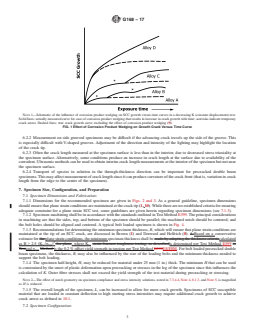
achieved. The effect of corrosion product wedging on crack growth versus time curve is shown schematically in Fig. 1 (9). When
wedging forces occur, they can invalidate further results and the test should be ended.
6.1.2 Crack-tip blunting or branching out, or both, of the plane of the precrack can invalidate the test. For valid tests, the crack
must remain within 610° of the centerline of the specimen.
6.1.3 Drying or contamination of the corrodent in the crack during interim measurements of the crack length may affect the
cracking behavior during subsequent exposure.
NOTE 1—Do not allow corrodent in the crack to dry during periodic measurements to avoid repassivation at the crack tip and the resulting change in
corrosion conditions. Remove one specimen at a time from corrodent. For tests conducted in deaerated test environments or in environments that contain
readily oxidizable species or corrosion products, interim crack length examinations may produce changes in the conditions at the crack tip that can, in
turn, affect cracking behavior during the subsequent exposure period.
6.2 Interferences in Visual Crack Length Measurements:
6.2.1 Corrosion products on the side surfaces of the specimen can interfere with accurate crack length measurements. Corrosion
products on these surfaces may be removed by careful scrubbing with a nonmetallic abrasive pad. However, for interim
measurements, a minimum area of surface should be cleaned to allow for visual crack length measurements if reexposure is
planned.
The boldface numbers in parentheses refer to the list of references at the end of this standard.
G168 − 17
NOTE 1—Schematic of the influence of corrosion product wedging on SCC growth versus time curves in a decreasing K (constant displacement) test.
Solid lines: actually measured curve for case of corrosion product wedging that results in increase in crack growth with time; asterisks indicate temporary
crack arrest. Dashed lines: true crack growth curve excluding the effect of corrosion product wedging (9).
FIG. 1 Effect of Corrosion Product Wedging on Growth Crack Versus Time Curve
6.2.2 Measurement on side grooved specimens may be difficult if the advancing crack travels up the side of the groove. This
is especially difficult with V-shaped grooves. Adjustment of the direction and intensity of the lighting may highlight the location
of the crack tip.
6.2.3 Often the crack length measured at the specimen surface is less than in the interior, due to decreased stress triaxiality at
the specimen surface. Alternatively, some conditions produce an increase in crack length at the surface due to availability of the
corrodent. Ultrasonic methods can be used to obtain interim crack length measurements at the interior of the specimen but not near
the specimen surface.
6.2.4 Transport of species in solution in the through-thickness direction can be important for precracked double beam
specimens. This may affect measurement of crack length since it can produce curvature of the crack front (that is, variation in crack
length from the edge to the center of the specimen).
7. Specimen Size, Configuration, and Preparation
7.1 Specimen Dimensions and Fabrication:
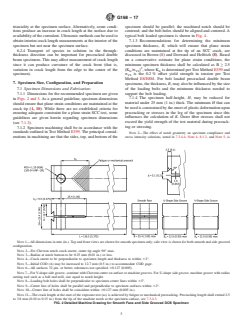
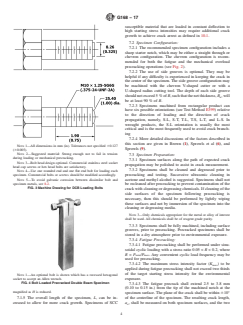
7.1.1 Dimensions for the recommended specimen are given in Figs. 2 and 3. As a general guideline, specimen dimensions
should ensure that plane strain conditions are maintained at the crack tip (1, 10). While there are no established criteria for ensuring
adequate constraint for a plane strain SCC test, some guidelines are given herein regarding specimen dimensions (see 7.1.3).
7.1.2 Specimen machining shall be in accordance with the standards outlined in Test Method E399. The principal considerations
in machining are that the sides, top, and bottom of the specimen should be parallel; the machined notch should be centered; and
the bolt holes should be aligned and centered. A typical bolt loaded specimen is shown in Fig. 4.
7.1.3 Recommendations for determining the minimum specimen thickness, B, which will ensure that plane strain conditions are
maintained at the tip of an SCC crack, are discussed in Brown (1) and Dorward and Helfrich (8). A Based on a conservative
estimate for the plane strain conditions, the minimum specimen thickness shall be made by adopting the thickness criteriacalculated
as B ≥ 2.5 (K /σ ) for plane, where K strain fracture toughness testing, as describedis determined per Test Method E399 in
Ic YS Ic
Testand σ Method is the 0.2 % offset yield strength in tension per Test Method E399E8/E8M. For bolt loaded precracked double
YS
beam specimens, the thickness, B, may also be influenced by the size of the loading bolts and the minimum thickness needed to
support the bolt loading.
7.1.4 The specimen half-height, H, may be reduced for material under 25 mm (1 in.) thick. The minimum H that can be used
is constrained by the onset of plastic deformation upon precracking or stresses in the leg of the specimen since this influences the
calculation of K. Outer fiber stresses shall not exceed the yield strength of the test material during precracking or stressing.
NOTE 2—The effect of notch geometry on specimen compliance and stress intensity solutions, noted in 7.3.4.4, Note 4, 8.1.3, and Note 5, is magnified
as H is reduced.
7.1.5 The overall length of the specimen, L, can be increased to allow for more crack growth. Specimens of SCC susceptible
material that are loaded in constant deflection to high starting stress intensities may require additional crack growth to achieve
crack arrest as defined in 10.1.
7.2 Specimen Configuration:
G168 − 17
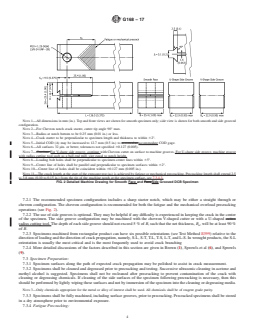
NOTE 1—All dimensions in mm (in.). Top and front views are shown for smooth specimen only; side view is shown for both smooth and side grooved
configuration.
NOTE 2—For Chevron notch crack starter, cutter tip angle 90° max.
NOTE 3—Radius at notch bottom to be 0.25 mm (0.01 in.) or less.
NOTE 4—Crack starter to be perpendicular to specimen length and thickness to within 62°.
NOTE 5—Initial COD (Δ) may be increased to 12.7 mm (0.5 in.) to accomodateaccommodate COD gage.
NOTE 6—All surfaces 32 μin. or better, tolerances not specified 60.127 (0.005).
NOTE 7—Continue For V-shape side groove, continue with Chevron cutter on surface to machine grooves. For U-shape side groove, machine groove
with radius cutting tool such as a ball end mill, size equal to notch height.
NOTE 8—Loading bolt holes shall be perpendicular to specimen center lines within 65°.
NOTE 9—Center line of holes shall be parallel and perpendicular to specimen surfaces within 62°.
NOTE 10—Center line of holes shall be coincident within 60.127 mm (0.005 in.).
NOTE 11—The crack length at the start of the exposure test (a ) is achieved by fatigue or mechanical precracking. Precracking length shall extend 2.5
to 3.8 mm (0.10 to 0.15 in.) from the tip of the machine notch at the specimen surface, see 7.3.4.3.
FIG. 2 Detailed Machine Drawing for Smooth Face and FaceSide Grooved DCB Specimen
7.2.1 The recommended specimen configuration includes a sharp starter notch, which may be either a straight through or
chevron configuration. The chevron configuration is recommended for both the fatigue and the mechanical overload precracking
operations (see Fig. 2).
7.2.2 The use of side grooves is optional. They may be helpful if any difficulty is experienced in keeping the crack in the center
of the specimen. The side groove configuration may be machined with the chevron V-shaped cutter or with a U-shaped cutter.
radius cutting tool. The depth of each side groove should not exceed 5 % of B, such that the net thickness, B , will be at least 90 %
n
of B.
7.2.3 Specimens machined from rectangular product can have six possible orientations (see Test Method E399) relative to the
direction of loading and the direction of crack propagation, namely, S-L, S-T, T-L, T-S, L-T, and L-S. In wrought products, the S-L
orientation is usually the most critical and is the most frequently used to avoid crack branching
7.2.4 More detailed discussions of the factors described in this section are given in Brown (1), Sprowls et al (6), and Sprowls
(9).
7.3 Specimen Preparation:
7.3.1 Specimen surfaces along the path of expected crack propagation may be polished to assist in crack measurement.
7.3.2 Specimens shall be cleaned and degreased prior to precracking and testing. Successive ultrasonic cleaning in acetone and
methyl alcohol is suggested. Specimens shall not be recleaned after precracking to prevent contamination of the crack with
cleaning or degreasing chemicals. If cleaning of the side surfaces of the specimen following precracking is necessary, then this
should be performed by lightly wiping these surfaces and not by immersion of the specimen into the cleaning or degreasing media.
NOTE 3—Only chemicals appropriate for the metal or alloy of interest shall be used. All chemicals shall be of reagent grade purity.
7.3.3 Specimens shall be fully machined, including surface grooves, prior to precracking. Precracked specimens shall be stored
in a dry atmosphere prior to environmental exposure.
7.3.4 Fatigue Precracking:
G168 − 17
NOTE 1—All dimensions in mm (in). Tolerances not specified 60.127 (60.005).
NOTE 2—Suggested material: Strong enough not to fail in tension during loading or mechanical precracking.
NOTE 3—Bolt head design optional. Commercial stainless steel socket head cap screws or hex head bolts are satisfactory.
NOTE 4—Use one rounded end and one flat end bolt for loading each specimen. Commercial bolts or screws should be modified accordingly.
NOTE 5—To avoid galvanic corrosion between dissimilar bolt and specimen metals, see 8.2.
FIG. 3 Machine Drawing for DCB Loading Bolts
NOTE 1—An optional bolt is shown which has a recessed hexagonal socket to accept an Allen wrench.
FIG. 4 Bolt Loaded Precracked Double Beam Specimen
7.3.4.1 Fatigue precracking shall be performed under sinusoidal cyclic loading with a stress ratio 0.05 < R < 0.2, where R =
P /P . Any convenient cyclic load frequency may be used for precracking.
min max
7.3.4.2 The maximum stress intensity factor (K ) to be applied during fatigue precracking shall not exceed two thirds of the
max
target starting stress intensity for the environmental exposure.
7.3.4.3 The fatigue precrack shall extend 2.5 to 3.8 mm (0.10 to 0.15 in.) from the tip of the machined notch at the specimen
surface. The plane of the crack shall be within 610° of the centerline of the specimen. The resulting crack length, a , shall be
o
measured on both specimen surfaces, and the two values averaged. The measuring instrument shall have an accuracy of 0.025 mm
(0.001 in.).
G168 − 17
7.3.4.4 The stress intensity factor during precracking shall be computed from the following equation (2, 11):
1/2 3/2
K 5 @3.464 P a ~110.673~H/a!!#/@~B ! H # (1)
I n
H
3.464·P·a· 1 1 0.673
S D
a
K 5 (1)
I 1⁄2 3⁄2
~B · B ! ·H
n
where:
1/2 1/2
K = stress intensity factor, MPa-m (ksi-in. ),
I
P = applied load, MN (klbf),
a = crack length, m (in.),
B = specimen thickness, m (in.),
B = specimen thickness at the machined notch for face grooved specimens, m (in.) (B = B for smooth face specimens), and
n n
H = specimen half height, m (in.).
NOTE 4—The stress intensity solutions provided by Eq 1, Eq 2, and Eq X1.2 are based on theoretical compliance of specimens of the recommended
configuration in Fig. 2. They have been validated by the work of Fichter (11). However, significant deviation in starter notch geometry and specimen half
height may result in inaccurate K values (12, 13).
I
7.3.5 Mechanical Precracking:
7.3.5.1 Specimens that are precracked by mechanical overload shall be precracked immediately prior to, and as the initial step
of, the environmental exposure test initiation. It may be convenient to support the specimen in a vise during the mechanical
precracking procedure. Mechanical precracking may be difficult on higher toughness materials; for example, aluminum alloys with
1/2
K > 25 MPa-m . Regardless of the material toughness, mechanical precracking is also difficult for specimens that are machined
IC
with the crack propagation direction normal to predominant grain orientation; for example, L-T or S-T (see Test Method E399)
orientations in rolled plate.
7.3.5.2 Crack mouth opening displacement, V , shall be monitored with a clip-on crack mouth opening displacement (COD)
o
gage during precracking. A typical COD gage is described in Test Method E399, Annex A1.
7.3.5.3 The mechanical precrack shall be extended 2.5 to 3.8 mm (0.10 to 0.15 in.) from the tip of the machined notch at the
specimen surface. The resulting crack length, a , shall be measured on both specimen surfaces, and the two values averaged. The
o
measuring instrument shall have an accuracy of 0.025 mm (0.001 in.).
7.3.5.4 The resulting stress intensity after mechanical precracking will be K , the stress intensity for mechanical crack arrest.
Ia
If K is greater than the target starting stress intensity, then K shall be used as the starting stress intensity for the stress corrosion
Ia Ia
test (that is, K ). If a mechanically precracked specimen is inadvertently overloaded, no attempt shall be made to reduce the initial
io
stress by partially unloading the specimen. This will produce compressive stresses at the crack tip, which will retard or prevent
crack initiation. If K is less than the target starting stress intensity, then adjustment of crack mouth opening, V , should be made
Ia o
following procedures provided in 8.1 (Eq 3).
7.3.5.5 The resulting stress intensity factor, K , should be computed from the following equation (11):
Ia
1/2 2 2
K 5 ~V E!/$2.309 H ~a /H10.673! @111.5~C /a !2 1.15~C /a ! #% (2)
Ia o o o o o o
V ·E
o
K 5 (2)
2 2
Ia
a C c
0 0 0
1⁄2
2.309·H · 1 0.673 · 1 1 1.5 · 2 1.15·
S D F S D S DG
H a a
0 0
where:
1/2 1/2
K = stress intensity factor at crack arrest, Mpa-m (ksi-in. ),
Ia
V = crack mouth opening displacement, m (in.),
o
E = Young’s Modulus, MPa (ksi),
a = starting crack length at start of exposure test, m (in.),
o
C = distance from load line to COD gage attachment location, m (in.), and
o
H = specimen half height, m (in.).
7.4 Residual Stress Effects—Residual stresses can have an influence on SCC. The effect can be significant when test specimens
are removed from material in which complete stress relief is impractical, such as weldments, as-heat treated materials, complex
wrought parts, and parts with intentionally produced residual stresses. Residual stresses superimposed on the applied stress can
cause the local crack-tip stress intensity factor to be different from that calculated from externally applied forces or displacements.
Irregular crack growth during precracking, such as excessive crack front curvature or out-of-plane crack growth, often indicates
that residual stresses will affect subsequent SCC growth behavior. Changes in the zero-force value of crack mouth opening
displacement as a result of precrack growth is another indication that residual stresses will affect the subsequent SCC growth.
8. General Procedure
8.1 Stressing Procedure:
G168 − 17
8.1.1 Precracked double beam specimens may be stressed either in constant displacement or constant load. The constant
displacement condition may be achieved by a wedge inserted in the machined notch or by loading bolts. The constant load
condition may be achieved through the use of dead weight loading or approximated with the use of proof rings with adequate
compliance to minimize load reduction that will occur during the test due to crack growth in the specimen (3).
8.1.2 Suggested loading bolts are shown in Fig. 3. A precracked double beam specimen stressed in constant displacement with
two bolts is shown in Fig. 4. The loading bolts shall be tightened until the crack mouth opening displacement (V ) reaches a value
o
corresponding to the desired target starting stress intensity value for the measured precrack length. The bolts shall be tightened in
small increments, alternating between the two, such that the specimen is deflected symmetrically about the centerline. Another
approach is to mount the nonstressed end of the specimen in a vice and use two wrenches, turning both wr
...