

ASTM D5483-21
(Test Method)Standard Test Method for Oxidation Induction Time of Lubricating Greases by Pressure Differential Scanning Calorimetry
General Information
- Abstract
SIGNIFICANCE AND USE
5.1 Oxidation induction time, as determined under the conditions of this test method, can be used as an indication of oxidation stability.3 This test method can be used for research and development, quality control and specification purposes. However, no correlation has been determined between the results of this test method and service performance.
SCOPE
1.1 This test method covers the determination of oxidation induction time of lubricating greases subjected to oxygen at 3.5 MPa (500 psig) and temperatures between 155 °C and 210 °C.
1.2 Warning—The original data published in Research Report RR:D02-1314, was not analyzed in accordance the current D2PP. It also used instruments which are no longer manufactured and in a check of currently used instruments, none of the original instruments were still in use. The new precision of this test method is still to be established.
1.3 The values stated in SI units are to be regarded as standard. The values given in parentheses are for information only.
1.4 This standard does not purport to address all of the safety concerns, if any, associated with its use. It is the responsibility of the user of this standard to establish appropriate safety, health, and environmental practices and determine the applicability of regulatory limitations prior to use.
1.5 This international standard was developed in accordance with internationally recognized principles on standardization established in the Decision on Principles for the Development of International Standards, Guides and Recommendations issued by the World Trade Organization Technical Barriers to Trade (TBT) Committee.
- Status
- Published
- Publication Date
- 30-Nov-2021
- Technical Committee
- D02 - Petroleum Products, Liquid Fuels, and Lubricants
- Drafting Committee
- D02.09.0E - Oxidation of Greases
Buy Documents
ASTM D5483-21 - Standard Test Method for Oxidation Induction Time of Lubricating Greases by Pressure Differential Scanning Calorimetry
REDLINE ASTM D5483-21 - Standard Test Method for Oxidation Induction Time of Lubricating Greases by Pressure Differential Scanning Calorimetry
Overview
ASTM D5483-21 is the standard test method developed by ASTM International for determining the oxidation induction time (OIT) of lubricating greases using pressure differential scanning calorimetry (PDSC). This method measures how long a grease sample can withstand oxidative degradation when exposed to high-pressure oxygen at elevated temperatures. The results from this standardized procedure provide valuable insights into the oxidation stability of lubricating greases, supporting research and development, quality control, and specification activities in the lubricants industry.
Key Topics
- Oxidation Induction Time (OIT): The main metric obtained using this method, OIT is defined as the period from initial oxygen exposure to the extrapolated onset of an oxidation exotherm. It gives an indication of the grease's resistance to oxidation under controlled, accelerated conditions.
- Pressure Differential Scanning Calorimetry (PDSC): Utilized as the primary analytical technique, PDSC enables precise control over pressure and temperature conditions, simulating aggressive environments to evaluate grease stability.
- Test Conditions: The method involves exposing a small, weighed grease sample to oxygen at 3.5 MPa (500 psig) and a temperature range between 155°C and 210°C, with the oxidation reaction closely monitored and recorded.
- Repeatability and Reproducibility: The standard identifies precision parameters, including determinability, repeatability, and reproducibility, ensuring reliability and consistency of results across laboratories.
Applications
- Product Development: By determining oxidation induction times, formulators can assess and compare the oxidative stability of new grease compounds or additive packages during the R&D phase.
- Quality Control: Manufacturers use this method to monitor production consistency, verify raw material quality, and validate finished lubricating greases meet specific oxidation stability requirements.
- Specifications and Compliance: ASTM D5483-21 provides a recognized basis for setting induction time specifications in technical data sheets and purchasing contracts, supporting industry standards and regulatory expectations.
- Comparative Analysis: Laboratories can compare different greases’ resistance to oxidation, helping end-users select appropriate lubricants for demanding applications where oxidation stability is critical.
Related Standards
- ASTM D4057 - Practice for Manual Sampling of Petroleum and Petroleum Products: Covers procedures for collecting representative samples, supporting accurate OIT testing.
- ASTM D4175 - Terminology Relating to Petroleum Products, Liquid Fuels, and Lubricants: Standardized definitions relevant to lubricant analysis and reporting.
- ASTM E697 - Practice for Use of Electron-Capture Detectors in Gas Chromatography: Referenced for complementary chromatographic analyses.
- ASTM E1858 - Test Methods for Determining Oxidation Induction Time of Hydrocarbons by Differential Scanning Calorimetry: Related methodology for hydrocarbon oxidation assessment.
Practical Value
Adherence to ASTM D5483-21 ensures consistent, repeatable results for evaluating the oxidation resistance of lubricating greases. Using pressure differential scanning calorimetry, manufacturers and laboratories can effectively screen, benchmark, and control the performance of greases intended for high-temperature or long-duration service. The standard underpins technical specifications and procurement decisions across the lubrication, automotive, industrial, and manufacturing sectors.
Keywords: ASTM D5483, oxidation induction time, lubricating grease, PDSC, oxidation stability, differential scanning calorimetry, quality control, lubricant testing, grease performance, international standards.
Relations
- Refers
ASTM D4175-23a - Standard Terminology Relating to Petroleum Products, Liquid Fuels, and Lubricants - Effective Date
- 15-Dec-2023
- Refers
ASTM D4175-23e1 - Standard Terminology Relating to Petroleum Products, Liquid Fuels, and Lubricants - Effective Date
- 01-Jul-2023
- Refers
ASTM E697-96(2019) - Standard Practice for Use of Electron-Capture Detectors in Gas Chromatography - Effective Date
- 01-Sep-2019
- Refers
ASTM E697-96(2011) - Standard Practice for Use of Electron-Capture Detectors in Gas Chromatography - Effective Date
- 01-Nov-2011
- Refers
ASTM D4057-06(2011) - Standard Practice for Manual Sampling of Petroleum and Petroleum Products - Effective Date
- 01-Jun-2011
- Effective Date
- 01-Sep-2008
- Refers
ASTM E697-96(2006) - Standard Practice for Use of Electron-Capture Detectors in Gas Chromatography - Effective Date
- 01-Mar-2006
- Effective Date
- 10-Mar-2003
- Effective Date
- 10-May-2000
- Refers
ASTM D4057-95(2000) - Standard Practice for Manual Sampling of Petroleum and Petroleum Products - Effective Date
- 10-Apr-2000
- Effective Date
- 10-Apr-1996
- Refers
ASTM E697-96(2001) - Standard Practice for Use of Electron-Capture Detectors in Gas Chromatography - Effective Date
- 10-Apr-1996
Buy Documents
ASTM D5483-21 - Standard Test Method for Oxidation Induction Time of Lubricating Greases by Pressure Differential Scanning Calorimetry
REDLINE ASTM D5483-21 - Standard Test Method for Oxidation Induction Time of Lubricating Greases by Pressure Differential Scanning Calorimetry
Get Certified
Connect with accredited certification bodies for this standard

Element Materials Technology
Materials testing and product certification.

ABS Group Brazil
ABS Group certification services in Brazil.

ABS Quality Evaluations Inc.
American Bureau of Shipping quality certification.
Sponsored listings
Frequently Asked Questions
ASTM D5483-21 is a standard published by ASTM International. Its full title is "Standard Test Method for Oxidation Induction Time of Lubricating Greases by Pressure Differential Scanning Calorimetry". This standard covers: SIGNIFICANCE AND USE 5.1 Oxidation induction time, as determined under the conditions of this test method, can be used as an indication of oxidation stability.3 This test method can be used for research and development, quality control and specification purposes. However, no correlation has been determined between the results of this test method and service performance. SCOPE 1.1 This test method covers the determination of oxidation induction time of lubricating greases subjected to oxygen at 3.5 MPa (500 psig) and temperatures between 155 °C and 210 °C. 1.2 Warning—The original data published in Research Report RR:D02-1314, was not analyzed in accordance the current D2PP. It also used instruments which are no longer manufactured and in a check of currently used instruments, none of the original instruments were still in use. The new precision of this test method is still to be established. 1.3 The values stated in SI units are to be regarded as standard. The values given in parentheses are for information only. 1.4 This standard does not purport to address all of the safety concerns, if any, associated with its use. It is the responsibility of the user of this standard to establish appropriate safety, health, and environmental practices and determine the applicability of regulatory limitations prior to use. 1.5 This international standard was developed in accordance with internationally recognized principles on standardization established in the Decision on Principles for the Development of International Standards, Guides and Recommendations issued by the World Trade Organization Technical Barriers to Trade (TBT) Committee.
SIGNIFICANCE AND USE 5.1 Oxidation induction time, as determined under the conditions of this test method, can be used as an indication of oxidation stability.3 This test method can be used for research and development, quality control and specification purposes. However, no correlation has been determined between the results of this test method and service performance. SCOPE 1.1 This test method covers the determination of oxidation induction time of lubricating greases subjected to oxygen at 3.5 MPa (500 psig) and temperatures between 155 °C and 210 °C. 1.2 Warning—The original data published in Research Report RR:D02-1314, was not analyzed in accordance the current D2PP. It also used instruments which are no longer manufactured and in a check of currently used instruments, none of the original instruments were still in use. The new precision of this test method is still to be established. 1.3 The values stated in SI units are to be regarded as standard. The values given in parentheses are for information only. 1.4 This standard does not purport to address all of the safety concerns, if any, associated with its use. It is the responsibility of the user of this standard to establish appropriate safety, health, and environmental practices and determine the applicability of regulatory limitations prior to use. 1.5 This international standard was developed in accordance with internationally recognized principles on standardization established in the Decision on Principles for the Development of International Standards, Guides and Recommendations issued by the World Trade Organization Technical Barriers to Trade (TBT) Committee.
ASTM D5483-21 is classified under the following ICS (International Classification for Standards) categories: 75.100 - Lubricants, industrial oils and related products. The ICS classification helps identify the subject area and facilitates finding related standards.
ASTM D5483-21 has the following relationships with other standards: It is inter standard links to ASTM D4175-23a, ASTM D4175-23e1, ASTM E697-96(2019), ASTM E697-96(2011), ASTM D4057-06(2011), ASTM E1858-08, ASTM E697-96(2006), ASTM E1858-03, ASTM E1858-00, ASTM D4057-95(2000), ASTM E697-96, ASTM E697-96(2001). Understanding these relationships helps ensure you are using the most current and applicable version of the standard.
ASTM D5483-21 is available in PDF format for immediate download after purchase. The document can be added to your cart and obtained through the secure checkout process. Digital delivery ensures instant access to the complete standard document.
Standards Content (Sample)
This international standard was developed in accordance with internationally recognized principles on standardization established in the Decision on Principles for the
Development of International Standards, Guides and Recommendations issued by the World Trade Organization Technical Barriers to Trade (TBT) Committee.
Designation: D5483 − 21
Standard Test Method for
Oxidation Induction Time of Lubricating Greases by
Pressure Differential Scanning Calorimetry
This standard is issued under the fixed designation D5483; the number immediately following the designation indicates the year of
original adoption or, in the case of revision, the year of last revision. A number in parentheses indicates the year of last reapproval. A
superscript epsilon (´) indicates an editorial change since the last revision or reapproval.
1. Scope* E697 Practice for Use of Electron-Capture Detectors in Gas
Chromatography
1.1 This test method covers the determination of oxidation
E1858 Test Methods for Determining Oxidation Induction
induction time of lubricating greases subjected to oxygen at
Time of Hydrocarbons by Differential Scanning Calorim-
3.5 MPa (500 psig) and temperatures between 155 °C and
etry
210 °C.
1.2 Warning—The original data published in Research Re-
3. Terminology
port RR:D02-1314, was not analyzed in accordance the current
D2PP. It also used instruments which are no longer manufac- 3.1 Definitions of Terms Specific to This Standard:
tured and in a check of currently used instruments, none of the
3.1.1 extrapolated onset time, n—a time determined on a
original instruments were still in use.The new precision of this
thermal curve, as the intersection of the extrapolated baseline
test method is still to be established.
and a line tangent to the oxidation exotherm constructed at its
1.3 The values stated in SI units are to be regarded as
maximum rate.
standard. The values given in parentheses are for information
3.1.2 oxidation induction time (OIT), n—the period of time
only.
from the first exposure to an oxidizing atmosphere until the
1.4 This standard does not purport to address all of the
extrapolated onset time.
safety concerns, if any, associated with its use. It is the
3.1.3 thermal curve, n—a graph of sample heat flow versus
responsibility of the user of this standard to establish appro-
time.
priate safety, health, and environmental practices and deter-
mine the applicability of regulatory limitations prior to use.
1.5 This international standard was developed in accor- 4. Summary of Test Method
dance with internationally recognized principles on standard-
4.1 Asmall quantity of grease is weighed into a sample pan
ization established in the Decision on Principles for the
and placed in a test cell. The cell is heated to a specified
Development of International Standards, Guides and Recom-
temperature and then pressurized with oxygen. The cell is held
mendations issued by the World Trade Organization Technical
at a regulated temperature and pressure until an exothermic
Barriers to Trade (TBT) Committee.
reaction occurs. The extrapolated onset time is measured and
2. Referenced Documents
reported as the oxidation induction time for the grease under
the specified test temperature.
2.1 ASTM Standards:
D4057 Practice for Manual Sampling of Petroleum and
5. Significance and Use
Petroleum Products
D4175 Terminology Relating to Petroleum Products, Liquid
5.1 Oxidation induction time, as determined under the
Fuels, and Lubricants
conditions of this test method, can be used as an indication of
oxidation stability. This test method can be used for research
This test method is under the jurisdiction of ASTM Committee D02 on and development, quality control and specification purposes.
Petroleum Products, Liquid Fuels, and Lubricants and is the direct responsibility of
However, no correlation has been determined between the
Subcommittee D02.09.0E on Oxidation of Greases.
results of this test method and service performance.
Current edition approved Dec. 1, 2021. Published January 2022. Originally
approved in 1993. Last previous edition approved in 2020 as D5483 – 20. DOI:
10.1520/D5483-21.
For referenced ASTM standards, visit the ASTM website, www.astm.org, or
contact ASTM Customer Service at service@astm.org. For Annual Book of ASTM Rhee, In-Sik, “Development of a New Oxidation Stability Test Method for
Standards volume information, refer to the standard’s Document Summary page on Greases Using a Pressure Differential Scanning Calorimeter (PDSC),” NLGI
the ASTM website. Spokesman, Vol 55, No. 4, July 1991, pp. 123–132.
*A Summary of Changes section appears at the end of this standard
Copyright © ASTM International, 100 Barr Harbor Drive, PO Box C700, West Conshohocken, PA 19428-2959. United States
D5483 − 21
6. Apparatus 8.1.1 Weigh approximately 10 mg of indium into an alumi-
num sample pan, insert a lid and crimp the lid to the pan using
6.1 Pressure Differential Scanning Calorimeter (PDSC), the
the encapsulation press. Place the crimped pan onto the sample
essential instrumentation required to provide the minimum
platform in the pressure cell. Seal an empty pan in the same
differential scanning calorimetric capability for these test
manner and place it on the reference platform. Set the cell
methods include:
cover in place and close the cell.
6.1.1 Pressure System, consisting of:
8.1.2 Open the oxygen cylinder valve slightly and set a
6.1.1.1 Pressure Vessel, or similar means of sealing the test
pressure of 3.5 MPa 6 0.2 MPa (500 psig 6 25 psig) on the
chamber at any applied oxygen pressure within the pressure
cell inlet line with the pressure regulator. Partially open the
limits of these test methods.
inlet valve on the cell and allow the pressure to slowly build up
6.1.1.2 Temperature Sensor, to provide an indication of the
in the cell. This should require approximately 2 min. Using the
specimen/furnace temperature to 60.4 °C.
outlet valve, adjust the oxygen purge rate through the flowme-
6.1.1.3 Differential Sensors, to detect a heat flow difference
ter to 100 mL⁄min 6 10 mL⁄min. The open position of these
between specimen and reference with a sensitivity of 5 µW.
valves should remain fixed during the test.
6.1.1.4 Pressure Transducer, or similar device to measure
8.1.3 Set the thermal analyzer to heat from ambient tem-
the pressure inside the test chamber to 60.2 MPa, including
perature (approximately 22 °C) to 180 °C) at a programmed
any temperature dependence of the transducer.
rate of 10 °C⁄min. After completion of the run, measure the
6.1.1.5 A source of pressurized oxygen or air capable of
melting temperature of the indium. If the melting temperature
sustaining a regulated gas pressure in the test chamber of up to
differs from 157.4 °C 6 0.2 °C (see Note 4), correct the
3.5 MPa.
difference by using either the hardware or software calibration
6.1.1.6 Ameans of sustaining a Test Chamber Environment
procedure described in the manufacturer’s instruction manual.
of a purge gas of 50 mL/min within 5 %.
If the hardware calibration procedure is used, the temperature
6.1.2 Temperature Controller, capable of executing a spe-
correction should be performed under 3.5 MPa (500 psig)
cific temperature program by operating the furnace(s) between
oxygen pressure with a 100 mL⁄min purge rate. A typical
selected temperature limits at a rate of temperature change of
melting calibration curve is shown in Fig. 1.
40 °C⁄min constant to 1 % and an isothermal temperature
constant to 60.4 °C
NOTE4—Themeltingtemperatureofindiumis156.6 °Catatmospheric
pressure, but has been found to be elevated to 157.4 °C under the
6.1.3 Data Collection Device, to provide a means of
conditions of this test method, 3.5 MPa (500 psig) of oxygen.
acquiring, storing, and displaying measured or calculated
signals,orboth.TheminimumoutputsignalsrequiredforDSC 8.2 Temperature Controller Calibration:
are heat flow, temperature and time. 8.2.1 The controller thermocouple calibration should be
performed according to the instrument’s manual.
NOTE 1—At the time that the original round robin data for this test
method was generated, only DuPont Instruments (now TA instruments)
8.3 Cell Base Pressure Gauge Calibration—The calibration
manufactured equipment that met the requirements of 6.1. Subsequently,
should be conducted using a calibrated pressure transducer or
other companies have manufactured equipment meeting these require-
a previously calibrated gauge according to the pressure cell
ments. Their use is permitted provided their performance is consistent
manufacturer’s instructions.
with the repeatability and reproducibility described in Section 11.
NOTE2—Thelinkbetweenthetestchamberandthepressuretransducer
9. Procedure
should allow for fast pressure equilibrium to ensure accurate recording of
the pressure above the specimen during testing.
9.1 Before starting a test, the control thermocouple calibra-
NOTE 3—The capability to record the first derivative of the heat flow
tion shall be conducted at the test temperature (either 210 °C,
curve will be helpful in cases where the baseline is not constant.
180 °C, or 155 °C). When the test
...
This document is not an ASTM standard and is intended only to provide the user of an ASTM standard an indication of what changes have been made to the previous version. Because
it may not be technically possible to adequately depict all changes accurately, ASTM recommends that users consult prior editions as appropriate. In all cases only the current version
of the standard as published by ASTM is to be considered the official document.
Designation: D5483 − 20 D5483 − 21
Standard Test Method for
Oxidation Induction Time of Lubricating Greases by
Pressure Differential Scanning Calorimetry
This standard is issued under the fixed designation D5483; the number immediately following the designation indicates the year of
original adoption or, in the case of revision, the year of last revision. A number in parentheses indicates the year of last reapproval. A
superscript epsilon (´) indicates an editorial change since the last revision or reapproval.
1. Scope*
1.1 This test method covers the determination of oxidation induction time of lubricating greases subjected to oxygen at 3.5 MPa
(500 psig) and temperatures between 155 °C and 210 °C.
1.2 Warning—The original data published in Research Report RR:D02-1314, was not analyzed in accordance the current D2PP.
It also used instruments which are no longer manufactured and in a check of currently used instruments, none of the original
instruments were still in use. The new precision of this test method is still to be established.
1.3 The values stated in SI units are to be regarded as standard. The values given in parentheses are for information only.
1.4 This standard does not purport to address all of the safety concerns, if any, associated with its use. It is the responsibility
of the user of this standard to establish appropriate safety, health, and environmental practices and determine the applicability of
regulatory limitations prior to use.
1.5 This international standard was developed in accordance with internationally recognized principles on standardization
established in the Decision on Principles for the Development of International Standards, Guides and Recommendations issued
by the World Trade Organization Technical Barriers to Trade (TBT) Committee.
2. Referenced Documents
2.1 ASTM Standards:
D4057 Practice for Manual Sampling of Petroleum and Petroleum Products
D4175 Terminology Relating to Petroleum Products, Liquid Fuels, and Lubricants
E697 Practice for Use of Electron-Capture Detectors in Gas Chromatography
E1858 Test Methods for Determining Oxidation Induction Time of Hydrocarbons by Differential Scanning Calorimetry
3. Terminology
3.1 Definitions of Terms Specific to This Standard:
3.1.1 extrapolated onset time, n—a time determined on a thermal curve, as the intersection of the extrapolated baseline and a line
tangent to the oxidation exotherm constructed at its maximum rate.
This test method is under the jurisdiction of ASTM Committee D02 on Petroleum Products, Liquid Fuels, and Lubricants and is the direct responsibility of Subcommittee
D02.09.0E on Oxidation of Greases.
Current edition approved Jan. 1, 2020Dec. 1, 2021. Published February 2020January 2022. Originally approved in 1993. Last previous edition approved in 20152020 as
D5483 – 05 (2015).D5483 – 20. DOI: 10.1520/D5483-20.10.1520/D5483-21.
For referenced ASTM standards, visit the ASTM website, www.astm.org, or contact ASTM Customer Service at service@astm.org. For Annual Book of ASTM Standards
volume information, refer to the standard’s Document Summary page on the ASTM website.
*A Summary of Changes section appears at the end of this standard
Copyright © ASTM International, 100 Barr Harbor Drive, PO Box C700, West Conshohocken, PA 19428-2959. United States
D5483 − 21
3.1.2 oxidation induction time (OIT), n—the period of time from the first exposure to an oxidizing atmosphere until the
extrapolated onset time.
3.1.3 thermal curve, n—a graph of sample heat flow versus time.
4. Summary of Test Method
4.1 A small quantity of grease is weighed into a sample pan and placed in a test cell. The cell is heated to a specified temperature
and then pressurized with oxygen. The cell is held at a regulated temperature and pressure until an exothermic reaction occurs. The
extrapolated onset time is measured and reported as the oxidation induction time for the grease under the specified test temperature.
5. Significance and Use
5.1 Oxidation induction time, as determined under the conditions of this test method, can be used as an indication of oxidation
stability. This test method can be used for research and development, quality control and specification purposes. However, no
correlation has been determined between the results of this test method and service performance.
6. Apparatus
6.1 Pressure Differential Scanning Calorimeter (PDSC), the essential instrumentation required to provide the minimum
differential scanning calorimetric capability for these test methods include:
6.1.1 Pressure System, consisting of:
6.1.1.1 Pressure Vessel, or similar means of sealing the test chamber at any applied oxygen pressure within the pressure limits of
these test methods.
6.1.1.2 Temperature Sensor, to provide an indication of the specimen/furnace temperature to 60.4 °C.
6.1.1.3 Differential Sensors, to detect a heat flow difference between specimen and reference with a sensitivity of 5 μW.
6.1.1.4 Pressure Transducer, or similar device to measure the pressure inside the test chamber to 60.2 MPa, including any
temperature dependence of the transducer.
6.1.1.5 A source of pressurized oxygen or air capable of sustaining a regulated gas pressure in the test chamber of up to 3.5 MPa.
6.1.1.6 A means of sustaining a Test Chamber Environment of a purge gas of 50 mL/min within 5 %.
6.1.2 Temperature Controller, capable of executing a specific temperature program by operating the furnace(s) between selected
temperature limits at a rate of temperature change of 40 °C ⁄min constant to 1 % and an isothermal temperature constant to 60.4 °C
6.1.3 Data Collection Device, to provide a means of acquiring, storing, and displaying measured or calculated signals, or both.
The minimum output signals required for DSC are heat flow, temperature and time.
NOTE 1—At the time that the original round robin data for this test method was generated, only DuPont Instruments (now TA instruments) manufactured
equipment that met the requirements of 6.1. Subsequently, other companies have manufactured equipment meeting these requirements. Their use is
permitted provided their performance is consistent with the repeatability and reproducibility described in Section 11.
NOTE 2—The link between the test chamber and the pressure transducer should allow for fast pressure equilibrium to ensure accurate recording of the
pressure above the specimen during testing.
NOTE 3—The capability to record the first derivative of the heat flow curve will be helpful in cases where the baseline is not constant.
6.2 Flow Meter, capable of reading 200 mL ⁄min or another selected flow rate, accurate to within 65 %. Ensure the flowmeter is
calibrated.
Rhee, In-Sik, “Development of a New Oxidation Stability Test Method for Greases Using a Pressure Differential Scanning Calorimeter (PDSC),” NLGI Spokesman, Vol
55, No. 4, July 1991, pp. 123–132.
D5483 − 21
FIG. 1 Calibration
6.3 Analytical Balance, with a capacity of at least 100 mg and capable of weighing to the nearest 0.01 mg or less than 1 % of
the specimen mass.
7. Reagents and Materials
7.1 Oxygen, extra dry, of not less than 99.5 % purity by volume. (Warning—Oxidizer. Gas under pressure. In addition to other
precautions, use stainless steel or copper tubing which is compatible with oxygen, and pressure gauges which are designated for
use with oxygen.)
7.2 Indium, of not less than 99.9 % purity by mass.
8. Calibration
8.1 Sample Temperature Calibration:
8.1.1 Weigh approximately 10 mg of indium into an aluminum sample pan, insert a lid and crimp the lid to the pan using the
encapsulation press. Place the crimped pan onto the sample platform in the pressure cell. Seal an empty pan in the same manner
and place it on the reference platform. Set the cell cover in place and close the cell.
8.1.2 Open the oxygen cylinder valve slightly and set a pressure of 3.5 MPa 6 0.2 MPa (500 psig 6 25 psig) on the cell inlet line
with the pressure regulator. Partially open the inlet valve on the cell and allow the pressure to slowly build up in the cell. This
should require approximately 2 min. Using the outlet valve, adjust the oxygen purge rate through the flowmeter to 100 mL ⁄min
6 10 mL ⁄min. The open position of these valves should remain fixed during the test.
8.1.3 Set the thermal analyzer to heat from ambient temperature (approximately 22 °C) to 180 °C) at a programmed rate of
10 °C ⁄min. After completion of the run, measure the melting temperature of the indium. If the melting temperature differs from
157.4 °C 6 0.2 °C (see Note 4), correct the difference by using either the hardware or software calibration procedure described
in the manufacturer’s instruction manual. If the hardware calibration procedure is used, the temperature correction should be
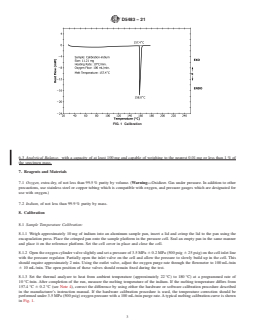
performed under 3.5 MPa (500 psig) oxygen pressure with a 100 mL ⁄min purge rate. A typical melting calibration curve is shown
in Fig. 1.
D5483 − 21
FIG. 2 Sample Preparation on SFI Pan
NOTE 4—The melting temperature of indium
...