

ASTM G138-12(2020)e1
(Test Method)Standard Test Method for Calibration of a Spectroradiometer Using a Standard Source of Irradiance
General Information
- Abstract
SIGNIFICANCE AND USE
4.1 This method is intended for use by laboratories performing calibration of a spectroradiometer for spectral irradiance measurements using a spectral irradiance standard with known spectral irradiance values and associated uncertainties traceable to a national metrological laboratory that has participated in intercomparisons of standards of spectral irradiance, known uncertainties and known measurement geometry.
4.2 This method is generalized to allow for the use of different types of input optics provided that those input optics are suitable for the wavelength range and measurement geometry of the calibration.
4.3 This method is generalized to allow for the use of different types of monochromators provided that they can be configured for a bandwidth, wavelength range, and throughput levels suitable for the calibration being performed.
4.4 This method is generalized to allow for the use of different types of optical radiation detectors provided that the spectral response of the detector over the wavelength range of the calibration is appropriate to the signal levels produced by the monochromator.
SCOPE
1.1 This test method covers the calibration of spectroradiometers for the measurement of spectral irradiance using a standard of spectral irradiance that is traceable to a national metrological laboratory that has participated in intercomparisons of standards of spectral irradiance.
1.2 This method is not limited by the input optics of the spectroradiometric system. However, choice of input optics affects the overall uncertainty of the calibration.
1.3 This method is not limited by the type of monochromator or optical detector used in the spectroradiometer system. Parts of the method may not apply to determine which parts apply to the specific spectroradiometer being used. It is important that the choice of monochromator and detector be appropriate for the wavelength range of interest for the calibration. Though the method generally applies to photodiode array detector based systems, the user should note that these types of spectroradiometers often suffer from stray light problems and have limited dynamic range. Diode array spectroradiometers are not recommended for use in the ultraviolet range unless these specific problems are addressed.
1.4 The calibration described in this method employs the use of a standard of spectral irradiance. The standard of spectral irradiance must have known spectral irradiance values at given wavelengths for a specific input current and clearly defined measurement geometry. Uncertainties must also be known for the spectral irradiance values. The values assigned to this standard must be traceable to a national metrological laboratory that has participated in intercomparisons of standards of spectral irradiance. These standards may be obtained from a number of national standards laboratories and commercial laboratories. The spectral irradiance standards consist mainly of tungsten halogen lamps with coiled filaments enclosed in a quartz envelope, though other types of lamps are used. Standards can be obtained with calibration values covering all or part of the wavelength range from 200 to 4500 nm.
1.5 This standard does not purport to address all of the safety concerns, if any, associated with its use. It is the responsibility of the user of this standard to establish appropriate safety, health, and environmental practices and determine the applicability of regulatory limitations prior to use.2
1.6 This international standard was developed in accordance with internationally recognized principles on standardization established in the Decision on Principles for the Development of International Standards, Guides and Recommendations issued by the World Trade Organization Technical Barriers to Trade (TBT) Committee.
- Status
- Published
- Publication Date
- 31-May-2020
- Technical Committee
- G03 - Weathering and Durability
- Drafting Committee
- G03.09 - Radiometry
Overview
ASTM G138-12(2020)e1, published by ASTM International, defines the standard test method for calibrating spectroradiometers using a standard source of irradiance. This method is essential for laboratories performing spectral irradiance measurements where traceability to a national metrological laboratory is required. By following this standardized procedure, users ensure accurate, repeatable, and internationally comparable spectroradiometric measurements, backed by well-documented uncertainties and best laboratory practices.
Key Topics
- Calibration Traceability: Calibration must use a spectral irradiance standard with values and uncertainties traceable to a recognized national metrological institution that participates in international comparisons.
- System Flexibility: The method supports the use of various types of input optics, monochromators, and detectors, provided their characteristics match the wavelength range and geometry required for calibration.
- Measurement Uncertainties: Proper selection and configuration of system components, including input optics and detectors, directly influence the overall uncertainty of the calibration process.
- Spectral Irradiance Standards: Tungsten halogen lamps are commonly used as reference standards, with calibration values that can span wavelengths from 200 to 4500 nm.
- Limitations and Cautions: The standard does not address all safety concerns; users must adhere to relevant safety, health, and regulatory guidelines unique to their applications and environment.
Applications
Spectroradiometer calibration is crucial in several fields, including:
- Photometry & Radiometry: Accurate spectral irradiance calibrations are vital in research, product testing, and quality control for lighting and optical sensors.
- Colorimetry: Ensuring that spectroradiometers are properly calibrated allows for precise color measurements in manufacturing, display calibration, and material testing.
- Environmental Monitoring: Calibrated instruments are used for measuring solar irradiance, atmospheric phenomena, and UV monitoring.
- Material Testing & Weathering: Used in compliance testing for materials exposed to light sources, ensuring durability and performance standards are met.
- Traceable Research: Laboratories and institutions use these calibrations for traceable, repeatable experimental measurements that require international comparability.
Proper application of ASTM G138 ensures that spectroradiometric systems produce data that is reliably comparable across laboratories and over time, supporting compliance, research, and quality assurance needs.
Related Standards
ASTM G138 references and complements several key documents and international standards, including:
- ASTM E772: Terminology of Solar Energy Conversion, offering definitions for terms used across photometry and radiometry standards.
- ASTM E1341: Practice for Obtaining Spectroradiometric Data from Radiant Sources for Colorimetry.
- CIE Publications: Including CIE Publication No. 63 (Spectroradiometric Measurement of Light Sources), which provide further guidance on measurement procedures and uncertainties.
- NIST Technical Notes: Such as NIST Technical Note 1927, which outlines guidelines for evaluating and expressing uncertainty in measurement results.
Following ASTM G138 ensures alignment with international best practices for the calibration of optical measurement systems, reinforcing confidence in spectral irradiance data across industries.
Keywords: ASTM G138, spectroradiometer calibration, standard source of irradiance, spectral irradiance standard, radiometry, photometry, traceability, laboratory calibration, measurement uncertainty, tungsten halogen lamp, national metrological laboratory, optical calibration standards.
Relations
- Effective Date
- 01-Jun-2020
- Effective Date
- 01-Sep-2013
- Effective Date
- 01-Nov-2011
- Effective Date
- 01-Sep-2011
- Effective Date
- 01-Jul-2006
- Effective Date
- 01-Apr-2005
- Effective Date
- 01-Jan-2001
- Effective Date
- 01-Jan-2001
- Effective Date
- 27-Feb-1987
- Effective Date
- 27-Feb-1987
- Effective Date
- 01-Jun-2020
- Effective Date
- 01-Jun-2020
- Effective Date
- 01-Jun-2020
- Effective Date
- 01-Jun-2020
- Effective Date
- 01-Jun-2020
Get Certified
Connect with accredited certification bodies for this standard

IMP NDT d.o.o.
Non-destructive testing services. Radiography, ultrasonic, magnetic particle, penetrant, visual inspection.
Inštitut za kovinske materiale in tehnologije
Institute of Metals and Technology. Materials testing, metallurgical analysis, NDT.
Q Techna d.o.o.
NDT and quality assurance specialist. 30+ years experience. NDT personnel certification per ISO 9712, nuclear and thermal power plant inspections, QA/
Sponsored listings
Frequently Asked Questions
ASTM G138-12(2020)e1 is a standard published by ASTM International. Its full title is "Standard Test Method for Calibration of a Spectroradiometer Using a Standard Source of Irradiance". This standard covers: SIGNIFICANCE AND USE 4.1 This method is intended for use by laboratories performing calibration of a spectroradiometer for spectral irradiance measurements using a spectral irradiance standard with known spectral irradiance values and associated uncertainties traceable to a national metrological laboratory that has participated in intercomparisons of standards of spectral irradiance, known uncertainties and known measurement geometry. 4.2 This method is generalized to allow for the use of different types of input optics provided that those input optics are suitable for the wavelength range and measurement geometry of the calibration. 4.3 This method is generalized to allow for the use of different types of monochromators provided that they can be configured for a bandwidth, wavelength range, and throughput levels suitable for the calibration being performed. 4.4 This method is generalized to allow for the use of different types of optical radiation detectors provided that the spectral response of the detector over the wavelength range of the calibration is appropriate to the signal levels produced by the monochromator. SCOPE 1.1 This test method covers the calibration of spectroradiometers for the measurement of spectral irradiance using a standard of spectral irradiance that is traceable to a national metrological laboratory that has participated in intercomparisons of standards of spectral irradiance. 1.2 This method is not limited by the input optics of the spectroradiometric system. However, choice of input optics affects the overall uncertainty of the calibration. 1.3 This method is not limited by the type of monochromator or optical detector used in the spectroradiometer system. Parts of the method may not apply to determine which parts apply to the specific spectroradiometer being used. It is important that the choice of monochromator and detector be appropriate for the wavelength range of interest for the calibration. Though the method generally applies to photodiode array detector based systems, the user should note that these types of spectroradiometers often suffer from stray light problems and have limited dynamic range. Diode array spectroradiometers are not recommended for use in the ultraviolet range unless these specific problems are addressed. 1.4 The calibration described in this method employs the use of a standard of spectral irradiance. The standard of spectral irradiance must have known spectral irradiance values at given wavelengths for a specific input current and clearly defined measurement geometry. Uncertainties must also be known for the spectral irradiance values. The values assigned to this standard must be traceable to a national metrological laboratory that has participated in intercomparisons of standards of spectral irradiance. These standards may be obtained from a number of national standards laboratories and commercial laboratories. The spectral irradiance standards consist mainly of tungsten halogen lamps with coiled filaments enclosed in a quartz envelope, though other types of lamps are used. Standards can be obtained with calibration values covering all or part of the wavelength range from 200 to 4500 nm. 1.5 This standard does not purport to address all of the safety concerns, if any, associated with its use. It is the responsibility of the user of this standard to establish appropriate safety, health, and environmental practices and determine the applicability of regulatory limitations prior to use.2 1.6 This international standard was developed in accordance with internationally recognized principles on standardization established in the Decision on Principles for the Development of International Standards, Guides and Recommendations issued by the World Trade Organization Technical Barriers to Trade (TBT) Committee.
SIGNIFICANCE AND USE 4.1 This method is intended for use by laboratories performing calibration of a spectroradiometer for spectral irradiance measurements using a spectral irradiance standard with known spectral irradiance values and associated uncertainties traceable to a national metrological laboratory that has participated in intercomparisons of standards of spectral irradiance, known uncertainties and known measurement geometry. 4.2 This method is generalized to allow for the use of different types of input optics provided that those input optics are suitable for the wavelength range and measurement geometry of the calibration. 4.3 This method is generalized to allow for the use of different types of monochromators provided that they can be configured for a bandwidth, wavelength range, and throughput levels suitable for the calibration being performed. 4.4 This method is generalized to allow for the use of different types of optical radiation detectors provided that the spectral response of the detector over the wavelength range of the calibration is appropriate to the signal levels produced by the monochromator. SCOPE 1.1 This test method covers the calibration of spectroradiometers for the measurement of spectral irradiance using a standard of spectral irradiance that is traceable to a national metrological laboratory that has participated in intercomparisons of standards of spectral irradiance. 1.2 This method is not limited by the input optics of the spectroradiometric system. However, choice of input optics affects the overall uncertainty of the calibration. 1.3 This method is not limited by the type of monochromator or optical detector used in the spectroradiometer system. Parts of the method may not apply to determine which parts apply to the specific spectroradiometer being used. It is important that the choice of monochromator and detector be appropriate for the wavelength range of interest for the calibration. Though the method generally applies to photodiode array detector based systems, the user should note that these types of spectroradiometers often suffer from stray light problems and have limited dynamic range. Diode array spectroradiometers are not recommended for use in the ultraviolet range unless these specific problems are addressed. 1.4 The calibration described in this method employs the use of a standard of spectral irradiance. The standard of spectral irradiance must have known spectral irradiance values at given wavelengths for a specific input current and clearly defined measurement geometry. Uncertainties must also be known for the spectral irradiance values. The values assigned to this standard must be traceable to a national metrological laboratory that has participated in intercomparisons of standards of spectral irradiance. These standards may be obtained from a number of national standards laboratories and commercial laboratories. The spectral irradiance standards consist mainly of tungsten halogen lamps with coiled filaments enclosed in a quartz envelope, though other types of lamps are used. Standards can be obtained with calibration values covering all or part of the wavelength range from 200 to 4500 nm. 1.5 This standard does not purport to address all of the safety concerns, if any, associated with its use. It is the responsibility of the user of this standard to establish appropriate safety, health, and environmental practices and determine the applicability of regulatory limitations prior to use.2 1.6 This international standard was developed in accordance with internationally recognized principles on standardization established in the Decision on Principles for the Development of International Standards, Guides and Recommendations issued by the World Trade Organization Technical Barriers to Trade (TBT) Committee.
ASTM G138-12(2020)e1 is classified under the following ICS (International Classification for Standards) categories: 19.100 - Non-destructive testing. The ICS classification helps identify the subject area and facilitates finding related standards.
ASTM G138-12(2020)e1 has the following relationships with other standards: It is inter standard links to ASTM G138-12, ASTM E772-13, ASTM E1341-06(2011)e1, ASTM E772-11, ASTM E1341-06, ASTM E772-05, ASTM E1341-96, ASTM E1341-96(2001), ASTM E772-87(2001), ASTM E772-87(1993)e1, ASTM E2236-10(2019), ASTM E824-10(2018)e1, ASTM E927-19, ASTM E973-16(2020), ASTM E772-15(2021). Understanding these relationships helps ensure you are using the most current and applicable version of the standard.
ASTM G138-12(2020)e1 is available in PDF format for immediate download after purchase. The document can be added to your cart and obtained through the secure checkout process. Digital delivery ensures instant access to the complete standard document.
Standards Content (Sample)
This international standard was developed in accordance with internationally recognized principles on standardization established in the Decision on Principles for the
Development of International Standards, Guides and Recommendations issued by the World Trade Organization Technical Barriers to Trade (TBT) Committee.
´1
Designation: G138 − 12 (Reapproved 2020)
Standard Test Method for
Calibration of a Spectroradiometer Using a Standard Source
of Irradiance
This standard is issued under the fixed designation G138; the number immediately following the designation indicates the year of
original adoption or, in the case of revision, the year of last revision.Anumber in parentheses indicates the year of last reapproval.A
superscript epsilon (´) indicates an editorial change since the last revision or reapproval.
ε NOTE—An editorial change was made to 3.1 in July 2020.
INTRODUCTION
Astandardized means of performing and reporting calibration of the spectroradiometer for spectral
irradiance measurements is desirable.
This test method presents specific technical requirements for a laboratory performing calibration of
a spectroradiometer for spectral irradiance measurements. A detailed procedure for performing the
calibration and reporting the results is outlined.
This test method for calibration is applicable to spectroradiometric systems consisting of at least a
monochromator, input optics, and an optical radiation detector, and applies to spectroradiometric
calibrations performed with a standard of spectral irradiance with known irradiance values traceable
to a national metrological laboratory that has participated in intercomparisons of standards of spectral
irradiance. The standard must also have known uncertainties and measurement geometry associated
with its irradiance values.
1. Scope troradiometers are not recommended for use in the ultraviolet
range unless these specific problems are addressed.
1.1 This test method covers the calibration of spectroradi-
ometers for the measurement of spectral irradiance using a 1.4 The calibration described in this method employs the
use of a standard of spectral irradiance. The standard of
standard of spectral irradiance that is traceable to a national
metrological laboratory that has participated in intercompari- spectral irradiance must have known spectral irradiance values
at given wavelengths for a specific input current and clearly
sons of standards of spectral irradiance.
defined measurement geometry. Uncertainties must also be
1.2 This method is not limited by the input optics of the
known for the spectral irradiance values. The values assigned
spectroradiometric system. However, choice of input optics
to this standard must be traceable to a national metrological
affects the overall uncertainty of the calibration.
laboratory that has participated in intercomparisons of stan-
1.3 This method is not limited by the type of monochroma-
dards of spectral irradiance. These standards may be obtained
tor or optical detector used in the spectroradiometer system.
from a number of national standards laboratories and commer-
Parts of the method may not apply to determine which parts
cial laboratories. The spectral irradiance standards consist
apply to the specific spectroradiometer being used. It is
mainly of tungsten halogen lamps with coiled filaments en-
important that the choice of monochromator and detector be
closed in a quartz envelope, though other types of lamps are
appropriate for the wavelength range of interest for the
used. Standards can be obtained with calibration values cov-
calibration. Though the method generally applies to photo-
ering all or part of the wavelength range from 200 to 4500 nm.
diode array detector based systems, the user should note that
1.5 This standard does not purport to address all of the
these types of spectroradiometers often suffer from stray light
safety concerns, if any, associated with its use. It is the
problems and have limited dynamic range. Diode array spec-
responsibility of the user of this standard to establish appro-
priate safety, health, and environmental practices and deter-
mine the applicability of regulatory limitations prior to use.
This test method is under the jurisdiction of ASTM Committee G03 on
Weathering and Durability and is the direct responsibility of Subcommittee G03.09
on Radiometry.
CurrenteditionapprovedJune1,2020.PublishedJuly2020.Originallyapproved Available from the CIE, (International Commission on Illumination), http://
in 1996. Last previous edition approved in 2012 as G138–12. DOI: 10.1520/ www.techstreet.com/ciegate.tmpl CIE Central Bureau, Kegelgasse 27, A-1030
G0138-12R20E01. Vienna, Austria.
Copyright © ASTM International, 100 Barr Harbor Drive, PO Box C700, West Conshohocken, PA 19428-2959. United States
´1
G138 − 12 (2020)
1.6 This international standard was developed in accor- 3.1.11 ultraviolet, adj—optical radiation at wavelengths be-
dance with internationally recognized principles on standard- low 400 nanometres.
ization established in the Decision on Principles for the
3.2 Definitions of Terms Specific to This Standard:
Development of International Standards, Guides and Recom-
3.2.1 calibration subsystems, n—the instruments used to
mendations issued by the World Trade Organization Technical
supply and monitor current to a standard lamp during
Barriers to Trade (TBT) Committee.
calibration, consisting of a DC power supply, a current shunt,
and a digital voltmeter.
2. Referenced Documents
3.2.2 National Metrological Institution (NMI), n—A na-
2.1 ASTM Standards:
tion‘s internationally recognized standardization laboratory.
E772Terminology of Solar Energy Conversion
3.2.2.1 Discussion—The International Bureau of Weights
E1341Practice for Obtaining Spectroradiometric Data from
andMeasurements(abbreviationBIPMfromtheFrenchterms)
Radiant Sources for Colorimetry
establishestherecognitionthroughMutualRecognitionAgree-
2.2 Other Documents: ments. See http://www.bipm.org/en/cipm-mra. The NMI for
the United States of America is the National Institute for
CIEPublicationNo.63 TheSpectrodiometricMeasurement
of Light Sources Standards and Technology (NIST).
NIST Technical Note 1927:Guidelines for Evaluation and
3.2.3 passband,n—theeffectivebandwidth(c.f.),orspectral
Expressing Uncertainty of NIST Measurement Results
interval, over which the spectroradiometer system transmits at
agivenwavelengthsetting.Expressedasfull-widthatone-half
3. Terminology
maximum, as in bandwidth.Afunction of the linear dispersion
(nm/mm) and slit or aperture widths (mm) of the monochro-
3.1 Definitions:
mator system.
3.1.1 General terms pertaining to optical radiation and
opticalmeasurementsystemsaredefinedinTerminologyE772.
3.2.4 primary standard of spectral irradiance, n—a broad
Some of the more important terms from that standard used in
spectrum light source with known spectral irradiance values at
this paper are listed here.
various wavelengths which are traceable to a national metro-
3.1.2 bandwidth, n—the extent of a band of radiation
logical laboratory that has participated in intercomparisons of
reported as the difference between the two wavelengths at
standards of spectral irradiance.
which the amount of radiation is half of its maximum over the
3.2.5 responsivity, n—symbol R = dS/dφ, S is signal from
given band.
spectroradiometer detector, φ is radiant flux at the detector.
3.1.3 diffuser, n—a device used to scatter or disperse light
3.2.6 secondary standard of spectral irradiance, n—a stan-
usually through the process of diffuse transmission or reflec-
dard calibrated by reference to another standard such as a
tion.
primary or reference standard.
3.1.4 integrating sphere, n—a hollow sphere coated inter-
3.2.7 slit scattering function, n—symbol Z(λ ,λ),therespon-
o
nallywithawhitediffusereflectingmaterialandprovidedwith
sivity of the combined detector and monochromator system as
separate openings for incident and exiting radiation.
a function of wavelengths, λ, in the neighborhood of a given
3.1.5 irradiance, n—radiant flux incident per unit area of a
wavelength setting, λ . The slit scattering function is the
o
surface.
spectral responsivity in the neighborhood of specific wave-
length setting, λ .
3.1.6 monochromator, n—aninstrumentforisolatingnarrow
o
portions of the optical spectrum of a light source
3.2.8 spectral scattering (stray light), n— light with wave-
lengthsoutsidethepassbandofaspectroradiometeraparticular
3.1.7 polarization, n—with respect to optical radiation, the
wavelength setting that is received by the detector and contrib-
restriction of the magnetic or electric field vector to a single
utes to the output signal.
plane.
3.1.8 radiant flux, n—thetimerateofflowofradiantenergy
4. Significance and Use
measured in watts.
4.1 Thismethodisintendedforusebylaboratoriesperform-
3.1.9 spectral irradiance, n—irradianceperunitwavelength
ing calibration of a spectroradiometer for spectral irradiance
interval at a given wavelength.
measurements using a spectral irradiance standard with known
3.1.10 spectroradiometer, n—an instrument for measuring
spectral irradiance values and associated uncertainties trace-
the radiant energy of a light source at each wavelength
able to a national metrological laboratory that has participated
throughout the spectrum.
in intercomparisons of standards of spectral irradiance, known
uncertainties and known measurement geometry.
4.2 This method is generalized to allow for the use of
For referenced ASTM standards, visit the ASTM website, www.astm.org, or
different types of input optics provided that those input optics
contact ASTM Customer Service at service@astm.org. For Annual Book of ASTM
are suitable for the wavelength range and measurement geom-
Standards volume information, refer to the standard’s Document Summary page on
etry of the calibration.
the ASTM website.
G03
4.3 This method is generalized to allow for the use of
Available from American National Standards Institute, 11 West 42nd Street,
13th Floor, New York, NY 10036 different types of monochromators provided that they can be
´1
G138 − 12 (2020)
configured for a bandwidth, wavelength range, and throughput 1). If the monochromator has interchangeable slits, it is
levels suitable for the calibration being performed. important that the manufacturer document the effective band-
width of the monochromator with all possible combinations of
4.4 This method is generalized to allow for the use of
the slits or that these bandwidths be determined experimen-
different types of optical radiation detectors provided that the
tally. Configuration of the slits should be such that the
spectral response of the detector over the wavelength range of
bandpass function of the monochromator is symmetric, pref-
the calibration is appropriate to the signal levels produced by
erably triangular. The bandwidth should be constant across the
the monochromator.
wavelength region of interest and maintained between 85%
5. Apparatus and 100% of the measurement wavelength interval. The
precision of the wavelength positioning of the monochromator
5.1 Laboratory:
should be 0.1 nm with an absolute accuracy of better than 0.5
5.1.1 The room in which the calibrations are performed and
nm (see Practice E1341). For improved performance in the uv,
especially the area surrounding the optical bench should be
itisrecommendedthathighorderrejectionfiltersbeinsertedin
devoidofreflectivesurfaces.Thecalibrationvaluesassignedto
theopticalpathinthemonochromator.Thepurposeofthehigh
the spectral irradiance standard are for direct irradiance from
order rejection filters is to block radiation in the monochroma-
the lamp and any radiation entering the monochromator from
tor of unwanted wavelengths that could otherwise overpower
some other source including ambient reflections will be a
the signals being measured. The effects of variations in
source of error.
temperature and humidity on the performance of the mono-
5.1.2 The temperature and humidity in the laboratory shall
chromator should be addressed in writing by the manufacturer.
be maintained so as to agree with the conditions under which
5.2.1.2 The monochromator shall not be subject to shock or
the calibrations of the spectral irradiance standard and the
mechanical vibration during the calibration. This can be
calibration subsystems were performed (typically 20 °C,
facilitated by the use of a vibration isolated lab table. If any
25°C, 50% relative humidity).
optical parts in the monochromator are configurable by the
5.1.3 Air drafts in the laboratory should be minimized since
they could affect the output of electrical discharge lamps. user, refer to the manufacturer precautions about opening the
monochromator and handling any parts therein.
5.2 Spectroradiometer
5.2.2 Optical Radiation Detector:
5.2.1 Monochromator:
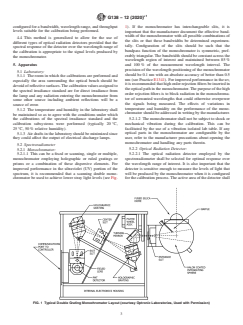
5.2.1.1 This can be a fixed or scanning, single or multiple, 5.2.2.1 The optical radiation detector employed by the
monochromator employing holographic or ruled gratings or spectroradiometer shall be selected for optimal response over
prisms or a combination of these dispersive elements. For the wavelength range of interest. It is also important that the
improved performance in the ultraviolet (UV) portion of the detector is sensitive enough to measure the levels of light that
spectrum, it is recommended that a scanning double mono- will be produced by the monochromator when it is configured
chromator be used to achieve lower stray light levels (see Fig. forthecalibrationprocess.Theactiveareaofthedetectorshall
FIG. 1 Typical Double Grating Monochromator Layout (courtesy Optronic Laboratories, Used with Permission)
´1
G138 − 12 (2020)
be evenly illuminated by the radiation leaving the exit slit of 5.3.2 Compare the signal from the detector with the filter in
the monochromator. A photomultiplier is typically used be- place to the shuttered, or dark signal of the detector. A signal
cause of its high responsivity and good signal-to-noise ratio. between 10% and 90% of the unfiltered signal indicates
For this reason it is recommended for use when measuring significant scattered light is reaching the detector, possibly due
spectral irradiance in the uv portion of the spectrum. to a non-light-tight enclosure.
5.2.2.2 Anyeffectsofvariationintemperatureandhumidity
5.4 Optical Radiation Sources
on the response of the detector documented by the manufac-
5.4.1 Wavelength Calibration Source:
turer shall be reported. Of all components of the
5.4.1.1 A stable wavelength source is required to calibrate
spectroradiometer, the detector is usually the most sensitive to
the wavelength positioning accuracy of the monochromator.
changesintemperature.Somedetectorsmayrequirecoolingin
Thiscanbeagasdischargelamporalaser.Theimportantthing
order to maintain a specific temperature. Avoid mechanical
is that the source have a known spectral emission line(s) of
shock to the detector. If the detector requires an amplifier, any
narrow bandwidth.
reported limitations and uncertainties in the detector system
5.4.1.2 If a laser source is used, occupants of the room
must factor in the contribution of the amplifier.
should wear eye protection appropriate for the class of laser.
5.2.3 If a diode array based spectroradiometer system is
Lasers should always be shielded from direct eye view.
used, note the following precautions:
5.4.2 Standard of Spectral Irradiance:
5.2.3.1 The diode array spectroradiometer should employ
5.4.2.1 The spectral irradiance standard is a critical compo-
internal focusing optics within the monochromator.
nent in the calibration process. This standard shall be obtained
5.2.3.2 When measuring in the ultraviolet, the method of
from a national standards laboratory or a certified commercial
stray light control, such as by the use of high order rejection
laboratory. It must have known spectral irradiance values over
filters or internal baffling, or both, shall be documented.
the wavelength range of interest. Uncertainties for these
5.2.3.3 It is highly recommended that diode array spectro-
spectral irradiance values must also be known in order to
radiometers should not be used for measurements below
compute the total uncertainty of the calibration outlined in this
300nm without extensive characterization of stray light char-
method. The conditions (temperature, relative humidity, cali-
acteristics and detector performance.
bration distance from the reference plane, orientation and
5.2.4 Input Optics:
polarity of the lamp current input leads or contacts) under
5.2.4.1 Some means of collecting the incident radiation and
which the standard was calibrated by the supplier must be
guiding it to evenly fill the entrance slit of the monochromator
clearly stated and duplicative. Specifically, the current to the
is required. The input optics also can serve several other
lamp and the measurement geometry must be reported by the
important purposes.
supplier in a written document or calibration certificate. The
(1) Cosine Receptor—Ideally, a cosine receptor will accept
calibrationcertificateshouldalsocontainaphysicaldescription
allradiationfromanentirehemisphereandsampleradiantflux
of the lamp including materials used in its construction and
according to the cosine of the incident angle.
electrical rating. A unique serial number identifying the stan-
(2) Depolarizer—The components in the monochromator
dardshouldalsobeinthecertificate,alongwitharecordofthe
are unfavorably affected by polarized light.Adepolarizer such
date on which it was calibrated, and a reference to a specific
as integrating sphere can produce more consistent results from
national metrological laboratory that has participated in inter-
light sources of any polarization type.
comparisons of standards of spectral irradiance standard for
(3) Diffuser—A diffuser can remove hotspots from the
traceability. Fig. 2 shows the spectral irradiance distribution of
incident radiation field and produce even illumination on the
a typical tungsten halogen irradiance standard, often used for
entrance slit. It can also serve to depolarize optical radiation.
irradiance calibration over the wavelength range indicated.
5.2.4.2 Reflective input optics are more desirable than
5.4.2.2 Careshouldbeexercisedwhenhandlingthespectral
transmissive optics as they perform all three of the functions
irradiance standard. It should never be necessary to touch the
previously discussed and are generally more useful over larger
envelope of the lamp. If the envelope is accidentally touched,
wavelength ranges. It is important to take into account the
carefully clean the lamp with denatured alcohol or other
amount of attenuation caused by the input optics as this will
appropriate optical cleaner. Never move the lamp when it is
affect the signal levels at the detector. Ensure that the input
lighted.Avoidmechanicalshocktothelamp.Thelampcurrent
optics are suitable for the wavelength range of interest. The
should be ramped up slowly over a period of 10 to 15 seconds
predominant choice of input optics is the integrating sphere.
to avoid thermal shock to the filament and possible filament
5.3 Wide-band Cut-on and Cut-off Filters: breakage. Monitor the lamp current and only perform calibra-
tionmeasurementswhilethecurrentisstablewithinatolerance
5.3.1 Wideband cut-on and cut-off filters transmit radiation
of +/-0.05% (or less) of the recommended operating current.
of longer or shorter wavelengths, respectively, than the indi-
When not in use, store the lamp in a dust-free enclosure in the
cated (cut-on/-off) wavelengths. These are also known as
geometry (for example, bulb vertical) recommended by the
long-pass or short-pass filters. Such filters are needed to
provider of the lamp.
establish the level of stray light in the monochromator. The
monochromator is set to a given wavelength in a region where 5.4.2.3 The spectral irradiance standard requires recalibra-
the transmission of the filter is negligible (zero), but has high tion or replacement after a stated period of use stated by the
transmittance in nearby band above (for cut-on filter) or below lamp supplier (for example, “50 Hr”, as stated for NIST
(for cut-off filter) the test wavelength. spectral irradiance standard lamps). For this reason, it is
´1
G138 − 12 (2020)
FIG. 2 Spectral Irradiance of Typical Tungsten Filament Quartz Halogen Irradiance Standard
important to keep a record of the amount of time the standard intervals. If at any point during that 8 h, drift of more than 1 %
is used during each calibration. The time to ramp the lamp occurs at any wavelength, discard the lamp and use a different
current up and down and reach the stability criteria of 5.4.2.2 one for a secondary standard.[1]
are not counted as part of this “period of use”. [1] 5.4.4.3 In some cases, it may be desirable and cost-efficient
5.4.3 Secondary Standards of Spectral Irradiance (Control
to use the primary standard to regularly calibrate secondary
Standards): standards and then use the secondary standards for daily
5.4.3.1 The laboratory shall maintain control standards that
calibrations of the spectroradiometer.
are of the same type and optical spectral distribution as the
5.4.4.4 Previous sections of this standard are explicitly
primary standard.At least three control standards shall be kept
written for calibrations based on a primary standard. When
at all times with traceability through a primary standard of
usingasecondarystandardasastandardforthecalibration,the
spectral irradiance from an NMI that has participated in
followingchangesoradditionsmustbemadetothecalibration
intercomparisons of standards of spectral irradiance. The
method thus far described:
control standards shall be measured as soon as possible after
Apparatus-The care and handling of secondary standards
theprimarystandardisassignedcalibrationvalues.Inaddition,
should be identical to that of a primary standard.
regularlyscheduledmeasurementsofthecontrolstandardswill
Report-Additional information for the transfer calibration
be used to determine the long-term reproducibility of the
will be necessary. Everything that was listed for the primary
calibration system, which will be used in determining the
standard can be reclassified as information that should be
calibration uncertainty. If any of the standards, secondary or
available if requested. The information that was previously
primary, should vary from its initial calibrated values at any
required for the primary standard should now be required for
point throughout the spectrum by more than 5 %, the lamp
the secondary standard.[1,4,5]
should be replaced.
Precision and Bias-The uncertainty calculations should re-
5.4.4 Use of Secondary Standards as Calibration Reference
flect the additional step in the calibration transferring from
5.4.4.1 Secondarystandardsaretobecalibratedthroughthe
primary to secondary standard.
primary standard. In many cases, manufacturers of spectral
5.5 Power Supply System for Spectral Irradiance Standard
irradiancestandardscansupplythesametypeoflampusedfor
5.5.1 Stable DC Power Supply:
the standard without calibration values at a significantly
5.5.1.1 This is required to power the spectral irradiance
reduced price.
standard during the calibration process.
5.4.4.2 Secondarystandardlampsmustgothroughaburn-in
5.5.2 Current Shunt:
process, as the manufacturer most likely will not have per-
formed this. Run the lamp at its rated current level for 24 h. 5.5.2.1 This is required to accurately monitor the current to
After this period, continue running the lamp for an additional the spectral irradiance standard. The current shunt must be
8- h period
...