

ASTM D8210-22
(Test Method)Standard Test Method for Automatic Determination of Low-Temperature Viscosity of Automatic Transmission Fluids, Hydraulic Fluids, and Lubricants Using a Rotational Viscometer
General Information
- Abstract
SIGNIFICANCE AND USE
5.1 The low-temperature, low-shear-rate viscosity of automatic transmission fluids, gear oils, torque and tractor fluids, power steering fluids, and hydraulic oils are of considerable importance to the proper operation of many mechanical devices. Low-temperature viscosity limits of these fluids are often specified to ensure their suitability for use and are cited in many specifications.
5.2 The manual test method, Test Method D2983, was developed to determine whether a gear oil or an automatic transmission fluid (ATF) would meet low-temperature performance criterion originally defined using a particular model viscometer.4 The viscosity range covered in the original ATF performance correlation studies was from less than 1000 mPa·s to more than 60 000 mPa·s. The success of these correlations and the development of this test method with gear oil and ATF performance has over time been applied to other fluids and lubricants such as hydraulic fluids, and etc.
5.3 Some formulated fluid types may form a structure, presumably due to the presence of wax, when soaked at or below a certain low temperature. The viscometer’s spindle rotation can degrade this structure during the viscosity measurement, which may result in a decrease in the apparent viscosity as the step time increases. This decrease in a fluid’s apparent viscosity is often referred to as shear thinning. A sample that exhibits a high initial apparent viscosity may impede the lubrication of certain machinery, such as automatic transmissions.4 However, it is not unusual to see a sample exhibit shear thinning behaviour when measuring high viscosity products such as gear oils, especially those formulated using solvent refined base stocks. It is recommended, that if this phenomenon is observed in ATF or similar low viscosity products, the suitability of the fluid for the application should be carefully considered. If desired, Test Method D5133 or D6821, may be used to study the behavior of these fluids.
5.4 The...
SCOPE
1.1 This test method automates the determination of low temperature, low-shear-rate viscosity of driveline and hydraulic fluids, such as automatic transmission fluids, gear oils, hydraulic fluids, and other lubricants. It utilizes a thermoelectrically temperature-controlled sample chamber along with a programmable rotational viscometer. This test method covers a viscosity range of 300 mPa·s to 900 000 mPa·s measured at temperatures from –40 °C to –10 °C.
1.2 The precision data were determined at –40 °C and –26 °C for a viscosity range of 6380 mPa·s to 255 840 mPa·s.
1.3 The values stated in SI units are to be regarded as standard. No other units of measurement are included in this standard except those noted below.
1.3.1 Exception—The test method uses the SI unit, milliPascal-second (mPa·s), as the unit of viscosity. (1 cP = 1 mPa·s).
1.4 This standard does not purport to address all of the safety concerns, if any, associated with its use. It is the responsibility of the user of this standard to establish appropriate safety, health, and environmental practices and determine the applicability of regulatory limitations prior to use.
1.5 This international standard was developed in accordance with internationally recognized principles on standardization established in the Decision on Principles for the Development of International Standards, Guides and Recommendations issued by the World Trade Organization Technical Barriers to Trade (TBT) Committee.
- Status
- Published
- Publication Date
- 30-Jun-2022
- Technical Committee
- D02 - Petroleum Products, Liquid Fuels, and Lubricants
- Drafting Committee
- D02.07 - Flow Properties
Buy Documents
ASTM D8210-22 - Standard Test Method for Automatic Determination of Low-Temperature Viscosity of Automatic Transmission Fluids, Hydraulic Fluids, and Lubricants Using a Rotational Viscometer
REDLINE ASTM D8210-22 - Standard Test Method for Automatic Determination of Low-Temperature Viscosity of Automatic Transmission Fluids, Hydraulic Fluids, and Lubricants Using a Rotational Viscometer
Overview
ASTM D8210-22 is the standard test method developed by ASTM International for the automatic determination of low-temperature viscosity of automatic transmission fluids (ATFs), hydraulic fluids, gear oils, and other lubricants using a rotational viscometer. This standard provides a consistent automated procedure to assess the low-temperature, low-shear-rate viscosity of driveline and hydraulic fluids within a viscosity range of 300 mPa·s to 900,000 mPa·s at temperatures from –40 °C to –10 °C. Ensuring reliable fluid performance at low temperatures is critical for the operational integrity and protection of mechanical systems in automotive, industrial, and agricultural applications.
Key Topics
Purpose and Importance
The low-temperature viscosity of lubricants affects the performance and longevity of many mechanical devices. Meeting established viscosity limits assures the proper function of automatic transmissions, gear systems, power steering units, and hydraulic equipment in cold conditions.Automated Test Method
ASTM D8210-22 utilizes a thermoelectrically controlled sample chamber with a programmable rotational viscometer to automate viscosity measurements. This replaces manual test procedures, improving repeatability and allowing more efficient laboratory workflows.Sample Conditioning Options
The standard provides detailed procedures for both standard and abbreviated thermal conditioning:- Standard (over 14 hours at set temperature) for precise correlation to longstanding methods.
- Abbreviated (reduced soak time) for faster assessments, recognizing some samples may yield lower viscosity results due to shorter conditioning.
Shear Thinning Detection
The method documents changes in lubricant structure, such as shear thinning, that can occur during testing, especially for wax-containing fluids. High initial apparent viscosity can signal potential risks for inadequate lubrication in machinery.Statistical Robustness
Interlaboratory studies demonstrated measurement precision and comparability to established manual methods (such as ASTM D2983). For many applications, the two methods are statistically equivalent, guaranteeing confidence in test outcomes.
Applications
Automatic Transmission Fluids (ATF) Testing
Ensures that ATFs maintain suitable viscosity at low temperatures, preventing gear shifting issues and wear in automotive transmissions.Gear Oil Evaluation
Assesses gear oils intended for vehicle and industrial gearboxes to confirm they provide adequate lubrication in cold environments.Hydraulic and Power Steering Fluids
Validates the performance of fluids used in hydraulic and power steering systems, ensuring responsive operation and avoiding system damage upon cold starts.Quality Control for Lubricant Manufacturers
Lubricant producers rely on ASTM D8210-22 to certify products meet customer and regulatory specifications for low-temperature operation.Specification and Compliance
Facilitates compliance with industry specifications that cite minimum or maximum viscosity requirements under specific temperature conditions.
Related Standards
- ASTM D2983 - Manual test method for low-temperature viscosity using a rotational viscometer.
- ASTM D5133 / D6821 - Specialized methods for low shear viscosity and temperature-scanning techniques.
- ASTM D341 - Practice for viscosity-temperature charts and equations for liquid hydrocarbons.
- ASTM D2162 - Viscosity standards calibration procedures.
- ASTM D5293 - Test method for engine oil viscosity at low temperatures using a cold-cranking simulator.
- ISO/IEC 17025 - General requirements for testing and calibration laboratory competence.
Practical Value
Implementing ASTM D8210-22 enhances laboratory efficiency by automating complex viscosity measurements, reducing variability and operator error. In industries where fluid performance at low temperature is safety- or reliability-critical, this standard offers an authoritative, globally-recognized reference. Lubricant manufacturers, automotive OEMs, and independent testing laboratories benefit from consistent, precise low-temperature viscosity determination-supporting both product development and regulatory compliance.
Keywords: ASTM D8210-22, low-temperature viscosity, rotational viscometer, automatic transmission fluid testing, gear oil viscosity, hydraulic fluid performance, lubricant specification, cold weather lubrication, viscosity measurement, ASTM standards, automotive fluids testing.
Relations
- Effective Date
- 01-Mar-2024
- Refers
ASTM D4175-23a - Standard Terminology Relating to Petroleum Products, Liquid Fuels, and Lubricants - Effective Date
- 15-Dec-2023
- Effective Date
- 01-Nov-2023
- Refers
ASTM D4175-23e1 - Standard Terminology Relating to Petroleum Products, Liquid Fuels, and Lubricants - Effective Date
- 01-Jul-2023
- Effective Date
- 01-Jun-2020
- Effective Date
- 01-Jun-2020
- Effective Date
- 01-May-2020
- Effective Date
- 01-May-2020
- Effective Date
- 01-May-2020
- Effective Date
- 01-Nov-2019
- Effective Date
- 01-May-2019
- Effective Date
- 01-Apr-2018
- Effective Date
- 01-Jul-2017
- Effective Date
- 01-Jul-2017
- Refers
ASTM D341-17 - Standard Practice for Viscosity-Temperature Charts for Liquid Petroleum Products - Effective Date
- 01-Jul-2017
Buy Documents
ASTM D8210-22 - Standard Test Method for Automatic Determination of Low-Temperature Viscosity of Automatic Transmission Fluids, Hydraulic Fluids, and Lubricants Using a Rotational Viscometer
REDLINE ASTM D8210-22 - Standard Test Method for Automatic Determination of Low-Temperature Viscosity of Automatic Transmission Fluids, Hydraulic Fluids, and Lubricants Using a Rotational Viscometer
Get Certified
Connect with accredited certification bodies for this standard

Element Materials Technology
Materials testing and product certification.

ABS Group Brazil
ABS Group certification services in Brazil.

ABS Quality Evaluations Inc.
American Bureau of Shipping quality certification.
Sponsored listings
Frequently Asked Questions
ASTM D8210-22 is a standard published by ASTM International. Its full title is "Standard Test Method for Automatic Determination of Low-Temperature Viscosity of Automatic Transmission Fluids, Hydraulic Fluids, and Lubricants Using a Rotational Viscometer". This standard covers: SIGNIFICANCE AND USE 5.1 The low-temperature, low-shear-rate viscosity of automatic transmission fluids, gear oils, torque and tractor fluids, power steering fluids, and hydraulic oils are of considerable importance to the proper operation of many mechanical devices. Low-temperature viscosity limits of these fluids are often specified to ensure their suitability for use and are cited in many specifications. 5.2 The manual test method, Test Method D2983, was developed to determine whether a gear oil or an automatic transmission fluid (ATF) would meet low-temperature performance criterion originally defined using a particular model viscometer.4 The viscosity range covered in the original ATF performance correlation studies was from less than 1000 mPa·s to more than 60 000 mPa·s. The success of these correlations and the development of this test method with gear oil and ATF performance has over time been applied to other fluids and lubricants such as hydraulic fluids, and etc. 5.3 Some formulated fluid types may form a structure, presumably due to the presence of wax, when soaked at or below a certain low temperature. The viscometer’s spindle rotation can degrade this structure during the viscosity measurement, which may result in a decrease in the apparent viscosity as the step time increases. This decrease in a fluid’s apparent viscosity is often referred to as shear thinning. A sample that exhibits a high initial apparent viscosity may impede the lubrication of certain machinery, such as automatic transmissions.4 However, it is not unusual to see a sample exhibit shear thinning behaviour when measuring high viscosity products such as gear oils, especially those formulated using solvent refined base stocks. It is recommended, that if this phenomenon is observed in ATF or similar low viscosity products, the suitability of the fluid for the application should be carefully considered. If desired, Test Method D5133 or D6821, may be used to study the behavior of these fluids. 5.4 The... SCOPE 1.1 This test method automates the determination of low temperature, low-shear-rate viscosity of driveline and hydraulic fluids, such as automatic transmission fluids, gear oils, hydraulic fluids, and other lubricants. It utilizes a thermoelectrically temperature-controlled sample chamber along with a programmable rotational viscometer. This test method covers a viscosity range of 300 mPa·s to 900 000 mPa·s measured at temperatures from –40 °C to –10 °C. 1.2 The precision data were determined at –40 °C and –26 °C for a viscosity range of 6380 mPa·s to 255 840 mPa·s. 1.3 The values stated in SI units are to be regarded as standard. No other units of measurement are included in this standard except those noted below. 1.3.1 Exception—The test method uses the SI unit, milliPascal-second (mPa·s), as the unit of viscosity. (1 cP = 1 mPa·s). 1.4 This standard does not purport to address all of the safety concerns, if any, associated with its use. It is the responsibility of the user of this standard to establish appropriate safety, health, and environmental practices and determine the applicability of regulatory limitations prior to use. 1.5 This international standard was developed in accordance with internationally recognized principles on standardization established in the Decision on Principles for the Development of International Standards, Guides and Recommendations issued by the World Trade Organization Technical Barriers to Trade (TBT) Committee.
SIGNIFICANCE AND USE 5.1 The low-temperature, low-shear-rate viscosity of automatic transmission fluids, gear oils, torque and tractor fluids, power steering fluids, and hydraulic oils are of considerable importance to the proper operation of many mechanical devices. Low-temperature viscosity limits of these fluids are often specified to ensure their suitability for use and are cited in many specifications. 5.2 The manual test method, Test Method D2983, was developed to determine whether a gear oil or an automatic transmission fluid (ATF) would meet low-temperature performance criterion originally defined using a particular model viscometer.4 The viscosity range covered in the original ATF performance correlation studies was from less than 1000 mPa·s to more than 60 000 mPa·s. The success of these correlations and the development of this test method with gear oil and ATF performance has over time been applied to other fluids and lubricants such as hydraulic fluids, and etc. 5.3 Some formulated fluid types may form a structure, presumably due to the presence of wax, when soaked at or below a certain low temperature. The viscometer’s spindle rotation can degrade this structure during the viscosity measurement, which may result in a decrease in the apparent viscosity as the step time increases. This decrease in a fluid’s apparent viscosity is often referred to as shear thinning. A sample that exhibits a high initial apparent viscosity may impede the lubrication of certain machinery, such as automatic transmissions.4 However, it is not unusual to see a sample exhibit shear thinning behaviour when measuring high viscosity products such as gear oils, especially those formulated using solvent refined base stocks. It is recommended, that if this phenomenon is observed in ATF or similar low viscosity products, the suitability of the fluid for the application should be carefully considered. If desired, Test Method D5133 or D6821, may be used to study the behavior of these fluids. 5.4 The... SCOPE 1.1 This test method automates the determination of low temperature, low-shear-rate viscosity of driveline and hydraulic fluids, such as automatic transmission fluids, gear oils, hydraulic fluids, and other lubricants. It utilizes a thermoelectrically temperature-controlled sample chamber along with a programmable rotational viscometer. This test method covers a viscosity range of 300 mPa·s to 900 000 mPa·s measured at temperatures from –40 °C to –10 °C. 1.2 The precision data were determined at –40 °C and –26 °C for a viscosity range of 6380 mPa·s to 255 840 mPa·s. 1.3 The values stated in SI units are to be regarded as standard. No other units of measurement are included in this standard except those noted below. 1.3.1 Exception—The test method uses the SI unit, milliPascal-second (mPa·s), as the unit of viscosity. (1 cP = 1 mPa·s). 1.4 This standard does not purport to address all of the safety concerns, if any, associated with its use. It is the responsibility of the user of this standard to establish appropriate safety, health, and environmental practices and determine the applicability of regulatory limitations prior to use. 1.5 This international standard was developed in accordance with internationally recognized principles on standardization established in the Decision on Principles for the Development of International Standards, Guides and Recommendations issued by the World Trade Organization Technical Barriers to Trade (TBT) Committee.
ASTM D8210-22 is classified under the following ICS (International Classification for Standards) categories: 75.100 - Lubricants, industrial oils and related products. The ICS classification helps identify the subject area and facilitates finding related standards.
ASTM D8210-22 has the following relationships with other standards: It is inter standard links to ASTM D6708-24, ASTM D4175-23a, ASTM D2983-23, ASTM D4175-23e1, ASTM D5133-20a, ASTM D5293-20, ASTM D341-20e1, ASTM D341-20, ASTM D5133-20, ASTM D5133-19, ASTM D6708-19, ASTM D6708-18, ASTM D5293-17, ASTM D5293-17e1, ASTM D341-17. Understanding these relationships helps ensure you are using the most current and applicable version of the standard.
ASTM D8210-22 is available in PDF format for immediate download after purchase. The document can be added to your cart and obtained through the secure checkout process. Digital delivery ensures instant access to the complete standard document.
Standards Content (Sample)
This international standard was developed in accordance with internationally recognized principles on standardization established in the Decision on Principles for the
Development of International Standards, Guides and Recommendations issued by the World Trade Organization Technical Barriers to Trade (TBT) Committee.
Designation: D8210 − 22
Standard Test Method for
Automatic Determination of Low-Temperature Viscosity of
Automatic Transmission Fluids, Hydraulic Fluids, and
Lubricants Using a Rotational Viscometer
This standard is issued under the fixed designation D8210; the number immediately following the designation indicates the year of
original adoption or, in the case of revision, the year of last revision. A number in parentheses indicates the year of last reapproval. A
superscript epsilon (´) indicates an editorial change since the last revision or reapproval.
1. Scope* 2. Referenced Documents
2.1 ASTM Standards:
1.1 This test method automates the determination of low
D341 Practice for Viscosity-Temperature Equations and
temperature, low-shear-rate viscosity of driveline and hydrau-
Charts for Liquid Petroleum or Hydrocarbon Products
lic fluids, such as automatic transmission fluids, gear oils,
D2162 Practice for Basic Calibration of Master Viscometers
hydraulic fluids, and other lubricants. It utilizes a thermoelec-
and Viscosity Oil Standards
trically temperature-controlled sample chamber along with a
D2983 Test Method for Low-Temperature Viscosity of Au-
programmable rotational viscometer.This test method covers a
tomaticTransmission Fluids, Hydraulic Fluids, and Lubri-
viscosity range of 300 mPa·s to 900 000 mPa·s measured at
cants using a Rotational Viscometer
temperatures from –40 °C to –10 °C.
D4175 Terminology Relating to Petroleum Products, Liquid
1.2 The precision data were determined at –40 °C and Fuels, and Lubricants
–26 °C for a viscosity range of 6380 mPa·s to 255 840 mPa·s. D5133 Test Method for Low Temperature, Low Shear Rate,
Viscosity/Temperature Dependence of Lubricating Oils
1.3 The values stated in SI units are to be regarded as
Using a Temperature-Scanning Technique
standard. No other units of measurement are included in this
D5293 Test Method for Apparent Viscosity of Engine Oils
standard except those noted below.
and Base Stocks Between –10 °C and –35 °C Using
1.3.1 Exception—The test method uses the SI unit,
Cold-Cranking Simulator
milliPascal-second (mPa·s), as the unit of viscosity. (1 cP =
D6708 Practice for StatisticalAssessment and Improvement
1 mPa·s).
of Expected Agreement Between Two Test Methods that
Purport to Measure the Same Property of a Material
1.4 This standard does not purport to address all of the
D6821 Test Method for LowTemperatureViscosity of Drive
safety concerns, if any, associated with its use. It is the
Line Lubricants in a Constant Shear Stress Viscometer
responsibility of the user of this standard to establish appro-
D8278 Specification for Digital Contact Thermometers for
priate safety, health, and environmental practices and deter-
Test Methods Measuring Flow Properties of Fuels and
mine the applicability of regulatory limitations prior to use.
Lubricants
1.5 This international standard was developed in accor- 3
2.2 ISO Standard:
dance with internationally recognized principles on standard-
ISO/IEC 17025 General requirements for the competence of
ization established in the Decision on Principles for the
testing and calibration laboratories
Development of International Standards, Guides and Recom-
ISO 17034 General requirement for the competence of
mendations issued by the World Trade Organization Technical
reference material producers
Barriers to Trade (TBT) Committee.
3. Terminology
3.1 Definitions:
3.1.1 apparent viscosity, n—the determined viscosity ob-
tained by use of this test method. D4175
1 2
This test method is under the jurisdiction of ASTM Committee D02 on For referenced ASTM standards, visit the ASTM website, www.astm.org, or
Petroleum Products, Liquid Fuels, and Lubricants and is the direct responsibility of contact ASTM Customer Service at service@astm.org. For Annual Book of ASTM
Subcommittee D02.07 on Flow Properties. Standards volume information, refer to the standard’s Document Summary page on
Current edition approved July 1, 2022. Published August 2022. Originally the ASTM website.
approved in 2018. Last previous edition approved in 2020 as D8210 – 20. DOI: Available fromAmerican National Standards Institute (ANSI), 25 W. 43rd St.,
10.1520/D8210-22. 4th Floor, New York, NY 10036, http://www.ansi.org.
*A Summary of Changes section appears at the end of this standard
Copyright © ASTM International, 100 Barr Harbor Drive, PO Box C700, West Conshohocken, PA 19428-2959. United States
D8210 − 22
3.1.1.1 Discussion—Inallcasestheterm“viscosity”implies abbreviated program reduces to 4 h the time the sample is held
that the value is the “apparent viscosity.” at test temperature before beginning viscosity measurement.
3.1.1.2 Discussion—Apparent viscosity may vary with the Since the time at test temperature is less for this option, the
spindle speed (shear rate) of a rotational viscometer when the measured viscosity may be lower than the normal length test,
fluid is non-Newtonian. Option A, noted in 4.1.
3.1.2 digital contact thermometer (DCT), n—an electronic
4.3 From the beginning of a test until viscosity measure-
device consisting of a digital display and associated tempera-
ments are complete, the digital viscometer records elapsed
ture sensing probe. D4175
time, and sample temperature. Near the end of the thermal
conditioning the viscosity is measured at spindle speeds of
3.1.2.1 Discussion—This device consists of a temperature
0.6 rpm, 1.5 rpm, 3.0 rpm, 6.0 rpm, 12 rpm, 30 rpm, 60 rpm,
sensor connected to a measuring instrument; this instrument
and 120 rpm for 180 s for each speed step. Two average
measures the temperature-dependent quantity of the sensor,
apparent viscosities are calculated for each spindle speed. The
computes the temperature from the measured quantity, and
initialviscosityistheaveragefrom7sto9sataspindlespeed.
provides a digital output. This digital output goes to a digital
The stabilized viscosity is the average from 160 s to 179 s at a
displayand/orrecordingdevicethatmaybeinternalorexternal
spindle speed.The results are shown in table format in order of
to the device.
increasing spindle speeds listing the spindle speed, viscosity,
3.1.2.2 Discussion—The devices are often referred to as a
torque, and temperature. The test data can be printed or saved
“digital thermometers,” however the term includes devices that
to a CSV (comma-separated values) file, which provides a
sense temperature by means other than being in physical
record to both the thermal conditioning and viscosity measure-
contact with the media.
ments. Confirmation of the thermal conditioning can be veri-
3.1.2.3 Discussion—PET is an acronym for portable elec-
fiedbyplottingelapsedtimeversustemperaturerecordedinthe
tronic thermometer, a subset of digital contact thermometers
data file.
(DCT).
4.4 In recognition of the fact that some samples come
3.2 Definitions of Terms Specific to This Standard:
directly from the process line at temperatures near the preheat
3.2.1 initial viscosity, n—average apparent viscosity mea-
temperature of 50 °C, Appendix X1 lists the program criteria
sured shortly after initiating spindle rotation.
neededforeitherthefull-lengthtest(OptionA)withoutpreheat
3.2.1.1 Discussion—This is apparent viscosity is the aver-
or the abbreviated test (Option B) without preheat.
age for the 7 s to 9 s time span after initiating the spindle
rotation at a spindle speed.
5. Significance and Use
3.2.2 reference viscosity, n—the viscosity of Newtonian
5.1 The low-temperature, low-shear-rate viscosity of auto-
reference fluid whose values were determined by the use of a
matic transmission fluids, gear oils, torque and tractor fluids,
master viscometer at one or more temperatures.
power steering fluids, and hydraulic oils are of considerable
3.2.3 stabilized viscosity, n—average apparent viscosity
importance to the proper operation of many mechanical de-
measured during the last 10 s at a spindle speed.
vices. Low-temperature viscosity limits of these fluids are
3.2.4 test chamber retaining ring, n—cone-shaped collar
often specified to ensure their suitability for use and are cited
that secures the sample tube in the test chamber.
in many specifications.
3.2.5 viscometer retaining ring, n—the collar that holds the
5.2 The manual test method, Test Method D2983, was
viscometer in position on the viscometer tray.
developed to determine whether a gear oil or an automatic
3.2.6 viscometer tray, n—the support platform on which the
transmission fluid (ATF) would meet low-temperature perfor-
viscometer is mounted.
mance criterion originally defined using a particular model
viscometer. The viscosity range covered in the original ATF
4. Summary of Test Method
performancecorrelationstudieswasfromlessthan1000 mPa·s
to more than 60 000 mPa·s. The success of these correlations
4.1 A 20 mL sample of the test fluid is heated to 50 °C and
and the development of this test method with gear oil andATF
held there for 30 min before cooling it to room temperature.
performance has over time been applied to other fluids and
Thisisfollowedbycoolinginaprescribedmannerthatmimics
lubricants such as hydraulic fluids, and etc.
a sample cooling in an air bath to the test temperature, which
follows Newton’s Cooling Law. This thermal conditioning is
5.3 Some formulated fluid types may form a structure,
consistent with that described in the Annex of Test Method
presumably due to the presence of wax, when soaked at or
D2983. The equation with the constants used are noted in
below a certain low temperature. The viscometer’s spindle
Annex A1. The sample is cooled to test temperature in 1.7 h, rotation can degrade this structure during the viscosity
then held there for 14 h before the viscosity is measured with
measurement, which may result in a decrease in the apparent
a specific insulated spindle at specific series of shear rates viscosity as the step time increases. This decrease in a fluid’s
(rotational speeds). When the viscosity measurements are
apparent viscosity is often referred to as shear thinning. A
complete,thesamplechamberisreturnedtoroomtemperature.
4.2 This test method includes an abbreviated thermal con-
Selby, T. W., “Automatic Transmission Fluid Viscosity at Low-Temperatures
ditioning program, Option B, which is based on the reference
and Its Effect on Transmission Performance,” SAE Technical Paper 600049, 1960,
in the 1987 and earlier versions of Test Method D2983. This https://doi.org/10.4271/600049.
D8210 − 22
sample that exhibits a high initial apparent viscosity may 30.0 r⁄min, 60.0 r⁄min, and 120 r⁄min. It shall have an inte-
impede the lubrication of certain machinery, such as automatic grated RTD sensor with a calibrated range from –45 °C to
transmissions. However, it is not unusual to see a sample +90 °C with a resolution of 0.1 °C or less. It shall be capable
exhibit shear thinning behaviour when measuring high viscos- of automatically initiating the viscosity measurement after a
ity products such as gear oils, especially those formulated specifiedelapsedtesttime,atmultiplespindlespeedswitheach
using solvent refined base stocks. It is recommended, that if for a specific duration. It shall record elapsed time,
this phenomenon is observed in ATF or similar low viscosity temperature, spindle speed, torque, and viscosity throughout a
products, the suitability of the fluid for the application should test consistent with data collection parameters in AnnexA2.A
be carefully considered. If desired, Test Method D5133 or summary of the measured viscosity, torque, and spindle speed
D6821, may be used to study the behavior of these fluids. will be displayed at test completion with an option to print or
save.
5.4 The viscosity determined by this test method using
option A was found to be statistically indistinguishable from
NOTE1—Whenmeasuringviscositiesbelow7000 mPa(s),aviscometer
with a maximum torque near the lower limit shown in 6.2 should be
Test Method D2983 – 16 measurements based on the ILS data
selected.
to establish this test method’s precision. The ILS results were
consistent with the data obtained on numerous ATF and gear 6.3 Viscometer Spindle—Insulated viscometer spindle con-
oils evaluated in developing this test method. forming to the following dimensions (Fig. 1): A ~ 115 mm, B
and C = ~3.17 mm, D = 31.1 mm 6 0.1 mm and made from
5.5 Due to the shorter time at test temperature, results from
stainless steel. As shown in Fig. 1, the insulated spindle shall
the abbreviated thermal conditioning (Option B) may differ
have a gap of ~ 4 mm in the upper segment which is covered
from results obtained with the 14 h soak at test temperature
by a material with poor thermal conduction and pinned to both
(Option A). For the samples used in developing this test
the upper and lower portions of the upper segment. The gap is
method, results obtained with the abbreviated procedure (Op-
tion B) tended to be less than 14 h soak (Option A). This
difference seemed to be larger for products that contained high
wax base stock.
6. Apparatus
6.1 Thermal Conditioning Unit (TCU) and Viscometer
Support —TheTCUprovidesanuppermechanismtoholdand
position the viscometer described in 6.2 over the sample
chamber with its spindle centered on the sample chamber. The
lower element of the unit contains a thermo-electric tempera-
ture controlled chamber that holds the sample tube. Tempera-
ture control is by means of a PID (proportional-integral-
derivative) programmable controller capable of at least 0.1 °C
control over a range from –45 °C to +90 °C. The time and
temperature requirements for each test temperature are in
Annex A1.
6.2 Rotational Viscometer —Adigital rotational viscometer
with selectable spindle speeds and a maximum torque between
0.0670 mN·m and 0.1800 mN·m and capable of sensing a
change in torque of less than 0.3 % of maximum torque. The
viscometer shall have an accuracy that is no more than 61%
of maximum torque. The selection of spindle speeds is at least
0.6 r/min, 1.5 r⁄min, 3.0 r⁄min, 6.0 r⁄min, 12.0 r⁄min,
Henderson, K. O., J. T. Masteropierro, R. A. Patterson, “Automating ASTM
D2983 Low-Temperature Viscosity Measurements,” JTE20160292, https://
doi.org10.1520/JTE20160292
The sole source of supply known to the committee at this time is Cannon
Instrument Company, 2143 High Tech Road, State College, PA 16803, www.can-
noninstrument.com. TESC is a registered trademark of Cannon Instrument Com-
pany. If you are aware of alternative suppliers, please provide this information to
ASTM International Headquarters. Your comments will receive careful consider-
ation at a meeting of the responsible technical committee, which you may attend.
The sole source of supply known to the committee at this time is AMETEK
Brookfield, 11 Commerce Blvd., Middleboro, MA02346, www.brookfieldengineer-
ing.com. Brookfield is a registered trademark of AMETEK Brookfield. If you are
aware of alternative suppliers, please provide this information to ASTM Interna-
tional Headquarters.Your comments will receive careful consideration at a meeting
of the responsible technical committee, which you may attend. FIG. 1 Insulated Spindle
D8210 − 22
to be placed at approximately the mid-point of upper segment. by independent assessment for viscosity measurement. The
A ridge denoting spindle immersion depth will be located values shall be traceable to a primary standard.
35.6 mm 6 0.5 mm, E, from the bottom of the spindle with a
NOTE 2—Typically the calibration constant for the viscometers used in
reduced spindle diameter extending ~5 mm above and below
establishing the reference viscosity values is traceable to the primary
the immersion mark.
viscosity standard, water, via the use of Practice D2162.
6.3.1 Periodically (depending on use, but at least every 3
7.2 Calibration Fluids—See Table 1.
months) inspect spindle for run-out (wobble) when attached to
NOTE 3—It is preferable for the calibration fluid’s data to include
theviscometer.Thetotalrun-outofthespindleshallnotexceed
viscosity values at tenth of a degree increments for 0.5 °C above and
below the test temperature at which it is used. This minimizes the need to
1mm(0mm 6 0.5 mm).
calculate the temperature from the measured viscosity.
6.4 Sample Tube—A standard laboratory test tube of ap-
proximately 25 mm OD and 150 mm in length, preferably 8. Sample Chamber Temperature Calibration
without a lip, preferably disposable.
8.1 The following is to determine the difference between
6.5 Thermometer—Digital contact thermometer D02- sample temperature and the temperature measured by the TCU
DCT15 listed in Specification D8278. and viscometer at a test temperature.This difference is referred
to as the calibration offset and shall be determined for each test
6.6 Thermometer Holder—A sample tube stopper with low
temperature for both sensors. These calibration offsets can be
thermal conductivity to hold the DCT probe at the correct
determined either with the use of a DCT (8.7) or by using the
distance from the top of the sample tube. The stopper consists
viscometer to measure the viscosity (8.8).
of two segments. The lower segment is 32 mm 6 2mm in
NOTE 4—The sample temperature calibration establishes the tempera-
length and 21 mm 6 2 mm OD. The upper segment is 30 mm
ture difference between the sample and the sensors in the chamber wall.
62 mmODandgreaterthan6 mminlength.Thestoppershall
By using the calibration offsets for theTCU and viscometer, the displayed
include a means of holding the DCT probe at the correct or recorded temperature is the temperature of the sample.
distance from the top of the sample tube. A hole ~3 mm
8.2 RecordthecurrentTCU’scalibrationtemperatureoffset.
diameter will pass through both segments. See Fig. 2.
(See device’s instruction manual for access details.)
6.7 Probe Sheath—A tube with low thermal conductivity,
8.3 Record the current viscometer probe offset. (See de-
such as styrene, ~3 mm OD with a 1.8 mm ID that covers the
vice’s instruction manual for access details.)
DCT probe below the top of the thermometer holder to 62 mm
8.4 Place 20 mL 6 0.4 mL of a calibration fluid in a clean
from tip of DCT probe.
25 mm by 150 mm sample tube.
7. Certified Viscosity Reference Standards
8.5 Place the sample tube into the TCU chamber.
7.1 Sample Temperature Calibration Fluid—A Newtonian
8.6 To use a DCT to determine offsets follow the instruc-
fluid that is free of petroleum waxes and has a viscosity
tions in 8.7. To determine by measuring sample viscosity,
certified by a laboratory that has been shown to meet the
follow the instructions in 8.8.
requirements of ISO/IEC 17025 and ISO 17034 or equivalent
8.7 DCTdetermination ofTCU and viscometer temperature
offsets with a DCT meeting 6.5 criteria.
8.7.1 Insert DCTprobe and sheath through the thermometer
holderintosampletubesothatthetipis138 mm 62 mmfrom
the rim of the sample tube.
8.7.2 Manually set TCU temperature control to the test
temperature for which the offsets are being determined.
8.7.3 Wait 2 h, then record DCT temperature.
8.7.4 If DCT temperature differs from TCU by less than
0.1 °C, then advance to 8.7.7.
8.7.5 Adjust the TCU calibration offset as necessary to
correct the difference.
TABLE 1 Calibration Fluids
Test Temperature, Viscosity, Recommended
A
°C mPa·s Reference Fluid
–40.0 CL160
–35.0 CL200
–30.0 9000 CL250
–26.0 to CL280
–20.0 14000 CL380
–12.0 CL600
–10.0 CL680
A
While the recommended reference fluids are the same as those used in Test
Method D5293, other certified viscosity reference standards that meet the criteria
in 7.1 and 7.2 are acceptable.
FIG. 2 Sample Tube Stopper
D8210 − 22
8.7.6 Wait 1 h, then record the DCT temperature and repeat 9.5.1.1 Verify that the TCU is configured for the intended
8.7.4. test temperature. If not, configure the TCU to follow the
8.7.7 Adjust the viscometer temperature probe offset as parameters shown in A1.1 for the appropriate test temperature.
necessary to show the sample temperature. Check and adjust the TCU calibration offset if necessary.
8.7.8 Continue to 8.9. 9.5.1.2 Configure the viscometer to collect sample data
accordingtotheparametersshowninA2.2.1.Checkandadjust
8.8 Viscometric Determination of Temperature Offsets:
the viscometer probe offset if necessary.
8.8.1 Without the spindle attached, lower the viscometer
9.5.2 For an Abbreviated Thermal Conditioning, Option B:
tray to its measurement position and initiate the viscometer’s
9.5.2.1 Verify that the TCU is configured for the intended
zero compensation function, and when complete, raise the
test temperature. If not, configure the TCU to follow the
viscometer tray.
parameters shown in A1.2 for the appropriate test temperature.
8.8.2 Attach the spindle to the viscometer, then lower
Check and adjust the TCU calibration offset if necessary.
viscometer tray to the measurement position.
9.5.2.2 Configure the viscometer to collect sample data
8.8.3 Manually set the TCU temperature control to the test
accordingtotheparametersshowninA2.2.2.Checkandadjust
temperature for which the offsets are being determined.
the viscometer probe offset if necessary.
8.8.4 Load the viscometer with the program in A2.1.1.
8.8.5 Start the program. 9.6 Start the TCU thermal conditioning program and the
8.8.6 When the program is complete, note the viscosity viscometer.
NOTE 6—Option A thermal conditioning and viscosity measurement
obtained at the highest torque.
will be complete in 17 h and 14 min. Option B thermal conditioning and
8.8.7 Determine the sample temperature using the
viscosity measurement will be complete in 6 h and 54 min.
temperature-viscosity data for the standard.
9.7 At the end of a test the viscometer displays a table
NOTE 5—The sample temperature can be calculated using the reference
showing measurement parameters and the results for each
fluid temperature viscosity data and Practice D341. There are software
program step. The viscosity measurements begin with step 5.
programs available for this calculation.
The odd numbered steps are the sample’s initial viscosity
8.8.8 If the calculated temperature differs by less than
measurements at a spindle speed.The even numbered steps are
0.1 °C from the calibration fluid’s value, then continue to 8.9.
the sample’s stabilized viscosity at a spindle speed. Scroll
8.8.9 Calculate a new calibration offset taking into account
down the table until the highest torque for the even numbered
TCU calibration offset noted in 8.2.
step provided it is less than 80 %. Then record the viscosity,
8.8.10 Enter the new calibration offset into the TCU tem-
torque, spindle speed, and temperature. The viscosity result
perature control following the instructions in the TCU manual.
shown for the odd step number is to be reported as the initial
8.8.11 Calculate a new viscometer probe offset, taking into
viscosity. The viscosity result shown for the even step number
account viscometer probe offset noted in 8.3.
istobereportedasthesample’sstabilizedviscosity.Ifthereare
8.8.12 Enter the ne
...
This document is not an ASTM standard and is intended only to provide the user of an ASTM standard an indication of what changes have been made to the previous version. Because
it may not be technically possible to adequately depict all changes accurately, ASTM recommends that users consult prior editions as appropriate. In all cases only the current version
of the standard as published by ASTM is to be considered the official document.
Designation: D8210 − 20 D8210 − 22
Standard Test Method for
Automatic Determination of Low-Temperature Viscosity of
Automatic Transmission Fluids, Hydraulic Fluids, and
Lubricants Using a Rotational Viscometer
This standard is issued under the fixed designation D8210; the number immediately following the designation indicates the year of
original adoption or, in the case of revision, the year of last revision. A number in parentheses indicates the year of last reapproval. A
superscript epsilon (´) indicates an editorial change since the last revision or reapproval.
1. Scope*
1.1 This test method automates the determination of low temperature, low-shear-rate viscosity of driveline and hydraulic fluids,
such as automatic transmission fluids, gear oils, hydraulic fluids, and other lubricants. It utilizes a thermoelectrically
temperature-controlled sample chamber along with a programmable rotational viscometer. This test method covers a viscosity
range of 300 mPa·s to 900 000 mPa·s measured at temperatures from –40 °C to –10 °C.
1.2 The precision data were determined at –40 °C and –26 °C for a viscosity range of 6380 mPa·s to 255 840 mPa·s.
1.3 The values stated in SI units are to be regarded as standard. No other units of measurement are included in this standard except
those noted below.
1.3.1 Exception—The test method uses the SI unit, milliPascal-second (mPa·s), as the unit of viscosity. (1 cP = 1 mPa·s).
1.4 This standard does not purport to address all of the safety concerns, if any, associated with its use. It is the responsibility
of the user of this standard to establish appropriate safety, health, and environmental practices and determine the applicability of
regulatory limitations prior to use.
1.5 This international standard was developed in accordance with internationally recognized principles on standardization
established in the Decision on Principles for the Development of International Standards, Guides and Recommendations issued
by the World Trade Organization Technical Barriers to Trade (TBT) Committee.
2. Referenced Documents
2.1 ASTM Standards:
D341 Practice for Viscosity-Temperature Equations and Charts for Liquid Petroleum or Hydrocarbon Products
D2162 Practice for Basic Calibration of Master Viscometers and Viscosity Oil Standards
D2983 Test Method for Low-Temperature Viscosity of Automatic Transmission Fluids, Hydraulic Fluids, and Lubricants using
a Rotational Viscometer
D4175 Terminology Relating to Petroleum Products, Liquid Fuels, and Lubricants
D5133 Test Method for Low Temperature, Low Shear Rate, Viscosity/Temperature Dependence of Lubricating Oils Using a
Temperature-Scanning Technique
This test method is under the jurisdiction of ASTM Committee D02 on Petroleum Products, Liquid Fuels, and Lubricants and is the direct responsibility of Subcommittee
D02.07 on Flow Properties.
Current edition approved Nov. 1, 2020July 1, 2022. Published November 2020August 2022. Originally approved in 2018. Last previous edition approved in 20192020
as D8210 – 19b.D8210 – 20. DOI: 10.1520/D8210-20.10.1520/D8210-22.
For referenced ASTM standards, visit the ASTM website, www.astm.org, or contact ASTM Customer Service at service@astm.org. For Annual Book of ASTM Standards
volume information, refer to the standard’s Document Summary page on the ASTM website.
*A Summary of Changes section appears at the end of this standard
Copyright © ASTM International, 100 Barr Harbor Drive, PO Box C700, West Conshohocken, PA 19428-2959. United States
D8210 − 22
D5293 Test Method for Apparent Viscosity of Engine Oils and Base Stocks Between –10 °C and –35 °C Using Cold-Cranking
Simulator
D6708 Practice for Statistical Assessment and Improvement of Expected Agreement Between Two Test Methods that Purport
to Measure the Same Property of a Material
D6821 Test Method for Low Temperature Viscosity of Drive Line Lubricants in a Constant Shear Stress Viscometer
D8278 Specification for Digital Contact Thermometers for Test Methods Measuring Flow Properties of Fuels and Lubricants
2.2 ISO Standard:
ISO/IEC 17025 General requirements for the competence of testing and calibration laboratories
ISO 17034 General requirement for the competence of reference material producers
3. Terminology
3.1 Definitions:
3.1.1 apparent viscosity, n—the determined viscosity obtained by use of this test method. D4175
3.1.1.1 Discussion—
In all cases the term “viscosity” implies that the value is the “apparent viscosity.”
3.1.1.2 Discussion—
Apparent viscosity may vary with the spindle speed (shear rate) of a rotational viscometer when the fluid is non-Newtonian.
3.1.2 digital contact thermometer (DCT), n—an electronic device consisting of a digital display and associated temperature
sensing probe. D4175
3.1.2.1 Discussion—
This device consists of a temperature sensor connected to a measuring instrument; this instrument measures the temperature-
dependent quantity of the sensor, computes the temperature from the measured quantity, and provides a digital output. This digital
output goes to a digital display and/or recording device that may be internal or external to the device.
3.1.2.2 Discussion—
The devices are often referred to as a “digital thermometers,” however the term includes devices that sense temperature by means
other than being in physical contact with the media.
3.1.2.3 Discussion—
PET is an acronym for portable electronic thermometer, a subset of digital contact thermometers (DCT).
3.2 Definitions of Terms Specific to This Standard:
3.2.1 initial viscosity, n—average apparent viscosity measured shortly after initiating spindle rotation.
3.2.1.1 Discussion—
This is apparent viscosity is the average for the 7 s to 9 s time span after initiating the spindle rotation at a spindle speed.
3.2.2 reference viscosity, n—the viscosity of Newtonian reference fluid whose values were determined by the use of a master
viscometer at one or more temperatures.
3.2.3 stabilized viscosity, n—average apparent viscosity measured during the last 10 s at a spindle speed.
3.2.4 test chamber retaining ring, n—cone-shaped collar that secures the sample tube in the test chamber.
3.2.5 viscometer retaining ring, n—the collar that holds the viscometer in position on the viscometer tray.
3.2.6 viscometer tray, n—the support platform on which the viscometer is mounted.
4. Summary of Test Method
4.1 A 20 mL sample of the test fluid is heated to 50 °C and held there for 30 min before cooling it to room temperature. This is
followed by cooling in a prescribed manner that mimics a sample cooling in an air bath to the test temperature, which follows
Newton’s Cooling Law. This thermal conditioning is consistent with that described in the Annex of Test Method D2983. The
equation with the constants used are noted in Annex A1. The sample is cooled to test temperature in 1.7 h, then held there for 14 h
Available from American National Standards Institute (ANSI), 25 W. 43rd St., 4th Floor, New York, NY 10036, http://www.ansi.org.
D8210 − 22
before the viscosity is measured with a specific insulated spindle at specific series of shear rates (rotational speeds). When the
viscosity measurements are complete, the sample chamber is returned to room temperature.
4.2 This test method includes an abbreviated thermal conditioning program, Option B, which is based on the reference in the 1987
and earlier versions of Test Method D2983. This abbreviated program reduces to 4 h the time the sample is held at test temperature
before beginning viscosity measurement. Since the time at test temperature is less for this option, the measured viscosity may be
lower than the normal length test, Option A, noted in 4.1.
4.3 From the beginning of a test until viscosity measurements are complete, the digital viscometer records elapsed time, and
sample temperature then during viscosity measurement it records, spindle speed, torque, and viscosity at 10 s intervals for 180 s
at each speed. At temperature. Near the end of test, a summary of the viscosity data is displayed by the viscometer. For each spindle
speed, the summary contains an average viscosity for the first 160 s and an average of 160 s to 180 s, which is the test result. the
thermal conditioning the viscosity is measured at spindle speeds of 0.6 rpm, 1.5 rpm, 3.0 rpm, 6.0 rpm, 12 rpm, 30 rpm, 60 rpm,
and 120 rpm for 180 s for each speed step. Two average apparent viscosities are calculated for each spindle speed. The initial
viscosity is the average from 7 s to 9 s at a spindle speed. The stabilized viscosity is the average from 160 s to 179 s at a spindle
speed. The results are shown in table format in order of increasing spindle speeds listing the spindle speed, viscosity, torque, and
temperature. The test data can be printed or saved to a CSV (comma-separated values) file, which provides a record to both the
thermal conditioning and viscosity measurements. Confirmation of the thermal conditioning can be verified by plotting elapsed
time versus temperature recorded in the data file.
4.4 In recognition of the fact that some samples come directly from the process line at temperatures near the preheat temperature
of 50 °C, Appendix X1 lists the program criteria needed for either the full-length test (Option A) without preheat or the abbreviated
test (Option B) without preheat.
5. Significance and Use
5.1 The low-temperature, low-shear-rate viscosity of automatic transmission fluids, gear oils, torque and tractor fluids, power
steering fluids, and hydraulic oils are of considerable importance to the proper operation of many mechanical devices.
Low-temperature viscosity limits of these fluids are often specified to ensure their suitability for use and are cited in many
specifications.
5.2 The manual test method, Test Method D2983, was developed to determine whether a gear oil or an automatic transmission
fluid (ATF) would meet low-temperature performance criterion originally defined using a particular model viscometer. The
viscosity range covered in the original ATF performance correlation studies was from less than 1000 mPa·s to more than
60 000 mPa·s. The success of the ATF correlation these correlations and the development of this test method with gear oil and ATF
performance has over time been applied to other fluids and lubricants such as gear oils, hydraulic fluids, and so forth.etc.
5.3 Some formulated fluid types may form a structure, presumably due to the presence of wax, when soaked at or below a certain
low temperature. The viscometer’s spindle rotation can degrade this structure during the viscosity measurement, which may result
in a decrease in the apparent viscosity as the step time increases. This decrease in a fluid’s apparent viscosity is often referred to
as shear thinning. A sample that exhibits a high initial apparent viscosity may impede the lubrication of certain machinery, such
as automatic transmissions. However, it is not unusual to see a sample exhibit shear thinning behaviour when measuring high
viscosity products such as gear oils, especially those formulated using solvent refined base stocks. It is recommended, that if this
phenomenon is observed in ATF or similar low viscosity products, the suitability of the fluid for the application should be carefully
considered. If desired, Test Method D5133 or D6821, may be used to study the behavior of these fluids.
5.4 The viscosity determined by this test method using option A was found to be statistically indistinguishable from Test Method
D2983 – 16 measurements based on the ILS data to establish this test method’s precision. The ILS results were consistent with the
data obtained on numerous ATF and gear oils evaluated in developing this test method.
5.5 Due to the shorter time at test temperature, results from the abbreviated thermal conditioning (Option B) may differ from
Selby, T. W., “Automatic Transmission Fluid Viscosity at Low-Temperatures and Its Effect on Transmission Performance,” Transactions, Society of Automotive
Engineers, Vol. SAE Technical Paper 600049, 1960, https://doi.org/10.4271/600049.68, 1960, pp. 457–465.
Henderson, K. O., J. T. Masteropierro, R. A. Patterson, “Automating ASTM D2983 Low-Temperature Viscosity Measurements,” JTE20160292, https://doi.org10.1520/
JTE20160292
D8210 − 22
results obtained with the 14 h soak at test temperature (Option A). For the samples used in developing this test method, results
obtained with the abbreviated procedure (Option B) tended to be less than 14 h soak (Option A). This difference seemed to be larger
for products that contained high wax base stock.
6. Apparatus
6.1 Thermal Conditioning Unit (TCU) and Viscometer Support —The TCU provides an upper mechanism to hold and position
the viscometer described in 6.2 over the sample chamber with its spindle centered on the sample chamber. The lower element of
the unit contains a thermo-electric temperature controlled chamber that holds the sample tube. Temperature control is by means
of a PID (proportional-integral-derivative) programmable controller capable of at least 0.1 °C control over a range from –45 °C
to +90 °C. The time and temperature requirements for each test temperature are in Annex A1.
6.2 Rotational Viscometer —A digital rotational viscometer with selectable spindle speeds and a maximum torque between
0.0670 mN·m and 0.1800 mN·m and capable of sensing a change in torque of less than 0.3 % of maximum torque. The viscometer
shall have an accuracy that is no more than 61 % of maximum torque. The selection of spindle speeds is at least 0.6 r/min,
1.5 r ⁄min, 3.0 r ⁄min, 6.0 r ⁄min, 12.0 r ⁄min, 30.0 r ⁄min, 60.0 r ⁄min, and 120 r ⁄min. It shall have an integrated RTD sensor with a
calibrated range from –45 °C to +90 °C with a resolution of 0.1 °C or less. It shall be capable of automatically initiating the
viscosity measurement after a specified elapsed test time, at multiple spindle speeds with each for a specific duration. It shall record
elapsed time, temperature, spindle speed, torque, and viscosity throughout a test consistent with data collection parameters in
Annex A2. A summary of the measured viscosity, torque, and spindle speed will be displayed at test completion with an option
to print or save.
NOTE 1—When measuring viscosities below 7000 mPa(s), a viscometer with a maximum torque near the lower limit shown in 6.2 should be selected.
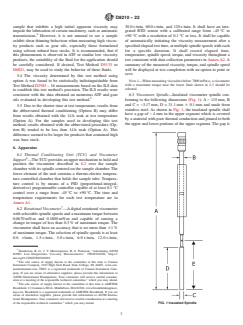
6.3 Viscometer Spindle—Insulated viscometer spindle conforming to the following dimensions (Fig. 1): A ~ 115 mm, B ~
3.15 mm, and C = 3.15 mm 6 0.03 mm, ~3.17 mm, D = 31.1 mm 6 0.1 mm and made from stainless steel. As shown in Fig. 1,
the insulated spindle shall have a gap of ~ 4 mm in the upper segment which is covered by a material with poor thermal conduction
and pinned to both the upper and lower portions of the upper segment. The gap is to be placed at approximately the mid-point of
upper segment. The narrow middle segment shall be ~9.5 mm in length and ~1.8 mm in diameter. In the center of the middle
segment will be a narrow band that is centered in the segment and 35.6 mm 6 0.5 mm A ridge denoting spindle immersion depth
will be located 35.6 mm 6 0.5 mm, E, from the bottom of the spindle.spindle with a reduced spindle diameter extending ~5 mm
above and below the immersion mark.
6.3.1 Periodically (depending on use, but at least every 3 months) inspect spindle for run-out (wobble) when attached to the
viscometer. The total run-out of the spindle shall not exceed 1 mm (0 mm 6 0.5 mm).
6.4 Sample Tube—A standard laboratory test tube of approximately 25 mm OD and 150 mm in length, preferably without a lip,
preferably disposable.
6.5 Thermometer—Digital contact thermometer D02-DCT15 listed in Specification D8278.
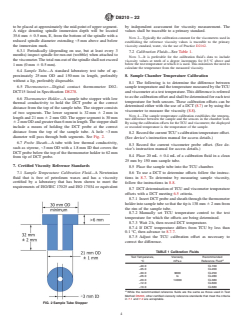
6.6 Thermometer Holder—A sample tube stopper with low thermal conductivity to hold the DCT probe at the correct distance
from the top of the sample tube. The stopper consists of two segments. The lower segment is 32 mm 6 2 mm in length and 21 mm
6 2 mm OD. The upper segment is 30 mm 6 2 mm OD and greater than 6 mm in length. The stopper shall include a means of
holding the DCT probe at the correct distance from the top of the sample tube. A hole ~3 mm diameter will pass through both
segments. See Fig. 2.
6.7 Probe Sheath—A tube with low thermal conductivity, such as styrene, ~3 mm OD with a 1.8 mm ID that covers the DCT probe
below the top of the thermometer holder to 62 mm from tip of DCT probe.
The sole source of supply known to the committee at this time is Cannon Instrument Company, 2143 High Tech Road, State College, PA 16803, www.cannoninstru-
ment.com. TESC is a registered trademark of Cannon Instrument Company. If you are aware of alternative suppliers, please provide this information to ASTM International
Headquarters. Your comments will receive careful consideration at a meeting of the responsible technical committee, which you may attend.
The sole source of supply known to the committee at this time is AMTEKAMETEK Brookfield, 11 Commerce Blvd., Middleboro, MA 02346, www.brookfieldengi-
neering.com. Brookfield is a registered trademark of AMETEK Brookfield. If you are aware of alternative suppliers, please provide this information to ASTM International
Headquarters. Your comments will receive careful consideration at a meeting of the responsible technical committee, which you may attend.
D8210 − 22
FIG. 1 Insulated Spindle
7. Certified Viscosity Reference Standards
7.1 Sample Temperature Calibration Fluid—A Newtonian fluid that is free of petroleum waxes and has a viscosity certified by a
laboratory that has been shown to meet the requirements of ISO/IEC 17025 and ISO 17034 or equivalent by independent
assessment for viscosity measurement. The values shall be traceable to a primary standard.
NOTE 2—Typically the calibration constant for the viscometers used in establishing the reference viscosity values is traceable to the primary viscosity
standard, water, via the use of Practice D2162.
7.2 Calibration Fluids—See Table 1.
NOTE 3—It is preferable for the calibration fluid’s data to include viscosity values at tenth of a degree increments for 0.5 °C above and below the test
temperature at which it is used. This minimizes the need to calculate the temperature from the measured viscosity.
8. Sample Chamber Temperature Calibration
8.1 The following is to determine the difference between sample temperature and the temperature measured by the TCU and
viscometer at a test temperature. This difference is referred to as the calibration offset and shall be determined for each test
temperature for both sensors. These calibration offsets can be determined either with the use of a DCT (8.7) or by using the
viscometer to measure the viscosity (8.8).
D8210 − 22
FIG. 2 Sample Tube Stopper
TABLE 1 Calibration Fluids
Test Temperature, Viscosity, Recommended
A
°C mPa·s Reference Fluid
–40.0 CL160
–35.0 CL200
–30.0 CL250
–26.0 to CL280
–20.0 CL380
–12.0 CL600
–10.0 CL680
A
While the recommended reference fluids are the same as those used in Test
Method D5293, other certified viscosity reference standards that meet the criteria
in 7.1 and 7.2 are acceptable.
NOTE 4—The sample temperature calibration establishes the temperature difference between the sample and the sensors in the chamber wall. By using
the calibration offsets for the TCU and viscometer, the displayed or recorded temperature is the temperature of the sample.
8.2 Record the current TCU’s calibration temperature offset. (See device’s instruction manual for access details.)
8.3 Record the current viscometer probe offset. (See device’s instruction manual for access details.)
8.4 Place 20 mL 6 0.4 mL of a calibration fluid in a clean 25 mm by 150 mm sample tube.
8.5 Place the sample tube into the TCU chamber.
8.6 To use a DCT to determine offsets follow the instructions in 8.7. To determine by measuring sample viscosity, follow the
instructions in 8.8.
8.7 DCT determination of TCU and viscometer temperature offsets with a DCT meeting 6.5 criteria.
8.7.1 Insert DCT probe and sheath through the thermometer holder into sample tube so that the tip is 138 mm 6 2 mm from the
rim of the sample tube.
8.7.2 Manually set TCU temperature control to the test temperature for which the offsets are being determined.
D8210 − 22
8.7.3 Wait 2 h, then record DCT temperature.
8.7.4 If DCT temperature differs from TCU by less than 0.1 °C, then advance to 8.7.7.
8.7.5 Adjust the TCU calibration offset as necessary to correct the difference.
8.7.6 Wait 1 h, then record the DCT temperature and repeat 8.7.4.
8.7.7 Adjust the viscometer temperature probe offset as necessary to show the sample temperature.
8.7.8 Continue to 8.9.
8.8 Viscometric Determination of Temperature Offsets:
8.8.1 Without the spindle attached, lower the viscometer tray to its measurement position and initiate the viscometer’s zero
compensation function, and when complete, raise the viscometer tray.
8.8.2 Attach the spindle to the viscometer, then lower viscometer tray to the measurement position.
8.8.3 Manually set the TCU temperature control to the test temperature for which the offsets are being determined.
8.8.4 Load the viscometer with the program in A2.1.1.
8.8.5 Start the program.
8.8.6 When the program is complete, note the viscosity obtained at the highest torque.
8.8.7 Determine the sample temperature using the temperature-viscosity data for the standard.
NOTE 5—The sample temperature can be calculated using the reference fluid temperature viscosity data and Practice D341. There are software programs
available for this calculation.
8.8.8 If the calculated temperature differs by less than 0.1 °C from the calibration fluid’s value, then continue to 8.9.
8.8.9 Calculate a new calibration offset taking into account TCU calibration offset noted in 8.2.
8.8.10 Enter the new calibration offset into the TCU temperature control following the instructions in the TCU manual.
8.8.11 Calculate a new viscometer probe offset, taking into account viscometer probe offset noted in 8.3.
8.8.12 Enter the new viscometer probe offset following the viscometer’s instruction manual.
8.8.13 Load the viscometer program in A2.1.2 and start program.
8.8.14 When the viscometer measurement program is complete, repeat the steps beginning with 8.8.7.
8.9 Record the TCU calibration offset and offset, DVT probe offset offset, and test temperature for future use.
8.10 Calibration is complete for this test temperature.
9. Procedure
9.1 Place 20 mL 6 0.4 mL of sample in a clean 25 mm by 150 mm sample tube.
9.2 Place the sample tube into chamber of the TCU and tighten the retaining ring.
D8210 − 22
9.3 Without the spindle attached, lower the viscometer tray to its measurement position so that the viscometer retaining ring rests
on test chamber retaining ring, then initiate the viscometer’s zero compensation function. When complete, raise the viscometer tray.
9.4 Attach the spindle to the viscometer, then lower viscometer tray until the viscometer retaining ring is resting on the test
chamber retaining ring.
9.5 TCU and Viscometer Setup:
9.5.1 For an Overnight Thermal Conditioning, Option A:
9.5.1.1 Verify that the TCU is configured for the intended test temperature. If not, configure the TCU to follow the parameters
shown in A1.1 for the appropriate test temperature. Check and adjust the TCU calibration offset if necessary.
9.5.1.2 Configure the viscometer to collect sample data according to the parameters shown in A2.2.1. Check and adjust the
viscometer probe offset if necessary.
9.5.2 For an Abbreviated Thermal Conditioning, Option B:
9.5.2.1 Verify that the TCU is configured for the intended test temperature. If not, configure the TCU to follow the parameters
shown in A1.2 for the appropriate test temperature. Check and adjust the TCU calibration offset if necessary.
9.5.2.2 Configure the viscometer to collect sample data according to the parameters shown in A2.2.2. Check and adjust the
viscometer probe offset if necessary.
9.6 Start the TCU thermal conditioning program and the viscometer.
NOTE 6—Option A thermal conditioning and viscosity measurement will be complete in 17 h and 12 min.14 min. Option B thermal conditioning and
viscosity measurement will be complete in 6 h and 54 min.
9.7 Record the At the end of a test the viscometer displays a table showing measurement parameters and the results for each
program step. The viscosity measurements begin with step 5. The odd numbered steps are the sample’s initial viscosity
measurements at a spindle speed. The even numbered steps are the sample’s stabilized viscosity at a spindle speed. Scroll down
the table until the highest torque for the even numbered step provided it is less than 80 %. Then record the viscosity, torque, spindle
speed, and temperature for the average recorded during 160 s to 180 s spindle speed measurement where the torque is less than
80 % and greater 20 %. temperature. The viscosity result shown for the odd step number is to be reported as the initial viscosity.
The viscosity result shown for the even step number is to be reported as the sample’s stabilized viscosity. If there are two spindle
speeds meeting the criteria, record the values at the highest spindle speed.
NOTE 7—The stabilized viscosity value is the same as the viscosity value reported by versions of this test method prior to 2021. Thus, the new term
stabilized viscosity
...