

ASTM D5056-22
(Test Method)Standard Test Method for Trace Metals in Petroleum Coke by Atomic Absorption
General Information
- Abstract
SIGNIFICANCE AND USE
5.1 The presence and concentration of various metallic elements in a petroleum coke are major factors in the suitability of the coke for various uses. This test method provides a means of measuring the amounts of those metallic elements in the coke sample.
5.2 The concentration of these elements is one factor in determining the economic value of the coke. Coke used for production of electrodes will have different specification requirements dependent on what service the electrodes will be used in. Generally the fuel cokes are highest in metallic element concentration and have the least economic value.
5.3 The test method provides a standard procedure for use by the purchaser and seller in the commercial transfer of petroleum coke to determine whether the lot of coke meets the specifications of the purchasing party.
SCOPE
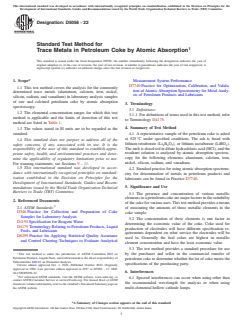
1.1 This test method covers the analysis for the commonly determined trace metals (aluminum, calcium, iron, nickel, silicon, sodium, and vanadium) in laboratory analysis samples of raw and calcined petroleum coke by atomic absorption spectroscopy.
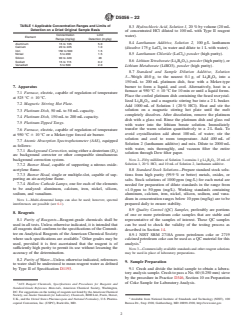
1.2 The elemental concentration ranges for which this test method is applicable and the limits of detection of this test method are listed in Table 1.
1.3 The values stated in SI units are to be regarded as the standard.
1.4 This standard does not purport to address all of the safety concerns, if any, associated with its use. It is the responsibility of the user of this standard to establish appropriate safety, health, and environmental practices and determine the applicability of regulatory limitations prior to use. For warning statements, see Sections 9 – 11.
1.5 This international standard was developed in accordance with internationally recognized principles on standardization established in the Decision on Principles for the Development of International Standards, Guides and Recommendations issued by the World Trade Organization Technical Barriers to Trade (TBT) Committee.
- Status
- Published
- Publication Date
- 30-Sep-2022
- Technical Committee
- D02 - Petroleum Products, Liquid Fuels, and Lubricants
- Drafting Committee
- D02.03 - Elemental Analysis
Overview
ASTM D5056-22 is the Standard Test Method for Trace Metals in Petroleum Coke by Atomic Absorption developed by ASTM International. This test method is specifically designed to determine the concentrations of commonly found trace metals in both raw and calcined petroleum coke using atomic absorption spectroscopy (AAS).
Accurately measuring the presence and quantity of metals such as aluminum, calcium, iron, nickel, silicon, sodium, and vanadium is crucial for assessing the quality and economic value of petroleum coke. Industries rely on these results to meet product specifications and regulatory requirements, especially when the end use involves sensitive applications such as electrode production or fuel.
Key Topics
- Trace Metals Analysis: Focused on measuring aluminum, calcium, iron, nickel, silicon, sodium, and vanadium.
- Applicability: Suitable for laboratory analysis samples of raw and calcined petroleum coke.
- Methodology: Utilizes atomic absorption spectroscopy after sample preparation involving ashing, fusion, and dissolution steps.
- Concentration Ranges:
- Aluminum: 15-105 mg/kg
- Calcium: 20-225 mg/kg
- Iron: 150-500 mg/kg
- Nickel: 5-200 mg/kg
- Silicon: 90-420 mg/kg
- Sodium: 15-115 mg/kg
- Vanadium: 5-500 mg/kg
- Commercial Significance: Directly impacts the evaluation of petroleum coke for commercial transactions and quality control between buyers and sellers.
- Standardization: Developed in accordance with internationally recognized principles established by the World Trade Organization TBT Committee.
Applications
The ASTM D5056-22 standard test method is widely applied in various industrial and laboratory scenarios:
- Quality Control in Production: Ensures petroleum coke meets stringent specifications required for its intended use, particularly in the production of electrodes for electric arc furnaces and aluminum smelting.
- Economic Valuation: Assists in determining the value of petroleum coke based on its metallic element content. Cokes with higher metal concentrations are often less valuable, especially for electrode manufacturing.
- Fuel Grade Coke Assessment: Provides essential data on the suitability of petroleum coke for use as fuel, where higher trace metal content is more common and less desirable in premium applications.
- Purchaser-Seller Agreements: Supplies a standardized procedure to resolve disputes and certify that product lots comply with buying party requirements during commercial transfers.
- Regulatory Compliance: Supports facilities in meeting environmental and safety regulations regarding trace metal emissions or product composition.
Related Standards
The ASTM D5056-22 test method references several related ASTM standards for proper sample preparation, terminology, and instrument calibration:
- ASTM D346 - Practice for Collection and Preparation of Coke Samples for Laboratory Analysis
- ASTM D1193 - Specification for Reagent Water
- ASTM D4175 - Terminology Relating to Petroleum Products, Liquid Fuels, and Lubricants
- ASTM D6299 - Practice for Statistical Quality Assurance and Control Charting Techniques
- ASTM D7740 - Practice for Optimization, Calibration, and Validation of Atomic Absorption Spectrometry for Metal Analysis of Petroleum Products and Lubricants
By following ASTM D5056-22, laboratories and industry professionals can ensure consistent, reliable, and internationally recognized trace metal analysis in petroleum coke, supporting quality assurance, regulatory compliance, and fair market practices.
Relations
- Refers
ASTM D4175-23a - Standard Terminology Relating to Petroleum Products, Liquid Fuels, and Lubricants - Effective Date
- 15-Dec-2023
- Effective Date
- 01-Dec-2023
- Refers
ASTM D4175-23e1 - Standard Terminology Relating to Petroleum Products, Liquid Fuels, and Lubricants - Effective Date
- 01-Jul-2023
- Effective Date
- 01-Jul-2020
- Effective Date
- 15-Dec-2017
- Effective Date
- 15-Nov-2017
- Effective Date
- 01-Jan-2017
- Effective Date
- 01-Oct-2013
- Effective Date
- 01-Jul-2011
- Effective Date
- 01-May-2010
- Effective Date
- 01-Mar-2010
- Effective Date
- 01-Mar-2010
- Effective Date
- 01-Nov-2009
- Effective Date
- 15-Oct-2008
- Effective Date
- 01-Nov-2007
Get Certified
Connect with accredited certification bodies for this standard

Element Materials Technology
Materials testing and product certification.

ABS Group Brazil
ABS Group certification services in Brazil.

ABS Quality Evaluations Inc.
American Bureau of Shipping quality certification.
Sponsored listings
Frequently Asked Questions
ASTM D5056-22 is a standard published by ASTM International. Its full title is "Standard Test Method for Trace Metals in Petroleum Coke by Atomic Absorption". This standard covers: SIGNIFICANCE AND USE 5.1 The presence and concentration of various metallic elements in a petroleum coke are major factors in the suitability of the coke for various uses. This test method provides a means of measuring the amounts of those metallic elements in the coke sample. 5.2 The concentration of these elements is one factor in determining the economic value of the coke. Coke used for production of electrodes will have different specification requirements dependent on what service the electrodes will be used in. Generally the fuel cokes are highest in metallic element concentration and have the least economic value. 5.3 The test method provides a standard procedure for use by the purchaser and seller in the commercial transfer of petroleum coke to determine whether the lot of coke meets the specifications of the purchasing party. SCOPE 1.1 This test method covers the analysis for the commonly determined trace metals (aluminum, calcium, iron, nickel, silicon, sodium, and vanadium) in laboratory analysis samples of raw and calcined petroleum coke by atomic absorption spectroscopy. 1.2 The elemental concentration ranges for which this test method is applicable and the limits of detection of this test method are listed in Table 1. 1.3 The values stated in SI units are to be regarded as the standard. 1.4 This standard does not purport to address all of the safety concerns, if any, associated with its use. It is the responsibility of the user of this standard to establish appropriate safety, health, and environmental practices and determine the applicability of regulatory limitations prior to use. For warning statements, see Sections 9 – 11. 1.5 This international standard was developed in accordance with internationally recognized principles on standardization established in the Decision on Principles for the Development of International Standards, Guides and Recommendations issued by the World Trade Organization Technical Barriers to Trade (TBT) Committee.
SIGNIFICANCE AND USE 5.1 The presence and concentration of various metallic elements in a petroleum coke are major factors in the suitability of the coke for various uses. This test method provides a means of measuring the amounts of those metallic elements in the coke sample. 5.2 The concentration of these elements is one factor in determining the economic value of the coke. Coke used for production of electrodes will have different specification requirements dependent on what service the electrodes will be used in. Generally the fuel cokes are highest in metallic element concentration and have the least economic value. 5.3 The test method provides a standard procedure for use by the purchaser and seller in the commercial transfer of petroleum coke to determine whether the lot of coke meets the specifications of the purchasing party. SCOPE 1.1 This test method covers the analysis for the commonly determined trace metals (aluminum, calcium, iron, nickel, silicon, sodium, and vanadium) in laboratory analysis samples of raw and calcined petroleum coke by atomic absorption spectroscopy. 1.2 The elemental concentration ranges for which this test method is applicable and the limits of detection of this test method are listed in Table 1. 1.3 The values stated in SI units are to be regarded as the standard. 1.4 This standard does not purport to address all of the safety concerns, if any, associated with its use. It is the responsibility of the user of this standard to establish appropriate safety, health, and environmental practices and determine the applicability of regulatory limitations prior to use. For warning statements, see Sections 9 – 11. 1.5 This international standard was developed in accordance with internationally recognized principles on standardization established in the Decision on Principles for the Development of International Standards, Guides and Recommendations issued by the World Trade Organization Technical Barriers to Trade (TBT) Committee.
ASTM D5056-22 is classified under the following ICS (International Classification for Standards) categories: 75.160.10 - Solid fuels. The ICS classification helps identify the subject area and facilitates finding related standards.
ASTM D5056-22 has the following relationships with other standards: It is inter standard links to ASTM D4175-23a, ASTM D6299-23a, ASTM D4175-23e1, ASTM D7740-20, ASTM D6299-17b, ASTM D6299-17a, ASTM D6299-17, ASTM D6299-13e1, ASTM D7740-11, ASTM D346-04(2010), ASTM D6299-10e2, ASTM D6299-10, ASTM D6299-09, ASTM D6299-08, ASTM D6299-07e1. Understanding these relationships helps ensure you are using the most current and applicable version of the standard.
ASTM D5056-22 is available in PDF format for immediate download after purchase. The document can be added to your cart and obtained through the secure checkout process. Digital delivery ensures instant access to the complete standard document.
Standards Content (Sample)
This international standard was developed in accordance with internationally recognized principles on standardization established in the Decision on Principles for the
Development of International Standards, Guides and Recommendations issued by the World Trade Organization Technical Barriers to Trade (TBT) Committee.
Designation: D5056 − 22
Standard Test Method for
Trace Metals in Petroleum Coke by Atomic Absorption
This standard is issued under the fixed designation D5056; the number immediately following the designation indicates the year of
original adoption or, in the case of revision, the year of last revision. A number in parentheses indicates the year of last reapproval. A
superscript epsilon (´) indicates an editorial change since the last revision or reapproval.
1. Scope* Measurement System Performance
D7740 Practice for Optimization, Calibration, and Valida-
1.1 This test method covers the analysis for the commonly
tion ofAtomicAbsorption Spectrometry for MetalAnaly-
determined trace metals (aluminum, calcium, iron, nickel,
sis of Petroleum Products and Lubricants
silicon, sodium, and vanadium) in laboratory analysis samples
of raw and calcined petroleum coke by atomic absorption
3. Terminology
spectroscopy.
3.1 Definitions:
1.2 The elemental concentration ranges for which this test
3.1.1 For definitions of terms used in this test method, refer
method is applicable and the limits of detection of this test
to Terminology D4175.
method are listed in Table 1.
4. Summary of Test Method
1.3 The values stated in SI units are to be regarded as the
standard.
4.1 A representative sample of the petroleum coke is ashed
at 525 °C under specified conditions. The ash is fused with
1.4 This standard does not purport to address all of the
lithium tetraborate (Li B O ), or lithium metaborate (LiBO ).
safety concerns, if any, associated with its use. It is the 2 4 7 3
Themeltisdissolvedindilutehydrochloricacid(HCl),andthe
responsibility of the user of this standard to establish appro-
resultant solution is analyzed by atomic absorption spectros-
priate safety, health, and environmental practices and deter-
copy for the following elements: aluminum, calcium, iron,
mine the applicability of regulatory limitations prior to use.
nickel, silicon, sodium, and vanadium.
For warning statements, see Sections9–11.
1.5 This international standard was developed in accor-
4.2 Standard practice for using atomic absorption spectrom-
dance with internationally recognized principles on standard-
etry for determination of metals in petroleum products and
ization established in the Decision on Principles for the
lubricants can be found in Practice D7740.
Development of International Standards, Guides and Recom-
5. Significance and Use
mendations issued by the World Trade Organization Technical
Barriers to Trade (TBT) Committee.
5.1 The presence and concentration of various metallic
elementsinapetroleumcokearemajorfactorsinthesuitability
2. Referenced Documents
ofthecokeforvarioususes.Thistestmethodprovidesameans
2.1 ASTM Standards:
of measuring the amounts of those metallic elements in the
D346 Practice for Collection and Preparation of Coke
coke sample.
Samples for Laboratory Analysis
5.2 The concentration of these elements is one factor in
D1193 Specification for Reagent Water
determining the economic value of the coke. Coke used for
D4175 Terminology Relating to Petroleum Products, Liquid
production of electrodes will have different specification re-
Fuels, and Lubricants
quirements dependent on what service the electrodes will be
D6299 Practice for Applying Statistical Quality Assurance
used in. Generally the fuel cokes are highest in metallic
and Control Charting Techniques to Evaluate Analytical
element concentration and have the least economic value.
5.3 The test method provides a standard procedure for use
This test method is under the jurisdiction of ASTM Committee D02 on by the purchaser and seller in the commercial transfer of
Petroleum Products, Liquid Fuels, and Lubricantsand is the direct responsibility of
petroleum coke to determine whether the lot of coke meets the
Subcommittee D02.03 on Elemental Analysis.
specifications of the purchasing party.
Current edition approved Oct. 1, 2022. Published October 2022. Originally
approved in 1990. Last previous edition approved in 2017 as D5056 – 17. DOI:
6. Interferences
10.1520/D5056-22.
For referenced ASTM standards, visit the ASTM website, www.astm.org, or
6.1 Spectral interferences can occur when using other than
contact ASTM Customer Service at service@astm.org. For Annual Book of ASTM
the recommended wavelength for analysis or when using
Standards volume information, refer to the standard’s Document Summary page on
the ASTM website. multi-elemental hollow cathode lamps.
*A Summary of Changes section appears at the end of this standard
Copyright © ASTM International, 100 Barr Harbor Drive, PO Box C700, West Conshohocken, PA 19428-2959. United States
D5056 − 22
TABLE 1 Applicable Concentration Ranges and Limits of
8.3 Hydrochloric Acid, Solution 1, 20 % by volume (20 mL
Detection on a Dried Original Sample Basis
of concentrated HCl diluted to 100 mL with Type II reagent
Concentration Limit
water).
Element
Range (mg/kg) Detection (mg/kg)
8.4 Lanthanum Additive, Solution 2, 100 g⁄L lanthanum
Aluminum 15 to 105 5.0
Calcium 20 to 225 1.0
(dissolve 175 g LaCl in water and dilute to 1 L with water).
Iron 150 to 500 1.5
8.5 Lanthanum Chloride (LaCl ) powder (high purity).
Nickel 5 to 200 1.5
Silicon 90 to 420 20
8.6 Lithium Tetraborate (Li B O ), powder (high purity), or
Sodium 15 to 115 0.2
2 4 7
Vanadium 5 to 500 2.0
Lithium Metaborate (LiBO3), powder (high purity).
8.7 Standard and Sample Dilution Additive, Solution
3—Weigh 40.0 g, to the nearest 0.1 g, of Li B O into a
2 4 7
150 mL to 200 mL platinum dish, fuse with a Meker-type
7. Apparatus burner to form a liquid, and cool. Alternatively, heat in a
furnace at 950 °C 6 10 °C for 10 min or until a liquid forms.
7.1 Furnace, electric, capable of regulation of temperature
Place the cooled platinum dish containing the fused recrystal-
at 525 °C 6 10 °C.
lized Li B O , and a magnetic stirring bar into a 2 L beaker.
2 4 7
7.2 Magnetic Stirring Hot Plate.
Add 1000 mL of Solution 1 (20 % HCl). Heat and stir the
solution on a magnetic stirring hot plate until the melt
7.3 Platinum Dish, 50 mL to 58 mL capacity.
completely dissolves. After dissolution, remove the platinum
7.4 Platinum Dish, 150 mL to 200 mL capacity.
dish with a glass rod. Rinse the platinum dish and glass rod
7.5 Platinum-Tipped Tongs.
with water into the lithium borate solution. Immediately
transfer the warm solution quantitatively to a 2 L flask. To
7.6 Furnace, electric, capable of regulation of temperature
avoid crystallization add about 100 mL of water; stir the
at 950 °C 6 10 °C or a Meker-type forced air burner.
solution and cool to room temperature. Add 400 mL of
7.7 Atomic Absorption Spectrophotometer (AAS), equipped
Solution 2 (lanthanum additive) and mix. Dilute to 2000 mL
as follows:
with water, mix thoroughly, and vacuum filter the entire
7.7.1 Background Correction, using either a deuterium (D )
solution through Dow filter paper.
arc background corrector or other comparable simultaneous
background correction system.
NOTE 2—Fifty millilitres of Solution 3 contains 1 g Li B O ,25mLof
2 4 7
Solution 1, 20 % HCl, and 10 mL of Solution 2, lanthanum additive.
7.7.2 Burner Head, capable of supporting a nitrous oxide-
acetylene flame.
8.8 Standard Stock Solutions—Prepare standard stock solu-
7.7.3 Burner Head, single or multiple-slot, capable of sup-
tions from high purity (99.9 % or better) metals, oxides, or
porting an air-acetylene flame.
salts. Stock solutions of 1000 ppm (mg⁄L) for each metal are
7.7.4 Hollow Cathode Lamps, one for each of the elements
needed for preparation of dilute standards in the range from
to be analyzed: aluminum, calcium, iron, nickel, silicon,
<1.0 ppm to 50 ppm (mg/L). Working standards containing
sodium, and vanadium.
aluminum, calcium, iron, nickel, silicon, sodium, and vana-
dium in concentration ranges below 10 ppm (mg/kg) are to be
NOTE 1—Multi-elemental lamps can also be used; however, spectral
prepared daily to ensure stability.
interferences are possible (see 6.1).
8.9 Quality Control (QC) Samples, preferably are portions
8. Reagents
of one or more petroleum coke samples that are stable and
8.1 Purity of Reagents—Reagent-grade chemicals shall be
representative of the samples of interest. These QC samples
used in all tests. Unless otherwise indicated, it is intended that
can be used to check the validity of the testing process as
all reagents shall conform to the specifications of the Commit-
described in Section 14.
tee on Analytical Reagents of the American Chemical Society
8.9.1 NIST SRM 2718A green petroleum coke or 2719
where such specifications are available. Other grades may be
calcined petroleum coke can be used as a QC material for this
used, provided it is first ascertained that the reagent is of
analysis.
sufficiently high purity to permit its use without lessening the
NOTE 3—Commercially available standards and other reagent solutions
may be used in place of laboratory preparations.
accuracy of the determination.
8.2 Purity of Water—Unless otherwise indicated, references
9. Sample Preparation
to water shall be understood to mean reagent water as defined
9.1 Crush and divide the initial sample to obtain a labora-
by Type II of Specification D1193.
tory analysis sample. Crush to pass a No. 60 (0.250 mm) sieve
by the procedure in Practice D346, Section 10 on Preparation
3 of Coke Sample for Laboratory Analysis.
ACS Reagent Chemicals, Specifications and Procedures for Reagents and
Standard-Grade Reference Materials, American Chemical Society, Washington,
DC. For suggestions on the testing of reagents not listed by theAmerican Chemical
Society, see Analar Standards for Laboratory Chemicals, BDH Ltd., Poole, Dorset,
U.K., and the United States Pharmacopeia and National Formulary, U.S. Pharma- Available from National Institute of Standards and Technology (NIST), 100
copeial Convention, Inc. (USPC), Rockville, MD. Bureau Dr., Stop 2300, Gaithersburg, MD 20899-2300, http://www.nist.gov.
D5056 − 22
constituents may precipitate, primarily hydrous silica, due to heating the
9.2 Crush approximately a 30 g of representative portion of
highly acidic solution. If this occurs, it is necessary to repeat the analysis.
the minus No. 60 sieve analysis sample to pass a No. 200
(0.075 mm) sieve. Use a tungsten carbide mill to minimize 11.5 Remove the dish from the hot plate, rinse down the
metal contamination. Dry this sample to constant weight at walls of the dish with water, and quantitatively transfer the
110 °C to 115 °C (approximately 8 h) and store in a desiccator solution to a 100 mL flask. Add 10 mL of Solution 2, dilute
until cool. (Note that preparation of the minus 200 mesh with water, and mix thoroughly (see Note 5).
analysis samples, from the minus 60 mesh analysis samples,
11.6 Prepare any required dilution
...
This document is not an ASTM standard and is intended only to provide the user of an ASTM standard an indication of what changes have been made to the previous version. Because
it may not be technically possible to adequately depict all changes accurately, ASTM recommends that users consult prior editions as appropriate. In all cases only the current version
of the standard as published by ASTM is to be considered the official document.
Designation: D5056 − 17 D5056 − 22
Standard Test Method for
Trace Metals in Petroleum Coke by Atomic Absorption
This standard is issued under the fixed designation D5056; the number immediately following the designation indicates the year of
original adoption or, in the case of revision, the year of last revision. A number in parentheses indicates the year of last reapproval. A
superscript epsilon (´) indicates an editorial change since the last revision or reapproval.
1. Scope*
1.1 This test method covers the analysis for the commonly determined trace metals (aluminum, calcium, iron, nickel, silicon,
sodium, and vanadium) in laboratory analysis samples of raw and calcined petroleum coke by atomic absorption spectroscopy.
1.2 The elemental concentration ranges for which this test method is applicable and the limits of detection of this test method are
listed in Table 1.
1.3 The values stated in SI units are to be regarded as the standard.
1.4 This standard does not purport to address all of the safety concerns, if any, associated with its use. It is the responsibility
of the user of this standard to establish appropriate safety safety, health, and healthenvironmental practices and determine the
applicability of regulatory limitations prior to use.For warning statements, see Sections 89 – 1011.
1.5 This international standard was developed in accordance with internationally recognized principles on standardization
established in the Decision on Principles for the Development of International Standards, Guides and Recommendations issued
by the World Trade Organization Technical Barriers to Trade (TBT) Committee.
2. Referenced Documents
2.1 ASTM Standards:
D346 Practice for Collection and Preparation of Coke Samples for Laboratory Analysis
D1193 Specification for Reagent Water
D4175 Terminology Relating to Petroleum Products, Liquid Fuels, and Lubricants
D6299 Practice for Applying Statistical Quality Assurance and Control Charting Techniques to Evaluate Analytical Measure-
ment System Performance
This test method is under the jurisdiction of ASTM Committee D02 on Petroleum Products, Liquid Fuels, and Lubricantsand is the direct responsibility of Subcommittee
D02.03 on Elemental Analysis.
Current edition approved May 1, 2017Oct. 1, 2022. Published May 2017October 2022. Originally approved in 1990. Last previous edition approved in 20152017 as
D5056 – 15. – 17. DOI: 10.1520/D5056-17.10.1520/D5056-22.
For referenced ASTM standards, visit the ASTM website, www.astm.org, or contact ASTM Customer Service at service@astm.org. For Annual Book of ASTM Standards
volume information, refer to the standard’s Document Summary page on the ASTM website.
*A Summary of Changes section appears at the end of this standard
Copyright © ASTM International, 100 Barr Harbor Drive, PO Box C700, West Conshohocken, PA 19428-2959. United States
D5056 − 22
TABLE 1 Applicable Concentration Ranges and Limits of
Detection on a Dried Original Sample Basis
Concentration Limit
Element
Range (mg/kg) Detection (mg/kg)
Aluminum 15 to 105 5.0
Calcium 20 to 225 1.0
Iron 150 to 500 1.5
Nickel 5 to 200 1.5
Silicon 90 to 420 20
Sodium 15 to 115 0.2
Vanadium 5 to 500 2.0
D7740 Practice for Optimization, Calibration, and Validation of Atomic Absorption Spectrometry for Metal Analysis of
Petroleum Products and Lubricants
3. Terminology
3.1 Definitions:
3.1.1 For definitions of terms used in this test method, refer to Terminology D4175.
4. Summary of Test Method
4.1 A representative sample of the petroleum coke is ashed at 525 °C under specified conditions. The ash is fused with lithium
tetraborate (Li B O ), or lithium metaborate (LiBO ). The melt is dissolved in dilute hydrochloric acid (HCl), and the resultant
2 4 7 3
solution is analyzed by atomic absorption spectroscopy for the following elements: aluminum, calcium, iron, nickel, silicon,
sodium, and vanadium.
4.2 Standard practice for using atomic absorption spectrometry for determination of metals in petroleum products and lubricants
can be found in Practice D7740.
5. Significance and Use
5.1 The presence and concentration of various metallic elements in a petroleum coke are major factors in the suitability of the coke
for various uses. This test method provides a means of measuring the amounts of those metallic elements in the coke sample.
5.2 The concentration of these elements is one factor in determining the economic value of the coke. Coke used for production
of electrodes will have different specification requirements dependent on what service the electrodes will be used in. Generally the
fuel cokes are highest in metallic element concentration and have the least economic value.
5.3 The test method provides a standard procedure for use by the purchaser and seller in the commercial transfer of petroleum coke
to determine whether the lot of coke meets the specifications of the purchasing party.
6. Interferences
6.1 Spectral interferences can occur when using other than the recommended wavelength for analysis or when using
multi-elemental hollow cathode lamps.
7. Apparatus
7.1 Furnace, electric, capable of regulation of temperature at 525 °C 6 10 °C.
7.2 Magnetic Stirring Hot Plate.
7.3 Platinum Dish, 50 mL to 58 mL capacity.
7.4 Platinum Dish, 150 mL to 200 mL capacity.
D5056 − 22
7.5 Platinum-Tipped Tongs.
7.6 Furnace, electric, capable of regulation of temperature at 950 °C 6 10 °C or a Meker-type forced air burner.
7.7 Atomic Absorption Spectrophotometer (AAS), equipped as follows:
7.7.1 Background Correction, using either a deuterium (D ) arc background corrector or other comparable simultaneous
background correction system.
7.7.2 Burner Head, capable of supporting a nitrous oxide-acetylene flame.
7.7.3 Burner Head, single or multiple-slot, capable of supporting an air-acetylene flame.
7.7.4 Hollow Cathode Lamps, one for each of the elements to be analyzed: aluminum, calcium, iron, nickel, silicon, sodium, and
vanadium.
NOTE 1—Multi-elemental lamps can also be used; however, spectral interferences are possible (see 5.16.1).
8. Reagents
8.1 Purity of Reagents—Reagent-grade chemicals shall be used in all tests. Unless otherwise indicated, it is intended that all
reagents shall conform to the specifications of the Committee on Analytical Reagents of the American Chemical Society where
such specifications are available. Other grades may be used, provided it is first ascertained that the reagent is of sufficiently high
purity to permit its use without lessening the accuracy of the determination.
8.2 Purity of Water—Unless otherwise indicated, references to water shall be understood to mean reagent water as defined by Type
II of Specification D1193.
8.3 Hydrochloric Acid, Solution 1, 20 % by volume (20 mL of concentrated HCl diluted to 100 mL with Type II reagent water).
8.4 Lanthanum Additive, Solution 2, 100 g ⁄L lanthanum (dissolve 175 g LaCl in water and dilute to 1 L with water).
8.5 Lanthanum Chloride (LaCl ) powder (high purity).
8.6 Lithium Tetraborate (Li B O ), powder (high purity), or Lithium Metaborate (LiBO3), powder (high purity).
2 4 7
8.7 Standard and Sample Dilution Additive, Solution 3—Weigh 40.0 g, to the nearest 0.1 g, of Li B O into a 150 mL to 200 mL
2 4 7
platinum dish, fuse with a Meker-type burner to form a liquid, and cool. Alternatively, heat in a furnace at 950 °C 6 10 °C for
10 min or until a liquid forms. Place the cooled platinum dish containing the fused recrystallized Li B O , and a magnetic stirring
2 4 7
bar into a 2 L beaker. Add 1000 mL of Solution 1 (20 % HCl). Heat and stir the solution on a magnetic stirring hot plate until the
melt completely dissolves. After dissolution, remove the platinum dish with a glass rod. Rinse the platinum dish and glass rod with
water into the lithium borate solution. Immediately transfer the warm solution quantitatively to a 2 L flask. To avoid crystallization
add about 100 mL of water; stir the solution and cool to room temperature. Add 400 mL of Solution 2 (lanthanum additive) and
mix. Dilute to 2000 mL with water, mix thoroughly, and vacuum filter the entire solution through Dow filter paper.
NOTE 2—Fifty millilitres of Solution 3 contains 1 g Li B O , 25 mL of Solution 1, 20 % HCl, and 10 mL of Solution 2, lanthanum additive.
2 4 7
8.8 Standard Stock Solutions—Prepare standard stock solutions from high purity (99.9 % or better) metals, oxides, or salts. Stock
solutions of 1000 ppm (mg ⁄L) for each metal are needed for preparation of dilute standards in the range from <1.0 ppm to 50 ppm
Reagent Chemicals, American Chemical Society Specifications,ACS Reagent Chemicals, Specifications and Procedures for Reagents and Standard-Grade Reference
Materials, American Chemical Society, Washington, DC. For Suggestionssuggestions on the testing of reagents not listed by the American Chemical Society, see
AnnualAnalar Standards for Laboratory Chemicals, BDH Ltd., Poole, Dorset, U.K., and the United States Pharmacopeia and National Formulary, U.S. Pharmacopeial
Convention, Inc. (USPC), Rockville, MD.
D5056 − 22
(mg/L). Working standards containing aluminum, calcium, iron, nickel, silicon, sodium, and vanadium in concentration ranges
below 10 ppm (mg/kg) are to be prepared daily to ensure stability.
8.9 Quality Control (QC) Samples, preferably are portions of one or more petroleum coke samples that are stable and
representative of the samples of interest. These QC samples can be used to check the validity of the testing process as described
in Section 1314.
8.9.1 NIST SRM 2718A green petroleum coke or 2719 calcined petroleum coke can be used as a QC material for this analysis.
NOTE 3—Commercially available standards and other reagent solutions may be used in place of laboratory preparations.
9. Sample Preparation
9.1 Crush and divide the initial sample to obtain a laboratory analysis sample. Crush to pass a No. 60 (0.250 mm) sieve by the
procedure in Practice D346, Section 10 on Preparation of Coke Sample for Laboratory Analysis.
9.2 Crush approximately a 30 g of representative portion of the minus No. 60 sieve analysis sample to pass a No. 200 (0.075 mm)
sieve. Use a tungsten carbide mill to minimize metal contamination. Dry this sample to constant weight at 110 °C to 115 °C
(approximately 8 h) and store in a desiccator until cool. (Note that preparation of the minus 200 mesh analysis samples, from the
minus 60 mesh analysis samples, neither removes metals through loss nor increases metals through contamination. Full dissolution
of the ash is required.)
10. Preparation of Apparatus
10.1 Consult the manufacturer’s instructions for the operation of the atomic absorption spectrophotometer. The present method
assumes that good operating procedures are followed. Design differences between spectrophotometers make it impractical to
specify the required manipulations in detail here. (Warning—Proper operating procedures are required for safety as well as for
reliability of results. An explosion can result from the flame blow-back unless the correct burner h
...