

ASTM D5709-22
(Test Method)Standard Test Method for Sieve Analysis of Petroleum Coke
General Information
- Abstract
SIGNIFICANCE AND USE
5.1 The test method concerns the sieving of coke into designated size fractions for the purpose of characterizing the material as to its particle size distribution. It requires the use of standard sieves, standard sampling methods, standard sample preparation methods, and a minimum initial sample mass based on lot topsize. Suggestions are given for industry typical sieve stacks for both green and calcined petroleum coke.
5.2 Particle size distribution is significant in that many physical characteristics of a coke are related to such a distribution including bulk density and surface area. Nuisance characteristics, such as excessive fines in a lot, can also be controlled.
5.3 Results from this test method are useful in determining whether a coke lot meets purchase specifications, for classification purposes, and for quality control. The results of this test method can also be used to predict the performance of a particular lot of coke in a process.
SCOPE
1.1 This test method details a procedure for performing particle size distribution analysis by dry sieve testing on green petroleum coke with a topsize of no more than 75 mm and calcined petroleum coke with a topsize of no more than 25 mm. Size fractions go down to and include 4.75 mm for green petroleum coke and 75 μm for calcined petroleum coke.
Note 1: To convert units, see Table 1 on nominal dimensions in Specification E11. For example, 75 mm is approximately equivalent to a nominal sieve opening of 3 in. and 25 mm to a nominal sieve opening of 1 in. Likewise, 4.75 mm can be converted to approximately 0.187 in. and 75 microns to 0.0029 in.
1.2 The values stated in SI units are to be regarded as standard. No other units of measurement are included in this standard.
1.2.1 The sieve size is reported as U.S.A. standard test series in any units listed in Table 1 on nominal dimensions of Specification E11, or their commercial size equivalents.
1.3 This standard does not purport to address all of the safety concerns, if any, associated with its use. It is the responsibility of the user of this standard to establish appropriate safety, health, and environmental practices and determine the applicability of regulatory limitations prior to use.
1.4 This international standard was developed in accordance with internationally recognized principles on standardization established in the Decision on Principles for the Development of International Standards, Guides and Recommendations issued by the World Trade Organization Technical Barriers to Trade (TBT) Committee.
- Status
- Published
- Publication Date
- 30-Apr-2022
- Technical Committee
- D02 - Petroleum Products, Liquid Fuels, and Lubricants
- Drafting Committee
- D02.05 - Properties of Fuels, Petroleum Coke and Carbon Material

Overview
ASTM D5709-22: Standard Test Method for Sieve Analysis of Petroleum Coke defines the procedures for assessing particle size distribution in both green and calcined petroleum coke. The method employs dry sieving with a defined stack of standard sieves to separate coke into distinct size fractions. Accurate particle size analysis is essential for petroleum coke producers, users, and laboratories aiming for quality control, meeting purchase specifications, and optimizing operational processes.
The method outlines requirements for representative sampling, standard sample preparation, and determination of initial sample mass based on the topsize of the coke being tested. ASTM D5709-22 is aligned with internationally recognized standardization practices, ensuring consistency and comparability of results across global operations.
Key Topics
Sample Collection and Preparation
- Emphasizes representative sampling methods to ensure accurate results.
- Specifies that gross samples must remain uncrushed and reflective of the actual lot.
- Details procedures for dividing bulk samples into the proper analysis mass.
Sieve Stack and Sieving Process
- Involves use of standard wire mesh sieves specified in ASTM E11.
- Recommends typical sieve sizes for green and calcined petroleum coke.
- Outlines use of mechanical sieve shakers for efficient particle separation.
Calculation and Reporting
- All particle size fractions are weighed with precision.
- Percent retained and percent passing are calculated for each sieve fraction.
- Data supports particle size distribution curves and compliance documentation.
Significance in Operations
- Helps control nuisance factors such as excessive fines.
- Particle size distribution directly influences bulk density and surface area.
- Results are key in evaluating whether coke meets specific purchase or processing requirements.
Applications
The sieve analysis of petroleum coke using ASTM D5709-22 is essential in:
Quality Control Laboratories
- Ensuring petroleum coke shipments conform to specification by providing reliable particle size distribution data.
- Supporting certification of compliance for buyers and sellers in the petroleum coke market.
Petroleum Coke Producers
- Controlling blend uniformity and reducing undesirable properties, such as excessive fines, which can negatively affect handling and downstream processing.
End-Use Industries
- Manufacturers of anodes, graphite, electrodes, and other carbon products rely on particle size distribution for process optimization and product performance.
- Predicting behavior of coke in calcination or further processing based on size fractions.
Process Classification
- Sorting coke material into size classes for targeted applications and performance assessments.
Related Standards
Several ASTM standards complement or reference ASTM D5709-22:
- ASTM E11 - Specification for Woven Wire Test Sieve Cloth and Test Sieves (defines sieve dimensions and tolerances)
- ASTM D346 - Practice for Collection and Preparation of Coke Samples for Laboratory Analysis
- ASTM D2013 - Practice for Preparing Coal Samples for Analysis
- ASTM D2234/D2234M - Practice for Collection of a Gross Sample of Coal
- ASTM D4057 - Practice for Manual Sampling of Petroleum and Petroleum Products
- ASTM D6970 - Practice for Collection of Calcined Petroleum Coke Samples for Analysis
- ASTM D8145 - Practice for Sampling of Green Petroleum Coke
Conclusion
Adhering to ASTM D5709-22 ensures robust and reproducible sieve analysis of petroleum coke, delivering vital data for specification compliance, process optimization, and quality assurance. Employing standardized methods helps the petroleum coke industry meet buyers’ demands, maintain production efficiency, and support downstream processing requirements, making sieve analysis a cornerstone of petroleum coke quality management.
Relations
- Effective Date
- 01-Oct-2023
- Effective Date
- 01-Jul-2023
- Effective Date
- 01-Dec-2019
- Effective Date
- 01-May-2018
- Refers
ASTM D6969-16 - Standard Practice for Preparation of Calcined Petroleum Coke Samples for Analysis - Effective Date
- 01-Jun-2016
- Refers
ASTM D6969-15 - Standard Practice for Preparation of Calcined Petroleum Coke Samples for Analysis - Effective Date
- 01-Jun-2015
- Effective Date
- 01-Oct-2013
- Effective Date
- 01-May-2009
- Effective Date
- 15-Oct-2008
- Effective Date
- 15-Oct-2008
- Effective Date
- 15-Oct-2008
- Effective Date
- 01-Jun-2007
- Effective Date
- 01-Nov-2004
- Effective Date
- 01-May-2004
- Effective Date
- 01-Dec-2003
Get Certified
Connect with accredited certification bodies for this standard

Element Materials Technology
Materials testing and product certification.

ABS Group Brazil
ABS Group certification services in Brazil.

ABS Quality Evaluations Inc.
American Bureau of Shipping quality certification.
Sponsored listings
Frequently Asked Questions
ASTM D5709-22 is a standard published by ASTM International. Its full title is "Standard Test Method for Sieve Analysis of Petroleum Coke". This standard covers: SIGNIFICANCE AND USE 5.1 The test method concerns the sieving of coke into designated size fractions for the purpose of characterizing the material as to its particle size distribution. It requires the use of standard sieves, standard sampling methods, standard sample preparation methods, and a minimum initial sample mass based on lot topsize. Suggestions are given for industry typical sieve stacks for both green and calcined petroleum coke. 5.2 Particle size distribution is significant in that many physical characteristics of a coke are related to such a distribution including bulk density and surface area. Nuisance characteristics, such as excessive fines in a lot, can also be controlled. 5.3 Results from this test method are useful in determining whether a coke lot meets purchase specifications, for classification purposes, and for quality control. The results of this test method can also be used to predict the performance of a particular lot of coke in a process. SCOPE 1.1 This test method details a procedure for performing particle size distribution analysis by dry sieve testing on green petroleum coke with a topsize of no more than 75 mm and calcined petroleum coke with a topsize of no more than 25 mm. Size fractions go down to and include 4.75 mm for green petroleum coke and 75 μm for calcined petroleum coke. Note 1: To convert units, see Table 1 on nominal dimensions in Specification E11. For example, 75 mm is approximately equivalent to a nominal sieve opening of 3 in. and 25 mm to a nominal sieve opening of 1 in. Likewise, 4.75 mm can be converted to approximately 0.187 in. and 75 microns to 0.0029 in. 1.2 The values stated in SI units are to be regarded as standard. No other units of measurement are included in this standard. 1.2.1 The sieve size is reported as U.S.A. standard test series in any units listed in Table 1 on nominal dimensions of Specification E11, or their commercial size equivalents. 1.3 This standard does not purport to address all of the safety concerns, if any, associated with its use. It is the responsibility of the user of this standard to establish appropriate safety, health, and environmental practices and determine the applicability of regulatory limitations prior to use. 1.4 This international standard was developed in accordance with internationally recognized principles on standardization established in the Decision on Principles for the Development of International Standards, Guides and Recommendations issued by the World Trade Organization Technical Barriers to Trade (TBT) Committee.
SIGNIFICANCE AND USE 5.1 The test method concerns the sieving of coke into designated size fractions for the purpose of characterizing the material as to its particle size distribution. It requires the use of standard sieves, standard sampling methods, standard sample preparation methods, and a minimum initial sample mass based on lot topsize. Suggestions are given for industry typical sieve stacks for both green and calcined petroleum coke. 5.2 Particle size distribution is significant in that many physical characteristics of a coke are related to such a distribution including bulk density and surface area. Nuisance characteristics, such as excessive fines in a lot, can also be controlled. 5.3 Results from this test method are useful in determining whether a coke lot meets purchase specifications, for classification purposes, and for quality control. The results of this test method can also be used to predict the performance of a particular lot of coke in a process. SCOPE 1.1 This test method details a procedure for performing particle size distribution analysis by dry sieve testing on green petroleum coke with a topsize of no more than 75 mm and calcined petroleum coke with a topsize of no more than 25 mm. Size fractions go down to and include 4.75 mm for green petroleum coke and 75 μm for calcined petroleum coke. Note 1: To convert units, see Table 1 on nominal dimensions in Specification E11. For example, 75 mm is approximately equivalent to a nominal sieve opening of 3 in. and 25 mm to a nominal sieve opening of 1 in. Likewise, 4.75 mm can be converted to approximately 0.187 in. and 75 microns to 0.0029 in. 1.2 The values stated in SI units are to be regarded as standard. No other units of measurement are included in this standard. 1.2.1 The sieve size is reported as U.S.A. standard test series in any units listed in Table 1 on nominal dimensions of Specification E11, or their commercial size equivalents. 1.3 This standard does not purport to address all of the safety concerns, if any, associated with its use. It is the responsibility of the user of this standard to establish appropriate safety, health, and environmental practices and determine the applicability of regulatory limitations prior to use. 1.4 This international standard was developed in accordance with internationally recognized principles on standardization established in the Decision on Principles for the Development of International Standards, Guides and Recommendations issued by the World Trade Organization Technical Barriers to Trade (TBT) Committee.
ASTM D5709-22 is classified under the following ICS (International Classification for Standards) categories: 75.160.10 - Solid fuels. The ICS classification helps identify the subject area and facilitates finding related standards.
ASTM D5709-22 has the following relationships with other standards: It is inter standard links to ASTM D8145-23a, ASTM D8145-23, ASTM D6970-03(2019), ASTM D8145-18, ASTM D6969-16, ASTM D6969-15, ASTM E11-13, ASTM E11-09e1, ASTM D6970-03(2008), ASTM D6970-03(2013)e1, ASTM D6969-03(2008), ASTM D2013-07, ASTM D2013-04, ASTM E11-04, ASTM D2013-03. Understanding these relationships helps ensure you are using the most current and applicable version of the standard.
ASTM D5709-22 is available in PDF format for immediate download after purchase. The document can be added to your cart and obtained through the secure checkout process. Digital delivery ensures instant access to the complete standard document.
Standards Content (Sample)
This international standard was developed in accordance with internationally recognized principles on standardization established in the Decision on Principles for the
Development of International Standards, Guides and Recommendations issued by the World Trade Organization Technical Barriers to Trade (TBT) Committee.
Designation: D5709 − 22
Standard Test Method for
Sieve Analysis of Petroleum Coke
This standard is issued under the fixed designation D5709; the number immediately following the designation indicates the year of
original adoption or, in the case of revision, the year of last revision. A number in parentheses indicates the year of last reapproval. A
superscript epsilon (´) indicates an editorial change since the last revision or reapproval.
1. Scope* D4749 Test Method for Performing the Sieve Analysis of
Coal and Designating Coal Size
1.1 This test method details a procedure for performing
D6969 Practice for Preparation of Calcined Petroleum Coke
particle size distribution analysis by dry sieve testing on green
Samples for Analysis
petroleum coke with a topsize of no more than 75 mm and
D6970 Practice for Collection of Calcined Petroleum Coke
calcinedpetroleumcokewithatopsizeofnomorethan25 mm.
Samples for Analysis
Size fractions go down to and include 4.75 mm for green
D8145 Practice for Sampling of Green Petroleum Coke
petroleum coke and 75 µm for calcined petroleum coke.
E11 Specification for Woven Wire Test Sieve Cloth and Test
NOTE 1—To convert units, see Table 1 on nominal dimensions in
Sieves
Specification E11. For example, 75 mm is approximately equivalent to a
nominal sieve opening of 3 in. and 25 mm to a nominal sieve opening of
3. Terminology
1 in. Likewise, 4.75 mm can be converted to approximately 0.187 in. and
75 microns to 0.0029 in.
3.1 Definitions of Terms Specific to This Standard:
1.2 The values stated in SI units are to be regarded as
3.1.1 bulk sample, n—the reduced and divided representa-
standard. No other units of measurement are included in this
tiveportionofthegrosssampleaspreparedforshipmenttoand
standard.
received by a laboratory, to be prepared for analysis.
1.2.1 The sieve size is reported as U.S.A. standard test
3.1.2 gross sample, n—the original, uncrushed, representa-
series in any units listed in Table 1 on nominal dimensions of
tive portion taken from a shipment or lot of coke.
Specification E11, or their commercial size equivalents.
3.1.3 lot, n—a quantity of coke to be represented by a gross
1.3 This standard does not purport to address all of the
sample.
safety concerns, if any, associated with its use. It is the
3.1.4 representative sample, n—a sample collected in such a
responsibility of the user of this standard to establish appro-
manner that every particle in the lot to be sampled is equally
priate safety, health, and environmental practices and deter-
mine the applicability of regulatory limitations prior to use. represented in the gross sample.
1.4 This international standard was developed in accor-
3.1.5 topsize, n—the size of the smallest opening of one
dance with internationally recognized principles on standard-
sieve of a series upon which is cumulatively retained a total of
ization established in the Decision on Principles for the
less than 5 % of the sample. This defined topsize is not to be
Development of International Standards, Guides and Recom-
confused with the size of the largest particle in a lot.
mendations issued by the World Trade Organization Technical
Barriers to Trade (TBT) Committee.
4. Summary of Test Method
4.1 A representative coke sample is divided into ranges of
2. Referenced Documents
particle size by the use of a series of square-holed sieves.
2.1 ASTM Standards:
D2013 Practice for Preparing Coal Samples for Analysis
5. Significance and Use
5.1 The test method concerns the sieving of coke into
designated size fractions for the purpose of characterizing the
This test method is under the jurisdiction of ASTM Committee D02 on
material as to its particle size distribution. It requires the use of
Petroleum Products, Liquid Fuels, and Lubricants and is the direct responsibility of
SubcommitteeD02.05onPropertiesofFuels,PetroleumCokeandCarbonMaterial.
standard sieves, standard sampling methods, standard sample
Current edition approved May 1, 2022. Published May 2022. Originally
preparationmethods,andaminimuminitialsamplemassbased
approved in 1995. Last previous edition approved in 2015 as D5709 – 09 (2015).
on lot topsize. Suggestions are given for industry typical sieve
DOI: 10.1520/D5709-22.
stacks for both green and calcined petroleum coke.
For referenced ASTM standards, visit the ASTM website, www.astm.org, or
contact ASTM Customer Service at service@astm.org. For Annual Book of ASTM
5.2 Particle size distribution is significant in that many
Standards volume information, refer to the standard’s Document Summary page on
the ASTM website. physical characteristics of a coke are related to such a
*A Summary of Changes section appears at the end of this standard
Copyright © ASTM International, 100 Barr Harbor Drive, PO Box C700, West Conshohocken, PA 19428-2959. United States
D5709 − 22
TABLE 1 Industry Typical Sieves TABLE 2 Initial Minimum Test Sample Mass Requirements for
Sieve Analysis
Calcined Petroleum Coke Green Petroleum Coke
Initial Sample Expected
25.0 mm 25.0 mm
Topsize Type of Coke Mass Requirement, Relative
19.0 mm 12.5 mm
g Error, %
12.5mm 4.75mm
4.75 mm −4.75 mm
75 mm Green 50 000 6
3.35 mm 50 mm Green 30 000 6
2.36 mm
25 mm Green/Calcined 1500 3
1.18 mm 19 mm Green/Calcined 1300 1
600 µm
12.5 mm Green/Calcined 1000 1
300 µm
4.75 mm Green/Calcined 800 1
212 µm
2.36 mm Green/Calcined 700 1
150 µm
1.18 mm Green/Calcined 500 1
75 µm 600 µm Green/Calcined 300 1
−75 µm
300 µm Green/Calcined 100 1
A
150 µm Green/Calcined 50 1
A
For topsize less than 150 µm, use an initial sample mass requirement of 50 g.
distribution including bulk density and surface area. Nuisance
7.1.6 Check Specification E11 for more details on standard
characteristics, such as excessive fines in a lot, can also be
sieves, service checks, and calibration.
controlled.
7.2 Sieve Shaker:
5.3 Results from this test method are useful in determining
7.2.1 Use a batch type sieve shaker.
whether a coke lot meets purchase specifications, for classifi-
7.2.2 For sieving small quantities of coke or very fine coke
cation purposes, and for quality control. The results of this test
(below 70 mesh), use a laboratory type sieving machine.
method can also be used to predict the performance of a
particular lot of coke in a process.
8. Sample Preparation
8.1 A representative gross sample of the coke lot must be
6. Interferences
collected using appropriate procedures from Practice D6970
6.1 A sieve analysis is very sensitive to the sieve cloth and
for calcined petroleum coke or Practice D8145 for green
sievecloth-frameintegrity.Minorseparationsofthesievecloth
petroleum coke. (Warning—The gross sample must not be
from the frame such as one broken sieve wire, and slight
crushed or reduced in topsize during the gross sample collec-
distortions of sieve wires, can cause serious inaccuracies in the
tion process or during subsequent divisions of the sample.)
final results of a sieve analysis.
8.2 The gross sample is divided into a smaller bulk sample
6.2 Blinding of or a reduction in the number of openings in
following guidelines in Practice D6970 for calcined petroleum
a sieve due to a collection of particles caught in the mesh can
coke or Practice D8145 for green petroleum coke. The bulk
introduce errors.
samplemustremainrepresentativeincludingnolossintopsize.
Keeping in mind the initial sample mass requirements (see
6.3 Flooding or overloading of any sieve with particles
reduces the probability of any given particle encountering an Table 2), the bulk sample must be at least twice the largest
minimum mass that you estimate will be required for the
opening in the sieve.
analysis.
7. Apparatus
8.3 Upon delivery of the bulk sample to the laboratory, the
7.1 Sieves:
sample shall be stored in a safe, dry location. Prevent any size
7.1.1 Sieves will be used in a descending size opening
degradation, loss of mass, or contamination of the sample until
sequence, larger mesh openings above smaller.
needed for the sieve analysis.
7.1.1.1 Typical sets of sieves to be used are listed in Table
8.4 Immediately prior to the sieve analysis, examine the
1.
bulk sample determining whether it is dry and free flowing. If
NOTE 2—Sets of sieves are often modified. Typically, specifications on not, use the air drying apparatus and drying procedure of
sets of sieves are negotiated between the buyer and the seller. The actual
Practice D2013.
sequence used by the operator performing the analysis can vary. For
8.5 Determine the initial minimum test sample mass re-
example, intermediate sieves can be chosen to avoid sieve flooding and to
make the sieving operation more efficient. Table 1 on nominal dimensions quired for the analysis from Table 2.
in Specification E11 is to be used as a guide.
8.6 Reduce the bulk sample to the recommended minimum
7.1.2 A topsize sieve shall be used.
test sample mass required using the division methods outlined
7.1.3 Wire sieve cloth and frames used will conform to
in Practice D6969 for calcined petroleum coke or Practice
Specification E11.
D8145 for green petroleum coke.
7.1.4 Wire composition and types of frames must be sized
9. Procedure
properly for potential sieving operations. Stainless steel sieve
cloth is very resistant to distortion and preferred over softer 9.1 Accurately weigh the minimum test sample mass (see
metals. 8.6) before sieving with a precision equal to or better than
7.1.5 Collecting pans and sieve covers de
...
This document is not an ASTM standard and is intended only to provide the user of an ASTM standard an indication of what changes have been made to the previous version. Because
it may not be technically possible to adequately depict all changes accurately, ASTM recommends that users consult prior editions as appropriate. In all cases only the current version
of the standard as published by ASTM is to be considered the official document.
Designation: D5709 − 09 (Reapproved 2015) D5709 − 22
Standard Test Method for
Sieve Analysis of Petroleum Coke
This standard is issued under the fixed designation D5709; the number immediately following the designation indicates the year of
original adoption or, in the case of revision, the year of last revision. A number in parentheses indicates the year of last reapproval. A
superscript epsilon (´) indicates an editorial change since the last revision or reapproval.
1. Scope Scope*
1.1 This test method details a procedure for performing particle size distribution analysis by dry sieve testing on green petroleum
coke with a topsize of no more than 75 mm and calcined petroleum coke with a topsize of no more than 25 mm. Size fractions
go down to and include 4.75 mm for green petroleum coke and 75 μm for calcined petroleum coke.
NOTE 1—To convert units, see Table 1 on nominal dimensions in Specification E11. For example, 75 mm is approximately equivalent to a nominal sieve
opening of 3 in. and 25 mm to a nominal sieve opening of 1 in. Likewise, 4.75 mm can be converted to approximately 0.187 in. and 75 microns to
0.0029 in.
1.2 The values stated in SI units are to be regarded as standard. No other units of measurement are included in this standard.
1.2.1 The sieve size is reported as U.S.A. standard test series in any units listed in Table 1 on nominal dimensions of Specification
E11, or their commercial size equivalents.
1.3 This standard does not purport to address all of the safety concerns, if any, associated with its use. It is the responsibility
of the user of this standard to establish appropriate safety safety, health, and healthenvironmental practices and determine the
applicability of regulatory limitations prior to use.
1.4 This international standard was developed in accordance with internationally recognized principles on standardization
established in the Decision on Principles for the Development of International Standards, Guides and Recommendations issued
by the World Trade Organization Technical Barriers to Trade (TBT) Committee.
2. Referenced Documents
2.1 ASTM Standards:
D346 Practice for Collection and Preparation of Coke Samples for Laboratory Analysis
D2013 Practice for Preparing Coal Samples for Analysis
D2234/D2234MD4749 Practice for Collection of a Gross Sample of CoalTest Method for Performing the Sieve Analysis of Coal
and Designating Coal Size
D4057D6969 Practice for Manual Sampling Preparation of Petroleum and Petroleum ProductsCalcined Petroleum Coke
Samples for Analysis
D4749D6970 Test Method for Performing the Sieve Analysis of Coal and Designating Coal SizePractice for Collection of
Calcined Petroleum Coke Samples for Analysis
D8145 Practice for Sampling of Green Petroleum Coke
This test method is under the jurisdiction of ASTM Committee D02 on Petroleum Products, Liquid Fuels, and Lubricants and is the direct responsibility of Subcommittee
D02.05 on Properties of Fuels, Petroleum Coke and Carbon Material.
Current edition approved Oct. 1, 2015May 1, 2022. Published December 2015May 2022. Originally approved in 1995. Last previous edition approved in 20092015 as
D5709 – 09.D5709 – 09 (2015). DOI: 10.1520/D5709-09R15.10.1520/D5709-22.
For referenced ASTM standards, visit the ASTM website, www.astm.org, or contact ASTM Customer Service at service@astm.org. For Annual Book of ASTM Standards
volume information, refer to the standard’s Document Summary page on the ASTM website.
*A Summary of Changes section appears at the end of this standard
Copyright © ASTM International, 100 Barr Harbor Drive, PO Box C700, West Conshohocken, PA 19428-2959. United States
D5709 − 22
E11 Specification for Woven Wire Test Sieve Cloth and Test Sieves
3. Terminology
3.1 Definitions of Terms Specific to This Standard:
3.1.1 bulk sample, n—the reduced and divided representative portion of the gross sample as prepared for shipment to and received
by a laboratory, to be prepared for analysis.
3.1.2 gross sample, n—the original, uncrushed, representative portion taken from a shipment or lot of coke.
3.1.3 lot, n—a quantity of coke to be represented by a gross sample.
3.1.4 representative sample, n—a sample collected in such a manner that every particle in the lot to be sampled is equally
represented in the gross sample.
3.1.5 topsize, n—the size of the smallest opening of one sieve of a series upon which is cumulatively retained a total of less than
5 % of the sample. This defined topsize is not to be confused with the size of the largest particle in a lot.
4. Summary of Test Method
4.1 A representative coke sample is divided into ranges of particle size by the use of a series of square-holed sieves.
5. Significance and Use
5.1 The test method concerns the sieving of coke into designated size fractions for the purpose of characterizing the material as
to its particle size distribution. It requires the use of standard sieves, standard sampling methods, standard sample preparation
methods, and a minimum initial sample mass based on lot topsize. Suggestions are given for industry typical sieve stacks for both
green and calcined petroleum coke.
5.2 Particle size distribution is significant in that many physical characteristics of a coke are related to such a distribution including
bulk density and surface area. Nuisance characteristics, such as excessive fines in a lot, can also be controlled.
5.3 Results from this test method are useful in determining whether a coke lot meets purchase specifications, for classification
purposes, and for quality control. The results of this test method can also be used to predict the performance of a particular lot of
coke in a process.
6. Interferences
6.1 A sieve analysis is very sensitive to the sieve cloth and sieve cloth-frame integrity. Minor separations of the sieve cloth from
the frame such as one broken sieve wire, and slight distortions of sieve wires, can cause serious inaccuracies in the final results
of a sieve analysis.
6.2 Blinding of or a reduction in the number of openings in a sieve due to a collection of particles caught in the mesh can introduce
errors.
6.3 Flooding or overloading of any sieve with particles reduces the probability of any given particle encountering an opening in
the sieve.
7. Apparatus
7.1 Sieves:
7.1.1 Sieves will be used in a descending size opening sequence, larger mesh openings above smaller.
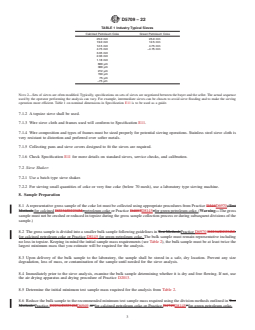
7.1.1.1 Typical sets of sieves to be used are listed in Table 1.
D5709 − 22
TABLE 1 Industry Typical Sieves
Calcined Petroleum Coke Green Petroleum Coke
25.0 mm 25.0 mm
19.0 mm 12.5 mm
12.5 mm 4.75 mm
4.75 mm −4.75 mm
3.35 mm
2.36 mm
1.18 mm
600 μm
300 μm
212 μm
150 μm
75 μm
−75 μm
NOTE 2—Sets of sieves are often modified. Typically, specifications on sets of sieves are negotiated between the buyer and the seller. The actual sequence
used by the operator performing the analysis can vary. For example, intermediate sieves can be chosen to avoid sieve flooding and to make the sieving
operation more efficient. Table 1 on nominal dimensions in Specification E11 is to be used as a guide.
7.1.2 A topsize sieve shall be used.
7.1.3 Wire sieve cloth and frames used will conform to Specification E11.
7.1.4 Wire composition and types of frames must be sized properly for potential sieving operations. Stainless steel sieve cloth is
very resistant to distortion and preferred over softer metals.
7.1.5 Collecting pans and sieve covers designed to fit the sieves are required.
7.1.6 Check Specification E11 for more details on standard sieves, service checks, and calibration.
7.2 Sieve Shaker:
7.2.1 Use a batch type sieve shaker.
7.2.2 For sieving small quantities of coke or very fine coke (below 70 mesh), use a laboratory type sieving machine.
8. Sample Preparation
8.1 A representative gross sample of the coke lot must be collected using appropriate procedures from Practice D346D6970, Test
Methods for calcined D2234/D2234M, petroleum coke or Practice D4057D8145. for green petroleum coke. (Warning—The gross
sample must not be crushed or reduced in topsize during the gross sample collection process or during subsequent divisions of the
sample.)
8.2 The gross sample is divided into a smaller bulk sample following guidelines in Test MethodsPractice D6970 D2234/D2234M.
for calcined petroleum coke or Practice D8145 for green petroleum coke. The bulk sample must remain representative including
no loss in topsize. Keeping in mind the initial sample mass requirements (see Table 2), the bulk sample must be at least twice the
largest minimum mass that you estimate will be required for the analysis.
8.3 Upon delivery of the bulk sample to the laboratory, the sample shall be stored in a safe, dry location. Prevent any size
degradation, loss of mass, or contamination of the sample until needed for the sieve analysis.
8.4 Immediately prior to the sieve analysis, examine the bulk sample determining whether it is dry and free flowing. If not, use
the air drying apparatus and drying procedure of Practice D2013.
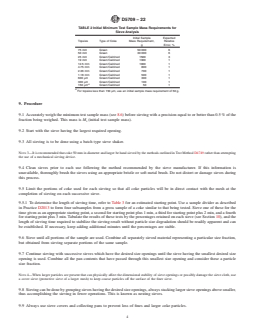
8.5 Determine the initial minimum test sample mass required for the analysis from Table 2.
8.6 Reduce the bulk sample to the recommended minimum test sample mass required using the division methods outlined in Test
Methods Practice D2234/D2234MD6969 or for calcined petroleum coke or Practice D4749D8145. for green petroleum coke.
D5709 − 22
TABLE 2 Initial Minimum Test Sample Mass Requirements for
Sieve Analysis
Initial Sample Expected
Topsize Type of Coke Mass Requirement, Relative
g Error, %
75 mm Green 50 000 6
50 mm Green 30 000 6
25 mm Green/Calcined 1500 3
19 mm Green/Calcined 1300 1
12.5 mm Green/Calcined 1000 1
4.75 mm Green/Calcined 800 1
2.36 mm Green/Calcined 700 1
1.18 mm Green/Calcined 500 1
600 μm Green/Calcined 300 1
300 μm Green/Calcined 100 1
A
150 μm Green/Calcined 50 1
A
For topsize less than 150 μm, use an initial sample mass requirement of 50 g.
9. Procedure
9.1 Accurately weigh the minimum test sample mass (see 8.6) before sieving with a precision equal to or better than 0.5 % of the
fraction being weighed. This mass is M (initial test sample mass).
i
9.2 Start with the sieve
...