

ASTM B117-19
(Practice)Standard Practice for Operating Salt Spray (Fog) Apparatus
General Information
- Abstract
SIGNIFICANCE AND USE
3.1 This practice provides a controlled corrosive environment which has been utilized to produce relative corrosion resistance information for specimens of metals and coated metals exposed in a given test chamber.
3.2 Prediction of performance in natural environments has seldom been correlated with salt spray results when used as stand alone data.
3.2.1 Correlation and extrapolation of corrosion performance based on exposure to the test environment provided by this practice are not always predictable.
3.2.2 Correlation and extrapolation should be considered only in cases where appropriate corroborating long-term atmospheric exposures have been conducted.
3.3 The reproducibility of results in the salt spray exposure is highly dependent on the type of specimens tested and the evaluation criteria selected, as well as the control of the operating variables. In any testing program, sufficient replicates should be included to establish the variability of the results. Variability has been observed when similar specimens are tested in different fog chambers even though the testing conditions are nominally similar and within the ranges specified in this practice.
SCOPE
1.1 This practice covers the apparatus, procedure, and conditions required to create and maintain the salt spray (fog) test environment. Suitable apparatus which may be used is described in Appendix X1.
1.2 This practice does not prescribe the type of test specimen or exposure periods to be used for a specific product, nor the interpretation to be given to the results.
1.3 The values stated in SI units are to be regarded as standard. The values given in parentheses after SI units are provided for information only and are not considered standard.
1.4 This standard does not purport to address all of the safety concerns, if any, associated with its use. It is the responsibility of the user of this standard to establish appropriate safety, health, and environmental practices and determine the applicability of regulatory limitations prior to use.
1.5 This international standard was developed in accordance with internationally recognized principles on standardization established in the Decision on Principles for the Development of International Standards, Guides and Recommendations issued by the World Trade Organization Technical Barriers to Trade (TBT) Committee.
- Status
- Published
- Publication Date
- 31-Oct-2019
- Technical Committee
- G01 - Corrosion of Metals
- Drafting Committee
- G01.05 - Laboratory Corrosion Tests
Overview
ASTM B117-19: Standard Practice for Operating Salt Spray (Fog) Apparatus is a widely recognized international standard developed by ASTM International. This practice specifies the requirements for creating and maintaining a controlled salt spray (fog) test environment, which is essential for assessing the relative corrosion resistance of metals and coated metals. Frequently used by quality control laboratories and manufacturers, it plays a key role in process qualification and quality acceptance procedures.
Key Topics
Salt Spray (Fog) Test Environment
Defines how to create and sustain a highly controlled salt-laden atmosphere using specified apparatus and procedures to simulate corrosive marine conditions.Apparatus Requirements
Describes the needed equipment, which includes fog chambers, salt solution reservoirs, atomizing nozzles, specimen supports, temperature controls, and clean compressed air supply.Test Solutions
Covers preparation of sodium chloride solutions with strict requirements for purity, concentration (typically 5% by mass), pH (6.5 to 7.2), and exclusion of anti-caking agents and impurities.Specimen Handling and Positioning
Details guidelines for the number, preparation, and placement of test specimens to ensure consistent, reliable results. Emphasizes cleaning, protection of edges, and prevention of cross-contamination.Test Conditions and Duration
Specifies continuous exposure conditions, monitoring schedules for pH, temperature, salt concentration, and collection rates, as well as recommended duration of testing.Result Evaluation and Reporting
Outlines procedures for cleaning, examining, and documenting test specimens post-exposure, with a focus on reproducibility and full disclosure of test variables.
Applications
Comparative Corrosion Testing
Used by manufacturers, laboratories, and research institutions to evaluate the relative corrosion resistance of different metals, coatings, and surface treatments under accelerated conditions.Quality Control and Process Qualification
Serves as a benchmark procedure in production environments to verify that materials or coatings meet specified quality and durability standards.Product Development
Assists in the selection and development of corrosion-resistant alloys, surface finishes, and coatings for automotive, marine, aerospace, and infrastructure applications.Regulatory and Certification Compliance
Frequently referenced by industrial, military, and governmental bodies to ensure compliance with international corrosion testing requirements.
Note: While ASTM B117-19 provides valuable comparative information, it does not directly predict real-world service performance. Correlation with natural atmospheric exposure is only meaningful when supported by long-term field data.
Related Standards
ASTM B368 - Copper-Accelerated Acetic Acid-Salt Spray (CASS) Testing
For testing specific coatings, especially decorative chromium plate.ASTM G85 - Modified Salt Spray (Fog) Testing
Addresses salt spray testing with altered parameters for specific applications.ASTM D609 - Preparation of Cold-Rolled Steel Panels
Provides guidance on preparing steel specimens for testing.ASTM D1654 - Evaluation of Painted or Coated Specimens
For assessing failure or deterioration after corrosive exposure.ASTM D1193 - Specification for Reagent Water
Governs water quality crucial for solution preparation.ASTM E70 - Test Method for pH of Aqueous Solutions
Used for checking the pH of the salt solution and collected fog condensates.
Practical Value
Adhering to ASTM B117-19 ensures uniformity and reliability in corrosion testing and comparative analysis. Built on decades of industry experience, this practice streamlines product validation and regulatory processes while enabling stakeholders to make informed material selection and process improvement decisions.
Keywords: ASTM B117-19, salt spray test, fog apparatus, corrosion testing, standard practice, metals, coated metals, quality control, corrosion resistance, salt fog chamber, accelerated corrosion, international standard.
Relations
- Effective Date
- 01-Jan-2024
- Effective Date
- 01-Nov-2019
- Effective Date
- 01-Dec-2016
- Effective Date
- 01-Jun-2015
- Effective Date
- 01-May-2013
- Effective Date
- 01-Jun-2012
- Effective Date
- 01-Nov-2011
- Effective Date
- 01-May-2011
- Effective Date
- 01-Jul-2009
- Effective Date
- 15-Apr-2009
- Effective Date
- 01-Nov-2008
- Effective Date
- 01-Oct-2008
- Effective Date
- 01-Nov-2006
- Effective Date
- 01-Mar-2006
- Effective Date
- 01-Nov-2005
Get Certified
Connect with accredited certification bodies for this standard

Element Materials Technology
Materials testing and product certification.

Inštitut za kovinske materiale in tehnologije
Institute of Metals and Technology. Materials testing, metallurgical analysis, NDT.
Sponsored listings
Frequently Asked Questions
ASTM B117-19 is a standard published by ASTM International. Its full title is "Standard Practice for Operating Salt Spray (Fog) Apparatus". This standard covers: SIGNIFICANCE AND USE 3.1 This practice provides a controlled corrosive environment which has been utilized to produce relative corrosion resistance information for specimens of metals and coated metals exposed in a given test chamber. 3.2 Prediction of performance in natural environments has seldom been correlated with salt spray results when used as stand alone data. 3.2.1 Correlation and extrapolation of corrosion performance based on exposure to the test environment provided by this practice are not always predictable. 3.2.2 Correlation and extrapolation should be considered only in cases where appropriate corroborating long-term atmospheric exposures have been conducted. 3.3 The reproducibility of results in the salt spray exposure is highly dependent on the type of specimens tested and the evaluation criteria selected, as well as the control of the operating variables. In any testing program, sufficient replicates should be included to establish the variability of the results. Variability has been observed when similar specimens are tested in different fog chambers even though the testing conditions are nominally similar and within the ranges specified in this practice. SCOPE 1.1 This practice covers the apparatus, procedure, and conditions required to create and maintain the salt spray (fog) test environment. Suitable apparatus which may be used is described in Appendix X1. 1.2 This practice does not prescribe the type of test specimen or exposure periods to be used for a specific product, nor the interpretation to be given to the results. 1.3 The values stated in SI units are to be regarded as standard. The values given in parentheses after SI units are provided for information only and are not considered standard. 1.4 This standard does not purport to address all of the safety concerns, if any, associated with its use. It is the responsibility of the user of this standard to establish appropriate safety, health, and environmental practices and determine the applicability of regulatory limitations prior to use. 1.5 This international standard was developed in accordance with internationally recognized principles on standardization established in the Decision on Principles for the Development of International Standards, Guides and Recommendations issued by the World Trade Organization Technical Barriers to Trade (TBT) Committee.
SIGNIFICANCE AND USE 3.1 This practice provides a controlled corrosive environment which has been utilized to produce relative corrosion resistance information for specimens of metals and coated metals exposed in a given test chamber. 3.2 Prediction of performance in natural environments has seldom been correlated with salt spray results when used as stand alone data. 3.2.1 Correlation and extrapolation of corrosion performance based on exposure to the test environment provided by this practice are not always predictable. 3.2.2 Correlation and extrapolation should be considered only in cases where appropriate corroborating long-term atmospheric exposures have been conducted. 3.3 The reproducibility of results in the salt spray exposure is highly dependent on the type of specimens tested and the evaluation criteria selected, as well as the control of the operating variables. In any testing program, sufficient replicates should be included to establish the variability of the results. Variability has been observed when similar specimens are tested in different fog chambers even though the testing conditions are nominally similar and within the ranges specified in this practice. SCOPE 1.1 This practice covers the apparatus, procedure, and conditions required to create and maintain the salt spray (fog) test environment. Suitable apparatus which may be used is described in Appendix X1. 1.2 This practice does not prescribe the type of test specimen or exposure periods to be used for a specific product, nor the interpretation to be given to the results. 1.3 The values stated in SI units are to be regarded as standard. The values given in parentheses after SI units are provided for information only and are not considered standard. 1.4 This standard does not purport to address all of the safety concerns, if any, associated with its use. It is the responsibility of the user of this standard to establish appropriate safety, health, and environmental practices and determine the applicability of regulatory limitations prior to use. 1.5 This international standard was developed in accordance with internationally recognized principles on standardization established in the Decision on Principles for the Development of International Standards, Guides and Recommendations issued by the World Trade Organization Technical Barriers to Trade (TBT) Committee.
ASTM B117-19 is classified under the following ICS (International Classification for Standards) categories: 77.060 - Corrosion of metals. The ICS classification helps identify the subject area and facilitates finding related standards.
ASTM B117-19 has the following relationships with other standards: It is inter standard links to ASTM E70-24, ASTM G85-19, ASTM D1654-08(2016), ASTM E70-07(2015), ASTM E691-13, ASTM D609-00(2012), ASTM E691-11, ASTM G85-11, ASTM G85-09, ASTM B368-09, ASTM D1654-08, ASTM E691-08, ASTM D609-00(2006), ASTM D1193-06, ASTM E691-05. Understanding these relationships helps ensure you are using the most current and applicable version of the standard.
ASTM B117-19 is available in PDF format for immediate download after purchase. The document can be added to your cart and obtained through the secure checkout process. Digital delivery ensures instant access to the complete standard document.
Standards Content (Sample)
This international standard was developed in accordance with internationally recognized principles on standardization established in the Decision on Principles for the
Development of International Standards, Guides and Recommendations issued by the World Trade Organization Technical Barriers to Trade (TBT) Committee.
Designation: B117 − 19
Standard Practice for
Operating Salt Spray (Fog) Apparatus
This standard is issued under the fixed designation B117; the number immediately following the designation indicates the year of
original adoption or, in the case of revision, the year of last revision. A number in parentheses indicates the year of last reapproval. A
superscript epsilon (´) indicates an editorial change since the last revision or reapproval.
This standard has been approved for use by agencies of the U.S. Department of Defense.
1. Scope D1654 Test Method for Evaluation of Painted or Coated
Specimens Subjected to Corrosive Environments
1.1 This practice covers the apparatus, procedure, and
E70 Test Method for pH of Aqueous Solutions With the
conditions required to create and maintain the salt spray (fog)
Glass Electrode
test environment. Suitable apparatus which may be used is
E691 Practice for Conducting an Interlaboratory Study to
described in Appendix X1.
Determine the Precision of a Test Method
1.2 This practice does not prescribe the type of test speci-
G85 Practice for Modified Salt Spray (Fog) Testing
men or exposure periods to be used for a specific product, nor
the interpretation to be given to the results.
3. Significance and Use
1.3 The values stated in SI units are to be regarded as
3.1 This practice provides a controlled corrosive environ-
standard. The values given in parentheses after SI units are
ment which has been utilized to produce relative corrosion
provided for information only and are not considered standard.
resistance information for specimens of metals and coated
1.4 This standard does not purport to address all of the
metals exposed in a given test chamber.
safety concerns, if any, associated with its use. It is the
responsibility of the user of this standard to establish appro- 3.2 Prediction of performance in natural environments has
priate safety, health, and environmental practices and deter- seldom been correlated with salt spray results when used as
mine the applicability of regulatory limitations prior to use. stand alone data.
1.5 This international standard was developed in accor-
3.2.1 Correlation and extrapolation of corrosion perfor-
dance with internationally recognized principles on standard-
mance based on exposure to the test environment provided by
ization established in the Decision on Principles for the
this practice are not always predictable.
Development of International Standards, Guides and Recom-
3.2.2 Correlation and extrapolation should be considered
mendations issued by the World Trade Organization Technical
only in cases where appropriate corroborating long-term atmo-
Barriers to Trade (TBT) Committee.
spheric exposures have been conducted.
2. Referenced Documents 3.3 The reproducibility of results in the salt spray exposure
is highly dependent on the type of specimens tested and the
2.1 ASTM Standards:
evaluation criteria selected, as well as the control of the
B368 Test Method for Copper-Accelerated Acetic Acid-Salt
operating variables. In any testing program, sufficient repli-
Spray (Fog) Testing (CASS Test)
cates should be included to establish the variability of the
D609 Practice for Preparation of Cold-Rolled Steel Panels
results. Variability has been observed when similar specimens
for Testing Paint, Varnish, Conversion Coatings, and
are tested in different fog chambers even though the testing
Related Coating Products
conditions are nominally similar and within the ranges speci-
D1193 Specification for Reagent Water
fied in this practice.
4. Apparatus
This practice is under the jurisdiction of ASTM Committee G01 on Corrosion
of Metals and is the direct responsibility of Subcommittee G01.05 on Laboratory
4.1 The apparatus required for salt spray (fog) exposure
Corrosion Tests.
consists of a fog chamber, a salt solution reservoir, a supply of
Current edition approved Nov. 1, 2019. Published December 2019. Originally
suitably conditioned compressed air, one or more atomizing
approved in 1939. Last previous edition approved in 2018 as B117–18. DOI:
10.1520/B0117–19.
nozzles, specimen supports, provision for heating the chamber,
For referenced ASTM standards, visit the ASTM website, www.astm.org, or
and necessary means of control. The size and detailed con-
contact ASTM Customer Service at service@astm.org. For Annual Book of ASTM
struction of the apparatus are optional, provided the conditions
Standards volume information, refer to the standard’s Document Summary page on
the ASTM website. obtained meet the requirements of this practice.
Copyright © ASTM International, 100 Barr Harbor Drive, PO Box C700, West Conshohocken, PA 19428-2959. United States
B117 − 19
4.2 Drops of solution which accumulate on the ceiling or 7. Position of Specimens During Exposure
cover of the chamber shall not be permitted to fall on the
7.1 The position of the specimens in the salt spray chamber
specimens being exposed.
during the test shall be such that the following conditions are
4.3 Drops of solution which fall from the specimens shall met:
not be returned to the solution reservoir for respraying. 7.1.1 Unless otherwise specified, the specimens shall be
supported or suspended with the surface of interest at an angle
4.4 Material of construction shall be such that it will not
between 15° and 30° from the vertical. It is recommended that
affect the corrosiveness of the fog.
the orientation of specimens in the cabinet be consistent to
4.5 AllwaterusedforthispracticeshallconformtoTypeIV
minimize variability.
water in Specification D1193 (except that for this practice
7.1.2 The specimens shall not contact each other or any
limits for chlorides and sodium may be ignored).This does not
metallic material or any material capable of acting as a wick.
apply to running tap water. All other water will be referred to
7.1.3 Each specimen shall be placed to permit unencum-
as reagent grade.
bered exposure to the fog.
7.1.4 Salt solution from one specimen shall not drip on any
NOTE1—Waterusedwithaconductivity≤1.0µS/cm(orresistivity≥1.0
MΩ·cm) may cause damage to some equipment due to the reactive nature
other specimen.
of the water. In addition, it may cause issues with stabilizing pH
NOTE 3—Suitable materials for the construction or coating of racks and
measurements.
supports are glass, rubber, plastic, or suitably coated wood. Bare metal
shall not be used. Specimens shall preferably be supported from the
5. Test Specimens
bottomortheside.Slottedwoodenstripsaresuitableforthesupportofflat
5.1 The type and number of test specimens to be used, as
panels. Suspension from glass hooks or waxed string may be used as long
well as the criteria for the evaluation of the test results, shall be as the specified position of the specimens is obtained, if necessary by
means of secondary support at the bottom of the specimens.
defined in the specifications covering the material or product
being exposed or shall be mutually agreed upon between the
8. Salt Solution
purchaser and the seller.
8.1 The salt solution shall be prepared by dissolving 5 6 1
6. Preparation of Test Specimens
parts by mass of sodium chloride in 95 parts of water
conforming to Type IV water in Specification D1193 (except
6.1 Specimens shall be suitably cleaned. The cleaning
that for this practice limits for chlorides and sodium may be
methodshallbeoptionaldependingonthenatureofthesurface
ignored). Careful attention should be given to the chemical
and the contaminants. Care shall be taken that specimens are
content of the salt. The salt used shall be sodium chloride with
not recontaminated after cleaning by excessive or careless
not more than 0.3 % by mass of total impurities. Halides
handling.
(Bromide, Fluoride, and Iodide) other than Chloride shall
6.2 Specimens for the evaluation of paints and other organic
constitute less than 0.1 % by mass of the salt content. Copper
coatings shall be prepared in accordance with applicable
content shall be less than 0.3 ppm by mass. Sodium chloride
specification(s) for the material(s) being exposed, or as agreed
thathashadanti-cakingagentsaddedshallnotbeusedbecause
upon between the purchaser and the supplier. Otherwise, the
such agents may act as corrosion inhibitors. See Table 1 for a
test specimens shall consist of steel meeting the requirements
listing of these impurity restrictions. Upon agreement between
of Practice D609 and shall be cleaned and prepared for coating
the purchaser and the seller, analysis may be required and
in accordance with the applicable procedure of Practice D609.
limits established for elements or compounds not specified in
6.3 Specimens coated with paints or nonmetallic coatings the chemical composition given above.
shall not be cleaned or handled excessively prior to test.
8.2 The pH of the salt solution shall be such that when
6.4 Whenever it is desired to determine the development of atomized at 35 °C (95 °F) the collected solution will be in the
corrosion from an abraded area in the paint or organic coating,
pH range from 6.5 to 7.2 (Note 4). Before the solution is
a scratch or scribed line shall be made through the coating with atomized it shall be free of suspended solids (Note 5). The pH
a sharp instrument so as to expose the underlying metal before
measurement shall be made at 23 °C 6 3 °C (73 °F 6 5 °F)
testing. The conditions of making the scratch shall be as using a suitable glass pH-sensing electrode, reference
defined in Test Method D1654, unless otherwise agreed upon electrode, and pH meter system in accordance with Test
between the purchaser and the seller. Method E70. pH measurement shall be recorded once daily
(exceptonweekends,orholidayswhenthesaltspraytestisnot
6.5 Unless otherwise specified, the cut edges of plated,
interrupted for exposing, rearranging, or removing test speci-
coated, or duplex materials and areas containing identification
mens or to check and replenish the solution in the reservoir.
marks or in contact with the racks or supports shall be
The maximum interval between pH measurements shall not
protected with a suitable coating stable under the conditions of
exceed 96 h). Only diluted, reagent grade hydrochloric acid
the practice.
(HCl) or reagent grade sodium hydroxide (NaOH) shall be
NOTE2—Shoulditbedesirabletocuttestspecimensfrompartsorfrom
used to adjust the pH.
preplated, painted, or otherwise coated steel sheet, the cut edges shall be
protected by coating them with paint, wax, tape, or other effective media NOTE 4—Temperature affects the pH of a salt solution prepared from
so that the development of a galvanic effect between such edges and the water saturated with carbon dioxide at room temperature and pH adjust-
adjacent plated or otherwise coated metal surfaces, is prevented. ment may be made by the following three methods:
B117 − 19
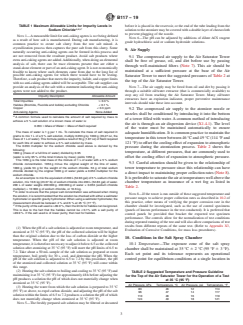
TABLE 1 Maximum Allowable Limits for Impurity Levels in before it is placed in the reservoir, or the end of the tube leading from the
A,B,C
Sodium Chloride
solutiontotheatomizermaybecoveredwithadoublelayerofcheesecloth
to prevent plugging of the nozzle.
NOTE 1—Ameasurable limit for anti-caking agents is not being defined
NOTE 6—The pH can be adjusted by additions of dilute ACS reagent
as a result of how salt is manufactured. During salt manufacturing, it is
grade hydrochloric acid or sodium hydroxide solutions.
common practice to create salt slurry from the raw salt mined. A
crystallization process then captures the pure salt from this slurry. Some
9. Air Supply
naturally occurring anti-caking agents can be formed in this process and
are not removed from the resultant product. Avoid salt products where
9.1 The compressed air supply to the Air Saturator Tower
extra anti-caking agents are added.Additionally, when doing an elemental
shall be free of grease, oil, and dirt before use by passing
analysis of salt, there can be trace elements present that are either a
through well-maintained filters (Note 7). This air should be
stand-alone element or part of an anti-caking agent. It is not economically
maintained at a sufficient pressure at the base of the Air
feasible to know where such elements came from due to the long list of
possible anti-caking agents for which there would have to be testing. Saturator Tower to meet the suggested pressures of Table 2 at
Therefore, a salt product that meets the impurity, halide, and copper limits
the top of the Air Saturator Tower.
with no anti-caking agents added will be acceptable. The salt supplier can
provide an analysis of the salt with a statement indicating that anti-caking NOTE 7—The air supply may be freed from oil and dirt by passing it
agents were not added to the product. through a suitable oil/water extractor (that is commercially available) to
stop any oil from reaching the Air Saturator Tower. Many oil/water
Impurity Description Allowable Amount
extractors have an expiration indicator, proper preventive maintenance
Total Impurities # 0.3 %
intervals should take these into account.
Halides (Bromide, Fluoride and Iodide) excluding Chloride < 0.1 %
Copper < 0.3 ppm
9.2 The compressed air supply to the atomizer nozzle or
Anti-caking Agents None Added
nozzles shall be conditioned by introducing it into the bottom
A
A common formula used to calculate the amount of salt required by mass to
of a tower filled with water.Acommon method of introducing
achieve a 5 % salt solution of a known mass of water is:
the air is through an air dispersion device (X1.4.1). The level
0.0533Mass of Water5 Mass of NaCl required
of the water must be maintained automatically to ensure
The mass of water is 1 g per 1 mL. To calculate the mass of salt required in
adequate humidification. It is common practice to maintain the
grams to mix 1 L of a 5 % salt solution, multiply 0.053 g by 1000 g (35.27 oz, the
temperatureinthistowerbetween46 °Cand49 °C(114 °Fand
mass of 1 L of water). This formula yields a result of 53 g (1.87 oz) of NaCl required
for each litre of water to achieve a 5 % salt solution by mass. 121 °F) to offset the cooling effect of expansion to atmospheric
The 0.053 multiplier for the sodium chloride used above is derived by the
pressure during the atomization process. Table 2 shows the
following:
temperature, at different pressures, that are commonly used to
1000 g (mass of a full litre of water) divided by 0.95
(water is only 95 % of the total mixture by mass) yields 1053 g offset the cooling effect of expansion to atmospheric pressure.
This 1053 g is the total mass of the mixture of 1 L of water with a 5 % sodium
9.3 Careful attention should be given to the relationship of
chloride concentration. 1053 g minus the original weight of the litre of water,
1000 g, yields 53 g for the weight of the sodium chloride. 53 g of total sodium
tower temperature to pressure since this relationship can have
chloride divided by the original 1000 g of water yields a 0.053 multiplier for the
a direct impact to maintaining proper collection rates (Note 8).
sodium chloride.
Itispreferabletosaturatetheairattemperatureswellabovethe
As an example: to mix the equivalent of 200 L (52.83 gal) of 5 % sodium chloride
solution, mix 10.6 kg (23.37 lb) of sodium chloride into 200 L (52.83 gal) of water.
chamber temperature as insurance of a wet fog as listed in
200 L of water weighs 200 000 g. 200 000 g of water × 0.053 (sodium chloride
Table 2.
multiplier) = 10 600 g of sodium chloride, or 10.6 kg.
B
In order to ensure that the proper salt concentration was achieved when mixing
NOTE 8—If the tower is run outside of these suggested temperature and
the solution, it is recommended that the solution be checked with either a salimeter
pressure ranges to achieve proper collection rates as described in 10.2 of
hydrometer or specific gravity hydrometer. When using a salimeter hydrometer, the
this practice, other means of verifying the proper corrosion rate in the
measurement should be between 4 % and 6 % at 25 °C (77 °F).
C
chamber should be investigated, such as the use of control specimens
If the purity of the salt used is >99.9 %, then the limits for halides can be ignored.
This is due to the fact that the halides cannot be $0.1% with a salt purity of (panels of known performance in the test conducted). It is preferred that
>99.9 %. If the salt used is of lower purity, then test for halides.
control panels be provided that bracket the expected test specimen
performance. The controls allow for the normalization of test conditions
during repeated running of the test and will also allow comparisons of test
results from different repeats of the same test. (Refer to Appendix X3,
(1) When the pH of a salt solution is adjusted at room temperature, and
Evaluation of Corrosive Conditions, for mass loss procedures).
atomized at 35 °C (95 °F), the pH of the collected solution will be higher
than the original solution due to the loss of carbon dioxide at the higher
10. Conditions in the Salt Spray Chamber
temperature. When the pH of the salt solution is adjusted at room
temperature,itisthereforenecessarytoadjustitbelow6.5sothecollected
10.1 Temperature—The exposure zone of the salt spray
solution after atomizing at 35 °C (95 °F) will meet the pH limits of 6.5 to
chamber shall be maintained at 35 °C 6 2 °C (95 °F 6 3 °F).
7.2. Take about a 50 mL sample of the salt solution as prepared at room
Each set point and its tolerance represents an operational
temperature, boil gently for 30 s, cool, and determine the pH. When the
control point for equilibrium conditions at a single location in
pH of the salt solution is adjusted to 6.5 to 7.2 by this procedure, the pH
of the atomized and collected solution at 35 °C (95 °F) will come within
this range.
(2) Heatingthesaltsolutiontoboilingandcoolingto35 °C(95 °F)and
TABLE 2 Suggested Temperature and Pressure Guideline
maintainingitat35 °C(95 °F)forapproximately48hbeforeadjustingthe
for the Top of the Air Saturator Tower for the Operation of a Test
pH produces a solution the pH of which does not materially change when
at 35 °C (95 °F)
atomized at 35 °C (95 °F).
Air Pressure, kPa Temperature, °C Air Pressure, psi Temperature, °F
(3) Heating the water from which the salt solution is prepared to 35 °C
83 46 12 114
(95 °F) or above, to expel carbon dioxide, and adjusting the pH of the salt
96 47 14 117
solutionwithinthelimitsof6.5to7.2producesasolutionthepHofwhich
110 48 16 119
does not materially change when atomized at 35 °C (95 °F). 124 49 18 121
NOTE 5—The freshly prepared salt solution may be filtered or decanted
B117 − 19
appropriate method can be chosen by the user.
the cabinet which may not necessarily represent the uniformity
NOTE 11—Suitable collecting devices are glass or plastic funnels with
of conditions throughout the cabinet. The temperature within
the stems inserted through stoppers into graduated cylinders, or crystal-
theexposurezoneoftheclosedcabinetshallberecorded(Note
lizing dishes. Funnels and dishes with a diameter of 10 cm (3.94 in.) have
2 2
9) at least once daily (except on Saturdays, Sundays, and
an area of about 80 cm (12.4 in. ).
holidays when the salt spray test is not interrupted for
NOTE 12—The specific gravity of salt solution will change with
temperature. Table3showssaltconcentrationanddensityversustempera-
exposing, rearranging, or removing test specimens or to check
ture and can be used to determine if the sample measured is within
and replenish the solution in the reservoir)
specification.Thesampletobemeasuredmaybeacompositesamplefrom
multiple fog-collecting devices within a single cabinet, if necessary, to
NOTE 9—A suitable method to record the temperature is by a continu-
obtain sufficient solution volume for measurement.
ous recording device or by a thermometer which can be read from outside
Table 3 shows the salt concentration and salt density of 4 %, 5 %, and
the closed cabinet. The recorded temperature must be obtained with the
6 % salt solution between 20 °C and 40 °C. A measurement that falls
saltspraychamberclosedtoavoidafalselowreadingbecauseofwet-bulb
within the range between 4 % and 6 % is acceptable.
effect when the chamber is open.
It is important to understand the equipment being used to measure
10.2 Atomization and Quantity of Fog—Place at least two
specific gravity. One common practice for specific gravity measurement is
clean fog collectors per atomizer tower within the exposure
the use of a hydrometer. If used, careful attention to the hydrometer type
is important as most are manufactured and calibrated for measurements at
zone so that no drops of solution will be collected from the test
15.6 °C (60 °F). Since salt density is temperature dependent, an offset will
specimens or any other source. Position the collectors in the
be necessary to make an accurate measurement at other temperatures.
proximity of the test specimens, one nearest to any nozzle and
Contact the hydrometer manufacturer to find the proper offset for the
the other farthest from all nozzles. A typical arrangement is
hydrometer being used.
shown in Fig. 1. The fog shall be such that for each
NOTE 13—Salt solutions from 2 % to 6 % will give the same results,
2 2
though for uniformity the limits are set at 4 % to 6 %.
80 cm (12.4 in. ) of horizontal collecting area, there will be
collected from 1.0 mLto 2.0 mLof solution per hour based on
10.3 The nozzle or nozzles shall be so directed or baffled
an average run of at least 16 h (Note 11). The sodium chloride
that none of the spray can impinge directly on the test
concentration of the collected solution shall be 5 % 6 1
specimens.
mass % (Notes 11-13). The pH of the collected solution shall
be 6.5 to 7.2. The pH measurement shall be made as described
11. Continuity of Exposure
in 8.2 (Note 4). Both sodium chloride concentration and
11.1 Unless otherwise specified in the specifications cover-
volume of condensate collected (measured in mL) shall be
ing the material or product being tested, the test shall be
recordedoncedaily(exceptonweekends,orholidayswhenthe
continuous for the duration of the entire test period. Continu-
salt spray test is not interrupted for exposing, rearranging, or
ous operation implies that the chamber be closed and the spray
removing test specimens or to check and replenish the solution
operating continuously except for the short daily interruptions
in the reservoir. The maximum interval between these data
collection measurements shall not exceed 96 h).
NOTE 10—Common methods of measuring sodium chloride concentra-
“Thermodynamic Properties of the NaCl + H2O system II. Thermodynamic
tion are specific gravity hydrometer, salimeter hydrometer, refractometer,
Properties of NaCl(aq), NaCl.2H2O(cr), and Phase Equilibria,” Journal of Physics
and titration. This list is not all inclusive of every method, and a
...
This document is not an ASTM standard and is intended only to provide the user of an ASTM standard an indication of what changes have been made to the previous version. Because
it may not be technically possible to adequately depict all changes accurately, ASTM recommends that users consult prior editions as appropriate. In all cases only the current version
of the standard as published by ASTM is to be considered the official document.
Designation: B117 − 18 B117 − 19
Standard Practice for
Operating Salt Spray (Fog) Apparatus
This standard is issued under the fixed designation B117; the number immediately following the designation indicates the year of
original adoption or, in the case of revision, the year of last revision. A number in parentheses indicates the year of last reapproval. A
superscript epsilon (´) indicates an editorial change since the last revision or reapproval.
This standard has been approved for use by agencies of the U.S. Department of Defense.
1. Scope
1.1 This practice covers the apparatus, procedure, and conditions required to create and maintain the salt spray (fog) test
environment. Suitable apparatus which may be used is described in Appendix X1.
1.2 This practice does not prescribe the type of test specimen or exposure periods to be used for a specific product, nor the
interpretation to be given to the results.
1.3 The values stated in SI units are to be regarded as the standard. The values given in parentheses are for information only.after
SI units are provided for information only and are not considered standard.
1.4 This standard does not purport to address all of the safety concerns, if any, associated with its use. It is the responsibility
of the user of this standard to establish appropriate safety, health, and environmental practices and determine the applicability of
regulatory limitations prior to use.
1.5 This international standard was developed in accordance with internationally recognized principles on standardization
established in the Decision on Principles for the Development of International Standards, Guides and Recommendations issued
by the World Trade Organization Technical Barriers to Trade (TBT) Committee.
2. Referenced Documents
2.1 ASTM Standards:
B368 Test Method for Copper-Accelerated Acetic Acid-Salt Spray (Fog) Testing (CASS Test)
D609 Practice for Preparation of Cold-Rolled Steel Panels for Testing Paint, Varnish, Conversion Coatings, and Related Coating
Products
D1193 Specification for Reagent Water
D1654 Test Method for Evaluation of Painted or Coated Specimens Subjected to Corrosive Environments
E70 Test Method for pH of Aqueous Solutions With the Glass Electrode
E691 Practice for Conducting an Interlaboratory Study to Determine the Precision of a Test Method
G85 Practice for Modified Salt Spray (Fog) Testing
3. Significance and Use
3.1 This practice provides a controlled corrosive environment which has been utilized to produce relative corrosion resistance
information for specimens of metals and coated metals exposed in a given test chamber.
3.2 Prediction of performance in natural environments has seldom been correlated with salt spray results when used as stand
alone data.
3.2.1 Correlation and extrapolation of corrosion performance based on exposure to the test environment provided by this
practice are not always predictable.
3.2.2 Correlation and extrapolation should be considered only in cases where appropriate corroborating long-term atmospheric
exposures have been conducted.
This practice is under the jurisdiction of ASTM Committee G01 on Corrosion of Metals and is the direct responsibility of Subcommittee G01.05 on Laboratory Corrosion
Tests.
Current edition approved Aug. 1, 2018Nov. 1, 2019. Published October 2018December 2019. Originally approved in 1939. Last previous edition approved in 20162018
as B117 – 16.B117–18. DOI: 10.1520/B0117-18.10.1520/B0117–19.
For referenced ASTM standards, visit the ASTM website, www.astm.org, or contact ASTM Customer Service at service@astm.org. For Annual Book of ASTM Standards
volume information, refer to the standard’sstandard’s Document Summary page on the ASTM website.
Copyright © ASTM International, 100 Barr Harbor Drive, PO Box C700, West Conshohocken, PA 19428-2959. United States
B117 − 19
3.3 The reproducibility of results in the salt spray exposure is highly dependent on the type of specimens tested and the
evaluation criteria selected, as well as the control of the operating variables. In any testing program, sufficient replicates should
be included to establish the variability of the results. Variability has been observed when similar specimens are tested in different
fog chambers even though the testing conditions are nominally similar and within the ranges specified in this practice.
4. Apparatus
4.1 The apparatus required for salt spray (fog) exposure consists of a fog chamber, a salt solution reservoir, a supply of suitably
conditioned compressed air, one or more atomizing nozzles, specimen supports, provision for heating the chamber, and necessary
means of control. The size and detailed construction of the apparatus are optional, provided the conditions obtained meet the
requirements of this practice.
4.2 Drops of solution which accumulate on the ceiling or cover of the chamber shall not be permitted to fall on the specimens
being exposed.
4.3 Drops of solution which fall from the specimens shall not be returned to the solution reservoir for respraying.
4.4 Material of construction shall be such that it will not affect the corrosiveness of the fog.
4.5 All water used for this practice shall conform to Type IV water in Specification D1193 (except that for this practice limits
for chlorides and sodium may be ignored). This does not apply to running tap water. All other water will be referred to as reagent
grade.
NOTE 1—Water used with a conductivity ≤1.0 μS/cm (or resistivity ≥1.0 MΩ·cm) may cause damage to some equipment due to the reactive nature of
the water. In addition, it may cause issues with stabilizing pH measurements.
5. Test Specimens
5.1 The type and number of test specimens to be used, as well as the criteria for the evaluation of the test results, shall be defined
in the specifications covering the material or product being exposed or shall be mutually agreed upon between the purchaser and
the seller.
6. Preparation of Test Specimens
6.1 Specimens shall be suitably cleaned. The cleaning method shall be optional depending on the nature of the surface and the
contaminants. Care shall be taken that specimens are not recontaminated after cleaning by excessive or careless handling.
6.2 Specimens for the evaluation of paints and other organic coatings shall be prepared in accordance with applicable
specification(s) for the material(s) being exposed, or as agreed upon between the purchaser and the supplier. Otherwise, the test
specimens shall consist of steel meeting the requirements of Practice D609 and shall be cleaned and prepared for coating in
accordance with the applicable procedure of Practice D609.
6.3 Specimens coated with paints or nonmetallic coatings shall not be cleaned or handled excessively prior to test.
6.4 Whenever it is desired to determine the development of corrosion from an abraded area in the paint or organic coating, a
scratch or scribed line shall be made through the coating with a sharp instrument so as to expose the underlying metal before
testing. The conditions of making the scratch shall be as defined in Test Method D1654, unless otherwise agreed upon between
the purchaser and the seller.
6.5 Unless otherwise specified, the cut edges of plated, coated, or duplex materials and areas containing identification marks
or in contact with the racks or supports shall be protected with a suitable coating stable under the conditions of the practice.
NOTE 2—Should it be desirable to cut test specimens from parts or from preplated, painted, or otherwise coated steel sheet, the cut edges shall be
protected by coating them with paint, wax, tape, or other effective media so that the development of a galvanic effect between such edges and the adjacent
plated or otherwise coated metal surfaces, is prevented.
7. Position of Specimens During Exposure
7.1 The position of the specimens in the salt spray chamber during the test shall be such that the following conditions are met:
7.1.1 Unless otherwise specified, the specimens shall be supported or suspended between 15with the surface of interest at an
angle between 15° and 30° from the vertical and preferably parallel to the principal direction of flow of fog through the chamber,
based upon the dominant surface being tested.vertical. It is recommended that the orientation of specimens in the cabinet be
consistent to minimize variability.
7.1.2 The specimens shall not contact each other or any metallic material or any material capable of acting as a wick.
7.1.3 Each specimen shall be placed to permit unencumbered exposure to the fog.
7.1.4 Salt solution from one specimen shall not drip on any other specimen.
NOTE 3—Suitable materials for the construction or coating of racks and supports are glass, rubber, plastic, or suitably coated wood. Bare metal shall
not be used. Specimens shall preferably be supported from the bottom or the side. Slotted wooden strips are suitable for the support of flat panels.
Suspension from glass hooks or waxed string may be used as long as the specified position of the specimens is obtained, if necessary by means of
secondary support at the bottom of the specimens.
B117 − 19
8. Salt Solution
8.1 The salt solution shall be prepared by dissolving 5 6 1 parts by mass of sodium chloride in 95 parts of water conforming
to Type IV water in Specification D1193 (except that for this practice limits for chlorides and sodium may be ignored). Careful
attention should be given to the chemical content of the salt. The salt used shall be sodium chloride with not more than 0.3 % by
mass of total impurities. Halides (Bromide, Fluoride, and Iodide) other than Chloride shall constitute less than 0.1 % by mass of
the salt content. Copper content shall be less than 0.3 ppm 0.3 ppm by mass. Sodium chloride that has had anti-caking agents added
shall not be used because such agents may act as corrosion inhibitors. See Table 1 for a listing of these impurity restrictions. Upon
agreement between the purchaser and the seller, analysis may be required and limits established for elements or compounds not
specified in the chemical composition given above.
8.2 The pH of the salt solution shall be such that when atomized at 35°C (95°F)35 °C (95 °F) the collected solution will be in
the pH range from 6.5 to 7.2 (Note 4). Before the solution is atomized it shall be free of suspended solids (Note 5). The pH
measurement shall be made at 2323 °C 6 3°C (733 °C (73 °F 6 5°F)5 °F) using a suitable glass pH-sensing electrode, reference
electrode, and pH meter system in accordance with Test Method E70. pH measurement shall be recorded once daily (except on
weekends, or holidays when the salt spray test is not interrupted for exposing, rearranging, or removing test specimens or to check
TABLE 1 Maximum Allowable Limits for Impurity Levels in
A,B,C
Sodium Chloride
NOTE 1—A measurable limit for anti-caking agents is not being defined
as a result of how salt is manufactured. During salt manufacturing, it is
common practice to create salt slurry from the raw salt mined. A
crystallization process then captures the pure salt from this slurry. Some
naturally occurring anti-caking agents can be formed in this process and
are not removed from the resultant product. Avoid salt products where
extra anti-caking agents are added. Additionally, when doing an elemental
analysis of salt, there can be trace elements present that are either a
stand-alone element or part of an anti-caking agent. It is not economically
feasible to know where such elements came from due to the long list of
possible anti-caking agents for which there would have to be testing.
Therefore, a salt product that meets the impurity, halide, and copper limits
with no anti-caking agents added will be acceptable. The salt supplier can
provide an analysis of the salt with a statement indicating that anti-caking
agents were not added to the product.
Impurity Description Allowable Amount
Total Impurities # 0.3 %
Halides (Bromide, Fluoride and Iodide) excluding Chloride < 0.1 %
Copper < 0.3 ppm
Anti-caking Agents None Added
A
A common formula used to calculate the amount of salt required by mass to
achieve a 5 % salt solution of a known mass of water is:
0.053 3Mass of Water 5Mass of NaCl required
The mass of water is 1 g 1 g per 1 mL. To calculate the mass of salt required in
grams to mix 1 L of a 5 % salt solution, multiply 0.0530.053 g by 1000 g (35.27 oz,
the mass of 1 L of water). This formula yields a result of 53 g (1.87 oz) of NaCl
required for each litre of water to achieve a 5 % salt solution by mass.
The 0.053 multiplier for the sodium chloride used above is derived by the
following:
1000 g (mass of a full Llitre of water) divided by 0.95
(water is only 95 % of the total mixture by mass) yields 1053 g
This 1053 g is the total mass of the mixture of one L 1 L of water with a 5%5 %
sodium chloride concentration. 1053 g 1053 g minus the original weight of the
Llitre of water, 1000 g, 1000 g, yields 53 g for the weight of the sodium chloride. 53
g of total sodium chloride divided by the original 1000 g of water yields a 0.053
multiplier for the sodium chloride.
As an example: to mix the equivalent of 200 L (52.83 gal) of 5 % sodium chloride
solution, mix 10.6 kg (23.37 lb) of sodium chloride into 200 L (52.83 gal) of water.
200 L of water weighs 200 000 g. 200 000 g 200 000 g. 200 000 g of water ×
0.053 (sodium chloride multiplier) = 10 60010 600 g of sodium chloride, or 10.6
kg.
B
In order to ensure that the proper salt concentration was achieved when mixing
the solution, it is recommended that the solution be checked with either a salimeter
hydrometer or specific gravity hydrometer. When using a salimeter hydrometer, the
measurement should be between 44 % and 6 % at 25°C (77°F). 25 °C (77 °F).
C
If the purity of the salt used is >99.9%,>99.9 %, then the limits for halides can be
ignored. This is due to the fact that the halides cannot be $0.1% with a salt purity
of >99.9%.>99.9 %. If the salt used is of lower purity, then test for halides.
B117 − 19
and replenish the solution in the reservoir. The maximum interval between pH measurements shall not exceed 96 h). Only diluted,
reagent grade hydrochloric acid (HCl) or reagent grade sodium hydroxide (NaOH) shall be used to adjust the pH.
NOTE 4—Temperature affects the pH of a salt solution prepared from water saturated with carbon dioxide at room temperature and pH adjustment may
be made by the following three methods:
B117 − 19
(1) When the pH of a salt solution is adjusted at room temperature, and atomized at 35°C (95°F),35 °C (95 °F), the pH of the collected solution will
be higher than the original solution due to the loss of carbon dioxide at the higher temperature. When the pH of the salt solution is adjusted at room
temperature, it is therefore necessary to adjust it below 6.5 so the collected solution after atomizing at 35°C (95°F)35 °C (95 °F) will meet the pH limits
of 6.5 to 7.2. Take about a 50-mL50 mL sample of the salt solution as prepared at room temperature, boil gently for 30 s, cool, and determine the pH.
When the pH of the salt solution is adjusted to 6.5 to 7.2 by this procedure, the pH of the atomized and collected solution at 35°C (95°F)35 °C (95 °F)
will come within this range.
(2) Heating the salt solution to boiling and cooling to 35°C (95°F)35 °C (95 °F) and maintaining it at 35°C (95°F)35 °C (95 °F) for approximately 48
h before adjusting the pH produces a solution the pH of which does not materially change when atomized at 35°C (95°F).35 °C (95 °F).
(3) Heating the water from which the salt solution is prepared to 35°C (95°F)35 °C (95 °F) or above, to expel carbon dioxide, and adjusting the pH
of the salt solution within the limits of 6.5 to 7.2 produces a solution the pH of which does not materially change when atomized at 35°C (95°F).35 °C
(95 °F).
NOTE 5—The freshly prepared salt solution may be filtered or decanted before it is placed in the reservoir, or the end of the tube leading from the
solution to the atomizer may be covered with a double layer of cheesecloth to prevent plugging of the nozzle.
NOTE 6—The pH can be adjusted by additions of dilute ACS reagent grade hydrochloric acid or sodium hydroxide solutions.
9. Air Supply
9.1 The compressed air supply to the Air Saturator Tower shall be free of grease, oil, and dirt before use by passing through
well-maintained filters (Note 7). This air should be maintained at a sufficient pressure at the base of the Air Saturator Tower to meet
the suggested pressures of Table 2 at the top of the Air Saturator Tower.
NOTE 7—The air supply may be freed from oil and dirt by passing it through a suitable oil/water extractor (that is commercially available) to stop any
oil from reaching the Air Saturator Tower. Many oil/water extractors have an expiration indicator, proper preventive maintenance intervals should take
these into account.
9.2 The compressed air supply to the atomizer nozzle or nozzles shall be conditioned by introducing it into the bottom of a tower
filled with water. A common method of introducing the air is through an air dispersion device (X1.4.1). The level of the water must
be maintained automatically to ensure adequate humidification. It is common practice to maintain the temperature in this tower
between 46 and 49°C (114–121°F) 46 °C and 49 °C (114 °F and 121 °F) to offset the cooling effect of expansion to atmospheric
pressure during the atomization process. Table 2 shows the temperature, at different pressures, that are commonly used to offset
the cooling effect of expansion to atmospheric pressure.
9.3 Careful attention should be given to the relationship of tower temperature to pressure since this relationship can have a direct
impact to maintaining proper collection rates (Note 8). It is preferable to saturate the air at temperatures well above the chamber
temperature as insurance of a wet fog as listed in Table 2.
NOTE 8—If the tower is run outside of these suggested temperature and pressure ranges to achieve proper collection rates as described in 10.2 of this
practice, other means of verifying the proper corrosion rate in the chamber should be investigated, such as the use of control specimens (panels of known
performance in the test conducted). It is preferred that control panels be provided that bracket the expected test specimen performance. The controls allow
for the normalization of test conditions during repeated running of the test and will also allow comparisons of test results from different repeats of the
same test. (Refer to Appendix X3, Evaluation of Corrosive Conditions, for mass loss procedures).
10. Conditions in the Salt Spray Chamber
10.1 Temperature—The exposure zone of the salt spray chamber shall be maintained at 3535 °C 6 2°C (952 °C (95 °F 6
3°F).3 °F). Each set point and its tolerance represents an operational control point for equilibrium conditions at a single location
in the cabinet which may not necessarily represent the uniformity of conditions throughout the cabinet. The temperature within
the exposure zone of the closed cabinet shall be recorded (Note 9) at least once daily (except on Saturdays, Sundays, and holidays
when the salt spray test is not interrupted for exposing, rearranging, or removing test specimens or to check and replenish the
solution in the reservoir)
NOTE 9—A suitable method to record the temperature is by a continuous recording device or by a thermometer which can be read from outside the
closed cabinet. The recorded temperature must be obtained with the salt spray chamber closed to avoid a false low reading because of wet-bulb effect
when the chamber is open.
10.2 Atomization and Quantity of Fog—Place at least two clean fog collectors per atomizer tower within the exposure zone so
that no drops of solution will be collected from the test specimens or any other source. Position the collectors in the proximity of
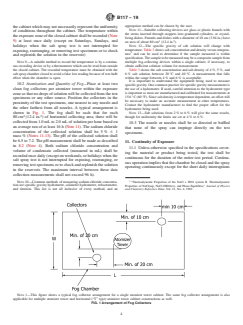
the test specimens, one nearest to any nozzle and the other farthest from all nozzles. A typical arrangement is shown in Fig. 1. The
2 2
fog shall be such that for each 80 cm (12.4 in. ) of horizontal collecting area, there will be collected from 1.01.0 mL to 2.0 mL
TABLE 2 Suggested Temperature and Pressure Guideline
for the Top of the Air Saturator Tower for the Operation of a Test
at 35°C (95°F)35 °C (95 °F)
Air Pressure, kPa Temperature, °C Air Pressure, psi Temperature, °F
83 46 12 114
96 47 14 117
110 48 16 119
124 49 18 121
B117 − 19
NOTE 1—This figure shows a typical fog collector arrangement for a single atomizer tower cabinet. The same fog collector arrangement is also
applicable for multiple atomizer tower and horizontal (“T” type) atomizer tower cabinet constructions as well.
FIG. 1 Arrangement of Fog Collectors
of solution per hour based on an average run of at least 16 h (Note 11). The sodium chloride concentration of the collected solution
shall be 55 % 6 1 mass % (Notes 11-13). The pH of the collected solution shall be 6.5 to 7.2. The pH measurement shall be made
as described in 8.2 (Note 4). Both sodium chloride concentration and volume of condensate collected (measured in mL) shall be
recorded once daily (except on weekends, or holidays when the salt spray test is not interrupted for exposing, rearranging, or
removing test specimens or to check and replenish the solution in the reservoir. The maximum interval between these data
collection measurements shall not exceed 96 h).
NOTE 10—Common methods of measuring sodium chloride concentration are specific gravity hydrometer, salimeter hydrometer, refractometer, and
titration. This list is not all inclusive of every method, and an appropriate method can be chosen by the user.
NOTE 11—Suitable collecting devices are glass or plastic funnels with the stems inserted through stoppers into graduated cylinders, or crystallizing
2 2
dishes. Funnels and dishes with a diameter of 10 cm (3.94 in.) have an area of about 80 cm (12.4 in. ).
TABLE 3 Temperature versus Density Data
Temperature Density, g/cm
°C (°F)
4-percent Salt Concentration 5-percent Salt Concentration 6-percent Salt
Concentration
20 (68) 1.025758 1.032360 1.038867
21 (69.8) 1.025480 1.032067 1.038560
22 (71.6) 1.025193 1.031766 1.038245
23 (73.4) 1.024899 1.031458 1.037924
24 (75.2) 1.024596 1.031142 1.037596
25 (77) 1.024286 1.030819 1.037261
26 (78.8) 1.023969 1.030489 1.036919
27 (80.6) 1.023643 1.030152 1.036570
28 (82.4) 1.023311 1.029808 1.036215
29 (84.2) 1.022971 1.029457 1.035853
30 (86) 1.022624 1.029099 1.035485
31 (87.8) 1.022270 1.028735 1.035110
32 (89.6) 1.021910 1.028364 1.034729
33 (91.4) 1.021542 1.027986 1.034343
34 (93.2) 1.021168 1.027602 1.033950
35 (95) 1.020787 1.027212 1.033551
36 (96.8) 1.020399 1.026816 1.033146
37 (98.6) 1.020006 1.026413 1.032735
38 (100.4) 1.019605 1.026005 1.032319
39 (102.2) 1.019199 1.025590 1.031897
40 (104) 1.018786 1.025170 1.031469
B117 − 19
NOTE 12—The specific gravity of salt solution will change with temperature. Table 3 shows salt concentration and density versus temperature and
can be used to determine if the sample measured is within specification. The sample to be measured may be a composite sample from multiple
fog-collecting devices within a single cabinet, if necessary, to obtain sufficient solution volume for measurement.
Table 3 shows the salt concentration and salt density of 4 %, 5 %
...