

ASTM D5493-23
(Test Method)Standard Test Method for Permittivity of Geotextiles Under Load
General Information
- Abstract
SIGNIFICANCE AND USE
5.1 The thickness of a geotextile decreases with increase in the normal compressive stress. This decrease in thickness may result in the partial closing or the opening of the voids of geotextile depending on its initial structure and the boundary conditions.
5.2 This test method measures the permittivity due to a change of void structure of a geotextile as a result of an applied compressive stress.
SCOPE
1.1 This test method covers the determination of the water permittivity behavior of geotextiles in a direction normal to the plane of the geotextile when subjected to specific normal compressive loads.
1.2 Use of this test method is limited to geotextiles. This test method is not intended for application with geotextile-related products such as geogrids, geonets, geomembranes, and other geocomposites.
1.3 The values stated in SI units are to be regarded as the standard. The inch-pound units given in parentheses are for information only.
1.4 This standard does not purport to address all of the safety concerns, if any, associated with its use. It is the responsibility of the user of this standard to establish appropriate safety, health, and environmental practices and determine the applicability of regulatory limitations prior to use.
1.5 This international standard was developed in accordance with internationally recognized principles on standardization established in the Decision on Principles for the Development of International Standards, Guides and Recommendations issued by the World Trade Organization Technical Barriers to Trade (TBT) Committee.
- Status
- Published
- Publication Date
- 30-Apr-2023
- Technical Committee
- D35 - Geosynthetics
- Drafting Committee
- D35.03 - Permeability and Filtration
Overview
ASTM D5493-23 is the international standard test method developed by ASTM International for determining the permittivity of geotextiles under load. This method focuses on measuring the water flow rate through geotextile materials in a direction normal (perpendicular) to the fabric plane while they are subjected to specific compressive stresses. The primary objective is to evaluate how the structure of a geotextile changes under pressure and how this affects its hydraulic behavior - a critical factor for the selection and specification of geotextiles in civil and geotechnical engineering applications.
This standard is applicable exclusively to geotextile materials and does not cover related products like geogrids, geonets, geomembranes, or geocomposites.
Key Topics
Permittivity Measurement: The test method measures the volumetric flow rate of water per unit cross-sectional area per unit head, providing a quantifiable value of geotextile permittivity under varying normal loads.
Effect of Load: The thickness and internal void structure of geotextiles change when compressive stress is applied, directly affecting their permeability properties.
Test Direction: The standard specifies water flow measurement normal to the geotextile plane, which simulates real-world conditions when geotextiles are subjected to overlying soils or loads.
Apparatus and Setup: The method employs a constant head permeameter with specific requirements to ensure accurate and repeatable results. Proper specimen sampling, calibration of equipment, and use of de-aired water are integral parts of the procedure.
Data Reporting: The standard emphasizes consistent reporting, including test conditions, sample details, apparatus properties, and calculations for permittivity.
Applications
ASTM D5493-23 is widely used for:
- Product Evaluation: Assessing the suitability of geotextiles for separation, filtration, drainage, and protection functions in civil engineering projects, particularly where water movement and soil stability are concerns.
- Quality Control: Verifying the hydraulic properties of manufactured geotextiles against project specifications or quality benchmarks.
- Design Optimization: Selecting appropriate geotextile materials based on their ability to maintain required permittivity under expected field loads, thus preventing issues like soil clogging, waterlogging, or structure failure.
- Research and Development: Supporting manufacturers and engineers in developing new geotextile products with enhanced performance under compressive stresses.
- Regulatory Compliance: Providing standardized data required for compliance with international or project-specific geosynthetics standards.
Related Standards
For comprehensive testing and understanding of geotextile performance and properties, the following ASTM standards are closely related to ASTM D5493-23:
- ASTM D123: Terminology Relating to Textiles
- ASTM D653: Terminology Relating to Soil, Rock, and Contained Fluids
- ASTM D4354: Practice for Sampling of Geosynthetics and Rolled Erosion Control Products (RECPs) for Testing
- ASTM D4439: Terminology for Geosynthetics
- ASTM D4491/D4491M: Test Methods for Water Permeability of Geotextiles by Permittivity
- ASTM D4716/D4716M: Test Method for Determining In-plane Flow Rate per Unit Width and Hydraulic Transmissivity of a Geosynthetic
- ASTM E11: Specification for Woven Wire Test Sieve Cloth and Test Sieves
Practical Value
Accurate measurement of geotextile permittivity under compressive loads is essential for designing reliable and durable geotechnical structures. By following ASTM D5493-23, engineers and manufacturers ensure that geotextile materials are properly evaluated for critical functions such as drainage and filtration, even under the challenging conditions found in real-world applications. This contributes to improved project performance, enhanced sustainability, and reduced maintenance costs in infrastructure and environmental projects.
Keywords: ASTM D5493-23, geotextile permittivity, geotextile under load, water permeability, hydraulic properties, geosynthetics testing, civil engineering standards, compressive stress, filtration, drainage
Relations
- Effective Date
- 01-Feb-2024
- Effective Date
- 01-May-2020
- Effective Date
- 15-Apr-2018
- Effective Date
- 01-Aug-2017
- Effective Date
- 01-Mar-2017
- Refers
ASTM D4491/D4491M-17 - Standard Test Methods for Water Permeability of Geotextiles by Permittivity - Effective Date
- 01-Jan-2017
- Refers
ASTM D4491/D4491M-16 - Standard Test Methods for Water Permeability of Geotextiles by Permittivity - Effective Date
- 01-Jul-2016
- Effective Date
- 15-Sep-2015
- Effective Date
- 01-Sep-2015
- Effective Date
- 01-Sep-2015
- Effective Date
- 01-Jul-2015
- Refers
ASTM D4491/D4491M-15 - Standard Test Methods for Water Permeability of Geotextiles by Permittivity - Effective Date
- 01-Jul-2015
- Effective Date
- 01-Apr-2015
- Effective Date
- 01-Aug-2014
- Effective Date
- 01-Mar-2014
Get Certified
Connect with accredited certification bodies for this standard

Control Union Certifications
Global certification for agriculture and sustainability.

Hohenstein Institut
Textile testing and certification.

Bureau Veritas Bangladesh
Bureau Veritas certification services in Bangladesh.
Sponsored listings
Frequently Asked Questions
ASTM D5493-23 is a standard published by ASTM International. Its full title is "Standard Test Method for Permittivity of Geotextiles Under Load". This standard covers: SIGNIFICANCE AND USE 5.1 The thickness of a geotextile decreases with increase in the normal compressive stress. This decrease in thickness may result in the partial closing or the opening of the voids of geotextile depending on its initial structure and the boundary conditions. 5.2 This test method measures the permittivity due to a change of void structure of a geotextile as a result of an applied compressive stress. SCOPE 1.1 This test method covers the determination of the water permittivity behavior of geotextiles in a direction normal to the plane of the geotextile when subjected to specific normal compressive loads. 1.2 Use of this test method is limited to geotextiles. This test method is not intended for application with geotextile-related products such as geogrids, geonets, geomembranes, and other geocomposites. 1.3 The values stated in SI units are to be regarded as the standard. The inch-pound units given in parentheses are for information only. 1.4 This standard does not purport to address all of the safety concerns, if any, associated with its use. It is the responsibility of the user of this standard to establish appropriate safety, health, and environmental practices and determine the applicability of regulatory limitations prior to use. 1.5 This international standard was developed in accordance with internationally recognized principles on standardization established in the Decision on Principles for the Development of International Standards, Guides and Recommendations issued by the World Trade Organization Technical Barriers to Trade (TBT) Committee.
SIGNIFICANCE AND USE 5.1 The thickness of a geotextile decreases with increase in the normal compressive stress. This decrease in thickness may result in the partial closing or the opening of the voids of geotextile depending on its initial structure and the boundary conditions. 5.2 This test method measures the permittivity due to a change of void structure of a geotextile as a result of an applied compressive stress. SCOPE 1.1 This test method covers the determination of the water permittivity behavior of geotextiles in a direction normal to the plane of the geotextile when subjected to specific normal compressive loads. 1.2 Use of this test method is limited to geotextiles. This test method is not intended for application with geotextile-related products such as geogrids, geonets, geomembranes, and other geocomposites. 1.3 The values stated in SI units are to be regarded as the standard. The inch-pound units given in parentheses are for information only. 1.4 This standard does not purport to address all of the safety concerns, if any, associated with its use. It is the responsibility of the user of this standard to establish appropriate safety, health, and environmental practices and determine the applicability of regulatory limitations prior to use. 1.5 This international standard was developed in accordance with internationally recognized principles on standardization established in the Decision on Principles for the Development of International Standards, Guides and Recommendations issued by the World Trade Organization Technical Barriers to Trade (TBT) Committee.
ASTM D5493-23 is classified under the following ICS (International Classification for Standards) categories: 59.080.70 - Geotextiles. The ICS classification helps identify the subject area and facilitates finding related standards.
ASTM D5493-23 has the following relationships with other standards: It is inter standard links to ASTM D4439-24, ASTM D4354-12(2020), ASTM D4439-18, ASTM D4439-17, ASTM D123-17, ASTM D4491/D4491M-17, ASTM D4491/D4491M-16, ASTM D123-15b, ASTM D123-15a, ASTM D4439-15a, ASTM D4439-15, ASTM D4491/D4491M-15, ASTM D123-15, ASTM D653-14, ASTM D4439-14. Understanding these relationships helps ensure you are using the most current and applicable version of the standard.
ASTM D5493-23 is available in PDF format for immediate download after purchase. The document can be added to your cart and obtained through the secure checkout process. Digital delivery ensures instant access to the complete standard document.
Standards Content (Sample)
This international standard was developed in accordance with internationally recognized principles on standardization established in the Decision on Principles for the
Development of International Standards, Guides and Recommendations issued by the World Trade Organization Technical Barriers to Trade (TBT) Committee.
Designation: D5493 − 23
Standard Test Method for
Permittivity of Geotextiles Under Load
This standard is issued under the fixed designation D5493; the number immediately following the designation indicates the year of
original adoption or, in the case of revision, the year of last revision. A number in parentheses indicates the year of last reapproval. A
superscript epsilon (´) indicates an editorial change since the last revision or reapproval.
1. Scope Geotextiles by Permittivity
D4716/D4716M Test Method for Determining the (In-plane)
1.1 This test method covers the determination of the water
Flow Rate per Unit Width and Hydraulic Transmissivity
permittivity behavior of geotextiles in a direction normal to the
of a Geosynthetic Using a Constant Head
plane of the geotextile when subjected to specific normal
E11 Specification for Woven Wire Test Sieve Cloth and Test
compressive loads.
Sieves
1.2 Use of this test method is limited to geotextiles. This test
method is not intended for application with geotextile-related
3. Terminology
products such as geogrids, geonets, geomembranes, and other
3.1 Definitions:
geocomposites.
3.1.1 geotextile, n—any permeable textile material used
1.3 The values stated in SI units are to be regarded as the
with foundation, soil, rock, earth, or any other geotechnical
standard. The inch-pound units given in parentheses are for
engineering related material as an integral part of a manmade
information only.
project, structure, or system (see Terminology D4439).
1.4 This standard does not purport to address all of the
3.1.2 hydraulic gradient, i, n—the loss of hydraulic head per
safety concerns, if any, associated with its use. It is the
unit distance of flow, dh/dL (see Test Method D4716/
responsibility of the user of this standard to establish appro-
D4716M).
priate safety, health, and environmental practices and deter-
–1
3.1.3 permittivity, (ψ), (T ), n—of geotextiles, the volumet-
mine the applicability of regulatory limitations prior to use.
ric flow rate of water per unit cross-sectional area per unit head
1.5 This international standard was developed in accor-
under laminar flow conditions, in the normal direction through
dance with internationally recognized principles on standard-
a geotextile (see Terminology D4439).
ization established in the Decision on Principles for the
3.2 For the definitions of other terms relating to geotextiles,
Development of International Standards, Guides and Recom-
refer to Terminology D4439. For the definitions of textile
mendations issued by the World Trade Organization Technical
terms, refer to Terminology D123. For the definitions of
Barriers to Trade (TBT) Committee.
coefficient of permeability, refer to Terminology D653.
2. Referenced Documents
4. Summary of Test Method
2.1 ASTM Standards:
4.1 This test method provides a procedure for measuring the
D123 Terminology Relating to Textiles
water flow, in the normal direction, through a known cross
D653 Terminology Relating to Soil, Rock, and Contained
section of a single layer of a geotextile at a predetermined
Fluids
constant hydraulic head over a range of applied normal
D4354 Practice for Sampling of Geosynthetics and Rolled
compressive stresses.
Erosion Control Products (RECPs) for Testing
D4439 Terminology for Geosynthetics
4.2 The permittivity of a geotextile, ψ, can be determined by
D4491/D4491M Test Methods for Water Permeability of
measuring the flow rate of water, in the normal direction,
through a known cross section of a geotextile at a predeter-
mined constant water head.
This test method is under the jurisdiction of ASTM Committee D35 on
Geosynthetics and is the direct responsibility of Subcommittee D35.03 on Perme- 4.3 Water flow through geotextiles can be laminar, transient,
ability and Filtration.
or turbulent, and therefore permittivity cannot be taken as a
Current edition approved May 1, 2023. Published June 2023. Originally
constant.
approved in 1993. Last previous edition approved in 2016 as D5493 – 06 (2016).
DOI: 10.1520/D5493-23.
For referenced ASTM standards, visit the ASTM website, www.astm.org, or 5. Significance and Use
contact ASTM Customer Service at service@astm.org. For Annual Book of ASTM
5.1 The thickness of a geotextile decreases with increase in
Standards volume information, refer to the standard’s Document Summary page on
the ASTM website. the normal compressive stress. This decrease in thickness may
Copyright © ASTM International, 100 Barr Harbor Drive, PO Box C700, West Conshohocken, PA 19428-2959. United States
D5493 − 23
result in the partial closing or the opening of the voids of 6.3.5 Two rigid metallic plates with the geometry shown in
geotextile depending on its initial structure and the boundary Fig. 1 act as a structural component on both sides of the wire
conditions. meshes. The lower one is supported by the apparatus, while the
upper one can move freely but is adjusted to the diameter of the
5.2 This test method measures the permittivity due to a
flow channel.
change of void structure of a geotextile as a result of an applied
6.3.6 The upper metallic plate is connected to a device
compressive stress.
capable of applying the requested normal load on the test
6. Apparatus
specimen (dead loads, air piston, or any suitable device). The
mechanical connection between the upper metallic plate and
6.1 The apparatus is a constant head permeameter. General
the loading mechanism consists of four rods, 3 mm in diameter,
guidance on the hydraulic design of a constant head permeame-
distributed on a circle approximately 30 mm in diameter.
ter can be found in Test Methods D4491/D4491M.
6.3.7 A dial or digital indicator can be connected to the
6.2 The components installed around the test specimen are
loading mechanism to monitor the specimen thickness during
designed in such a way that a normal load can be applied
the test.
uniformly on the entire flow surface without significantly
restraining the flow rate. The permittivity of the apparatus,
6.4 A de-airing system that may be a commercially avail-
calculated using the calibration curve established in Section 10,
able system, or one consisting of a vacuum pump capable of
shall be at least ten times greater than the permittivity of the
removing a minimum of 150 L/min of air in connection with a
test specimen under the hydraulic conditions prevailing during
non-collapsible storage tank with a large enough storage
a given test. However, the central deflection of the loading
capacity for the test series, or at least one specimen at a time.
mechanism on the plane of the geotextile shall not exceed
Allow the de-aired water to stand in closed storage under a
0.25 mm while subjected to the maximum normal load applied
slight vacuum until room temperature is attained.
during the test.
6.5 Thermometer or digital temperature sensor with a reso-
6.3 The recommended apparatus configuration for applying
lution of 0.1 °C.
the compressive stress is shown in Fig. 1.
6.3.1 Stopwatch accurate to 0.1 s.
7. Sampling
6.3.2 Water volume container accurate to 2 %.
6.3.3 An optimum flow diameter has been found to be 7.1 Lot Sample—As a lot sample for acceptance testing, take
50 mm to minimize hydraulic side effects while ensuring an at random the number of rolls of geotextile directed in an
optimum rigidity of the loading mechanism. applicable material specification and the supplier (for example,
6.3.4 A wire meshes, 1.0 mm in opening, complying with Practice D4354) or other agreement between the purchaser and
Specification E11 is installed as the contact surface on both the supplier. Consider rolls of geotextile to be the primary
sides of the test specimen. sampling units. If the specification requires sampling during
FIG. 1 Specimen Holder and Loading Mechanism
D5493 − 23
manufacture, select the rolls for the lot sample at uniformly where:
spaced time intervals throughout the production period.
ut = water viscosity at test temperature, mP, as determined
7.1.1 An adequate specification or other agreement between
from Table 1, and
the purchaser and the supplier requires taking into account the
u20 = water viscosity at 20 °C, mP.
variability between rolls of geotextile and between specimens
9. Specimen Preparation
from a swatch from a roll of geotextile so as to provide a
sampling plan with a meaningful producer’s risk, consumer’s
9.1 Prepare four specimens of the geotextile to be tested,
risk, acceptable quality level, and limiting quality level.
avoiding sampling along the edges of the geotextile roll to
ensure homogeneity of the specimens.
7.2 Laboratory Sample—Consider the units in the lot
sample as the units in the laboratory sample. Take a sample that
9.2 The minimum specimen flow area diameter is 50 mm.
will exclude material from the outer wrap of the roll or the
9.3 Referring to Fig. 2, select the specimens, A, B, C, and D
inner wrap around the core unless the sample is taken at the
as follows:
production site, at which point the inner and outer wrap
9.3.1 Take the four specimens along a diagonal line. Take
material may be u
...
This document is not an ASTM standard and is intended only to provide the user of an ASTM standard an indication of what changes have been made to the previous version. Because
it may not be technically possible to adequately depict all changes accurately, ASTM recommends that users consult prior editions as appropriate. In all cases only the current version
of the standard as published by ASTM is to be considered the official document.
Designation: D5493 − 06 (Reapproved 2016) D5493 − 23
Standard Test Method for
Permittivity of Geotextiles Under Load
This standard is issued under the fixed designation D5493; the number immediately following the designation indicates the year of
original adoption or, in the case of revision, the year of last revision. A number in parentheses indicates the year of last reapproval. A
superscript epsilon (´) indicates an editorial change since the last revision or reapproval.
1. Scope
1.1 This test method covers the determination of the water permittivity behavior of geotextiles in a direction normal to the plane
of the geotextile when subjected to specific normal compressive loads.
1.2 Use of this test method is limited to geotextiles. This test method is not intended for application with geotextile-related
products such as geogrids, geonets, geomembranes, and other geocomposites.
1.3 The values stated in SI units are to be regarded as the standard. The inch-pound units given in parentheses are for information
only.
1.4 This standard does not purport to address all of the safety concerns, if any, associated with its use. It is the responsibility
of the user of this standard to establish appropriate safety and healthsafety, health, and environmental practices and determine
the applicability of regulatory limitations prior to use.
1.5 This international standard was developed in accordance with internationally recognized principles on standardization
established in the Decision on Principles for the Development of International Standards, Guides and Recommendations issued
by the World Trade Organization Technical Barriers to Trade (TBT) Committee.
2. Referenced Documents
2.1 ASTM Standards:
D123 Terminology Relating to Textiles
D653 Terminology Relating to Soil, Rock, and Contained Fluids
D4354 Practice for Sampling of Geosynthetics and Rolled Erosion Control Products (RECPs) for Testing
D4439 Terminology for Geosynthetics
D4491/D4491M Test Methods for Water Permeability of Geotextiles by Permittivity
D4716/D4716M Test Method for Determining the (In-plane) Flow Rate per Unit Width and Hydraulic Transmissivity of a
Geosynthetic Using a Constant Head
E11 Specification for Woven Wire Test Sieve Cloth and Test Sieves
3. Terminology
3.1 Definitions:
This test method is under the jurisdiction of ASTM Committee D35 on Geosynthetics and is the direct responsibility of Subcommittee D35.03 on Permeability and
Filtration.
Current edition approved Jan. 1, 2016May 1, 2023. Published June 2016June 2023. Originally approved in 1993. Last previous edition approved in 20112016 as
D5493 – 06 (2016).(2011). DOI: 10.1520/D5493-06R16.10.1520/D5493-23.
For referenced ASTM standards, visit the ASTM website, www.astm.org, or contact ASTM Customer Service at service@astm.org. For Annual Book of ASTM Standards
volume information, refer to the standard’s Document Summary page on the ASTM website.
Copyright © ASTM International, 100 Barr Harbor Drive, PO Box C700, West Conshohocken, PA 19428-2959. United States
D5493 − 23
3.1.1 geotextile, n—any permeable textile material used with foundation, soil, rock, earth, or any other geotechnical engineering
related material as an integral part of a manmade project, structure, or system (see Terminology D4439).
3.1.2 hydraulic gradient, i, n—the loss of hydraulic head per unit distance of flow, dh/dL (see Test Method D4716/D4716M).
-1–1
3.1.3 permittivity, (ψ), (T ), nn——of geotextiles, the volumetric flow rate of water per unit cross-sectional area per unit head
under laminar flow conditions, in the normal direction through a geotextile (see Terminology D4439).
3.2 For the definitions of other terms relating to geotextiles, refer to Terminology D4439. For the definitions of textile terms, refer
to Terminology D123. For the definitions of coefficient of permeability, refer to Terminology D653.
4. Summary of Test Method
4.1 This test method provides a procedure for measuring the water flow, in the normal direction, through a known cross section
of a single layer of a geotextile at a predetermined constant hydraulic headshead over a range of applied normal compressive
stresses.
4.2 The permittivity of a geotextile, ψ, can be determined by measuring the flow rate of water, in the normal direction, through
a known cross section of a geotextile at a predetermined constant water heads. head.
4.3 Water flow through geotextiles can be laminar, transient, or turbulent, and therefore permittivity cannot be taken as a constant.
5. Significance and Use
5.1 The thickness of a geotextile decreases with increase in the normal compressive stress. This decrease in thickness may result
in the partial closing or the opening of the voids of geotextile depending on its initial structure and the boundary conditions.
5.2 This test method measures the permittivity due to a change of void structure of a geotextile as a result of an applied
compressive stress.
6. Apparatus
6.1 The apparatus is a constant head permeameter. General guidance on the hydraulic design of a constant head permeameter can
be found in Test Methods D4491/D4491M.
6.2 The components installed around the test specimen are designed in such a way that a normal load can be applied uniformly
on the entire flow surface without restraining significantly restraining the flow rate. The permittivity of the apparatus, calculated
using the calibration curve established in Section 10, shall be at least 10ten times greater than the permittivity of the test specimen
under the hydraulic conditions prevailing during a given test. However, the central deflection of the loading mechanism on the
plane of the geotextile shall not exceed 0.025 mm 0.25 mm while subjected to the maximum normal load applied during the test.
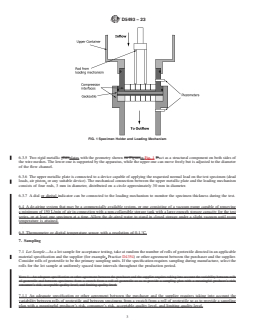
6.3 The recommended apparatus configuration for applying the compressive stress is shown in Fig. 1:.
6.3.1 Stopwatch accurate to 0.1 s.
6.3.2 Water volume container accurate to 2 %.
6.3.3 An optimum flow diameter has been found to be 50 mm to minimize hydraulic side effects while ensuring an optimum
rigidity of the loading mechanism.
6.3.4 A wire meshes, 1.0 mm in opening, complying with Specification E11 is installed as the contact surface on both sides of the
test specimen.
D5493 − 23
FIG. 1 Specimen Holder and Loading Mechanism
6.3.5 Two rigid metallic plateplates with the geometry shown on Figurein Fig. 1 2 act as a structural component on both sides of
the wire meshes. The lower one is supported by the apparatus, while the upper one can move freely but is adjusted to the diameter
of the flow channel.
6.3.6 The upper metallic plate is connected to a device capable of applying the requested normal load on the test specimen (dead
loads, air piston, or any suitable device). The mechanical connection between the upper metallic plate and the loading mechanism
consists of four rods, 3 mm in diameter, distributed on a circle approximately 30 mm in diameter.
6.3.7 A dial or digital indicator can be connected to the loading mechanism to monitor the specimen thickness during the test.
6.4 A de-airing system that may be a commercially available system, or one consisting of a vacuum pump capable of removing
a minimum of 150 L/min of air in connection with a non-collapsible storage tank with a large enough storage capacity for the test
series, or at least one specimen at a time. Allow the de-aired water to stand in closed storage under a slight vacuum until room
temperature is attained.
6.5 Thermometer or digital temperature sensor with a resolution of 0.1 °C.
7. Sampling
7.1 Lot Sample—As a lot sample for acceptance testing, take at random the number of rolls of geotextile directed in an applicable
material specification and the supplier (for example, Practice D4354) or other agreement between the purchaser and the supplier.
Consider rolls of geotextile to be the primary sampling units. If the specification requires sampling during manufacture, select the
rolls for the lot sample at uniformly spaced time intervals throughout the production period.
NOTE 1—An adequate specification or other agreement between the purchaser and the supplier requires taking into account the variability between rolls
of geotextile and between specimens from a swatch from a roll of geotextile so as to provide a sampling plan with a meaningful producer’s risk,
consumer’s risk, acceptable quality level, and limiting quality level.
7.1.1 An adequate specification or other agreement between the purchaser and the supplier requires taking into account the
variability between rolls of geotextile and between specimens from a swatch from a roll of geotextile so as to provide a sampling
plan with a meaningful producer’s risk, consumer’s risk, acceptable quality level, and limiting quality level.
D5493 − 23
7.2 Laboratory Sample—Consider the units in the lot sample as the units in the laboratory sample. Take a sample that will exclude
material from the outer wrap of the roll or the inner wrap around the core unless the sample is taken at the production site, at which
point the inner and outer wrap material may be used.
8. Test Water Preparation
8.1 The test water shall be potable tap water or deionized water as prepared below.
8.2 De-air the test water to provide reproducible test results.
8.3 De-air the water used for saturation.
8.4 De-air the water under a vacuum of 710 mm (28 in.) of mercury (Hg) for the period of time to bring the dissolved oxygen
content down to a maximum of 6 ppm.
8.5 Use dissolved oxygen meter or commercially available chemical kits to determine the dissolved oxygen content.
8.5 The deaired system may be a commercially available system, or one consisting of a vacuum pump capable of removing a
minimum of 150 L/min of air in connection with a non-collapsible storage tank with a large enough storage capacity for the test
series, or at least one specimen at a time. Allow the deaired water to stand in closed storage under a slight vacuum until room
temperature is attained.
8.6 If water temperature other than 20°C20 °C is being used, make a temperature correction to the resulting value of permittivity.
8.7 Determine the temperature correction factor using the following equation:
Rt 5 ut/u20 (1)
where:
ut = water viscosity at test temperature, mP, as determined from Table 1, and
u20 = water viscosity at 20°C, mP.
u20 = water viscosity at 20 °C, mP.
9. Specimen Preparation
9.1 Prepare four specimens of the geotextile to be teste
...