

ASTM G50-20
(Practice)Standard Practice for Conducting Atmospheric Corrosion Tests on Metals
General Information
- Abstract
SIGNIFICANCE AND USE
3.1 The procedures described herein can be used to evaluate the corrosion resistance of metals when exposed to the weather, as well as to evaluate the relative corrosivity of the atmosphere at specific locations. Because of the variability and complexity of weather effects and the industrial and natural factors influencing the atmospheric corrosivity of a test site, a multi-year exposure period should be considered to minimize their influence. Also, as corrosivity may vary at a site from season to season, exposures should be made either at the same time of the year to minimize variability or these differences should be established by multiple exposures.
3.2 Control specimens should always be employed in weathering tests. The control specimens should be from a material having established weathering characteristics. A substantial amount of corrosion data shall have been accumulated for the control specimens. It is also good practice to retain samples of all materials exposed so that possible effects of long-term aging can be measured.
SCOPE
1.1 This practice covers and defines conditions for exposure of metals and alloys to the weather. It sets forth the general procedures that should be followed in any atmospheric test. It is presented as an aid in conducting atmospheric corrosion tests so that some of the pitfalls of such testing may be avoided. As such, it is concerned mainly with panel exposures to obtain data for comparison purposes.
1.2 The values stated in inch-pound units are to be regarded as standard. The values given in parentheses are mathematical conversions to SI units that are provided for information only and are not considered standard.
1.3 This standard does not purport to address all of the safety concerns, if any, associated with its use. It is the responsibility of whoever uses this standard to consult and establish appropriate safety, health, and environmental practices and determine the applicability of regulatory limitations prior to use.
1.4 This international standard was developed in accordance with internationally recognized principles on standardization established in the Decision on Principles for the Development of International Standards, Guides and Recommendations issued by the World Trade Organization Technical Barriers to Trade (TBT) Committee.
- Status
- Published
- Publication Date
- 31-Oct-2020
- Technical Committee
- G01 - Corrosion of Metals
Overview
ASTM G50-20: Standard Practice for Conducting Atmospheric Corrosion Tests on Metals describes best practices and procedures for exposing metals and alloys to atmospheric conditions to evaluate their corrosion resistance. Developed by ASTM International, this widely recognized standard sets forth the general requirements and methodologies for atmospheric corrosion testing, focusing mainly on panel exposures to obtain data for comparing materials or site conditions. By following the standard, organizations can reliably assess the impact of natural weathering and site-specific factors on metallic materials, helping guide material selection, maintenance, and protective strategies in a variety of environmental settings.
Key Topics
- Exposure Conditions: Defines how metals and alloys should be exposed to the weather, with a focus on test sites representative of potential use environments (industrial, rural, marine, etc.).
- Test Racks and Frames: Provides guidelines for constructing and placing racks and frames in ways that maximize exposure and minimize site contamination or interference.
- Specimen Selection and Preparation: Outlines recommendations for specimen size, shape, thickness, and preparation, including cleaning and identification methods.
- Use of Control Specimens: Emphasizes the importance of including control specimens with known weathering characteristics for comparison purposes.
- Test Duration and Evaluation: Advises on planning multi-year exposure tests and periodic removal and evaluation of specimens to account for seasonal or long-term site variability.
- Data Reporting: Requires detailed documentation of test methods, environmental conditions, and evaluation results, ensuring consistency and comparability of corrosion data.
- Safety Considerations: Highlights the user’s responsibility to implement appropriate safety and environmental practices when conducting tests.
Applications
ASTM G50-20 is essential for industries and organizations needing to understand how metals respond to atmospheric exposure, including:
- Material Selection: Comparing corrosion resistance of different metals and alloys when designing structures or products for outdoor use in diverse climates.
- Site Assessment: Evaluating the corrosivity of specific locations to assess maintenance needs or protective coating requirements for infrastructure, such as bridges, pipelines, transmission towers, and marine installations.
- Quality Assurance: Verifying the performance of metallic coatings or treatments against established benchmarks using standardized exposure and evaluation methods.
- Product Development: Supporting research and development of new alloys, coatings, or corrosion-resistant solutions by providing reliable, reproducible data on atmospheric effects.
- Regulatory and Environmental Compliance: Assisting in documenting and demonstrating the suitability of materials for use in regulated industries or challenging environments.
Related Standards
Several other ASTM standards are frequently referenced or used in conjunction with ASTM G50-20 to ensure comprehensive atmospheric corrosion testing practices:
- ASTM G1: Practice for preparing, cleaning, and evaluating corrosion test specimens.
- ASTM G33: Practice for recording data from atmospheric corrosion tests of metallic-coated steel specimens.
- ASTM G46: Guide for examination and evaluation of pitting corrosion.
- ASTM G84: Practice for measurement of time-of-wetness on surfaces exposed to wetting conditions.
- ASTM G91: Practice for monitoring atmospheric SO₂ deposition rate for atmospheric corrosivity evaluation.
- ASTM G92: Practice for characterization of atmospheric test sites.
- ASTM G140: Test method for determining atmospheric chloride deposition rate by the wet candle method.
- ASTM A380/A380M: Practice for cleaning, descaling, and passivation of stainless steel parts, equipment, and systems.
- ASTM D2010/D2010M: Test methods for evaluation of total sulfation activity in the atmosphere by the lead dioxide technique.
By adhering to ASTM G50-20 and related standards, professionals can ensure consistent, reliable atmospheric corrosion test results that drive better decisions regarding materials and structures exposed to natural weathering. These practices support improved durability, safety, and cost-effectiveness in engineering and maintenance programs.
Relations
- Effective Date
- 01-Oct-2019
- Effective Date
- 01-May-2018
- Effective Date
- 01-May-2017
- Effective Date
- 01-Nov-2014
- Effective Date
- 01-May-2013
- Effective Date
- 15-Feb-2013
- Effective Date
- 01-Dec-2011
- Effective Date
- 01-Nov-2011
- Effective Date
- 01-Oct-2010
- Effective Date
- 01-Sep-2010
- Effective Date
- 01-Sep-2010
- Effective Date
- 01-May-2010
- Effective Date
- 01-May-2008
- Effective Date
- 01-May-2005
- Effective Date
- 01-Nov-2004
Get Certified
Connect with accredited certification bodies for this standard

Element Materials Technology
Materials testing and product certification.

Inštitut za kovinske materiale in tehnologije
Institute of Metals and Technology. Materials testing, metallurgical analysis, NDT.
Sponsored listings
Frequently Asked Questions
ASTM G50-20 is a standard published by ASTM International. Its full title is "Standard Practice for Conducting Atmospheric Corrosion Tests on Metals". This standard covers: SIGNIFICANCE AND USE 3.1 The procedures described herein can be used to evaluate the corrosion resistance of metals when exposed to the weather, as well as to evaluate the relative corrosivity of the atmosphere at specific locations. Because of the variability and complexity of weather effects and the industrial and natural factors influencing the atmospheric corrosivity of a test site, a multi-year exposure period should be considered to minimize their influence. Also, as corrosivity may vary at a site from season to season, exposures should be made either at the same time of the year to minimize variability or these differences should be established by multiple exposures. 3.2 Control specimens should always be employed in weathering tests. The control specimens should be from a material having established weathering characteristics. A substantial amount of corrosion data shall have been accumulated for the control specimens. It is also good practice to retain samples of all materials exposed so that possible effects of long-term aging can be measured. SCOPE 1.1 This practice covers and defines conditions for exposure of metals and alloys to the weather. It sets forth the general procedures that should be followed in any atmospheric test. It is presented as an aid in conducting atmospheric corrosion tests so that some of the pitfalls of such testing may be avoided. As such, it is concerned mainly with panel exposures to obtain data for comparison purposes. 1.2 The values stated in inch-pound units are to be regarded as standard. The values given in parentheses are mathematical conversions to SI units that are provided for information only and are not considered standard. 1.3 This standard does not purport to address all of the safety concerns, if any, associated with its use. It is the responsibility of whoever uses this standard to consult and establish appropriate safety, health, and environmental practices and determine the applicability of regulatory limitations prior to use. 1.4 This international standard was developed in accordance with internationally recognized principles on standardization established in the Decision on Principles for the Development of International Standards, Guides and Recommendations issued by the World Trade Organization Technical Barriers to Trade (TBT) Committee.
SIGNIFICANCE AND USE 3.1 The procedures described herein can be used to evaluate the corrosion resistance of metals when exposed to the weather, as well as to evaluate the relative corrosivity of the atmosphere at specific locations. Because of the variability and complexity of weather effects and the industrial and natural factors influencing the atmospheric corrosivity of a test site, a multi-year exposure period should be considered to minimize their influence. Also, as corrosivity may vary at a site from season to season, exposures should be made either at the same time of the year to minimize variability or these differences should be established by multiple exposures. 3.2 Control specimens should always be employed in weathering tests. The control specimens should be from a material having established weathering characteristics. A substantial amount of corrosion data shall have been accumulated for the control specimens. It is also good practice to retain samples of all materials exposed so that possible effects of long-term aging can be measured. SCOPE 1.1 This practice covers and defines conditions for exposure of metals and alloys to the weather. It sets forth the general procedures that should be followed in any atmospheric test. It is presented as an aid in conducting atmospheric corrosion tests so that some of the pitfalls of such testing may be avoided. As such, it is concerned mainly with panel exposures to obtain data for comparison purposes. 1.2 The values stated in inch-pound units are to be regarded as standard. The values given in parentheses are mathematical conversions to SI units that are provided for information only and are not considered standard. 1.3 This standard does not purport to address all of the safety concerns, if any, associated with its use. It is the responsibility of whoever uses this standard to consult and establish appropriate safety, health, and environmental practices and determine the applicability of regulatory limitations prior to use. 1.4 This international standard was developed in accordance with internationally recognized principles on standardization established in the Decision on Principles for the Development of International Standards, Guides and Recommendations issued by the World Trade Organization Technical Barriers to Trade (TBT) Committee.
ASTM G50-20 is classified under the following ICS (International Classification for Standards) categories: 77.060 - Corrosion of metals. The ICS classification helps identify the subject area and facilitates finding related standards.
ASTM G50-20 has the following relationships with other standards: It is inter standard links to ASTM G140-02(2019), ASTM G91-11(2018), ASTM D2010/D2010M-98(2017), ASTM G140-02(2014), ASTM G46-94(2013), ASTM A380/A380M-13, ASTM G1-03(2011), ASTM G91-11, ASTM D2010/D2010M-98(2010), ASTM G91-97(2010), ASTM G92-86(2010), ASTM G33-99(2010), ASTM G140-02(2008), ASTM G46-94(2005), ASTM G91-97(2004). Understanding these relationships helps ensure you are using the most current and applicable version of the standard.
ASTM G50-20 is available in PDF format for immediate download after purchase. The document can be added to your cart and obtained through the secure checkout process. Digital delivery ensures instant access to the complete standard document.
Standards Content (Sample)
This international standard was developed in accordance with internationally recognized principles on standardization established in the Decision on Principles for the
Development of International Standards, Guides and Recommendations issued by the World Trade Organization Technical Barriers to Trade (TBT) Committee.
Designation: G50 − 20
Standard Practice for
Conducting Atmospheric Corrosion Tests on Metals
This standard is issued under the fixed designation G50; the number immediately following the designation indicates the year of original
adoption or, in the case of revision, the year of last revision.Anumber in parentheses indicates the year of last reapproval.Asuperscript
epsilon (´) indicates an editorial change since the last revision or reapproval.
1. Scope sion Test Specimens
G33 Practice for Recording Data from Atmospheric Corro-
1.1 This practice covers and defines conditions for exposure
sion Tests of Metallic-Coated Steel Specimens
of metals and alloys to the weather. It sets forth the general
G46 Guide for Examination and Evaluation of Pitting Cor-
procedures that should be followed in any atmospheric test. It
rosion
ispresentedasanaidinconductingatmosphericcorrosiontests
G84 Practice for Measurement of Time-of-Wetness on Sur-
so that some of the pitfalls of such testing may be avoided.As
faces Exposed to Wetting Conditions as in Atmospheric
such, it is concerned mainly with panel exposures to obtain
Corrosion Testing
data for comparison purposes.
G91 Practice for Monitoring Atmospheric SO Deposition
1.2 The values stated in inch-pound units are to be regarded
Rate for Atmospheric Corrosivity Evaluation
as standard. The values given in parentheses are mathematical
G92 Practice for Characterization of Atmospheric Test Sites
conversions to SI units that are provided for information only
G140 Test Method for Determining Atmospheric Chloride
and are not considered standard.
Deposition Rate by Wet Candle Method
1.3 This standard does not purport to address all of the
safety concerns, if any, associated with its use. It is the
3. Significance and Use
responsibility of whoever uses this standard to consult and
3.1 The procedures described herein can be used to evaluate
establish appropriate safety, health, and environmental prac-
thecorrosionresistanceofmetalswhenexposedtotheweather,
tices and determine the applicability of regulatory limitations
as well as to evaluate the relative corrosivity of the atmosphere
prior to use.
at specific locations. Because of the variability and complexity
1.4 This international standard was developed in accor-
of weather effects and the industrial and natural factors
dance with internationally recognized principles on standard-
influencing the atmospheric corrosivity of a test site, a multi-
ization established in the Decision on Principles for the
year exposure period should be considered to minimize their
Development of International Standards, Guides and Recom-
mendations issued by the World Trade Organization Technical influence.Also, as corrosivity may vary at a site from season to
Barriers to Trade (TBT) Committee. season, exposures should be made either at the same time of
the year to minimize variability or these differences should be
2. Referenced Documents
established by multiple exposures.
2.1 ASTM Standards:
3.2 Control specimens should always be employed in
A380/A380M Practice for Cleaning, Descaling, and Passi-
weathering tests. The control specimens should be from a
vation of Stainless Steel Parts, Equipment, and Systems
material having established weathering characteristics. A sub-
D2010/D2010M Test Methods for Evaluation of Total Sul-
stantial amount of corrosion data shall have been accumulated
fation Activity in the Atmosphere by the Lead Dioxide
for the control specimens. It is also good practice to retain
Technique
samples of all materials exposed so that possible effects of
G1 Practice for Preparing, Cleaning, and Evaluating Corro-
long-term aging can be measured.
4. Test Sites
This practice is under the jurisdiction of ASTM Committee G01 on Corrosion
of Metals and is the direct responsibility of Subcommittee G01.04 on Corrosion of
4.1 Test sites should be chosen at a number of locations
Metals in Natural Atmospheric and Aqueous Environments.
representative of the atmospheric environments where the
Current edition approved Nov. 1, 2020. Published November 2020. Originally
metals or alloys are likely to be used. If such information is not
approved in 1976. Last previous edition approved in 2015 as G50–10(2015). DOI:
10.1520/G0050-20.
available, the selection should include sites typical of
For referenced ASTM standards, visit the ASTM website, www.astm.org, or
industrial, rural, and marine atmospheres. Test site
contact ASTM Customer Service at service@astm.org. For Annual Book of ASTM
characterization, if needed, shall be conducted in accordance
Standards volume information, refer to the standard’s Document Summary page on
the ASTM website. with Practice G92.
Copyright © ASTM International, 100 Barr Harbor Drive, PO Box C700, West Conshohocken, PA 19428-2959. United States
G50−20
4.2 Exposure racks should be located in cleared, well- sizes. This is a convenience when it is not possible to prepare
drained areas such that the exposed specimens will be sub- specimens of a preplanned size, and it is often helpful in fitting
jected to the full effects of the atmosphere at the location of the the specimens snugly into the frames.
test site. Shadows of trees, buildings, or structures should not
5.5 The racks should be designed to give exposure to as
fall on the specimens, and local contamination of the atmo-
large an area of the underside of the specimens as possible.
sphereshouldbeavoided,unlessthespecificinfluencesofsuch
Structural members of the rack should not be located directly
conditions are intended to be assessed.
under the specimens where they would shelter the underside of
4.3 In special cases, the exposure racks may be partially
the specimens.
shelteredtoallowaccumulationofcorrosivematerialsfromthe
5.6 As most published data on atmospheric corrosion of
air but at the same time prevent washing by rain. If sheltering
metals are based on an exposure angle of 30° from the
is used, its purpose and configuration should be described in
horizontal, it is recommended that this angle be used in
detail.
conjunction with an orientation facing the Equator. Racks
4.4 If local pollution effects are to be investigated, the
should be designed so that the lowest specimens are at least 30
samples should be exposed at different distances from the
in. (760 mm) above the ground. See Notes 2 and 3.
source and at different elevations. Where it is particularly
NOTE 2—Maximum exposure to the sun may be obtained by exposing
important to obtain corrosion rates involving a micro-
specimens facing the Equator at an angle equal to the latitude of the test
environment, samples should be mounted directly on the
site. Exposure at this angle will yield the lowest corrosion rates for most
structure involved. Suitable attachment must be devised for
materials. Although these corrosion rates will change at other angles of
each case.
exposure,theorderofmeritestablishedforeachmaterialwillbethesame.
NOTE 3—In special instances, it may be desirable to orient racks and
5. Exposure Racks and Frames frames in the direction of a specific corrodent source, for example, the
ocean, for marine environments. Also, this practice should not be
5.1 Test racks and frames should be constructed of a
construed as prohibiting special orientation of test frames for specific test
material that will remain intact for the entire proposed period
purposes, but it is strongly suggested that in such cases testing also be
of exposure. Galvanized pipe has been found adequate for rack done in accordance with this practice so that a basis point for comparison
with available data is determined. Any special orientation or preferential
constructioninmostenvironments(Note1).Type304stainless
source of corrosion should be specifically identified in the exposure site
steel is adequate as a frame material for all environments. For
description.
marine exposures, alloy 400 UNS No. N04400 or Type 316
5.7 ArackofthedesignanddimensionsshowninFig.2will
stainless steel has also been successfully used. Aluminum
give the correct exposure angle and can support the specimen
(5052 and 6061-T6) and copper frames also have given
frame described in 5.4.
satisfactory service in a wide range of environments. Care
should be observed in the use of copper frames, as corrosion
5.8 The ground under the racks should be kept free of
products splashed during rainfall might affect the corrosion of
weeds, bushes, and debris. Organic herbicides, defoliants, or
other metals such as aluminum or magnesium.
pesticides should not be used for this purpose.
NOTE 1—If galvanized pipe is field-threaded, thread areas must be
protected to ensure joint integrity for long exposure periods. In severe
6. Test Specimens
environments, additional coatings may be required to provide corrosion-
6.1 When the material to be tested is in sheet form, a
free service.
specimen size of 4 in. by 6 in. (100 mm by 150 mm) is
5.2 Racks and frames also may be constructed of wood.
appropriate. Specimens may be larger, for example, 4 in. by 8
Insulators may be attached to wooden frames with aluminum
in. (100 mm by 200 mm), to suit a particular test; however, the
bronze, alloy 400, or stainless steel screws. In such a case, no
specimens preferably should not be smaller than 4 in. by 6 in.
wood sections should be used with dimensions less than 2 in.
by 4 in. (50 mm by 100 mm), and at least two coats of an
6.2 Toassureadequaterigidityofthespecimensontherack,
exterior grade paint or enamel over a suitable primer must be
a minimum thickness of 0.030 in. (0.75 mm) is suggested. It
applied. Periodic maintenance will be required on all wood
may be difficult to accommodate thicknesses greater than
construction.
0.250 in. (6.25 mm) in the insulator grooves. (Special deep-
throated insulators can be obtained to accommodate thicker
5.3 Solid, glazed, electrical insulator knobs should be used
specimens, or the edges of thicker specimens can be machined
to hold the specimens on the frames, using stainless steel, alloy
to fit standard insulators.)
400, aluminum, nylon, or bronze bolts and nuts. Specimens
shallbemountedinthegroovesoftheseinsulators.Inselecting
6.3 When it is desired to test samples of odd shapes, such as
fasteners for use on specific frame materials, care should be
bolts, nuts, pipes, angles, assemblies, and structures, etc., a
taken to avoid unfavorable galvanic relationships.
means of supporting them in the test racks must be devised. It
5.4 Asuitable frame for mounting the insulators is shown in is important that the specimens be electrically insulated from
Fig. 1. This frame will accommodate 70 standard 4 in. by 6 in. their respective supports and from each other to prevent
(100 mm by 150 mm) specimens; other sizes can be mounted unintentional galvanic corrosion. However, if desired, galvanic
by rearranging the insulators in the holes provided. It is couples of dissimilar metals can be exposed on these frames.
acceptable to slot the holes in the frames in such a manner that Efforts should be made to minimize crevices between speci-
the mounting frames are adjustable for specimens of other mens and support materials.
G50−20
FIG. 1 Suitable Test Frame
6.4 The total number of test specimens required should be 6.5 Included with each series of test specimens should be an
determinedfromaknowledgeofthedurationofthetestandthe appropriate number of control specimens, as defined in 3.2.
planned removals of the specimens for intermediate evalua-
7. Preparation of Test Sp
...
This document is not an ASTM standard and is intended only to provide the user of an ASTM standard an indication of what changes have been made to the previous version. Because
it may not be technically possible to adequately depict all changes accurately, ASTM recommends that users consult prior editions as appropriate. In all cases only the current version
of the standard as published by ASTM is to be considered the official document.
Designation: G50 − 10 (Reapproved 2015) G50 − 20
Standard Practice for
Conducting Atmospheric Corrosion Tests on Metals
This standard is issued under the fixed designation G50; the number immediately following the designation indicates the year of original
adoption or, in the case of revision, the year of last revision. A number in parentheses indicates the year of last reapproval. A superscript
epsilon (´) indicates an editorial change since the last revision or reapproval.
1. Scope
1.1 This practice covers and defines conditions for exposure of metals and alloys to the weather. It sets forth the general procedures
that should be followed in any atmospheric test. It is presented as an aid in conducting atmospheric corrosion tests so that some
of the pitfalls of such testing may be avoided. As such, it is concerned mainly with panel exposures to obtain data for comparison
purposes.
1.2 The values stated in inch-pound units are to be regarded as standard. The values given in parentheses are mathematical
conversions to SI units that are provided for information only and are not considered standard.
1.3 This standard does not purport to address all of the safety concerns, if any, associated with its use. It is the responsibility
of whoever uses this standard to consult and establish appropriate safety safety, health, and healthenvironmental practices and
determine the applicability of regulatory limitations prior to use.
1.4 This international standard was developed in accordance with internationally recognized principles on standardization
established in the Decision on Principles for the Development of International Standards, Guides and Recommendations issued
by the World Trade Organization Technical Barriers to Trade (TBT) Committee.
2. Referenced Documents
2.1 ASTM Standards:
A380A380/A380M Practice for Cleaning, Descaling, and Passivation of Stainless Steel Parts, Equipment, and Systems
D2010/D2010M Test Methods for Evaluation of Total Sulfation Activity in the Atmosphere by the Lead Dioxide Technique
G1 Practice for Preparing, Cleaning, and Evaluating Corrosion Test Specimens
G33 Practice for Recording Data from Atmospheric Corrosion Tests of Metallic-Coated Steel Specimens
G46 Guide for Examination and Evaluation of Pitting Corrosion
G84 Practice for Measurement of Time-of-Wetness on Surfaces Exposed to Wetting Conditions as in Atmospheric Corrosion
Testing
G91 Practice for Monitoring Atmospheric SO Deposition Rate for Atmospheric Corrosivity Evaluation
G92 Practice for Characterization of Atmospheric Test Sites
G140 Test Method for Determining Atmospheric Chloride Deposition Rate by Wet Candle Method
3. Significance and Use
3.1 The procedures described herein can be used to evaluate the corrosion resistance of metals when exposed to the weather, as
This practice is under the jurisdiction of ASTM Committee G01 on Corrosion of Metals and is the direct responsibility of Subcommittee G01.04 on Atmospheric
CorrosionCorrosion of Metals in Natural Atmospheric and Aqueous Environments.
Current edition approved Nov. 1, 2015Nov. 1, 2020. Published December 2015November 2020. Originally approved in 1976. Last previous edition approved in 20102015
as G50G50–10(2015).–10. DOI: 10.1520/G0050-10R15.10.1520/G0050-20.
For referenced ASTM standards, visit the ASTM website, www.astm.org, or contact ASTM Customer Service at service@astm.org. For Annual Book of ASTM Standards
volume information, refer to the standard’sstandard’s Document Summary page on the ASTM website.
Copyright © ASTM International, 100 Barr Harbor Drive, PO Box C700, West Conshohocken, PA 19428-2959. United States
G50 − 20
well as to evaluate the relative corrosivity of the atmosphere at specific locations. Because of the variability and complexity of
weather effects and the industrial and natural factors influencing the atmospheric corrosivity of a test site, a multi-year exposure
period should be considered to minimize their influence. Also, as corrosivity may vary at a site from season to season, exposures
should be made either at the same time of the year to minimize variability or these differences should be established by multiple
exposures.
3.2 Control specimens should always be employed in weathering tests. The control specimens should be from a material having
established weathering characteristics. A substantial amount of corrosion data shall have been accumulated for the control
specimens. It is also good practice to retain samples of all materials exposed so that possible effects of long-term aging can be
measured.
4. Test Sites
4.1 Test sites should be chosen at a number of locations representative of the atmospheric environments where the metals or alloys
are likely to be used. If such information is not available, the selection should include sites typical of industrial, rural, and marine
atmospheres. Test site characterization, if needed, shall be conducted in accordance with Practice G92.
4.2 Exposure racks should be located in cleared, well-drained areas such that the exposed specimens will be subjected to the full
effects of the atmosphere at the location of the test site. Shadows of trees, buildings, or structures should not fall on the specimens,
and local contamination of the atmosphere should be avoided, unless the specific influences of such conditions are intended to be
assessed.
4.3 In special cases, the exposure racks may be partially sheltered to allow accumulation of corrosive materials from the air but
at the same time prevent washing by rain. If sheltering is used, its purpose and configuration should be described in detail.
4.4 If local pollution effects are to be investigated, the samples should be exposed at different distances from the source and at
different elevations. Where it is particularly important to obtain corrosion rates involving a micro-environment, samples should be
mounted directly on the structure involved. Suitable attachment must be devised for each case.
5. Exposure Racks and Frames
5.1 Test racks and frames should be constructed of a material that will remain intact for the entire proposed period of exposure.
Galvanized pipe has been found adequate for rack construction in most environments (Note 1). Type 304 stainless steel is adequate
as a frame material for all environments. For marine exposures, alloy 400 UNS No. N04400 or Type 316 stainless steel has also
been successfully used. Aluminum (5052 and 6061-T6) and copper frames also have given satisfactory service in a wide range of
environments. Care should be observed in the use of copper frames, as corrosion products splashed during rainfall might affect the
corrosion of other metals such as aluminum or magnesium.
NOTE 1—If galvanized pipe is field-threaded, thread areas must be protected to ensure joint integrity for long exposure periods. In severe environments,
additional coatings may be required to provide corrosion-free service.
5.2 Racks and frames also may be constructed of wood. Insulators may be attached to wooden frames with aluminum bronze, alloy
400, or stainless steel screws. In such a case, no wood sections should be used with dimensions less than 22 in. by 4 in. (50(50 mm
by 100 mm), and at least two coats of an exterior grade paint or enamel over a suitable primer must be applied. Periodic
maintenance will be required on all wood construction.
5.3 Solid, glazed, electrical insulator knobs should be used to hold the specimens on the frames, using stainless steel, alloy 400,
aluminum, nylon, or bronze bolts and nuts. Specimens shall be mounted in the grooves of these insulators. In selecting fasteners
for use on specific frame materials, care should be taken to avoid unfavorable galvanic relationships.
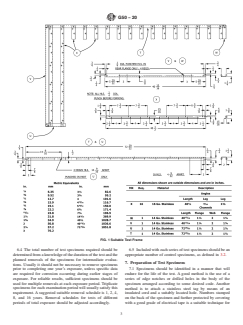
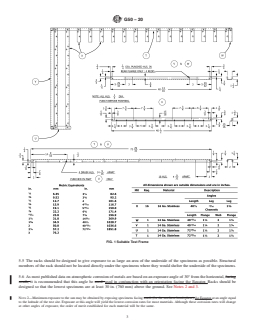
5.4 A suitable frame for mounting the insulators is shown in Fig. 1. This frame will accommodate 70 standard 44 in. by 6-in.
(1006 in. (100 mm by 150-mm)150 mm) specimens; other sizes can be mounted by rearranging the insulators in the holes
provided. It is acceptable to slot the holes in the frames in such a manner that the mounting frames are adjustable for specimens
of other sizes. This is a convenience when it is not possible to prepare specimens of a preplanned size, and it is often helpful in
fitting the specimens snugly into the frames.
G50 − 20
FIG. 1 Suitable Test Frame
5.5 The racks should be designed to give exposure to as large an area of the underside of the specimens as possible. Structural
members of the rack should not be located directly under the specimens where they would shelter the underside of the specimens.
5.6 As most published data on atmospheric corrosion of metals are based on an exposure angle of 30° from the horizontal, facing
south, it is recommended that this angle be used. used in conjunction with an orientation facing the Equator. Racks should be
designed so that the lowest specimens are at least 30 in. (760 mm) above the ground. See Notes 2 and 3.
NOTE 2—Maximum exposure to the sun may be obtained by exposing specimens facing south (for the northern hemisphere) the Equator at an angle equal
to the latitude of the test site. Exposure at this angle will yield the lowest corrosion rates for most materials. Although these corrosion rates will change
at other angles of exposure, the order of merit established for each material will be the same.
G50 − 20
NOTE 3—In special instances, it may be desirable to orient racks and frames in the direction of a specific corrodent source, for example, the ocean, for
marine environments. Also, this practice should not be construed as prohibiting special orientation of test frames for specific test purposes, but it is
strongly suggested that in such cases testing also be done in accordance with this practice so that a basis point for comparison with available data is
determined. Any special orientation or preferential source of corrosion should be specifically identified in the exposure site description.
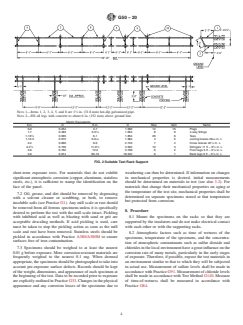
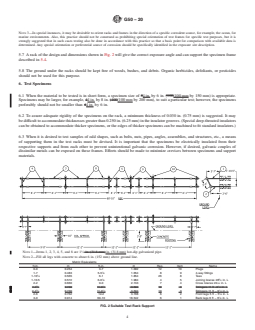
5.7 A rack of the design and dimensions shown in Fig. 2 will give the correct exposure angle and can support the specimen frame
described in 5.4.
5.8 The ground under the racks should be kept free of weeds, bushes, and debris. Organic herbicides, defoliants, or pesticides
should not be used for this purpose.
6. Test Specimens
6.1 When the material to be tested is in sheet form, a specimen size of 44 in. by 6 in. (100(100 mm by 150 mm) is appropriate.
Specimens may be larger, for example, 44 in. by 8 in. (100(100 mm by 200 mm), to suit a particular test; however, the specimens
preferably should not be smaller than 44 in. by 6 in.
6.2 To assure adequate rigidity of the specimens on the rack, a minimum thickness of 0.030 in. (0.75 mm) is suggested. It may
be difficult to accommodate thicknesses greater than 0.250 in. (6.25 mm) in the insulator grooves. (Special deep-throated insulators
can be obtained to accommodate thicker specimens, or the edges of thicker specimens can be machined to fit standard insulators.)
6.3 When it is desired to test samples of odd shapes, such as bolts, nuts, pipes, angles, assemblies, and structures, etc., a means
of supporting them in the test racks must be devised. It is important that the specimens be electrically insulated from their
respective supports and from each other to prevent unintentional galvanic corrosion. However, if desired, galvanic couples of
dissimilar metals can be exposed on these frames. Efforts should be made to minimize crevices between specimens and support
materials.
NOTE 1—Items 1, 2, 3, 4, 5, and 8 are 1 ⁄4-in. (31.8-mm) in. (31.8 mm) hot-dip galvanized pipe.
NOTE 2—Fill all legs with concrete to about 6 in. (152 mm) above ground line.
Metric Equivalents
ft-in. m ft-in. m Req.
...