

ASTM D2010/D2010M-98(2017)
(Test Method)Standard Test Methods for Evaluation of Total Sulfation Activity in the Atmosphere by the Lead Dioxide Technique
General Information
- Abstract
SIGNIFICANCE AND USE
5.1 Sulfur oxide gases are produced during the combustion of materials containing sulfur. These gases are precursors of atmospheric sulfuric acid, which has been shown to be injurious to living creatures and plants, as well as some inanimate materials such as metals, limestone and sandstone building materials.
5.2 Sulfur dioxide is moderately toxic and strongly phytotoxic to many species. Permissible ambient levels of SO2 have been established by law.
5.3 When it is necessary to establish whether ambient air concentrations of sulfuric acid precursors, such as sulfur oxides, are present and to comply with legal criteria, manual and automatic monitoring systems specific for the individual sulfur species are used. Likely locations for monitoring sites for the estimation of concentrations and concentration trends over long periods of time can be screened conveniently using the PbO2 candles or sulfation plates.
5.4 Atmospheric corrosion of metallic materials is a function of many weather and atmospheric variables. The effect of specific corrodants, such as SO2, can accelerate the atmospheric corrosion of metals or structures significantly. The PbO2 candle and sulfation plate test methods provide simple techniques to monitor SO2 levels in the atmosphere independently to yield a weighted average result.
5.5 The results of these test methods are useful for characterizing atmospheric corrosion test sites regarding the effective average concentrations of SO2 in the atmosphere at these locations.
5.6 These test methods are useful for determining microclimatic seasonal and long-term variations in effective average SO2 concentrations.
5.7 The results of these test methods may be used in correlations of atmospheric corrosion rates with atmosphere data to determine the sensitivity of the corrosion rate to the SO2 level.
5.8 These test methods may also be used with other test methods to characterize the atmosphere at sites at which buildings or other constructi...
SCOPE
1.1 These test methods describe the evaluation of the total sulfation activity in the atmosphere. Because of its oxidizing power, lead dioxide (PbO2) converts not only sulfur dioxide (SO2), but other compounds, such as mercaptans and hydrogen sulfide, into sulfate. It fixes sulfur trioxide and sulfuric acid mist present in the atmosphere (see Note 1).
1.2 Test Method A describes the use of a PbO2 candle, and Test Method B describes that of a PbO2 sulfation plate.2
1.3 These test methods provide a weighted average effective SO2 level for a 30-day interval.
1.4 The results of these test methods correlate approximately with volumetric SO2 concentrations, although the presence of dew or condensed moisture tends to enhance the capture of SO2 onto the candle or plate.
1.5 The values stated in SI units shall be regarded as the standard. The values given in brackets are for information only and may be approximate.
Note 1: It has been shown that the rate constant of the chemical reaction between SO2 and PbO2 is independent of the concentration of SO2 up to levels of 1000 ppm(v), if 15 % or less of the PbO2 has been reduced (1).3 15 % of the PbO2 is equivalent to 11 to 12 mg of SO2/cm2 per day.
1.6 This standard does not purport to address all of the safety concerns, if any, associated with its use. It is the responsibility of the user of this standard to establish appropriate safety and health practices and determine the applicability of regulatory limitations prior to use. For specific precautionary statements, see Section 8.
1.7 This international standard was developed in accordance with internationally recognized principles on standardization established in the Decision on Principles for the Development of International Standards, Guides and Recommendations issued by the World Trade Organization Technical Barriers to Trade (TBT) Committee.
- Status
- Published
- Publication Date
- 30-Apr-2017
- Technical Committee
- D22 - Air Quality
- Drafting Committee
- D22.03 - Ambient Atmospheres and Source Emissions
Overview
ASTM D2010/D2010M-98(2017): Standard Test Methods for Evaluation of Total Sulfation Activity in the Atmosphere by the Lead Dioxide Technique, is an internationally recognized standard developed by ASTM. This standard provides methods for assessing the total sulfation activity, representing the presence of sulfur oxides and related compounds in the atmosphere. Sulfur oxide gases, primarily produced through the combustion of sulfur-containing materials, contribute to atmospheric pollution and the formation of sulfuric acid, posing risks to living organisms and construction materials.
Designed for use by air quality professionals, environmental engineers, and researchers, ASTM D2010/D2010M outlines manual methods using lead dioxide (PbO₂) to measure atmospheric sulfation. These methods serve as practical tools in air pollution monitoring, atmospheric corrosion studies, and the planning of protective measures for sensitive materials.
Key Topics
Test Methods: The standard details two primary procedures for evaluating atmospheric sulfation:
- PbO₂ Candle (Test Method A): Exposes a lead dioxide-coated candle to the atmosphere for a fixed period (typically one month), capturing sulfur compounds from the air.
- PbO₂ Sulfation Plate (Test Method B): Utilizes a filter paper disc coated with lead dioxide in a petri dish, exposed downward to trap airborne sulfur compounds.
Sulfur Compound Measurement: Lead dioxide acts as an oxidizing agent, converting sulfur dioxide (SO₂), sulfur trioxide, hydrogen sulfide, mercaptans, and sulfuric acid mists into measurable sulfates.
Ambient SO₂ Evaluation: Both methods provide a weighted average of SO₂ concentration over the exposure period, offering valuable insights into seasonal and long-term pollution trends.
Ambient Air Compliance: Results can be used to verify compliance with legal thresholds for sulfur dioxide and support environmental regulation efforts.
Corrosion Assessment: The lead dioxide technique is directly linked to the assessment of atmospheric corrosion on metals and construction materials, allowing correlations between pollutant concentration and corrosion rate.
Applications
Air Quality Monitoring:
- Quickly screen locations for sulfur oxides and related pollutants using simple, cost-effective manual samplers.
- Assess compliance with permissible ambient SO₂ levels and support planning for more sophisticated sampling methods if necessary.
Corrosion Site Characterization:
- Characterize atmospheric corrosion test sites by determining effective SO₂ concentrations, influencing decisions on materials selection and protective measures.
- Evaluate the impact of corrosive gases on infrastructure, including metals, limestone, and sandstone.
Environmental Research:
- Measure microclimatic, seasonal, and long-term variations in ambient sulfur oxide levels.
- Support studies analyzing the relationship between atmospheric pollutants and corrosion dynamics.
Site Planning and Protection:
- Inform construction planning by assessing the atmospheric environment and potential need for protective coatings or materials.
- Monitor locations where sensitive equipment, artworks, or historical buildings are at risk from acidic atmospheric compounds.
Related Standards
For a comprehensive approach to atmospheric sampling, sulfation activity evaluation, and air quality assessment, consider these related ASTM standards:
- ASTM D516: Test Method for Sulfate Ion in Water
- ASTM D1193: Specification for Reagent Water
- ASTM D1356: Terminology Relating to Sampling and Analysis of Atmospheres
- ASTM D1357: Practice for Planning the Sampling of the Ambient Atmosphere
- ASTM G91: Practice for Monitoring Atmospheric SO₂ Deposition Rate for Atmospheric Corrosivity Evaluation
Using ASTM D2010/D2010M in conjunction with these standards enhances data reliability and supports a holistic evaluation of environmental air quality and material durability in atmospheric conditions.
Relations
- Effective Date
- 01-May-2017
- Effective Date
- 01-Sep-2020
- Effective Date
- 15-Mar-2020
- Effective Date
- 01-Aug-2019
- Effective Date
- 15-Oct-2015
- Effective Date
- 01-Jul-2015
- Effective Date
- 01-Dec-2014
- Effective Date
- 01-May-2014
- Effective Date
- 15-Jan-2014
- Effective Date
- 01-Nov-2011
- Effective Date
- 01-Oct-2011
- Effective Date
- 01-Sep-2011
- Effective Date
- 01-Sep-2010
- Effective Date
- 01-Apr-2010
- Effective Date
- 01-Aug-2007
Get Certified
Connect with accredited certification bodies for this standard

CIS Institut d.o.o.
Personal Protective Equipment (PPE) certification body. Notified Body NB-2890 for EU Regulation 2016/425 PPE.

Kiwa BDA Testing
Building and construction product certification.
Kmetijski inštitut Slovenije
Agricultural Institute of Slovenia. Soil testing, plant health, agricultural product analysis.
Sponsored listings
Frequently Asked Questions
ASTM D2010/D2010M-98(2017) is a standard published by ASTM International. Its full title is "Standard Test Methods for Evaluation of Total Sulfation Activity in the Atmosphere by the Lead Dioxide Technique". This standard covers: SIGNIFICANCE AND USE 5.1 Sulfur oxide gases are produced during the combustion of materials containing sulfur. These gases are precursors of atmospheric sulfuric acid, which has been shown to be injurious to living creatures and plants, as well as some inanimate materials such as metals, limestone and sandstone building materials. 5.2 Sulfur dioxide is moderately toxic and strongly phytotoxic to many species. Permissible ambient levels of SO2 have been established by law. 5.3 When it is necessary to establish whether ambient air concentrations of sulfuric acid precursors, such as sulfur oxides, are present and to comply with legal criteria, manual and automatic monitoring systems specific for the individual sulfur species are used. Likely locations for monitoring sites for the estimation of concentrations and concentration trends over long periods of time can be screened conveniently using the PbO2 candles or sulfation plates. 5.4 Atmospheric corrosion of metallic materials is a function of many weather and atmospheric variables. The effect of specific corrodants, such as SO2, can accelerate the atmospheric corrosion of metals or structures significantly. The PbO2 candle and sulfation plate test methods provide simple techniques to monitor SO2 levels in the atmosphere independently to yield a weighted average result. 5.5 The results of these test methods are useful for characterizing atmospheric corrosion test sites regarding the effective average concentrations of SO2 in the atmosphere at these locations. 5.6 These test methods are useful for determining microclimatic seasonal and long-term variations in effective average SO2 concentrations. 5.7 The results of these test methods may be used in correlations of atmospheric corrosion rates with atmosphere data to determine the sensitivity of the corrosion rate to the SO2 level. 5.8 These test methods may also be used with other test methods to characterize the atmosphere at sites at which buildings or other constructi... SCOPE 1.1 These test methods describe the evaluation of the total sulfation activity in the atmosphere. Because of its oxidizing power, lead dioxide (PbO2) converts not only sulfur dioxide (SO2), but other compounds, such as mercaptans and hydrogen sulfide, into sulfate. It fixes sulfur trioxide and sulfuric acid mist present in the atmosphere (see Note 1). 1.2 Test Method A describes the use of a PbO2 candle, and Test Method B describes that of a PbO2 sulfation plate.2 1.3 These test methods provide a weighted average effective SO2 level for a 30-day interval. 1.4 The results of these test methods correlate approximately with volumetric SO2 concentrations, although the presence of dew or condensed moisture tends to enhance the capture of SO2 onto the candle or plate. 1.5 The values stated in SI units shall be regarded as the standard. The values given in brackets are for information only and may be approximate. Note 1: It has been shown that the rate constant of the chemical reaction between SO2 and PbO2 is independent of the concentration of SO2 up to levels of 1000 ppm(v), if 15 % or less of the PbO2 has been reduced (1).3 15 % of the PbO2 is equivalent to 11 to 12 mg of SO2/cm2 per day. 1.6 This standard does not purport to address all of the safety concerns, if any, associated with its use. It is the responsibility of the user of this standard to establish appropriate safety and health practices and determine the applicability of regulatory limitations prior to use. For specific precautionary statements, see Section 8. 1.7 This international standard was developed in accordance with internationally recognized principles on standardization established in the Decision on Principles for the Development of International Standards, Guides and Recommendations issued by the World Trade Organization Technical Barriers to Trade (TBT) Committee.
SIGNIFICANCE AND USE 5.1 Sulfur oxide gases are produced during the combustion of materials containing sulfur. These gases are precursors of atmospheric sulfuric acid, which has been shown to be injurious to living creatures and plants, as well as some inanimate materials such as metals, limestone and sandstone building materials. 5.2 Sulfur dioxide is moderately toxic and strongly phytotoxic to many species. Permissible ambient levels of SO2 have been established by law. 5.3 When it is necessary to establish whether ambient air concentrations of sulfuric acid precursors, such as sulfur oxides, are present and to comply with legal criteria, manual and automatic monitoring systems specific for the individual sulfur species are used. Likely locations for monitoring sites for the estimation of concentrations and concentration trends over long periods of time can be screened conveniently using the PbO2 candles or sulfation plates. 5.4 Atmospheric corrosion of metallic materials is a function of many weather and atmospheric variables. The effect of specific corrodants, such as SO2, can accelerate the atmospheric corrosion of metals or structures significantly. The PbO2 candle and sulfation plate test methods provide simple techniques to monitor SO2 levels in the atmosphere independently to yield a weighted average result. 5.5 The results of these test methods are useful for characterizing atmospheric corrosion test sites regarding the effective average concentrations of SO2 in the atmosphere at these locations. 5.6 These test methods are useful for determining microclimatic seasonal and long-term variations in effective average SO2 concentrations. 5.7 The results of these test methods may be used in correlations of atmospheric corrosion rates with atmosphere data to determine the sensitivity of the corrosion rate to the SO2 level. 5.8 These test methods may also be used with other test methods to characterize the atmosphere at sites at which buildings or other constructi... SCOPE 1.1 These test methods describe the evaluation of the total sulfation activity in the atmosphere. Because of its oxidizing power, lead dioxide (PbO2) converts not only sulfur dioxide (SO2), but other compounds, such as mercaptans and hydrogen sulfide, into sulfate. It fixes sulfur trioxide and sulfuric acid mist present in the atmosphere (see Note 1). 1.2 Test Method A describes the use of a PbO2 candle, and Test Method B describes that of a PbO2 sulfation plate.2 1.3 These test methods provide a weighted average effective SO2 level for a 30-day interval. 1.4 The results of these test methods correlate approximately with volumetric SO2 concentrations, although the presence of dew or condensed moisture tends to enhance the capture of SO2 onto the candle or plate. 1.5 The values stated in SI units shall be regarded as the standard. The values given in brackets are for information only and may be approximate. Note 1: It has been shown that the rate constant of the chemical reaction between SO2 and PbO2 is independent of the concentration of SO2 up to levels of 1000 ppm(v), if 15 % or less of the PbO2 has been reduced (1).3 15 % of the PbO2 is equivalent to 11 to 12 mg of SO2/cm2 per day. 1.6 This standard does not purport to address all of the safety concerns, if any, associated with its use. It is the responsibility of the user of this standard to establish appropriate safety and health practices and determine the applicability of regulatory limitations prior to use. For specific precautionary statements, see Section 8. 1.7 This international standard was developed in accordance with internationally recognized principles on standardization established in the Decision on Principles for the Development of International Standards, Guides and Recommendations issued by the World Trade Organization Technical Barriers to Trade (TBT) Committee.
ASTM D2010/D2010M-98(2017) is classified under the following ICS (International Classification for Standards) categories: 13.040.20 - Ambient atmospheres. The ICS classification helps identify the subject area and facilitates finding related standards.
ASTM D2010/D2010M-98(2017) has the following relationships with other standards: It is inter standard links to ASTM D2010/D2010M-98(2010), ASTM D1356-20a, ASTM D1356-20, ASTM D1357-95(2019), ASTM D1356-15a, ASTM D1356-15, ASTM D1356-14b, ASTM D1356-14a, ASTM D1356-14, ASTM G91-11, ASTM D1357-95(2011), ASTM D516-11, ASTM G91-97(2010), ASTM D1356-05(2010), ASTM D516-07. Understanding these relationships helps ensure you are using the most current and applicable version of the standard.
ASTM D2010/D2010M-98(2017) is available in PDF format for immediate download after purchase. The document can be added to your cart and obtained through the secure checkout process. Digital delivery ensures instant access to the complete standard document.
Standards Content (Sample)
This international standard was developed in accordance with internationally recognized principles on standardization established in the Decision on Principles for the
Development of International Standards, Guides and Recommendations issued by the World Trade Organization Technical Barriers to Trade (TBT) Committee.
Designation: D2010/D2010M − 98 (Reapproved 2017)
Standard Test Methods for
Evaluation of Total Sulfation Activity in the Atmosphere by
the Lead Dioxide Technique
This standard is issued under the fixed designation D2010/D2010M; the number immediately following the designation indicates the
year of original adoption or, in the case of revision, the year of last revision. A number in parentheses indicates the year of last
reapproval. A superscript epsilon (´) indicates an editorial change since the last revision or reapproval.
This standard has been approved for use by agencies of the U.S. Department of Defense.
1. Scope 1.7 This international standard was developed in accor-
dance with internationally recognized principles on standard-
1.1 These test methods describe the evaluation of the total
ization established in the Decision on Principles for the
sulfation activity in the atmosphere. Because of its oxidizing
Development of International Standards, Guides and Recom-
power, lead dioxide (PbO ) converts not only sulfur dioxide
mendations issued by the World Trade Organization Technical
(SO ),butothercompounds,suchasmercaptansandhydrogen
Barriers to Trade (TBT) Committee.
sulfide, into sulfate. It fixes sulfur trioxide and sulfuric acid
mist present in the atmosphere (see Note 1).
2. Referenced Documents
1.2 Test MethodAdescribes the use of a PbO candle, and 4
2.1 ASTM Standards:
Test Method B describes that of a PbO sulfation plate.
D516Test Method for Sulfate Ion in Water
1.3 Thesetestmethodsprovideaweightedaverageeffective
D1193Specification for Reagent Water
SO level for a 30-day interval. D1356Terminology Relating to Sampling and Analysis of
Atmospheres
1.4 The results of these test methods correlate approxi-
D1357Practice for Planning the Sampling of the Ambient
mately with volumetric SO concentrations, although the
Atmosphere
presence of dew or condensed moisture tends to enhance the
G91Practice for Monitoring Atmospheric SO Deposition
capture of SO onto the candle or plate.
Rate for Atmospheric Corrosivity Evaluation
1.5 The values stated in SI units shall be regarded as the
standard.Thevaluesgiveninbracketsareforinformationonly 3. Terminology
and may be approximate.
3.1 Definitions—For definitions of terms used in these test
NOTE 1—It has been shown that the rate constant of the chemical methods, refer to Terminology D1356.
reaction between SO and PbO is independent of the concentration of
2 2 3.2 Definitions of Terms Specific to This Standard:
SO up to levels of 1000 ppm(v), if 15% or less of the PbO has been
2 2
3.2.1 sulfation—the process by which sulfur-containing
3 2
reduced (1). 15% of the PbO is equivalent to 11 to 12 mg of SO /cm
2 2
compounds are oxidized by the action of PbO .
per day.
3.2.2 sulfation activity—the capture rate of sulfur-
1.6 This standard does not purport to address all of the
containing compounds as they are oxidized by PbO under the
safety concerns, if any, associated with its use. It is the 2
conditions of these test methods.
responsibility of the user of this standard to establish appro-
priate safety and health practices and determine the applica-
4. Summary of Test Methods
bility of regulatory limitations prior to use. For specific
4.1 Test Method A—Inert cylinders are coated with PbO
precautionary statements, see Section 8. 2
paste and exposed to the atmosphere for an extended period of
time, usually one month. Sulfur oxides react chemically with
the paste, forming lead sulfate (PbSO ) (1-5).
These test methods are under the jurisdiction ofASTM Committee D22 on Air
Quality and are the direct responsibility of Subcommittee D22.03 on Ambient
4.2 Test Method B—Sulfation plates consisting of a PbO
Atmospheres and Source Emissions.
paste in an inverted dish are likewise exposed to the atmo-
Current edition approved May 1, 2017. Published May 2017. Originally
sphere (6).
approved in 1962. Last previous edition approved in 2010 as D2010/D2010M–98
(2010). DOI: 10.1520/D2010_D2010M-98R17.
Test Method B has been adapted from Practice G91, which is under the
jurisdiction of ASTM Committee G01 on Corrosion of Metals and is the direct For referenced ASTM standards, visit the ASTM website, www.astm.org, or
responsibility of Subcommittee G01.04 on Atmospheric Corrosion. contact ASTM Customer Service at service@astm.org. For Annual Book of ASTM
Theboldfacenumbersinparenthesesrefertothelistofreferencesattheendof Standards volume information, refer to the standard’s Document Summary page on
this standard. the ASTM website.
Copyright © ASTM International, 100 Barr Harbor Drive, PO Box C700, West Conshohocken, PA 19428-2959. United States
D2010/D2010M − 98 (2017)
4.3 Test Methods A and B—The cylinders or plates are 6. Apparatus
returned to a laboratory after the sampling period; the paste is
6.1 Test Method A:
removed and suspended in hot sodium carbonate (Na CO )
2 3
6.1.1 Lead Dioxide Candle—An inert cylinder with a sur-
solution to dissolve the PbSO and convert the sulfate to 2
face area of approximately 100 cm , covered with a fabric and
soluble sodium sulfate (Na SO ). The Na SO solution is
2 4 2 4
coated with PbO paste. See Appendix X1 for preparation of
separated from the PbO slurry by filtration. The sulfate is
the candle.
determined by precipitation with barium chloride (BaCl ) (7).
6.1.2 Sampling Apparatus—This may be a louvered
enclosure, such as a cylinder or a rectangular box. If
4.4 The chemistry of the process is illustrated, for the case
cylindrical, it shall be not less than 20-cm [8-in.] high and
of SO , in the following reactions:
18-cm [7-in.] in diameter; if rectangular, it shall be not less
PbO 1SO →PbSO
2 2 4
than 20 by 20 by 20 cm [8 by 8 by 8 in.]. Position the louvers
PbSO 1Na CO →Na SO 1PbCO
4 2 3 2 4 3
at an angle of π/4 (45°) to provide maximum protection from
Na SO 1BaCl →BaSO ↓12NaCl
2 4 2 4
the rain. Construct the enclosure of an inert material, such as
plastic or wood. Do not coat the enclosure with a lead based
5. Significance and Use
paint.Thesamplingapparatusshallhaveprovisionstoholdthe
PbO candle in a vertical position.
5.1 Sulfur oxide gases are produced during the combustion
of materials containing sulfur. These gases are precursors of
6.2 Test Method B:
atmospheric sulfuric acid, which has been shown to be injuri-
6.2.1 Sulfation Plate—A polystyrene or polycarbonate cul-
ous to living creatures and plants, as well as some inanimate
ture (petri) dish, 50 or 60 mm in diameter, containing a filter
materials such as metals, limestone and sandstone building
paper disc, coated with PbO paste. See Appendix X2 for
materials.
preparation of the sulfation plate.
6.2.2 Bracket, to hold the plates securely in an inverted
5.2 Sulfur dioxide is moderately toxic and strongly phyto-
positionsothatthePbO mixturefacesdownward.Thebracket
toxic to many species. Permissible ambient levels of SO have 2
design shall include a retaining clip or other provision to hold
been established by law.
theplateintheeventofstrongwinds.Theretainerclipmaybe
5.3 When it is necessary to establish whether ambient air
made from stainless steel, spring bronze, hard aluminum alloy
concentrations of sulfuric acid precursors, such as sulfur
(3003H19), or other alloys with sufficient strength and atmo-
oxides, are present and to comply with legal criteria, manual
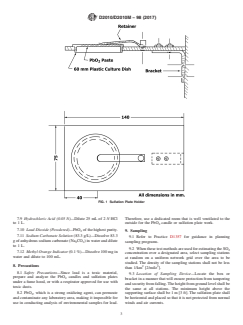
spheric corrosion resistance.Atypical bracket design is shown
and automatic monitoring systems specific for the individual
in Fig. 1.
sulfur species are used. Likely locations for monitoring sites
for the estimation of concentrations and concentration trends
7. Reagents and Materials
over long periods of time can be screened conveniently using
7.1 Purity of Reagents—Reagent grade chemicals shall be
the PbO candles or sulfation plates.
usedinalltests.Allreagentsshallconformtothespecifications
5.4 Atmospheric corrosion of metallic materials is a func- of the Committee on Analytical Reagents of the American
tion of many weather and atmospheric variables. The effect of Chemical Society, except where such reagents are not avail-
specific corrodants, such as SO , can accelerate the atmo- able.
spheric corrosion of metals or structures significantly. The
7.2 Purity of Water—References to water shall be under-
PbO candle and sulfation plate test methods provide simple
stood to mean reagent water as defined by Type II of Specifi-
techniques to monitor SO levels in the atmosphere indepen-
cation D1193.
dently to yield a weighted average result.
7.3 Acetone—Reagent grade.
5.5 The results of these test methods are useful for charac-
7.4 Barium Chloride Solution (50 g/L)—Dissolve 59 g of
terizingatmosphericcorrosiontestsitesregardingtheeffective
barium chloride dihydrate (BaCl ×2H O) in water and dilute
2 2
average concentrations of SO in the atmosphere at these
to1L.
locations.
7.5 Ethyl Alcohol (95%).
5.6 These test methods are useful for determining microcli-
7.6 Gum Tragacanth, powdered.
matic seasonal and long-term variations in effective average
SO concentrations.
7.7 Hydrochloric Acid (sp gr 1.19)—Concentrated hydro-
chloric acid (HCl).
5.7 The results of these test methods may be used in
7.8 Hydrochloric Acid (2 N)—Dilute 171 mL of concen-
correlations of atmospheric corrosion rates with atmosphere
trated HCl to 1 L.
datatodeterminethesensitivityofthecorrosionratetotheSO
level.
5.8 These test methods may also be used with other test
Reagent Chemicals, American Chemical Society Specifications, American
Chemical Society, Washington, DC. For suggestions on the testing of reagents not
methods to characterize the atmosphere at sites at which
listed by the American Chemical Society, see Analar Standards for Laboratory
buildings or other construction are planned in order to deter-
Chemicals, BDH Ltd., Poole, Dorset, U.K., and the United States Pharmacopeia
mine the extent of protective measures required for the
and National Formulary, U.S. Pharmacopeial Convention, Inc. (USPC), Rockville,
materials of construction. MD.
D2010/D2010M − 98 (2017)
FIG. 1 Sulfation Plate Holder
7.9 Hydrochloric Acid (0.05 N)—Dilute 25 mL of 2 N HCl Therefore, use a dedicated room that is well ventilated to the
to1L. outside for the PbO candle or sulfation plate work.
7.10 Lead Dioxide (Powdered)—PbO of the highest purity.
9. Sampling
7.11 Sodium Carbonate Solution (83.3 g/L)—Dissolve 83.3
9.1 Refer to Practice D1357 for guidance in planning
gofanhydroussodiumcarbonate(Na CO )inwateranddilute
2 3 sampling programs.
to1L.
9.2 WhenthesetestmethodsareusedforestimatingtheSO
7.12 Methyl Orange Indicator(0.1%)—Dissolve100mgin
concentration over a designated area, select sampling stations
water and dilute to 100 mL.
at random on a uniform network grid over the area to be
studied. The density of the sampling stations shall not be less
8. Precautions 2 2
than 1/km [2/mile ].
8.1 Safety Precautions—Since lead is a toxic material,
9.3 Location of Sampling Device—Locate the box or
prepare and analyze the PbO candles and sulfation plates
bracketinamannerthatwillensureprotectionfromtampering
under a fume hood, or with a respirator approved for use with
andsecurityfromfalling.Theheightfromgroundlevelshallbe
toxic dusts.
the same at all stations. The minimum height above the
8.2 PbO , which is a strong oxidizing agent, can permeate supporting surface shall be 1 m [3 ft].The sulfation plate shall
and contaminate any laboratory area, making it impossible for behorizontalandplacedsothatitisnotprotectedfromnormal
use in conducting analysis of environmental samples for lead. winds and air currents.
D2010/D2010M − 98 (2017)
9.4 The sampling period may be 1 month or long enough to 12. Precision and Bias
provide a convenient minimum of total sulfate for analysis.
12.1 Test Method A (8):
The work of Keagy (5), which is used as the criterion for the
12.1.1 The interlaboratory study of Project Threshold pro-
sampling procedure for candles, shows a range from 5 to 2000
videdthefollowingconclusionsregardingtheprecisionofTest
mg of barium sulfate (BaSO ) per candle. The sampling
Method A.
frequencysha
...