

ASTM F1383-20
(Test Method)Standard Test Method for Permeation of Liquids and Gases Through Protective Clothing Materials Under Conditions of Intermittent Contact
General Information
- Abstract
SIGNIFICANCE AND USE
5.1 This test method is used to measure chemical permeation through specimens of protective clothing under the condition of intermittent contact of a test chemical with the specimen. In many applications, protective clothing is contacted intermittently to chemicals, not continuously as is tested by Test Method F739.
5.2 This test method is normally used to evaluate flat specimens and seams from finished items of protective clothing and of materials that are candidates for items of protective clothing.
5.2.1 Finished items of protective clothing include gloves, sleeves, aprons, suits, coveralls, hoods, boots, respirators, and the like.
5.2.2 The phrase “specimens from finished items” encompasses seams or other discontinuous regions as well as continuous regions of protective clothing items.
5.2.3 Selected seams for testing are representative of seams used in the principal construction of the protective clothing item and typically include seams of both the base material and where the base material is joined with other types of materials.
5.3 In some cases, it may be of interest to compare permeation behaviors that occur under conditions of intermittent contact with those that occur during continuous contact. Test Method F739 is recommended for measuring permeation under the conditions of continuous contact of the test chemical with the protective clothing specimen.
5.4 The breakthrough detection time, standardized breakthrough time, and the cumulative permeation are key measures of the effectiveness of a clothing material to be a barrier to the test chemical. Such information is used in the comparison of clothing materials during the process of selecting clothing for protection from hazardous chemicals. Long breakthrough detection times and standardized breakthrough times and low amounts of cumulative permeation are characteristics of more effective barrier materials than materials with higher permeation characteristics.
Note 1: At present, there ...
SCOPE
1.1 This test method measures the permeation of liquids and gases through protective clothing materials under the condition of intermittent contact.
1.2 This test method is designed for use when the test chemical is a gas or a liquid, where the liquid is either volatile (that is, having a vapor pressure greater than 1 mm Hg at 25 °C) or soluble in water or another liquid that does not interact with the clothing material.
1.3 The values stated in SI units are to be regarded as standard. The values given in parentheses are mathematical conversions to inch-pound units that are provided for information only and are not considered standard.
1.4 This standard does not purport to address all of the safety concerns, if any, associated with its use. It is the responsibility of the user of this standard to establish appropriate safety, health, and environmental practices and determine the applicability of regulatory limitations prior to use. Specific hazard statements are given in Section 7.
1.5 This international standard was developed in accordance with internationally recognized principles on standardization established in the Decision on Principles for the Development of International Standards, Guides and Recommendations issued by the World Trade Organization Technical Barriers to Trade (TBT) Committee.
- Status
- Published
- Publication Date
- 31-Oct-2020
- Technical Committee
- F23 - Personal Protective Clothing and Equipment
- Drafting Committee
- F23.30 - Chemicals
Buy Documents
ASTM F1383-20 - Standard Test Method for Permeation of Liquids and Gases Through Protective Clothing Materials Under Conditions of Intermittent Contact
REDLINE ASTM F1383-20 - Standard Test Method for Permeation of Liquids and Gases Through Protective Clothing Materials Under Conditions of Intermittent Contact
Overview
ASTM F1383-20, published by ASTM International, specifies a standard test method for measuring the permeation of liquids and gases through protective clothing materials under intermittent contact conditions. Protecting workers from hazardous chemical exposure is critical across industries such as chemical manufacturing, pharmaceuticals, laboratories, emergency response, and transportation. This standard addresses scenarios where protective clothing is exposed to chemicals intermittently, rather than continuously, as covered by related standards like ASTM F739.
ASTM F1383-20 outlines procedures to assess the resistance of clothing materials-including finished items and seams-by quantifying breakthrough detection time, standardized breakthrough time, cumulative permeation, and related metrics. These measurements are essential for evaluating and comparing the effectiveness of protective clothing barriers.
Key Topics
- Intermittent Chemical Contact: Focuses on real-world exposures where protective garments contact chemicals in cycles rather than continuously.
- Specimen Types: Applies to flat materials and seams from finished garments such as gloves, sleeves, aprons, coveralls, hoods, boots, and respirators.
- Testing Methodology:
- Measures the time until a chemical is detected after initial exposure (breakthrough detection time).
- Quantifies the total mass of a chemical that permeates through the material over specific intervals.
- Utilizes both closed-loop and open-loop test systems depending on the nature of the chemical challenge and required analytical sensitivity.
- Material Characterization: Tests actual construction elements, including seams representative of garment assembly, providing practical insight into real-world performance.
- Analytical Sensitivity: Employs sensitive analytical techniques to detect low levels of permeation accurately, critical for effectively determining protective performance.
Applications
ASTM F1383-20 is used by a variety of stakeholders to ensure the safety and reliability of chemical protective clothing:
- Manufacturers: To qualify new materials and garment assemblies for compliance and suitability in environments with hazardous chemical exposure.
- Health & Safety Professionals: For selecting appropriate protective clothing based on specific chemical hazards, exposure scenarios, and performance requirements.
- Third-party Testing Laboratories: To perform certification, benchmarking, or materials R&D for chemical-resistant protective garments.
- Regulatory Agencies and Employers: As a tool to evaluate and verify compliance with workplace safety regulations for personnel protective equipment (PPE).
Practical applications include:
- Quality assurance of gloves, suits, and protective ensembles for emergency response teams
- Evaluation of chemical protective clothing used in laboratory and industrial environments with intermittent splash or vapor contact risks
- Comparison of material and seam constructions to optimize protection while maintaining comfort and dexterity
Related Standards
Several ASTM and international standards complement or provide context for ASTM F1383-20:
- ASTM F739: Standard Test Method for Permeation of Liquids and Gases Through Protective Clothing Materials Under Continuous Contact
- ASTM F903: Resistance of Protective Clothing Materials to Penetration by Liquids
- ASTM F1407: Resistance of Chemical Protective Clothing Materials to Liquid Permeation-Permeation Cup Method
- ASTM D471 / D543 / D751: Test and evaluation methods for the effects of chemicals on rubber, plastics, and coated fabrics
- ASTM F1001: Guide for Selecting Chemicals for Permeation Testing
- ASTM F1194: Guide for Reporting Results of Permeation Testing
- ISO 6529: Determination of resistance of protective clothing materials to permeation by liquids and gases
Following ASTM F1383-20 ensures rigorous, standardized assessment of chemical resistance for protective clothing, supporting workplace safety and regulatory compliance. This helps organizations select the most effective PPE for intermittent chemical exposure scenarios, ultimately reducing health risks and improving worker protection.
Relations
- Refers
ASTM E171/E171M-11(2020) - Standard Practice for Conditioning and Testing Flexible Barrier Packaging - Effective Date
- 01-May-2020
- Effective Date
- 01-Jul-2019
- Effective Date
- 01-Jul-2018
- Effective Date
- 01-Jun-2018
- Effective Date
- 01-Jun-2017
- Effective Date
- 01-Jun-2017
- Effective Date
- 01-Feb-2017
- Refers
ASTM E171/E171M-11(2015) - Standard Practice for Conditioning and Testing Flexible Barrier Packaging - Effective Date
- 01-Oct-2015
- Effective Date
- 01-Jul-2015
- Effective Date
- 01-Jul-2013
- Effective Date
- 01-Sep-2012
- Refers
ASTM F1001-12 - Standard Guide for Selection of Chemicals to Evaluate Protective Clothing Materials - Effective Date
- 01-Aug-2012
- Effective Date
- 01-Jun-2012
- Refers
ASTM E171/E171M-11 - Standard Practice for Conditioning and Testing Flexible Barrier Packaging - Effective Date
- 15-Nov-2011
- Effective Date
- 01-Jul-2011
Buy Documents
ASTM F1383-20 - Standard Test Method for Permeation of Liquids and Gases Through Protective Clothing Materials Under Conditions of Intermittent Contact
REDLINE ASTM F1383-20 - Standard Test Method for Permeation of Liquids and Gases Through Protective Clothing Materials Under Conditions of Intermittent Contact
Get Certified
Connect with accredited certification bodies for this standard

CIS Institut d.o.o.
Personal Protective Equipment (PPE) certification body. Notified Body NB-2890 for EU Regulation 2016/425 PPE.

Kiwa BDA Testing
Building and construction product certification.
Kmetijski inštitut Slovenije
Agricultural Institute of Slovenia. Soil testing, plant health, agricultural product analysis.
Sponsored listings
Frequently Asked Questions
ASTM F1383-20 is a standard published by ASTM International. Its full title is "Standard Test Method for Permeation of Liquids and Gases Through Protective Clothing Materials Under Conditions of Intermittent Contact". This standard covers: SIGNIFICANCE AND USE 5.1 This test method is used to measure chemical permeation through specimens of protective clothing under the condition of intermittent contact of a test chemical with the specimen. In many applications, protective clothing is contacted intermittently to chemicals, not continuously as is tested by Test Method F739. 5.2 This test method is normally used to evaluate flat specimens and seams from finished items of protective clothing and of materials that are candidates for items of protective clothing. 5.2.1 Finished items of protective clothing include gloves, sleeves, aprons, suits, coveralls, hoods, boots, respirators, and the like. 5.2.2 The phrase “specimens from finished items” encompasses seams or other discontinuous regions as well as continuous regions of protective clothing items. 5.2.3 Selected seams for testing are representative of seams used in the principal construction of the protective clothing item and typically include seams of both the base material and where the base material is joined with other types of materials. 5.3 In some cases, it may be of interest to compare permeation behaviors that occur under conditions of intermittent contact with those that occur during continuous contact. Test Method F739 is recommended for measuring permeation under the conditions of continuous contact of the test chemical with the protective clothing specimen. 5.4 The breakthrough detection time, standardized breakthrough time, and the cumulative permeation are key measures of the effectiveness of a clothing material to be a barrier to the test chemical. Such information is used in the comparison of clothing materials during the process of selecting clothing for protection from hazardous chemicals. Long breakthrough detection times and standardized breakthrough times and low amounts of cumulative permeation are characteristics of more effective barrier materials than materials with higher permeation characteristics. Note 1: At present, there ... SCOPE 1.1 This test method measures the permeation of liquids and gases through protective clothing materials under the condition of intermittent contact. 1.2 This test method is designed for use when the test chemical is a gas or a liquid, where the liquid is either volatile (that is, having a vapor pressure greater than 1 mm Hg at 25 °C) or soluble in water or another liquid that does not interact with the clothing material. 1.3 The values stated in SI units are to be regarded as standard. The values given in parentheses are mathematical conversions to inch-pound units that are provided for information only and are not considered standard. 1.4 This standard does not purport to address all of the safety concerns, if any, associated with its use. It is the responsibility of the user of this standard to establish appropriate safety, health, and environmental practices and determine the applicability of regulatory limitations prior to use. Specific hazard statements are given in Section 7. 1.5 This international standard was developed in accordance with internationally recognized principles on standardization established in the Decision on Principles for the Development of International Standards, Guides and Recommendations issued by the World Trade Organization Technical Barriers to Trade (TBT) Committee.
SIGNIFICANCE AND USE 5.1 This test method is used to measure chemical permeation through specimens of protective clothing under the condition of intermittent contact of a test chemical with the specimen. In many applications, protective clothing is contacted intermittently to chemicals, not continuously as is tested by Test Method F739. 5.2 This test method is normally used to evaluate flat specimens and seams from finished items of protective clothing and of materials that are candidates for items of protective clothing. 5.2.1 Finished items of protective clothing include gloves, sleeves, aprons, suits, coveralls, hoods, boots, respirators, and the like. 5.2.2 The phrase “specimens from finished items” encompasses seams or other discontinuous regions as well as continuous regions of protective clothing items. 5.2.3 Selected seams for testing are representative of seams used in the principal construction of the protective clothing item and typically include seams of both the base material and where the base material is joined with other types of materials. 5.3 In some cases, it may be of interest to compare permeation behaviors that occur under conditions of intermittent contact with those that occur during continuous contact. Test Method F739 is recommended for measuring permeation under the conditions of continuous contact of the test chemical with the protective clothing specimen. 5.4 The breakthrough detection time, standardized breakthrough time, and the cumulative permeation are key measures of the effectiveness of a clothing material to be a barrier to the test chemical. Such information is used in the comparison of clothing materials during the process of selecting clothing for protection from hazardous chemicals. Long breakthrough detection times and standardized breakthrough times and low amounts of cumulative permeation are characteristics of more effective barrier materials than materials with higher permeation characteristics. Note 1: At present, there ... SCOPE 1.1 This test method measures the permeation of liquids and gases through protective clothing materials under the condition of intermittent contact. 1.2 This test method is designed for use when the test chemical is a gas or a liquid, where the liquid is either volatile (that is, having a vapor pressure greater than 1 mm Hg at 25 °C) or soluble in water or another liquid that does not interact with the clothing material. 1.3 The values stated in SI units are to be regarded as standard. The values given in parentheses are mathematical conversions to inch-pound units that are provided for information only and are not considered standard. 1.4 This standard does not purport to address all of the safety concerns, if any, associated with its use. It is the responsibility of the user of this standard to establish appropriate safety, health, and environmental practices and determine the applicability of regulatory limitations prior to use. Specific hazard statements are given in Section 7. 1.5 This international standard was developed in accordance with internationally recognized principles on standardization established in the Decision on Principles for the Development of International Standards, Guides and Recommendations issued by the World Trade Organization Technical Barriers to Trade (TBT) Committee.
ASTM F1383-20 is classified under the following ICS (International Classification for Standards) categories: 13.340.10 - Protective clothing. The ICS classification helps identify the subject area and facilitates finding related standards.
ASTM F1383-20 has the following relationships with other standards: It is inter standard links to ASTM E171/E171M-11(2020), ASTM D1777-96(2019), ASTM F903-18, ASTM F1194-18, ASTM F1001-12(2017), ASTM F1407-12(2017), ASTM F903-17, ASTM E171/E171M-11(2015), ASTM D1777-96(2015), ASTM F1494-13, ASTM F739-12, ASTM F1001-12, ASTM F1407-12, ASTM E171/E171M-11, ASTM F1407-11. Understanding these relationships helps ensure you are using the most current and applicable version of the standard.
ASTM F1383-20 is available in PDF format for immediate download after purchase. The document can be added to your cart and obtained through the secure checkout process. Digital delivery ensures instant access to the complete standard document.
Standards Content (Sample)
This international standard was developed in accordance with internationally recognized principles on standardization established in the Decision on Principles for the
Development of International Standards, Guides and Recommendations issued by the World Trade Organization Technical Barriers to Trade (TBT) Committee.
Designation: F1383 − 20
Standard Test Method for
Permeation of Liquids and Gases Through Protective
Clothing Materials Under Conditions of Intermittent Contact
This standard is issued under the fixed designation F1383; the number immediately following the designation indicates the year of
original adoption or, in the case of revision, the year of last revision. A number in parentheses indicates the year of last reapproval. A
superscript epsilon (´) indicates an editorial change since the last revision or reapproval.
INTRODUCTION
Workers involved in the production, use, and transportation of liquid and gaseous chemicals can be
exposed to numerous compounds capable of causing harm upon contact with the human body. The
deleterious health effects of these chemicals can range from acute trauma such as skin irritation and
burn, to chronic degenerative disease and mutagenic conditions, including cancer. Since engineering
controls may not eliminate all possible exposures, attention is often placed on reducing the potential
for direct skin contact through the use of protective clothing that resists permeation, penetration, and
degradation.
This test method is used to measure the resistance to permeation under the condition of intermittent
contact of the protective clothing material with liquid or gaseous chemicals. Resistance to permeation
and penetration under conditions of continuous contact should be determined by Test Methods F739
and F903, respectively. In certain situations, the permeation of liquids through protective clothing
materials can be measured using a permeation cup following Test Method F1407. An undesirable
change in the physical properties of protective clothing materials is called degradation. Methods for
measuring the degradation of rubbers, plastics, and coated materials are found in Test Method D471,
Practice D543, and Test Method D751, respectively.Astarting point for selecting the chemicals to be
used in assessing the chemical resistance of clothing materials is Guide F1001.
1. Scope priate safety, health, and environmental practices and deter-
mine the applicability of regulatory limitations prior to use.
1.1 Thistestmethodmeasuresthepermeationofliquidsand
Specific hazard statements are given in Section 7.
gases through protective clothing materials under the condition
1.5 This international standard was developed in accor-
of intermittent contact.
dance with internationally recognized principles on standard-
1.2 This test method is designed for use when the test
ization established in the Decision on Principles for the
chemical is a gas or a liquid, where the liquid is either volatile
Development of International Standards, Guides and Recom-
(that is, having a vapor pressure greater than 1 mm Hg at
mendations issued by the World Trade Organization Technical
25 °C) or soluble in water or another liquid that does not
Barriers to Trade (TBT) Committee.
interact with the clothing material.
2. Referenced Documents
1.3 The values stated in SI units are to be regarded as
standard. The values given in parentheses are mathematical
2.1 ASTM Standards:
conversions to inch-pound units that are provided for informa-
D471 Test Method for Rubber Property—Effect of Liquids
tion only and are not considered standard.
D543 Practices for Evaluating the Resistance of Plastics to
1.4 This standard does not purport to address all of the
Chemical Reagents
safety concerns, if any, associated with its use. It is the D751 Test Methods for Coated Fabrics
responsibility of the user of this standard to establish appro-
D1777 Test Method for Thickness of Textile Materials
E105 Practice for Probability Sampling of Materials
ThistestmethodisunderthejurisdictionofASTMCommitteeF23onPersonal
Protective Clothing and Equipment and is the direct responsibility of Subcommittee
F23.30 on Chemicals. For referenced ASTM standards, visit the ASTM website, www.astm.org, or
Current edition approved Nov. 1, 2020. Published November 2020. Originally contact ASTM Customer Service at service@astm.org. For Annual Book of ASTM
approved in 1992. Last previous edition approved in 2012 as F1383 – 12. DOI: Standards volume information, refer to the standard’s Document Summary page on
10.1520/F1383-20. the ASTM website.
Copyright © ASTM International, 100 Barr Harbor Drive, PO Box C700, West Conshohocken, PA 19428-2959. United States
F1383 − 20
3.1.3 closed-loop, adj—refers to a testing mode in which
there is no change in the volume of the collection medium
except for sampling.
3.1.4 collection medium, n—a liquid, gas, or solid that
absorbs,adsorbs,dissolves,suspends,orotherwisecapturesthe
test chemical and does not affect the measured permeation.
3.1.5 contact time, n—in an intermittent contact test, the
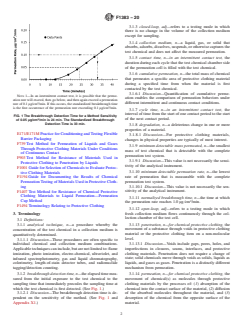
duration during each cycle that the test chemical chamber side
of the permeation cell is filled with the test chemical.
3.1.6 cumulative permeation, n—the total mass of chemical
that permeates a specific area of protective clothing material
during a specified time from when the material is first
contacted by the test chemical.
3.1.6.1 Discussion—Quantification of cumulative perme-
NOTE 1—In an intermittent contact test, it is possible that the perme-
ation enables the comparison of permeation behaviors under
ation rate will exceed, then go below, and then again exceed a permeation
different intermittent and continuous contact conditions.
rate of 0.1 µg/cm /min. If this occurs, the standardized breakthrough time
is the first occurrence of the permeation rate exceeding 0.1 µg/cm /min.
3.1.7 cycle time, n—in an intermittent contact test, the
interval of time from the start of one contact period to the start
FIG. 1 The Breakthrough Detection Time for a Method Sensitivity
2 of the next contact period.
of 0.05 µg/cm /min is 24 min. The Standardized Breakthrough
DetectionTimeis33min.
3.1.8 degradation, n—a deleterious change in one or more
properties of a material.
E171/E171M Practice for Conditioning and Testing Flexible
3.1.8.1 Discussion—For protective clothing materials,
Barrier Packaging
changes in physical properties are typically of most interest.
F739 Test Method for Permeation of Liquids and Gases
3.1.9 minimum detectable mass permeated, n—the smallest
Through Protective Clothing Materials Under Conditions
mass of test chemical that is detectable with the complete
of Continuous Contact
permeation test system.
F903 Test Method for Resistance of Materials Used in
3.1.9.1 Discussion—This value is not necessarily the sensi-
Protective Clothing to Penetration by Liquids
tivity of the analytical instrument.
F1001 Guide for Selection of Chemicals to Evaluate Protec-
3.1.10 minimum detectable permeation rate, n—the lowest
tive Clothing Materials
rate of permeation that is measurable with the complete
F1194 Guide for Documenting the Results of Chemical
permeation test system.
PermeationTesting of Materials Used in Protective Cloth-
ing 3.1.10.1 Discussion—This value is not necessarily the sen-
sitivity of the analytical instrument.
F1407 Test Method for Resistance of Chemical Protective
Clothing Materials to Liquid Permeation—Permeation
3.1.11 normalized breakthrough time, n—the time at which
Cup Method
the permeation rate reaches 1.0 µg⁄cm /min.
F1494 Terminology Relating to Protective Clothing
3.1.12 open-loop, adj—refers to a testing mode in which
fresh collection medium flows continuously through the col-
3. Terminology
lection chamber of the test cell.
3.1 Definitions:
3.1.13 penetration, n—for chemical protective clothing, the
3.1.1 analytical technique, n—a procedure whereby the
movement of a substance through voids in protective clothing
concentration of the test chemical in a collection medium is
material or the protective clothing item on a non-molecular
quantitatively determined.
level.
3.1.1.1 Discussion—These procedures are often specific to
individual chemical and collection medium combinations. 3.1.13.1 Discussion—Voids include gaps, pores, holes, and
imperfections in closures, seams, interfaces, and protective
Applicabletechniquescaninclude,butarenotlimitedto:flame
ionization, photo ionization, electro-chemical, ultraviolet, and clothing materials. Penetration does not require a change of
state; solid chemicals move through voids as solids, liquids as
infrared spectrophotometry, gas and liquid chromatography,
colorimetry, length-of-stain detector tubes, and radionuclide liquids, and gases as gases. Penetration is a distinctly different
mechanism from permeation.
tagging/detection counting.
3.1.2 breakthroughdetectiontime,n—theelapsedtimemea- 3.1.14 permeation, n—for chemical protective clothing, the
sured from the initial exposure to the test chemical to the movement of chemical(s) as molecules through protective
sampling time that immediately precedes the sampling time at clothing materials by the processes of: (1) absorption of the
which the test chemical is first detected. (See Fig. 1.) chemical into the contact surface of the material, (2) diffusion
3.1.2.1 Discussion—The breakthrough detection time is de- of the absorbed molecules throughout the material, and (3)
pendent on the sensitivity of the method. (See Fig. 1 and desorption of the chemical from the opposite surface of the
Appendix X1.) material.
F1383 − 20
3.1.14.1 Discussion—Permeation is a distinctly different 5. Significance and Use
mechanism from penetration.
5.1 This test method is used to measure chemical perme-
3.1.15 protective clothing, n—item of clothing that is spe-
ation through specimens of protective clothing under the
cifically designed and constructed for the intended purpose of
condition of intermittent contact of a test chemical with the
isolating all or part of the body from a potential hazard; or,
specimen. In many applications, protective clothing is con-
isolating the external environment from contamination by the
tacted intermittently to chemicals, not continuously as is tested
wearer of the clothing.
by Test Method F739.
3.1.16 purge time, n—in an intermittent contact test, the
5.2 This test method is normally used to evaluate flat
time immediately following the termination of the contact time
specimensandseamsfromfinisheditemsofprotectiveclothing
when the test chemical is removed from the test chemical
and of materials that are candidates for items of protective
chamber side and air or nitrogen is blown over the outside
clothing.
surface of the protective clothing material.
5.2.1 Finished items of protective clothing include gloves,
3.1.17 seam, n—a line along which two pieces of material sleeves, aprons, suits, coveralls, hoods, boots, respirators, and
the like.
are joined together in protective clothing.
3.1.17.1 Discussion—Common ways that seams are con- 5.2.2 The phrase “specimens from finished items” encom-
passes seams or other discontinuous regions as well as con-
structed include sewing with thread, welding with heat, taping,
gluing, or combinations thereof. tinuous regions of protective clothing items.
5.2.3 Selected seams for testing are representative of seams
3.1.18 standardized breakthrough time, n—the first time at
used in the principal construction of the protective clothing
which the permeation rate reaches 0.1 µg/cm /min (see Fig. 1).
item and typically include seams of both the base material and
3.1.19 test chemical, n—the solid, liquid, gas or mixture
where the base material is joined with other types of materials.
thereof, used to evaluate the performance of a protective
5.3 In some cases, it may be of interest to compare
clothing material.
permeation behaviors that occur under conditions of intermit-
3.1.19.1 Discussion—The liquid or gas may be either one
tent contact with those that occur during continuous contact.
component (for example, a neat liquid or gas) or have several
Test Method F739 is recommended for measuring permeation
components (for example, a mixture). To be tested with this
under the conditions of continuous contact of the test chemical
method, a solid must be soluble in a liquid or have a vapor
with the protective clothing specimen.
pressure greater than 1 mm Hg at 25 °C.
5.4 The breakthrough detection time, standardized break-
3.1.20 volatile liquid, n—a liquid with a vapor pressure
through time, and the cumulative permeation are key measures
greater than 1 mm Hg at 25 °C.
of the effectiveness of a clothing material to be a barrier to the
3.2 For other protective clothing definitions, refer to Termi-
test chemical. Such information is used in the comparison of
nology F1494.
clothing materials during the process of selecting clothing for
protection from hazardous chemicals. Long breakthrough de-
4. Summary of Test Method
tection times and standardized breakthrough times and low
4.1 The permeation of chemical(s) through a protective
amounts of cumulative permeation are characteristics of more
clothing material is assessed by measuring the breakthrough
effective barrier materials than materials with higher perme-
detection time, standardized breakthrough time, normalized
ation characteristics.
breakthrough time, and subsequent permeation rate through
NOTE 1—At present, there is limited quantitative information about
replicate specimens of the material intermittently contacted
acceptable levels of dermal contact with most chemicals. Therefore, the
with the chemical.
data obtained using this test method cannot be used to infer safe exposure
levels.
4.2 In the permeation test apparatus, the protective clothing
material specimen partitions the test chemical from the collec- 5.4.1 The reporting of a standardized breakthrough time
greater than a specific time period does not mean that no
tion medium.
chemical permeated through the protective clothing material
4.2.1 Contact of the test chemical with the clothing materi-
since the standard breakthrough time is determined based on
al’s outside surface is made intermittent by periodically adding
the permeation rate reaching a level of 0.1 µg/cm /min. Some
andremovingthetestchemicalfromthetestchemicalchamber
chemical had already permeated the specimen prior to the
side of the test cell.
reported standardized breakthrough time.
4.2.2 The collection medium is analyzed quantitatively for
5.4.2 The reporting of cumulative permeation over a speci-
its concentration of the test chemical and, thereby, the amount
fied test period is another means to report barrier performance
of that chemical that has permeated the protective clothing
of protective clothing for resistance to permeation. This mea-
material specimen as a function of time after its initial contact
surement quantifies the total amount of chemical that passed
with the material.
through a known area of the material during the specified test
4.2.3 By either graphical representation or appropriate
period.
calculations, or both, the breakthrough detection time, the
standardized breakthrough time, normalized breakthrough
NOTE2—Itispossibletorelatecumulativepermeationtestresultstothe
time, and the cumulative permeation of the test chemical are
total amount of chemical to which an individual wearer may be exposed
determined. by accounting for the exposed surface area and the underlying air layer.
F1383 − 20
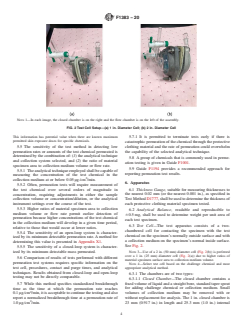
NOTE 1—In each image, the closed chamber is on the right and the flow chamber is on the left of the assembly.
FIG. 2 Test Cell Setup—(a) 1 in. Diameter Cell; (b) 2 in. Diameter Cell
This information has potential value when there are known maximum
5.7.1 It is permitted to terminate tests early if there is
permitted skin exposure doses for specific chemicals.
catastrophic permeation of the chemical through the protective
5.5 The sensitivity of the test method in detecting low clothing material and the rate of permeation could overwhelm
permeation rates or amounts of the test chemical permeated is the capability of the selected analytical technique.
determined by the combination of: (1) the analytical technique
5.8 A group of chemicals that is commonly used in perme-
and collection system selected, and (2) the ratio of material
ation testing is given in Guide F1001.
specimen area to collection medium volume or flow rate.
5.9 Guide F1194 provides a recommended approach for
5.5.1 The analytical technique employed shall be capable of
reporting permeation test results.
measuring the concentration of the test chemical in the
collection medium at or below 0.05 µg⁄cm /min.
6. Apparatus
5.5.2 Often, permeation tests will require measurement of
the test chemical over several orders of magnitude in 6.1 Thickness Gauge, suitable for measuring thicknesses to
concentration, requiring adjustments in either the sample the nearest 0.02 mm (or the nearest 0.001 in.), as specified in
collection volume or concentration/dilution, or the analytical TestMethodD1777,shallbeusedtodeterminethethicknessof
instrument settings over the course of the test. each protective clothing material specimen tested.
5.5.3 Higher ratios of material specimen area to collection
6.2 Analytical Balance, readable and reproducible to
medium volume or flow rate permit earlier detection of
60.5 mg, shall be used to determine weight per unit area of
permeation because higher concentrations of the test chemical
each test specimen.
in the collection medium will develop in a given time period,
6.3 Test Cell—The test apparatus consists of a two-
relative to those that would occur at lower ratios.
chambered cell for contacting the specimen with the test
5.5.4 The sensitivity of an open-loop system is character-
chemical on the specimen’s normally outside surface and with
ized by its minimum detectable permeation rate.Amethod for
a collection medium on the specimen’s normal inside surface.
determining this value is presented in Appendix X1.
See Fig. 2.
5.5.5 The sensitivity of a closed-loop system is character-
ized by its minimum detectable mass permeated.
NOTE 3—Use of a 2 in. (50 mm) diameter cell (Fig. 2(b)) is preferred
over a 1 in. (25 mm) diameter cell (Fig. 2(a)) due to higher ratios of
5.6 Comparison of results of tests performed with different
material specimen surface area to collection medium volume.
permeation test systems requires specific information on the
NOTE 4—Select test cell based on the challenge chemical and most
test cell, procedures, contact and purge times, and analytical
appropriate analytical method.
techniques. Results obtained from closed-loop and open-loop
6.3.1 The chambers are of two types:
testing may not be directly comparable.
6.3.1.1 Closed Chamber—The closed chamber contains a
5.7 While this method specifies standardized breakthrough fixed volume of liquid and a straight bore, standard taper spout
time as the time at which the permeation rate reaches for adding challenge chemical or collection medium. Small
0.1 µg⁄cm /min,itisacceptabletocontinuethetestingandalso volumes of collection medium may be removed with or
report a normalized breakthrough time at a permeation rate of without replacement for analysis. The 1 in. closed chamber is
1.0 µg⁄cm /min. 23 mm (0.917 in.) in length and 25.3 mm (1.0 in.) internal
F1383 − 20
diameter (see Fig. 2(a)). The internal volume of the closed
chamber is 17.1 mL. The 2 in. closed chamber is 22.0 mm
(0.87 in.) in length and 50 mm (2.0 in.) internal diameter (see
Fig.2(b)).Theinternalvolumeoftheclosedchamberis48mL.
6.3.1.2 Flow Chamber—The flow chamber has inlet and
outlet ports with valves through which a challenge chemical or
a collection medium flows during the test.The flow chamber is
used for continuously passing a gaseous challenge over the
normally outside surface of the test specimen, or continuously
passing a gaseous or liquid collection medium over the
normally inside surface of the test specimen. The 1 in. flow
chamber is 31 mm (1.25 in.) in length and 25.3 mm (1.0 in.)
internal diameter. The inlet and outlet ports have 4 mm
(0.19 in.) internal diameters (see Fig. 2(a)). The internal
volume of the flow chamber is 17.8 mL. The 2 in. flow
chamber is 35 mm (1.38 in.) in length and 50 mm (2.0 in.)
internal diameter. The inlet and outlet ports have 4 mm
(0.16 in.) internal diameters (see Fig. 2(b)). The internal
volume of the flow chamber is 68.7 mL.
6.3.1.3 The open, circular end of each chamber is flared to
NOTE 1—The clothing material specimen is oriented such that its
create a flange that facilitates clamping the chambers together.
normally outside surface (as worn by a user) faces the test chemical
6.3.1.4 Use chemically inert and non-absorptive test cell
chamber.
parts that contact the test chemical.
FIG. 3 ASTM Permeation Cell Configured for Intermittent Contact
NOTE 5—The standard closed and flow chambers are made of glass.
Testing (Top View)
Test chemicals (for example, hydrofluoric acid) that are corrosive to glass
require chambers constructed of alternative materials.
to the collection medium volume. Similarly, use a lower
6.3.2 Select the test cell configuration based on the chal-
volume test chamber for a high hazardous chemical to mini-
lenge chemical and most appropriate analytical method.
mize the amount of chemical being used for testing.
NOTE 6—The configuration can be of two closed chambers, two flow
6.3.3.3 In open-loop tests, lower collection medium flow
chambers, or one closed and one flow chamber.
rates will increase the system sensitivity by lowering the
6.3.2.1 When the flow chamber contains the challenge
minimum detectable permeation rate. However, these ap-
chemical, the chemical is introduced through the longer stem
proaches to increasing sensitivity must be achieved within the
that goes all the way to the end of the chamber.Ashorter stem
constraints of having sufficient volumes and mixing rates so as
onthesideofthetestchamberprovidesthechallengechemical
not to interfere with the permeation process.
a means of exit from the test chamber. This mode of entry and
6.3.3.4 Liquid test chemicals that are mixtures must be
exit of the challenge chemical aids in mixing of the chemical
stirred to minimize concentration gradients. Stirring may be
inside the test chamber. Flow of the challenge chemical must
effected by a stirring rod inserted through the fill spout or a
be regulated such that its composition and the concentration do
magnetic stirrer. If there is not a good seal of the shaft of the
not change over time.
rod and the spout, evaporation of the chemical can occur,
6.3.2.2 The open end of each chamber is flared to create a
reducing its volume and potentially changing its composition.
flange that facilitates clamping the chambers together.
6.3.3.5 For a liquid collection medium that is not circulated,
6.3.3 Additional Information:
the test cell can consist of two test chambers clamped together,
6.3.3.1 Make leak-tight connections to the collection cham-
provided that the collection medium can be mixed, withdrawn,
ber inlet and outlet tube must be made. In addition, all tubing
and replenished as needed during the test.
coming into contact with the test chemical should be made
6.3.3.6 The test chemical side chamber may be modified to
from material that does not absorb or react with the test
include an additional outlet port (with stopcock) positioned
chemical. Glass, PTFE, or stainless steel can be used in most
downward opposite the liquid chemical inlet port. Such a
cases. Connections of external tubing to the glass inlet and
modification will facilitate the repeated addition and removal
outlet ports of the test cell chambers can be made by means of
of liquid test chemicals.
PTFE pressure-fit union connectors.
6.4 Alternative Test Cell—Alternative permeation test cells
6.3.3.2 In closed-loop tests where increased analytical sen-
may be used, provided that the results are reported as pre-
sitivity is required, use a shorter length chamber to reduce the
scribed in Section 12. The cell and configuration described
volumeofthecollectionmedium.Thisincreasesthesensitivity
above and shown in Fig. 3, however, is the standard. If a
of the method by increasing the ratio of material specimen area
different cell is used, it must be documented as described in
Section 12.
6.5 Constant-Temperature Chamber or Bath—Used to
The closed and flow chambers are available from Pesce Lab Sales, Inc. 355 N.
Lincoln St, Kennett Square, PA 19348. maintain the test cell within 61 °C of the test temperature.The
F1383 − 20
standard temperature for this test is 27 °C. Condition all test 8.2.1 For a 2 in. (50 mm) diameter cell, each material
materials, including the test cells and chemicals, in the cham- specimentobetestedshallhaveaminimumcrossdimensionof
ber(s) of bath(s) prior to testing. 68.6 mm (2.7 in.). A 76.2 mm (3 in.) diameter circle is
convenient.
6.6 Circulating Pump, if appropriate, used to transport the
8.2.2 For a 1 in. (25 mm) diameter cell, each material
collection medium or test chemical, or both, through the test
specimen to be tested shall have minimum cross dimension of
cell.All parts contacting the test chemical or fluid containing it
43 mm (1.7 in.).A51 mm (2 in.) diameter circle is convenient.
must be chemically inert and non-absorptive to the test
chemical. The flow rate must be sufficiently high to provide 8.2.3 Specimens are permitted to extend beyond the edge of
adequate mixing, dilution, or both within the test cell.
the sealing surface if the larger specimen does not interfere
with the ability to seal the test cell.
NOTE 7—If a circulating pump is used, care should be taken to avoid
inducing pressure which may deform or damage the test specimen.
8.3 A minimum of three random specimens shall be tested.
6.7 Flow Meter, used to measure the flow rate of the
Random specimens shall be generated as described in Practice
collection medium through the collection chamber. A cali-
E105.
brated rotameter, or similarly accurate device, shall be used.
8.4 To avoid incidental contamination of exposed surfaces,
The flow rate shall be measured in-line with all system
clean gloves shall be worn when handling specimens.
components in place at the start of each test.
8.5 To avoid affecting permeation quantification, the collec-
6.8 Thermometer or Thermocouple, used to measure the
tionmediumshouldnotinteractwiththetestmaterialandmust
temperature of the constant-temperature chamber (or bath) or
have adequate capacity for the permeant. To have adequate
the collection chamber of the test cell, or both. A calibrated
capacity for the permeant, the collection medium should not
device accurate to 60.5 °C shall be used.
exceed 20 % of its saturation concentration from the permeant
7. Hazards at any time during the test. For a liquid collection medium,
saturation is the maximum solubility or miscibility of the
7.1 Before this test method is carried out, safety precautions
permeant in the liquid at the test temperature. For a gaseous
recommended for handling any potentially hazardous chemical
collection medium, saturation is determined by the vapor
should be identified and reviewed to provide appropriate
pressure of the permeant.
protective equipment to all personnel.
7.1.1 For carcinogenic, mutagenic, teratogenic, and other
8.6 Under conditions in which the test chamber or bath is at
toxic (poisonous) chemicals, the work area should be isolated,
a temperature significantly different from that of the test
well ventilated, and meticulously clean. Involved personnel
chemicalorcollectionmediumthatisbeingintroducedintothe
should be outfitted with appropriate protective equipment.
test cell, the temperature in the test chemical chamber or the
7.1.2 For corrosive or otherwise hazardous chemicals, in-
collection chamber, or both, should be measured. It may be
volved personnel should be outfitted with appropriate protec-
necessary to precondition the test chemical or collection
tive equipment.
medium before it enters the test cell. Similarly, it may be
7.2 Emergency equipment, such as a safety shower, eye necessarytomaintainthetemperatureofthecollectionmedium
after it leaves the test cell to prevent condensation or precipi-
wash,andself-containedbreathingapparatus,shouldbereadily
accessible from the test area. tation.
7.3 Appropriateproceduresforthedisposalofthechemicals
8.7 The combination of system configuration, analytical
should be followed.
technique, and collection medium shall be selected to allow
quantification of the test chemical over the range of concen-
8. Testing and Analytical Technique Considerations
trations that is consistent with 5.5.1, without exceeding the
8.1 Each protective clothing material specimen shall be maximum concentration limits within the system as defined in
permitted to consist of either a single layer or a composite of 8.5.
multiple layers that is representative of actual protective
8.7.1 Distilled water is preferred as a collection medium for
clothing construction, with all layers arranged in proper order.
non-volatile and semi-volatile test chemicals and non-water
In each test, the specimen’s normally outer surface shall
sensitive protective clothing materials. Consider alternative
contact the test chemical.
liquidsonlywhenthetestchemicaldoesnotm
...
This document is not an ASTM standard and is intended only to provide the user of an ASTM standard an indication of what changes have been made to the previous version. Because
it may not be technically possible to adequately depict all changes accurately, ASTM recommends that users consult prior editions as appropriate. In all cases only the current version
of the standard as published by ASTM is to be considered the official document.
´1
Designation: F1383 − 12 F1383 − 20
Standard Test Method for
Permeation of Liquids and Gases Through Protective
Clothing Materials Under Conditions of Intermittent Contact
This standard is issued under the fixed designation F1383; the number immediately following the designation indicates the year of
original adoption or, in the case of revision, the year of last revision. A number in parentheses indicates the year of last reapproval. A
superscript epsilon (´) indicates an editorial change since the last revision or reapproval.
ε NOTE—Editorially corrected 8.8.1 in February 2015.
INTRODUCTION
Workers involved in the production, use, and transportation of liquid and gaseous chemicals can be
exposed to numerous compounds capable of causing harm upon contact with the human body. The
deleterious health effects of these chemicals can range from acute trauma such as skin irritation and
burn, to chronic degenerative disease such as and mutagenic conditions, including cancer. Since
engineering controls may not eliminate all possible exposures, attention is often placed on reducing
the potential for direct skin contact through the use of protective clothing that resists permeation,
penetration, and degradation.
This test method is used to measure the resistance to permeation under the condition of intermittent
contact of the protective clothing material with liquid or gaseous chemicals. Resistance to permeation
and penetration under conditions of continuous contact should be determined by Test Methods F739
and F903, respectively. In certain situations, the permeation of liquids through protective clothing
materials can be measured using a permeation cup following Test Method F1407. An undesirable
change in the physical properties of protective clothing materials is called degradation. Methods for
measuring the degradation of rubbers, plastics, and coated fabricsmaterials are found in Test
MethodsMethod D471, Test Method Practice D543, and Test Method D751, respectively. A starting
point for selecting the chemicals to be used in assessing the chemical resistance of clothing materials
is Guide F1001.
1. Scope
1.1 This test method measures the permeation of liquids and gases through protective clothing materials under the condition of
intermittent contact.
1.2 This test method is designed for use when the test chemical is a gas or a liquid;liquid, where the liquid is either volatile (that
is, having a vapor pressure greater than 1 mm Hg at 25°C)25 °C) or soluble in water or another liquid that does not interact with
the clothing material.
1.3 The values stated in SI units are to be regarded as standard. The values given in parentheses are mathematical conversions to
inch-pound units that are provided for information only and are not considered standard.
This test method is under the jurisdiction of ASTM Committee F23 on Personal Protective Clothing and Equipment and is the direct responsibility of Subcommittee
F23.30 on Chemicals.
Current edition approved Sept. 1, 2012Nov. 1, 2020. Published October 2012November 2020. Originally approved in 1992. Last previous edition approved in 20112012
as F1383 - 11.F1383 – 12. DOI: 10.1520/F1383-12E01.10.1520/F1383-20.
Copyright © ASTM International, 100 Barr Harbor Drive, PO Box C700, West Conshohocken, PA 19428-2959. United States
F1383 − 20
1.4 This standard does not purport to address all of the safety concerns, if any, associated with its use. It is the responsibility
of the user of this standard to establish appropriate safety safety, health, and healthenvironmental practices and determine the
applicability of regulatory limitations prior to use. Specific hazard statements are given in Section 7.
1.5 This international standard was developed in accordance with internationally recognized principles on standardization
established in the Decision on Principles for the Development of International Standards, Guides and Recommendations issued
by the World Trade Organization Technical Barriers to Trade (TBT) Committee.
2. Referenced Documents
2.1 ASTM Standards:
D471 Test Method for Rubber Property—Effect of Liquids
D543 Practices for Evaluating the Resistance of Plastics to Chemical Reagents
D751 Test Methods for Coated Fabrics
D1777 Test Method for Thickness of Textile Materials
E105 Practice for Probability Sampling of Materials
E171E171/E171M Practice for Conditioning and Testing Flexible Barrier Packaging
E177 Practice for Use of the Terms Precision and Bias in ASTM Test Methods
E691 Practice for Conducting an Interlaboratory Study to Determine the Precision of a Test Method
F739 Test Method for Permeation of Liquids and Gases Through Protective Clothing Materials Under Conditions of Continuous
Contact
F903 Test Method for Resistance of Materials Used in Protective Clothing to Penetration by Liquids
F1001 Guide for Selection of Chemicals to Evaluate Protective Clothing Materials
F1194 Guide for Documenting the Results of Chemical Permeation Testing of Materials Used in Protective Clothing
F1407 Test Method for Resistance of Chemical Protective Clothing Materials to Liquid Permeation—Permeation Cup Method
F1494 Terminology Relating to Protective Clothing
2.2 ISO Standard:
ISO 6529 Protective Clothing—Determination of Resistance of Protective Clothing Materials to Permeation by Liquids and
Gases
3. Terminology
3.1 Definitions:
3.1.1 analytical technique, n—a procedure whereby the concentration of the test chemical in a collection medium is quantitatively
determined.
3.1.1.1 Discussion—
These procedures are often specific to individual chemical and collection medium combinations. Applicable techniques can
include, but are not limited toto: flame ionization, photo ionization, electro-chemical, ultraviolet, and infrared spectrophotometry,
gas and liquid chromatography, colorimetry, length-of-stain detector tubes, and radionuclide tagging/detection counting.
3.1.2 breakthrough detection time, n—the elapsed time measured from the initial exposure to the test chemical to the sampling
time that immediately precedes the sampling time at which the test chemical is first detected. (See Fig. 1.)
3.1.2.1 Discussion—
The breakthrough detection time is dependent on the sensitivity of the method. (See Fig. 1 and Appendix X1.)
3.1.3 closed-loop, adj—refers to a testing mode in which there is no change in the volume of the collection medium except for
sampling.
3.1.4 collection medium, n—a liquid, gas, or solid that absorbs, adsorbs, dissolves, suspends, or otherwise captures the test
chemical and does not affect the measured permeation.
3.1.5 contact time, n—in an intermittent contact test, the duration during each cycle that the test chemical side chamber side of
the permeation cell is filled with the test chemical.
3.1.6 cumulative permeation, n—the total mass of chemical that permeates a specific area of protective clothing material during
a specified time from when the material is first contacted by the test chemical.
For referenced ASTM standards, visit the ASTM website, www.astm.org, or contact ASTM Customer Service at service@astm.org. For Annual Book of ASTM Standards
volume information, refer to the standard’s Document Summary page on the ASTM website.
F1383 − 20
NOTE 1—In an intermittent contact test, it is possible that the permeation rate will exceed, then go below, and then again exceed a permeation rate of
2 2
0.1 μg/cm /min. If this occurs, the standardized breakthrough time is the first occurrence of the permeation rate exceeding 0.1 μg/cm /min.
FIG. 1 The Breakthrough Detection Time for a Method Sensitivity of 0.05 μg/cm /min is 2324 min. The Standardized Breakthrough De-
tection Time is 33 min.
3.1.6.1 Discussion—
Quantification of cumulative permeation enables the comparison of permeation behaviors under different intermittent and
continuous contact conditions.
3.1.7 cycle time, n—in an intermittent contact test, the interval of time from the start of one contact period to the start of the next
contact period.
3.1.8 degradation, n—a deleterious change in one or more properties of a material.
3.1.8.1 Discussion—
For protective clothing materials, changes in physical properties are typically of most interest.
3.1.9 minimum detectable mass permeated, n—the smallest mass of test chemical that is detectable with the complete permeation
test system.
3.1.9.1 Discussion—
This value is not necessarily the sensitivity of the analytical instrument.
3.1.10 minimum detectable permeation rate, n—the lowest rate of permeation that is measurable with the complete permeation test
system.
3.1.10.1 Discussion—
This value is not necessarily the sensitivity of the analytical instrument.
3.1.11 normalized breakthrough time, n—the time at which the permeation rate reaches 1.0 μg ⁄cm /min.
3.1.12 open-loop, adj—refers to a testing mode in which fresh collection medium flows continuously through the collection
chamber of the test cell.
3.1.13 penetration, n—for chemical protective clothing, the movement of substances a substance through voids in protective
clothing materials or items material or the protective clothing item on a non-molecular level.
3.1.13.1 Discussion—
Voids include gaps, pores, holes, and imperfections in closures, seams, interfaces, and protective clothing materials. Penetration
does not require a change inof state; solid chemicals move through voids in materials as solids, liquids as liquids, and gases as
gases. Penetration is a distinctly different mechanism from permeation.
3.1.14 permeation, n—for chemical protective clothing, the movementsmovement of chemicalschemical(s) as molecules through
protective clothing materials by the processes of: (1) absorption of the chemical into the contact surface of the materials,material,
(2) diffusion of the absorbed molecules throughout the material, and (3) desorption of the chemical from the opposite surface of
the material.
F1383 − 20
3.1.14.1 Discussion—
Permeation is a distinctly different mechanism from penetration.
3.1.15 protective clothing, n—item of clothing that is specifically designed and constructed for the intended purpose of isolating
all or part of the body from a potential hazard; or, isolating the external environment from contamination by the wearer of the
clothing.
3.1.16 purge time, n—in an intermittent contact test, the time immediately following the termination of the contact time when the
test chemical is removed from the test chemical side chamber side and air or nitrogen is blown over the outside surface of the
protective clothing material.
3.1.17 seam, n—a line along which two pieces of material are joined together in protective clothing.
3.1.17.1 Discussion—
Common ways that seams are constructed include sewing with thread, welding with heat, taping, gluing, or combinations thereof.
3.1.18 standardized breakthrough time, n—the first time at which the permeation rate reaches 0.1 μg/cm /min (see Fig. 1).
3.1.19 test chemical, n—the solid, liquid, gas or mixture thereof, used to evaluate the performance of a protective clothing
material.
3.1.19.1 Discussion—
The liquid or gas may be either one component (for example, a neat liquid or gas) or have several components (for example, a
mixture). To be tested with this method, a solid must be soluble in a liquid or have a vapor pressure greater than 1 mm Hg at 25 °C.
3.1.20 volatile liquid, n—a liquid with a vapor pressure greater than 1 mm Hg at 25 °C.
3.2 For other protective clothing definitions, refer to Terminology F1494.
4. Summary of Test Method
4.1 The permeation of chemical(s) through a protective clothing material is assessed by measuring the breakthrough detection
time, standardized breakthrough time, normalized breakthrough time, and subsequent permeation rate through replicate specimens
of the material intermittently contacted with the chemical.
4.2 In the permeation test apparatus, the protective clothing material specimen partitions the test chemical from the collection
medium.
4.2.1 Contact of the test chemical with the clothing material’s outside surface is made intermittent by periodically adding and
removing the test chemical from the test chemical chamber side of the test cell.
4.2.2 The collection medium is analyzed quantitatively for its concentration of the test chemical and therebyand, thereby, the
amount of that chemical that has permeated the barrier protective clothing material specimen as a function of time after its initial
contact with the material.
4.2.3 By either graphical representation or appropriate calculations, or both, the breakthrough detection time, the standardized
breakthrough time, normalized breakthrough time, and the cumulative permeation of the test chemical are determined.
5. Significance and Use
5.1 This test method is used to measure chemical permeation through specimens of protective clothing under the condition of
intermittent contact of a test chemical with the specimen. In many applications, protective clothing is contacted intermittently to
chemicals, not continuously as is tested by Test Method F739.
5.2 This test method is normally used to evaluate flat specimens and seams from finished items of protective clothing and of
materials that are candidates for items of protective clothing.
F1383 − 20
5.2.1 Finished items of protective clothing include gloves, arm shields, sleeves, aprons, suits, hats, coveralls, hoods, boots,
respirators, and the like.
5.2.2 The phrase specimens“specimens from finished itemsitems” encompasses seamedseams or other discontinuous regions as
well as the usual continuous regions of protective clothing items.
5.2.3 Selected seams for testing are representative of seams used in the principal construction of the protective clothing item and
typically include seams of both the base material and where the base material is joined with other types of materials.
5.3 In some cases, it may be of interest to compare permeation behaviors that occur under conditions of intermittent contact with
those that occur during continuous contact. Test Method F739 is recommended for measuring permeation under the conditions of
continuous contact of the test chemical with the protective clothing specimen.
5.4 The breakthrough detection time, standardized breakthrough time, and the cumulative permeation are key measures of the
effectiveness of a clothing material as to be a barrier to the test chemical. Such information is used in the comparison of clothing
materials during the process of selecting clothing for protection from hazardous chemicals. Long breakthrough detection times and
standardized breakthrough times and low amounts of cumulative permeation are characteristics of better barriers. more effective
barrier materials than materials with higher permeation characteristics.
NOTE 1—At present, there is limited quantitative information exists about acceptable levels of dermal contact with most chemicals. Therefore, the data
obtained using this test method cannot be used to infer safe exposure levels.
5.4.1 The reporting of a standardized breakthrough time greater than a specific time period does not mean that no chemical has
permeated through the protective clothing material assince the standard breakthrough time is determined based on the permeation
rate reaching a level of 0.1 μg/cm min, indicating that some chemical has/min. Some chemical had already permeated the
specimen prior to the reported standardized breakthrough time.
5.4.2 Cumulative permeation represents the mass that permeates through a protective clothing material over a specific period of
time for a specific surface area of material. It is possible to use this information to model how much chemical can enter an item
The reporting of cumulative permeation over a specified test period is another means to report barrier performance of protective
clothing for a particular exposure based on a knowledge of the exposed surface area, the free volume inside the protective clothing
item, and amount of air mixing or air exchange for the protective clothing item.resistance to permeation. This measurement
quantifies the total amount of chemical that passed through a known area of the material during the specified test period.
NOTE 2—It is possible to relate cumulative permeation test results to the total amount of chemical to which an individual wearer may be exposed by
accounting for the exposed surface area and the underlying air layer. This information has potential value when there are known maximum permitted skin
exposure doses for specific chemicals.
5.5 The sensitivity of the test method in detecting low permeation rates or amounts of the test chemical permeated is determined
by the combination of: (1) the analytical technique and collection system selected, and (2) the ratio of material specimen area to
collection medium volume or flow rate.
5.5.1 The analytical technique employed shouldshall be capable of measuring the concentration of the test chemical in the
collection medium at,at or below, levels below 0.05 μg consistent ⁄cm with standardized breakthrough time value specified in
/min.3.1.15.
5.5.2 Often, permeation tests will require measurement of the test chemical over several orders of magnitude in concentration,
requiring adjustments in either the sample collection volume or concentration/dilution, or the analytical instrument settings over
the course of the test.
5.5.3 Higher ratios of material specimen area to collection medium volume or flow rate permit earlier detection of permeation
because higher concentrations of the test chemical in the collection medium will develop in a given time period, relative to those
that would occur at lower ratios.
5.5.4 The sensitivity of an open-loop system is characterized by its minimum detectable permeation rate. A method for
determining this value is presented in Appendix X1.
F1383 − 20
NOTE 1—The clothing material specimen is oriented such that its normally outside surface (as worn by a user) faces the test chemical chamber.
FIG. 23 ASTM Permeation Cell Configured for Intermittent Contact Testing (Top View)
5.5.5 The sensitivity of a closed-loop system is characterized by its minimum detectable mass permeated.
5.6 Comparison of results of tests performed with different permeation test systems requires specific information on the test cell,
procedures, contact and purge times, and analytical techniques. Results obtained from closed-loop and open-loop testing may not
be directly comparable.
5.7 While this method specifies standardized breakthrough time as the time at which the permeation rate reaches 0.1 μg ⁄cm /min,
it is acceptable to continue the testing and also report a normalized breakthrough time at a permeation rate of 1.0 μg ⁄cm /min.
5.7.1 It is permitted to terminate tests early if there is catastrophic permeation of the chemical through the protective clothing
material and the rate of permeation could overwhelm the capability of the selected analytical technique.
5.8 A group of chemicals that is recommended for use commonly used in permeation testing is given in Guide F1001.
5.9 Guide F1194 provides a recommended approach for reporting permeation test results.
6. Apparatus
6.1 Thickness Gauge, suitable for measuring thicknesses to the nearest 0.02 mm (or the nearest 0.001 in.), as specified in Test
Method D1777, shall be used to determine the thickness of each protective clothing material specimen tested.
6.2 Analytical Balance, readable and reproducible to 60.5 mg 60.5 mg, shall be used to determine weight per unit area of each
test specimen.
6.3 Test Cell—The test apparatus consists of a two-chambered cell for contacting the specimen with the test chemical on the
specimen’s normally outside surface and with a collection medium on the specimen’s normal inside surface. See Fig. 2.
NOTE 3—Use of a 2 in. (50 mm) diameter cell (Fig. 2(b)) is preferred over a 1 in. (25 mm) diameter cell (Fig. 2(a)) due to higher ratios of material
specimen surface area to collection medium volume.
NOTE 4—Select test cell based on the challenge chemical and most appropriate analytical method.
F1383 − 20
NOTE 1—In each image, the closed chamber is on the right and the flow chamber is on the left of the assembly.
FIG. 2 Test Cell Setup—(a) 1 in. Diameter Cell; (b) 2 in. Diameter Cell
6.3.1 The test cell,chambers are as shown in Fig. 2, is constructed of two sections of straight glass pipe, each nominally sized to
a 25.4 mm (1.0 in.) diameter.of two types: Materials other than glass may be used. Such materials would be required for tests
involving chemicals (for example, hydrofluoric acid), which are incompatible with glass. The section that is designated to contain
the test chemical is 25.4 mm (1.0 in.) in length. The second section, which is designated to contain the collection medium, is 32
mm (1.2 in.) or less in length.
6.3.1.1 Closed Chamber—The closed chamber contains a fixed volume of liquid and a straight bore, standard taper spout for
adding challenge chemical or collection medium. Small volumes of collection medium may be removed with or without
replacement for analysis. The 1 in. closed chamber is 23 mm (0.917 in.) in length and 25.3 mm (1.0 in.) internal diameter (see
Fig. 2(a)). The internal volume of the closed chamber is 17.1 mL. The 2 in. closed chamber is 22.0 mm (0.87 in.) in length and
50 mm (2.0 in.) internal diameter (see Fig. 2(b)). The internal volume of the closed chamber is 48 mL.
6.3.1.2 Flow Chamber—The flow chamber has inlet and outlet ports with valves through which a challenge chemical or a
collection medium flows during the test. The flow chamber is used for continuously passing a gaseous challenge over the normally
outside surface of the test specimen, or continuously passing a gaseous or liquid collection medium over the normally inside
surface of the test specimen. The 1 in. flow chamber is 31 mm (1.25 in.) in length and 25.3 mm (1.0 in.) internal diameter. The
inlet and outlet ports have 4 mm (0.19 in.) internal diameters (see Fig. 2(a)). The internal volume of the flow chamber is 17.8 mL.
The 2 in. flow chamber is 35 mm (1.38 in.) in length and 50 mm (2.0 in.) internal diameter. The inlet and outlet ports have 4 mm
(0.16 in.) internal diameters (see Fig. 2(b)). The internal volume of the flow chamber is 68.7 mL.
6.3.1.3 The open open, circular end of each chamber is flared to create a flange that facilitates clamping the chambers together.
6.3.1.4 Inlet and outlet ports with valves, if desired, are added to each chamber to enable the introduction and withdrawal of test
chemical and collection medium, if appropriate. The collection medium inlet tube should direct the collection medium directly
towards the center of the clothing material specimen. The inside diameter of tubing, ports, stopcocks, etc. should be at least 2 mm
(0.08 in.) to prevent undesirable pressure differences in the system.Use chemically inert and non-absorptive test cell parts that
contact the test chemical.
NOTE 5—The standard closed and flow chambers are made of glass. Test chemicals (for example, hydrofluoric acid) that are corrosive to glass require
chambers constructed of alternative materials.
Available from American National Standards Institute (ANSI), 25 W. 43rd St., 4th Floor, New York, NY 10036, http://www.ansi.org.
The test cell as shown inclosed and flow chambers are Fig. 2 is available from Pesce Lab Sales, P.O. Box 235, 226 Birch St., Inc. 355 N. Lincoln St, Kennett Square,
PA 19348.
F1383 − 20
6.3.1.3 Each chamber may also be equipped with a straight bore, standard taper spout. This spout may be useful for adding and
removing test chemical and collection medium. The spouts may also be used to introduce stirrers into the chambers.
6.3.1.4 Upon assembly, the clothing material is clamped between the two chambers by means of a yoke having at least three bolts.
Two PTFE gaskets having smooth, rounded edges are used at the joint, with the clothing material between them.
6.3.2 Select the test cell configuration based on the challenge chemical and most appropriate analytical method.
NOTE 6—The configuration can be of two closed chambers, two flow chambers, or one closed and one flow chamber.
6.3.2.1 When the flow chamber contains the challenge chemical, the chemical is introduced through the longer stem that goes all
the way to the end of the chamber. A shorter stem on the side of the test chamber provides the challenge chemical a means of exit
from the test chamber. This mode of entry and exit of the challenge chemical aids in mixing of the chemical inside the test chamber.
Flow of the challenge chemical must be regulated such that its composition and the concentration do not change over time.
6.3.2.2 The open end of each chamber is flared to create a flange that facilitates clamping the chambers together.
6.3.3 Discussion—Additional Information: The bolts shall be tightened with sufficient torque to prevent leakage of the test
chemical or the collection medium but avoid damage to the clothing material or the test cell.
6.3.3.1 Leak-tight Make leak-tight connections to the collection chamber inlet and outlet tube must be made. In addition, all tubing
coming into contact with the test chemical should be made from material that does not absorb or react with the test chemical. Glass,
PTFE, or stainless steel can be used in most cases. Connections of external tubing to the glass inlet and outlet ports of the test cell
chambers can be made by means of PTFE pressure-fit union connectors.
6.3.3.2 In closed-loop tests where increased analytical sensitivity is required, use a shorter length chamber to reduce the volume
of the collection medium. This increases the sensitivity of the method by increasing the ratio of material specimen area to the
collection medium volume. Similarly, use a lower volume test chamber for a high hazardous chemical to minimize the amount of
chemical being used for testing.
6.3.3.3 In closed-loop tests where increased analytical sensitivity is required, a shorter length of glass pipe may be used to contain
the collection medium. This reduces the contained volume and increases the ratio of material specimen area to the collection
medium volume. In open-loop tests, lower collection medium flow rates will increase the system sensitivity by lowering the
minimum detectable permeation rate. However, these approaches to increasing sensitivity must be achieved within the constraints
of having sufficient volumes and mixing rates so as not to interfere with the permeation process.
6.3.3.4 Liquid test chemicals that are mixtures must be stirred to minimize concentration gradients. Stirring may be effected by
a stirring rod inserted through the fill spout or a magnetic stirrer. If there is not a good seal of the shaft of the rod and the spout,
evaporation of the chemical can occur, reducing its volume and potentially changing its composition.
6.3.3.5 For a liquid collection medium that is not circulated, the test cell can consist of two test chambers clamped together,
provided that the collection medium can be mixed, withdrawn, and replenished as needed during the test.
6.3.3.6 The test chemical side chamber may be modified to include an additional outlet port (with stopcock) positioned downward
opposite the liquid chemical inlet port. Such a modification will facilitate the repeated addition and removal of liquid test
chemicals.
6.4 Alternative Test Cell—Alternative permeation test cells may be used, provided that the results are reported as prescribed in
Section 12. The cell and configuration described above and shown in Fig. 23, however, is the standard. If a different cell is used,
it must be documented as described in Section 12.
6.5 Constant Temperature Constant-Temperature Chamber or Bath—Used to maintain the test cell within 61°C61 °C of the test
temperature. The standard temperature for this test is 27°C.27 °C. Condition all test materials, including the test cells and
chemicals, in the chamber(s) of bath(s) prior to testing.
F1383 − 20
6.6 Circulating Pump, if appropriate, used to transport the collection medium and/or test chemical or test chemical, or both,
through the test cell. All parts contacting the test chemical or fluid containing it must be chemically inert and non-absorptive to
the test chemical. The flow rate must be sufficiently high to provide adequate mixing and/or dilution mixing, dilution, or both
within the test cell.
NOTE 7—If a circulating pump is used, care should be taken to avoid inducing pressure which may deform or damage the test specimen.
6.7 Flow Meter, Flow meter, used to measure the flow rate of the collection medium through the collection chamber. A calibrated
rotameter, or similarly accurate device, mayshall be used. The flow rate shall be measured in-line with all system components in
place at the start of each test.
6.8 Thermometer or Thermocouple, Thermometer or thermocouple, used to measure the temperature of the constant-temperature
chamber (or bath) and/oror the collection chamber of the test cell. cell, or both. A calibrated device,device accurate to 60.5°C
must60.5 °C shall be used.
7. Hazards
7.1 Before this test method is carried out, safety precautions recommended for handling any potentially hazardous chemical should
be identified and reviewed to provide full protection appropriate protective equipment to all personnel.
7.1.1 For carcinogenic, mutagenic, teratogenic, and other toxic (poisonous) chemicals, the work area should be isolated,
well-ventilated, well ventilated, and meticulously clean. Involved personnel should be outfitted with appropriate protective
clothing and equipment.
7.1.2 For corrosive or otherwise hazardous chemicals, involved personnel should, as a minimum, should be outfitted with
appropriate protective clothing and equipment.
7.2 Emergency equipment, such as a safety shower, eye wash, and self-contained breathing apparatus, should be readily accessible
from the test area.
7.3 Appropriate procedures for the disposal of the chemicals should be followed.
8. Testing and Analytical Technique Considerations
8.1 Each protective clothing material specimen may shall be permitted to consist of either a single layer or a composite of multiple
layers that is representative of an actual protective clothing construction, with all layers arranged in proper order. In each test, the
specimen’s normally outer surface shall contact the test chemical.
8.1.1 If,If in a proposed design of an item of protective clothing,protective clothing different materials or thicknesses of materials
are specified at different locations, specimens from each location shall be tested.
8.1.2 If,If in a proposed design, design of protective clothing seams are specified,used, additional specimens containing such
seams shall be tested. Care must be taken to ensure that the test cell can be properly sealed when specimens of nonuniform
thickness are tested.
NOTE 8—Use of a 2 in. (50 mm) diameter cell is preferred over a 1 in. (25 mm) diameter cell for this reason.
8.2 Each material specimen to be tested shall have minimum cross dimension of 43 mm (1.7 in.). Sample size is dependent on
test cell dimensions.A51 mm (2 in.) diameter circle is convenient.
8.2.1 For a 2 in. (50 mm) diameter cell, each material specimen to be tested shall have a minimum cross dimension of 68.6 mm
(2.7 in.). A 76.2 mm (3 in.) diameter circle is convenient.
8.2.2 For a 1 in. (25 mm) diameter cell, each material specimen to be tested shall have minimum cross dimension of 43 mm (1.7
in.). A 51 mm (2 in.) diameter circle is convenient.
F1383 − 20
8.2.3 Specimens are permitted to extend beyond the edge of the sealing surface if the larger specimen does not interfere with the
ability to seal the test cell.
8.3 A minimum of three random specimens shall be tested. Random specimens shall be generated as described in Practice E105.
8.4 To avoid incidental contamination of exposed surfaces, clean gloves mayshall be worn when handling specimens.
8.5 To avoid affecting permeation measurements, aquantification, the collection medium should not interact with the test
material,material and must have adequate capacity for the permeant. To have adequate capacity for the permeant, the collection
medium should not exceed 20 % of its saturation concentration from the permeant at any time during the test. For a liquid
collection medium, saturation is the maximum solubility or miscibility of th
...