

ASTM F903-18
(Test Method)Standard Test Method for Resistance of Materials Used in Protective Clothing to Penetration by Liquids
General Information
- Abstract
SIGNIFICANCE AND USE
5.1 This test method is normally used to evaluate the barrier effectiveness against penetration of liquids through materials, seams, closures, or other planar assemblies used in protective clothing and specimens from finished items of protective clothing.
5.1.1 Finished items of protective clothing include gloves, arm protectors, aprons, coveralls, suits, hoods, boots, and similar items.
5.1.2 The phrase “specimens from finished items” is permitted to include continuous regions of protective clothing items as well as seamed or other discontinuous regions of protective clothing.
5.1.3 The types of specimens are limited to those that are relatively flat (planar) that are capable of being sealed in the test cell specified in this test method without peripheral leakage.
5.2 A substitute challenge liquid (for example, water or isopropanol) is appropriate in some cases to generalize material penetration resistance to liquids. However, it is possible that differences in chemical and molecular properties (for example, surface tension) may lead to different results.
5.3 In addition to the failure mode where a liquid finds a pathway for penetration through a void, imperfection, or defect in material or clothing subassembly, some selected chemicals cause degradation of barrier material, film, or coating, leading to penetration over extended periods of contact.7
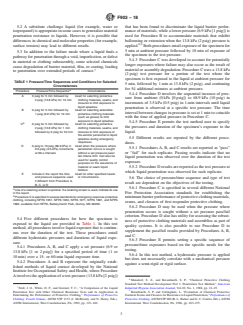
5.4 Five different procedures for how the specimen is exposed to the liquid are provided in Table 1. In this test method, all procedures involve liquid exposure that is continuous over the duration of the test. These procedures entail different hydrostatic pressures and durations of liquid exposure.
5.4.1 Procedures A, B, and C apply a set pressure (6.9 or 13.8 kPa [1 or 2 psig]) for a specified period of time (1 or 10 min) over a 15- or 60-min liquid exposure time.
5.4.2 Procedures A and B represent the originally established methods of liquid contact developed by the National Institute for Occu...
SCOPE
1.1 This test method is used to test specimens of protective clothing materials, assemblies such as seams and closures, or interfaces used in the construction of protective clothing. The resistance to visible penetration of the test liquid is determined with the liquid in continuous contact with the normally outside (exterior) surface of the test specimen.
1.2 This test method includes different procedures for maintaining the liquid in contact with the test specimen in terms of the length of exposure and the pressure applied. Suggestions are provided for how to select an appropriate procedure for liquid contact.
1.3 In some cases, significant amounts of hazardous materials will permeate specimens that pass the penetration tests. For more sensitive analyses, use either Test Method F739 or F1383 to determine permeation.
1.4 This test method does not address penetration of vapors through protective clothing materials.
1.5 This test method is not applicable to non-planar protective clothing materials, interfaces, or assemblies such as the fingertips or crotch areas of gloves, which are possible failure points.
1.6 This test method does not address the liquid penetration resistance of full protective clothing items or ensembles. Use Test Method F1359 for this purpose.
1.7 The values as stated in inch-pound units are to be regarded as the standard. The values in parentheses are for information only.
1.8 This standard does not purport to address all of the safety concerns, if any, associated with its use. It is the responsibility of the user of this standard to establish appropriate safety, health, and environmental practices and determine the applicability of regulatory limitations prior to use. Specific hazards are given in Section 7.
1.9 This international standard was developed in accordance with internationally recognized principles on standardization established in the Decision on Principles for t...
- Status
- Published
- Publication Date
- 30-Jun-2018
- Technical Committee
- F23 - Personal Protective Clothing and Equipment
- Drafting Committee
- F23.30 - Chemicals
Buy Documents
ASTM F903-18 - Standard Test Method for Resistance of Materials Used in Protective Clothing to Penetration by Liquids
REDLINE ASTM F903-18 - Standard Test Method for Resistance of Materials Used in Protective Clothing to Penetration by Liquids
Overview
ASTM F903-18, titled Standard Test Method for Resistance of Materials Used in Protective Clothing to Penetration by Liquids, establishes a reliable laboratory procedure to evaluate how well protective clothing materials, seams, and closures resist visible liquid penetration. Developed by ASTM International, this standard focuses on barrier effectiveness for a variety of planar (flat) materials, such as those used in gloves, arm protectors, aprons, suits, hoods, and boots. The method is essential for safety professionals and manufacturers to ensure that protective apparel provides adequate defense against hazardous liquid exposures in occupational environments.
Key Topics
Scope and Methodology
- Evaluates specimens from flat regions of finished protective clothing items as well as seams and closures, focusing on their resistance to visible liquid penetration.
- Provides multiple exposure procedures, varying by hydrostatic pressure and duration, to simulate different use scenarios.
Types of Specimens
- Only planar (relatively flat) samples suitable for reliable sealing in the test apparatus can be evaluated.
- Appropriate for continuous fabric and seamed regions; not suitable for complex, non-planar geometries.
Testing Procedures
- Five alternative procedures (A-E) are included, allowing for set pressures, incremental increases, and user-defined conditions based on specific needs.
- Procedures assess performance under direct liquid contact, controlling for pressure and exposure time.
Result Reporting
- Outcomes typically classified as "pass" (no penetration observed) or "fail" (liquid penetration detected).
- For certain procedures, the specific pressure at which penetration occurs is recorded.
Limitations
- Does not assess vapor penetration or full clothing ensembles; focuses on localized liquid penetration.
- Full system integrity testing is addressed by related standards.
Applications
ASTM F903-18 is widely applied in industries where personal protective equipment (PPE) is critical for chemical safety and worker protection:
- Occupational Health and Safety: Chemical manufacturing, pharmaceutical production, and industrial cleaning require assurance that protective clothing forms an effective barrier against harmful liquid chemicals.
- Product Development and Quality Control: Manufacturers use this method to select suitable materials and verify product consistency during PPE production.
- Compliance and Certification: Helps clothing manufacturers demonstrate compliance with regulatory and client requirements for liquid penetration resistance.
- Emergency Response Apparel: Used to specify and validate materials for firefighter, rescue worker, and hazardous material (HAZMAT) suits, ensuring they meet stringent performance requirements for liquid splash protection.
Related Standards
For a comprehensive safety strategy, practitioners often reference the following international and ASTM standards alongside ASTM F903-18:
- ASTM F739 - Test Method for Permeation of Liquids and Gases through Protective Clothing Materials under Continuous Contact.
- ASTM F1383 - Test Method for Permeation under Intermittent Contact.
- ASTM F1359 - Test Method for Liquid Penetration Resistance of Protective Ensembles under shower spray while on a mannequin.
- NFPA Standards: For example, NFPA 1951, 1952, 1971, 1991, and 1992 relate to fire and rescue personal protective equipment.
- ISO 2859-1, MIL-STD-105E, ANSI/ASQ Z1.4: Standards for sampling procedures and inspection by attributes, essential for developing representative sampling plans in quality assurance.
By following ASTM F903-18, organizations protect workers by ensuring that protective clothing meets rigorous benchmarks for liquid barrier performance, facilitating safer workplaces and robust regulatory compliance.
Keywords: ASTM F903, protective clothing, liquid penetration resistance, PPE testing, chemical barrier, seam testing, occupational safety, hydrostatic pressure, quality control, PPE compliance.
Relations
- Effective Date
- 01-Jul-2018
- Effective Date
- 01-Jan-2020
- Effective Date
- 01-Jul-2019
- Effective Date
- 01-Jul-2015
- Effective Date
- 01-Sep-2012
- Effective Date
- 01-Sep-2012
- Effective Date
- 01-Jul-2011
- Effective Date
- 01-May-2011
- Effective Date
- 01-Apr-2011
- Effective Date
- 01-Oct-2010
- Effective Date
- 01-Oct-2009
- Effective Date
- 15-Jan-2009
- Effective Date
- 15-Oct-2007
- Effective Date
- 01-Jul-2007
- Effective Date
- 01-Jul-2007
Buy Documents
ASTM F903-18 - Standard Test Method for Resistance of Materials Used in Protective Clothing to Penetration by Liquids
REDLINE ASTM F903-18 - Standard Test Method for Resistance of Materials Used in Protective Clothing to Penetration by Liquids
Get Certified
Connect with accredited certification bodies for this standard

CIS Institut d.o.o.
Personal Protective Equipment (PPE) certification body. Notified Body NB-2890 for EU Regulation 2016/425 PPE.

Kiwa BDA Testing
Building and construction product certification.
Kmetijski inštitut Slovenije
Agricultural Institute of Slovenia. Soil testing, plant health, agricultural product analysis.
Sponsored listings
Frequently Asked Questions
ASTM F903-18 is a standard published by ASTM International. Its full title is "Standard Test Method for Resistance of Materials Used in Protective Clothing to Penetration by Liquids". This standard covers: SIGNIFICANCE AND USE 5.1 This test method is normally used to evaluate the barrier effectiveness against penetration of liquids through materials, seams, closures, or other planar assemblies used in protective clothing and specimens from finished items of protective clothing. 5.1.1 Finished items of protective clothing include gloves, arm protectors, aprons, coveralls, suits, hoods, boots, and similar items. 5.1.2 The phrase “specimens from finished items” is permitted to include continuous regions of protective clothing items as well as seamed or other discontinuous regions of protective clothing. 5.1.3 The types of specimens are limited to those that are relatively flat (planar) that are capable of being sealed in the test cell specified in this test method without peripheral leakage. 5.2 A substitute challenge liquid (for example, water or isopropanol) is appropriate in some cases to generalize material penetration resistance to liquids. However, it is possible that differences in chemical and molecular properties (for example, surface tension) may lead to different results. 5.3 In addition to the failure mode where a liquid finds a pathway for penetration through a void, imperfection, or defect in material or clothing subassembly, some selected chemicals cause degradation of barrier material, film, or coating, leading to penetration over extended periods of contact.7 5.4 Five different procedures for how the specimen is exposed to the liquid are provided in Table 1. In this test method, all procedures involve liquid exposure that is continuous over the duration of the test. These procedures entail different hydrostatic pressures and durations of liquid exposure. 5.4.1 Procedures A, B, and C apply a set pressure (6.9 or 13.8 kPa [1 or 2 psig]) for a specified period of time (1 or 10 min) over a 15- or 60-min liquid exposure time. 5.4.2 Procedures A and B represent the originally established methods of liquid contact developed by the National Institute for Occu... SCOPE 1.1 This test method is used to test specimens of protective clothing materials, assemblies such as seams and closures, or interfaces used in the construction of protective clothing. The resistance to visible penetration of the test liquid is determined with the liquid in continuous contact with the normally outside (exterior) surface of the test specimen. 1.2 This test method includes different procedures for maintaining the liquid in contact with the test specimen in terms of the length of exposure and the pressure applied. Suggestions are provided for how to select an appropriate procedure for liquid contact. 1.3 In some cases, significant amounts of hazardous materials will permeate specimens that pass the penetration tests. For more sensitive analyses, use either Test Method F739 or F1383 to determine permeation. 1.4 This test method does not address penetration of vapors through protective clothing materials. 1.5 This test method is not applicable to non-planar protective clothing materials, interfaces, or assemblies such as the fingertips or crotch areas of gloves, which are possible failure points. 1.6 This test method does not address the liquid penetration resistance of full protective clothing items or ensembles. Use Test Method F1359 for this purpose. 1.7 The values as stated in inch-pound units are to be regarded as the standard. The values in parentheses are for information only. 1.8 This standard does not purport to address all of the safety concerns, if any, associated with its use. It is the responsibility of the user of this standard to establish appropriate safety, health, and environmental practices and determine the applicability of regulatory limitations prior to use. Specific hazards are given in Section 7. 1.9 This international standard was developed in accordance with internationally recognized principles on standardization established in the Decision on Principles for t...
SIGNIFICANCE AND USE 5.1 This test method is normally used to evaluate the barrier effectiveness against penetration of liquids through materials, seams, closures, or other planar assemblies used in protective clothing and specimens from finished items of protective clothing. 5.1.1 Finished items of protective clothing include gloves, arm protectors, aprons, coveralls, suits, hoods, boots, and similar items. 5.1.2 The phrase “specimens from finished items” is permitted to include continuous regions of protective clothing items as well as seamed or other discontinuous regions of protective clothing. 5.1.3 The types of specimens are limited to those that are relatively flat (planar) that are capable of being sealed in the test cell specified in this test method without peripheral leakage. 5.2 A substitute challenge liquid (for example, water or isopropanol) is appropriate in some cases to generalize material penetration resistance to liquids. However, it is possible that differences in chemical and molecular properties (for example, surface tension) may lead to different results. 5.3 In addition to the failure mode where a liquid finds a pathway for penetration through a void, imperfection, or defect in material or clothing subassembly, some selected chemicals cause degradation of barrier material, film, or coating, leading to penetration over extended periods of contact.7 5.4 Five different procedures for how the specimen is exposed to the liquid are provided in Table 1. In this test method, all procedures involve liquid exposure that is continuous over the duration of the test. These procedures entail different hydrostatic pressures and durations of liquid exposure. 5.4.1 Procedures A, B, and C apply a set pressure (6.9 or 13.8 kPa [1 or 2 psig]) for a specified period of time (1 or 10 min) over a 15- or 60-min liquid exposure time. 5.4.2 Procedures A and B represent the originally established methods of liquid contact developed by the National Institute for Occu... SCOPE 1.1 This test method is used to test specimens of protective clothing materials, assemblies such as seams and closures, or interfaces used in the construction of protective clothing. The resistance to visible penetration of the test liquid is determined with the liquid in continuous contact with the normally outside (exterior) surface of the test specimen. 1.2 This test method includes different procedures for maintaining the liquid in contact with the test specimen in terms of the length of exposure and the pressure applied. Suggestions are provided for how to select an appropriate procedure for liquid contact. 1.3 In some cases, significant amounts of hazardous materials will permeate specimens that pass the penetration tests. For more sensitive analyses, use either Test Method F739 or F1383 to determine permeation. 1.4 This test method does not address penetration of vapors through protective clothing materials. 1.5 This test method is not applicable to non-planar protective clothing materials, interfaces, or assemblies such as the fingertips or crotch areas of gloves, which are possible failure points. 1.6 This test method does not address the liquid penetration resistance of full protective clothing items or ensembles. Use Test Method F1359 for this purpose. 1.7 The values as stated in inch-pound units are to be regarded as the standard. The values in parentheses are for information only. 1.8 This standard does not purport to address all of the safety concerns, if any, associated with its use. It is the responsibility of the user of this standard to establish appropriate safety, health, and environmental practices and determine the applicability of regulatory limitations prior to use. Specific hazards are given in Section 7. 1.9 This international standard was developed in accordance with internationally recognized principles on standardization established in the Decision on Principles for t...
ASTM F903-18 is classified under the following ICS (International Classification for Standards) categories: 13.340.10 - Protective clothing. The ICS classification helps identify the subject area and facilitates finding related standards.
ASTM F903-18 has the following relationships with other standards: It is inter standard links to ASTM F903-17, ASTM F104-11(2020), ASTM D1777-96(2019), ASTM D1777-96(2015), ASTM F1383-12, ASTM F739-12, ASTM F1383-11, ASTM D1777-96(2011)e1, ASTM F104-11, ASTM E105-10, ASTM F104-03(2009), ASTM D3776-09, ASTM F1359-07, ASTM F1383-07, ASTM F739-07. Understanding these relationships helps ensure you are using the most current and applicable version of the standard.
ASTM F903-18 is available in PDF format for immediate download after purchase. The document can be added to your cart and obtained through the secure checkout process. Digital delivery ensures instant access to the complete standard document.
Standards Content (Sample)
This international standard was developed in accordance with internationally recognized principles on standardization established in the Decision on Principles for the
Development of International Standards, Guides and Recommendations issued by the World Trade Organization Technical Barriers to Trade (TBT) Committee.
Designation: F903 − 18
Standard Test Method for
Resistance of Materials Used in Protective Clothing to
Penetration by Liquids
ThisstandardisissuedunderthefixeddesignationF903;thenumberimmediatelyfollowingthedesignationindicatestheyearoforiginal
adoption or, in the case of revision, the year of last revision.Anumber in parentheses indicates the year of last reapproval.Asuperscript
epsilon (´) indicates an editorial change since the last revision or reapproval.
INTRODUCTION
Workers involved in the production, use, and transportation of liquid chemicals can be exposed to
numerous compounds capable of causing harm upon contact with the human body. The deleterious
effects of these chemicals can range from acute trauma such as skin irritation and burn, to chronic
degenerative disease such as cancer. Since engineering controls may not eliminate all possible
exposures, attention is often placed on reducing the potential for direct skin contact through the use
of protective clothing that resists permeation, penetration, and degradation.
This test method determines resistance of protective clothing materials, seams, and closures to
liquidpenetrationonly.ResistanceofprotectiveclothingmaterialstopermeationisdeterminedbyTest
Method F739 or F1383. While degradation resistance is not directly determined by this test method,
the degradation of a material can be a contributing factor to the observed penetration of a liquid.
Test Method F1359 assesses the liquid penetration of full protective clothing items or ensembles of
clothing and equipment.
1. Scope 1.4 This test method does not address penetration of vapors
through protective clothing materials.
1.1 This test method is used to test specimens of protective
clothing materials, assemblies such as seams and closures, or
1.5 This test method is not applicable to non-planar protec-
interfaces used in the construction of protective clothing. The
tive clothing materials, interfaces, or assemblies such as the
resistance to visible penetration of the test liquid is determined
fingertips or crotch areas of gloves, which are possible failure
with the liquid in continuous contact with the normally outside
points.
(exterior) surface of the test specimen.
1.6 This test method does not address the liquid penetration
1.2 This test method includes different procedures for main-
resistance of full protective clothing items or ensembles. Use
taining the liquid in contact with the test specimen in terms of
Test Method F1359 for this purpose.
the length of exposure and the pressure applied. Suggestions
1.7 The values as stated in inch-pound units are to be
are provided for how to select an appropriate procedure for
regarded as the standard. The values in parentheses are for
liquid contact.
information only.
1.3 In some cases, significant amounts of hazardous mate-
rials will permeate specimens that pass the penetration tests.
1.8 This standard does not purport to address all of the
For more sensitive analyses, use either Test Method F739 or
safety concerns, if any, associated with its use. It is the
F1383 to determine permeation.
responsibility of the user of this standard to establish appro-
priate safety, health, and environmental practices and deter-
mine the applicability of regulatory limitations prior to use.
ThistestmethodisunderthejurisdictionofASTMCommitteeF23onPersonal
Protective Clothing and Equipment and is the direct responsibility of Subcommittee Specific hazards are given in Section 7.
F23.30 on Chemicals.
1.9 This international standard was developed in accor-
Current edition approved July 1, 2018. Published July 2018. Originally approved
dance with internationally recognized principles on standard-
in1984.Lastpreviouseditionapprovedin2017asF903 – 17.DOI:10.1520/F0903-
18. ization established in the Decision on Principles for the
Copyright © ASTM International, 100 Barr Harbor Drive, PO Box C700, West Conshohocken, PA 19428-2959. United States
F903 − 18
Development of International Standards, Guides and Recom- 3.1.2 penetration, n—for chemical protective clothing, the
mendations issued by the World Trade Organization Technical movement of substances through voids in a protective clothing
Barriers to Trade (TBT) Committee. material or items on a non-molecular level.
3.1.2.1 Discussion—Voids include gaps, pores, holes, and
2. Referenced Documents
imperfections in closures, seams, and interfaces between pro-
tective clothing items. Penetration does not require a change of
2.1 ASTM Standards:
state; solid chemicals move through voids in the material as
D1777 Test Method for Thickness of Textile Materials
solids, liquids as liquids, and gases as gases. Penetration is a
D3776 Test Methods for Mass Per Unit Area (Weight) of
distinctly different mechanism from permeation.
Fabric
E105 Practice for Probability Sampling of Materials
3.1.3 permeation, n—for chemical protective clothing, the
F104 Classification System for Nonmetallic Gasket Materi-
movement of chemicals as molecules through protective cloth-
als
ing material or items by the processes of: (1) absorption of the
F739 Test Method for Permeation of Liquids and Gases
chemical into the contact surface of the material, (2) diffusion
throughProtectiveClothingMaterialsunderConditionsof
of the absorbed molecules throughout the material, and (3)
Continuous Contact
desorption of the chemical from the opposite surface of the
F1359 Test Method for Liquid Penetration Resistance of
material.
Protective Clothing or Protective Ensembles Under a
3.1.3.1 Discussion—Permeation is a distinctly different
Shower Spray While on a Mannequin
mechanism from penetration and does not require a void in the
F1383 Test Method for Permeation of Liquids and Gases
material to occur.
throughProtectiveClothingMaterialsunderConditionsof
3.1.4 protective clothing, n—an item of clothing that is
Intermittent Contact
specifically designed and constructed for the intended purpose
2.2 NFPA Standards:
of isolating all or part of the body from a potential hazard; or,
NFPA1951 Standard on Protective Ensembles for Technical
isolating the external environment from contamination by the
Rescue Incidents
wearer of the clothing.
NFPA 1952 Standard on Surface Water Operations Protec-
3.1.4.1 Discussion—The potential hazard addressed by this
tive Clothing and Equipment
test method is penetration by liquids.
NFPA1971 Standard on Protective Ensembles for Structural
4. Summary of Test Method
Fire Fighting and Proximity Fire Fighting
NFPA 1991 Standard of Vapor-Protective Ensembles for
4.1 Aprotectiveclothingspecimenisplacedinaspecialized
Hazardous Materials Emergencies
test cell where its normal exterior side is contacted by a liquid.
NFPA 1992 Standard on Liquid Splash-Protective En-
The interior side of the specimen is open to viewing and is
sembles and Clothing for Hazardous Materials Emergen-
observed for evidence of visible penetration of the liquid.
cies
4.2 This test method provides different procedures for
2.3 Military Standard:
length of times and pressures applied by the liquid during its
MIL-STD-105E Sampling Procedures and Tables for In-
contact with the specimen. For most procedures, the observa-
spection by Attributes
tion of visible liquid penetration is indicated as a failing result.
2.4 ANSI/ASQ Standard:
In one procedure, the pressure is sequentially increased to
ANSI/ASQ Z1.4 Sampling Procedures and Tables for In-
specified levels and the test result is the specific pressure when
spection by Attributes
visible liquid penetration was observed. This test method also
2.5 ISO Standard:
allows for other methods of liquid contact.
ISO 2859-1 Sampling Plans for Inspection by Attributes
5. Significance and Use
3. Terminology
5.1 This test method is normally used to evaluate the barrier
3.1 Definitions:
effectiveness against penetration of liquids through materials,
3.1.1 degradation, n—a deleterious change in one or more
seams, closures, or other planar assemblies used in protective
properties of a material.
clothing and specimens from finished items of protective
clothing.
5.1.1 Finished items of protective clothing include gloves,
For referenced ASTM standards, visit the ASTM website, www.astm.org, or
arm protectors, aprons, coveralls, suits, hoods, boots, and
contact ASTM Customer Service at service@astm.org. For Annual Book of ASTM
similar items.
Standards volume information, refer to the standard’s Document Summary page on
the ASTM website.
5.1.2 The phrase “specimens from finished items” is per-
Available from National Fire Protection Association (NFPA), 1 Batterymarch
mitted to include continuous regions of protective clothing
Park, Quincy, MA 02169-7471, http://www.nfpa.org.
4 items as well as seamed or other discontinuous regions of
Available from DLA Document Services, Building 4/D, 700 Robbins Ave.,
protective clothing.
Philadelphia, PA 19111-5098, http://quicksearch.dla.mil.
Available from American Society for Quality (ASQ), 600 N. Plankinton Ave.,
5.1.3 The types of specimens are limited to those that are
Milwaukee, WI 53203, http://www.asq.org.
relatively flat (planar) that are capable of being sealed in the
Available from International Organization for Standardization (ISO), ISO
test cell specified in this test method without peripheral
Central Secretariat, BIBC II, Chemin de Blandonnet 8, CP 401, 1214 Vernier,
Geneva, Switzerland, http://www.iso.org. leakage.
F903 − 18
5.2 A substitute challenge liquid (for example, water or that has been found to discriminate the liquid barrier perfor-
isopropanol)isappropriateinsomecasestogeneralizematerial mance of materials, while a lower pressure (6.9 kPa [1 psig]) is
penetration resistance to liquids. However, it is possible that used for Procedure B to accommodate materials that exhibit
differences in chemical and molecular properties (for example, ballooning or extension when the 13.8 kPa (2 psig) pressure is
8,9
surface tension) may lead to different results. applied. Both procedures entail exposure of the specimen for
5 min at ambient pressure followed by 10 min of exposure of
5.3 In addition to the failure mode where a liquid finds a
the specimen to the test pressure.
pathway for penetration through a void, imperfection, or defect
5.4.3 Procedure C was developed to account for potentially
in material or clothing subassembly, some selected chemicals
longer exposures where failure may also occur as the result of
cause degradation of barrier material, film, or coating, leading
material or assembly degradation. Procedure C uses a 13.8 kPa
to penetration over extended periods of contact.
(2 psig) test pressure for a portion of the test where the
specimen is first exposed to the liquid at ambient pressure for
TABLE 1 Pressure/Time Sequences and Conditions for Selected
5 min, followed by 1 min at 13.8 kPa (2 psig), and continuing
Circumstances
for 54 additional minutes at ambient pressure.
A
Procedure Pressure/Time Sequence Circumstance
5.4.4 Procedure D involves the sequential increase of pres-
A 0 psig for 5 min followed by Used for selecting protective
sure from ambient (0 kPa [0 psig]) to 68.9 kPa (10 psig) in
2 psig (13.8 kPa) for 10 min clothing materials, seams, and
closures to limit exposure to increments of 3.5 kPa (0.5 psig) in 1-min intervals until liquid
liquid splashes.
penetration is observed at a specific test pressure. The time
B 0 psig for 5 min followed by Used for selecting extensible
interval between changes in pressure is set at 1 min to coincide
1 psig (6.9 kPa) for 10 min protective clothing materials
(such as gloves) to limit with the time of applied pressure in Procedure C.
exposure to liquid splashes.
5.4.5 Procedure E permits the test method user to specify
B
C 0 psig for 5 min followed by Used for selecting protective
the pressures and duration of the specimen’s exposure to the
2 psig (13.8 kPa) for 1 min clothing materials, seams, and
followed by 0 psig for 54 min closures to limit exposure of
liquid.
fire-service personnel to liquid
5.5 Different results are reported by the different proce-
splashes during emergency
responses.
dures.
D 0 psig to 10 psig (68.9 kPa) in Used when the pressure where
5.5.1 Procedures A, B, and C results are reported as “pass”
0.5-psig (3.5-kPa) increments penetration occurs is sought
at 60-s intervals without a set pressure pass/ or “fail” for each replicate. Passing results indicate that no
fail criteria limit. Can also be
liquid penetration was observed over the duration of the test
used for quality control
exposure.
purposes on the assurance of
material or seam liquid 5.5.2 Procedure D results are reported as the test pressure at
holdout.
which liquid penetration was observed for each replicate.
E Include in the report the time Used for other specified needs
and pressure sequence used or circumstance.
5.6 The choice of pressure/time sequence and type of test
if different from Procedure A,
result are dependent on the objectives of the testing.
B, C, or D
5.6.1 Procedure C is specified in several different National
A
Useofaretainingscreenisoptional.Ifaretainingscreenisused,indicateitsuse
Fire Protection Association standards for establishing the
in the report.
B
ProcedureCisspecifiedinseveralstandardsforemergencyresponseprotective
minimum barrier performance of protective clothing materials,
clothing, including NFPA 1951, NFPA 1952, NFPA 1971, NFPA 1991, and NFPA
seams, and closures of first responder protective clothing.
1992, available from NFPA, Batterymarch Park, Quincy, MA 02269.
5.6.2 Procedure D may be used when the pressure where
penetration occurs is sought without a set pressure pass/fail
criterion. Procedure D also has utility for assessing the robust-
5.4 Five different procedures for how the specimen is
ness of protective clothing materials and assemblies as part of
exposed to the liquid are provided in Table 1. In this test
quality systems. It is also possible to use Procedure D to
method, all procedures involve liquid exposure that is continu-
supplement the pass/fail results provided by Procedures A, B,
ous over the duration of the test. These procedures entail
and C.
different hydrostatic pressures and durations of liquid expo-
5.6.3 Procedure E permits setting a specific sequence of
sure.
pressure/time exposures based on the specific needs for the
5.4.1 Procedures A, B, and C apply a set pressure (6.9 or
testing.
13.8 kPa [1 or 2 psig]) for a specified period of time (1 or
5.6.4 In this test method, a hydrostatic pressure is applied
10 min) over a 15- or 60-min liquid exposure time.
but does not necessarily correlate with a mechanical pressure
5.4.2 Procedures A and B represent the originally estab-
against a semi-rigid or rigid surface.
lished methods of liquid contact developed by the National
Institute for Occupational Safety and Health, where Procedure
Ainvolves the application of a test pressure (13.8 kPa [2 psig])
Mansdorf, S. Z., and Berardinelli, S. P., “Chemical Protective Clothing
Standard Test Method Development Part 1: Penetration Test Method,” American
Stull, J. O., White, D. F., and Greimel, T. C., “A Comparison of the Liquid Industrial Hygiene Association Journal, Vol 49, No. 1, 1988, pp. 21–25.
Penetration Test with Other Chemical Resistance Tests and its Application in Berardinelli, S. P. and Cottingham, L. “Evaluation of Chemical Protective
Determining the Performance of Protective Clothing,” Performance of Protective Garment Seams and Closures for Resistance to Liquid Penetration,” Performance of
Clothing: Fourth Volume, ASTM STP 1133 (J. McBriarity and N. Henry, Eds.), Protective Clothing,ASTM STP900 (R. L. Barker and G. C. Coletta, Eds.),ASTM
ASTM International, West Conshohocken, PA, 1992, pp. 123–140. International, West Conshohocken, PA, 1986, pp. 263–275.
F903 − 18
5.6.5 It is recommended that a human factors investigation, (Polytetrafluoroethylene), conforming to USP class VI and
hazard/riskexposureassessment,orsimilarstudybeconducted having 79 % open area. A carbon black dot indicates the
todeterminethemostsuitableprocedureforrelatingthechoice smooth side to contact the test specimen. (See Fig. 10.)
of a specific procedure for measuring protective clothing
NOTE 2—It is important that the screen does not cause damage to the
material liquid penetration resistance to the intended protective
specimen when clamped on top of the specimen in the test cell.
performance of the clothing material.
6.2.4 Gasket—A variety of materials and closed-cell foams
5.7 Thistestmethodpermitstheuseofaretainingscreenfor
are acceptable, such as polyethylene, silicone, buna-n,
preventing the overextension of a specimen as pressure is
neoprene, or PTFE, provided that the material is confirmed not
applied. However, it is important that the selected retaining
to leach or degrade when exposed to the challenge liquid for a
screen does not interfere with the observation of liquid
period lasting longer than the test exposure time.
penetration or affect the sealing of the specimen in the test cell.
7. Hazards
5.8 A critical feature of the test is how the specimen is
7.1 Beforecarryingoutthistestmetho
...
This document is not an ASTM standard and is intended only to provide the user of an ASTM standard an indication of what changes have been made to the previous version. Because
it may not be technically possible to adequately depict all changes accurately, ASTM recommends that users consult prior editions as appropriate. In all cases only the current version
of the standard as published by ASTM is to be considered the official document.
Designation: F903 − 17 F903 − 18
Standard Test Method for
Resistance of Materials Used in Protective Clothing to
Penetration by Liquids
This standard is issued under the fixed designation F903; the number immediately following the designation indicates the year of original
adoption or, in the case of revision, the year of last revision. A number in parentheses indicates the year of last reapproval. A superscript
epsilon (´) indicates an editorial change since the last revision or reapproval.
INTRODUCTION
Workers involved in the production, use, and transportation of liquid chemicals can be exposed to
numerous compounds capable of causing harm upon contact with the human body. The deleterious
effects of these chemicals can range from acute trauma such as skin irritation and burn, to chronic
degenerative disease,disease such as cancer. Since engineering controls may not eliminate all possible
exposures, attention is often placed on reducing the potential for direct skin contact through the use
of protective clothing that resists permeation, penetration, and degradation.
This test method determines resistance of protective clothing materials, seams, and closures to
liquid penetration only. Resistance of protective clothing materials to permeation is determined by Test
Method F739 or F1383. While degradation resistance is not directly determined by this test method,
the degradation of a material can be a contributing factor to the observed penetration of a liquid.
Test Method F1359 assesses the liquid penetration of full protective clothing items or ensembles of
clothing and equipment.
1. Scope
1.1 This test method is used to test specimens of protective clothing materials, assemblies such as seams and closures, or
interfaces used in the construction of protective clothing. The resistance to visible penetration of the test liquid is determined with
the liquid in continuous contact with the normally outside (exterior) surface of the test specimen.
1.2 This test method includes different procedures for maintaining the liquid in contact with the test specimen in terms of the
length of exposure and the pressure applied. Suggestions are provided for how to select an appropriate procedure for liquid contact.
1.3 In some cases, significant amounts of hazardous materials will permeate specimens that pass the penetration tests. For more
sensitive analyses, use either Test Method F739 or F1383 to determine permeation.
1.4 This test method does not address penetration of vapors through protective clothing materials.
1.5 This test method is not applicable to non-planar protective clothing materials, interfaces, or assemblies such as the finger
tips fingertips or crotch areas of gloves, which are possible failure points.
1.6 This test method does not address the liquid penetration resistance of full protective clothing items or ensembles. Use Test
Method F1359 for this purpose.
1.7 The values as stated in inch-pound units are to be regarded as the standard. The values in parentheses are for information
only.
1.8 This standard does not purport to address all of the safety concerns, if any, associated with its use. It is the responsibility
of the user of this standard to establish appropriate safety safety, health, and healthenvironmental practices and determine the
applicability of regulatory limitations prior to use. Specific hazards are given in Section 7.
1.9 This international standard was developed in accordance with internationally recognized principles on standardization
established in the Decision on Principles for the Development of International Standards, Guides and Recommendations issued
by the World Trade Organization Technical Barriers to Trade (TBT) Committee.
This test method is under the jurisdiction of ASTM Committee F23 on Personal Protective Clothing and Equipment and is the direct responsibility of Subcommittee
F23.30 on Chemicals.
Current edition approved Feb. 1, 2017July 1, 2018. Published March 2017July 2018. Originally approved in 1984. Last previous edition approved in 20102017 as
F903 – 10.F903 – 17. DOI: 10.1520/F0903-17.10.1520/F0903-18.
Copyright © ASTM International, 100 Barr Harbor Drive, PO Box C700, West Conshohocken, PA 19428-2959. United States
F903 − 18
2. Referenced Documents
2.1 ASTM Standards:
D1777 Test Method for Thickness of Textile Materials
D3776 Test Methods for Mass Per Unit Area (Weight) of Fabric
E105 Practice for Probability Sampling of Materials
F104 Classification System for Nonmetallic Gasket Materials
F739 Test Method for Permeation of Liquids and Gases through Protective Clothing Materials under Conditions of Continuous
Contact
F1359 Test Method for Liquid Penetration Resistance of Protective Clothing or Protective Ensembles Under a Shower Spray
While on a Mannequin
F1383 Test Method for Permeation of Liquids and Gases through Protective Clothing Materials under Conditions of Intermittent
Contact
2.2 NFPA Standards:
NFPA 1951 Standard on Protective Ensembles for Technical Rescue Incidents
NFPA 1952 Standard on Surface Water Operations Protective Clothing and Equipment
NFPA 1971 Standard on Protective Ensembles for Structural Fire Fighting and Proximity Fire Fighting
NFPA 1991 Standard of Vapor-Protective Ensembles for Hazardous Materials Emergencies
NFPA 1992 Standard on Liquid Splash-Protective Ensembles and Clothing for Hazardous Materials Emergencies
2.3 Military Standard:
MIL-STD-105E Sampling Procedures and Tables for Inspection by Attributes
2.4 ANSI/ASQ Standard:
ANSI/ASQ Z1.4 Sampling Procedures and Tables for Inspection by Attributes
2.5 ISO Standard:
ISO 2859-1 Sampling Plans for Inspection by Attributes
3. Terminology
3.1 Definitions:
3.1.1 degradation, n—a deleterious change in one or more properties of a material.
3.1.2 penetration, n—for chemical protective clothing, the movement of substances through voids in a protective clothing
material or items on a non-molecular level.
3.1.2.1 Discussion—
Voids include gaps, pores, holes, and imperfections in closures, seams, and interfaces between protective clothing items.
Penetration does not require a change of state; solid chemicals move through voids in the material as solids, liquids as liquids, and
gases as gases. Penetration is a distinctly different mechanism from permeation.
3.1.3 permeation, n—for chemical protective clothing, the movement of chemicals as molecules through protective clothing
material or items by the processes ofof: (1) absorption of the chemical into the contact surface of the material, (2) diffusion of the
absorbed molecules throughout the material, and (3) desorption of the chemical from the opposite surface of the material.
3.1.3.1 Discussion—
Permeation is a distinctly different mechanism from penetration and does not require a void in the material to occur.
3.1.4 protective clothing, n—an item of clothing that is specifically designed and constructed for the intended purpose of
isolating all or part of the body from a potential hazard; or, isolating the external environment from contamination by the wearer
of the clothing.
3.1.4.1 Discussion—
For referenced ASTM standards, visit the ASTM website, www.astm.org, or contact ASTM Customer Service at service@astm.org. For Annual Book of ASTM Standards
volume information, refer to the standard’s Document Summary page on the ASTM website.
Available from National Fire Protection Association (NFPA), 1 Batterymarch Park, Quincy, MA 02169-7471, http://www.nfpa.org.
Available from DLA Document Services, Building 4/D, 700 Robbins Ave., Philadelphia, PA 19111-5098, http://quicksearch.dla.mil.
Available from American Society for Quality (ASQ), 600 N. Plankinton Ave., Milwaukee, WI 53203, http://www.asq.org.
Available from International Organization for Standardization (ISO), ISO Central Secretariat, BIBC II, Chemin de Blandonnet 8, CP 401, 1214 Vernier, Geneva,
Switzerland, http://www.iso.org.
F903 − 18
The potential hazard addressed by this test method is penetration by liquids.
4. Summary of Test Method
4.1 A protective clothing specimen is placed in a specialized test cell where its normal exterior side is contacted by a liquid.
The interior side of the specimen is open to viewing and is observed for evidence of visible penetration of the liquid.
4.2 This test method provides different procedures for length of times and pressures applied by the liquid during its contact with
the specimen. For most procedures, the observation of visible liquid penetration is indicated as a failing result. In one procedure,
the pressure is sequentially increased to specified levels and the test result is the specific pressure when visible liquid penetration
was observed. This test method also allows for other methods of liquid contact.
5. Significance and Use
5.1 This test method is normally used to evaluate the barrier effectiveness against penetration of liquids through materials,
seams, closures, or other planar assemblies used in protective clothing and specimens from finished items of protective clothing.
5.1.1 Finished items of protective clothing include gloves, arm protectors, aprons, coveralls, suits, hoods, boots, and similar
items.
5.1.2 The phrase “specimens from finished items” is permitted to include continuous regions of protective clothing items as well
as seamed or other discontinuous regions of protective clothing.
5.1.3 The types of specimens are limited to those that are relatively flat (planar) that are capable of being sealed in the test cell
specified in this test method without peripheral leakage.
5.2 A substitute challenge liquid (for example, water or isopropanol) is appropriate in some cases to generalize material
penetration resistance to liquids. However, it is possible that differences in chemical and molecular properties (for example, surface
tension) may lead to different results.
5.3 In addition to the failure mode where a liquid finds a pathway for penetration through a void, imperfection, or defect in
material or clothing subassembly, some selected chemicals cause degradation of barrier material, film, or coating, leading to
penetration over extended periods of contact.
5.4 Five different procedures for how the specimen is exposed to the liquid are provided in Table 1. In this test method, all
procedures involve liquid exposure that is continuous over the duration of the test. These procedures entail different hydrostatic
pressures and durations of liquid exposure.
5.4.1 Procedures A, B, and C apply a set pressure (6.9 or 13.8 kPa [1 or 2 psig]) for a specified period of time (1 or 10 min)
over a 15- or 60-min liquid exposure time.
5.4.2 Procedures A and B represent the originally established methods of liquid contact developed by the National Institute for
Occupational Safety and Health, where Procedure A involves the application of a test pressure (13.8 kPa [2 psig]) that has been
found to discriminate the liquid barrier performance of materials, while a lower pressure (6.9 kPa [1 psig]) is used for Procedure
8,9
B to accommodate materials that exhibit ballooning or extension when the 13.8 kPa (2 psig) pressure is applied. Both procedures
entail exposure of the specimen for 5 min at ambient pressure followed by 10 min of exposure of the specimen to the test pressure.
5.4.3 Procedure C was developed to account for potentially longer exposures where failure may also occur as the result of
material or assembly degradation. Procedure C uses a 13.8 kPa (2 psig) test pressure for a portion of the test where the specimen
is first exposed to the liquid at ambient pressure for 5 min, followed by 1 min at 13.8 kPa (2 psig), and continuing for 54 additional
minutes at ambient pressure.
5.4.4 Procedure D involves the sequential increase of pressure from ambient (0 kPa [0 psig]) to 68.9 kPa (10 psig) in increments
of 3.5 kPa (0.5 psig) in 1-min intervals until liquid penetration is observed at a specific test pressure. The time interval between
changes in pressure is set at 1 min to coincide with the time of applied pressure in Procedure C.
5.4.5 Procedure E permits the test method user to specify the pressures and duration of the specimen’s exposure to the liquid.
5.5 Different results are reported by the different procedures.
5.5.1 Procedures A, B, and C results are reported as pass“pass” or fail“fail” for each replicate. Passing results indicate that no
liquid penetration was observed over the duration of the test exposure.
5.5.2 Procedure D results are reported as the test pressure at which liquid penetration was observed for each replicate.
5.6 The choice of pressure/time sequence and type of test result are dependent on the objectives of the testing.
Stull, J. O., White, D. F., and Greimel, T. C., “A Comparison of the Liquid Penetration Test with Other Chemical Resistance Tests and its Application in Determining
the Performance of Protective Clothing,” Performance of Protective Clothing: Fourth Volume, ASTM STP 1133 (J. McBriarity and N. Henry, Eds.), ASTM International, West
Conshohocken, PA, 1992, pp. 123–140.
Mansdorf, S. Z., and Berardinelli, S. P., “Chemical Protective Clothing Standard Test Method Development Part 1: Penetration Test Method,” American Industrial
Hygiene Association Journal, Vol 49, No. 1, 1988, pp. 21–25.
Berardinelli, S. P. and Cottingham, L. “Evaluation of Chemical Protective Garment Seams and Closures for Resistance to Liquid Penetration,” Performance of Protective
Clothing, ASTM STP 900 (R. L. Barker and G. C. Coletta, Eds.), ASTM International, West Conshohocken, PA, 1986, pp. 263–275.
F903 − 18
TABLE 1 Pressure/Time Sequences and Conditions for Selected
Circumstances
A
Procedure Pressure/Time Sequence Circumstance
A 0 psig for 5 min followed by Used for selecting protective
2 psig (13.8 kPa) for 10 min clothing materials, seams, and
closures to limit exposure to
liquid splashes.
B 0 psig for 5 min followed by Used for selecting extensible
1 psig (6.9 kPa) for 10 min protective clothing materials
(such as gloves) to limit
exposure to liquid splashes.
B
C 0 psig for 5 min followed by Used for selecting protective
2 psig (13.8 kPa) for 1 min clothing materials, seams, and
followed by 0 psig for 54 min closures to limit exposure of
fire-service personnel to liquid
splashes during emergency
responses.
D 0 psig to 10 psig (68.9 kPa) in Used when the pressure where
0.5-psig (3.5-kPa) increments penetration occurs is sought
at 60-s intervals without a set pressure pass/
fail criteria limit. Can also be
used for quality control
purposes on the assurance of
material or seam liquid
holdout.
E Include in the report the time Used for other specified needs
and pressure sequence used or circumstance.
if different from Procedure A,
B, C, or D
A
Use of a retaining screen is optional. If a retaining screen is used, indicate its use
in the report.
B
Procedure C is specified in several standards for emergency response protective
clothing, including NFPA 1951, NFPA 1952, NFPA 1971, NFPA 1991, and NFPA
1992, available from NFPA, Batterymarch Park, Quincy, MA 02269.
5.6.1 Procedure C is specified in several different National Fire Protection Association standards for establishing the minimum
barrier performance of protective clothing materials, seams, and closures of first responder protective clothing.
5.6.2 Procedure D may be used when the pressure where penetration occurs is sought without a set pressure pass/fail criterion.
Procedure D also has utility for assessing the robustness of protective clothing materials and assemblies as part of quality systems.
It is also possible to use Procedure D to supplement the pass/fail results provided by Procedures A, B, and C.
5.6.3 Procedure E permits setting a specific sequence of pressure/time exposures based on the specific needs for the testing.
5.6.4 In this test method, a hydrostatic pressure is applied but does not necessarily correlate with a mechanical pressure against
a semi-rigid or rigid surface.
5.6.5 It is recommended that a human factors investigation, hazard/risk exposure assessment, or similar study be conducted to
determine the most suitable procedure for relating the choice of a specific procedure for measuring protective clothing material
liquid penetration resistance to the intended protective performance of the clothing material.
5.7 This test method permits the use of a retaining screen for preventing the overextension of a specimen as pressure is applied.
However, it is important that the selected retaining screen does not interfere with the observation of liquid penetration or affect
the sealing of the specimen in the test cell.
5.8 A critical feature of the test is how the specimen is sealed in the test cell. Inadequate sealing of the specimen can lead to
a false result (observed liquid penetration that is due to the method of sealing rather than penetration through the specimen). It is
recommended that any special means used to seal specimens in the test cell be validated for providing sufficient integrity of the
specimen in the test cell, not contribute to specimen damage, and not interfere with the observation of liquid penetration. Special
means used to seal specimens in the test cell should be documented in the report.
5.9 A minimum number of three test specimens is established for this test method. However, it is also appropriate to establish
sampling plans based on a specific acceptable quality limit using a larger number of specimens, depending on the application of
the test method. Potential sampling plans for this approach are found in MIL-S
...