

ASTM F2053-00(2023)
(Guide)Standard Guide for Documenting the Results of Airborne Particle Penetration Testing of Protective Clothing Materials
General Information
- Abstract
SIGNIFICANCE AND USE
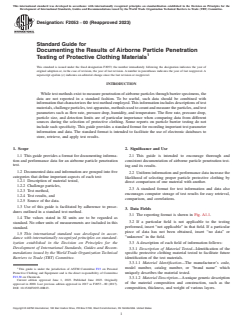
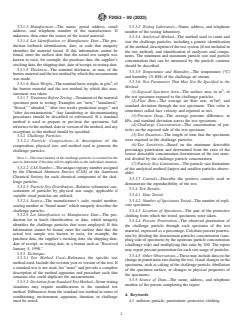
2.1 This guide is intended to encourage thorough and consistent documentation of airborne particle penetration testing and its results.
2.2 Uniform information and performance data increase the likelihood of selecting proper particle protective clothing by direct comparison of one material with another.
2.3 A standard format for test information and data also encourages computer storage of test results for easy retrieval, comparison, and correlations.
SCOPE
1.1 This guide provides a format for documenting information and performance data for an airborne particle penetration test.
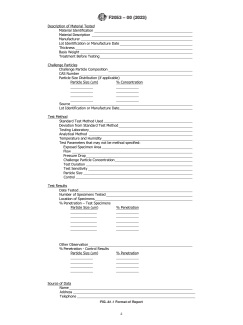
1.2 Documented data and information are grouped into five categories that define important aspects of each test:
1.2.1 Description of material tested,
1.2.2 Challenge particles,
1.2.3 Test method,
1.2.4 Test results, and
1.2.5 Source of the data.
1.3 Use of this guide is facilitated by adherence to procedures outlined in a standard test method.
1.4 The values stated in SI units are to be regarded as standard. No other units of measurements are included in this standard.
1.5 This international standard was developed in accordance with internationally recognized principles on standardization established in the Decision on Principles for the Development of International Standards, Guides and Recommendations issued by the World Trade Organization Technical Barriers to Trade (TBT) Committee.
- Status
- Published
- Publication Date
- 31-May-2023
- Technical Committee
- F23 - Personal Protective Clothing and Equipment
- Drafting Committee
- F23.30 - Chemicals
Overview
ASTM F2053-00(2023), Standard Guide for Documenting the Results of Airborne Particle Penetration Testing of Protective Clothing Materials, sets out a comprehensive framework for recording and reporting the outcomes of airborne particle penetration tests on protective clothing. Developed by ASTM Committee F23 on Personal Protective Clothing and Equipment, this standard supports thorough, uniform documentation to enable material comparison, selection, and data retrieval across the industry.
Effective documentation in airborne particle penetration testing is crucial for accurately assessing protective clothing performance. By ensuring consistency in test reports, ASTM F2053-00(2023) enhances the reliability of data used by manufacturers, laboratories, and end users in determining material suitability for various environments involving airborne particulate hazards.
Key Topics
The standard guides users in documenting five key categories of information in airborne particle penetration testing:
- Description of Material Tested
- Material identification (manufacturer, model, lot, thickness, weight, pre-test treatment)
- Challenge Particles
- Properties and identification of particles used in testing (composition, size, source, CAS number, lot)
- Test Method
- Reference to standardized or custom methods, including apparatus, analytical procedures, and testing conditions
- Test Results
- Details such as test date, number of specimens, location sampled, percent particle penetration, and other relevant observations
- Source of Data
- Contact information for the person reporting the data
The guide also highlights the need to specify testing variables such as flow rate, pressure drop, humidity, temperature, and other relevant parameters, all reported in SI units. If data are not available or applicable, the fields should be clearly marked as "no data" or "not applicable," ensuring transparency.
Applications
ASTM F2053-00(2023) provides practical value across several use cases in the field of protective clothing and personal protective equipment:
- Material Selection and Comparison
- Enables objective, side-by-side comparison of protective clothing materials by standardizing test data
- Quality Assurance and Compliance
- Supports regulatory and contractual requirements for detailed test reporting in healthcare, manufacturing, and hazardous environments
- Data Management and Retrieval
- The standard format encourages the use of electronic databases, improving the storage, retrieval, and correlation of test results over time
- Performance Evaluation
- Facilitates in-depth performance assessment under various operational conditions by documenting specifics such as specimen treatment and test controls
Uniform documentation improves confidence in selecting appropriate materials for protection against airborne particles in industries like pharmaceuticals, clean rooms, chemical processing, and emergency response.
Related Standards
For comprehensive airborne particle protection testing and data management, organizations may also reference the following standards:
- ASTM F2299 - Standard Test Method for Determining the Initial Efficiency of Materials Used in Medical Face Masks to Penetration by Particulates Using Latex Spheres
- ASTM F1671 - Standard Test Method for Resistance of Materials Used in Protective Clothing to Penetration by Blood-Borne Pathogens
- ISO 17491-4 - Protective clothing: Test methods for clothing providing protection against chemicals; Part 4: Determination of resistance to penetration by aerosol sprays
- EN 13982-2 - Protective clothing for use against solid particulates
Adhering to ASTM F2053-00(2023) strengthens an organization’s approach to airborne particle penetration testing, supporting improved safety, clear communication, and regulatory compliance in protective clothing applications.
Get Certified
Connect with accredited certification bodies for this standard

CIS Institut d.o.o.
Personal Protective Equipment (PPE) certification body. Notified Body NB-2890 for EU Regulation 2016/425 PPE.

Kiwa BDA Testing
Building and construction product certification.
Kmetijski inštitut Slovenije
Agricultural Institute of Slovenia. Soil testing, plant health, agricultural product analysis.
Sponsored listings
Frequently Asked Questions
ASTM F2053-00(2023) is a guide published by ASTM International. Its full title is "Standard Guide for Documenting the Results of Airborne Particle Penetration Testing of Protective Clothing Materials". This standard covers: SIGNIFICANCE AND USE 2.1 This guide is intended to encourage thorough and consistent documentation of airborne particle penetration testing and its results. 2.2 Uniform information and performance data increase the likelihood of selecting proper particle protective clothing by direct comparison of one material with another. 2.3 A standard format for test information and data also encourages computer storage of test results for easy retrieval, comparison, and correlations. SCOPE 1.1 This guide provides a format for documenting information and performance data for an airborne particle penetration test. 1.2 Documented data and information are grouped into five categories that define important aspects of each test: 1.2.1 Description of material tested, 1.2.2 Challenge particles, 1.2.3 Test method, 1.2.4 Test results, and 1.2.5 Source of the data. 1.3 Use of this guide is facilitated by adherence to procedures outlined in a standard test method. 1.4 The values stated in SI units are to be regarded as standard. No other units of measurements are included in this standard. 1.5 This international standard was developed in accordance with internationally recognized principles on standardization established in the Decision on Principles for the Development of International Standards, Guides and Recommendations issued by the World Trade Organization Technical Barriers to Trade (TBT) Committee.
SIGNIFICANCE AND USE 2.1 This guide is intended to encourage thorough and consistent documentation of airborne particle penetration testing and its results. 2.2 Uniform information and performance data increase the likelihood of selecting proper particle protective clothing by direct comparison of one material with another. 2.3 A standard format for test information and data also encourages computer storage of test results for easy retrieval, comparison, and correlations. SCOPE 1.1 This guide provides a format for documenting information and performance data for an airborne particle penetration test. 1.2 Documented data and information are grouped into five categories that define important aspects of each test: 1.2.1 Description of material tested, 1.2.2 Challenge particles, 1.2.3 Test method, 1.2.4 Test results, and 1.2.5 Source of the data. 1.3 Use of this guide is facilitated by adherence to procedures outlined in a standard test method. 1.4 The values stated in SI units are to be regarded as standard. No other units of measurements are included in this standard. 1.5 This international standard was developed in accordance with internationally recognized principles on standardization established in the Decision on Principles for the Development of International Standards, Guides and Recommendations issued by the World Trade Organization Technical Barriers to Trade (TBT) Committee.
ASTM F2053-00(2023) is classified under the following ICS (International Classification for Standards) categories: 13.340.10 - Protective clothing. The ICS classification helps identify the subject area and facilitates finding related standards.
ASTM F2053-00(2023) is available in PDF format for immediate download after purchase. The document can be added to your cart and obtained through the secure checkout process. Digital delivery ensures instant access to the complete standard document.
Standards Content (Sample)
This international standard was developed in accordance with internationally recognized principles on standardization established in the Decision on Principles for the
Development of International Standards, Guides and Recommendations issued by the World Trade Organization Technical Barriers to Trade (TBT) Committee.
Designation: F2053 − 00 (Reapproved 2023)
Standard Guide for
Documenting the Results of Airborne Particle Penetration
Testing of Protective Clothing Materials
This standard is issued under the fixed designation F2053; the number immediately following the designation indicates the year of
original adoption or, in the case of revision, the year of last revision. A number in parentheses indicates the year of last reapproval. A
superscript epsilon (´) indicates an editorial change since the last revision or reapproval.
INTRODUCTION
While test methods exist to measure penetration of airborne particles through barrier specimens, the
data are not reported in a standard fashion. To be useful, such data should be combined with
information that characterizes the test method employed. This information includes descriptions of test
materials, challenge particles, test apparatus, methods used to count and measure the particles, and test
parameters such as flow rate, pressure drop, humidity, and temperature. The flow rate, pressure drop,
particle size, and detection limits are of particular importance when comparing data from different
sources during the selection of protective clothing. Some reports on particle barrier testing do not
include such specificity. This guide provides a standard format for recording important test parameter
information and data. The standard format is intended to facilitate the use of electronic databases to
store, retrieve, and apply test results.
1. Scope 2. Significance and Use
1.1 This guide provides a format for documenting informa-
2.1 This guide is intended to encourage thorough and
tion and performance data for an airborne particle penetration
consistent documentation of airborne particle penetration test-
test.
ing and its results.
1.2 Documented data and information are grouped into five
2.2 Uniform information and performance data increase the
categories that define important aspects of each test:
likelihood of selecting proper particle protective clothing by
1.2.1 Description of material tested,
direct comparison of one material with another.
1.2.2 Challenge particles,
2.3 A standard format for test information and data also
1.2.3 Test method,
encourages computer storage of test results for easy retrieval,
1.2.4 Test results, and
comparison, and correlations.
1.2.5 Source of the data.
1.3 Use of this guide is facilitated by adherence to proce-
3. Data Fields
dures outlined in a standard test method.
3.1 The reporting format is shown in Fig. A1.1.
1.4 The values stated in SI units are to be regarded as
3.2 If a particular field is not applicable to the testing
standard. No other units of measurements are included in this
performed, insert “not applicable” in that field. If a particular
standard.
piece of data has not been obtained, insert “no data” or
1.5 This international standard was developed in accor-
“unknown” in the field.
dance with internationally recognized principles on standard-
ization established in the Decision on Principles for the 3.3 A description of each field of information follows:
Development of International Standards, Guides and Recom-
3.3.1 Description of Material Tested—Identification of the
mendations issued by the World Trade Organization Technical
specific protective clothing material tested to facilitate future
Barriers to Trade (TBT) Committee.
identification of the test materials.
3.3.1.1 Material Identification—The manufacturer’s code,
1 model number, catalog number, or “brand name” which
This guide is under the jurisdiction of ASTM Committee F23 on Personal
Protective Clothing and Equipment and is the direct responsibility of Committee
uniquely describes the material tested.
F23.30 on Chemicals.
3.3.1.2 Material Description—A unique generic description
Current edition approved June 1, 2023. Published June 2023. Originally
of the material composition and construction, such as the
approved in 2000. Last previous edition approved in 2017 as F2053 – 00 (2017).
DOI: 10.1520/F2053-00R23. composition, thickness, and weight of various layers.
Copyright © ASTM International, 100 Barr Harbor Drive, PO Box C700, West Conshohocken, PA 19428-2959. United States
F2053 − 00 (2023)
3.3.1.3 Manufacturer—The name, postal address, email 3.3.3.3 Testing Laboratory—Name, address, and telephone
address, and telephone number of the manufacturer. If number of the testing laboratory.
unknown, then enter the source of the tested material.
3.3.3.4 Analytical Method—The method used to count and
3.3.1.4 Lot Identification or Manufacture Date—The pro-
size the challenge particles, including a generic identification
duction lot/batch identification, date, or code that uniquely
of the method, description of the test system (if not included in
identifies the material tested. If this information cannot be
the test method), and identification of analyzers and compo-
found, enter the earliest date that the actual test sample was
nents. The minimum and maximum particle size and particle
known to exist, for example, the purchase date, the supplier’s
concentration that can be measured by the particle counters
stocking data, the shipping date, date of receipt, or testing date.
should be described.
3.3.1.5 Thickness—The nominal thickness, in mm, of the
3.3.3.5 Temperature and Humidity—The temperature (°C)
barrier material and the test method by which this measurement
and humidity (% RH) of the challenge air stream.
was made.
2 3.3.3.6 Test Parameters That May Not Be Specified in the
3.3.1.6 Basis Weight—The nominal basis weight, in g/m , of
Method:
the barrier material and the test method by which this mea-
(1) Exposed Specimen Area—The surface area, in m , of
surement was taken.
the test specimen exposed to the challenge particles.
3.3.1.7 Treatment Before Testing—Treatment of the material
3 2
(2) Flow Rate—The average air flow
...