

ASTM D6550-20
(Test Method)Standard Test Method for Determination of Olefin Content of Gasolines by Supercritical-Fluid Chromatography
General Information
- Abstract
SIGNIFICANCE AND USE
5.1 Gasoline-range olefinic hydrocarbons have been demonstrated to contribute to photochemical reactions in the atmosphere, which result in the formation of photochemical smog in susceptible urban areas.
5.2 The California Air Resources Board (CARB) has specified a maximum allowable limit of total olefins in motor gasoline. This necessitates an appropriate analytical test method for determination of total olefins to be used both by regulators and producers.
5.3 This test method compares favorably with Test Method D1319 (FIA) for the determination of total olefins in motor gasolines. It does not require any sample preparation, has a comparatively short analysis time of about 10 min, and is readily automated. Alternative methods for determination of olefins in gasoline include Test Methods D6839 and D6296.
SCOPE
1.1 This test method covers the determination of the total amount of olefins in blended motor gasolines and gasoline blending stocks by supercritical-fluid chromatography (SFC). Results are expressed in terms of mass percent olefins. The method working range is from expected concentration of 1 % by mass to expected concentration of 25 % by mass total olefins.
1.2 This test method can be used for analysis of commercial gasolines, including those containing varying levels of oxygenates, such as methyl tert/butyl ether (MTBE), diisopropyl ether (DIPE), methyl tert/amyl ether (TAME), and ethanol, without interference.
Note 1: This test method has not been designed for the determination of the total amounts of saturates, aromatics, and oxygenates.
1.3 This test method includes a relative bias section based on Practice D6708 accuracy assessment between Test Method D6550 mass percent and Test Method D1319 volume percent for total olefins in spark-ignition engine fuels as a possible Test Method D6550 alternative to Test Method D1319 for U.S. EPA regulations reporting. The Practice D6708 derived correlation equation is only applicable for test result range from 0.53 % to 26.88 % by mass as reported by Test Method D6550.
1.4 The values stated in SI units are to be regarded as standard. No other units of measurement are included in this standard.
1.5 This standard does not purport to address all of the safety concerns, if any, associated with its use. It is the responsibility of the user of this standard to establish appropriate safety, health, and environmental practices and determine the applicability of regulatory limitations prior to use.
1.6 This international standard was developed in accordance with internationally recognized principles on standardization established in the Decision on Principles for the Development of International Standards, Guides and Recommendations issued by the World Trade Organization Technical Barriers to Trade (TBT) Committee.
- Status
- Published
- Publication Date
- 30-Jun-2020
- Technical Committee
- D02 - Petroleum Products, Liquid Fuels, and Lubricants
- Drafting Committee
- D02.04.0C - Liquid Chromatography
Buy Documents
ASTM D6550-20 - Standard Test Method for Determination of Olefin Content of Gasolines by Supercritical-Fluid Chromatography
REDLINE ASTM D6550-20 - Standard Test Method for Determination of Olefin Content of Gasolines by Supercritical-Fluid Chromatography
Overview
ASTM D6550-20: Standard Test Method for Determination of Olefin Content of Gasolines by Supercritical-Fluid Chromatography is an internationally recognized standard created by ASTM for precisely quantifying the total olefin content in gasoline and gasoline blending stocks. This test plays a crucial role for fuel producers, regulators, and laboratories to ensure compliance with environmental regulations, such as those established by the California Air Resources Board (CARB), which target reduction of photochemical smog precursors in urban environments.
The method utilizes supercritical-fluid chromatography (SFC) to separate and quantify olefins in gasoline samples, reporting results in terms of mass percent. This standard covers a working range of 1% to 25% mass olefins and is applicable to a wide variety of commercial fuels, including those containing oxygenates like MTBE, DIPE, TAME, and ethanol, without interference.
Key Topics
Purpose and Significance:
- Olefinic hydrocarbons in gasoline contribute significantly to atmospheric photochemical reactions and the formation of urban smog.
- Regulatory bodies, such as CARB, limit the olefin content in gasoline, necessitating accurate and reliable test methods.
Scope and Applicability:
- Suitable for blended gasolines and gasoline blending stocks.
- Effective across a broad olefin concentration range (1%–25% by mass).
- Accommodates analysis of fuels with various oxygenate additives.
- Does not determine total saturates, aromatics, or oxygenates.
Method Advantages:
- No need for prior sample preparation.
- Short analysis time (typically about 10 minutes).
- Fully automatable and compatible with modern laboratory instrumentation.
- Provides favorable comparison with established methods such as ASTM D1319 (FIA), with correlation provisions for regulatory compliance and reporting.
Reporting and Quality:
- Results are expressed as mass percent to the nearest 0.1% for values over 1%.
- Emphasizes quality control through routine use of certified reference materials and dedicated system performance checks.
Applications
Regulatory Compliance:
Enables fuel suppliers and refineries to meet environmental legislation by accurately assessing the olefin content in gasolines.Environmental Monitoring:
Supports agencies and environmental labs in tracking and reporting on air quality and emissions-related metrics.Quality Control in Production:
Essential for routine testing within refineries to control product specifications and consistency, especially when producing reformulated or oxygenated fuels.Alternative Method Validation:
Offers a practical alternative to ASTM D1319, supporting U.S. EPA reporting requirements when validated by correlation equations, thereby increasing testing flexibility in certified labs.Product Development:
Useful in research and development settings when formulating new gasoline blends with target olefin concentrations for performance or emissions reduction.
Related Standards
- ASTM D1319: Test Method for Hydrocarbon Types in Liquid Petroleum Products by Fluorescent Indicator Adsorption.
- ASTM D4052: Test Method for Density, Relative Density, and API Gravity of Liquids by Digital Density Meter.
- ASTM D6296: Test Method for Total Olefins in Spark-Ignition Engine Fuels by Multidimensional Gas Chromatography.
- ASTM D5186: Test Method for Determination of Aromatic Content and Polynuclear Aromatic Content of Diesel Fuels by Supercritical-Fluid Chromatography.
- ASTM D6839: Test Method for Hydrocarbon Types, Oxygenated Compounds, and Benzene in Spark Ignition Engine Fuels by Gas Chromatography.
- ASTM D6708: Practice for Statistical Assessment and Improvement of Expected Agreement Between Two Test Methods.
- ASTM D6299: Practice for Applying Statistical Quality Assurance and Control Charting Techniques.
Keywords: ASTM D6550, olefin content, gasolines, supercritical-fluid chromatography, SFC, environmental compliance, CARB, photochemical smog, fuel analysis, petroleum standards, regulatory testing, laboratory automation, oxygenated fuels, fuel quality control.
Relations
- Effective Date
- 01-Mar-2024
- Effective Date
- 01-Mar-2024
- Effective Date
- 01-Dec-2023
- Effective Date
- 01-Dec-2023
- Effective Date
- 01-Dec-2019
- Effective Date
- 01-May-2019
- Effective Date
- 01-Apr-2018
- Effective Date
- 15-Dec-2017
- Effective Date
- 15-Nov-2017
- Effective Date
- 01-Jan-2017
- Effective Date
- 20-Apr-2016
- Effective Date
- 01-Apr-2016
- Effective Date
- 01-Apr-2016
- Effective Date
- 01-Jan-2016
- Effective Date
- 01-Dec-2015
Buy Documents
ASTM D6550-20 - Standard Test Method for Determination of Olefin Content of Gasolines by Supercritical-Fluid Chromatography
REDLINE ASTM D6550-20 - Standard Test Method for Determination of Olefin Content of Gasolines by Supercritical-Fluid Chromatography
Get Certified
Connect with accredited certification bodies for this standard

DNV
DNV is an independent assurance and risk management provider.

Lloyd's Register
Lloyd's Register is a global professional services organisation specialising in engineering and technology.
DNV Energy Systems
Energy and renewable energy certification.
Sponsored listings
Frequently Asked Questions
ASTM D6550-20 is a standard published by ASTM International. Its full title is "Standard Test Method for Determination of Olefin Content of Gasolines by Supercritical-Fluid Chromatography". This standard covers: SIGNIFICANCE AND USE 5.1 Gasoline-range olefinic hydrocarbons have been demonstrated to contribute to photochemical reactions in the atmosphere, which result in the formation of photochemical smog in susceptible urban areas. 5.2 The California Air Resources Board (CARB) has specified a maximum allowable limit of total olefins in motor gasoline. This necessitates an appropriate analytical test method for determination of total olefins to be used both by regulators and producers. 5.3 This test method compares favorably with Test Method D1319 (FIA) for the determination of total olefins in motor gasolines. It does not require any sample preparation, has a comparatively short analysis time of about 10 min, and is readily automated. Alternative methods for determination of olefins in gasoline include Test Methods D6839 and D6296. SCOPE 1.1 This test method covers the determination of the total amount of olefins in blended motor gasolines and gasoline blending stocks by supercritical-fluid chromatography (SFC). Results are expressed in terms of mass percent olefins. The method working range is from expected concentration of 1 % by mass to expected concentration of 25 % by mass total olefins. 1.2 This test method can be used for analysis of commercial gasolines, including those containing varying levels of oxygenates, such as methyl tert/butyl ether (MTBE), diisopropyl ether (DIPE), methyl tert/amyl ether (TAME), and ethanol, without interference. Note 1: This test method has not been designed for the determination of the total amounts of saturates, aromatics, and oxygenates. 1.3 This test method includes a relative bias section based on Practice D6708 accuracy assessment between Test Method D6550 mass percent and Test Method D1319 volume percent for total olefins in spark-ignition engine fuels as a possible Test Method D6550 alternative to Test Method D1319 for U.S. EPA regulations reporting. The Practice D6708 derived correlation equation is only applicable for test result range from 0.53 % to 26.88 % by mass as reported by Test Method D6550. 1.4 The values stated in SI units are to be regarded as standard. No other units of measurement are included in this standard. 1.5 This standard does not purport to address all of the safety concerns, if any, associated with its use. It is the responsibility of the user of this standard to establish appropriate safety, health, and environmental practices and determine the applicability of regulatory limitations prior to use. 1.6 This international standard was developed in accordance with internationally recognized principles on standardization established in the Decision on Principles for the Development of International Standards, Guides and Recommendations issued by the World Trade Organization Technical Barriers to Trade (TBT) Committee.
SIGNIFICANCE AND USE 5.1 Gasoline-range olefinic hydrocarbons have been demonstrated to contribute to photochemical reactions in the atmosphere, which result in the formation of photochemical smog in susceptible urban areas. 5.2 The California Air Resources Board (CARB) has specified a maximum allowable limit of total olefins in motor gasoline. This necessitates an appropriate analytical test method for determination of total olefins to be used both by regulators and producers. 5.3 This test method compares favorably with Test Method D1319 (FIA) for the determination of total olefins in motor gasolines. It does not require any sample preparation, has a comparatively short analysis time of about 10 min, and is readily automated. Alternative methods for determination of olefins in gasoline include Test Methods D6839 and D6296. SCOPE 1.1 This test method covers the determination of the total amount of olefins in blended motor gasolines and gasoline blending stocks by supercritical-fluid chromatography (SFC). Results are expressed in terms of mass percent olefins. The method working range is from expected concentration of 1 % by mass to expected concentration of 25 % by mass total olefins. 1.2 This test method can be used for analysis of commercial gasolines, including those containing varying levels of oxygenates, such as methyl tert/butyl ether (MTBE), diisopropyl ether (DIPE), methyl tert/amyl ether (TAME), and ethanol, without interference. Note 1: This test method has not been designed for the determination of the total amounts of saturates, aromatics, and oxygenates. 1.3 This test method includes a relative bias section based on Practice D6708 accuracy assessment between Test Method D6550 mass percent and Test Method D1319 volume percent for total olefins in spark-ignition engine fuels as a possible Test Method D6550 alternative to Test Method D1319 for U.S. EPA regulations reporting. The Practice D6708 derived correlation equation is only applicable for test result range from 0.53 % to 26.88 % by mass as reported by Test Method D6550. 1.4 The values stated in SI units are to be regarded as standard. No other units of measurement are included in this standard. 1.5 This standard does not purport to address all of the safety concerns, if any, associated with its use. It is the responsibility of the user of this standard to establish appropriate safety, health, and environmental practices and determine the applicability of regulatory limitations prior to use. 1.6 This international standard was developed in accordance with internationally recognized principles on standardization established in the Decision on Principles for the Development of International Standards, Guides and Recommendations issued by the World Trade Organization Technical Barriers to Trade (TBT) Committee.
ASTM D6550-20 is classified under the following ICS (International Classification for Standards) categories: 27.060.10 - Liquid and solid fuel burners. The ICS classification helps identify the subject area and facilitates finding related standards.
ASTM D6550-20 has the following relationships with other standards: It is inter standard links to ASTM D6300-24, ASTM D6708-24, ASTM D6299-23a, ASTM D6300-23a, ASTM D6300-19a, ASTM D6708-19, ASTM D6708-18, ASTM D6299-17b, ASTM D6299-17a, ASTM D6299-17, ASTM D6839-16, ASTM D6708-16a, ASTM D6300-16, ASTM D6708-16, ASTM D6839-15. Understanding these relationships helps ensure you are using the most current and applicable version of the standard.
ASTM D6550-20 is available in PDF format for immediate download after purchase. The document can be added to your cart and obtained through the secure checkout process. Digital delivery ensures instant access to the complete standard document.
Standards Content (Sample)
This international standard was developed in accordance with internationally recognized principles on standardization established in the Decision on Principles for the
Development of International Standards, Guides and Recommendations issued by the World Trade Organization Technical Barriers to Trade (TBT) Committee.
Designation:D6550 −20
Standard Test Method for
Determination of Olefin Content of Gasolines by
Supercritical-Fluid Chromatography
This standard is issued under the fixed designation D6550; the number immediately following the designation indicates the year of
original adoption or, in the case of revision, the year of last revision. A number in parentheses indicates the year of last reapproval. A
superscript epsilon (´) indicates an editorial change since the last revision or reapproval.
1. Scope* Development of International Standards, Guides and Recom-
mendations issued by the World Trade Organization Technical
1.1 This test method covers the determination of the total
Barriers to Trade (TBT) Committee.
amount of olefins in blended motor gasolines and gasoline
blending stocks by supercritical-fluid chromatography (SFC).
2. Referenced Documents
Results are expressed in terms of mass percent olefins. The
2.1 ASTM Standards:
method working range is from expected concentration of 1 %
D1319 Test Method for Hydrocarbon Types in Liquid Petro-
by mass to expected concentration of 25 % by mass total
leum Products by Fluorescent Indicator Adsorption
olefins.
D4052 Test Method for Density, Relative Density, and API
1.2 This test method can be used for analysis of commercial
Gravity of Liquids by Digital Density Meter
gasolines, including those containing varying levels of
D5186 Test Method for Determination of the Aromatic
oxygenates, such as methyl tert/butyl ether (MTBE), diisopro-
Content and Polynuclear Aromatic Content of Diesel
pyl ether (DIPE), methyl tert/amyl ether (TAME), and ethanol,
Fuels By Supercritical Fluid Chromatography
without interference.
D6296 Test Method for Total Olefins in Spark-ignition
NOTE 1—This test method has not been designed for the determination
Engine Fuels by Multidimensional Gas Chromatography
of the total amounts of saturates, aromatics, and oxygenates.
D6299 Practice for Applying Statistical Quality Assurance
and Control Charting Techniques to Evaluate Analytical
1.3 This test method includes a relative bias section based
Measurement System Performance
on Practice D6708 accuracy assessment between Test Method
D6300 Practice for Determination of Precision and Bias
D6550 mass percent and Test Method D1319 volume percent
Data for Use in Test Methods for Petroleum Products,
fortotalolefinsinspark-ignitionenginefuelsasapossibleTest
Liquid Fuels, and Lubricants
MethodD6550alternativetoTestMethodD1319forU.S.EPA
regulations reporting. The Practice D6708 derived correlation D6708 Practice for StatisticalAssessment and Improvement
of Expected Agreement Between Two Test Methods that
equation is only applicable for test result range from 0.53 % to
26.88 % by mass as reported by Test Method D6550. Purport to Measure the Same Property of a Material
D6839 Test Method for Hydrocarbon Types, Oxygenated
1.4 The values stated in SI units are to be regarded as
Compounds, and Benzene in Spark Ignition Engine Fuels
standard. No other units of measurement are included in this
by Gas Chromatography
standard.
1.5 This standard does not purport to address all of the
3. Terminology
safety concerns, if any, associated with its use. It is the
3.1 Definitions of Terms Specific to This Standard:
responsibility of the user of this standard to establish appro-
3.1.1 critical pressure, n—the pressure needed to condense
priate safety, health, and environmental practices and deter-
a gas to a liquid at the critical temperature.
mine the applicability of regulatory limitations prior to use.
3.1.2 critical temperature, n—the highest temperature at
1.6 This international standard was developed in accor-
which a gaseous fluid can be condensed to a liquid by means
dance with internationally recognized principles on standard-
of compression.
ization established in the Decision on Principles for the
3.1.3 supercritical fluid, n—a fluid maintained above its
critical temperature and critical pressure.
This test method is under the jurisdiction of ASTM Committee D02 on
Petroleum Products, Liquid Fuels, and Lubricants and is the direct responsibility of
Subcommittee D02.04.0C on Liquid Chromatography. For referenced ASTM standards, visit the ASTM website, www.astm.org, or
CurrenteditionapprovedJuly1,2020.PublishedJuly2020.Originallyapproved contact ASTM Customer Service at service@astm.org. For Annual Book of ASTM
in 2000. Last previous edition approved in 2015 as D6550 – 15. DOI: 10.1520/ Standards volume information, refer to the standard’s Document Summary page on
D6550-20. the ASTM website.
*A Summary of Changes section appears at the end of this standard
Copyright © ASTM International, 100 Barr Harbor Drive, PO Box C700, West Conshohocken, PA 19428-2959. United States
D6550−20
NOTE 2—The SFC instruments suitable for Test Method D5186 are
3.1.4 supercritical-fluid chromatography (SFC), n—a type
suitable for this test method, if equipped with two switching valves, as
of chromatography that employs a supercritical fluid as the
described under 6.1.7.
mobile phase.
6.1.1 Pump—The SFC pump shall be able to operate at the
4. Summary of Test Method
required pressures (typically up to about 30 MPa) and deliver
a sufficiently stable flow to meet the requirements of retention-
4.1 A small aliquot of the fuel sample is injected onto a set
time precision (better than 0.3 %) and detection background
of two chromatographic columns connected in series and
(see Section 8). The characteristics of the pump will largely
transported using supercritical carbon dioxide (CO)asthe
determine the optimum column diameter. The use of 4.6 mm
mobile phase. The first column is packed with high-surface-
internal diameter (i.d.) columns requires a pump capacity of at
area silica particles. The second column contains either high-
least 1 mL⁄min of liquid CO . Columns with an inside diam-
surface-area silica particles loaded with silver ions or strong-
eter of 2 mm and 1 mm require minimum pump capacities of
cation-exchange material loaded with silver ions.
200 µL⁄min and 50 µL⁄min, respectively.
4.2 Two switching valves are used to direct the different
6.1.2 Detectors—A FID is required for quantitation. A flow
classes of components through the chromatographic system to
restrictor shall be installed immediately before the FID. This
the detector. In a forward-flow mode, saturates (normal and
restrictor serves to maintain the required pressure in the
branchedalkanes,cyclicalkanes)passthroughbothcolumnsto
column, while allowing the pump and detector to perform as
the detector, while the olefins are trapped on the silver-loaded
specified. A (diode-array or variable wavelength) UV detector
column and the aromatics and oxygenates are retained on the
for establishing optimum switching times (see Sections 8 and
silica column. Aromatic compounds and oxygenates are sub-
9) is optional. Such a detector can be incorporated in two
sequently eluted from the silica column to the detector in a
different manners.
back-flush mode. Finally, the olefins are back-flushed from the
6.1.2.1 AUVdetectorwithaverysmalldeadvolumecanbe
silver-loaded column to the detector.
inserted between the column and the FID and operated in
4.3 A flame-ionization detector (FID) is used for quantita-
series.
tion. Calibration is based on the area of the chromatographic
6.1.2.2 A post-column splitting device, consisting of a
signal for olefins, relative to standard reference materials,
T-junctionwithanappropriateflowrestrictortotheFID,canbe
which contain a known mass % of total olefins as corrected for
inserted between the column and the UV detector. Using the
density.
T-junction, the two detectors can be operated in parallel. The
combination of restrictors (before the FID and after the UV
5. Significance and Use
detector) shall allow the pump and detector to perform as
5.1 Gasoline-range olefinic hydrocarbons have been dem-
specified.
onstrated to contribute to photochemical reactions in the
6.1.3 Sample-inlet System—A liquid-sample injection
atmosphere, which result in the formation of photochemical
valve is required, capable of introducing (sub-)microlitre
smog in susceptible urban areas.
volume with a precision better than 0.5 %. A 1 µL injection
volume was found to be adequate in combination with 4.6 mm
5.2 The CaliforniaAir Resources Board (CARB) has speci-
inside diameter columns. Corresponding injection volumes are
fied a maximum allowable limit of total olefins in motor
200 nL and 50 nL for columns with inside diameters of 2 mm
gasoline. This necessitates an appropriate analytical test
and 1 mm, respectively. The sample inlet system shall be
method for determination of total olefins to be used both by
installed and operated in a manner such that the chromato-
regulators and producers.
graphic separation is not negatively affected.
5.3 This test method compares favorably with Test Method
6.1.4 Columns—Two columns of equal inside diameter are
D1319 (FIA) for the determination of total olefins in motor
required:
gasolines. It does not require any sample preparation, has a
6.1.4.1 A high-surface-area-silica column, capable of sepa-
comparatively short analysis time of about 10 min, and is
rating alkanes and olefins from aromatics as specified in
readily automated. Alternative methods for determination of
Section 8. Typically, one or several 250 mm long columns are
olefins in gasoline include Test Methods D6839 and D6296.
used. These columns are packed with particles having an
average diameter of 5 µm or less, 600 nm (60 Å) pores, and a
6. Apparatus
surface area of ≥350 m /g.
6.1 Supercritical-fluid Chromatograph (SFC)—Any SFC
instrumentation can be used that has the following character-
istics and meets the performance requirements specified in 3
Sample valves with loop volumes down to 50 nL are commercially available
Section 8. from Valco (Houston, TX).
TABLE 1 Typical Columns
Silica Column Silver-loaded Column
Vendor Merck Vendor Hypersil, Phenomenex, Selerity
Packing material Lichrospher SI 60 Packing material Hypersil SCX, Selectosil SCX, Ag+ form
Particle size, µm 5 Particle size, µm 5
Length, mm 250 Length, mm 100 or 50
Internal diameter, mm 4.6 Internal diameter, mm 4.6
D6550−20
NOTE 3—Columns suitable forTest Method D5186 are also suitable for
6.1.7.4 Position D—Silica column (forward-flush mode)
the present method. A typical example is shown in Table 1.
connected in-line; silver-loaded column not in flow path. This
6.1.4.2 A silver-loaded-silica column or a cation-exchange position is used to optimize the separation. Also, this position
column in the silver form. Cation-exchange columns are allows Test Method D5186 to be performed without changing
claimed to yield more stable columns. Typically, one 50 mm the system.
or 100 mm long column packed with particles with an average 6.1.8 Sample Filter—Amicrofilter of a porosity of 0.20 µm,
diameter of 5 µm is used for the analysis. which is chemically-inert to hydrocarbon solvents, may be
usedfortheremovalofmicroscopicparticulatematterfromthe
NOTE 4—Some columns that have been used successfully are shown in
sample solution that potentially may harm the injection valve
Table 1.
and affect system performance.
6.1.5 Column-temperature Control—The chromatograph
shall be capable of column temperature control to within
7. Reagents and Materials
0.5 °C or less.
7.1 Purity of Reagents—Reagent grade chemicals shall be
6.1.6 Computor or Electronic Integrator—Means shall be
used in all tests. Unless otherwise indicated, it is intended that
providedforthedeterminationofaccumulatedpeakareas.This
all reagents conform to the specifications of the Committee on
can be done by means of a computer or electronic integrator.
Analytical Reagents of the American Chemical Society where
The computer or integrator shall have the capability of correct-
such specifications are available. Other grades may be used,
ing for baseline shifts during the run.
provided it is first ascertained that the reagent is of sufficiently
6.1.7 Switching Valves—Two six-way switching valves are
high purity to permit its use without lessening the accuracy of
configured in accordance with the scheme shown in Fig. 1.
the determination.
This configuration allows four different valve positions, de-
fined as follows:
7.2 Air—Zero-grade (hydrocarbon-free) air is used as the
6.1.7.1 PositionA—Silicacolumn(forward-flushmode)and
FID oxidant. (Warning—Air is usually supplied as a com-
silver-loaded column (forward-flush mode) connected in se-
pressed gas under high pressure, and it supports combustion.)
ries. This position is used (1) to inject the sample on the two
7.3 Calibration Solution—A mixture or standard of hydro-
columns, (2) to elute the saturates, (3) to trap the olefins on the
carbons with a known mass percent of olefins of the type and
silver-loaded column, and (4) to retain the aromatics and
concentration found in typical gasolines. A mixture of 75 %
oxygenates on the silica column.
isooctane and 25 % toluene combined with the mixture of
6.1.7.2 Position B—Silica column (backflush mode) con-
olefins found in Table 2 is appropriate to approximate the
nected in-line; silver-loaded column not in flow path. This
composition of the fuels being tested.
position is used to elute the aromatics and polar compounds.
6.1.7.3 Position C—Silica column not in flow path; silver-
loaded column (backflush mode) connected in-line. This posi-
ACS Reagent Chemicals, Specifications and Procedures for Reagents and
tion is used to elute the olefins.
Standard-Grade Reference Materials, American Chemical Society, Washington,
DC. For suggestions on the testing of reagents not listed by theAmerican Chemical
Society, see Analar Standards for Laboratory Chemicals, BDH Ltd., Poole, Dorset,
U.K., and the United States Pharmacopeia and National Formulary, U.S. Pharma-
Anderson, P. E., Demirbueker, M., and Blomberg, L. G., Journal of
copeial Convention, Inc. (USPC), Rockville, MD.
Chromatography, 596, 1991, pp. 301-311.
FIG. 1Configuration of Switching Valves (Shown in Position A)
D6550−20
TABLE 2 Type and Concentration of Olefins used in the
8.2 System Performance:
Calibration Solutions
8.2.1 System Optimization—The operation of the SFC sys-
Olefin Mixture Concentration (%)
tem shall be optimized in order to achieve the required
1-Hexene 9.30 %
separation on the silica column. This process is different if an
Cyclohexene 14.00 %
2-Methyl-1-hexene 3.90 %
optional UV detector is available.
2-Methyl-1-heptene 3.90 %
8.2.1.1 When the optional UV detector is installed, the
3-Methyl-2-pentene 27.90 %
separation between the three different classes of compounds
1-Heptene 24.70 %
1-Octene 12.40 %
can be monitored directly. Saturates show no UV absorption.
1-Nonene 3.90 %
Olefins show significant absorption at wavelengths up to about
220 nmbutnoabsorptionat250 nmorhigher.Aromaticsshow
considerable absorption at low wavelengths, extended to a
TABLE 3 Typical Densities of Calibration Standards Using the
wavelength of 250 nm and higher. The onset of the elution of
Olefins Listed in Table 2 in 75/25 Isooctane/Tolune
the olefin fraction (following the saturates fraction) can be
Olefin Concentration Density (60 °F)
(Wt%) (g/cm ) monitored at 220 nm. The elution of the aromatic fraction can
0.25 0.73144
be monitored at 250 nm. In this case, the performance mixture
1.06 0.73142
(see 7.6) can be used to optimize the separation of the olefins
5.16 0.72888
12.92 0.72722 and aromatics.
17.74 0.72889
8.2.1.2 Without a UV detector being installed, individual
24.55 0.72592
pure components and the performance mixture (see 7.6) can be
AVE Density 0.7290
used to optimize the system.
8.2.2 Column Requirements:
7.4 Carbon Dioxide (CO )—Supercritical-fluid-
8.2.2.1 Silica Column—The critical requirement for the
chromatographic grade, 99.99 % minimum purity, supplied
silica column is its ability to achieve a quantitative separation
pressurized in a cylinder with a dip tube for removal of liquid
between the olefins and aromatics. The performance of this
CO.(Warning—Liquid at high pressure. Release of pressure
column can be verified independently of that of the silver-
results in production of extremely cold, solid CO and gas,
loaded column by switching the valves to the appropriate
which can dilute available atmospheric oxygen.)
position (see 6.1.7.4).
7.5 Hydrogen—Hydrogen of high quality (hydrocarbon-
(1) When using a UV detector, the requirement is baseline
free) is used as the fuel for the FID. (Warning—Hydrogen is
resolution between the olefin and aromatic signals. The result-
usually supplied under high pressure and is extremely flam-
ing switching time (see Section 9) shall be chosen to occur just
mable.)
before the onset of the aromatics signal.
(2) When using only an FID, the resolution (R ) between
7.6 Loading-time Mixture—A mixture of a typical alkane
AO
and an olefin, which can be used to determine the loading time the olefinic compound and the aromatic compound in the
performance mixture shall be at least three when measured as
(see 8.2.2.3 (1) and 8.2.2.3 (2)) while protecting the silver-
loaded column from exposure to aromatic compounds. follows:
2 3 ~t 2 t !
7.7 Performance Mixture—A mixture of a typical alkane, a
A O
R 5 (1)
AO
1.699 3 y 1y
mono-aromatic (usually toluene), and a typical mono-olefin ~ !
A O
can be used to fine-tune this test method and to check its
where:
performance. A mixture of n-heptane, toluene, and 3-methyl-
t = retention time for the aromatic reference compound, s,
A
2-pentene has been successfully used for this purpose.
t = retention time for the olefinic reference compound, s,
O
7.8 Quality Control Sample—A motor gasoline containing
y = peak width at half height for the aromatic reference
A
olefins to be used to establish and monitor the precision of the
compound, s, and
analytical measurement system. y = peak width at half height for the olefinic reference
O
compound, s.
8. Preparation of Apparatus
8.2.2.2 All aromatic compounds, as well as oxygenates and
8.1 Install the SFC instrumentation in accordance with the
other polar molecules, are eluted from the silica column in the
manufacturer’s instructions. System operating conditions will
backflushmodeduringatime, t ,whichshallbelessthanfive
AR
depend on the column used and optimization of performance.
times the loading time, t . The elution of the aromatics and
L
The conditions listed in Table 1 have been used successfully. If
polars can be observed using an FID. Complete elution is
the performance characteristics in terms of retention and
thought to have occurred if the detector value (S ) has
End
resolution, specified in 8.2, are not achieved, the temperature,
returned to the baseline value observed before the elution of
pressure, or mobile-phase flow rate can be modified to achieve
any peaks (S ) to within 0.1 % of the height of the
Baseline
compliance.Asilica column of low activity can be reactivated
aromatics peak (h ), that is,
Aromatics
by solvent rinsing, using accepted liquid-chromatographic
activation strategies. S # S 1h /1000 (2)
End Baseline Aromatics
D6550−20
8.2.2.3 Silver-loaded Column—This column is operated ex- 8.2.3.1 Repeatability—The repeatability of the retention
clusively as an olefin trap. Its stability and chromatographic times has a direct influence on the precision of the total olefin
content determined because column switching is performed on
efficiency are not critical as long as the following two require-
ments are met. The column shall allow a quantitative separa- a time basis (see Section 9). Retention times obtained for
performance mixtures and standard gasolines on a given
tion between the saturates and the olefins and the quantitative
instrument and column set shall be repeatable within 0.5 %
release of all olefins under appropriate conditions. The perfor-
(relative) over a period of several days.
mance of the silver-loaded column can be verified indepen-
dently of that of the silica column by switching the valves to
NOTE 7—It has been observed that the first analysis after an idle period
t
...
This document is not an ASTM standard and is intended only to provide the user of an ASTM standard an indication of what changes have been made to the previous version. Because
it may not be technically possible to adequately depict all changes accurately, ASTM recommends that users consult prior editions as appropriate. In all cases only the current version
of the standard as published by ASTM is to be considered the official document.
Designation: D6550 − 15 D6550 − 20
Standard Test Method for
Determination of Olefin Content of Gasolines by
Supercritical-Fluid Chromatography
This standard is issued under the fixed designation D6550; the number immediately following the designation indicates the year of
original adoption or, in the case of revision, the year of last revision. A number in parentheses indicates the year of last reapproval. A
superscript epsilon (´) indicates an editorial change since the last revision or reapproval.
1. Scope*
1.1 This test method covers the determination of the total amount of olefins in blended motor gasolines and gasoline blending
stocks by supercritical-fluid chromatography (SFC). Results are expressed in terms of mass %percent olefins. The application
method working range is from 1 mass % to 25 mass % expected concentration of 1 % by mass to expected concentration of 25 %
by mass total olefins.
1.2 This test method can be used for analysis of commercial gasolines, including those containing varying levels of oxygenates,
such as methyl tert/butyl ether (MTBE), diisopropyl ether (DIPE), methyl tert/amyl ether (TAME), and ethanol, without
interference.
NOTE 1—This test method has not been designed for the determination of the total amounts of saturates, aromatics, and oxygenates.
1.3 This test method includes a relative bias section based on Practice D6708 accuracy assessment between Test Method D6550
mass percent and Test Method D1319 volume percent for total olefins in spark-ignition engine fuels as a possible Test Method
D6550 alternative to Test Method D1319 for U.S. EPA regulations reporting. The Practice D6708 derived correlation equation is
only applicable for fuels in the concentration test result range from 0.20.53 % to 26.226.88 % by mass as reported by Test Method
D6550. The applicable Test Method D1319 concentration range for total olefins is 0.2 % to 27.7 % by volume as reported by Test
Method D1319.
1.4 The values stated in SI units are to be regarded as standard. No other units of measurement are included in this standard.
1.5 This standard does not purport to address all of the safety concerns, if any, associated with its use. It is the responsibility
of the user of this standard to establish appropriate safety safety, health, and healthenvironmental practices and determine the
applicability of regulatory limitations prior to use.
1.6 This international standard was developed in accordance with internationally recognized principles on standardization
established in the Decision on Principles for the Development of International Standards, Guides and Recommendations issued
by the World Trade Organization Technical Barriers to Trade (TBT) Committee.
2. Referenced Documents
2.1 ASTM Standards:
D1319 Test Method for Hydrocarbon Types in Liquid Petroleum Products by Fluorescent Indicator Adsorption
D4052 Test Method for Density, Relative Density, and API Gravity of Liquids by Digital Density Meter
D5186 Test Method for Determination of the Aromatic Content and Polynuclear Aromatic Content of Diesel Fuels By
Supercritical Fluid Chromatography
D6296 Test Method for Total Olefins in Spark-ignition Engine Fuels by Multidimensional Gas Chromatography
D6299 Practice for Applying Statistical Quality Assurance and Control Charting Techniques to Evaluate Analytical Measure-
ment System Performance
D6300 Practice for Determination of Precision and Bias Data for Use in Test Methods for Petroleum Products, Liquid Fuels, and
Lubricants
This test method is under the jurisdiction of ASTM Committee D02 on Petroleum Products, Liquid Fuels, and Lubricants and is the direct responsibility of Subcommittee
D02.04.0C on Liquid Chromatography.
Current edition approved Dec. 1, 2015July 1, 2020. Published December 2015July 2020. Originally approved in 2000. Last previous edition approved in 2015 as
D6550 – 10 (2015).D6550 – 15. DOI: 10.1520/D6550-15.10.1520/D6550-20.
For referenced ASTM standards, visit the ASTM website, www.astm.org, or contact ASTM Customer Service at service@astm.org. For Annual Book of ASTM Standards
volume information, refer to the standard’s Document Summary page on the ASTM website.
*A Summary of Changes section appears at the end of this standard
Copyright © ASTM International, 100 Barr Harbor Drive, PO Box C700, West Conshohocken, PA 19428-2959. United States
D6550 − 20
D6708 Practice for Statistical Assessment and Improvement of Expected Agreement Between Two Test Methods that Purport
to Measure the Same Property of a Material
D6839 Test Method for Hydrocarbon Types, Oxygenated Compounds, and Benzene in Spark Ignition Engine Fuels by Gas
Chromatography
3. Terminology
3.1 Definitions of Terms Specific to This Standard:
3.1.1 critical pressure, n—the pressure needed to condense a gas to a liquid at the critical temperature.
3.1.2 critical temperature, n—the highest temperature at which a gaseous fluid can be condensed to a liquid by means of
compression.
3.1.3 supercritical fluid, n—a fluid maintained above its critical temperature and critical pressure.
3.1.4 supercritical-fluid chromatography (SFC), n—a type of chromatography that employs a supercritical fluid as the mobile
phase.
4. Summary of Test Method
4.1 A small aliquot of the fuel sample is injected onto a set of two chromatographic columns connected in series and transported
using supercritical carbon dioxide (CO ) as the mobile phase. The first column is packed with high-surface-area silica particles.
The second column contains either high-surface-area silica particles loaded with silver ions or strong-cation-exchange material
loaded with silver ions.
4.2 Two switching valves are used to direct the different classes of components through the chromatographic system to the
detector. In a forward-flow mode, saturates (normal and branched alkanes, cyclic alkanes) pass through both columns to the
detector, while the olefins are trapped on the silver-loaded column and the aromatics and oxygenates are retained on the silica
column. Aromatic compounds and oxygenates are subsequently eluted from the silica column to the detector in a back-flush mode.
Finally, the olefins are back-flushed from the silver-loaded column to the detector.
4.3 A flame-ionization detector (FID) is used for quantitation. Calibration is based on the area of the chromatographic signal
for olefins, relative to standard reference materials, which contain a known mass % of total olefins as corrected for density.
5. Significance and Use
5.1 Gasoline-range olefinic hydrocarbons have been demonstrated to contribute to photochemical reactions in the atmosphere,
which result in the formation of photochemical smog in susceptible urban areas.
5.2 The California Air Resources Board (CARB) has specified a maximum allowable limit of total olefins in motor gasoline.
This necessitates an appropriate analytical test method for determination of total olefins to be used both by regulators and
producers.
5.3 This test method compares favorably with Test Method D1319 (FIA) for the determination of total olefins in motor
gasolines. It does not require any sample preparation, has a comparatively short analysis time of about 10 min, and is readily
automated. Alternative methods for determination of olefins in gasoline include Test Methods D6839 and D6296.
6. Apparatus
6.1 Supercritical-fluid Chromatograph (SFC)—Any SFC instrumentation can be used that has the following characteristics and
meets the performance requirements specified in Section 8.
NOTE 2—The SFC instruments suitable for Test Method D5186 are suitable for this test method, if equipped with two switching valves, as described
under 6.1.7.
6.1.1 Pump—The SFC pump shall be able to operate at the required pressures (typically up to about 30 MPa) and deliver a
sufficiently stable flow to meet the requirements of retention-time precision (better than 0.3 %) and detection background (see
Section 8). The characteristics of the pump will largely determine the optimum column diameter. The use of 4.6 mm internal
diameter (i.d.) columns requires a pump capacity of at least 1 mL ⁄min of liquid CO . Columns with an inside diameter of 2 mm
and 1 mm require minimum pump capacities of 200 μL ⁄min and 50 μL ⁄min, respectively.
TABLE 1 Typical Columns
Silica Column Silver-loaded Column
Vendor Merck Vendor Hypersil, Phenomenex, Selerity
Packing material Lichrospher SI 60 Packing material Hypersil SCX, Selectosil SCX, Ag+ form
Particle size, μm 5 Particle size, μm 5
Length, mm 250 Length, mm 100 or 50
Internal diameter, mm 4.6 Internal diameter, mm 4.6
D6550 − 20
6.1.2 Detectors—A FID is required for quantitation. A flow restrictor shall be installed immediately before the FID. This
restrictor serves to maintain the required pressure in the column, while allowing the pump and detector to perform as specified.
A (diode-array or variable wavelength) UV detector for establishing optimum switching times (see Sections 8 and 9) is optional.
Such a detector can be incorporated in two different manners.
6.1.2.1 A UV detector with a very small dead volume can be inserted between the column and the FID and operated in series.
6.1.2.2 A post-column splitting device, consisting of a T-junction with an appropriate flow restrictor to the FID, can be inserted
between the column and the UV detector. Using the T-junction, the two detectors can be operated in parallel. The combination of
restrictors (before the FID and after the UV detector) shall allow the pump and detector to perform as specified.
6.1.3 Sample-inlet System—A liquid-sample injection valve is required, capable of introducing (sub-)microlitre volume with
a precision better than 0.5 %. A 1 μL injection volume was found to be adequate in combination with 4.6 mm inside diameter
columns. Corresponding injection volumes are 200 nL and 50 nL for columns with inside diameters of 2 mm and 1 mm,
respectively. The sample inlet system shall be installed and operated in a manner such that the chromatographic separation is not
negatively affected.
6.1.4 Columns—Two columns of equal inside diameter are required:
6.1.4.1 A high-surface-area-silica column, capable of separating alkanes and olefins from aromatics as specified in Section 8.
Typically, one or several 250 mm long columns are used. These columns are packed with particles having an average diameter of
5 μm or less, 600 nm (60 Å) pores, and a surface area of ≥350 m /g.
NOTE 3—Columns suitable for Test Method D5186 are also suitable for the present method. A typical example is shown in Table 1.
6.1.4.2 A silver-loaded-silica column or a cation-exchange column in the silver form. Cation-exchange columns are claimed
to yield more stable columns. Typically, one 50 mm or 100 mm long column packed with particles with an average diameter of
5 μm is used for the analysis.
NOTE 4—Some columns that have been used successfully are shown in Table 1.
6.1.5 Column-temperature Control—The chromatograph shall be capable of column temperature control to within 0.5 °C or
less.
6.1.6 Computor or Electronic Integrator—Means shall be provided for the determination of accumulated peak areas. This can
be done by means of a computer or electronic integrator. The computer or integrator shall have the capability of correcting for
baseline shifts during the run.
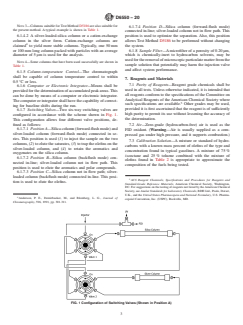
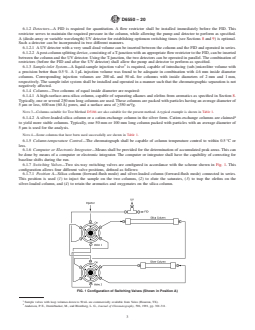
6.1.7 Switching Valves—Two six-way switching valves are configured in accordance with the scheme shown in Fig. 1. This
configuration allows four different valve positions, defined as follows:
6.1.7.1 Position A—Silica column (forward-flush mode) and silver-loaded column (forward-flush mode) connected in series.
This position is used (1) to inject the sample on the two columns, (2) to elute the saturates, (3) to trap the olefins on the
silver-loaded column, and (4) to retain the aromatics and oxygenates on the silica column.
FIG. 1 Configuration of Switching Valves (Shown in Position A)
Sample valves with loop volumes down to 50 nL are commercially available from Valco (Houston, TX).
Anderson, P. E., Demirbueker, M., and Blomberg, L. G., Journal of Chromatography, 596, 1991, pp. 301-311.
D6550 − 20
6.1.7.2 Position B—Silica column (backflush mode) connected in-line; silver-loaded column not in flow path. This position is
used to elute the aromatics and polar compounds.
6.1.7.3 Position C—Silica column not in flow path; silver-loaded column (backflush mode) connected in-line. This position is
used to elute the olefins.
6.1.7.4 Position D—Silica column (forward-flush mode) connected in-line; silver-loaded column not in flow path. This position
is used to optimize the separation. Also, this position allows Test Method D5186 to be performed without changing the system.
6.1.8 Sample Filter—A microfilter of a porosity of 0.20 μm, which is chemically-inert to hydrocarbon solvents, may be used
for the removal of microscopic particulate matter from the sample solution that potentially may harm the injection valve and affect
system performance.
7. Reagents and Materials
7.1 Purity of Reagents—Reagent grade chemicals shall be used in all tests. Unless otherwise indicated, it is intended that all
reagents conform to the specifications of the Committee on Analytical Reagents of the American Chemical Society where such
specifications are available. Other grades may be used, provided it is first ascertained that the reagent is of sufficiently high purity
to permit its use without lessening the accuracy of the determination.
7.2 Air—Zero-grade (hydrocarbon-free) air is used as the FID oxidant. (Warning—Air is usually supplied as a compressed gas
under high pressure, and it supports combustion.)
7.3 Calibration Solution—A mixture or standard of hydrocarbons with a known mass %percent of olefins of the type and
concentration found in typical gasolines. This olefin mixture can beA mixture of 75 % dilutediso by weight with olefin-free
components, such as alkylate, toluene, xylenes,octane and 25 % toluene combined with the mixture of olefins found in Table 2 and
oxygenates, such as MTBE, as is appropriate to approximate the composition of the fuels being tested.
7.4 Carbon Dioxide (CO ) —)—Supercritical-fluid-chromatographic grade, 99.99 % minimum purity, supplied pressurized in a
cylinder with a dip tube for removal of liquid CO . (Warning—Liquid at high pressure. Release of pressure results in production
of extremely cold, solid CO and gas, which can dilute available atmospheric oxygen.)
7.5 Hydrogen—Hydrogen of high quality (hydrocarbon-free) is used as the fuel for the FID. (Warning—Hydrogen is usually
supplied under high pressure and is extremely flammable.)
7.6 Loading-time Mixture—A mixture of a typical alkane and an olefin, which can be used to determine the loading time (see
8.2.2.3 (1) and 8.2.2.3 (2)) while protecting the silver-loaded column from exposure to aromatic compounds.
7.7 Performance Mixture—A mixture of a typical alkane, a mono-aromatic (usually toluene), and a typical mono-olefin can be
used to fine-tune this test method and to check its performance. A mixture of n-heptane, toluene, and 3-methyl-2-pentene has been
successfully used for this purpose.
7.8 Quality Control Sample—A motor gasoline containing olefins to be used to establish and monitor the precision of the
analytical measurement system.
8. Preparation of Apparatus
8.1 Install the SFC instrumentation in accordance with the manufacturer’s instructions. System operating conditions will depend
on the column used and optimization of performance. The conditions listed in Table 1 have been used successfully. If the
performance characteristics in terms of retention and resolution, specified in 8.2, are not achieved, the temperature, pressure, or
mobile-phase flow rate can be modified to achieve compliance. A silica column of low activity can be reactivated by solvent
rinsing, using accepted liquid-chromatographic activation strategies.
TABLE 2 Type and Concentration of Olefins used in the
Calibration Solutions
Olefin Mixture Concentration (%)
1-Hexene 9.30 %
Cyclohexene 14.00 %
2-Methyl-1-hexene 3.90 %
2-Methyl-1-heptene 3.90 %
3-Methyl-2-pentene 27.90 %
1-Heptene 24.70 %
1-Octene 12.40 %
1-Nonene 3.90 %
Reagent Chemicals, American Chemical Society Specifications,ACS Reagent Chemicals, Specifications and Procedures for Reagents and Standard-Grade Reference
Materials, American Chemical Society, Washington, DC. For Suggestionssuggestions on the testing of reagents not listed by the American Chemical Society, see
AnnualAnalar Standards for Laboratory Chemicals, BDH Ltd., Poole, Dorset, U.K., and the United States Pharmacopeia and National Formulary, U.S. Pharmacopeial
Convention, Inc. (USPC), Rockville, MD.
D6550 − 20
TABLE 3 Typical Densities of Calibration Standards Using the
Olefins Listed in Table 2 in 75/25 Isooctane/Tolune
Olefin Concentration Density (60 °F)
(Wt%) (g/cm )
0.25 0.73144
1.06 0.73142
5.16 0.72888
12.92 0.72722
17.74 0.72889
24.55 0.72592
AVE Density 0.7290
8.2 System Performance:
8.2.1 System Optimization—The operation of the SFC system shall be optimized in order to achieve the required separation on
the silica column. This process is different if an optional UV detector is available.
8.2.1.1 When the optional UV detector is installed, the separation between the three different classes of compounds can be
monitored directly. Saturates show no UV absorption. Olefins show significant absorption at wavelengths up to about 220 nm but
no absorption at 250 nm or higher. Aromatics show considerable absorption at low wavelengths, extended to a wavelength of
250 nm and higher. The onset of the elution of the olefin fraction (following the saturates fraction) can be monitored at 220 nm.
The elution of the aromatic fraction can be monitored at 250 nm. In this case, the performance mixture (see 7.6) can be used to
optimize the separation of the olefins and aromatics.
8.2.1.2 Without a UV detector being installed, individual pure components and the performance mixture (see 7.6) can be used
to optimize the system.
8.2.2 Column Requirements:
8.2.2.1 Silica Column—The critical requirement for the silica column is its ability to achieve a quantitative separation between
the olefins and aromatics. The performance of this column can be verified independently of that of the silver-loaded column by
switching the valves to the appropriate position (see 6.1.7.4).
(1) When using a UV detector, the requirement is baseline resolution between the olefin and aromatic signals. The resulting
switching time (see Section 9) shall be chosen to occur just before the onset of the aromatics signal.
(2) When using only an FID, the resolution (R ) between the olefinic compound and the aromatic compound in the
AO
performance mixture shall be at least three when measured as follows:
23 t 2 t
~ !
A O
R 5 (1)
AO
1.699 3 y 1y
~ !
A O
where:
t = retention time for the aromatic reference compound, s,
A
t = retention time for the olefinic reference compound, s,
O
y = peak width at half height for the aromatic reference compound, s, and
A
y = peak width at half height for the olefinic reference compound, s.
O
8.2.2.2 All aromatic compounds, as well as oxygenates and other polar molecules, are eluted from the silica column in the
backflush mode during a time, t , which shall be less than five times the loading time, t . The elution of the aromatics and polars
AR L
can be observed using an FID. Complete elution is thought to have occurred if the detector value (S ) has returned to the baseline
End
value observed before the elution of any peaks (S ) to within 0.1 % of the height of the aromatics peak (h ), that is,
Baseline Aromatics
S # S 1h /1000 (2)
End Baseline Aromatics
8.2.2.3 Silver-loaded Column—This column is operated exclusively as an olefin trap. Its stability and chromatographic
efficiency are not critical as long as the following two requirements are met. The column shall allow a quantitative separation
between the saturates and the olefins and the quantitative release of all olefins under appropriate conditions. The performance of
the silver-loaded column can be verified independently of that of the silica column by switching the valves to the appropriate
position (see 6.1.7.3).
NOTE 5—It is recommended that aromatic solutes should not be introduced on the silver-loaded column. This can be achieved by using a loading-time
mixture, which does not contain aromatics, or by using the silica column to trap the latter.
(1) When using a quality control sample for optimization, as will typically be the case when a UV detector is installed, no
olefins shall elute from the silver-loaded column in the forward-flush mode in a time, t , defined as:
L
t 5 t 133y (3)
L SAT SAT
where:
t = time for the saturated-peak apex, s, and
SAT
y = peak width at half height of the saturates peak, s.
SAT
D6550 − 20
(2) When using a performance mixture for optimization, as will typically be the case when using only an FID detector, no
olefins shall elute from the silver-loaded column in the forward-flush mode in a time, t , defined as:
L
t 5 t 153y (4)
L S S
where:
t = retention time for the saturates reference compound, s, and
S
y = peak width at half height for the saturates reference compound, s.
S
(3) All olefins shall be released from the silver-loaded column in the backflush mode within a time, t , that is less than five
BF
times the total time during wh
...